Synthesis of Modified Silane Acrylic Resins and Their Physical Properties as Weather-Resistant Coatings
Gyu-Yeol Yoo․Ji-Hyun Kim․Hong-Soo Park† Young-Geun Kim*․Seong-Kil Kim**
Department of Chemical Engineering, Myongji University, Yongin 449-728, Korea
Korea Institute of Construction Materials, Seoul 137-707, Korea
B&B Korea Co., Pocheon 487-811, Korea
(Received November 19, 2007 ; Accepted February 27, 2008)
Abstract : To prepare weather-resistant modified silane acrylic resin coatings for an architectural purpose, tetrapolymers were synthesized by radical polymerization.
3-Methacryloxypropyltrimethoxysilane (MPTS) as a silicone monomer and n-butyl acrylate, methyl methacrylate, and n-butyl methacrylate as acrylic monomers were used. The composition of monomers was adjusted to fix the glass transition temperature of acrylic polymer for 20ºC. The composition of MPTS in the synthesized polymer were varied from 10 wt% to 30 wt%. On the basis of synthesized resin amber paints were prepared and their physical properties and effects on weatherability were examined. The presence of MPTS in modified silane acrylic resins generally resulted in low molecular weight and broad molecular weight distribution, and also lowered the viscosity of the copolymers. The coated films prepared from these resins showed good and balanced properties in general. Adhesion to the substrate was outstanding in particular. Weatherability tests were carried out in three different types such as outdoor exposure, QUV, and SWO. The test results showed that the modified silane acrylic resins containing 30 wt% of MPTS had superior weathering properties.
Keywords : weather-resistant coatings, modified silane acrylic resin, weatherability.
1. Introduction
In general, the films of coatings are deteriorated by several factors with time.
Thus, this deterioration in quality with time is called degradation, and a property resisting degradation is called durability. The property that withstands several deteriorating environments is called weatherability.
The degradation in films causes reduction
✝Corresponding author (e-mail : [email protected])
in gloss retention, changes in colors, chalking, blistering, rusting, cracking and abrasion. To test the weatherability of a coating, it is desirable that the test is carried out in actual environments, but it will take several years. Therefore, an accelerated weatherability test is actually carried out instead[1,2]. As the prosperity of national life demands more environmentally friendly and pleasant life, weatherable coatings have been widely used in the exterior decoration of construction and building materials. This type of coatings are highly crosslinked so that
they are resistant to the various environments mentioned above.
Until the late of 1980s fluoro-resins represented by fluoroethylene/alkyl vinyl ether copolymers had been used as the main stream of weatherable coatings[3]. By introducing higher alkyl group in the molecules their flexibility and solubility were improved. In addition by bringing in hydroxyl group as a functional group they were designed as heart-dried types or two- component types whichwere crosslinkable with polyisocyanate at room temperature.
However, the fluoro-resins were expensive and easily polluted to the atmosphere.
Moreover, their hardness was very low and working condition was not favorable.
Therefore, a new type of weatherable coatings were in need. At present special attention is paid to inorganic ceramic coatings and silicone-acrylic coatings as new interior and exterior paints for the architectures. In the case of inorganic ceramic coatings they posses non- flammability and anti-pollution due to the use of inorganic pigments composed of pure ceramic component. But they tend to easily crack and need heating at 180~200ºC for 30 min.
On the other hand, silicone-acrylic coatings can be easily applied on various materials since their film hardness can be easily controlled. In addition, they can be made to one-component curable coatings whose curing is initiated by moisture at room temperature.
These coatings are cheaper than fluoro-based coatings. Though two-component waterborne silicone-acrylic coatings have been studied by several authors[4], there have been few reports on the synthesis and weatherability comparison of silicone-acrylic resins which can be cured by moisture at room temperature. For the silicone-acrylic coatings Rao and Babu[5] studied the solubility, molecular weight and thermal behavior of vinyltriacetoxysilane-bromo methacrylate
copolymers and claimed that lactone- formation was delayed with increasing content of vinyltriacetoxysilane. Yasuyuki et al.[6] synthesized silicone- and acrylic- emulsions and grafted these emulsion. Their TEM results on the phase separation of the grafted elastomers indicated that the degree of phase separation was affected by the synthesis method and by the composition of silicone-acrylic resins.
In this study a modified silane acrylic resin, a quaternary copolymer, was prepared by the copolymerization of n-butyl methacrylate, methyl methacrylate, n-butyl acrylate, and 3-methacryloxypropyltrimethoxysilane. The Tg
of the resin had been predetermined to be 20ºC and two types of modified silane acrylic resins were prepared, separately : mill-base modified silane acrylic resin and let-down modified silane acrylic resin. A white coating was then prepared by blending the mill-base modified silane acrylic resin and let-down modified silane acrylic resin in a ratio of 3 : 7, which is a typical blending ratio for architectural coatings. To examine the weather resistance of the prepared coatings, various weatherability tests were carried out.
2. Experimental
2.1. Materials
All the chemicals were reagent grades and used as received. The monomers were n-butyl methacrylate (BMA, Junsei Chemical Co.), methyl methacrylate (MMA, Tokyo Kasei Kogyo Co.), n-butyl acrylate (BA,
Tokyo Kasei Kogyo Co.),
3-methacryloxypropyltrimethoxysilane (MPTS, Sigma Chemical Co.) as a reactive silicone-monomer. 2,2'-azobisisobutyronitrile (AIBN, Wako Pure Chemical Co.) was used as an initiator, and methyltrimethoxysilane (MTS, Sigma Chemical Co.) and trimethyl orthoformate (TMO, Junsei Chemical Co.) were as drying agents. Tinuvin-292
(Ciba-Geigy Co., HALS) and Tinuvin-384 (Ciba-Geigy Co., benzotriazole derivative) were used as UV stabilizer and UV absorber, respectively. Di-n-butyltindilaurate (DBTDL, Songwon Industry Corp.) as a curing catalyst, TiO2 as a white pigment and CAB-551-0.01 (Eastman Kodak Co.) as a leveling agent were used.
2.2. Synthesis of Modified Silane Acrylic Resin
Mill-Base Modified Acrylic Resin. In order to synthesize a mill-base modified silane acrylic resin, 140 g of xylene and 120 g of toluene were introduced into a 1L four-necked flask and the materials listed in Table 1 (for KMB-20) were added to the flask under a nitrogen atmosphere. Then, another solution of 2.52 g of AIBN initiator and 5.4 g of MTS moisture scavenger was dropped into the flask at 82ºC for 120 min, and the mixture was allowed to age at 82ºC for 120 min. A solution of 0.36 g of AIBN that had been dissolved in 3.6 g of xylene was then added to the mixture four times as follows : 1) right after aging, 2) after 30 min, 3) after 60 min, and 4) during heating to 90ºC for 30 min. Then, the mixture was aged at 105ºC for 30 min. Next, the end of the reaction was determined by measuring solid contents of the mixture. With the addition of 12.6 g of MTS and 100 g of xylene to the mixture, finally, the product containing 50%
of solid content (measured after heating at 150°C, 30 min) was obtained. Unreacted materials were removed by use of excess normal hexane, and the precipitate was dried at 50ºC under a vacuum of 5 mmHg, producing a transparent viscous copolymer, KMB-20.
Let-Down Modified Acrylic Resin. In order to synthesize a let-down modified silane acrylic resin, 260 g of xylene, materials listed in Table 1 (for KLD-21), 2.52 g of AIBN, and 2.32 g of TMO were introduced into a 1L four-necked flask. The reaction and aging
conditions were the same as the above section (mill-base modified silane acrylic resin). At the end of the reaction, 5.4 g of TMO and 100 g of xylene were added to the reaction mixture, producing a product containing 50% solid content. The purifying condition was the same as the above section (mill-base modified silane acrylic resin) and the precipitate was dried at 50ºC under a vacuum of 5 mmHg, producing a transparent viscous copolymer, KLD-21. Furthermore, copolymers (KLD-22 and KLD-23), which contain 20 and 30 wt% of MPTS, respectively, were prepared by the same procedure as for KLD-21.
2.3. Instrumental Analysis
FTIR (Bio-Rad, FTS-40) and 1H-NMR (Varian, Unity-300) were used for the structural analysis of modified silane acrylic resins. Molecular weight and distribution were determined by GPC (Waters, R-410).
Thermal analysis was done by TGA (Shimadzu, TGA-50H) under air and by DSC (Thermold, DSC 4000) under N2. Silicon content was determined according to ASTM D 3733 by Atomic absorption spectroscope (Perkin Elmer, 5200).
2.4. Measurement of Kinematic Viscosity and Solid Content
Kinematic viscosity was measured by transparent solution test according to KS M 5000-2121. Solid content was obtained by measuring the residual weight of 1g-sample which was stored in an oven at 105±2°C for 3h.
2.5. Formulation of Coatings
The coatings were formulated with TiO2, by blending the mill-base modified silane acrylic resin and let-down modified silane acrylic resin at a ratio of 3 : 7 wt%. The details of the formulation are listed in Table 2. Coatings containing 0, 10, 20, 30 wt% of MPTS were designated as SA-2000,
SA-2010, SA-2020, and SA-2030, respectively. The SA-2000 was used for comparison.
2.6. Measurement of Physical Properties
For the tests of physical properties thin films were applies on various substrates such as tin plate (KS D 3516), steel plate (KS D 3512), glass (KS M 5000-1121) and aluminum sheet (KS D 6701). The measurement was done in accordance with the conditions listed in Table 3.
2.7. Weatherability Test
Outdoor exposure test was done according to KS M 5000-3241. For the accelerated weatherability test Sunshine Weather-Ometer (WOM : Atlas Electric Device CO., Ci65A) and QUV accelerated weathering tester (QUV, Q-Panel Co.) were employed by following KS M 5000-3231 method. Gloss retention, yellowness index difference, lightness index difference and color difference were determined at the exposure times of 500, 1,000, 2,000, 3,000 and 4,000h.
3. Results and Discussion
The monomers used in the synthesis of a modified silane acrylic resin consist of acrylate and methacrylate. In consideration of flexibility, hardness, heat resistance and weatherability of films, the molar ratio of the monomers, MMA and BMA, was fixed at 1 : 1 in the synthesis of the modified resin. The Tg of the modified acrylic resin was calculated by Fox equation[7]. With increasing Tg, the viscosity of a coating increases and the coating dry faster, but the flexibility, impact resistance and adhesion of the coating decrease. Therefore, the Tg of the coating was adjusted to be 20°C to be suitable for construction industries.
3.1. Analysis of Mill-base Resins
The molecular structure of a mill-base modified silane acrylic resin (KMB-20) is shown in Scheme 1 and their physical propertiesare tabulated in Table 1 along with polymerization conditions. The feed compositions were already optimized in the previous work[8].
Scheme 1. Synthesis of KMB-20.
FTIR spectrum of KMB-20 shown in Fig.
1(a) confirms the structure of KMB-20 by showing Si-O-CH3 at 845 cm-1 and stretching vibrations of C=O and C-O at 1740 cm-1 and 1150cm-1, respectively. The latter 2 peaks implies the presence of ester group in KMB-20. Fig. 2(a) presents
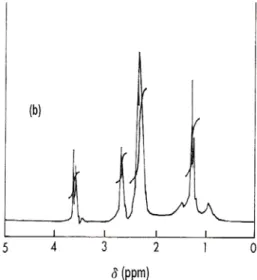
1H-NMR spectrum and it also confirms the structure of KMB-20 by the following chemical shifts : CH3-C at 1.0 ppm, C-CH2-C at 1.3 ppm, C-H at 1.6 ppm, C-CH2-CO- at 2.4 ppm, CH-CO- at 2.7 ppm and CH3-O-/Si-O-CO3- at 3.6 ppm.
Molecular weight and its distribution of KMB-20 were determined from the GPC elution curve (Fig. 3). The calculated average molecular weights were Mn = 33,900, Mw = 62,800 and Mz = 99,700 and the polydispersity was 1.85, indicative of fairly narrow distribution.
3.2. Analysis of Let-down Resins
Synthesis conditions and physical properties of let-down modified silane acrylic resins
(KLD) were listed in Table 1. Conversion of KLD resins did not show much difference but viscosity decreased with increasing content of MPTS. This may be related to the improved solubility of MPTS in hydrocarbon.
Fig. 1(b) shows FTIR spectrum of KLD-23 and itsspectrum is very similar to the Fig.
1(a). Higher content of MPTS in KLD-23 lead to increased intensities of Si-O-CH3and Si-O peaks at 820cm-1 and 1090 cm-1 were increased. The structure of KLD-23 was also proved by 1H-NMR spectrum shown in Fig.
2(b) : CH3-C at 1.0 ppm, C-CH2-C at 1.3 ppm, C-H at 1.6 ppm, C-CH2-CO- at 2.3 ppm, CH-CO- at 2.7 ppm and CH3-O-/Si-O-CO3- at 3.6 ppm. GPC results for the three KLD resins are as follows : Mn
= 20,500, Mw = 49,700, Mz = 93,500 and polydispersity = 2.42 for KLD-21 ; Mn = 22,500, Mw = 52,900, Mz = 99,000 and polydispersity = 2.35 for KLD-22, Mn = 11,900, Mw = 40,500, Mz= 83,600 and polydispersity = 3.40 for KLD-23. When compared with the results of KMB-20 broader molecular weight distributions of KLD resins resulted from the increased MPTS composition of higher molecular weight.
Fig. 1. FTIR spectra of (a) KMB-20 and (b) KLD-23.
Fig. 2. 1H-NMR spectra of (a) KMB-20 and (b) KLD-23.
Fig. 3. Molecular weight distribution curves for KMB-20, KLD-21, KLD-22, and KLD-23 determined by GPC.
3.3. Thermal Behavior of Modified Silane Acrylic Resins
Paul’s[9] TGA study on ethyl acrylate (EA)-MMA copolymers indicated that activation energy and thermal stability increased with increasing content of EA.
Finze[10] reported through the measurement of mass change by WOM (4300 hr)
Table 2. Preparation of White Coatings for Architectural Coatings
Types Materials Weight (wt %)
Mill-base
mill-base modified silane acrylic resin 21.6
TiO2 (rutile) 24.0
Let-down
let-down modified silane acrylic resin 50.4
leveling agent 0.1
UV absorber 0.2
UV stabilizer 0.1
xylene 3.6
Mill-base / Let-down 3/7
Physical property Instrument and Method Viscosity (KU) Krebs-Stormer viscometer
Pacific Scientific Co., serial 80328 KS M 5000-2122
Specific gravity KS M 5000-2131
Fineness of grind Braive Instruments Co., type 2020 KS M 5000-2141
Drying time Set-to-touch, Dry-hard, Dry-through method KS M 5000-2512
Hardness Yasuda Seiki Seisakusho, serial 4664
JIS K 5400 (8.4.1)
Flexibility Mandrel : Pacific Scientific Co., Conical KS M 5000-3331
Impact resistance DuPont impact tester type 552 Ureshima Seisakusho
JIS K 5400 (8.3.2) 60° Specular gloss Glossmeter
Pacific Scientific Co., Glossgard II KS M 5000-3312
Cross hatch adhesion ISO 2409 Abrasion resistance Abrasion tester
Toyo Seiki Seisakusho, Taber FS 141C-6192.1
Contrast ratio KS M 5000-3111
Salt exposure test ASTM B-117
Storage stability KS M 5000-2031
Table 3. Physical Properties and Their Testing Methods
accelerated test that alkyd resin based coatings lost 54% of original mass but silicone-acrylic resins modified with 30%
silicone lost only 20.3%.
Fig. 4 shows TGAresults of a blend of KMB-20 and KLDs in a weight ratio of 3 : 7. The thermal stability of the blend increased with the content of MPTS, in which the order of stability was : ML-2030
> ML-2020 > ML-2010. This result is consistent with Finzel’s results, inwhich the thermal stability of coatings increased with increasing silicone content. The weight losses of ML-2000, which did not contain silicone components, were 11, 16, and 43% at 250°C, 300°C and 350°C, respectively, which indicates that the poor thermal stability of ML-2000.
Fig. 4. TGA thermograms of modified silane acrylic resins.
ML-2010 : KMB-20/KLD-21 = 3/7 ML-2020 : KMB-20/KLD-22 = 3/7 ML-2030 : KMB-20/KLD-23 = 3/7
3.4. Physical Properties of Modified Silane Resins
The physical properties of modified silane acrylic paints are tabulated in Table 4.
Because the glass transition temperature of resin was adjusted using Flory-Fox equation, viscosity of all the coatings was low enough to be processed. Fineness-of-grind was
satisfactoryin spite of quick (60 min.) dispersion, and contrast ratio was in the acceptablerange of 0.942 to 0.951, depending on the content of white pigment. We believe that the excellent performance of TiO2 which we used in our formulation as white pigment resulted in these characteristics. It has been generally known that the coloring and hiding power of TiO2 as white pigment is superior to ZnS, lithophone, Sb2O3, and ZnO. The hardness of coatings was H, suitable for the architectural coatings and was lowered with MPTS content increased. This phenomenon can be understood in terms of the reduction of viscosity due to the increase of MPTS content as shown in Table 1. The gloss was a little low compared to standard value and drying time was less than 70 min. without addition of any curing catalysts, which indicates the fast dryness of modified silane acrylic resins. Abrasion resistance was in the range of 0.62 to 0.87 mg and was not affected by the content of MPTS. Flexibility was good due to the n-butyl acrylate used and heat resistance was increased with MPTS content due to the inherent heat resistance of silicone compound. Impact resistance was good for all the direct side of samples but was poor for the reverse sides of some samples. Crosshatch adhesions on various substrates were all excellent, which indicates a possibility of the coatings to apply on various substrates. On the other hand, for SA-2000, which did not contain silicone components, pencil hardness and drying time were good, and flexibility, heat resistance, and adhesion were poor, and the other physical properties were similar to the other coatings.
3.5 Salt Exposure Test
For salt exposure tests, the coatings were applied to cold rolled carbon steel sheets in a thickness of 0.076 mm and dried at 23±1°C for 7 days. X-shaped scribe areas were then prepared on the samples according to ASTM
Name of Sample
Type of Test SA-2000 SA-2010 SA-2020 SA-2030
Viscosity (KU) 97 80 94 90
Fineness of grind 7+ 7+ 7+ 7+
Contrast ratio 0.948 0.951 0.944 0.946
Pencil hardness (7days) 2H H F~H F
60° Specular gloss 83.6 84.0 82.1 81.9
Drying time (min)
set-to-touch 3 3 4 4
dry-hard 29 43 50 55
dry-througth 39 65 68 72
Storage stability (60°C×10days) good good good poor
Abrasion resistance
(mg loss/1000cycles) 0.70 0.62 0.87 0.62
Flexibility (1/8") fair good good good
Heat resistance (150°C×1hr)
gloss retention(%) 88 91 93 95
color difference(ΔE) 0.81 0.21 0.46 0.49
Impact resistance (500g/30, 50cm)
Direct 30cm good good good good
50cm fair good good good
Reverse 30cm poor good poor poor
50cm poor poor poor poor
Cross hatch adhesion (%)
Steel plate 100 100 100 100
Tin plate 100 100 100 100
Alumium 55 100 100 100
PET 0 100 100 100
Brass 15 100 100 100
Tile 0 100 100 100
Table 4. Film Properties of Modified Silane Acrylic Resin Coatings
D 1654-2. Degree of rusting and blistering[11] at both the scribed area and the unscribed area were determined according to ASTM D 610 and ASTM D 714, respectively. The degree of rusting was subdivided into 11 grades ; for example, when the rusting was less than 0.01%, the grade was 10, and when the rusting was 100%, the grade was 0. The degree of rusting and blistering were tested after 100, 200, 300, and 400 h of exposure and listed in Table 5. SA-2000 exhibited slight lower values in rusting and blistering when comparing with the others as shown in Table 5. All the coatings proved to be highly resistant to salt. It was found that the
resistance to salt increased with the content of MPTS.
3.6. Outdoor Exposure Test
The outdoor exposure test was carried out with an exposure angle of 30° at the rooftop for two years. The gloss retention, yellowness index difference, color difference, and lightness index difference of the samples were tested after outdoor exposures of 6, 12, 16, and 24 months.
Fig. 5 shows gloss retention as a function of time and gloss retention increased with MPTS content. Glossretention was remained at 85% even after 24 months for SA-2030 (30 wt% of MPTS). Fig. 6 compares the
yellowness index differences and the index differences were less than 0.6 upon exposure for 24 months. The indexes were quite dependent on the MPTS content and SA-2030 (MPTS 30 wt%) did not show any yellowness phenomenon. When it was exposed for 24 months, the index difference was only 0.1, indicative of its excellent weatherability. The indexes abruptly increased after 12 months. Fig. 7 displays the color difference as a function of time and the color differences were less than 4.0 for all the samples upon 24 month-exposure. After 24 months of exposure, the color difference of SA-2010 (containing 10 wt% of MPTS) was 3.8, which is differentiable with thenaked eyes, and the color differences of SA-2020 (containing 20 wt% of MPTS) and SA-2030 (containing 30 wt% of MPTS) were 3.0, which is a little discernable with the naked eyes, and 1.7, which is not differentiable with the naked eyes. From these results, it was found that the SA-2020 and SA-2030 were proved good weather resistant coatings. Fig.
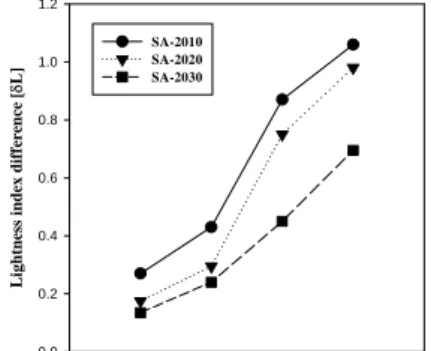
8 illustrates the lightness index difference.
Upon 24 month-exposure all the values were below 1.5 and the lightness had tendency of darkening. The lightness index difference for SA-2030 were less than 0.7 and became a little dark, which indicates no chalk phenomenon.
On the other hand, the results of outdoor exposure tests of SA-2000 for 6~24 months were as follows : gloss retention, yellowness index difference, color difference, and lightness index difference were 87~36%, 1.2~3.2, 3.2~7.7, and 1.2~0.8, respectively.
When comparing these values with the values of the coatings that contain MPTS as shown in Fig. 5~8, it was found that the weatherability of the coatings was improved with increasing MPTS content. This improvement in theweatherability of the coatings containing MPTS may be stemmed from the high binding energy of siloxane bond.
Time [month]
0 6 12 18 24 30
Gloss retention [%]
60 70 80 90 100
SA-2010 SA-2020 SA-2030
Fig. 5. Effects of outdoor exposure time on gloss retention of modified silane acylic resin coatings.
Time [month]
0 6 12 18 24 30
Yellowness index difference [δN]
0.0 0.1 0.2 0.3 0.4 0.5 0.6
SA-2010 SA-2020 SA-2030
Fig. 6. Effects of outdoor exposure time on yellowness index difference of modified silane acrylic resin coatings.
Exposure time [month]
0 6 12 18 24 30
Color difference [δE]
0 1 2 3 4
SA-2010 SA-2020 SA-2030
Fig. 7. Effects of outdoor exposure time on color difference of modified silane acrylic resin coatings.
Exposure time [month]
0 6 12 18 24 30
Lightness index difference [δL]
0.0 0.2 0.4 0.6 0.8 1.0 1.2
SA-2010 SA-2020 SA-2030
Fig. 8. Effects of outdoor exposure time on lightness index difference of modified silane acrylic resin coatings.
3.7. Accelerated Weatherability Test
Accelerated test was done by WOM and QUV for 1000, 2000, 3000 and 4000 h. Fig. 9 represents the gloss retention at the various times and the retention increased with time.
When SA-2030 with MPTS content of 30 wt% was exposed for 4000 h, the gloss retention was retained at 86% and 78% from WOM and QUV tests, respectively. When these values are compared with the standard one for weatherability, SA-2030 was proved to be a super –weatherable coating. Fig. 10 shows the effect of exposure time on the yellowness index difference. The index difference at 4,000 h-exposure was below 0.4 for all the coatings tested. The accelerated test results were much lower than those obtained in the outdoor exposure test. In the case of SA-2030 the index difference was less than 0.1, which implies negligible yellowness phenomenon. The yellowness had a tendency to abruptly increase after 3,000 h.
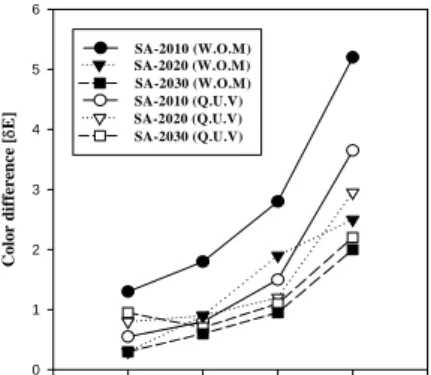
Fig. 11 shows the color difference obtained by the accelerated tests and the color differences were below 6.0 for all the paints upon 4,000 h-exposure. The results were inferior to the results obtained by the outdoor exposure test (24 months). The effect of MPTS content on color difference was as follows : higher than 3.0 for SA-2010, which
was detectable with the naked eyes ; 2.8 for SA-2020, a little detectable ; below 2.0 for SA-2030, hardly detectable. This result indicated that SA-2030 did not show any color-degradation after a long period of time.
Fig. 12 illustrates the lightness index difference. Upon 4,000-h exposure all the values were below 1.2 and the lightness had tendency of darkening. The lightness index difference for SA-2030 were less than 1.0, indicative of no chalk phenomenon.
Exposure time [hr]
0 1000 2000 3000 4000 5000
Gloss retention [%]
60 70 80 90 100
SA-2030 (W.O.M)
SA-2030 (Q.U.V) SA-2020 (W.O.M)
SA-2020 (Q.U.V) SA-2010 (W.O.M)
SA-2010 (Q.U.V)
Fig. 9. Effects of exposure time on the gloss retention of modified silane acrylic resin coatings in the accelerated weather test.
Exposure time [hr]
0 1000 2000 3000 4000 5000
Yellowness index difference [δN]
0.0 0.1 0.2 0.3 0.4
SA-2010 (Q.U.V) SA-2020 (Q.U.V) SA-2010 (W.O.M) SA-2020 (W.O.M)
SA-2030 (Q.U.V) SA-2030 (W.O.M)
Fig. 10. Effects of exposure time on the yellowness difference of modified silane acrylic resin coatings in the accelerated weather test.
Exposure time [hr]
0 1000 2000 3000 4000 5000
Color difference [δE]
0 1 2 3 4 5 6
SA-2010 (W.O.M)
SA-2010 (Q.U.V) SA-2020 (Q.U.V) SA-2020 (W.O.M)
SA-2030 (Q.U.V) SA-2030 (W.O.M)
Fig. 11. Effects of exposure time on the color difference of modified silane acrylic resin coatings in the accelerated weather test.
Exposure time [hr]
0 1000 2000 3000 4000 5000
Lightness index difference [δL]
-1.2 -1.0 -0.8 -0.6 -0.4 -0.2 0.0 0.2 0.4 0.6 0.8 1.0 1.2
SA-2010 (W.O.M) SA-2020 (W.O.M) SA-2030 (W.O.M) SA-2010 (Q.U.V) SA-2020 (Q.U.V) SA-2030 (Q.U.V)
Fig. 12. Effects of exposure time on the lightness index difference of modified silane acrylic resin coatings in the accelerated weather test.
Based on the results from the weatherability tests, the weatherability was increased with increasing content of MPTS.
As mentioned in the introduction, the improved weatherability of fluoro-resin coatings and silicone resin coatings is believed due to the large bonding energy between atoms in these materials and its prevention of degradation[12]. The present results also support this reasoning.
On the other hand, the results of accelerated weatherability tests of SA-2000 using WOM and QUV for 1000~4000h were as follows : gloss retentions, 70~47% (WOM) and 49~31% (QUV) ; yellowness index differences, 0.9~2.6 (WOM) and 1.5~3.5 (QUV) ; color differences, 2.9~5.1 (WOM) and 3.2~8.4 (QUV) ; and lightness index differences, 1.0~0.5 (WOM) and 1.6~0.5 (QUV). When comparing these values with the values of the coatings that contain MPTS as shown in Fig. 9~11, it was also found that the weatherability of the coatings was improved with increasing MPTS content.
4. Conclusions
Modified silane acrylic resins (KLD) were synthesized based on n-butyl methacrylate, methyl methacrylate, n-butyl acrylate and 3 -methacrylox ypropyltrimethox ysilane (MPTS). Then white coatings were formulated, and their film properties and weatherability were tested.
KLD had Mn of 11,900~22,500, polydispesity of 2.35~3.40, viscosity of 2.1~5.8 stoke and conversion of 87.8~89.6%.
In the synthesis of KLD average molecular weight and viscosity increased but thermal stability improved with increasing silicone component of MPTS. The formulated coatings showed excellent adhesion with various substrates and other physical properties were favorable. The outdoor exposure test and accelerated test indicated that gloss retention, yellowness index difference, color difference and lightness index difference were satisfactory. Especially SA-2030 with 30 wt% of MPTS was proved to be in a category of super-weatherable coatings.
References
1. H. K. Hardcastle, "Full Spectrum Monitoring for Outdoor Accelerated Weathering Device", U. S. Pat. Appl.
Publ., 285654A1 (2007).
2. K. Mon, T. Nanta, K. Tachi, and S.
Umemura, A New Weatherability Test Method for Coatings with Acceleration Factor of 100, Materiaru Raifu Gakkaishi, 13(4), 180 (2001).
3. T. Endo, “Development and Applications of New Reactive Monomers", pp. 156-168, CMC Co. Ltd., Tokyo (1993).
4. F. A. Zhang and C. L. Yu, Application of a Silicone Modified Acrylic Emulsion in Two-Component Waterborne Polyurethane Coatings, J. Coat. Technology and Research, 4(3), 289 (2007).
5. V. L. Rao and G. N. Babu, Copolymerization of Methyl-Alpha- Bromoacrylate, 2-Bromoethyl Methacrylate and 2,3-Dibromopropyl Methacrylate Vinyltriacetoxy Silane, Eur. Polym. J., 26(2), 227 (1990).
6. F. Yasuyuki, I. Masakazu, Y. Akira, and Y. Naoki, Synthesis and Morphology Analysis Silicone/Acryl Compound Rubbers, J. Polym. Sci. Technol., 50(5), 391 (1993).
7. M. Kobayashi, Study on the Squence Distribution and Glass Transition Temperature of Acrylic Resin for Industrial Paint (Ⅲ), J. Jpn. Col.
Material., 56(8), 518 (1983).
8. S. K. Kim, "Synthesis of Modified 3-Methacryloxypropyltrimethylsilane Acrylic Resins and Their Physical Properties as Super-Weatherable Coatings", Ph. D. Dissertation, Myongji Univ., Yongin, Korea (1998).
9. S. Paul, Pyrolysis Gas Chromatographic Analysis (PGC) of Methyl Methacrylate (MMA)- Ethyl Acrylate (EA) Copolymers, J. Coat. Technol., 52(661), 47 (1980).
10. W. A. Finzel, Film Erosion Studies of Silicone-Modified Copolymer Paints, J.
Coat. Technol., 52(660), 55 (1980).
11. L. J. Calbo, "Handbook of Coating Additives", pp. 307-356, Marcel Dekker, Inc., New York (1992).
12. H. Mayer, Masonry Protection with Silanes, Siloxanes and Silicone Resin, J.
Oil & Colour Chem. Assoc., 81(2), 89 (1998).