DOI https://doi.org/10.9725/kts.2019.35.3.169
Colloidal Probe 원자현미경을 이용한 2차전지 전극용 폴리머 바인더의 응착 및 마찰 특성 평가
웬당쾅1ㆍ정구현2†
1
울산대학교 기계공학부 학생연구원
2
울산대학교 기계공학부 부교수
Assessment of Adhesion and Frictional Properties of Polymer Binders for Secondary Cells using Colloidal Probe Atomic Force Microscope
Quang Dang Nguyen
1and Koo-Hyun Chung
2†1
Graduate student, School of Mechanical Engineering, University of Ulsan, Ulsan 44610, Republic of Korea
2
Associate professor, School of Mechanical Engineering, University of Ulsan, Ulsan 44610, Republic of Korea (Received April 5, 2019 ; Revised June 4, 2019 ; Accepted June 7, 2019)
Abstract − In lithium-ion batteries (LIBs), the stress induced by the volume change of an electrode during charge–discharge processes may often cause the mechanical integrity of the electrode to degrade. Polymer bind- ers with enhanced mechanical properties are preferred for improved mechanical integrity and cycling stability of the electrode. In addition, given that sliding and shearing between the polymer binder and components in the electrode may readily occur, frictional and adhesion characteristics of the polymer binder may play a critical role in the mechanical integrity of the electrode. In this study, frictional and adhesion characteristics of polyacrylonitrile (PAN) and polyvinylidene fluoride (PVDF) were investigated using a colloidal probe atomic force microscope.
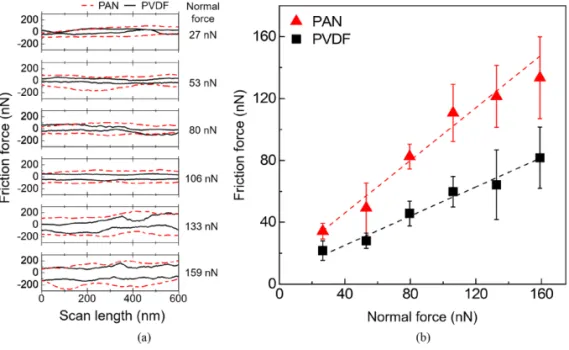
Friction loops were obtained under various normal forces ranging from 0 to 159 nN in air and electrolyte and then the interfacial shear strengths of PAN and PVDF in air were calculated to be 1.4 ± 0.5 and 1.3 ± 0.3 MPa, respec- tively. The results show that in electrolyte, interfacial shear strength of PAN decreased slightly (1.2 ± 0.2 MPa), whereas that of PVDF decreased drastically (0.06 ± 0.01 MPa). Decreases in mechanical properties and adhesion in electrolyte may be responsible for the decrease in interfacial shear strength in electrolyte. The findings from this study may be helpful in developing polymer binders to improve the mechanical integrity of electrodes in LIBs.
Keywords − adhesion (응착), atomic force microscopy (원자현미경), friction (마찰), electrolyte (전해질), polyacrylonitrile (PAN), polyvinylidene fluoride (PVDF)
1. 서 론
리튬이온 배터리(Lithium ion batteries, LIBs)와 같은 2 차 전지에서는 충전 및 방전 시, 전극의 팽창과 수축이 발생한다. 또한, 이에 따라 반복적으로 작용하는 응력은 전극의 기계적 무결성 (mechanical integrity)을 저감시킬
뿐만 아니라, 배터리 용량의 급격한 감소를 초래한다 [1,2]. 현재, 전극의 기계적, 전기적 특성을 유지시키기 위 하여 폴리머 바인더(polymer binder)가 많이 사용되고 있으며, 전극의 부피 변화를 효과적으로 감소시키기 위 해서는 우수한 기계적 물성을 가지는 폴리머 바인더를 사용하는 것이 요구된다[3-5]. 특히, 높은 용량을 구현할 수 있는 것으로 제시되고 있는 Si입자의 경우, 충전과 방 전 시 부피의 변화가 상대적으로 크므로[2], 우수한 기 계적 물성을 가지는 폴리머 바인더의 사용이 더욱 필요 할 것으로 예상된다.
†