Weed Turf. Sci. 4(1):10~17
http://dx.doi.org/10.5660/WTS.2015.4.1.10 Print ISSN 2287-7924, Online ISSN 2288-3312
10
Research Article Weed & Turfgrass Science
Weed & Turfgrass Science was renamed from both formerly Korean Journal of Weed Science from Volume 32 (3), 2012, and formerly Korean Journal of Turfgrass Science from Volume 25 (1), 2011 and Asian Journal of Turfgrass Science from Volume 26 (2), 2012 which were launched by The Korean Society of Weed Science and The Turfgrass Society of Korea founded in 1981 and 1987, respectively.
제주지역 목초지에 발생하는 잡초양상
이인용1*·김창석1·이정란1·황경준2·김경훈3·김미선1·송희근1
1
국립농업과학원 작물보호과,
2한국공항 제주사업팀,
3(주)경농
Investigation of Weed Flora in Pastures in Jeju Island
In-Yong Lee
1*, Chang-Seok Kim1, Jeongran Lee
1, Kyung-Jun Hwang
2, Kyung-Hoon Kim
3, Mi-Seon Kim
1, and Hee-Kun Song
11
Crop Protection Division, National Academy of Agricultural Science, RDA, Wanju 565-852, Korea
2
Jeju Business Team, Korea Airport Service, Jeju 232-923, Korea
3
Kyungnong Co., Gimje 576-942, Korea
서 언
농경지에서 잡초 분포조사는 정해진 장소, 일정한 주기로 실시되어야만 잡초발생 양상 등의 변화를 파악하여 잡초방 제의 기초자료로 활용될 수 있다. 우리나라에서 논은 경지 면적이 제일 넓고 중요한 관계로 1970년부터 2013년까지 10 년 단위로 총 5회 실시되어 시대별 제초제 사용패턴 등 잡 초방제법에 따라 잡초군락 변화를 알 수 있는 좋은 정보를 제공하였다(Oh et al., 1981; Kim, 1983; Park et al., 1995; Park et al., 2001; Park et al., 2002; Ha et al., 2014).
그러나 밭, 과수원 및 목초지의 잡초조사는 일정한 주기 로 실시한 것이 아니라 조사기관에 의해 조사시기가 결정
되어 연차간 잡초군락변화를 설명하기 부족한 것이 사실 이다. 즉 밭잡초 조사는 1984년(Ryang et al., 1984), 1990년 (Chang et al., 1990), 2002년(Park et al., 2003)에 실시되었 으며, 과수원 잡초는 1988년(Woo and Pyon, 1988), 1997년 (Jung et al., 1997), 2005 년(Park et al., 2005) 그리고 목초지 는 1971년(Kwon, 1971), 1988년(Kim et al., 1988), 1990년부 터 1996년(Ko et al., 1999), 2004년(Park et al., 2006a; 2006b) 에 수행되었다.
2000 년에 농촌진흥청 농업과학기술원에서는 농경지잡초 정밀 분포조사를 실시하면서 논, 밭, 과수원뿐만 아니라 목 초지도 조사하였다. 그 후 2013년부터 다시 새롭게 3년동 안 목초지잡초를 제주지역, 대관령지역, 서산지역을 나눠 ABSTRACT. This study was conducted to investigate the occurrence of weed flora in pastures in Jeju island of Korea and to establish the basic data for controlling them occurred in the pastures. Weed flora was investigated twice, May and July on 2003.
There were a total of 207 weed species including 49 families. Among them 67 species were annual, 39 species were biennial and 101 species were perennial. The compositions of major plant families, Asteraceae, Poaceae, Polygonaceae, Rosaceae, Fabaceae were 17, 15, 8, 7, 6%, respectively. Sixty-eight species of exotics were occurred, as well. Rumex obtusifolius was the highest in importance analysis and the followings were in order of Trifolium repens, Artemisia princeps, Plantago asiatica, Potentilla anemonefolia and Rumex acetosella etc. Among the exotic weeds, R. obtusifolius, T. repens, R. acetosella and C. holosteoides var. hallaisanense might be most problematic weeds species in pastures in Jeju island in the future. And at the boundary of some pastures and mountains Smilax china, Duchesnea indica, Rosa maximowicziana, etc. 17 shrub species were also occurred.
Key words: Jeju, Pasture, Weed
Received on November 28, 2014; Revised on February 23, 2015; Accepted on February 27, 2015
*
Corresponding author: Phone) +82-63-238-3320, Fax) +82-63-238-3838; E-mail) [email protected]
© 2015 The Korean Society of Weed Science and The Turfgrass Society of Korea
This is an Open-Access article distributed under the terms of the Creative Commons Attribution Non-Commercial License (http://cre-
ativecommons.org/licenses/by-nc/3.0) which permits unrestricted noncommercial use, distribution, and reproduction in any medium,
provided the original work is properly cited.
서 조사하였고 할 예정이다. 따라서 목초지에 발생하는 잡 초발생양상을 파악하기 위한 일련의 과정에서 2013년도에 제주도 목초지를 대상으로 잡초 조사결과를 보고하고자 한다.
재료 및 방법
조사지역 및 방법
제주도 목초지에 발생하는 잡초는 2013년 5월과 7월에 2회 실시하였다. 조사는 제주도의 45지점에서 실시하였으 며(Fig. 1), 대략적인 면적은 652,880 m
2이었다. 발생잡초는 각 시기별로 Braun-Branquet (1964)에 의한 7개 등급(r, +, 1, 2, 3, 4, 5)을 기준으로 피도( 被被 )를 조사하였다(Wikum and Shanholtzer, 1978). 이 때 각 단계별 조사기준은 Table 1과 같다.
제주지역 목초지잡초 조사결과의 분석
잡초조사 결과는 국가표준식물목록(KNA, 2007)에 의거
하여 목록을 작성하였고, 외래잡초는 한국귀화식물 원색도 감(Park, 2009)에 의해 표기하였다. 출현한 잡초종에 대해 서는 Raunkiaer (1934)의 생활형을 기준으로 일년생과 다 년생을 구분하였고 과별 분포 비율을 산정하였다. 잡초의 우점순위를 알아보기 위하여 중요치(IV)분석을 실시하였다 (Curtes and Mc Intosh, 1950).
결과 및 고찰
제주지역 목초지에 발생하는 잡초
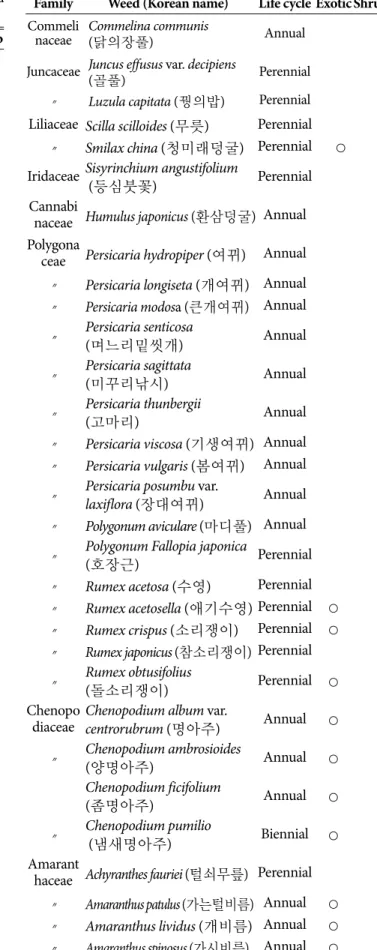
제주지역 목초지에 발생하는 잡초는 49과 207초종(Table 2) 이었다. 이는 Park et al. (2006b)이 보고한 33과 94종, Kim et al. (1988)이 조사한 44과 136종보다 많은 차이를 보였다.
이는 목초지 갱신 또는 관리방법 등에 의해 식생 변화가 있었음을 보여주고 있다. 또 Park et al. (2006b), Kim et al.
(1988) 조사시기와 비교하여 기후변화 등에 의해 계절적, 연차적으로 식생이 변할 수 있다는 것을 암시하고 있다.
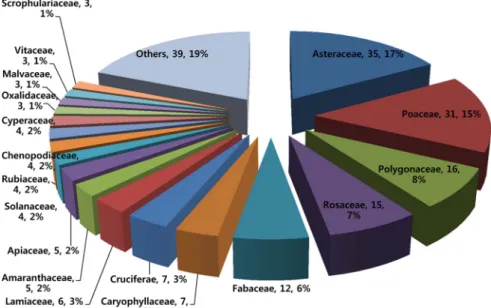
그리고 과별로 잡초발생 상황을 보면, 국화과(Asteraceae) 17%, 화본과(Poaceae) 15%, 마디풀과(Polygonaceae) 8%, 장 미과(Rosaceae) 7%, 콩과(Fabaceae) 6% 그리고 석죽과 o Relative frequency
(RF)(%) =
Frequency of any species
× 100 Total frequency of all species
o Relative cover (RF)(%) =
Cover of species A
× 100 Total cover of all species
o Important value (IV) = (RF + RC) /2 Fig. 1. Site of investigated in pasture weed in Jeju island, in 2013.
Table. 1. Braun-Branquet scale by cover-abundance (Braun- Branquet, 1964).
Scale Ranger of cover (%)
5 75-100
4 50-75
3 25-50
2 5-25
1 <5; numerous individuals + <5; few individuals
r very fewer individuals
12 이인용·김창석·이정란·황경준·김경훈·김미선·송희근
Table 2. Occurrence of weed flora in pasture fields in Jeju island in 2013.
Family Weed (Korean name) Life cycleExotic Shrub Pteridaceae Pteridium aquilinum var.
latiusculum (고사리) Perennial
Poaceae Aira caryophyllea (은털새) Annual ○
〃 Alopecurus aequalis (뚝새풀) Biennial
〃 Aleopecurus geniculatus (유럽
뚝새풀) Biennial ○
〃 Alopecurus pratensis(큰뚝새풀) Perennial
〃 Arthraxon hispidus (조개풀) Annual
〃 Bothriochloa ischaemum
(바랭이새) Perennial
〃 Bromus unioloides (큰이삭풀) Perennial 〃 Cynodon dactylon (우산잔디) Perennial 〃 Dactylis glomerata (오리새) Perennial ○
〃 Digitaria ciliaris (바랭이) Annual
〃 Digitaria violascens (민바랭이) Annual 〃 Echinochloa crus-galli (돌피) Annual
〃 Echinochloa utilis (피) Annual
〃 Eleusine indica (왕바랭이) Annual
〃 Eragrostis ferruginea (그령) Perennial 〃 Eragrostis multicaulis (비노리) Annual
〃 Holcus lanatus (흰털새) Annual ○
〃 Imperata cylindrica var.
koenigii (띠) Perennial
〃 Lolium multiflorum (쥐보리) Biennial ○ 〃 Miscanthus sinensis (참억새) Perennial 〃 Miscanthus sinensis var.
purpurascens (억새) Perennial
〃 Panicum dichotomiflorum
(미국개기장) Annual ○
〃 Paspalum dilatatum (큰참새피) Perennial ○ 〃 Paspalum thunbergii (참새피) Perennial
〃 Poa annua (새포아풀) Biennial
〃 Poa pratensis (왕포아풀) Perennial ○
〃 Setaria faberii (가을강아지풀) Annual
〃 Setaria glauca (금강아지풀) Annual 〃 Setaria glauca var. dura
(주름금강아지풀) Annual
〃 Setaria viridis (강아지풀) Annual
〃 Vulpia myuros (들묵새) Biennial ○
Cyperaceae Kyllinga brevifolia (파대가리) Perennial 〃 Cyperus difformis (알방동사니) Annual
〃 Cyperus esculentus var. sativus
(기름골) Perennial
〃 Cyperus iria (참방동사니) Annual
Araceae Arisaema heterophyllum
(두루미천남성) Perennial
〃 Pinellia ternata (반하) Perennial
Family Weed (Korean name) Life cycle Exotic Shrub Commeli
naceae Commelina communis
(닭의장풀) Annual
Juncaceae Juncus effusus var. decipiens
(골풀) Perennial
〃 Luzula capitata (꿩의밥) Perennial
Liliaceae Scilla scilloides (무릇) Perennial
〃 Smilax china (청미래덩굴) Perennial ○
Iridaceae Sisyrinchium angustifolium
(등심붓꽃) Perennial
Cannabi
naceae Humulus japonicus (환삼덩굴) Annual Polygona
ceae Persicaria hydropiper (여뀌) Annual
〃 Persicaria longiseta (개여뀌) Annual
〃 Persicaria modosa (큰개여뀌) Annual
〃 Persicaria senticosa
(며느리밑씻개) Annual
〃 Persicaria sagittata
(미꾸리낚시) Annual
〃 Persicaria thunbergii
(고마리) Annual
〃 Persicaria viscosa (기생여뀌) Annual
〃 Persicaria vulgaris (봄여뀌) Annual
〃 Persicaria posumbu var.
laxiflora (장대여뀌) Annual
〃 Polygonum aviculare (마디풀) Annual
〃 Polygonum Fallopia japonica
(호장근) Perennial
〃 Rumex acetosa (수영) Perennial
〃 Rumex acetosella (애기수영) Perennial ○
〃 Rumex crispus (소리쟁이) Perennial ○
〃 Rumex japonicus (참소리쟁이) Perennial 〃 Rumex obtusifolius
(돌소리쟁이) Perennial ○
Chenopo diaceae
Chenopodium album var.
centrorubrum (명아주) Annual ○
〃 Chenopodium ambrosioides
(양명아주) Annual ○
Chenopodium ficifolium
(좀명아주) Annual ○
〃 Chenopodium pumilio
(냄새명아주) Biennial ○
Amarant
haceae Achyranthes fauriei (털쇠무릎) Perennial
〃 Amaranthus patulus (가는털비름) Annual ○
〃 Amaranthus lividus (개비름) Annual ○
〃 Amaranthus spinosus (가시비름) Annual ○
〃 Amaranthus viridis (청비름) Annual ○
Table 2. Occurrence of weed flora in pasture fields in Jeju island in 2013 (continued).
Family Weed (Korean name) Life cycle Exotic Shrub Phytolacca
ceae Phytolacca americana
(미국자리공) Perennial ○
Aizoaceae Mollugo pentaphylla (석류풀) Annual ○ Portulacac
eae Portulaca oleracea (쇠비름) Annual
Caryophyl
laceae Cerastium glomeratum
(유럽점나도나물) Biennial ○
〃 Cerastium holosteoides var.
hallaisanense (점나도나물) Biennial
〃 Sagina japonica (개미자리) Biennial 〃 Spergula arvensis
(들개미자리) Biennial ○
〃 Stellaria alsine var. undulata
(벼룩나물) Biennial
〃 Stellaria aquatica (쇠별꽃) Biennial
〃 Stellaria media (별꽃) Biennial
Ranuncula
ceae Clematis apiifolia (사위질빵) Annual 〃 Ranunculus japonicus
(미나리아재비) Perennial
Fumariaceae Corydalis incisa
(자주괴불주머니) Biennial
Cruciferae Raphanus sativus
f.raphanistroides (갯무) Biennial 〃 Capsella bursa-pastoris (냉이) Biennial
〃 Rorippa indica (개갓냉이) Perennial
〃 Rorippa palustris (속속이풀) Biennial 〃 Sisymbrium officinale (유럽장대) Annual ○ 〃 Sisymbrium officinale var.
leiocarpum (민유럽장대) Biennial ○
〃 Lepidium virginicum
(콩다닥냉이) Biennial ○
Crassulace
ae Sedum bulbiferum
(말똥비름) Perennial
〃 Hylotelephium erythrostictum
(꿩의비름) Perennial
Rosaceae Agrimonia pilosa (짚신나물) Perennial 〃 Duchesnea indica (뱀딸기) Perennial ○ 〃 Potentilla anemonefolia
(가락지나물) Perennial
〃 Potentilla fragarioides
var. major (양지꽃) Perennial 〃 Potentilla freyniana
(세잎양지꽃) Perennial
〃 Rosa maximowicziana (용가시) Perennial ○
〃 Rosa multiflora (찔레) Perennial ○
〃 Rubus crataegifolius (산딸기) Perennial ○ 〃 Rubus hongnoensis (가시딸기) Perennial ○
〃 Rubus hirsutus (장딸기) Perennial ○
〃 Rubus oldhami (줄딸기) Perennial ○
〃 Rubus schizostylus (가시복분자) Perennial ○ 〃 Sanguisorba officinalis (오이풀) Perennial 〃 Stephanandra incisa (국수나무) Perennial ○ 〃 Rubus parvifolius var. taquetii
(사슨딸기) Perennial ○
Fabaceae Chamaecrista nomame (차풀) Annual
〃 Dunbaria villosa (여우팥) Perennial
〃 Glycine soja (돌콩) Annual
〃 Kummerowia striata (매듭풀) Annual
〃 Lespedeza cuneata (비수리) Perennial
〃 Pueraria lobata (칡) Perennial ○
〃 Sophora flavescens (고삼) Perennial 〃 Trifolium dubium (애기노랑토끼풀) Perennial ○ 〃 Trifolium pratense (붉은토끼풀) Perennial ○
〃 Trifolium repens (토끼풀) Perennial ○
〃 Vicia angustifolia var. segetilis (살갈퀴) Biennial 〃 Vicia tetrasperma (얼치기완두) Biennial
Geraniaceae Erodium moschatum (유럽쥐손이풀) Annual ○ Oxalidaceae Oxalis corniculata (괭이밥) Annual
〃 Oxalis corniculata for. rubrifolia
(붉은괭이밥) Annual
〃 Oxalis stricta (선괭이밥) Annual
Euphorbiaceae Acalypha australis (깨풀) Annual 〃 Euphorbia helioscopia (등대풀) Biennial
Malvaceae Abutilon theophrasti (어저귀) Annual ○ 〃 Malva neglecta (난쟁이아욱) Biennial ○
〃 Sida rhombifolia (나도공단풀) Annual ○
Violaceae Viola mandshurica (제비꽃) Perennial
〃 Viola verecunda (콩제비꽃) Perennial
Onagraceae Oenothera biennis (달맞이꽃) Biennial Apiaceae Centella asiatica (병풀) Perennial 〃 Hydrocotyle maritima (선피막이) Perennial 〃 Hydrocotyle sibthorpioides (피막이) Perennial
〃 Hydrocotyle yabei (제주피막이) Perennial
〃 Torilis scabra (개사상자) Biennial
Convolvula
ceae Cuscuta pentagona (미국실새삼) Annual ○ Boraginaceae Bothriospermum tenellum (꽃받이) Biennial Verbenaceae Verbena officinalis (마편초) Perennial Lamiaceae Ajuga decumbens (금창초) Perennial 〃 Lamium amplexicaule(광대나물) Biennial 〃 Lamium purpureum
(자주광대나물) Biennial ○
〃 Leonurus japonicus (익모초) Annual
〃 Mentha piperascens (박하) Perennial
〃 Mosla dianthera (쥐깨풀) Annual
14 이인용·김창석·이정란·황경준·김경훈·김미선·송희근
(Caryophyllaceae), 십자화과(Cruciferae), 꿀풀과(Lamiaceae) 각각 3%순으로 발생하였다(Fig. 2). 제주지역 목초지에 발 생한 잡초의 과별 잡초발생상황은 국화과, 화본과, 마디풀 과 순이라는 Park et al. (2006b) 보고와 유사한 경향을 보 였다. 또 Kim and Shin (2007)에 의하면, 주요 잡초의 식 물학적 분포에서 국화과, 화본과, 마디풀과에 속하는 잡초 가 전체의 43%이고 그 외 나머지 12개과의 잡초종수는 전 체 잡초의 68%를 점유하고 있다는 보고와 유사하다. 그리 고 생활형에 따른 잡초를 분류하면, 일년생잡초가 전체의 32%를 차지하는 67종, 월년생잡초가 19%로 39종, 그리고 Table 2. Occurrence of weed flora in pasture fields in Jeju island
in 2013 (continued).
Family Weed (Korean name) Life cycle Exotic Shrub Solanaceae Physalis alkekengi var.
franchetii (꽈리) Perennial
〃 Solanum americanum
(미국까마중) Annual ○
〃 Solanum carolinense
(도깨비가지) Perennial ○
〃 Solanum viarum
(왕도깨비가지) Perennial ○
Scrophulari-
aceae Mazus pumilus (주름잎) Biennial 〃 Veronica persica (큰개불알풀) Biennial ○ 〃 Veronica arvensis (선개불알풀) Biennial ○ Acanthaceae Justicia procumbens (쥐꼬리망초) Annual
Plantagi-
naceae Plantago asiatica (질경이) Perennial 〃 Plantago lanceolata (창질경이) Perennial ○ Rubiaceae Galium spurium var.
echinospermon (갈퀴덩굴) Annual ○ 〃 Galium verum var. asiaticum
(솔나물) Perennial
〃 Paederia scandens (계요등) Perennial 〃 Rubia cordifolia var. pratensis
(갈퀴꼭두서니) Perennial
Cucurbita-
ceae Trichosanthes kirilowii (하늘타리)Perennial Campanu-
aceae Codonopsis lanceolata (더덕) Perennial 〃 Lobelia chinensis (수염가래꽃) Perennial Asteraceae Ambrosia artemisiifolia var.
elatior (돼지풀) Annual ○
〃 Artemisia capillaris (사철쑥) Perennial 〃 Artemisia japonica (제비쑥) Perennial 〃 Artemisia princeps (쑥) Perennial 〃 Aster ageratoides
(까실쑥부쟁이) Perennial
〃 Bidens bipinnata (도깨비바늘) Annual
〃 Centipeda minima (중대가리풀) Annual
〃 Cirsium japonica var. maackii
(엉겅퀴) Perennial
〃 Cirsium japonicum var.
spinossimum (가시엉겅퀴) Perennial
〃 Conyza sumatrensis (큰망초) Biennial ○
〃 Conyza canadensis (망초) Biennial
〃 Conyza parva (애기망초) Biennial ○
〃 Crassocephalum crepidioides
(주홍서나물) Annual ○
〃 Eclipta prostrata (한련초) Annual
〃 Erigeron annuus (개망초) Biennial ○
〃 Galinsoga ciliata (털별꽃아재비) Annual ○
〃 Gnaphalium affine (떡쑥) Biennial
〃 Gnaphalium japonicum (풀솜나물) Perennial 〃 Gnaphalium purpureum
(자주풀솜나물) Annual ○
〃 Hypochaeris radicata (서양금혼초) Perennial ○
〃 Ixeris strigosa (선씀바귀) Perennial
〃 Ixeridium dentatum (씀바귀) Perennial
〃 Aster yomena (쑥부쟁이) Perennial
〃 Lactuca indica (왕고들빼기) Biennial
〃 Senecio vulgaris (개쑥갓) Biennial ○
〃 Sigesbeckia pubescens (털진득찰) Annual 〃 Solidago altissima (양미역취) Perennial ○ 〃 Solidago virgaurea subsp. asiatica
(미역취) Perennial
〃 Sonchus asper (큰방가지똥) Biennial
〃 Sonchus oleraceus (방가지똥) Biennial ○
〃 Tagetes minuta (만수국아재비) Annual ○
〃 Taraxacum platycarpum (민들레) Perennial 〃 Taraxacum officinale (서양민들레) Perennial ○ 〃 Xanthium canadense (큰도꼬마리) Annual ○
〃 Youngia japonica (뽀리뱅이) Biennial
Orchidaceae Spiranthes sinensis (타래난초) Perennial Dioscoreace
ae Dioscorea japonica (참마) Perennial Asclepiadac
eae Metaplexis japonica (박주가리) Perennial Menisperm
aceae Cocculus trilobus (댕댕이덩굴) Perennial ○ Rutaceae Zanthoxylum schinifolium
(산초나무) Perennial ○
Lardizabalac
eae Akebia quinata (으름) Perennial ○
Caprifoliace
ae Lonicera japonica (인동덩굴) Perennial ○
Vitaceae Ampelopsis heterophylla (개머루) Perennial ○
〃 Cayratia japonica (거지덩굴) Perennial
〃 Vitis coignetiae (산머루) Perennial ○
다년생잡초가 49%로 101종이었다(Fig. 3). 일년생잡초에 비 해 다년생잡초의 발생비율이 높은 것은 대부분의 목초지
가 중산간지에 위치하여 평야지와는 식생이 다르고 산야 초의 일부가 목초지에서 발생하였기 때문으로 판단된다.
이런 결과는 Park et al. (2006b) 보고에서도 언급된 바 있다.
제주지역 목초지에 발생하는 잡초 중 중요도(우점도)가 높은 상위 10초종은 돌소리쟁이(Rumex obtusifolius), 토끼 풀(Trifolium repens), 쑥(Artemisia princeps), 질경이(Plantago asiatica), 가락지나물(Potentilla anemonefolia), 애기수영 (Rumex acetosella) 순이었다(Table 3). Table 3에서 보는 바 와 같이, 중요도(우점도) 제일 높은 돌소리쟁이의 중요값 은 3.62인 반면에 논잡초 중에서 우점도가 높은 피의 중요 값은 17.3이다. 이것은 목초지에는 다양한 잡초가 발생되 고 있음을 의미하는 것이다.
제주지역 목초지에 발생한 잡초 중에서 외래잡초는 22과 68종으로 전체 32.9%를 차지하였다(Table 2). 이는 Park et al.
(2006b)이 보고한 10과 18종보다도 많은 차이를 보였다. 이 Fig. 2. Ratio of weeds occurred in pasture fields based on their families in Jeju island in 2013.
Fig. 3. Classification of weeds occurred in pasture fields based on their life cycle in Jeju island in 2013.
Table 3. Occurrence of major weeds flora ordered by importance value in pasture fields in Jeju island in 2013 (ordered top 10 species).
No. Weeds F.
zR.F. (%) T.C. (%) R.C. (%) I.V.
1 Rumex obtusifolius (돌소리쟁이) 78 3.12 91 4.13 3.62
2 Trifolium repens (토끼풀) 76 3.03 92 4.18 3.60
3 Artemisia princeps (쑥) 82 3.29 84 3.81 3.55
4 Plantago asiatica (질경이) 80 3.21 80 3.63 3.42
5 Potentilla anemonefolia (가락지나물) 73 2.94 73 3.31 3.13
6 Rumex acetosella (애기수영) 53 2.14 74 3.36 2.75
7 Poa annua (새포아풀) 44 1.78 72 3.27 2.52
8 Hydrocotyle maritima (선피막이) 51 2.05 60 2.72 2.39
9 Cerastium glomeratum (유럽점나도나물) 44 1.78 63 2.86 2.32
10 Digitaria ciliaris (바랭이) 42 1.69 53 2.41 2.05
z
F.: Frequency; R.F.: relative frequency; T.C.: Total cover; R.C.: relative cover; I.V.: importance value.
16 이인용·김창석·이정란·황경준·김경훈·김미선·송희근
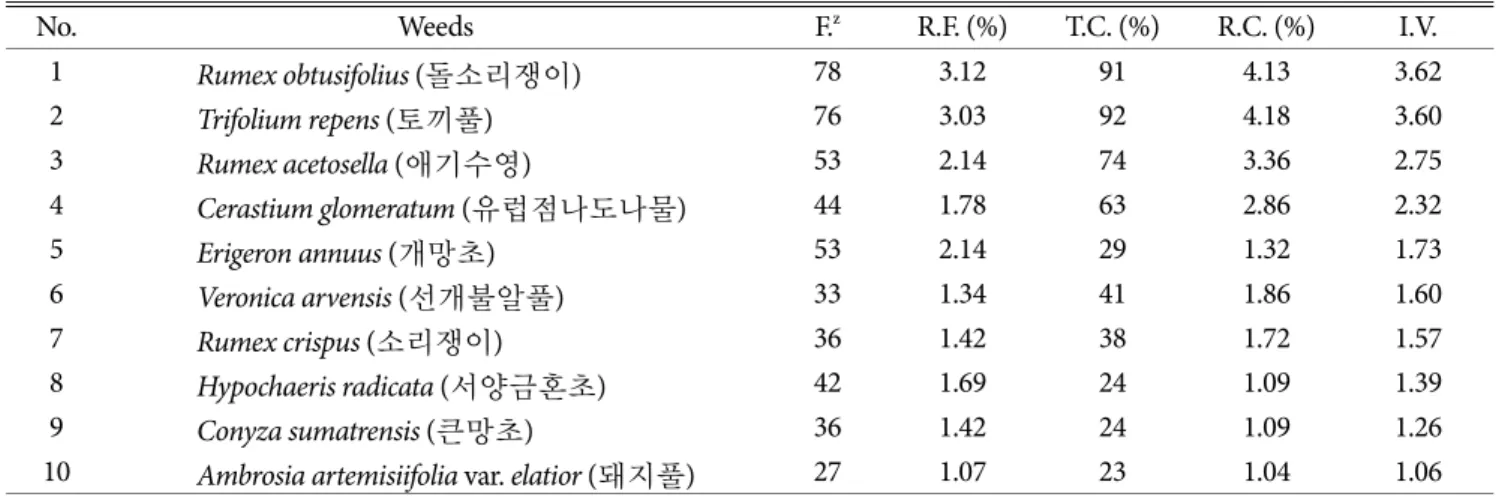
는 조사기간이 10년정도 차이를 보여 기후변화 등으로 발 생초종이 변화를 보인 것으로 사료된다. 이 중에서 돌소리 쟁이, 토끼풀, 애기수영, 유럽점나도나물 등은 전체 밭잡초 에서 10위 안에 발생하고 있었다(Table 4). 이 중에서 돌소 리쟁이, 애기수영 등은 현재에도 목초지를 황폐화시키는 등의 피해를 주고 있으며, 특유의 타감물질을 분비하여 목 초의 생육을 떨어뜨리는 등 향후 제주도 목초지에서 문제 될 수 있음을 암시하고 있다. 그리고 일부지만 목본도 17 종이 발생하였다(Table 2). 특히 가시딸기, 찔레, 청미레덩 굴 등은 관리가 부실한 목초지에서 많이 발생하였다.
이런 결과에서 제주지역 목초지내에 발생하는 잡초 중 돌소리쟁이, 토끼풀, 질경이, 가락지나물, 애기수영 등이 문 제인 관계로 이들 잡초가 확산되지 않도록 체계적인 관리 가 필요하다. 즉 목초지를 강한 예취를 해서 잡초발생을 미 연에 방지하는 것이 필요하다. 그러나 목초지 면적이 줄어 가고, 농가 일손이 부족한 현시점에서 충분한 대안이 될 수 있을 지 의문이다.
요 약
제주도 목초지에 발생하는 잡초를 조사하여 목초지 문제 잡초의 현황을 파악하고 잡초방제의 기초자료로 활용하기 위하여 2013년 5월과 7월에 2회 실시하였다. 제주지역 목 초지에 발생하는 잡초는 49과 207초종으로 일년생잡초가 전체의 32%를 차지하는 67종, 월년생잡초가 19%로 39종, 그리고 다년생잡초가 49%로 101종이었다. 그리고 과별로 보면, 국화과 17%, 화본과 15%, 마디풀과 8%, 장미과 7%, 콩과 6%, 석죽과, 십자화과, 꿀풀과 각각 3%순으로 발생하 였다. 우점도가 높은 잡초로는 돌소리쟁이, 토끼풀, 쑥, 질 경이, 가락지나물, 애기수영 등의 순이었다. 외래잡초는 22
과 68초종으로 전체 32.9%를 차지하였으며, 이 중에서 돌 소리쟁이, 토끼풀, 애기수영, 점나도나물 등은 향후 제주도 목초지에서 문제가 될 것으로 판단된다. 일부 목초지와 산 지와의 경계부분에서 청미래덩굴, 뱀딸기, 용가시 등의 목 본식물도 발생하였다.
주요어: 목초지, 잡초, 제주
Acknowledgement
This study was supported by joint research project of Rural Development Administration, Republic of Korea (Project number : PJ 009319).
References
Braun-Blanquet, J. 1964. Pflanzensoziologie: grundzüge der vegetationskunde. Zweite, umgearbeitete und vermehrte Auflage. Springer-Verlag: Wien. p. 865.
Chang, Y.H., Kim, C.S. and Youn. K.B. 1990. Weed occurrence in upland crop fields of Korea. Kor. J. Weed Sci. 10(4):294-304. (In Korean)
Curtis, J.T. and Mc Intosch, R.P. 1950. The interrelations of certain analytic and synthetic phytosociological characters. Ecol.
31:434-455.
Jung, J.S., Lee, J.S. and Choi, C.D. 1997. Weed occurrence in apple orchard in Korea. Kor. J. Weed Sci. 17(2):147-156. (In Korean) Kim, K.U., Kim, S.H., Kim, C.G., Kim, J.H. and Shin, D.H. 1988.
Weed flora of range area in Cheju island in Korea. Kor. J. Weed Sci. 8(3):291-298. (In Korean)
Kim, K.U. and Shin, D.H. 2007. Principle of weed control.
Table 4. Occurrence of invasive weeds flora ordered by importance value in pasture fields in Jeju island in 2013 (ordered top 10 species).
No. Weeds F.
zR.F. (%) T.C. (%) R.C. (%) I.V.
1 Rumex obtusifolius (돌소리쟁이) 78 3.12 91 4.13 3.62
2 Trifolium repens (토끼풀) 76 3.03 92 4.18 3.60
3 Rumex acetosella (애기수영) 53 2.14 74 3.36 2.75
4 Cerastium glomeratum (유럽점나도나물) 44 1.78 63 2.86 2.32
5 Erigeron annuus (개망초) 53 2.14 29 1.32 1.73
6 Veronica arvensis (선개불알풀) 33 1.34 41 1.86 1.60
7 Rumex crispus (소리쟁이) 36 1.42 38 1.72 1.57
8 Hypochaeris radicata (서양금혼초) 42 1.69 24 1.09 1.39
9 Conyza sumatrensis (큰망초) 36 1.42 24 1.09 1.26
10 Ambrosia artemisiifolia var. elatior (돼지풀) 27 1.07 23 1.04 1.06
z