Vol.12, No.5, pp.48-53 (2018) https://doi.org/10.20910/JASE.2018.12.5.48
서 론 1.
현대 항공기의 복잡하고 나날이 증가되는 임무 요구
사항을 수행하기 위해 항공전자시스템 기술발전의 비, 중이 증가되고 있다[1-3]. 이에 개발기간 단축과 개발 비용 절감을 위해 항공전자시스템의 개발에 상용기성, 품 적용가능성에 대한 연구가 진행되었다[2,3]. 또한,
복잡한 임무 요구사항을 실시간으로 정확하고 효율적 으로 관리하기 위한 실시간 운영 체계(RTOS;
real-time operating system)의 개발도 활발히 이루 어지고 있다. RTOS는 시간에 따른 정확한 태스크 관 리 시스템 자원 관리가 필요한 실시간 응용프로그램 , 을 위해 개발된 운영체계이다.
본 논문에서는 실시간 운영체계를 이용한 상용기성
품 마이크로 컨트롤러 유닛 (MCU; micro-controller 의 성능을 비교하였다 성능 비교를 위해
unit) . MCU
수직 충돌회피 알고리즘과 수평 충돌회피 알고리즘을 통합하여 차원 충돌회피 알고리즘을 3 C++언어로 구
항공기 차원 충돌회피 알고리즘 구현과 3
실시간 운영체계를 이용한 Micro Controller Unit 의 성능 비교
임지성1· 김동신2· 박인혁2·이상철2,†
1한국항공대학교 대학원 항공우주 및 기계공학과
2한국항공대학교 항공우주 및 기계공학부
Implementation of 3-D Collision Avoidance Algorithm and Comparison of Micro Controller Unit’s Performance using Real-Time Operating System
Ji-Sung Lim1, Dong-Sin Kim2 , In-Hyeok Park2 and Sangchul Lee2,
1Graduate School of Aerospace and Mechanical Engineering, Korea Aerospace University
2School of Aerospace and Mechanical Engineering, Korea Aerospace University Abstract
In this study, Real-Time Operating System(RTOS) and 3-D collision avoidance algorithm are implemented to three different Miciro Controller Unit(MCU)s and their performances compared. We selected Microchip Technology's ATmega2560, STM's ARM Cortex-M3 and ARM Cortex-M4, because they are widely used.
FreeRTOS, an open-source operating system, was also used. The 3D collision avoidance algorithm consists of the vertical and the horizontal avoidance algorithm, which is implemented using C++. The performances of the MCUs were compared with respect to used memory and calculation time. As a result, Cortex-M4’s calculation time was the fastest and ATmega2560 used least memory.
초 록
본 논문에서는 RTOS과 항공기의 차원 충돌회피 알고리즘을 세 개의 3 MCU에 적용하여 각 MCU의 성능을 비교하였다. MCU는 많이 사용되는 Microchip Technology사의 ATmega2560과 STM사의 ARM
를 선정하였으며 는 공개되어 있는 를 사용하였다 성능을 확
Cortex-M3, ARM Cortex-M4 , RTOS FreeRTOS .
인하기 위해 적용된 차원 충돌회피 알고리즘은 수직회피와 수평회피를 통합한 알고리즘이며 3 C++로 구
현하였다. MCU의 성능은 각 MCU의 사용 메모리와 계산 시간을 측정하여 비교하였다 비교 결과 세 .
중 계산 시간은 가 빨랐으며 이 적은 메모리를 사용하였다
MCU , ARM Cortex-M4 , ATmega2560 .
Key Words : 3-D Collision Avoidance Algorithm(3차원 충돌회피), Real Time Operating System(실시간운영 체계), Micro Controller Unit(마이크로 컨트롤러 유닛)
Received: Aug. 10, 2018 Revised: Sep. 29, 2018 Accepted: Oct. 14, 2018 Corresponding Author
†
Tel: +82-02-300-0108, E-mail: [email protected] The
Ⓒ Korea Aerospace University
현하였다[4]. 실시간 운영체계는 오픈소스인
를 사용하였다 는 프로세서인
FreeRTOS . MCU 8Bit
프로세서인
ATmega2560, 32Bit ARM Cortex M3, 를 사용하였다 구현한 알고리즘 실 ARM Cortex M4 .
행파일을 이용하여 FreeRTOS가 탑재된 각 MCU의 계산시간과 메모리 사용량을 측정하여 MCU의 성능을 비교하였다.
본 론 2.
차원 충돌회피 알고리즘 2.1 3
은
Figure 1 3차원 충돌회피 알고리즘을 구현하는데 사용된 NED(North East Down) 좌표계이다[4,5].
항공기의 선속도 성분과 항공기 선회반경은 Eq. (1)에 서 Eq. (4)와 같이 표현할 수 있다[6].
cos cos (1)
cos sin (2)
sin (3)
tan
(4)
여기서, 는 항공기의 속도, 는 비행경로 각, 는 방위각, 은 항공기의 선회반경, 는 항공기 뱅크 각, 는 중력 가속도를 각각 의미한다.
Fig. 1 Coordinate System
부터 에서 항공기의 비행경
Equation (1) Equation (4)
로 각과 비행속도가 일정하다는 가정 하에 항공기가 , 선회를 시간 동안 수행했을 때의 항공기의 위치는
와 같이 표현할 수 있다
Eq. (5) [6].
⋅cos cos
⋅sin sin
(5)
여기서, 는 선회를 시작할 때의 항공기의 위치,
은 부호함수, tan 를 각각 의미한다.
차원 충돌회피 알고리즘은 수직회피 알고리즘과 수 3
평회피 알고리즘을 통합하는 방법을 사용하였다[6].
수직 충돌회피 알고리즘은 항공기에 적용되고 있는 공 중충돌방지장치 (TCAS; traffic alert and collision
를 기준으로 수평 충돌회피
avoidance system) [7,8],
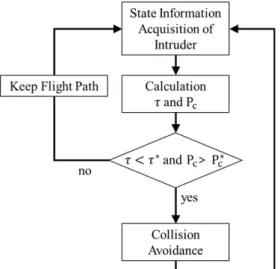
알고리즘은 Andrew Trapani, Heinz Erzberger가 발 표한 연구를 기반으로 구현하였다[9,10]. Figure 2는 구현된 차원 충돌회피 알고리즘 순서도를 보여준다3 .
에서 볼 수 있듯이 항공기의 충돌확률
Figure. 2 가
기준 값 보다 크고 최근접 지점까지의 남은시간 , 가 기준 값 보다 작으면 차원 충돌회피를 지시하게 3 된다 이와 반대되는 경우 항공기가 현재 비행경로를 . , 유지하도록 지시하게 된다. Table 1은 구현된 차원 3 충돌회피 알고리즘의 특성을 보여준다.
Fig. 2 3-D Collision Avoidance Algorithm Flow Chart
에서의 항공기의 충돌확률
Figure 2 는 최근접
지점에서의 각 축에 대한 두 항공기의 상대거리()를 이용해 구할 수 있다 두 항공기의 위치와 속도는 불. 확실성을 갖는 랜덤변수이므로, 는 랜덤확률분포를 가지는 랜덤변수이고,
는 의 분산으로 정의할 수 있다. Equation (6)은
와 를 이용해 충돌확률 를 구하는 것을 보여준다[6].
exp
(6)
상태변수 추정 방법 Probabilistic 상태변수 차원 Horizontal and
Vertical 충돌회피 방법 Prescribed
회피 기동 Horizontal and Vertical 다중충돌 회피 방법 Pairwise
충돌 회피의 책임 Cooperative Table 1 3-D collision avoidance algorithm
characteristics
2.2 RTOS
는 태스크 단위로 기능을 수행하며 각 태스
RTOS ,
트는 우선순위를 가지고 있어 높은 우선순위의 태스크 가 먼저 실행되며 시작 및 종료시점의 변경이 가능하 다 또한. , IPC(interprocess communication)메커니즘 을 통하여 태스크들 간의 통신 및 원활한 동기화를 제 공한다[11]. 이러한 특징으로, RTOS는 항공기 자동, 차 철도 로봇 우주선 제어 및 무기 통제 기상 관측, , , , , 가상 현실 등의 분야에 적용될 수 있다[12]. 특히 항, 공우주 분야로는 무인기 자동항법장치 전투기 및 훈, 련기 장비 각종 유도탄 유도장치 레이더 장치 센서 , , , 네트워크 장치 정찰 로봇 어뢰기 등에 적용되고 있, , 다.
상용 RTOS로는 VxWorks, INTEGRITY, OSE RTOS,
등이 있으며 의 경우
QNX RTOS, LynxOS , VxWorks
국방 및 항공우주분야에 특화된 상용 RTOS이자 최고 점유율을 차지하고 있다[13]. 오픈소스 RTOS로는 등이 있으며 본 논문 uC/OS II, FreeRTOS, RTEMS ,
에서는 FreeRTOS를 사용하였다. FreeRTOS는 4000 라인 내에서 8 bit, 16 bit, 32 bit 의 다양한 MCU에 포팅할 수 있으며, Multitasking, Co-routine, Queue,
등의 기능을 지원한다
Semaphore [14].
차원 충돌회피 시뮬레이션 결과 2.3 3
차원 충돌회피 알고리즘은 언어를 기반으로 구
3 C
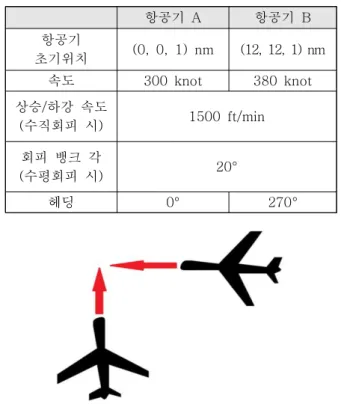
현하였다. 3차원 충돌회피 알고리즘의 시뮬레이션 결 과를 확인하기 위해 Fig. 3 및 Fig. 4와 같이 항공기 가 수직으로 횡단하는 상황과 마주보며 오는 상황을 가정하였다. 수직으로 횡단하는 상황을 scenario 1, 마주보며 오는 상황을 scenario 2로 정의하였다. 각 상황의 초기 조건은 Table 2 및 Table 3과 같다 시. 뮬레이션 결과는 두 항공기 A, B간의 거리 이동경로, , 고도로 확인하였다. 3차원 충돌회피 알고리즘의 시뮬 레이션 결과는 Fig. 5에서 Fig. 12와 같다.
항공기 A 항공기 B
항공기
초기위치 (0, 0, 1) nm (12, 12, 1) nm
속도 300 knot 380 knot
상승 하강 속도/ 수직회피 시
( ) 1500 ft/min
회피 뱅크 각 수평회피 시
( ) 20°
헤딩 0° 270°
Table 2 Initial condition of scenario 1
Fig. 3 Scenario 1 of pair of Aircraft
항공기 A 항공기 B 항공기
초기위치 (-12, 12, 1) nm (12, 12, 1) nm
속도 380 knot 380 knot
상승 하강 속도/ 수직회피 시
( ) 1500 ft/min
회피 뱅크 각 수평회피 시
( ) 20°
헤딩 90° 270°
Table 3 Initial condition of scenario 2
는 횡단하는 항공기 의 차원 시
Figure 5 (Scenario 1) 3 뮬레이션 결과이다. Figure. 6 및 Figure. 7을 통해 3 차원 충돌회피 알고리즘에서 설계된 것과 같이 고도회 피와 수평회피를 동시에 수행하는 것을 볼 수 있다.
Fig. 4 Scenario 2 of pair of Aircraft
는 마주보는 항공기 의 차원 시
Figure 8 (Scenario 2) 3
뮬레이션 결과이다. Figure. 9 및 Figure. 10을 통해 차원 충돌회피 알고리즘에서 설계된 것과 같이 고도 3
회피와 수평회피를 동시에 수행하는 것을 볼 수 있다.
Fig. 5 3-D view (Scenario 1)
South-North(nmi)
Fig. 6 Top view (Scenario 1)
0 50 100 150 200 250
Time(sec) 0
0.2 0.4 0.6 0.8 1 1.2 1.4 1.6 1.8 2
Attitude(nmi)
Aircraft A Aircraft B
Fig. 7 Altitude (Scenario 1)
Fig. 8 3-D view (Scenario 2)
-50 -40 -30 -20 West-East(nmi)-10 0 10 20 30 40
-5 0 5 10 15 20 25 30
Aircraft A Aircraft B
Fig. 9 Top view (Scenario 2)
0 50 100Time(sec)150 200 250 0
0.2 0.4 0.6 0.8 1 1.2 1.4 1.6 1.8 2
Aircraft A Aircraft B
Fig. 10 Altitude (Scenario 2)
성능 결과 2.4 Micro Controller Unit
본 논문에서 사용된 는
MCU Microchip Technology 사의 ATmega 2560과 STM사의 ARM Cortex-M3(S TM32F103RBT6), ARM Cortex-M4(STM32F407VG
이며 세 의 스펙은 와 같다
T6) , MCU Table 4 [15-16].
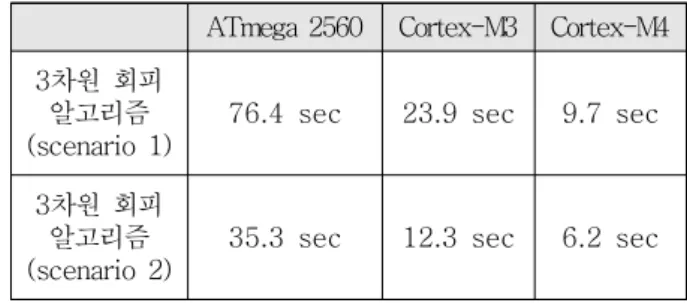
세 MCU의 성능 확인을 위해 적용한 차원 충돌회피 3 알고리즘은 서로 같으며 각 , MCU에서 실행파일이 구 동되기 위한 명령어만 조금 상이하다 성능확인을 위해 . 수집한 파라미터는 계산시간과 사용된 메모리이며 각, 각의 MCU에서 구동하였을 때 결과는 Table 5에서
과 같다 Table 7 .
는 각 에서 사용된 메모리를 보여준다
Table 5 MCU .
각 MCU내에서 Scenario 1과 Scenario 2를 적용했을 때, 같은 메모리를 사용하는 것을 확인할 수 있었다.
를 보면 와
Table 5 ARM Cortex-M3 ARM
의 메모리사용량은 차이가 없으며
Cortex-M4 , ARM
와 이 보다
Cortex-M3 ARM Cortex-M4 ATmega2560 약 1.5배 메모리를 많이 사용한다는 것을 알 수 있다. 이는 32 bit 프로세서가 8bit 프로세서에 비해 명령어 집합 (Instruction Set)이 더 많고 동일한 변수더라도 , 자료형(Data Type)이 더 크며 메모리 주소, (Memory
구성이 더 복잡하기 때문이라고 판단된다
Address) .
ATmega 2560 Cortex-M3 Cortex-M4 Data bus 8 bit 32 bit 32 bit
Flash
Memory 256 KB 128 KB 1024 KB
RAM 8 KB 20 KB 192 KB
Clock
speed 16 MHz 64 MHz 168 MHz Table 4 Specification of MCU
ATmega2560 Cortex-M3 Cortex-M4 차원 회피
3 알고리즘 (scenario 1, scenario 2)
3885 byte
5943 byte
5937 byte Table 5 Used memory of each MCU
및 은 각각 항공기가 회피를 수행 Table 6 Table 7
하는 동안 실시간으로 위치데이터를 출력하는 경우와,
출력하지 않는 경우에 따른 각 MCU의 계산시간을 보 여준다. Table 6과 Table 7을 비교해보면 위치데이터, 를 출력하는데 걸리는 시간은 각각 ATmega2560 약
초
4.8 , ARM Cortex-M3 약 3.6초, ARM Cortex-M4 약 3.65초 이다.
Scenario 과 1 Scenario 2 모두 ARM Cortex-M4가 계산시간이 빠르다는 것을 확인할 수 있다 위치출력을 . 고려하지 않고, 단순 계산시간만을 비교해봤을 때 ARM Cortex-M3를 기준으로 ARM Cortex-M4는 약
배 빠르고 은 약 배 느리다는 것
3.3 , ATmega2560 3.5
을 확인할 수 있다. 이는 Clock speed가 제일 높은 가 계산시간이 적게 걸렸으며
ARM Cortex-M4 , Clock
가 가장 낮은 이 계산 시간이 오래 speed Atmega 2560
걸린 것으로 판단된다.
ATmega 2560 Cortex-M3 Cortex-M4 차원 회피
3 알고리즘 (scenario 1)
76.4 sec 23.9 sec 9.7 sec
차원 회피 3
알고리즘 (scenario 2)
35.3 sec 12.3 sec 6.2 sec Table 6 Process time of each Micro Controller
위치데이터 출력하는 경우
Unit( )
ATmega 2560 Cortex-M3 Cortex-M4 차원 회피
3 알고리즘 (scenario 1)
71.6 sec 20.3 sec 6.0 sec
차원 회피 3
알고리즘 (scenario 2)
30.5 sec 8.7 sec 2.6 sec Table 7 Process time of each Micro Controller
위치데이터 출력하지 않는 경우
Unit( )
결 론 3.
본 논문에서는 실시간 운영체계와 를 이용하여
MCU
항공기의 차원 충돌회피 알고리즘을 구현하였고 3 MCU 성능을 확인하였다. 사용된 MCU는 흔히 사용되는
사의 사의 Microchip Technology ATmega2560, STM
이고 실시간 운 ARM Cortex-M3, ARM Coretex-M4 ,
영체계는 무료로 제공되고 있는 FreeRTOS를 사용하 였다 항공기 차원 충돌회피 알고리즘은 . 3 C++ 를 기 반으로 구현하였고 동일한 실행 파일과 , RTOS를 이용 하여 각각의 MCU에서의 계산시간과 사용된 메모리 값 을 측정하였다. 3차원 충돌회피 알고리즘을 각각의
에서 실행한 결과 거의 동일한 시뮬레이션 결과가 MCU
출력되었다. MCU의 성능비교 결과로는 ARM 성능은
Cortex-M3, ARM Cortex-M4 ATmega2560 보다 계산 시간은 약 3.5배 약 , 12배 빠르며 약 , 1.5배 많은 메모리를 사용하는 것을 확인할 수 있었다.
References
[1] C. G. Park, “Design of Lightweight RTOS for MCU,”
The journal of the Korea Institute of Maritime Information & Communication Sciences, Vol.15, No.6, pp.1301-1306, 2011.
[2] I. Moir, A. Seabrides, AIAA Eudation Series Aircraft Systems, AIAA, pp. 315-337, 2001.
[3] S. C. Lee, I. K. Kim and Y. I. Kim, “Development of Operational Flight Program for Stores Management Computer,” Journal of the Korean society for aeronautical & space sciences Journal, Vol.31, No. 5, pp.124~133, 2003.
[4] S. W. Yang and S. C. Lee, “A Study on the Development of an Avionics System,” Journal of the Korean Society for Aviation and Aeronautics Journal, Vol.15, No.1, pp.61-67, 2007.
[5] M. K. Park, K. B. Kim, and K. J. Yoon, “Design and Fabrication of coaxial quadrotor for indoor flight,” KSAS 2012 fall conference, pp. 1837-1840, November, 2012.
[6] Y. R. Kim, “A Development and Verification of 3-D Resolution Algorithm for Aircraft Collision Avoidance,” Master Degree Thesis, Korea Aerospace University.2012
[7] B. K. Jun, “Performance Improvement of the Collision Avoidance Algorithm for the TCAS-II System with
Safety Critical Software,” Master Degree Thesis, Korea Aerospace University. 2011.
[8] J. K. Kuchar and A. C. Drumm, “The Traffic Alert and Collision Avoidance System,” Lincoln Laboratory Journal, Vol.16, No2, 2007.
[9] A. Trapani, H. Erzberger and W. Dunbar,
“Performance Analysis of a Horizontal Separation Assurance Algorithm for Short-Range Conflicts,”
AIAA Guidance, Navigation, and Control Conference, Aug, 2009.
[10] A. Trapani, “Performance Analysis of a Horizontal Separation Assurance Algorithm for Short-Range Conflicts Detection and Resolution,” University of California Santa Cruz, Dec, 2008.
[11] S. H. Kim, S. O. Cho, S. S. Kim, C. K. Ryoo and K. Y. Choi, “Development of Embedded Program for UAV Flight Control System using RTOS and Model-Based Auto Code Generation,” Journal of Korean Society for Aeronautical and Space Science, Vol.39, No.10, pp.979-986, 2011.
[12] C. H. Koo, “Real-time software Development Technology Trends,” Current Industrial and Technological Trends in Aerospace, Vol.2, No.1, pp.86-93, 2004.
[13] S. J. Lee and D. H. Kim, “Technology Trends of Real-Time OS for Defense Application,”
Communications of the Korean Institute of Information Scientists and Engineers, Vol.29, No.10, pp.41-51, 2011.
[14] B. J. Hong, “A Design on CAN Communication Security on FreeRTOS,” Master Degree Thsis, Soongsil University, pp.4-7, 2017.
[15] Atmega 2560 Device Overview, https://www.microchi p.com/wwwproducts/en/ATmega2560
[16] Cortex M3 and M4 Product Specification, https://www.st.com/content/st_com/en/search.html#q=CO RTEX%20M3-t=products-page=1