Biosynthetic Regulation of Intracellular Invertase from Alkalophilic and Thermoplilic Bacillus cereus TA-11
Sung-Hun Yi*, Jung-Eun Song and Jong-Soo Lee4)
Department of Life Science and Genetic Engineering, Pai Chai University,
*Korea Food Research Institute
호알칼리성, 고온성 Bacillus cereus TA-11으로 생산된 세포내 Invertase의 생합성 조절
이성훈*ㆍ송정은ㆍ이종수 배재대학교 생명유전공학과
*한국식품연구원
Abstract
Regulation of invertase biosynthesis was studied with alkalophilic and thermophilic Bacillus cereus TA-11. Biosynthesis of invertase in Bacillus cereus TA-11 was effectively induced in the presence of 10 mM of sucrose for 180 min and 25 mM of raffinose for 90 min, respectively. Glucose repressed the invertase induction by sucrose and as late addition time of glucose, invertase formation was increased, indicating that glucose repression was occurred by inducer exclusion. Catabolite repression was not reduced by the addition of cAMP for 180 min of induction.
Corresponding Author : Jong-Soo Lee, Dept. of Life Science and Genetic Engineering, Pai Chai, Daejeon, Korea, 302-735, Tel : +82-42-520-5388, E-mail : [email protected]
요 약
호 알칼리성이며 고온성인 Bacillus cereus TA-11이 세포내로 생성하는 invertase의 생합 성 조절 양상을 조사하였다. Bacillus cereus TA-11의 세포내 invertase는 10 mM sucrose의 180분 처리와 25 mM raffinose의 90분 처리에서 각각 효율적으로 유도되었다. 또한 glucose는 sucrose에 의한 invertase의 유도를 억제하였고 cAMP첨가는 catabolite repression 을 감소시키지 못하였다.
key words : Regulation, induction, catabolite repression, invertase, Bacillus cereus TA-11
Ⅰ . Introduction
Invertase (β-fructofuranosidase ; β-D-fructofuranoside fructohydrolase ; EC 3.2.1.26) hydrolyzes sucrose to glucose and fructose and also catalyzes transfructosylation reaction with sucrose as substrate, resulting in the formation of various trisaccharides (fructosyl sucrose) of kestose type trisaccharides (fructosyl sucrose) (Straathof et al., 1986, ; Fitzgerald et al., 1968,
; Obenland et al., 1993) . It is widely used in food and medical industries for the production of fructose syrup and fructooligosaccharides which are low-calory sweetener, bifidus growth factor and anti-caries effector (Straathof et al., 1986, ; Fitzgerald et al., 1968) .
Invertase has been found in various plants (Obenland et al., 1993, ; Porntaveewat et al., 1994, ; Krishnan et al., 1985, ; Unger et al., 1992, ; Kim, 1980) and microorganisms (Hirayama et al., 1989, ; Yanase et al., 1991, ; Fujita et al., 1990, ; Babezinski, 1980, ; Montenecourt et al., 1973, ; Abrams et al., 1994) . It was known that two forms of invertase exist in Saccharomyces sp. : a large, secreted mannoprotein of 270 KDa molecular mass containing 50% mannose and 3% glucosamine by weight, and a smaller, intracellular glycan enzyme with a molecular mass of 135 KDa (Abrams et al., 1994) . In addition, the molecular mass of microbial invertase were 58 KDa from Zymomonas mobilis (Yanase et al., 1991) , 180 KDa and 340 KDa from Aspergillus niger (Hirayama et al., 1989), 52 KDa from Arthrobacter sp. K-1 (Fujita et al., 1990) and 25 KDa from Bacillus sp. TA-11 (Choi and Lee, 1995).
There is little information on the biosynthetic regulation studies of invertase from microorganisms and plant, except Saccharomyces mutants (Montenecourt et al., 1973) and recombinant E. coli (Yi et al., 2006). In previous paper (Yoon et al., 2007), we reported production and characterization of intracellular invertase from alkalophilic and thermophilic Baciillus cereus TA-11. The present study was performed to investigate induction and repression system of intracellular invertase in alkalophilic and thermophilic Bacillus cereus TA-11.
Ⅱ. Materials and Methods
1. Bacterial strains and culture condition
Alkalophilic and thermophilic Bacillus cereus TA-11 was used as a source of invertase (Yoon et al., 2007). The strain was cultivated in a fermentor (KFM-7, Korea Fermentor Co.) at 50℃ for 36 hrs in SY broth containing 1% (w/v) sucrose, 0.6% (w/v) yeast extracts and 0.1% (w/v) each of KH2PO4 and K2HPO4 with 0.5 vvm aeration and pH was maintained to 9.5 by adding 1.0 M Na2CO3. MY medium (1.0% maltose, 0.6% yeast extract, 0.1% K2HPO4
and KH2PO4) was used for regulation study.
2. Assay of invertase activity
Invertase activity was assayed by measuring the amount of reducing sugar released from sucrose as the substrate (Choi and Lee, 1995, ; Yoon et al., 2007) . The assay mixture contained 0.1 M sucrose, 0.1 M phosphate buffer (pH 6.5), and 0.2 mL of an enzyme solution in total volume of 1 mL. After incubation for 2 hrs at 37℃, reducing sugar formed in the reaction mixture was measured by the methods of dinitrosalisylic acid method. One unit of the activity was defined as the amount of enzyme that required to produce reducing sugar equivalent to 1 μM of glucose per min.
3. Biosynthetic regulation of the invertase
Induction and repression of the invertase from Bacillus cereus TA-11 was performed as followed. Cultured cells were harvested and washed twice with a biosynthesis regulation solution (MY medium without maltose). The pellet was resuspended in the biosynthesis regulation solution containing inducer or repressor and then incubated at 50℃ with agitation and the sample was taken at 30 min interval and determined invertase activity of the cell free extracts.
Ⅲ. Results and Discussion
1. Induction of the intracellular invertase
1) Effects of sugars
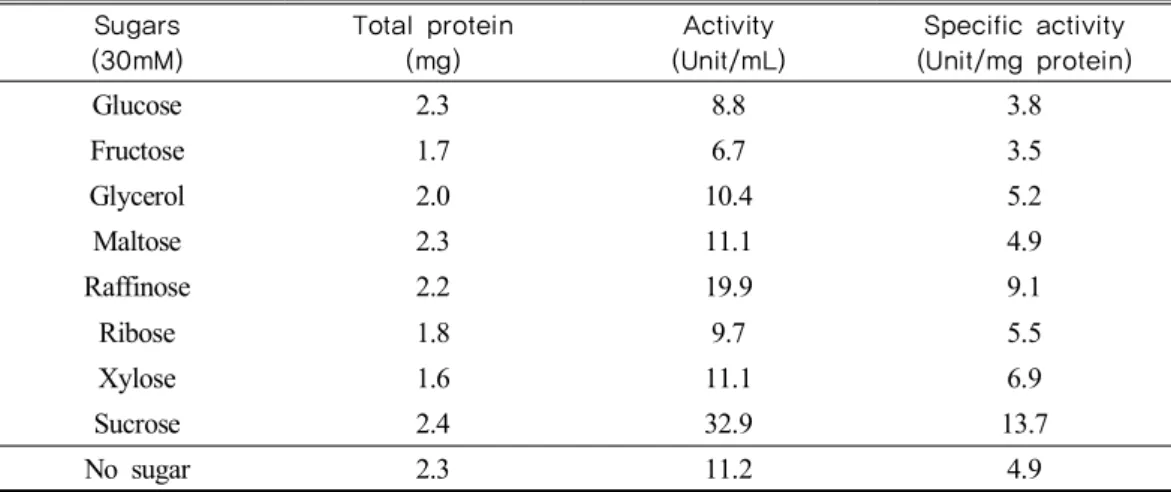
Table 1 shows the effects of sugars on invertase induction of Bacillus cereus TA-11.
Sucrose served as the most effective inducers and raffinose also induced the invertase more or less. However, fructose and glucose inhibited its induction.
Table. 1. Effects of various sugars on induction of invertase from Bacillus cereus TA-11 Sugars
(30mM)
Total protein (mg)
Activity (Unit/mL)
Specific activity (Unit/mg protein)
Glucose 2.3 8.8 3.8
Fructose 1.7 6.7 3.5
Glycerol 2.0 10.4 5.2
Maltose 2.3 11.1 4.9
Raffinose 2.2 19.9 9.1
Ribose 1.8 9.7 5.5
Xylose 1.6 11.1 6.9
Sucrose 2.4 32.9 13.7
No sugar 2.3 11.2 4.9
C o n c en tra tio n o f su c ro se (m M )
Specific activity (Unit/mg protein)
0 1 0 2 0 3 0 4 0 5 0
0 5 1 0 1 5 2 0 2 5
* After cultivation of Bacillus cereus TA-11 in 0.6% yeast extract containing enzyme regulation medium at 50 ℃ for 18 hrs, the cell was harvested, suspended in enzyme regulation medium (without yeast extract) and sugars were added to a final concentration of 30 mM for further cultivation at 50℃ for 24 hrs.
2) Effects of sucrose concentration and culture time
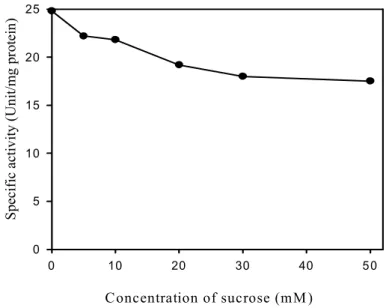
To investigate the effects of sucrose concentration and culture time on the induction of invertase, sucrose ranging from 1 mM to 50 mM was added in the biosynthesis regulation medium and then induced for 5 hrs at 50℃.
Induction of the invertase was increased with increasing sucrose concentration up to 10 mM and the induction was maximized at 10 mM sucrose (Figure 1). But, at concentration higher than 10 mM, the induction was not changed while induction of invertase by raffinose was maximized at 20 mM concentration. This results were different with 30 mM sucrose in recombinant E. coli pYC17 containing invertase gene of Bacillus cereus TA-11 (Yi et al., 2006).
Figure 2 shows the effect of culture time on invertase induction by sucrose and the invertase induction was effective in 3 hrs.
Fig. 1. Effect of sucrose concentration on induction of invertase from Bacillus cereus TA-11.
After cell harvested from culture, suspended in biosynthesis regulation medium containing 0-50 mM of sucrose and then incubated at 50℃ for 5 hrs.
0 6 0 1 2 0 1 80 2 40 3 0 0 0
5 1 0 1 5 2 0 2 5
C u ltu re tim e (m in )
Specific activity (Unit/mg protein)
Fig. 2. Effects of culture time on induction of invertase from Bacillus cereus TA-11.
After cell harvested from culture medium, suspended in biosynthesis regulation medium containing 10 mM sucrose and incubated for 4 hrs at 50℃.
2. Repression of the intracellular invertase
1) Effects of sugars
The effects of sugars on the repression of the invertase were investigated by adding 30 mM of various sugars in sucrose-containing biosynthesis regulation medium and further incubating for 3 hrs at 50℃. As shown in Table 2, glucose inhibited significantly the invertase induction by sucrose.
Table 2. Effects of sugars on the repression of invertase from Bacillus cereus TA-11 grown on sucrose.
Sugars (30mM)
Total protein (mg)
Activity (Unit/mL)
Specific activity (Unit/mg protein)
Glucose 3.1 56.4 18.2
Fructose 2.7 70.2 26.0
Glycerol 3.4 78.5 23.1
Maltose 3.4 85.0 25.0
Raffinose 3.2 84.8 26.5
Ribose 2.6 78.3 30.1
Xylose 2.5 81.8 32.7
Control 3.4 86.0 25.3
Concentration of sucrose (mM )
Specific activity (Unit/mg protein)
0 10 20 30 40 50
0 5 10 15 20 25
* After harvested cell from cultures, suspended in enzyme regulation medium containing 10 mM of sucrose, and at the start of incubation various sugars were added to a final concentration of 30 mM.
2) Effect of glucose concentration and addition period
Figure 3 shows the effect of glucose concentration on the induction of invertase by sucrose.
The invertase induction was markedly inhibited at 30 mM glucose. This repression pattern was similar that of recombinant E. coli pYC17 containing invertase gene of Bacillus cereus TA-11 except 10 mM of repression concentration (Yi et al., 2006).
To investigate the inhibition mechanism of glucose, 30 mM of glucose was added at the different intervals to the sucrose-containing biosynthesis regulation medium and its invertase formation was measured (Figure 4). As late as addition time of glucose, the invertase formation was increased, indicating that glucose inhibition was occurred by inducer exclusion, that is, interference of glucose to entry of sucrose into cell.
Fig. 3. Effects of glucose concentration on the induction of invertase by sucrose in Bacillus cereus TA-11.
After cell harvested, suspended in biosynthesis regulation medium containing 10 mM sucrose, various concentration of glucose were added and incubated for 3 hrs at 50℃.
0 30 60 90 120 150 180 0
5 10 15 20 25
Culture time (min)
Specific activity (Unit/mg protein)
Fig. 4. Effects of addition time of glucose on inductions the biosynthesis of invertase induced by 10mM sucrose in Bacillus cereus TA-11.
After cell harvested, suspended in biosynthesis regulation medium containing 10 mM of sucrose, glucose was added to a final concentration of 30 mM at various culture time after the start of induction by 10mM sucrose.
▽ : Control-sucrose only ● : Added after 0 min
□ : Added after 5 min ▲ : Added after 15 min
3) Effect of cAMP
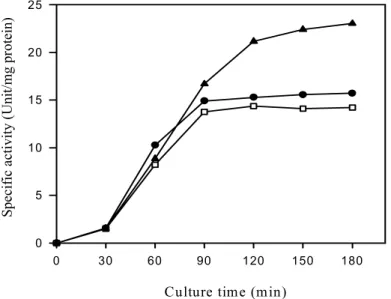
To investigate the effect of cAMP on catabolic repression of the invertase, mixture of 5 mM cAMP and 30 mM glucose was added in 10 mM sucrose- containing biosynthesis regulation medium and then the invertase formation was measured (Figure 5). Catabolic repression was reduced a little by addition of cAMP for 3 hrs of incubation.
0 30 60 90 120 150 180 0
5 10 15 20 25
Specific activity (Unit/mg protein)
Culture time (min)
Fig. 5. Effects of cAMP on the catabolite repression of invertase in Bacillus cereus TA-11.
After cell harvested, suspended in biosynthesis regulation medium containing 10 mM of sucrose, glucose (30 mM) and cAMP (5 mM) were added separately or together and then incubated at 50℃ for 3hrs.
▲ : Control-sucrose only ● : Glucose+cAMP □ : Glucose
Ⅳ . References
Abrams, B. B., Hckel, R., Mizunaga, T. and Lampen, J. O., 1994, Relationship of large and small invertase in Saccharomyces ; mutant selectively deficient in small invertase, J.
Bacteriol., 135, 809-817.
Babczinski, P., 1980, Partial purification, characterization and localization of the membrane- associated invertase of yeast, Biochim. Biophys. Acta., 614, 121-133.
Choi, Y. J. and Lee, J. S., 1995, Production of β-fructofuranosidase from alkalophilic, thermophilic Bacillus sp. TA-11, Korean J. Appl. Microbiol. Biotechnol., 23, 197-202.
Fizgerald, R. J., Spinell. D. M. and Stoudt, T. H., 1968, Enzymatic removal of artificial palque, Arch. Oral. Biol., 13, 125-128.
Fujita, K., Hara, K., Hashimoto, H., and Kitahata, S., 1990, Purification and some properties of β-fructofuranosidase I from Arhrobacter sp. K-1, Agric. Biol. Chem., 54, 913-919.
Hirayama, M., Sumi, N. and Hidaka, H., 1989, Purification and properties of a fructooligo saccharides-producing β-fructofuranosidase from Aspergillus niger ATCC 20611, Agric.
Biol. Chem., 53, 667-673.
Kim, B. M., 1980, Studies on invertase from Korean ginseng, Panax ginseng C. A. Meyer, Korean J. Food. Sci. Technol., 12, 1-5.
Krishnan, H. B., Blanchette, J. T. and Okita, T. W., 1985, Wheat invertase, Plant Physiol., 78, 241-245.
Obenaland, D., Simmen, U., Boller, T. and Wiemken, A., 1993, Purification and characterization of three soluble invertase from barley leaves, Plant Physiol., 101, 1331-1339.
Porntaveewat, W., Takayanagi, T. and Yokotsuka, K., 1994, Purification and properties of invertase from Muscat Bailey A grapes, J. Ferment. Bioeng., 78, 288-292.
Straathof A., Kieboom APG and Bekkum H., 1986, Invertase catalyzed fructosyl transfer in concentrated solutions of sucrose, Carbohydr. Res., 146, 154-159.
Unger, C., Hofsteenge, J. and Sturm, A., 1992, Purification and characterization of a soluble β-fructofuranosidase from Daucus carota, Eur. J. Biochem., 204, 915-921.
Yanase, H., Fukushi, H., Ueda, N., Maeda, Y., Toyoda, A. and K. Tonomura., 1991, Cloning, sequencing and characterization of the intracellular invertase gene from Zymomonas mobilis, Agric. Biol. Chem., 55, 1383-1390.
Yi, S . H., No, J. D., Lee, D. H. and Lee, J. S., 2006, Biosynthetic regulation of invertase from recombinant E. coli pYC17., J. Natural Sciences, Paichai Univ., 17, 103-111.
Yoon, M. H., Choi, W. Y., Kwon, S. J., Yi, S. H., Lee, D. H. and Lee, J. S., 2007 Purification and properties of intracellular invertase from alkalophilic and thermophilic Bacillus cereus TA-11, J. Appl. Biol. Chem., 28, 158-165.