This is an Open Access article distributed under the terms of the Creative Commons Attribution Non-Commercial License (http: //creativecommons.org/licenses/by- nc/4.0/) which permits unrestricted non-commercial use, distribution, and reproduction in any medium, provided the original work is properly cited.
Copyright: © 2018 Korean Journal of Agrcultural Science
https://doi.org/10.7744/kjoas.20180068
FOOD & CHEMISTRY
In-vitro antioxidant activity of flavonoids from Acer okamotoanum
Ji Hyun Kim1, Hyun Young Kim2, Sanghyun Lee3, Eun Ju Cho1,*
1Department of Food Science and Nutrition & Kimchi Research Institute, Pusan National University, Busan 46241, Korea
2Department of Food Science, Gyeongnam National University of Science and Technology, Jinju 52725, Korea
3Department of Integrative Plant Science, Chung-Ang University, Anseong 17546, Korea
*Corresponding Author: [email protected]
Abstract
Degenerative diseases are commonly associated with excess free radicals. Acer okamotoanum, a plant endemic to Korea, is reported to have anti-oxidant, anti-cancer, and anti-viral activities. We previously isolated flavonoids from the ethyl acetate fraction of A.
okamotoanum such as quercitrin (QU), isoquercitrin (IQ), and afzelin (AF). In the present study, the in vitro antioxidant activity of flavonoids such as QU, IQ, and AF isolated from the ethyl acetate fraction of A. okamotoanum were investigated by measuring the free radical scavenging activity including 1,1-diphenyl-2-picrylhydrazyl (DPPH), hydroxyl radical (•OH), and superoxide anion (O2-). The flavonoids (QU, IQ, and AF) concentration-dependently showed a DPPH radical scavenging activity. In particular, QU and IQ showed a higher DPPH radical scavenging activity than that of AF. In addition, the flavonoids (QU, IQ, and AF) at 10 μg/mL showed over an 80% scavenging effect against •OH radical production. Furthermore, the O2-
radical scavenging activity of the flavonoids, QU, IQ, and AF increased in a dose-dependent manner. Particularly, IQ exerted the strongest scavenging activities against •OH and O2- radicals among the other flavonoids. These results indicate that the flavonoids from A. okamotoanum, in particular IQ, would have a protective activity against oxidative stress induced by free radicals, and potentially be considered as a natural antioxidant agent.
Keywords: afzelin, anti-oxidant, free radical, isoquercitrin, quercitrin
Introduction
Degenerativediseasessuchascancer, diabetes, obesity, andAlzheimer’sdiseaseareassociated withtheover-productionoffreeradicalsinthebody (DiDomenicoetal., 2015). Theaccumulationof freeradicalinthecellsdamagesbiologicalmoleculessuchasproteins, lipids, anddeoxyribonucleic acid (Stanneretal., 2004; Halliwell, 2012). Hence, toremovefreeradicals, antioxidantenzymesinthe bodyareactivatedincludingsuperoxidedismutase, catalase, andreducedglutathione. Inaddition, the consumptionofdietaryantioxidantscanalsoprovideaddedprotectionfromfreeradicals (Halliwell, OPEN ACCESS
Accepted: September 18.2018 Revised: September 12.2018 Received: April 26.2018 DOI:
Citation: Kim JH, Kim HY, Lee S, Cho EJ. 2018. In-vitro antioxidant activity of flavonoids from Acer okamotoanum.
Korean Journal of Agricultural Science.
https://doi.org/10.7744/kjoas.20180068
2012). Dietaryantioxidantsareknowntoreducetheriskofseveraldiseasescausedbyfreeradicalsbysupplyingelectronsto damagedcells (Halliwell, 2012). Secondarymetabolitesobtainedfromplantssuchaspolyphenols, flavonoids, andvitamin Chavebeenshowntoconferantioxidanteffects, andareregardedtoconferlowersideeffectsandtoxicity, comparedwith othersyntheticantioxidantssuchasbutylatedhydroxyanisole, butylatedhydroxytoluene, andtert-butylhydroquinone (Liao andYin, 2000; Stanneretal., 2004). Therefore, naturalantioxidantsfromplantshavebeenconsistentlystudiedaspreventive therapyfordegenerativediseases.
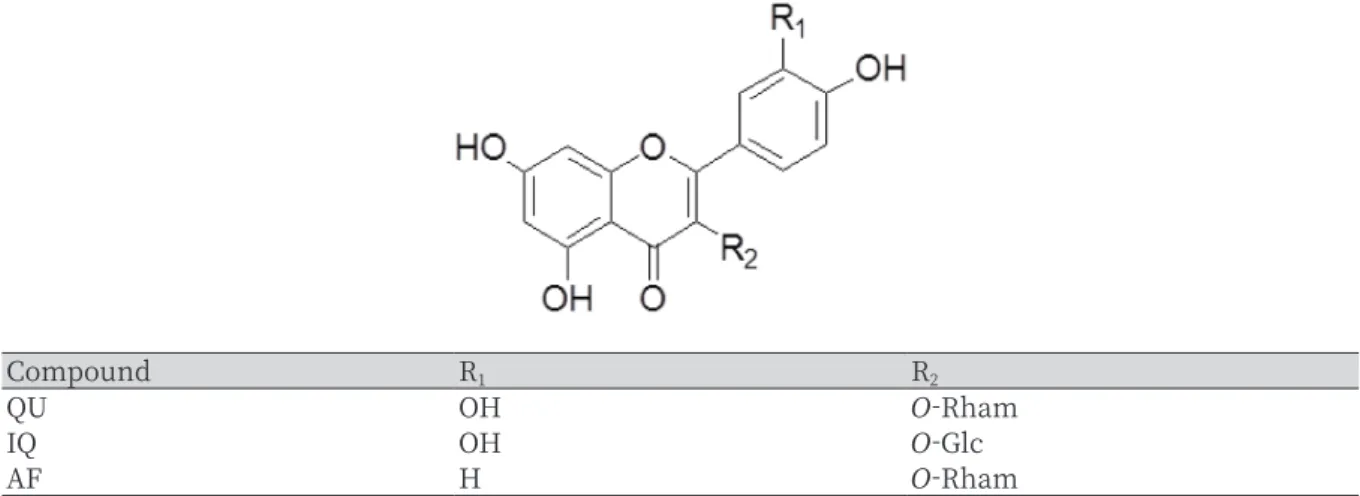
AcerokamotoanumisaplantendemicinKoreareportedtohavevariousbiologicalactivitiesincludinganti-cancer, anti- oxidant, andcognitiveimprovementeffects (Jinetal., 2008; Takayamaetal., 2013; Choietal., 2017). Previousstudiesshow thatA. okamotoanumcontainsseveralactivecompoundssuchasflavonolglycosidegallateester, cleomiscosinsAandC (Kimetal., 1998; Jinetal., 2007). Inaddition, wehavepreviouslyisolatedflavonoids (Fig. 1) fromtheethylacetatefraction ofA. okamotoanumsuchasquercitrin (QU), isoquercitrin (IQ), andafzelin (AF) (Leeetal., 2018), however, theirfreeradical scavengingactivitiesareyettobedetermined. Therefore, inthisstudy, weinvestigatedtheinvitroanti-oxidantactivitiesof theflavonoidsisolatedfromA. okamotoanum, namely, QU, IQ, andAF, bymeasuringtheirscavengingactivitiesagainstthe freeradicals1,1-dephenyl-2-picrylhydrazyl (DPPH), hydroxylradical (•OH), andsuperoxideanion (O2-).
Materials and Methods
Preparation of flavonoids
QU, IQ, andAFwereisolatedfromtheethylacetatefractionoftheaerialpartsofA. okamotoanumbyopencolumn chromatographyandwereidentifiedbyspectroscopicanalysis (Leeetal., 2018).
Reagents
DPPHand2-deoxy-ribosewere purchasedfromSigma (St. Louis, MO, USA) andH2O2 waspurchasedfromJunsei (Tokyo, Japan). FeSO4·7H2OwaspurchasedfromDaejungChemicals & MetalsCo. Ltd (Siheung, Korea), EDTAdisodium salt dehydrate and phosphoric acid were obtained from SamchunPure Chemical Co. Ltd (Pyeongtaek, Korea). The
Compound R1 R2
QU OH O-Rham
IQ OH O-Glc
AF H O-Rham
Fig. 1. The structures of flavonoids from Acer okamotoanum.
QU, quercitrin; IQ, isoquercitrin; AF, afzelin; O-Rham, O-Rhamnoside; O-Glc, O-glucoside.
thiobarbituricacid (TBA) wasfromAcrosOrganics (NewJersey, USA), trichloroaceticacid (TCA) wasfrompurchased KantoChemicalCo. Inc (Tokyo, Japan). Phenezinemethosulfate (PMS), NADHdisodiumsalt, andnitrotetrazoliumblue chloride (NBT) werefrompurchasedBioBasicCo. (Toronto, Canada).
DPPH radical scavenging activity
TheDPPHradicalscavengingactivityweredeterminedaccordingtothemethoddescribedbyHatanoetal. (1989). Each samplewasaddedtoDPPHsolutioninthe96wellplate, andthenincubatedfor30minatroomtemperatureintheabsence oflight. Theabsorbancewasmeasuredat540nmusingamicroplatereader (ThermoFisherScientific, Vantaa, Finland). The DPPHradicalscavengingactivitywasexpressedasIC50andapercentage (%) comparedtothecontrolasfollow.
DPPHscavengingactivity (%) = (Absc - Abss)/Absc × 100 Absc: Absorbanceofcontrol, Abss: Absorbanceofsample
Hydroxyl radical (•OH) scavenging activity
Hydroxylradical (•OH) scavengingactivitywasdeterminedaccordingtothemethoddescribedbyGutteridge (1987). Each samplewasaddedtothereactionmixturecontaining10mMFeSO4·7H2O-EDTA, 10mM2-deoxyribose, and10mMH2O2, andthenincubatedfor4hat37ºCwithoutlight. After, 1% TBAsolutionand2.8% TCAsolutionwereaddedtothemixture andheatedfor20minat100ºC. Theabsorbancewasmeasuredat490nmusingamicroplatereader (ThermoFisherScientific, Vantaa, Finland). The•OHradicalscavengingactivitywasrecordedasapercentage (%) comparedtothecontrol.
•OHscavengingactivity (%) = (Absc - Abss)/Absc × 100 Absc: Absorbanceofcontrol, Abss: Absorbanceofsample
Superoxide anion (O2-) scavenging activity
TheO2-radicalscavengingactivitiesweremeasuredaccordingtothemethoddescribedbyEwingandJanero (1995). Each samplewasaddedto0.1MTris-Hcl (pH7.4), 100μMPMS, 500μMNBT, and500μMNADH, andthenincubatedfor10 minatroomtemperaturewithoutlight. Theabsorbancewasmeasuredat560nmusingamicroplatereader (ThermoFisher Scientific, Vantaa, Finland). TheO2-radicalscavengingactivitywasrecordedasapercentage (%) comparedtothecontrol.
O2-scavengingactivity (%) = (Absc - Abss)/Absc × 100 Absc: Absorbanceofcontrol, Abss: Absorbanceofsample
Statistical analysis
Datawerepresentedasmean ± standarddeviation (SD). Analysisofvariance (ANOVA) followedwithDuncan’smultiple testwasusedforstatisticalanalysis. p < 0.05wasconsideredstatisticallysignificant.
Results and Discussion
Scavengingoffreeradicalsisvitalinthepreventionofthedeleteriouseffectscausedbytheaccumulationoffreeradicals thatoftenleadstovarious degenerativediseasessuchasdiabetes, cardiovascular diseaseand Alzheimer’sdisease (Di Domenicoetal., 2015; Singhetal., 2015). Numerousstudieshavereportedtheantioxidantactivitiesofdifferentextractsand
compoundsisolatedfromvariousplantsources. Particularly, flavonoidsareamongthemajorclassesofplantcompounds thatareshowntoexhibitstrongantioxidativeactivityinbiologicalsystemsbyactingasscavengersoffreeradicals (Lapshina etal., 2015). Inourpreviousstudy, theflavonoidsthatweisolatedfromethylacetatefractionofA. okamotoanum, namely, QU, IQ, andAF, hadpotentaldosereductasescavengingactivities (Leeetal., 2018). However, invitroradicalscavenging activityofthethreeflavonoidshasnotyetbeenelucidated. Therefore, inthepresentstudy, weinvestigatedtheantioxidant effectsoftheflavonoidsisolatedfromA. okamotoanumbymeasuringtheirfreeradicalscavengingactivities.
DPPHisastablenitrogen-centeredfreeradicalwhichactsasafreeradicalscavengerorahydrogendonor (HabuandIbeh, 2015). AntioxidantsreactwiththeDPPHradicaldirectlyandrestoreitbytransferringelectronsorhydrogen. Achangefrom thevioletcoloroftheDPPHradicalinitsreducedformtoyellowcanbeusedtospectrophotometricallydetermineand predicttheantioxidantactivitiesofvariouscompoundandplantextracts (Huangetal., 2005). AsshowninTable1, we examinedtheDPPHradicalscavengingactivityoftheflavonoidsfromA. okamotoanumincludingQU, IQ, andAF. The DPPHradicalscavengingactivityofthethreeflavonoidsevaluatedincreasedinadose-dependentmanner. Ataconcentration of25μg/mL, theDPPHradicalscavengingeffectsofQUandIQwere76.51 ± 0.45%, and75.71 ± 0.06%, respectively, suggestingtheirpromisingroleasfreeradicalscavengers. Furthermore, theIC50valuesofQUandIQwere3.67 ± 0.05μg/ mLand3.79 ± 0.07μg/mL, respectively.
•OHisthemostreactiveandtoxicradical, anditisstronglyrelatedtoseveralhumandiseasessuchasneurodegenerative diseasesandobesity (Rahmanetal., 2015). •OHcanreactwithbiologicalmoleculessuchasDNA, proteins, lipids, and membranephospholipids, leadingtothe generationoffreeradicals, whichinturnquicklyreactswithoxygen toform peroxides (HalliwellandGutteridge, 1984). Therefore, theremovalof•OHisthemosteffectivedefenseagainstvarious diseases. Inthe•OHassay, •OHisformedbyincubatingFe3+-EDTApremixturewithH2O2, causing2-deoxy-ribosedegradation andgeneratingamalondialdehyde (MDA)-likeproduct (Gutteridge, 1987). Table2showedthe•OHradicalscavenging activityofflavonoidsfromA. okamotoanum. The•OHradicalscavengingactivityofflavonoidsshowedover80% scavenging activityat10μg/mL. Particularly, IQshowedthehighest•OHradicalscavengingeffectsamongtheflavonoids. Theprevious researchinvestigatedthatIQshowedhigherinvitroanti-oxidantactivitythanQUintheFe2+-binding, electron-transfer-based ferricionreducingantioxidantpower (Lietal., 2016). TheOHgroupofIQshowedincreasestheelectron-transferandferric ionchelatingabilities (Lietal., 2016).
TheO2-radicalisproducedinbiologicalsystemsduringcellularrespiration (Lushchak, 2014) andO2-isconvertedintoa highlyreactiveradicalinthepresenceofironorduringtheincompletemetabolismofoxygen (KirkinezosamdMoraes,
Table 1. DPPH radical scavenging activity of flavonoids from Acer okamotoanum.
Treatment (µg/mL) Scavenging activity (%)
QU IQ AF
1 24.39 ± 1.00d 23.16 ± 1.14d -
5 60.54 ± 0.43c 63.51 ± 0.97c 4.39 ± 0.35c
10 74.04 ± 0.45b 71.00 ± 0.20b 12.63 ± 0.53b
25 76.51 ± 0.45a 75.71 ± 0.06a 18.77 ± 0.35a
IC50z (µg/mL) 3.67 ± 0.05 3.79 ± 0.07 726.74 ± 59.08
Values are means ± SD (n = 6).
DPPH, 1,1-diphenyl-2-picrylhydrazyl; QU, quercitrin; IQ, isoquercitrin; AF, afzelin.
zIC50 is the concentration in μg/mL required to inhibit the formation of DPPH radical by 50%.
a - d: Different letters are significantly different (p < 0.05) by Duncan’s multiple range test.
2001). HighlyreactiveradicalgeneratedbytheexcessofO2-, suchasH2O2, •OH, andperoxynitritedamagebiomolecules, resultinginvariousdiseasesinthebody (Stanneretal., 2004). Therefore, theremovalorneutralizationofO2-radicalsis necessarytoprotectthecellsfromtheirdeleteriouseffects. Inourstudy, theO2-radicalscavengingactivityofflavonoids increasedinadose-dependentmanner (Table3). Theconcentrationat25μg/mL, theO2-radicalscavengingactivitiesofIQ washigherthanotherflavonoids. TheseresultsindicatedthatflavonoidsfromA. okamotoanummayhaveprotectiveactivity againstO2-radical. ThepreviousstudyalsoreportedthatQU, IQ, andAFhavestrongO2-radicalscavengingactivity (Vellosa etal., 2015; Lietal., 2016).
Conclusion
ThepresentstudydemonstratedthattheflavonoidsisolatedfromtheethylacetatefractionofA. okamotoanum, namely, QU, IQ, andAFinhibitedthefreeradicalsDPPH, •OH, andO2-inadose-dependentmanner. IQexhibitedthehighestfree radicalscavengingactivityamongtheflavonoidsexamined. OurstudyshowedthattheflavonoidsfromA. okamotoanum possessantioxidantpotentialanditmightbeusefulagainstdiseasesrelatingtooxidativestressgeneratedbyfreeradicals.
Acknowledgements
ThisworkwassupportedbyBasicScienceResearchProgramthroughtheNationalResearchFoundationofKorea (NRF) fundedbytheMinistryofEducation (2015R1D1A1A01058868), RepublicofKorea. ThisresearchwassupportedbyGlobal Table 2. Hydroxyl radical (•OH) scavenging activity of flavonoids from Acer okamotoanum.
Treatment (µg/mL) Scavenging activity (%)
QU IQ AF
1 55.70 ± 2.51c 66.73 ± 2.73b 59.05 ± 0.93d
5 79.10 ± 0.67b 83.83 ± 1.86a 81.49 ± 0.39c
10 83.45 ± 1.26a 84.67 ± 3.50a 84.72 ± 0.28b
25 85.48 ± 1.61a 87.77 ± 0.96a 88.50 ± 1.81a
IC50z(µg/mL) 0.53 ± 0.06 0.12 ± 0.04 0.37 ± 0.02
Values are means ± SD (n = 6).
QU, quercitrin; IQ, isoquercitrin; AF, afzelin.
zIC50 is the concentration in μg/mL required to inhibit the formation of •OH radical by 50%.
a - d: Different letters are significantly different (p < 0.05) by Duncan’s multiple range test.
Table 3. Superoxide anion (O2-) scavenging activity of flavonoids from Acer okamotoanum.
Treatment (µg/mL) Scavenging activity (%)
QU IQ AF
1 0.52 ± 1.92d 3.30 ± 0.26d 4.34 ± 0.43d
5 18.94 ± 0.13c 23.44 ± 0.34c 11.50 ± 0.50c
10 38.51 ± 0.23b 46.76 ± 0.13b 25.31 ± 0.17b
25 59.56 ± 0.08a 64.46 ± 0.18a 43.69 ± 0.25a
IC50z (µg/mL) 17.46 ± 0.01 12.89 ± 0.04 49.70 ± 0.29
Values are means ± SD (n = 6).
QU, quercitrin; IQ, isoquercitrin; AF, afzelin.
zIC50 is the concentration in μg/mL required to inhibit the formation of O2- radical by 50%.
a - d: Different letters are significantly different (p < 0.05) by Duncan’s multiple range test.
PH.DFellowshipProgramthroughtheNationalResearchFoundationofKorea (NRF) fundedbytheMinistryofEducation (2016_H1A2A1906940).
References
Choi SY, Lee J, Lee DG, Lee S, Cho EJ. 2017. Acer okamotoanum improves cognition and memory function in Aβ25-35-induced Alzheimer’s mice model. Applied Biological Chemistry 60:1-9.
Di Domenico F, Barone E, Perluigi M, Butterfield DA. 2015. Strategy to reduce free radical species in Alzheimer's disease: An update of selected antioxidants. Expert Review of Neurotherapeutics 15:19-40.
Ewing JF, Janero DR. 1995. Microplate superoxide dismutase assay emplying a nonenzymatic superoxide generator. Analytical Biochemistry 232:243-248.
Gutteridge JM. 1987. Ferrous-salt-promoted damage to deoxyribose and benzoate. The increased effectiveness of hydroxyl-radical scavengers in the presence of EDTA. Biochemical Journal 243:709- 714.
Habu JB, Ibeh BO. 2015. In vitro antioxidant capacity and free radical scavenging evaluation of active metabolite constituents of Newbouldia laevis ethanolic leaf extract. Biological Research 48:16.
Halliwell B, Gutteridge JM. 1984. Oxygen toxicity, oxygen radicals, transition metals and disease.
Biochemical Journal 219:1-14.
Halliwell B. 2012. Free radicals and antioxidants: Updating a personal view. Nutrition Reviews 70:257-265.
Hatano T, Edamatsu R, Hiramatsu M, Mori A, Fujita Y, Yasuhara T, Yoshica T, Okuda T. 1989. Effects of the interation of tannins with co-existing substances, VI. Effects of tannins and related polyphenols on superoxide anion radical, and on 1,1-diphenyl-2-picrylhydrazyl radical. Chemical and Pharmaceutical Bulletin 37:2016-2021.
Huang D, Ou B, Prior RL. 2005. The chemistry behind antioxidant capacity assays. Journal of Agricultural and Food Chemistry 53:1841-1856.
Jin L, Han JG, Ha JH, Jeong HS, Kwon MC, Jeong MH, Lee HJ, Kang HY, Choi DH, Lee HY. 2008.
Comparison of antioxidant and glutathione S-transferase activities of extracts from Acer mono and A.
okamotoanum. Korean Journal of Medicinal Crop Science 16:427-433. [in Korean]
Jin W, Thuong PT, Su ND, Min BS, Son KH, Chang HW, Kim HP, Kang SS, Sok DE, Bae K. 2007. Antioxidant activity of cleomiscosins A and C isolated from Acer okamotoanum. Archives of Pharmacal Research 30:275-281.
Kim HJ, Woo ER, Shin CG, Park H. 1998. A new flavonol glycoside gallate ester from Acer okamotoanum and its inhibitory activity against human immunodeficiency virus-1 (HIV-1) integrase. Journal of Natural Products 61:145-148.
Kirkinezos IG, Moraes CT. 2001. Reactive oxygen species and mitochondrial diseases. Seminars in Cell and Developmental Biology 12:449-457.
Lapshina EA, Zamaraeva M, Cheshchevik VT, Olchowik-Grabarek E, Sekowski S, Zukowska I, Golovach NG,
Burd VN, Zavodnik IB. 2015. Cranberry flavonoids prevent toxic rat liver mitochondrial damage in vivo and scavenge free radicals in vitro. Cell Biochemistry and Function 33:202-210.
Lee J, Lee DG, Rodriguez JP, Park JY, Cho EJ, Jacinto SD, Lee S. 2018. Determination of flavonoids in Acer okamotoanum and their aldose reductase inhibitory activities. Horticulture, Environment, and Biotechnology 59:131-137.
Li X, Jiang Q, Wang T, Liu J, Chen D. 2016. Comparison of the antioxidant effects of quercitrin and isoquercitrin: understanding the role of the 6″-OH group. Molecules 21:9.
Liao K, Yin M. 2000. Individual and combined antioxidant effects of seven phenolic agents in human erythrocyte membrane ghosts and phosphatidylcholine liposome systems: Importance of the partition coefficient. Journal of Agricultural and Food Chemistry 48:2266-2270.
Lushchak VI. 2014. Free radicals, reactive oxygen species, oxidative stress and its classification. Chemico- Biological Interactions 224:164-175.
Rahman MM, Islam MB, Biswas M, Khurshid Alam AH. 2015. In vitro antioxidant and free radical scavenging activity of different parts of Tabebuia pallida growing in Bangladesh. BMC Research Notes 8:621.
Singh R, Devi S, Gollen R. 2015. Role of free radical in atherosclerosis, diabetes and dyslipidaemia: Larger- than-life. Diabetes Metabolism Research Reviews 31:113-126.
Stanner SA, Hughes J, Kelly CN, Buttriss J. 2004. A review of the epidemiological evidence for the 'antioxidant hypothesis'. Public Health Nutrition 7:407-422.
Takayama K, Sun BY, Stuessy TF. 2013. Anagentic speciation in Ullung island, Korea: Genetic diversity and structure in the island endemic species, Acer takesimense (Sapindaceae). Journal of Plant Research 126:323-333.
Vellosa JC, Regasini LO, Belló C, Schemberger JA, Khalil NM, de Araújo Morandim-Giannetti A, da Silva Bolzani V, Brunetti IL, de Faria Oliveira OM. 2015. Preliminary in vitro and ex vivo evaluation of afzelin, kaempferitrin and pterogynoside action over free radicals and reactive oxygen species. Archives of Pharmacal Research 38:1168-1177.