I. 서 론
농촌체험휴양마을사업이란 마을협의회 또는 어촌계가 Corresponding author : Son, Yong-Hoon
Tel : 02-880-8107 E-mail : [email protected]
마을의 자연환경, 전통문화 등 부존자원을 활용하여 도 시민에게 생활체험ㆍ휴양공간 프로그램을 제공하고 이 와 함께 지역 농림수산물 등을 판매하거나 숙박 또는 음 식 등의 서비스를 제공하는 사업이다(손재영, 2014).
한국의 농업과 농촌을 둘러싼 여건은 2000년대 이후 크게 변화하였다. 제도적으로는 ‘농어촌정비법(1995)’, ‘농
농촌체험휴양마을 운영관리 평가 및 유형화 - 양평 농촌체험휴양마을을 사례로 -
이동윤*ㆍ엄서호**ㆍ손용훈***,****
*서울대학교 환경대학원 협동과정 조경학 박사과정⋅**경기대학교 관광문화대학 명예교수⋅
***서울대학교 환경대학원 부교수⋅****서울대학교 환경계획연구소 겸무연구원
Operation Management Appraisal and the Classification of Rural Tourism Villages
- The Cases of Yang-Pyeong Rural Tourism Villages -
Yi, Dong-Yoon*ㆍUm, Seo-Ho**ㆍSon, Yong-Hoon***,****
*Ph.D. Candidate, Interdisciplinary Program in Landscape Architecture, Seoul National University
**Emeritus Professor, College of Tourism and Culture, Kyonggi University
***Associate Professor, Graduate School of Environment Studies, Seoul National University
****Adjunct Researcher, Environmental Planning Institute, Seoul National University
ABSTRACT : This study aims to understand why the sales volume and the number of visitors are different in each rural tourism village. The study considered that the management and operation of rural tourism villages is one of the major influencing factors. To prove this, the study determined what factors were related to the management and operation of villages and derived detailed items to evaluate them. In the study, the researchers conducted an in-depth interview and a literature review on the management and operation of rural tourism villages in Yangpyeong-gun. They also performed a case study on the Sumi village, one of the successfully managed and operated villages in Yangpyeong-gun, to determine the detailed items. As a result, seven factors were identified. These factors comprise operation entity, governance, shared vision, leadership, efficient role-playing, marketing efforts, and equity in profit distribution. Based on these seven factors, 85 of the evaluation items were developed. The management and operation scores of 85 items were measured and summed for each of the 21 rural tourism villages. First, 21 villages were divided into two groups by the sales figures to derive items to determine the difference in the mean value of the evaluation scores. Second, an independent sample t-test was conducted for each village at YangPyeong-gun. Third, the study divided the 21 villages into four groups using 46 evaluation items. Finally, the study’s researchers clarified some challenges to solve and appropriate management and operation plans considering each type of rural tourism village.
Key words : Rural Ttourism, Rural tourism village, Operation management items of rural tourism villages, Evaluating operation management of rural tourism villages 2)
업ㆍ농촌 종합대책(2004)’, ‘농림어업인 삶의 질 향상 및 농산어촌지역개발 촉진에 관한 특별법)’, ‘국가균형발전 특별법(2004)’ 등 법ㆍ제도가 구축되고, ‘농촌마을종합개 발사업(일반농산어촌개발사업)’ 등의 농촌지역개발사업이 본격화 되었다(김영택 등, 2014a). 이러한 농촌 정책의 변화에 힘입어 우리나라에서는 2002년부터 농촌지역활 성화를 위해 농촌관광마을개발사업을 추진하였다.
특히 2007년부터 시행된 ‘농촌체험휴양마을사업’은 ‘도 시와 농어촌 간의 교류촉진에 관한 법률’에 근거해 농림 축산식품부가 농촌관광마을을 활성화하기 위해 특례를 부여하고자 만든 사업자 지정제도이다. 2015년 농림축산 식품부의 통계에 따르면 2014년 기준 우리나라의 농촌 체험휴양마을은 840개소, 농어촌민박은 25,196개소로 집 계되고 있다(윤순덕 등, 2016). 2019년 기준 우리나라의 농촌체험휴양마을은 1,115개에 이른다.
전국 1,115개 농촌체험휴양마을 중 경기도 양평에 위 치하고 있는 농촌체험휴양마을은 27개이다(2017년 기준).
양평은 수도권과 매우 가깝고 상수원 보호구역으로 친환 경농업특구로 지정되었으며, 남한강과 북한강이 만나는 두물머리를 비롯하여 뛰어난 자연경관을 보유한 수도권 근교농촌이다. 상수원 보호구역으로 공장이 없고, 지형적 인 특성상 대규모 농업이 힘든 양평에서는 아름다운 자 연경관과 수도권과의 접근성을 활용하여 2000년대 초반 부터 농촌관광이 활발히 진행되었으며 2020년 기준 28 개 농촌체험휴양마을이 있다. 그 중 27개 마을이 (사)물 맑은양평농촌나드리라고 하는 중간지원조직의 회원으로 가입하여 활동하며, 공동 홍보 및 마케팅 활동을 진행하 고 있다. 양평군은 단일 시군 중 농촌체험휴양마을을 전 국에서 가장 많이 보유하고 있다.
양평군 농촌체험휴양마을의 체험객 수는 2013년 603,250 명을 정점으로 2014년 15.5% 감소한 509,819명, 2015년 은 2014년 대비 14.7% 감소한 434,556명으로 집계되었다 (양평군, 2016). 이러한 감소는 다른 이유들도 영향이 있 겠지만 주요한 이유로는 2014년 세월호 사건과 2015년 메르스 사태에 따른 감소로 볼 수 있다. 양평군 농촌체 험관광의 특성상 수학여행 및 체험과 관련된 방문객 수 가 큰 부분을 차지하고 있다. 수학여행 자체 행사들이 2014년 세월호 사건 발생 당시 거의 75% 가량이 감소된 것을 감안한다면 이러한 외부요인은 방문객 감소에 큰 영향을 준다는 것을 알 수 있다. 2015년 메르스 사태 또 한 수학여행과 체험관광객들에게 매우 불리한 상황으로 방문객 감소에 영향을 주었다. 2016년 조류독감 AI 바이 러스 등으로 인해 어려움이 이어졌다.
위와 같은 외부적인 감소 요인으로 인해 방문객이 감 소한 것이 주요 요인이나 이외에도 내부적으로 방문객을
증가시키기 위한 노력과 역량을 운영관리에 기울여야 함 에도 불구하고 농촌체험관광 사업을 추진 중인 마을의 이해 당사자 간 갈등 관리 등 현장중심의 실증적 연구는 지극히 미진한 실정이다(조중현 등, 2008).
기존 농촌마을의 평가와 관련된 연구들은 평가지표나 성과분석에 관련된 연구는 다수 있었으나, 이러한 연구 들은 계량적 수치나 가시적인 요소들에 편중되는 경향이 강했다(김대식과 최현성, 2007). 그러다보니 농촌마을의 운영이나 주민의 역량 등 내부적인 요소를 고려한 과정 을 평가하기보다는 주로 마을의 시설이나 경관 등 외부 적인 요소를 평가하는 것에 대한 연구 위주로 이루어졌 다. 이와 같은 맥락에서 대부분의 연구들이 방문객 수나, 매출액, 지역 경제 파급효과 등 표면적이고, 결과적인 측 면의 연구는 있으나 왜 그런 결과가 도출되었는지에 대 한 과정 중심의 연구는 미흡하다. 더욱이 그나마 그동안 이루어진 연구도 농촌마을종합개발사업 등 농촌지역개발 과 관련된 사업(하드웨어 위주의 사업)의 성과 등을 위 주로 한 연구가 대부분이어서 농촌체험휴양마을을 대상 으로 운영관리 및 과정 중심의 평가에 대한 연구는 더욱 미비한 실정이다.
이에 본 연구에서는 농촌체험휴양마을의 운영관리를 평가하기 위한 항목을 도출하여 운영관리를 평가하고, 평 가 결과에 근거하여 양평군 관내 농촌체험휴양마을을 유 형화하여 유형별 시사점을 도출하고자 하였으며, 농촌관 광 체험마을 운영 주체는 주로 운영위원회 등이 담당하므 로(박시현, 2013), 운영위원회를 연구 대상으로 진행하였다.
본 연구의 목적은 농촌체험휴양마을을 운영할 때 각 마을의 현황과 역량을 고려하여 평가하고, 각 유형 별로 지속가능한 운영관리를 위한 주요 과제를 고찰하는 것이다.
II. 연구방법
1. 연구의 범위
2017년 기준 양평군 관내에 소재한 마을 중 농촌체험 휴양마을로 지정된 마을은 27개 마을이다. 본 연구에서 는 27개 마을 중 (사)물맑은양평농촌나드리를 탈퇴한 미 사랑 마을과 미가입한 유곡산천 마을을 평가에서 제외하 였다. 또한 (사)물맑은양평농촌나드리의 회원 중 다른 마 을에 비해 매출액이 큰 외갓집체험마을과 수미마을을 평 가 대상에서 제외하고, 신규 가입한 양평시골여행마을과 용문산 마을을 제외하여, 최종적으로 21개 마을을 대상 으로 평가를 실시하였다.
기존 선행연구에서는 농촌마을을 공간적으로 파악한
경우는 많으나, 운영관리 등 과정과 관련하여 개별 마을 의 특성을 온전히 고려한 경우는 거의 없었다(김영택 등, 2014b). 따라서 본 연구에서는 선행연구검토와 사례 조사를 통해 운영관리와 관련된 항목들을 도출하고, 이 를 활용하였다.
2. 운영관리 평가항목 도출
농촌체험휴양마을의 운영관리 평가를 위한 항목을 도 출하기 위해 선행연구를 검토하였다. 나란희 등(2010)은 농촌전통테마마을 평가목표체계를 인적요소와 경제적요 소, 사회적요소로 구분하고 12개 항목으로 분류하였다.
김남조와 문성민(2007)은 농촌마을의 성과평가모형을
개발함에 있어 재무요소와 인적요소, 물리적 요인, 프로 그램 요인, 마케팅 요인으로 구분하고 16개 항목으로 분 류하였다. 김영택 등(2014)은 농촌마을 발전단계별 평가 지표에 있어 사회부문과 환경부문, 지역경제부문으로 구 분하고 39개 항목으로 분류하였다.
한경수 등(2007)은 농촌마을종합개발사업 중간평가에 있어 사업추진 및 내실화, 주민의 참여도, 경영관리 능 력, 지역성장 동력으로 구분하고 17개 항목으로 분류하 였다. 윤주와 최승담(2013)은 경제적요소와 비경제적요소 로 구분하였다. 선행연구 검토 결과를 (Table 1)과 같이 정리하였다.
정리된 내용을 바탕으로 2016년 으뜸마을로 선정되고 운영관리 면에서 양평군에서 가장 우수한 실적을 보이고
Main Category Subclass Researcher
Human factor Leader training level/ Population growth rate/ Household growth rate/ Aging population
Na, R.H. et al.
(2010) Economic factor Economic effect/ Income resource development/ Number of Guest Houses/ Number of visitors
Social factor Resident Community/ Resident satisfaction/ Business understanding/
Degree of resident participation
Financial factor Number of visitors/ Economic effect
Kim, N.J. and Moon, S.M.(2007) Physical factor Population migration/ Population groups/ Participation/ Education
Physical factor Accommodation/ Water source/ Eco-friendly agriculture Program factor Type of experience program/ Use of experience program Marketing factor Urban-Rural Exchange/ Customer management
Social sector Population potential/ Local community/ Service
Kim, Y.T.
et al.(2014b) Environment sector Living infrastructure/ Natural environment
Regional economy Employment-based/ Production-based/ Income-based
Performance of business Project promotion performance (process)/ Project cost execution performance
Han, K.S. et al.
(2007) Reinforcement of
resident competency Leader training/ Resident education Village operation
management and resident satisfaction
Operation of Promotion Committee/ Hiring a secretary/ Resident satisfaction/ Resident participation
Management ability
Establishment of an operation plan for shared facilities and performance/ Establish a plan to utilize profits by business/ Performance of linkage between regional projects and local
resources/ Local PR performance
Village development council operation/ Organization of departments in charge of business and public officials
Management ability Village development council operation/ Organization of departments in charge of business and public officials Revitalization of local
communities Vision Achievement/ Promotion and business performance for population inflow/ New moving-in population
Regional economic sector Employment base/ Production base/ Income base/ Economic effect/ Income resource development/ Number of Guest Houses/ Number of visitors/ Sales
Yun, J. et al.
(2013) Human sector Leader training level/ Population growth rate/ Aging population
Social sector Population potential/ Local community/ Service/ Habitant community/
Resident satisfaction/ Business understanding/ Resident participation Environment sector Living infrastructure/ Resource environment
Table 1. The arrangement of items related to the evaluation index among the prior research of rural experience and recreation villages
있는 수미마을을 대상으로 사례조사를 실시하였다. 수미 마을을 사례연구 대상으로 선정한 이유는 다음과 같다.
첫째, 경기도 양평 수미마을은 농촌체험휴양마을사업 초기에 실시한 사례이다(2006년 13가구의 대표로 수미마 을추진위원회가 구성되어 2010년 양평군 휴양마을사업 자로 선정).
둘째, 양평 수미마을은 농촌체험휴양마을 운영관리에 서 성공적인 사례이다(2016년 수미마을의 매출액은 13억 으로 전국 873개 농촌체험휴양마을 중에서도 매우 높고, 양평의 27개 농촌체험휴양마을 중에서는 외갓집 체험마 을에 이어 두 번째임).
셋째, 양평 수미마을은 주민주도의 운영관리체계가 체 계화된 사례이다(수미마을은 120조 항이 넘는 자체 정관을 만들어 체계적으로 관리하며, 마을 운영관리 조직 측면에 서도 분과별로 위원회와 팀을 만들어 체계적으로 운영 중임).
넷째, 마을 고유성을 반영한 비즈니스 모델을 가지고 있다(마을 체험사업에서 ‘소사장’ 제도를 도입하여 수익 시설 관리에 많은 주민들이 직접 참여하도록 함).
사례조사는 2017년 4월 25일 화요일 양평군 수미마을 위원장을 대상으로 평가항목에 근거하여 내용들에 대해 서 심층면접을 실시하였으며 사례조사를 통해 운영관리 평가에 필요한 다음과 같은 몇 가지 개념을 도출하였다.
첫째, 의사결정 및 합의. 대부분의 농촌체험휴양마을에서 는 마을이 무엇인지, 마을은 왜 존재해야하는지에 대한 당위 성과 명분에 대한 민주적 의사합의가 이루어지지 않고, 자연 발생적 마을의 형태가 유지되고 있는 경우가 대부분이다.
둘째, 공동체에 대한 이해와 사업에 대한 동의. 관리 운영 평가항목을 도출하기 위해서는 먼저 관리운영에 있
어 가장 기본이 되는 마을의 의미가 무엇인지, 공동체가 무엇인지, 마을공동체는 무엇이고, 왜 필요한지에 대한 평가가 필요하다.
셋째, 체험사업의 필요성. 마을에 있어 체험사업은 무 엇이며, 왜 해야 하는지에 대한 마을의 조율 정도에 대 한 평가가 필요하다.
넷째, 영향력 있는 리더의 존재. 체험사업은 무엇이며, 왜 해야 하고, 마을공동체를 위해 어떻게 긍정적으로 작 동하는지에 대한 합의 정도에 대해 평가가 이루어 졌다면 다음으로 해야 하는 일은 이 일에 대한 의지를 가지고 사 업 전반에 대한 이해와 열정을 가지고 사업을 이끌어 나 가겠다는 개인적 동기와 사명감, 봉사정신을 가지고 전문 지식을 습득하고 다양한 관계자들과의 의견 조율을 해 나 갈 수 있는 리더가 존재하는지에 대한 평가가 필요하다.
다섯째, 역할분담. 다음 단계에서는 리더를 중심으로 각 분야의 업무와 업무를 진행할 사람들의 역할분담과 상호합의에 대한 평가가 필요하다.
여섯째, 의사결정 및 책임. 무엇을 해야 할 지가 정해 지고, 왜 해야 하는지에 대한 합의가 이루어지고, 그 일 을 누가 할지 등의 업무와 역할분담에 대한 평가가 이루 어 졌다면 다음은 업무와 역할을 진행함에 있어 의사결 정은 누가 어떻게 해야 할 것인지와 실무적인 업무는 누 가할지 책임은 누가 질지에 대한 합의가 이루어 졌는지 에 대한 평가가 필요하다.
일곱째, 공정한 분배와 투명성 확보. 컨텐츠 개발과 마케팅 실무에 대한 평가와 수익에 대한 투명성을 확보 하고 공정하게 분배하고 있는지에 대한 평가가 요구된다.
선행연구검토와 사례조사의 결과를 바탕으로 운영관
Figure 1. 3-Areas and 7-Subareas of operation management of rural tourism village
리에 대한 개념을 (Table 2)와 같이 정리하고, 개념에 근거 하여 운영관리 평가지표를 관리기반영역, 관리체계영역, 관리피드백영역의 3개 영역으로 구분하였으며, 체험사업주 체의 단일성, 사업 진행에 대한 합의, 영향력 있는 리더 유무, 업무 정리 및 역할 분담, 의사 결정과 실무 구분, 컨 텐츠 개발 및 마케팅, 투명성 확보와 공정한 분배의 7개 항목으로 분류하였다. 사례조사 과정에서 3개 영역과 7개 항목 간에 (Figure 1)과 같은 위계가 있음을 확인하였다.
각 항목에 대해 각각 체험사업주체의 단일성 항목 4 개, 사업 진행에 대한 합의 항목 24개, 영향력 있는 리더 유무 8개, 업무 정리 및 역할 분담 8개, 의사 결정과 실 무 구분 5개, 컨텐츠 개발 및 마케팅 22개, 투명성 확보 와 공정한 분배 14개의 총 85개 세부 평가항목으로 정 리하여 농촌체험휴양마을 운영관리 평가표를 개발하였 다. 평가를 진행함에 있어 응답자가 쉽게 선택할 수 있 도록 세부 평가항목을 명목 척도화 하여, ‘예’ 또는 ‘아 니오’로 대답할 수 있도록 구성하였다.
3. 평가방법
조사는 2017년 5월 30일부터 8월 3일까지 진행되었으 며, 마을의 사정상 면접평가가 어려웠던 쌍겨리마을과 가루매마을은 사무장과 전화통화를 통해 관리운영 평가 표에 근거하여 평가를 실시하였고, 그 외 19개 마을은
직접 마을을 방문하여 면접평가를 실시하였다. 평가방법 은 관리운영 세부항목 평가표를 적용하여 범주 변수로 체크하는 식으로 하였다. 이를 통해서 마을별 평가항목 에 대한 합계점수를 도출하였다.
III. 연구결과 및 고찰
1. 운영관리 평가결과 분석
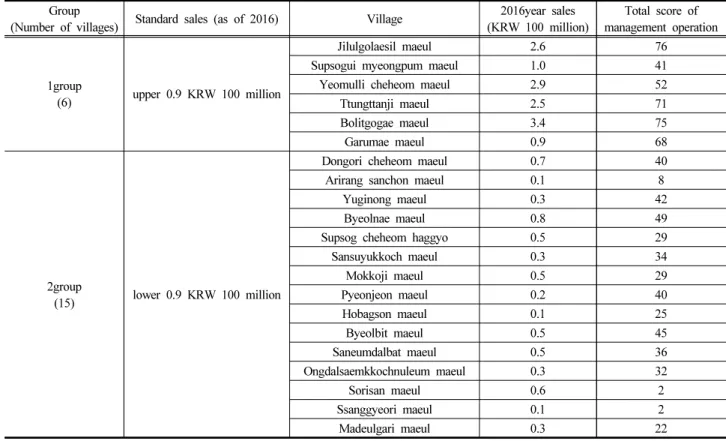
21개 마을의 운영관리 평가결과를 분석하기 위해, 운 영관리 평가항목 중 마을의 수익과 관련하여 유의미한 차이가 나는 항목을 찾고자 하였다. 이에 먼저 2016년 매출액 평균값인 0.9억 원을 기준으로 매출액이 평균 이 상인 1그룹과, 평균 이하인 2그룹으로 나누어서 각 항목 을 대상으로 하여 독립표본 t-검정을 실시하였다.
(Table 3)에서 보는 바와 같이 2016년 기준 매출액이 0.9 억 원 이상인 1그룹 마을은 질울고래실마을, 숲속의명품마 을, 여물리체험마을, 뚱딴지마을, 보릿고개마을, 가루매마 을 6개 마을로 나타났고, 0.9억 원 미만인 2그룹 마을은 동 오리체험마을, 별내마을, 숲속체험학교, 모꼬지마을, 별빛 마을, 산음달밭마을, 소리산마을, 아리랑산촌마을, 유기농 마을, 산수유꽃마을, 편전마을, 호박손마을, 옹달샘꽃누름 마을, 쌍겨리마을, 마들가리마을 15개 마을로 나타났다.
Area Subarea Item
Management base area
Unity of experience
business entity - Items on the type of sub ject of the experience project of the rural experience and recreation village
Agreement on business progress
- Democratic decision-making, which is the basis for sustainable management, and the process of consultation on organizational and decision-making for decision-making - Basic agreement for democratic decision-making, which is the basis of the
cooperative planning theory, and arrangements for it Presence of
influential leaders
- Competency for experience business
- Influence on the village community and ability to solve problems - Present a vision that is feasible and capable of forming a consensus - Establishing goals and strategies to achieve the vision
Management system area
Organize work and divide roles
- Understanding of work for sustainable management and operation - Classification of work
- Separation of role-sharing decision-making and practice for effective and efficient work Separation of
decision-making and practice
- Decision making and responsibility for maximizing work efficiency, practical progress and division of managers Content development and marketing
Content development
and marketing - Marketing 4P Mix Product, Price, Promotion, Place and basic competencies, processes and follow-up management to realize each element
Management
feedback area Securing transparency
and fair distribution - Building and maintaining trust through transparent accounting for sales and profits, agreed standards for disclosure and distribution, and fair treatment
Table 2. Summary of evaluation concepts related to operation management of rural tourism village
Group
(Number of villages) Standard sales (as of 2016) Village 2016year sales
(KRW 100 million) Total score of management operation
1group
(6) upper 0.9 KRW 100 million
Jilulgolaesil maeul 2.6 76
Supsogui myeongpum maeul 1.0 41
Yeomulli cheheom maeul 2.9 52
Ttungttanji maeul 2.5 71
Bolitgogae maeul 3.4 75
Garumae maeul 0.9 68
2group
(15) lower 0.9 KRW 100 million
Dongori cheheom maeul 0.7 40
Arirang sanchon maeul 0.1 8
Yuginong maeul 0.3 42
Byeolnae maeul 0.8 49
Supsog cheheom haggyo 0.5 29
Sansuyukkoch maeul 0.3 34
Mokkoji maeul 0.5 29
Pyeonjeon maeul 0.2 40
Hobagson maeul 0.1 25
Byeolbit maeul 0.5 45
Saneumdalbat maeul 0.5 36
Ongdalsaemkkochnuleum maeul 0.3 32
Sorisan maeul 0.6 2
Ssanggyeori maeul 0.1 2
Madeulgari maeul 0.3 22
Source: Yangpyeong gun internal data, 2016 Table 3. Group categorizing by sales
Item number
Levene’s
Equal variance test T-test for equality of means
F Significance
probability t Degree
of freedom Significance probability
(both sides) Mean
deviation Standard error
95% confidence interval Lower limit Upper limit
2-2 1.036 .321 2.635 19 .016* .567 .215 .117 1.017
2-4 1.246 .278 2.179 19 .042* .467 .214 .019 .915
2-5 130.286 .000 2.854 19 .010* .600 .210 .160 1.040
2-6 4.666 .044 5.940 19 .000** .867 .146 .561 1.172
2-7 . . 3.684 19 .002** .500 .136 .216 .784
2-8 1216.000 .000 2.179 19 .042* .467 .214 .019 .915
2-9 1.036 .321 2.635 19 .016* .567 .215 .117 1.017
2-10 9.819 .005 3.596 19 .002** .600 .167 .251 .949
2-11 9.819 .005 3.596 19 .002** .600 .167 .251 .949
2-19 . . 3.684 19 .002** .500 .136 .216 .784
2-20 1.246 .278 2.179 19 .042* .467 .214 .019 .915
2-21 .118 .735 3.178 19 .005** .633 .199 .216 1.050
2-22 1.246 .278 2.179 19 .042* .467 .214 .019 .915
2-23 1.036 .321 2.635 19 .016* .567 .215 .117 1.017
2-24 1.036 .321 2.635 19 .016* .567 .215 .117 1.017
3-1 130.286 .000 2.854 19 .010* .600 .210 .160 1.040
3-2 .118 .735 3.178 19 .005** .633 .199 .216 1.050
Table 4. Results of independent sample t-test between groups according to sales
Item number
Levene’s
Equal variance test T-test for equality of means
F Significance
probability t Degree
of freedom Significance probability
(both sides) Mean
deviation Standard error
95% confidence interval Lower limit Upper limit
3-3 .136 .716 3.943 19 .001** .700 .178 .328 1.072
3-4 1.246 .278 2.179 19 .042* .467 .214 .019 .915
3-5 9.651 .006 4.660 19 .000** .800 .172 .441 1.159
3-6 1.246 .278 2.179 19 .042* .467 .214 .019 .915
3-7 1216.000 .000 2.179 19 .042* .467 .214 .019 .915
4-2 43.429 .000 3.295 19 .004** .667 .202 .243 1.090
4-5 43.429 .000 3.295 19 .004** .667 .202 .243 1.090
4-6 43.429 .000 3.295 19 .004** .667 .202 .243 1.090
5-1 9.651 .006 4.660 19 .000** .800 .172 .441 1.159
5-2 16.964 .001 8.238 19 .000** .833 .101 .622 1.045
5-3 108.571 .000 5.210 19 .000** .667 .128 .399 .934
6-1 1216.000 .000 2.179 19 .042* .467 .214 .019 .915
6-2 1216.000 .000 2.179 19 .042* .467 .214 .019 .915
6-3 19.499 .000 3.864 19 .001** .733 .190 .336 1.131
6-4 1216.000 .000 2.491 19 .022* .533 .214 .085 .981
6-5 43.429 .000 3.295 19 .004** .667 .202 .243 1.090
6-6 43.429 .000 3.295 19 .004** .667 .202 .243 1.090
6-7 43.429 .000 3.295 19 .004** .667 .202 .243 1.090
6-8 19.499 .000 3.864 19 .001** .733 .190 .336 1.131
6-9 .118 .735 3.178 19 .005** .633 .199 .216 1.050
6-10 130.286 .000 2.854 19 .010* .600 .210 .160 1.040
6-11 1216.000 .000 2.491 19 .022* .533 .214 .085 .981
6-12 1.036 .321 2.635 19 .016* .567 .215 .117 1.017
6-13 1.036 .321 2.635 19 .016* .567 .215 .117 1.017
6-15 1.246 .278 2.179 19 .042* .467 .214 .019 .915
7-2 1216.000 .000 2.491 19 .022* .533 .214 .085 .981
7-5 .136 .716 3.943 19 .001** .700 .178 .328 1.072
7-6 16.383 .001 2.507 19 .021* .433 .173 .072 .795
7-8 3.430 .080 2.748 19 .013* .533 .194 .127 .940
*P < .05, ** P < .01
numberItem Area Item Keyword Detailed evaluation items
2-2
Management base area
Agreement on business progress
Network -Are there more than 3 networks?
2-4 Philosophy -Does your town have a long-term philosophy?
2-5 Goal -Do you have any goals related to village management?
2-6 Strategy -Do you have any strategies related to village management?
2-7 Understanding -Does the operator understand well about the experience project?
2-8 Subject understanding -Does the subject of the experience business understand well about the experience business?
2-9 Agreement -Is there a good agreement on the experience project?
2-10 Resident consent -Is there sufficient consent from the residents in conducting the experience project?
2-11 Residents cooperation -Is the cooperation of residents working well in carrying out the experience project?
Table 5. The derivation of items with significant results from independent sample t-tests, between groups, according to sales
numberItem Area Item Keyword Detailed evaluation items
2-19
Management base area
Agreement on business progress
Common sense -Do you have a common sense of value for the experience project?
2-20 Communication -Is communication about the experience project smooth?
2-21 Perception for
development -Is there a perception that the experience project is conducive to the development of the village?
2-22 Reason for business -Does the subject of the experience business know well about the reason for doing business?
2-23 Understanding about
Business -Does the subject of the experience business well understand what the experience business is?
2-24 Consensus -Is there a consensus on the tasks and roles for operating the experience business?
3-1
The presence or absence of
an influential
leader
Leader -Is there a leader who leads the operation of the experience business?
3-2 Communication skill
of leader -Is it possible for the leader of the experience project operation to communicate smoothly with the village operator?
3-3 Philosophy of Leader -Does the leader of the experience project operator have a clear philosophy?
3-4 Philosophy sympathy -Is it possible for the leader of the experience project operator to form a consensus on philosophy?
3-5 Goal setting -Is it possible for the leader of operator to set goals for the project?
3-6 Goal sympathy -Is it possible for the leader of the experience project operator to form a consensus on the goal?
3-7 Strategy establishment -Is it possible for the leader of the experience project operator to establish a strategy?
4-2
Management system area
Work arrangement
and role division
Manpower -Are there any personnel who can divide the village’s work?
4-5 Experience -Do you have enough knowledge and experience to do your job?
4-6 Enough time to work -Does each person in charge have enough working time to perform the job?
5-1
Decision-making and practice
separation
Practice category -Is there a distinction between the subject for decision-making and the subject?
5-2 Step -Is the meeting procedure for decision-making organized in documents, such as the
articles of incorporation?
5-3 Articles of
village -Are the articles of incorporation for decision-making well organized, reflecting the current situation of the village?
6-1
Content develop ment and marketing
Marketing -Is it possible to perform marketing work to run the experience business?
6-2 Product development -Is it possible to develop a product for operating an experience business?
6-3 Resource identification -Is it possible to develop products by understanding the current situation and resources of the village?
6-4 Price setting -Is it possible to set the price for the experience business operation?
6-5 promotion -Is it possible to conduct promotions for operation of the experience business?
6-6 Place -Is it possible to operate a site of operation for the experience business?
6-7 Sales target -Is it possible to set a sales target, based on capacity and turnover?
6-8 Marketing Manager -Is there a marketing manager to run the experience business?
6-9 Marketing competency -Does the person in charge have enough experience to undertake marketing?
6-10 Product manpower -Do you have any product development manpower to run the experience business?
6-11 Price manpower -Are there personnel who can set the price for the operation of the experience business?
6-12 Facilitating manpowe -Are there personnel who can conduct promotions for the operation of the experience business?
6-13 Place manpower -Are there personnel who can operate a site of operation for the experience business?
6-15 Brand -Is there any brand developed in the village?
7-2
Management feedback area
Securing transparency
and fair distribution
Accounting management -Is accounting management related to the operation of the experience business?
7-5 Profit generation -Are you generating profits through experience and sound operation?
7-6 Distribution -Are the profits being distributed?
7-8 Distribution criteria -Are there agreed standards for the fair distribution of revenue?
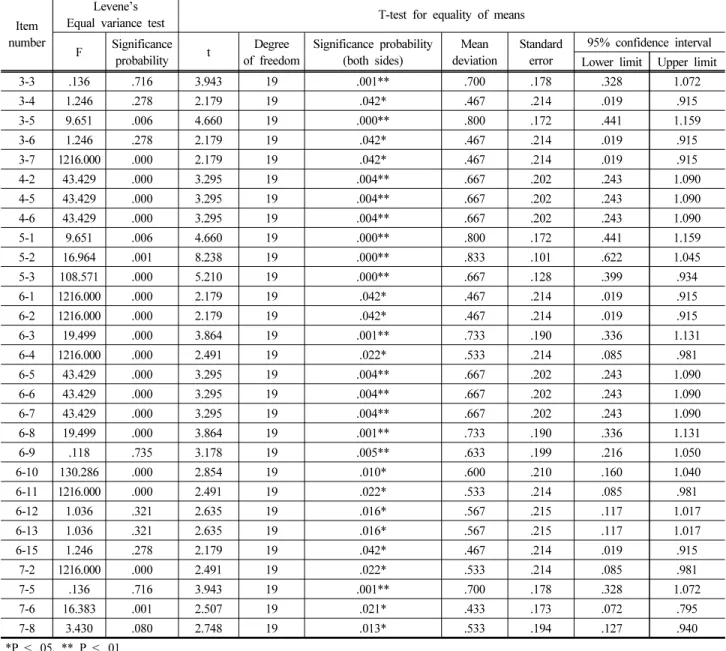
두 그룹 간 독립표본 t-검정에서 95% 신뢰수준에서으로 유의한 평균값 차이를 갖는 항목은 (Table 4), (Table 5)와 같다. 총 85개 세부 평가 항목 중 46개 세부 평가 항목 이 도출되었다. Levene의 등분산 검정은 등분산이 가정 된 값만 표기하였다.
2. 운영관리 평가항목 확정
46개 세부평가 항목은 관리기반영역에서는 사업진행 에 대한 합의(15개)와 영향력 있는 리더 유무 항목(7개) 이 확정되었다. 관리체계영역에서는 업무정리 및 역할분 담(3개), 의사결정과 실무 구분(3개), 컨텐츠 개발 및 마 케팅 항목(14개)의 세부항목이 확정되었다. 관리피드백영 역에서는 투명성 확보와 공정한 분배영역에서 4개 세부 항목이 확정되었다.
두 그룹 간 평균값의 차이가 유의한 46개 세부 평가 항목의 합계 점수와 2016년 매출액과의 영향관계를 보 기 위해 회귀분석을 실시하였으며 결과는 (Table 6)과 같 이 나타났다. 영향관계를 설명하는 수정된 R제곱이 0.632로 나타났으며, 유의한 것으로 확인되었다.
3. 운영관리 평가에 따른 유형분류
도출된 46개 운영관리 세부 평가항목 중 관리기반영 역 합계 점수와 관리체계영역 합계 점수에 근거하여 4개 의 유형으로 구분하였다. 관리기반영역의 합계 평균은 8.6점이고, 관리체계영역의 합계 평균은 9.7점이었다. 유 형분류에 있어 관리 피드백 영역을 제외시킨 것은 두 집 단의 해당 항목은 유의미한 차이가 있는 것으로 나타났 지만 매출액이 높은 집단에서도 거의 ‘아니오’로 응답하 여 사실상 두 집단 간 실직적은 차이가 있다고 보기 어 려워 유형화 기준에서는 제외하였다.
(Figure 2)와 같이 관리기반영역과 관리체계영역 각각 의 합계 평균을 기준으로 관리기반영역과 관리체계영역 의 합계가 모두 평균보다 높게 나타난 마을들은 유형 I 로, 관리기반영역의 합계 점수는 평균 보다 낮지만 관리 체계영역의 합계 점수는 평균보다 높은 마을들은 유형 II로, 관리기반영역의 합계는 평균보다 높지만, 관리체계 영역의 합계는 평균보다 낮은 마을들은 유형 III으로, 관 리기반영역과 관리체계영역 두 영역 모두 합계가 평균보 다 낮은 마을들은 유형 IV로 분류하였다.
Figure 2. Type classification according to the evaluation result of management and operation of the Rural Tourism Villages
Item Beta t p
Total score for items that have a significant correlation with sales .054 5.951 .000**
Regression model fit Modified R square = .632, F=35.410, p=.000**
*P < .05, ** P < .01
Table 6. Regression analysis result between management operation evaluation result and sales according to independent sample t-test result (n=21)
유형 I은 질울고래실마을, 보릿고개마을, 여물리체험마 을, 뚱딴지마을, 보릿고개마을, 가루매마을 6개 마을, 유 형 II는 유기농마을, 숲속의명품마을, 모꼬지마을, 별빛마 을, 마들가리마을 5개 마을, 유형 III은 편전마을과 산음 달밭마을 2개 마을, 유형 IV는 동오리체험마을, 숲속체험 학교, 소리산마을, 아리랑산촌마을, 산수유꽃마을, 호박손마 을, 옹달샘꽃누름마을, 쌍겨리마을 8개 마을로 분류되었다.
유형 I은 대체적으로 매출액도 높고 안정화된 마을들, 유형 II는 시작한 지 일정시간은 지났지만 안정화되지
못한 마을들, 유형 III은 신규마을들, 유형 IV는 시작한 지 오래되어 한 때 성장했다가 쇠퇴한 마을들과 신규마 을들로 구성되었다.
4. 유형별 현황 분석
(Table 7)에서 보는 바와 같이 유형 I의 질울고래실마 을, 여물리체험마을, 뚱딴지마을, 보릿고개마을, 별내마 을, 가루매마을은 운영기간이 평균 5년으로 비교적 체험
Type (Number
of villages) village Designated year
operating period (years)
sales (2015, KRW 100
million)
sales (2016, KRW 100
million)
Increase or decrease in sales(KRW 100 million)
Management base area
score
Management system area
score
Total score
Type I (6)
Jilulgolaesil maeul 2011 6 2.6 2.6 0 22 20 42
Yeomulli cheheom
maeul 2012 5 3.4 2.9 - 0.5 14 15 29
Ttungttanji maeul 2012 5 3.4 2.5 - 1.1 20 20 40
Bolitgogae maeul 2015 2 3.3 3.4 + 0.1 22 20 42
Byeolnae maeul 2013 4 1.0 0.8 - 0.2 10 16 26
Garumae maeul 2009 8 1.6 0.9 - 0.7 20 20 40
Average - 5 2.6 2.2 - 14 18 18.5 36.5
Type II (5)
Supsogui
myeongpum maeul 2013 4 1.1 1.0 - 0.1 7 17 24
Mokkoji maeul 2011 6 2.4 0.5 - 1.9 5 10 15
Byeolbit maeul 2015 2 0.4 0.5 + 0.1 7 15 22
Yuginong maeul 2012 5 0.5 0.3 - 0.2 8 10 18
Madeulgari maeul 2011 6 0.1 0.3 + 0.2 1 10 11
Average - 4.6 0.9 0.5 - 42 5.6 12.4 18
Type III (2)
Pyeonjeon maeul 2015 2 0.1 0.2 + 0.1 11 4 15
Saneumdalbat maeul 2015 2 0.0 0.5 + 0.5 9 4 13
Average - 2 0.05 0.35 + 700 10 4 14
Type IV (8)
Dongori cheheom
maeul 2012 5 1.2 0.7 - 0.5 6 5 11
Supsog cheheom
haggyo 2012 5 0.2 0.5 + 0.3 5 3 8
Sorisan maeul 2013 4 0.8 0.6 - 0.2 0 0 0
Arirang sanchon
maeul 2013 4 0.1 0.1 0 0 0 0
Sansuyukkoch maeul 2013 4 0.3 0.3 0 6 6 12
Hobagson maeul 2016 1 - 0.1 0 2 1 3
Ongdalsaemkkochnul
eum maeul 2013 4 0.7 0.3 - 0.4 4 7 11
Ssanggyeori maeul 2011 6 0.6 0.1 - 0.5 0 0 0
Average - 4.1 0.49 0.34 - 30 2.9 2.8 5.6
Table 7. Status of Yang-pyeong 21 rural tourism villages by Type
사업을 시작한지 오래된 마을들이다. 2015년 평균 매출 액은 2.6억 원, 2016년 평균 매출액은 2.2억으로 14% 감 소하였다. 관리기반영역 평균점수는 18점, 관리체계영역 평균은 18.5점으로 다른 유형에 비해서 높은 평균 점수 를 나타내었다. 유형 I의 질울고래실마을 여물리체험마 을, 뚱딴지마을, 보릿고개마을 4개 마을은 2016년 기준 매출액 2억 원 이상으로 안정화에 진입한 마을로 매출액 증대를 위한 홍보ㆍ마케팅 역량 강화가 요구되는 마을 이라고 할 수 있다.
유형 II의 숲속의명품마을, 모꼬지마을, 별빛마을, 유 기농마을, 마들가리마을 또한 운영기간은 평균 4.6년으로 비교적 체험사업을 시작한지 오래된 마을들이다. 2015년 평균 매출액은 0.9억 원, 2016년 평균 매출액은 0.52억으 로 42% 감소하였다. 관리기반영역 평균점수는 5.6점, 관 리체계영역 평균은 12.4점으로 관리기반영역의 점수가 낮고, 관리체계영역의 평균은 높게 나타났다. 유형 II의 5개 마을 중 숲속의명품마을, 모꼬지마을, 마들가리마을 3개 마을은 사업 초기 어느 정도 성장하였으나 갈등이 유발되어 운영에 어려움을 겪고 있는 마을이다.
유형 III의 편전마을과 산음달밭마을은 운영기간이 평 균 2년으로 체험사업을 시작한지 얼마 되지 않은 마을들 이다. 2015년 평균 매출액은 0.05억 원, 2016년 평균 매 출액은 0.35억으로 700% 증가하였다. 관리기반영역 평균 점수는 10점, 관리체계영역 평균은 4점으로 관리기반영 역 평균에 비해 관리체계영역 평균이 낮게 나타났다. 유 형 III의 마을들은 체험사업을 시작한 지 얼마 되지 않아 사업 체계화에 대한 과제가 많은 마을들이다.
유형 IV의 동오리체험마을, 숲속체험학교, 소리산마을, 아리랑산촌마을, 산수유꽃마을, 호박손마을, 옹달샘꽃누 름마을, 쌍겨리마을은 운영기간이 평균 4.1년으로 비교적 체험사업을 시작한지 오래된 마을들이다. 2015년 평균 매출액은 0.49억 원, 2016년 평균 매출액은 0.34억으로 30% 감소하였다. 관리기반영역 평균점수는 2.9점, 관리 체계영역 평균은 2.8점으로 관리기반과 관리체계 두 영 역 모두에서 낮은 평균으로 나타났다. 두 영역에서 모두 0점을 받은 소리산마을, 아리랑산촌마을, 쌍겨리마을 세 마을을 제외한 평균도 관리기반영역 평균 4.6점, 관리체 계영역 4.4점으로 역시 낮게 평가된 것으로 나타났다. 신 규마을인 호박손마을을 제외하면 대부분 마을은 체험사 업을 시작한 지 어느 정도 경과된 마을들로 운영관리상 성장의 한계점에서 고착화되고 있는 마을과 오히려 쇠퇴 기로 접어든 마을들도 있다.
5. 유형별 시사점
유형 I의 경우 평균 운영기간이 5년에, 평균매출액이 2억 이상 되며 관리기반영역과 관리체계영역에서 모두 우수한 관리현황을 나타내고 있다. 유형 I은 안정화 단 계에 진입했다고 할 수 있으며, 관리기반영역과 관리체 계영역에서 우수한 결과를 보이고 있으므로 앞으로의 지 속가능한 발전을 위해서는 다음 단계인 관리피드백영역 의 관리 시스템의 도입 및 전문 담당 인력 배치, 투명하 고 공정한 분배 확립 등이 요구된다.
유형 II의 경우 평균 운영기간이 4.6년에 2016년 매출 액 평균이 0.5억 원으로 다른 세 유형에 비해 매출액 감 소도 가장 큰 폭으로 나타나고 있으며 평균 운영기간에 비해 관리기반영역 평균 점수가 현저히 낮았다. 이는 유 형 II의 경우 사업 초기 관리기반 영역이 충족되어 관리 체계영역의 역량을 갖추었으나 이후 운영관리 과정에서 마을의 갈등을 비롯한 다양한 원인들로 인해 관리기반영 역이 약해지거나, 관리체계영역이 정상화 되지 못한 것 으로 판단된다. 유형 II는 고착화 또는 갈등 발생 단계로 관리기반영역이 붕괴되어 갈등 해소와 영향력 있는 리더 의 역할 회복이 절실하다. 체험마을사업을 왜 해야 하는 지에 대한 교육 및 정책지원이 필요하다. 이 경우 마을 구성원들과 충분한 시간을 두고 처음부터 다시 시작할 것인지, 체험사업을 중단할 것인지에 대해 고민해야 한다.
유형 III의 경우 평균 운영기간이 2년에 2016년 평균 매출액이 0.35억 원으로 총액은 다른 유형에 비해서 많 지 않지만 2015년에 비해 성장세를 보이고 있으며, 관리 기반영역이 우수하게 평가되어 관리체계영역 역량이 강 화될 경우 매출 증대로 이어질 수 있는 가능성이 있다.
유형 III은 신규마을(경험부족) 단계로 시작하는 단계이 므로 상품개발 및 영업활동을 할 수 있는 지원이 필요하다.
유형 IV의 경우 유형 II에 비해 관리기반영역과 관리 체계영역이 더 악화된 경우와 아직 관리운영 역량을 갖 추지 못한 경우, 체험사업이 마을의 공동 사업으로 원활 히 발전되지 못한 경우 등으로 볼 수 있다. 유형 IV는 특이하게도 유형 내에서 다시 신규마을 또는 침체기 및 쇠퇴기 단계로 구분될 수 있는데 신규마을을 제외한 중 간 단계의 마을과 쇠퇴기에 있는 마을의 경우 체험사업 을 중단하던지, 마을 사업으로써의 체험사업이 아닌 농 가나 개별 사업체 단위로 전환하던지 그마저도 결정이 어렵다면 안식년을 두어 체험사업을 해야 하는 당위성을 찾고, 공감대를 형성하는 과정이 필요하다.
IV. 결 론
본 연구는 운영관리 평가를 통해 농촌체험휴양마을 운영위원회가 발전방향 설정, 운영계획 수립 등에 있어 각 마을의 현황과 역량을 고려하여 적합한 기준을 적용 함으로써 효과적이고, 효율적으로 운영관리하고, 그 결과 로 지속가능성을 확보할 수 있도록 하는데 있어 학문적 근거를 제공하고자 하였다.
실제로 조사과정에서 나타난 결과는 마을공동체의 구성 원들이 사업 초기에 동참한 인원과 사업이 진행되는 과정, 그리고 몇 년이 지나는 동안 감소되거나 바뀌는 경우가 많은 것으로 나타났다. 정부사업 초기에는 사업에 대한 막 연한 기대감과 정부 지원의 충족 기준 때문에 외형상 기 준은 충족하지만 이후 사업이 진행되는 과정에서 ‘마을’과
‘공동체’라는 명목만 남고, 실제로는 ‘공동체’를 대표하지 못하고 소수 인원에 의해 운영되는 경우가 많았다.
1995년 농어촌정비법에 따른 농촌개발 사업이 시작된 지 26년이 지났다. 그동안 수없이 많은 농촌을 대상으로, 수없이 많은 사업이 진행되었다. 아쉽게도 사업이 종료 된 이후 지속적으로 이어지지 못한 경우가 많고, 대부분 은 운영관리에서 나타난 문제점들에 기인한다. 이에 본 연구에서는 농촌사업 중 하나인 농촌체험휴양마을 사업 에 있어 운영관리를 평가하기 위한 항목을 도출해 보고 평가를 해 보았다.
국내 농촌체험휴양마을의 평가가 더 실천적이고 현장 을 반영하기 위해서는 운영관리 ‘과정’에서 각 마을이 접하는 어려움과 이에 적응하는 과정에 대한 고려가 더 필요하다. 또한 각 마을의 단계에 맞는 평가와 이에 따 른 차별적 관리방안이 요구된다.
마지막으로 본 연구의 한계점은 운영관리 평가 지표 개발에 있어 현재까지와 다른 접근 방법을 취하면서 현 장기반의 인터뷰를 주로 수행하여, 연구자의 주관이 많 이 포함되었다는 점이다. 후속 연구에서는 전문가와 복 수의 마을 운영진을 대상으로 한 설문조사 및 AHP 분석 등을 통해서 보다 정량적인 관점에서, 본 연구의 주제를 뒷받침하는 연구가 더 필요하다고 하겠다.
Reference
1. Cho, J. H., Shim, J. S., Kim, Y. K. 2008. The Study of Reasons and Patterns of Conflict in the Agricultural Experience Villages. The Journal of Rural Society 18(1):
91-125.
2. Han, K. S., Kim, K. H., Jun, T. K., Um, D.H., Choi, Y.S. 2007. Development of An Evaluation System for the Interim Check of Integrated Rural Village Development Project. Journal of Agricultural Extension & Community Development 13(2): 121-132.
3. Kim, D. S., Choi, H. S. 2007. Development of Green- Tourism Potential Evaluation Method for Rural Villages Considering Amenity and Human Resources. Journal of The Korean Society Of Rural Planning 13(2): 7-16.
4. Kim, N. J., Moon, S. M. 2007. 2. Kim, Y. T., Choi, S.M., Kim, H.G., Im, S.B. 2014. Journal of Tourism Sciences 31(3): 97-116.
5. Kim, Y. T., Choi, S. M., Kim, H. G., Im, S.B. 2014a.
Development of Evaluation Indicators System by Rural Village Types. Journal of the Korean Society of Rural Planning 20(1): 37-49.
6. Kim, Y. T., Choi, S. M., Kim, H. G., Im, S.B. 2014b.
An Analysis of Importance Weight of Evaluation Indicators for Classification of Rural Village. Journal of the Korean Society of Rural Planning 20(3): 121-130.
7. Na, R. H., Yoon, Y. C., Kim, Y. J. 2010. Accomplishment Analysis of the Rural Traditional Theme Village by AHP Method. Journal of Agriculture & Life Science 44(4): 57-68.
8. Son, J. Y. 2014. A Study on the Activation of Green Tourism by the “Rural Experience and Recreation Village Business”. International Journal of Tourism and Hospitality Research 28(11): 95-107.
9. Park, S. H. 2013. Development direction of rural tourism for the 6th industrialization of rural areas. KREI.
10. Yangpyeong gun 2016. internal data about visitors and sales of rural tourism villages in yangpyeong gun.
11. Youn, J., Choi, S. D. 2013. Impact of Social Capital on Community-Based Tourism Development Performance:
Focused on Green Rural Tourism Village. Journal of Tourism Sciences 37(4): 77-96.
12. Yoon, S. D., Lee, S. M., Lim, K. H., Choi, J. U., Jeong, M. C., Rhee, S. Y., Kim, M. H., Hong, S. Y.
2016. Preference of Experience Program among Visitors to Social Enterprises in the Rural: Focused on Social Enterprises using Traditional Resources. The Korean Society of International Agriculture 28(3): 325-334.
Received 12 February 2021
First Revised 24 February 2021
Finally Revised 20 April 2021
Accepted 21 April 2021