Adaptation Study of Rice Cultivation in Gangwon Province to Climate Change
Youngho Seo
1*, Ansoo Lee
1, Byoungouk Cho
1, Anseok Kang
1, Byeongchan Jeong
1and Yeongsang Jung
21
Gangwon Agricultural Research & Extension Services, Udu-dong 402, Chuncheon, Gangwon-do 200-150, Korea
2
Kangwon National University, Chuncheon, Gangwon-do 200-701, Korea (Received June 14, 2010; Revised June 26, 2010; Accepted June 28, 2010)
기후변화에 대한 강원지역 벼 재배의 적응
서영호
1*·이안수
1·조병욱
1·강안석
1·정병찬
1·정영상
21
강원도농업기술원,
2강원대학교
(2010년 6월 14일 접수; 2010년 6월 26일 수정; 2010년 6월 28일 수락)
ABSTRACT
The impact of climate change on rice plants in Gangwon province was examined by comparing the climatic conditions during the recent 10 years (2000~2009) with those of normal (1971~2000) years, and by evaluating the rice plant responses. The daily mean air temperature increased by 0.5
oC while the daily range decreased by 0.1
oC as compared with the normal years. During the main rice growing period in field (from June to September) precipitation increased from 900 to 1,051mm and sunshine hours decreased from 704 to 619 hours. The respiration consumption effect during the rice growing period increased by 0.07 as a result of increased air temperature and reduced sunshine hours. The optimum heading date (determined by the mean air temperature for 40 days after the heading) was delayed in Chuncheon, Hongcheon, Wonju, and Gangneung compared with the normal. The maximum climatic yield potential based on mean temperature and sunshine hours for 40 days after the rice heading decreased by 94 kg/10a mainly due to the decrease in sunshine. The mean air temperature for 40 days after the rice heading from 1999 to 2009 in Chuncheon, Cheorwon, and Gangneung was generally above 22
oC, implying that yield and quality of rice can be reduced. Therefore, it is necessary to delay the heading date by planting mid- to late- maturing varieties or by changing the transplanting date in order to produce high quality rice and to maintain rice productivity. In addition, it is also important to develop or select cultivars suitable to changing climate for each region in Gangwon province.
Key words : Climate change, Rice, Gangwon province, Heading date
I. INTRODUCTION
Since the growth and yield of crops are determined by genetic characteristics, environment, and manage- ment, understanding of climate variability in a region is necessary for crop adaptation. Especially, the tempera- ture anomaly analysis is known to be a crucial factor in
tracing productivity of rice in Japan and Korea (Hayashi et al ., 1999; Hayashi, 2000).
In Korea, the mean air temperature has increased about 1.5
oC since 1904. The minimum air temperature in winter has clearly increased, and the daily tempera- ture range has been reduced due to comparatively large increase in minimum temperature (Kwon, 2003). Choi
* Corresponding Author: Youngho Seo ([email protected])
and Yun (2009) reported that the maximum tempera- ture in summer (June to August) from 1983 to 2007 was greater than the 30-year normal (1971~2000) by 0.1
oC because of the increased solar irradiance caused by decreased aerosol concentration including sulfur dioxide and increased atmospheric transmittance. Pre- cipitation has increased in the high latitude region of Northern hemisphere where air temperature has increased.
In Korea, the annual precipitation has been generally increasing, especially in recent 20 years (Kwon, 2003).
Rainfall intensity (determined by the total precipitation divided by the days of precipitation) also increased, especially in summer. We have more rainfall events greater than 50 mm d
−1compared to the past (Kwon, 2003).
The increase in temperature may have positive impacts such as extended crop growing season. On the other hand, rice can become deteriorated in terms of yield and quality due to the higher temperature during the grain filling period than the optimum range. The opti- mum mean air temperature at the ripening stage (i.e., 40 days after rice heading) for a high yield of Japonica type rice ranged from 21 to 23
oC with the maximum yield at 22
oC, and rice yield can decrease at a rate of 5% per 1
oC increase (Yun and Lee, 2001). For high quality rice, the mean air temperature for 40 days after heading should range from 20 to 22
oC (RDA, 2004).
Respiration of rice can be accelerated and therefore the production of carbohydrate can be reduced by the increase in temperature and decrease in solar irradia- tion. Climatic yield potential is determined by the mean air temperature and sunshine hours for 40days after the rice heading (Tsuboy, 1977), and meteorological pro- ductivity is determined by the mean air temperature and sunshine hours from 10 days before heading to 30days after heading and the number of spikelets per m
2(Lee et al ., 1988). Therefore, it can be inferred that rice yield increases with the increase in sunshine and decreases with the increase in the difference from the optimum mean air temperature. Accumulation of car- bon assimilation products is influenced by daily tem- perature range in early grain filling period. Kim et al . (2002) concluded that the yield prediction model using boundary line analysis based on mean air temperature, sunshine hours, and daily temperature range could be used to predict the yield responses to meteorological conditions during rice growing period. Son et al . (2002) reported that daily temperature range at ripening stage had a greater impact on rice yield in Gyeongnam prov-
ince than sunshine hours and mean air temperature, while sunshine hours more important than temperature in Jeonbuk province.
Climate change is important for rice growing man- agement due to its impact on the rice heading date and rice yield by affecting growth and development of rice and grain filling at ripening stage. This study was con- ducted to provide information for countermeasure to climate change impact on rice cultivation in Gangwon province by examining the climate condition during recent 10 years, from 2000 to 2009, as compared with the normal, 1971~2000, especially during rice heading and ripening stage and by analyzing the possible impact of climate change on rice cultivation.
II. MATERIALS AND METHODS Weather data (including mean air temperature, maxi- mum temperature, minimum temperature, daily tem- perature range, sunshine hours, and annual precipitation) were obtained from nine synoptic meteorological sta- tions in Gangwon province. Agricultural land in Gang- won province is classified to five zones: Northern inland region such as Chuncheon, Cheorwon, Hwacheon, and Yanggu, Southern inland region such as Wonju, Hongcheon, Hoengsung, and Younghwol, Alpine high- land including Inje, Pyoungchang, Jeongsun, and Tae- baek, Northern coast including Sokcho, Gosung, and Yangyang, and Southern coast including Gangneung, Donghae, and Samcheok. Northern inland has basin topography with large daily temperature range and fre- quent fog. Southern inland has relatively long spring and autumn and site-specific sudden weather change.
Alpine highland has cool summer and heavy fog and snow. Northern coast is characterized by relatively warm winter, long frost-free period, and cool wind from the sea. Southern coast has warm winter, long frost-free period, and strong wind in spring. Northern inland including Cheorwon has 38% of the total paddy rice field in Gangwon province, 43,869 ha in 2009, fol- lowed by 31% of Southern inland including Wonju and Hongcheon.
In order to examine the climate change impact on rice
cultivation, climate data during the major rice growing
period in field (from June to September) for recent
10years were compared with the normal in addition to
a whole year comparison. Respiration consumption
effect (RCE) was determined using mean air tempera-
ture and sunshine hours from June to September (Son
et al ., 2002).
RCE = 10 0.0301(Mean air temperature-10) /(sunshine hours) (1) Proper heading date was determined by mean air temperature at ripening stage (i.e., 40 days after rice heading) based on optimum temperature range, from 20 to 22 o C, for high quality rice production. Climatic yield potential (CYP) in kg/10a was determined using mean air temperature and total sunshine hours for 40 days after rice heading (Tsuboy, 1977).
CYP = 4.14·(sunshine hours) - 0.13·
(21.4-mean air temperature) 2 (2) Actual rice heading date and mean air temperature for 40days after heading were obtained from the results of rice regional adaptability trial in Chuncheon, Cheo- rwon, Gangneung, and Jinbu from 1999 to 2009.
III. RESULTS AND DISCUSSION
3.1. Climate change pattern in Gangwon prov- ince
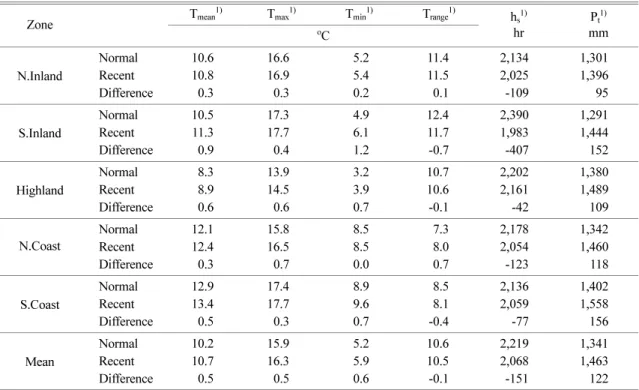
In Gangwon province, mean air temperature from 2000 to 2009 rose to 10.7 o C which is 0.5 o C higher than
the normal (1971~2000) (Table 1). Daily temperature range reduced by 0.1 o C, sunshine hours decreased by 151 hours, and annual precipitation increased by 122mm.
The increase in mean temperature and precipitation and decrease in daily range and precipitation are consistent with the climate change pattern observed in the whole country (Kwon, 2003). Kim et al. (2007) reported that mean air temperature from 1996 to 2005 in the south- eastern part of Korea rose by 0.3 o C, daily range reduced by 0.2 o C, precipitation increased by 188mm, and sunshine hours reduced by 83 hours compared with normal climate. The clearest anomaly was shown in the southern inland area of Gangwon province, i.e., increases in mean air temperature by 0.9 o C and precip- itation by 152 mm and reductions of daily range by 0.7 o C and sunshine hours by 407 hours.
During the major rice growing period in field (from June to September) mean air temperature for the recent 10 years rose to 21.3 o C (0.4 o C higher than normal years) and daily temperature range reduced to 9.0 o C (0.2 o C lower), similar to the climate change pattern for the whole year (Table 2). Increase in temperature may result in reduction of rice yield due to decreased carbo- hydrate accumulation by enhanced respiration and
Table 1.
Recent (2000~2009) climatic characteristics compared with normal (1971~2000) in Gangwon provinceZone Tmean1) Tmax1) Tmin1) Trange1) hs1)
hr Pt1)
mm
oC
N.Inland Normal 10.6 16.6 5.2 11.4 2,134 1,301
Recent 10.8 16.9 5.4 11.5 2,025 1,396
Difference 0.3 0.3 0.2 0.1 -109 95
S.Inland Normal 10.5 17.3 4.9 12.4 2,390 1,291
Recent 11.3 17.7 6.1 11.7 1,983 1,444
Difference 0.9 0.4 1.2 -0.7 -407 152
Highland Normal 8.3 13.9 3.2 10.7 2,202 1,380
Recent 8.9 14.5 3.9 10.6 2,161 1,489
Difference 0.6 0.6 0.7 -0.1 -42 109
N.Coast Normal 12.1 15.8 8.5 7.3 2,178 1,342
Recent 12.4 16.5 8.5 8.0 2,054 1,460
Difference 0.3 0.7 0.0 0.7 -123 118
S.Coast Normal 12.9 17.4 8.9 8.5 2,136 1,402
Recent 13.4 17.7 9.6 8.1 2,059 1,558
Difference 0.5 0.3 0.7 -0.4 -77 156
Mean Normal 10.2 15.9 5.2 10.6 2,219 1,341
Recent 10.7 16.3 5.9 10.5 2,068 1,463
Difference 0.5 0.5 0.6 -0.1 -151 122
1)Tmean; Daily mean air temperature, Tmax; Maximum air temperature, Tmin; Minimum air temperature, Trange; Daily range of air temperature, hs; sunshine hours, Pt; total precipitation
shortened vegetative growth period by earlier flowering and heading (Park et al ., 2006). One of the reasons for less rice yield in the subtropical zones than in the tem- perate zones is the lower dry matter production due to shorter growing period (Ying et al ., 1998). Sunshine hours for the four months decreased by 86 hours, cor- responding to 57% of the decrease for the whole year.
Precipitation increased by 151mm which is higher than the increase for the whole year, indicating reduced pre- cipitation in the remaining eight months compared with the normal. Kim et al. (2007) reported a clear decrease in sunshine hours in August and critical increase in pre- cipitation in August and September in south-eastern part of Korea. Similar to climate change for the whole year, the clearest change during the main rice growing period was observed in southern inland area of Gang- won province; rise of mean temperature by 0.6
oC and precipitation by 173 mm and reduction of daily range by 0.6
oC and sunshine hours by 212 hours.
3.2. Impact of climate change on rice cultivation
Respiration consumption coefficient, an indicator of
dry matter increment by increase in sunshine hours and respiration acceleration at high temperature, during recent 10years increased to 0.46 which is greater than normal years by 0.07 (Table 3). The increment in res- piration consumption coefficient was greatest in July, just before rice heading. High temperature and shortage of solar irradiation before heading can cause decreased carbohydrate accumulation in grain due to reduced photosynthesis and enhanced respiration consumption (Yun and Lee, 2001), resulting in negative impact on rice yield and quality. The prolonged poor weather con- ditions in terms of rice cultivation after heading can cause plant lodging through over-allocation of carbohy- drates to grains in addition to reduced yield by ham- pered photosynthesis (Cock and Yoshida, 1972). The greatest increment in respiration consumption coeffi- cient in Gangwon province was 0.17 in the southern inland area with clear rise in temperature and reduction of sunshine hour, while the least was 0.02 for the high- land region.
Table 4 shows the proper heading period for high quality rice production in Gangwon province deter-
Table 2.
Recent (2000~2009) climatic characteristics during rice growing period (Jun.~Sep.) compared with normal (1971~2000) in Gangwon provinceZone Tmean1) Tmax1) Tmin1) Trange1) hs1)
hr Pt1)
mm
oC
N.Inland Normal 22.0 27.4 17.7 9.7 709 932
Recent 22.2 27.5 17.9 9.6 610 1,051
Difference 0.1 0.1 0.2 -0.1 -99 120
S.Inland Normal 22.1 28.2 17.5 10.7 819 910
Recent 22.6 28.3 18.2 10.1 607 1,083
Difference 0.6 0.1 0.7 -0.6 -212 173
Highland Normal 18.9 24.0 14.6 9.4 674 926
Recent 19.3 24.4 15.3 9.1 654 1,058
Difference 0.5 0.4 0.7 -0.3 -20 132
N.Coast Normal 21.3 24.5 18.4 6.1 634 823
Recent 21.5 25.3 18.4 6.9 599 980
Difference 0.2 0.8 0.0 0.8 -35 156
S.Coast Normal 22.3 26.3 18.8 7.5 628 814
Recent 22.6 26.5 19.4 7.1 574 1,039
Difference 0.3 0.2 0.6 -0.4 -54 225
Mean Normal 20.9 26.0 16.8 9.2 704 900
Recent 21.3 26.3 17.3 9.0 619 1,051
Difference 0.4 0.3 0.5 -0.2 -86 151
1)Tmean; Daily mean air temperature, Tmax; Maximum air temperature, Tmin; Minimum air temperature, Trange; Daily range of air temperature, hs; sunshine hours, Pt; total precipitation
mined by the mean air temperature for 40 days after heading. The length of proper heading period in Gang- won province was 12 days for Chuncheon and 16 days for Sokcho, and increased by up to 3 days compared with the normal data. For instance, the proper heading period in Cheorwon was 13 days between 7 and 19 August in 2000~2009 compared with 10days for the normal. The first date of the proper heading period ranged from 5 August in Inje to 16 August in Wonju for the recent climate conditions, which was delayed by 1 to 3days in Chuncheon, Hongcheon, Wonju, and Gangneung compared with the normal. The proper heading period for Taebaek and Daegwallyeong ended before 2 August, implying that only early maturing cul- tivars can be cultivated in this region.
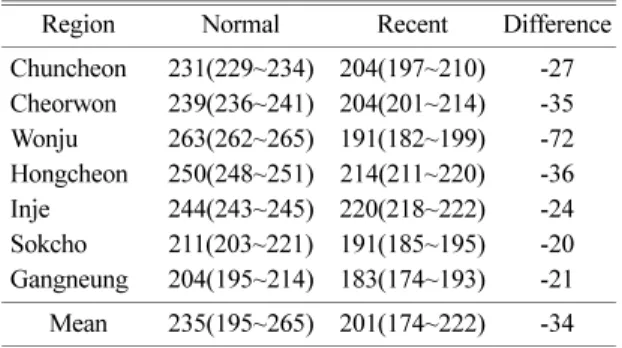
Sunshine hours for 40 days after rice heading based on the proper heading date are shown in Table 5. Sun- shine hours decreased from 235 hours for the normal to 201hours in recent years, which is less than 255 hours for the period from 1961 to 1990 in Korea (Yun and Lee, 2001). The reduction of sunshine hours was great- est in Wonju with 72 hours. The sunshine hours at rip- ening stage for the recent 10 years ranged from 183 to 220 hours in Gangwon province, which is less than that for Youngnam from 1996 to 2005 being 185~241 hours (Kim et al ., 2007). Insufficient solar irradiation at rip-
Table 3.
Respiration consumption effect during rice growing period (Jun.~Sep.) in recent (2000~2009) as compared with nor- mal (1971~2000)Zone Jun. Jul. Aug. Sep. Avg.
N.Inland Normal 0.34 0.54 0.47 0.30 0.41
Recent 0.39 0.70 0.55 0.36 0.50
Difference 0.05 0.16 0.08 0.06 0.09
S.Inland Normal 0.29 0.43 0.41 0.28 0.35
Recent 0.41 0.71 0.58 0.38 0.52
Difference 0.12 0.28 0.17 0.10 0.17
Highland Normal 0.27 0.44 0.43 0.28 0.36
Recent 0.28 0.47 0.45 0.32 0.38
Difference 0.01 0.03 0.02 0.04 0.02
N.Coast Normal 0.36 0.51 0.52 0.35 0.43
Recent 0.36 0.59 0.53 0.40 0.47
Difference 0.00 0.08 0.01 0.05 0.04
S.Coast Normal 0.39 0.56 0.55 0.38 0.47
Recent 0.41 0.66 0.62 0.43 0.53
Difference 0.02 0.10 0.07 0.05 0.06
Mean Normal 0.31 0.48 0.46 0.30 0.39
Recent 0.36 0.61 0.53 0.36 0.46
Difference 0.05 0.13 0.07 0.06 0.07
Table 4.
Optimum heading period for high quality rice in Gangwon provinceRegion FDMT
22oC1) FDMT
20oC1) Period (Days) Chuncheon Normal Aug. 12 Aug. 21 10
Recent Aug. 14 Aug. 25 12 Cheorwon Normal Aug. 10 Aug. 19 10 Recent Aug. 7 Aug. 19 13
Wonju Normal Aug. 13 Aug. 22 10
Recent Aug. 16 Aug. 27 12 Hongcheon Normal Aug. 10 Aug. 19 10 Recent Aug. 11 Aug. 22 12
Inje Normal Aug. 5 Aug. 16 12
Recent Aug. 5 Aug. 18 14
Taebaek Normal - Aug. 3 -
Recent - Aug. 2 -
Daegwallyeong Normal - - -
Recent - Jul. 21 -
Sokcho Normal Aug. 11 Aug. 25 15
Recent Aug. 11 Aug. 26 16 Gangneung Normal Aug. 14 Aug. 28 15 Recent Aug. 15 Aug. 29 15
1)FDMT22oC and FDMT20oC; First date for mean air tem- perature of 22oC and 20oC for 40 days after flowering, respec- tively.
ening stage can increase milky white or immature opaque rice. In addition, since shading treatment at the ripening stage enhances the protein content in rice grains (Guh et al ., 2003), the lack of sunshine may reduce palatability. Park (2008) reported increased 1000 grain weight with increasing sunshine hours for 30 days after rice heading and reduced protein content in grain with greater daily temperature range. For Inje, the sunshine hours at ripening stage was 220 hours, greater than those for other seven regions in Gangwon province.
Climatic yield potential decreased due to temperature rise and the reduction of sunshine hours during the rip- ening stage (Table 6). Maximum climatic yield poten- tial in Gangwon province was 817 kg/10a in the recent climate, less than the normal with 913 kg/10a. Espe- cially in Wonju, the climatic yield potential decreased by 290 kg probably due to the greatest reduction of sunshine in Gangwon province. On the other hand,
maximum climatic yield potential for Taebaek in high- land regions increased because of the increase in tem- perature to proper range and a little decrease in sunshine hours at ripening stage.
3.3. Mean air temperature at ripening stage in Gangwon province
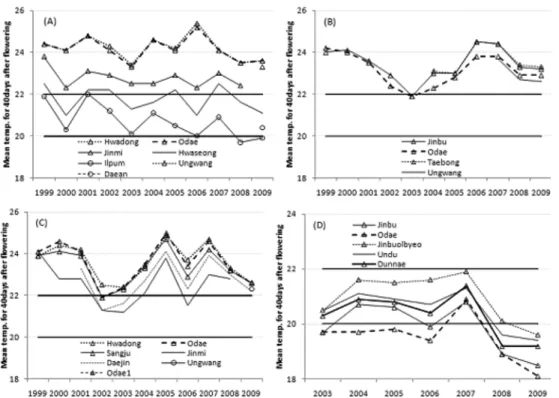
The actual mean air temperature at ripening stage in Chuncheon, Cheorwon, Gangneung, and Jinbu from 1999 to 2009 is presented in Fig. 1. In Chuncheon, the mean air temperature at ripening stage was above 22
oC for early maturing cultivars, while proper temperature range, between 20 and 22
oC, was maintained for mid to late maturing cultivars such as Hwaseongbyeo and Ilpumbyeo. The heading date of Odaebyeo, one of the early maturing cultivars, ranged from 30 July to 2 August, earlier than the optimum heading date for high quality rice (i.e., between 14 and 25 August). The heading date ranged from 13 to 16 August for Hwaseongbyeo, a mid-maturing cultivar, and from 17 to 28 August for Ilpumbyeo, a mid-late maturing culti- var. In Cheorwon, the mean air temperature at ripening stage of early maturing cultivars including Jinbubyeo, Odaebyeo, Taebongbyeo, and Unkwangbyeo, was above 22
oC, except in 2003. In Gangneung, the mean air tem- perature was generally above 22
oC. The mean air tem- perature at ripening stage above the proper range may result in damage by high temperature including low grain weight due to rapid growth of the rice kernel and short physiological ripening period. In addition, high temperature at ripening stage can increase protein con- tent in grain, especially in early ripening stage (Guh et Table 5.
Sunshine hours during ripening period for high qualityrice in Gangwon province
Region Normal Recent Difference
Chuncheon 231(229~234) 204(197~210) -27 Cheorwon 239(236~241) 204(201~214) -35 Wonju 263(262~265) 191(182~199) -72 Hongcheon 250(248~251) 214(211~220) -36 Inje 244(243~245) 220(218~222) -24 Sokcho 211(203~221) 191(185~195) -20 Gangneung 204(195~214) 183(174~193) -21 Mean 235(195~265) 201(174~222) -34
Table 6.
Maximum climatic yield potential and date for the yield in Gangwon provinceRegion MCYP1)(kg/10a) DMYP2)
Normal Recent Difference Normal Recent Difference
Chuncheon 954 857 - 97 Aug. 14 Aug. 21 7
Cheorwon 999 839 -160 Aug. 13 Aug. 19 6
Wonju 1,088 798 -290 Aug. 15 Aug. 24 9
Hongcheon 1,039 879 -160 Aug. 12 Aug. 19 7
Inje 1,011 910 -101 Aug. 8 Aug. 9 1
Taebaek 702 947 245 July 28 July 28 0
Daegwallyeong 704 597 -107 July 25 July 25 0
Sokcho 879 795 - 84 Aug. 22 Aug. 19 - 3
Gangneung 845 760 - 85 Aug. 22 Aug. 21 - 1
Mean 913 819 - 94
1)MCYP; Maximum climatic yield potential
2)DMYP; Date for the maximum climatic yield potential
al ., 2003). Park (2008) reported that the maximum weight of 1000 grain was observed at 22.2
oC of mean air temperature for 30 days after rice heading, and the maximum palatability value at 22.7
oC. Nampyeong- byeo, Ilpumbyeo, and Junambyeo, mid-late maturing cultivars, had the maximum palatability value from 22.2 to 22.4
oC, while Dongjin 1 at 23.5
oC. For Jinbu in highland, increase in temperature may have positive impact on yield and quality of rice because mean air temperature at ripening stage was below 22
oC or even lower than 20
oC in some cases.
3.4. Adaptation of rice cultivation in Gangwon province to climate change
Chung et al . (2006) expected that the heading date of rice in Korea would be accelerated by 7days in the near future, from 2011 to 2040, and 20 days for 2071~2100 compared with the current normal (from 1970 to 1999).
Early heading date results in high mean air temperature at ripening stage, which is expected to cause rice yield reduction by 3~26% due to short ripening period, decreased ratio of grain fertility, and enhanced respira- tion consumption by high temperature at night. Yun (1990) expected that rice yield may decrease by 20~37%
due to short ripening period after heading by high tem- perature under the current rice cultivation management, while increase by up to 18% through change in trans- planting time. Therefore, yield and quality of rice can be improved in Gangwon province through delayed heading date by growing mid to late maturing varieties rather than early maturing varieties as currently culti- vated, shifting transplanting time, and/or direct sowing.
Chung et al . (2006) projected the increased yield of Hwaseongbyeo (a mid-maturing cultivar) and Dongjin- byeo (a mid-late maturing cultivar) as well as Odaebyeo (an early maturing cultivar) in Taebaek and Pyoung- chang in highland zone under the future climate condi- tion.
Palatability value is in general low for early maturing cultivars due to high protein content (Heu et al ., 1969;
Guh et al ., 2003). The leaf area index at the heading stage and the number of grain per unit area for early maturing cultivars are less than those for mid-late maturing cultivars due to the early reproductive growth stage with relatively less biomass. The protein content of early maturing cultivars can be high due to relatively small receptor size, less carbohydrate accumulation, and high temperature at ripening stage. Some varieties
Fig. 1.
Daily mean temperature for 40 days after flowering as compared with the optimum temperature range (20~22oC) in Chuncheon (A), Cheorwon (B), Gangneung (C), and Jinbu (D).were selected for high palatability in Gangwon prov- ince, for instance Daeanbyeo for Chuncheon, Hwayeo- ngbyeo and Daeanbyeo for Wonju, Munjangbyeo for Gangneung, and Munjangbyeo, Odaebyeo and Unk- wangbyeo for Cheronwon (Park, 2008). Rice quality can be improved in Gangwon province by testing elite varieties with high palatability including Samkwang- byeo, Hopumbyeo, and Chilbobyeo for their regional adaptability and by disseminating the seeds to farmers.
Moreover, it is necessary to develop the varieties with medium size and half spindle-shape rather than small size semi-round type in terms of adaptability to high temperature at ripening stage (Yun and Lee, 2001). Yun et al . (2001) reported that Daeanbyeo and Donganbyeo maintained grain weight even at above 25
oC, and Guh et al . (2003) reported that Nihonbarae showed stable ripening characteristics at high tempera- ture. Although air temperature is generally rising, Yun and Lee (2001) reported that it is necessary to develop new varieties with both heat and cold tolerance because the possibility of chilling injury cannot be removed due to greater variation of climate in the future. They also reported that rice varieties with more tillering and smaller grain would be adaptable to reduced solar irra- diation at tillering stage and reproductive growth stage.
Furthermore, deep root system with everlasting vigor to late ripening stage, flexible stem, and resistance to viviparous germination would be desirable in order to adapt to the decreased sunshine, increased temperature, and enhanced precipitation at ripening stage.
In summary, it is necessary to develop a regional rice cropping system to delay the heading date and select or develop varieties adaptable to the projected climate change for sustainable production of high quality rice in Gangwon province.
적 요
강원 지역에서의 최근 10 년간 (2000~2009) 의 기상 환경을 평년 (1971~2000) 과 비교하여 벼 재배의 기상 환경 변화 추이를 살펴보고 , 고품질 쌀의 안정 생산을
위한 대책을 수립하기 위한 기초 자료를 제공하고자 하였다 . 평년에 비해 기온이 0.5
oC 올라가고 , 일교차는
0.1
oC 줄었으며 , 강수량은 122mm 많아졌고 , 일조시수 는 151 시간 줄었다 . 벼가 본답에서 주로 생육하는 6
월부터 9 월까지는 연중 기후 변화에 비해 강수량 증가
(151mm) 와 일조 시간 감소 (86 시간 ) 경향이 뚜렷하였 는데 , 원주 등 남부내륙권에서 가장 큰 폭의 변화를
보였다 . 호흡소모계수는 평년에 비해 0.07 높아졌는데 ,
특히 생식생장기인 7 월에 0.13 으로 증가폭이 가장 컸
다 . 이는 고온에서 호흡이 증가하고 일조시간 부족으로 건물 생산량이 낮아질 수 있음을 보여준다 . 고품질 벼 생산을 위한 등숙 온도인 20~22
oC 를 기준으로 산출한
알맞은 출수기는 평년에 비해 춘천 , 홍천 , 원주 , 강릉
은 늦어졌으나 , 철원은 앞당겨졌다 . 알맞은 출수기 후
40 일간의 일조시수는 평년에 비해 34 시간 줄어 유백미 와 사미가 많아질 염려가 있다 . 최대 기후등숙량은 원 주에서 가장 많이 줄어든 반면 , 태백 등 고랭지에서는
등숙 온도 상승으로 높아졌다 . 춘천 , 철원 , 강릉에서의
최근 11 년간 (1999~2009) 등숙 온도는 대체로 22
oC
이상이었다 . 향후 기후 전망에 의하면 출수기는 빨라지 고 등숙 온도는 올라갈 수 있으므로 , 중생종이나 중만 생종을 재배하거나 , 이앙 시기의 조절이나 직파 재배와
같은 재배 관리를 달리하여 출수기를 늦추면 쌀 수량 과 품질의 저하를 막을 수 있을 것으로 보인다 . 나아 가 등숙 기간의 기온 상승과 일조량 감소 , 강수량 증 가 등의 변화된 기상 여건에 잘 적응하는 품종을 육 성하거나 선발하여 보급 재배함으로써 고품질 쌀의 안 정 생산을 이루어야 할 것이다 .
ACKNOWLEDGEMENT
This study was carried out with the support of
“Cooperative Research Program for Agricultural Sci- ence & Technology Development (Project No. PJ006783)”, Rural Development Administration, Republic of Korea.
REFERENCES
Choi, M. H., and J. I. Yun, 2009: On recent variations in solar radiation and daily maximum temperature in sum- mer.
Korean Journal of Agricultural and Forest Meteo- rology 11
(4), 185-191. (in Korean with English abstract) Chung, U., K. S. Cho, and B. W. Lee, 2006: Evaluation of site-specific potential for rice production in Korea under the changing climate.Korean Journal of Agricultural and Forest Meteorology 8
(4), 229-241. (in Korean with English abstract)Cock, G. H., and S. Yoshida, 1972: Accumulation of 14C- labelled carbohydrate before flowering and the subse- quent redistribution and respiration in the rice plant.
Pro- ceeding of Crop Science Society of Japan 41
, 226-234.Guh, J. O., D. J. Lee, and S. M. Huh, 2003:
Quality and Taste of Rice
. Rural Development Administration, 276pp. (in Korean)Hayashi, Y., 2000: Climatic variability and its impacts on
paddy rice production in Japan and Korea. Gloabal agro- Environemnt Research Team, NIAST, MAFF, Japan, 54pp.
Hayashi, Y., H. Toritani, S. Goto, H. Kano, Y. S. Jung. S.
Hwang, and H. Kim, 1999: Projection of paddy rice pro- duction in the extent of Japan and Korea under possible fluctuation in climate.
Journal of Agricultural Meteorol- ogy 55
(2), 117-125.Heu, M. H., C. Y. Lee, Z. R. Choe, and S. I. Kim, 1969:
Variablity of protein content in rice grown at several dif- ferent environments.
Korean Journal of Crop Science 7
(1), 79-84.Kim, C. K., W. S. Hahn, and B. W. Lee, 2002: Boundary line analysis of rice yield response to meteorological condi- tion for yield prediction. II. Verification of yield predic- tion model.
Korean Journal of Agricultural and Forest Meteorology 4
(3), 164-168. (in Korean with English abstract) Kim, C. S., J. S. Lee, J. Y. Ko, E. S. Yun, U. S. Yeo, J. H.Lee, D. Y. Kwak, M. S. Shin, and B. W. Lee, 2007:
Evaluation of optimum rice heading period under recent climatic change in Yeongnam area.
Korean Journal of Agricultural and Forest Meteorology 9
(1), 17-28. (in Korean with English abstract)Kwon, W. T., 2003: Outlook on climate change.
Proceed- ings of The Korean Society of Agricultural and Forest Meteorology Conference
, 139-158. (in Korean) Lee, S. Y., S. S. Kim, J. S. Choi, Y. K. Choi, K. Y. Lee, M.S. Lim, and T. Murakami, 1988: Influence of cultural methods and climatic condition on rice yield in the southern plain and alpine area.
Research Report of Rural Development Administration (Rice) 30
(2), 25-31. (in Korean with English abstract)Park, H. K., M. Xu, K. B. Lee, W. Y. Choi, M. G. Choi, S.
S. Kim, and C. K. Kim, 2006: Comparison of rice growth under subtropical and temperate environments.
Korean Journal of Agricultural and Forest Meteorology
8
(2), 45-53. (in Korean with English abstract)Park, T. S., 2008:
Selection of the Premium Quality Culti- vars for Different Agricultural Regions and Finding Major Factors Associated with Eating Quality of Rice
. Rural Development Administration, 153pp. (in Korean with English abstract)RDA, 2004:
The Production of High Quality Rice and Quality Control.
Rural Development Administration, 283pp. (in Korean)Son, Y., H. W. Lee, S. Y. Kim, D. Y. Hwang, S. T. Park, and S. J. Yang, 2002: Relationship of climatic factors to rice yield in different area.
Yeongnam Agricultural Research Institute research report
162-172. (in Korean with English abstract)Tsuboy, S., 1977:
Handbook of Agroclimate
. Yanghyen- dang Press Inc., Japan, 854pp.Ying, J., S. Peng, Q. He, H. Yang, C. Yang, R. M.
Visperas, and K.G. Cassman, 1998: Comparison of high- yield rice in tropical and subtropical environments: I.
Determinants of grain and dry matter yields.
Field Crops Research 5
(1), 71-84.Yun, J. I., 1990: Analysis of the climatic impact on Korean rice production under the carbon dioxide scenario.
Korean Journal of Meteorology 26
(4): 263-274. (in Korean with English abstract)Yun, S. H., J. N. Im, J. T. Lee, K. M. Shim, and K. H.
Hwang, 2001: Climate change and coping with vulnera- bility of agricultural productivity.
Korean Journal of Agricultural and Forest Meteorology 3
(4), 220-227. (in Korean with English abstract)Yun, S. H., and J. T. Lee, 2001: Climate change impacts on optimum ripening periods of rice plant and its counter- measure in rice cultivation.