http://bxdoi.org/10.7783/KJMCS.2013.21.1.1
꼬마선충에서 메밀 추출물에 의한 산화성 스트레스 저항성 증가 및 수명 연장 효과
김철규·박상규† 순천향대학교 의료생명공학과
Buckwheat Extract Increases Resistance to Oxidative Stress and Lifespan in Caenorhabditis elegans
Chul Kyu Kim and Sang Kyu Park†
Department of Medical Biotechnology, Soonchunhyang University, Asan 336-745, Korea.
ABSTRACT : Buckwheat (Fagopyrum esculentum) has been known for having strong anti-oxidant, anti-mutagenic, and anti-carcinogenic activities. The free radical theory of aging, also known as the oxidative stress theory of aging, claims that cellular oxidative damage accumulated with time is a major causal factor of aging. In the present study, we investigated the effect of buckwheat extracts on resistance to oxidative stress and aging using Caenorhabditis elegans as a model system. Sur- vival under an oxidative-stress condition induced by paraquat increased markedly following 500 ㎎/L buckwheat extracts treatment, suggesting lower cellular oxidative damage by buckwheat extracts. A lifespan assay also revealed that treatment of buckwheat extracts significantly extended both the mean and maximum lifespan in C. elegans. Interestingly, this lifespan- extension by buckwheat extracts was not accompanied by reduced fertility. These findings suggest that buckwheat extracts can confer longevity phenotype to C. elegans through its strong anti-oxidant activity and support the aging theory which emphasizes a pivotal role of oxidative stress during aging.
Key Words : Buckwheat, Oxidative Stress, Lifespan, Fertility, C. elegans
INTRODUCTION
Buckwheat (Fagopyrum esculentum) is composed of 10-15%
proteins, 2-3% lipids, 65-70% carbohydrates, several minerals, and vitamins (Hwang et al., 2006). Phenolic compounds, such as rutin, orientin, vitexin, quercetin, isovitexin, kaempferol- 3-rutinoside, isoorientin, and catechins, are also contained in buckwheat (Havsteen, 1983). Among them, rutin has a strong anti-oxidant activity and results in the anti-oxidative, anti-carcinogenic, and anti-hemorrhagic properties of buckwheat (Kreft et al., 1994). Buckwheat meal lowers the glucose and insulin responses to a meal in healthy people, suggesting a potential beneficial role of buckwheat preventing diabetes and hyperglycemia (Koh et al., 2002). Extract from germinated seeds of buckwheat shows strong anti-oxidative and anti-microbial activities (Hwang et al., 2006). In addition, DNA oxidative damage occurred by hydroxyl radicals is significantly reduced by buckwheat honey (Zhou
et al., 2012). Obesity-induced rats supplemented by buckwheat show increased cellular levels of antioxidant and antioxidant enzymes, including glutathione, glutathione peroxidase, and glutathione S-transferase, as well as decreased oxidative stress (Kim et al., 2012).
A number of hypotheses have been proposed to explain the mechanistic basis of aging. In 1956, Dr. Denham Harman first introduced the free radical theory of aging, which postulates that normal aging is due to the accumulation of random deleterious oxidative damage to tissues (Harman, 1956). Oxidative damage is mainly contributed by reactive oxygen species (ROS), which are produced as byproducts of cellular respiration. ROS can be scavenged by cellular anti-oxidants, such as vitamin E, vitamin C, and glutathione. Nutritional anti-oxidants act through different mechanisms, including neutralization of free radicals, reduction of peroxide concentrations, repair of oxidized membranes, and decreased ROS production
†
Corresponding author: (Phone) +82-41-530-3094 (E-mail) [email protected]
Received 2012 October 31 / 1st Revised 2012 November 13 / 2nd Revised 2012 November 29 / Accepted 2012 December 27
(Berger, 2005). Dietary interventions of anti-oxidants have received particular attention due to their potential role in modulating oxidative stress associated with aging. Vitamin E supplementation partially suppresses age-associated gene expression profiles in the mouse heart and brain (Park et al., 2008). Aging rat myocardium exhibits increased oxidant production, lower ascorbic acid, and a marked increase in 8-oxo-2’-deoxy-guanosine, and all of these changes are suppressed by α-lipoic acid supplementation (Suh et al., 2001). Pre-treatment with coenzyme Q
10improves the functional recovery of senescent rat hearts after aerobic stress and the heart contractile function of elderly patients after cardiac surgery (Rosenfeldt et al., 2002). α-lipoic acid and coenzyme Q
10supplementation inhibit age-related alterations in the expression of genes involved in the extracellular matrix, cellular structure, and protein turnover, but have no impact on longevity or tumor patterns compared with those in control mice (Lee et al., 2004). Dietary supplementation with acetyl-L- carnitine in rats reverses the age-associated decline in mitochondrial function (Hagen et al., 1998). Global gene expression profiling has revealed several tissue-specific transcriptional biomarkers of aging, and dietary supplementation of anti-oxidants markedly retards the age- related changes in expression of these biomarkers of aging in mice (Park et al., 2009).
In the present study, we examined the effect of buckwheat extracts on resistance to oxidative stress to validate its antioxidant activity in vivo. We used paraquat (methyl viologen dichloride hydrate) as an oxidative stress inducer. Paraquat is widely used as a herbicide and can produce ROS acting as an electron acceptor (Bus and Gibson, 1984). The effect of buckwheat extracts on normal aging was also studied using Caenorhabditis elegans as a model system. C. elegans is a free living nematode widely used in various biological studies. It can be grown in the laboratory easily on agar plates containing E. coli as a food source and produce 300 eggs on average during their reproductive period. The life cycle and lifespan of C. elegans are relatively short (Wood, 1988). These make C. elegans as a good experimental system especially for aging researches. Here, mean and maximum lifespan of C. elegans and the number of progeny produced were compared between control and buckwheat extract-treated animals.
MATERIALS AND METHODS
1. Sample preparation and worm culture
Water extracts of buckwheat powder were filter-sterilized using 0.2 ㎛ cellulose acetate (hydrophilic) filters (Advantec, Japan). The C. elegans wild-type N2 CGCb strain was used as the model system for all experiments. Worms were cultured on NGM plates (1.7% agar, 2.5 ㎎/㎖
peptone, 25 mM NaCl, 50 mM KH
2PO
4(pH 6.0), 5 ㎍/㎖
cholesterol, 1 mM CaCl
2, and 1 mM MgSO
4) containing E.
coli OP50 as the food source. All experiments were performed at 20 ℃.
2. Resistance to oxidative stress
The effect of five different concentrations of buckwheat water extracts (0, 50, 100, 500, and 1000 ㎎/L) on resistance to oxidative stress was tested in vivo. Age- synchronized 3-day-old young adult worms were placed on small NGM plates containing the different concentrations of buckwheat extracts. All adult worms were removed from the plate after 4 hours. The eggs were hatched, and the worms were grown to adults at 20 ℃. After 3 days, adult worms were transferred to fresh NGM plates containing the buckwheat extracts and 20 mM paraquat (Sigma-Aldrich, St. Louis, MO) which induces oxidative stress in vivo. Survival of the worms treated with paraquat was monitored three times per day until all worms were dead. A worm was scored as dead when it did not respond to mechanical stimulation. Worms were transferred to fresh NGM plates with buckwheat and paraquat every 2 days. Sixty worms were scored in each group.
3. Lifespan assay
Longevity assessments were performed with age- synchronized N2 hermaphrodites on NGM plates at 20 ℃.
Five L4/young adult worms cultured on NGM plates were transferred to a fresh NGM plate and allowed to lay eggs for 4 hours. After removing five adults, the eggs were incubated at 20 ℃. Thirty young adults were picked 3 days after hatching and transferred to a fresh NGM plate.
12.5 ㎍/㎖ of 5-fluoro-2’-deoxyuridine (Sigma-Aldrich, St.
Louis, MO) was added to the NGM plates to prevent
progeny from hatching. Thereafter, worms were transferred
every 2-3 days until all worms were dead. Dead worms
were scored daily and removed from the plates
immediately. We compared the lifespan of worms treated with 500 ㎎/L of buckwheat extracts with that of control worms.
4. Determining fertility
Hermaphrodite fertility was monitored by daily transfer of ten hermaphrodites to individual fresh, spotted, NGM plates and subsequent progeny were counted 2 days later.
This process was repeated until no hatched worms were found on the NGM plates. We examined the effect of a 500 ㎎/L buckwheat extracts treatment on worm fertility.
5. Statistical analysis
The log-rank test was employed for the statistical analysis of resistance to oxidative stress and lifespan assay.
The log-rank test, also called as Mantel-Cox test, is a nonparametic test frequently used for comparing lifespan of two groups (Peto and Peto, 1972). In the statistical analysis of lifespan assay, we excluded worms lost or killed during the assay. For fertility assay, we calculated p-value using standard two-tailed student t-test.
RESULTS AND DISCUSSION
1. Anti-oxidant activity of buckwheat extracts
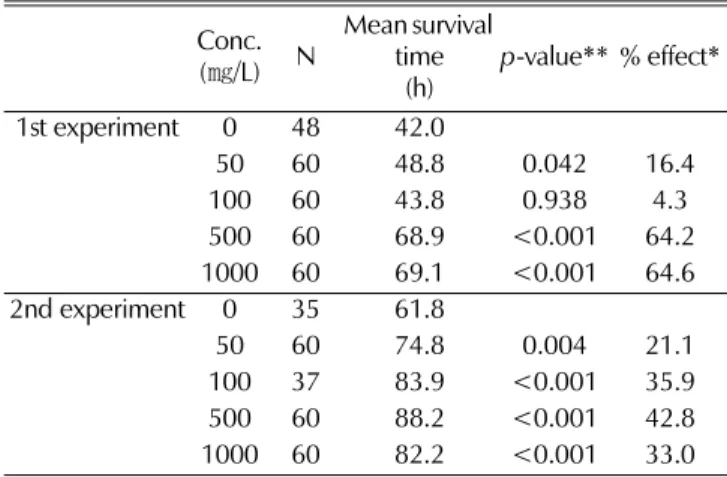
We induced oxidative stress in young adult worms using paraquat to measure the anti-oxidant activity of buckwheat extracts. Then, survival of worms was compared between control and experimental groups treated with different concentration of buckwheat extracts. There was no difference in time required for larval development and size and growth of the worms between control and buckwheat- treated worms. The mean survival time of control worms was 42.0 h, and the buckwheat extracts significantly increased mean survival time at higher concentrations (Table 1). Mean survival times of the 500 and 1000 ㎎/L buckwheat extracts-treated worms were 68.9 and 69.1 h, respectively. Both concentrations of buckwheat extracts increased mean survival up to 64% (p < 0.001). A replicative experiment showed markedly increased resistance to oxidative stress by all concentrations of buckwheat extracts tested. The most effective concentration of buckwheat extracts in the replicative experiment was 500 ㎎/L as shown in Table 1.
Mean survival time increased from 61.8 to 88.2 h (p < 0.001), and % effect was 42.8%.
Figure 1 shows the survival curve of the control and 500 ㎎/L buckwheat extracts-treated worms. These findings suggest that the buckwheat extracts have a strong anti- oxidant activity and can increase the survival of worms under oxidatively-stressed conditions in vivo. Recent study shows that buckwheat has strong antioxidant activities including hydroxyl radical and superoxide anion radical scavenging activities due to its phenolic and flavonoid contents (Sedej et al., 2012). Secondary metabolites of buckwheat play a key role in the antioxidant activity of buckwheat (Kreft et al., 1994). Further study focusing on the cellular pathways or organelles involved in the anti-
Table 1. Increased resistance to oxidative stress following treatmentwith different concentrations of buckwheat extracts.
Conc.
(㎎/L) N
Mean survival time
(h)
p-value** % effect*
1st experiment 0 48 42.0
50 60 48.8 0.042 16.4
100 60 43.8 0.938 4.3
500 60 68.9 <0.001 64.2
1000 60 69.1 <0.001 64.6
2nd experiment 0 35 61.8
50 60 74.8 0.004 21.1
100 37 83.9 <0.001 35.9
500 60 88.2 <0.001 42.8
1000 60 82.2 <0.001 33.0
**% effect was calculated as [(B-C)/C] × 100, where B is the mean
survival time of worms treated with each concentration of buckwheat extracts and C is the mean survival time of control worms (0㎎/L).**p-value was determined using the log-rank test and p-value lower than 0.05 was considered significant.
Fig. 1. Resistance to oxidative stress induced by paraquat was compared between the control group and the buckwheat group. The buckwheat group was treated with 500㎎/L of buckwheat extracts. Buckwheat significantly increased resistance to oxidative stress in C. elegans (p<0.001).
oxidant activity of the buckwheat extracts will be helpful to understand the underlying mechanisms of increased resistance to oxidative stress following buckwheat extracts treatment.
2. Longevity phenotype induced by buckwheat extracts The free radical theory of aging suggests that oxidative stress plays a pivotal role in normal aging and determines of lifespan of an organism (Sohal and Weindruch, 1996;
Beckman and Ames, 1998). Based on our finding that the buckwheat extracts reduced susceptibility to oxidative stress in C. elegans, we next examined the effect of the buckwheat extracts on C. elegans lifespan. As the 500 ㎎/L of buckwheat extracts showed the strongest anti-oxidant activity in the previous assay, we monitored the lifespan of worms treated with 500 ㎎/L of buckwheat extracts.
The mean and maximum lifespans of control worms were 19.7 and 27 days, respectively. Both mean and maximum lifespan were extended significantly by treating worms with the buckwheat extracts (Table 1). The mean lifespan of worms treated with the buckwheat extracts increased to 22.6 days and their maximum lifespan was 30 days (p < 0.001). The percent lifespan-extending effect of buckwheat calculated using the mean lifespan was 14.4%.
In the replicative experiment, mean lifespan increased from 19.3 days to 24.0 days (23.9% lifespan-extending effect) and maximum lifespan was extended from 27 days to 30 days (p < 0.001).
As shown in Fig. 2, the survival curve of C. elegans shifted to the left following treatment with the buckwheat
extracts, suggesting that strong anti-oxidant activity leads to extended mean and maximum lifespan of C. elegans.
These data support our hypothesis that increased resistance to oxidative stress provided by the buckwheat extracts can modulate the aging process and eventually confer a longevity phenotype in C. elegans. The lifespan-extending effect of buckwheat is reported here for the first time, and these results can be applied directly to mammalian studies and used to develop novel anti-aging nutritional supplements or natural therapeutic compounds.
3. Effect on fertility
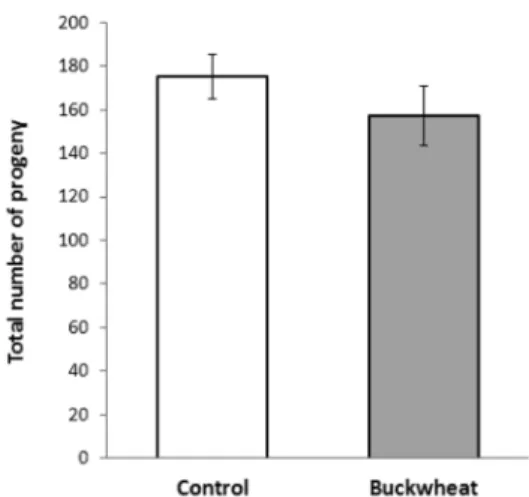
Many C. elegans genetic mutants with an extended lifespan show decreased reproductive activity, such as a reduced number of progeny and a delayed reproductive period (Larsen et al., 1995; Gems et al., 1998; Hughes, et al., 2007). It is believed that this phenomenon might be due to a trade-off of cellular resources between aging and reproduction. Long-lived mutants seem to re-locate their cellular resources from reproduction to somatic maintenance. We were interested in whether treatment of worms with the buckwheat extracts also accompanied reduced reproduction as previously observed in several long-lived mutants. Interestingly, worm fertility was not affected by the buckwheat extracts (Fig. 3). The total number of progeny produced during the gravid period decreased slightly in worms treated with 500 ㎎/L of buckwheat extracts, but was not significantly different from that of the control. The total number of progeny in the control was 175 ± 30.4 (mean ± SD, n = 9) and that in the buckwheat-treated worms was 157 ± 36.2 (n = 7) (p = 0.298).
Table 2. Effect of the buckwheat extracts on Caenorhabditis elegans lifespan.
Treatment*** Mean lifespan (day)
Maximum lifespan
(day) p-value** % effect*
1st
experiment Control 19.7 27
Buckwheat 22.6 30 <0.001 14.4 2nd
experiment Control 19.3 27
Buckwheat 24.0 30 <0.001 23.9
***% effect was calculated as [(B-C)/C] × 100, where B is the mean
lifespan of buckwheat-treated worms and C is the mean lifespan of the control.*****p-value was determined using the log-rank test.
***The control group was grown in NGM plates containing no buckwheat extracts and the buckwheat group was grown in NGM plates supplemented with 500㎎/L of buckwheat extracts.
Fig. 2. Buckwheat extended Caenorhabditis elegans lifespan.
500㎎/L of buckwheat extracts was added to NGM plates in the buckwheat group. Buckwheat significantly increased both mean and maximum lifespan in C. elegans (p<0.001).
The time-course distribution of progeny was also not significantly different between the control and the buckwheat-treated worms (Fig. 4). The number of progeny produced each day was similar between the two groups, and no delay in the reproductive period was observed.
Taken together, we conclude that the buckwheat extracts have a strong in vivo anti-oxidant activity and can extend both mean and maximum lifespan in C. elegans without reducing fertility.
ACKNOWLEDGEMENTS
This research was supported by the Globalization of Korean Foods R&D program, funded by the Ministry of Food, Agriculture, Forestry and Fisheries, Republic of Korea(Grant No. 911044-1).
LITERATURE CITED
Beckman KB and Ames BN. (1998). The free radical theory of aging matures. Physiological Reviews. 78:547-581.
Berger MM. (2005). Can oxidative damage be treated nutritionally?
Clinical Nutrition. 24:172-183.
Bus JS and Gibson JE. (1984). Paraquat: Model for oxidant- initiated toxicity. Environmental Health Perspectives. 55:37-46.
Gems D, Sutton AJ, Sundermeyer ML, Albert PS, King KV, Edgley ML, Larsen PL and Riddle DL. (1998). Two pleiotropic classes of daf-2 mutation affect larval arrest, adult behavior, reproduction and longevity in Caenorhabditis elegans.
Genetics. 150:129-155.
Hagen TM, Ingersoll RT, Wehr CM, Lykkesfeldt J, Vinarsky V, Bartholomew JC, Song MH and Ames BN. (1998).
Acetyl-L-carnitine fed to old rats partially restores mitochondrial function and ambulatory activity. Proceedings of the National Academy of Sciences of the United States of America.
95:9562-9566.
Harman D. (1956). Aging: A theory based on free radical and radiation chemistry. Journal of Gerontology. 11:298-300.
Havsteen B. (1983). Flavonoids a class of natural products of high pharmacological potency. Biochemical Pharmacology. 32:1141- 1148.
Hughes SE, Evason K, Xiong C and Kornfeld K. (2007).
Genetic and pharmacological factors that influence reproductive aging in nematodes. PLoS Genetics. 3:e25.
Hwang EJ, Lee SY, Kwon SJ, Park MH and Boo HO. (2006).
Antioxidative, antimicrobial and cytotoxic activities of Fagopyrum esculentum Möench extract in germinated seeds.
Korean Journal of Medicinal Crop Science. 14:1-7.
Kreft I, Bonafacci G and Zigo A. (1994). Secondary metabolites of buckwheat and their importance in human nutrition. Food Technology and Biotechnology Review. 32:195-197.
Kim JY, Son BK and Lee SS. (2012). Effects of adlay, buckwheat, and barley on transit time and the antioxidative system in obesity induced rats. Nutrition Research and Practice.
6:208-212.
Koh ES, Ju JS, Choi MG, Yoon TH, Ahn YS, Lim KJ, Kim SO and Kim JD. (2002). Effects of buckwheat, potato and rice on glycemic indices in healthy subjects. Korean Journal of Medicinal Crop Science. 10:253-258.
Larsen PL, Albert PS and Riddle DL. (1995). Genes that regulate both development and longevity in Caenorhabditis elegans. Genetics. 139:1567-1583.
Lee CK, Pugh TD, Klopp RG, Edwards J, Allison DB, Weindruch R and Prolla TA. (2004). The impact of alpha- lipoic acid, coenzyme Q10 and caloric restriction on life span and gene expression patterns in mice. Free Radical Biology and Medicine. 36:1043-1057.
Park SK, Kim K, Page GP, Allison DB, Weindruch R and Prolla TA. (2009). Gene expression profiling of aging in multiple mouse strains: Identification of aging biomarkers and impact of dietary antioxidants. Aging Cell. 8:484-495.
Park SK, Page GP, Kim K, Allison DB, Meydani M, Weindruch R and Prolla TA. (2008). alpha- and gamma- Tocopherol prevent age-related transcriptional alterations in the Fig. 3. Total number of progeny produced was compared
between the control and the buckwheat (500㎎/L) group. Error bars indicate standard errors (SE).
Fig. 4. Time-course distribution of progeny production in the control and the buckwheat (500㎎/L) group. Data are mean± standard errors (SE).
heart and brain of mice. Journal of Nutrition. 138:1010-1018.
Peto R and Peto J. (1972). Asymptotically efficient rank invarient test procedures. Journal of the Royal Statistical Society Series A. 135:185-207.
Rosenfeldt FL, Pepe S, Linnane A, Nagley P, Rowland M, Ou R, Marasco S, Lyon W and Esmore D. (2002). Coenzyme Q10 protects the aging heart against stress: Studies in rats, human tissues, and patients. Annals of the New York Academy of Sciences. 959:355-359.
Sedej I, Sakac M, Mandic A, Misan A, Tumbas V and Canadanovic-Brunet J. (2012). Buckwheat(Fagopyrum esculentum Moench) grain and fractions: Antioxidant compounds and activities. Journal of Food Science. 77:c954-c959.
Sohal RS and Weindruch R. (1996). Oxidative stress, caloric restriction, and aging. Science. 273:59-63.
Suh JH, Shigeno ET, Morrow JD, Cox B, Rocha AE, Frei B and Hagen TM. (2001). Oxidative stress in the aging rat heart is reversed by dietary supplementation with (R)-(alpha)-lipoic acid. The FASEB Journal. 15:700-706.
Wood WB. (1988). The nematode Caenorhabditis elegans. Cold Spring Harbor Laboratory Press. Cold Spring Harbor. New York, USA. p.1-16.
Zhou J, Li P, Cheng, N, Gao H, Wang B, Wei Y and Cao W.
(2012). Protective effects of buckwheat honey on DNA damage induced by hydroxyl radicals. Food and Chemical Toxicology.
50:2766-2773.