• 검색 결과가 없습니다.

Induction of IL-6 and IL-8 Expression by Leptin Treatment in Periodontal Ligament Cells and Gingival Fibroblasts

N/A
N/A
Protected

Academic year: 2021

Share "Induction of IL-6 and IL-8 Expression by Leptin Treatment in Periodontal Ligament Cells and Gingival Fibroblasts"

Copied!
8
0
0

로드 중.... (전체 텍스트 보기)

전체 글

(1)

http://dx.doi.org/10.11620/IJOB.2013.38.2.073

*Correspondence to: Yun-Jung Yoo, Department of Oral Biology, Yonsei University College of Dentistry, 50 , Seodaemoon-gu, Seoul, 120-752, Korea. Tel: +82-2-2228-3060, Fax: +82-2-2227-7903, E-mail: [email protected]

This is an Open-Access article distributed under the terms of the Creative Commons Attribution Non-Commercial License(http://creati- vecommons.org/licenses/by-nc/3.0) which permits unrestricted non- commercial use, distribution, and reproduction in any medium, pro- vided the original work is properly cited.

Induction of IL-6 and IL-8 Expression by Leptin Treatment in Periodontal Ligament Cells and Gingival Fibroblasts

Hong-Gyu Park

1

, Ji-Hye Kim

2

, Jeong-Heon Cha

1,2,3

, Eun-Jung Bak

3

, and Yun-Jung Yoo

1,2

*

1

Oral Cancer Research Institute, Yonsei University College of Dentistry, Seoul, Korea

2

Department of Applied Life Science, The Graduate School, Yonsei University, Seoul, Korea

3
Department of Oral Biology, Yonsei University College of Dentistry, Seoul, Korea (received March 28, 2013; revised April 24, 2013; accepted April 25, 2013)

Leptin is one of the adipocytokines produced from adi- pose tissue but its functions in periodontal tissue have not previously been investigated. In our current study, we exa- mined the effects of leptin on the expression of interleukin (IL)-6 and IL-8 in periodontal ligament (PDL) cells and gingival fibroblasts. Leptin receptor expression was evalua- ted by RT-PCR and the production of cytokines was mea- sured by ELISA. The phosphorylation of Akt and Erk1/2 was assessed by western blotting. mRNA of long and short form leptin receptors were detected in both PDL cells and gingival fibroblasts. Leptin was found to increase the pro- duction of IL-6 and IL-8 in both of these cell types, an effect which was not blocked by polymyxin B, an inhibitor of lipopolysaccharide (LPS). Leptin did not alter the pro- duction of IL-6 and IL-8 induced by LPS in PDL cells but increased Akt and Erk1/2 phosphorylation in these cells.

These results suggest that leptin acts as an inducer of IL-6 and IL-8 in PDL cells and gingival fibroblasts.

Key words: Periodontal ligament cells, Gingival fibroblasts, Leptin, Interleukin-6, Interleukin-8

Introduction

Leptin is one of the adipokines produced from adipocytes [1]. Leptin is encoded by the gene obese (ob), and its cir- culating levels are correlated with white adipose tissue mass [1,2]. Leptin decreases food intake and increases energy con- sumption by inducing anorexigenic factors. Additionally, leptin behaves as a mediator of inflammation in monocytes/

macrophages and neutrophils [2]. Leptin stimulates prolife- ration, phagocytosis, and expression of cytokines and enzymes such as interleukin (IL)-1, IL-6, tumor necrosis factor (TNF), nitric oxide synthase, and cyclooxygenase-2 in monocytes/

macrophages. Leptin also increases chemotaxis and hyd- rogen peroxide production in neutrophils. Leptin receptors are encoded by the gene diabetes (db), and multiple receptor isoforms result from alternative splicing of the db gene [1-4]. Among the isoforms, the long form of leptin receptor has a cytoplasmic domain with Janus kinase binding sites and plays a pivotal role mediating leptin signaling.

Periodontitis is an inflammatory disease caused by bac- teria or an immune reaction against bacteria [5,6]. Previous studies have demonstrated the relationship between perio- dontitis and leptin levels. Leptin concentration decreases in gingival crevicular fluid (GCF), but increases in serum, depending on the severity of periodontal destruction [7-9].

Elevated serum leptin level in periodontitis is associated

with acute myocardial infarction, suggesting that the inc-

73

(2)

rease in serum leptin in patients with periodontitis acce- lerates the inflammatory process in arteriosclerotic lesions and increases the risk for acute myocardial infarction [10].

Although studies have suggested that the higher concentra- tion of leptin in GCF may play a protective role in perio- dontal tissue, the mechanism underlying the change in leptin level or the function of leptin has not been investigated in periodontal tissue. The effect of leptin on periodontal liga- ment (PDL) cells and gingival fibroblasts has not been determined, but it was reported recently that leptin and the leptin receptor affect function of fibroblasts in synovium and dermis [11,12]. PDL cells and gingival fibroblasts mainly consist of periodontal tissue and play an important role producing pro-inflammatory cytokines in periodontal tissue [13]. IL-6 is closely related with the recruitment of T cells and acts as a T and B cell differentiation factor [14].

IL-8 stimulates the expression of adhesion molecules (CD11/18), the migration, and the release of enzyme and reactive oxygen intermediates in neutrophils [15]. Therefore, to investigate the function of leptin in periodontal tissue, we assessed leptin receptor expression and the effect of leptin on expression of pro-inflammatory cytokines such as IL-6 and IL-8 in PDL cells and gingival fibroblasts.

Material and Methods

Cell cultures

PDL or gingival fibroblast cells were prepared from teeth extracted for orthodontic treatment or from gingival tissue.

This protocol was approved by the Institutional Review Board of Yonsei Dental Hospital (IRB No. 2-2010-0005).

PDL tissue fragments were removed from the middle one- third of the extracted tooth roots and were washed three times with α-modified Eagle’s medium (α-MEM; Gibco BRL, Rockville, MD, USA) containing 300 mg/ml streptomycin, 300 unit/ml penicillin, and 0.75 mg/ml amphotericin-B (Gibco BRL). PDL tissue fragments were placed in 100 mm dishes containing α-MEM supplemented with 100 mg/ml strep- tomycin, 100 unit/ml penicillin, 0.25 mg/ml amphoteri- cin-B, and 20% fetal bovine serum (FBS, Gibco BRL). The culture media were replaced every 2 days until cells grew from the fragments, and then the cultures were maintained with α -MEM containing antibiotics and 10% FBS. Upon reaching 70% confluence, the cells were removed with 0.25% trypsin and passaged to 100 mm dishes. Gingival fibroblasts were

prepared from gingival tissues excised for crown lengthe- ning. Gingival tissues were cut into small fragments and then the tissue fragments were incubated in 2.4 U dispase II (Roche, Mannheim, Germany) and 0.25% collagenase (Roche) for 1 h at 37°C. The tissue fragments were then separated into epithelial and connective tissues. Connective tissue frag- ments were placed in 100 mm dishes containing Dulbecco's Modified Eagle's Medium (Gibco BRL) supplemented with antibiotics and 10% FBS and were cultured according to the same procedure as the PDL cells. THP-1 monocytes were maintained in Roswell Park Memorial Institute medium (Gibco BRL) 1640 containing antibiotics and 10% FBS.

Reverse transcription-polymerase chain reaction (RT-PCR) PDL cells or gingival fibroblasts (5 × 10

5

cells/well) were cultured in 6 well plates. THP-1 monocytes (5 × 10

5

cells/

well) were plated in 6 well culture plates and treated with phor- bol myristic acid (100 ng/ml, Sigma, St. Louis, USA) for 24 h to induce differentiation of monocytes into macrophages. Total RNA in adipose tissue from the inguinal region, PDL cells, gingival fibroblasts, or THP-1 macrophages was isolated with Trizol reagent (Invitrogen, Carlsbad, CA, USA). Two µg of total RNA was converted to cDNA using an RT Premix kit (Bioneer, Seoul, Korea) in accordance with the manufactu- rer’s instructions. The cDNA population was amplified with i-StarTaq (Intron Biotech, Seongnam, Korea) and compared with the concurrently measured GAPDH expression level. For semi quantitative RT-PCR, two concentrations of the cDNA template were amplified to determine the optimal cDNA amounts. In addition, several PCR cycles were tested to deter- mine the range in which amplification was in the exponen- tial phase. The PCR products were then resolved by electro- phoresis on 1% agarose gels containing ethidium bromide.

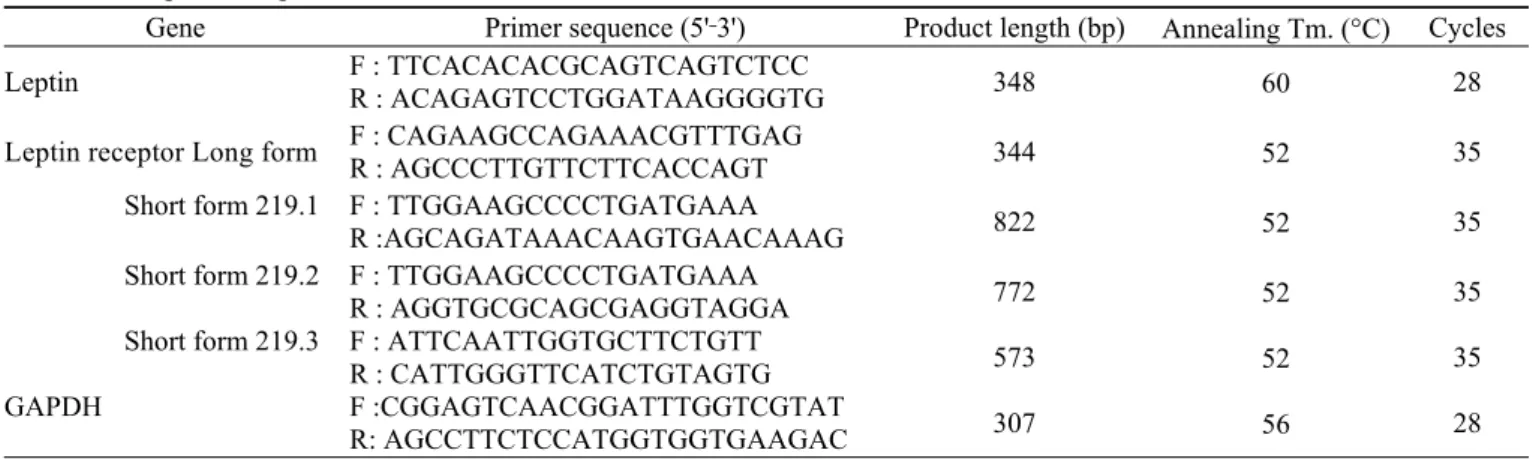
The primers, annealing temperatures and the optimized PCR cycle number are given in Table 1 [16,17].

Measurement of IL-6 and IL-8 production by enzyme- linked immunosorbent assay (ELISA)

PDL cells or gingival fibroblasts (1.7 × 10

5

cells/well) were plated in 24 well culture plates and maintained in media containing antibiotics and 10% FBS for 7 h. After the indicated time, the cells were starved in serum-free media for 20 h. Then, the cells were treated with human recom- binant leptin (R&D Systems, Minneapolis, MN, USA) or LPS (Sigma Chemical Co., St. Louis, Mo, USA) for 24 h.

The cells were pretreated with polymyxin B (Sigma) for 1 h

(3)

Table 1. PCR primer sequences

Gene Primer sequence (5'‐3') Product length (bp) Annealing Tm. (°C) Cycles

Leptin F : TTCACACACGCAGTCAGTCTCC

R : ACAGAGTCCTGGATAAGGGGTG 348 60 28

Leptin receptor Long form F : CAGAAGCCAGAAACGTTTGAG

R : AGCCCTTGTTCTTCACCAGT 344 52 35

Short form 219.1 F : TTGGAAGCCCCTGATGAAA

R :AGCAGATAAACAAGTGAACAAAG 822 52 35

Short form 219.2 Short form 219.3 GAPDH

F : TTGGAAGCCCCTGATGAAA R : AGGTGCGCAGCGAGGTAGGA F : ATTCAATTGGTGCTTCTGTT R : CATTGGGTTCATCTGTAGTG F :CGGAGTCAACGGATTTGGTCGTAT R: AGCCTTCTCCATGGTGGTGAAGAC

772 573 307

52 52 56

35 35 28

and then treated with leptin or LPS for 24 h. The PDL cells were treated with LPS in the absence or presence of leptin for 24 h to estimate the effect of leptin on LPS-induced cyto- kine expression. After treatment, the level of IL-6 or IL-8 was measured in the culture supernatants from cells using a com- mercially available ELISA kit (BioLegend, San Diego, CA, USA) in accordance with the manufacturer’s instructions.

Cell viability assay

Cell viability was measured using the 3-(4,5-dimethyl- thiazol-2-yl)2,5-diphenyl tetrazolium bromide (MTT) assay.

PDL cells or gingival fibroblasts (1.7 × 10

5

cells/well) were seeded in 24 well plates and maintained in media containing antibiotics and 10% FBS. After 7 h, the cells were starved in serum-free media for 20 h and then treated with the indi- cated concentrations of polymyxin B for 24 h. After treat- ment, 20 µl of MTT solution (5 mg/ml in PBS, Sigma) was added to each well. After a 4 h incubation, the media were aspirated, and 200 µl of dimethylsulfoxide (Sigma) was added to each well to dissolve the MTT-formazan crystals. The absorbance was measured with an MRX II microplate reader (Dynatech Labs, Chantilly, VA, USA) at 570 nm.

Western blotting

PDL cells (5 × 10

5

cells/well) were cultured in 6 well plates and maintained in media containing antibiotics and 10%

FBS for the protein analysis. After 7 h, the cells were starved in serum-free media for 20 h and then treated with 10 µg/ml leptin for the indicated time intervals. Then whole cells were lysed in 1× lysis buffer [20 mM Tris-HCl (pH 7.5), 150 mM NaCl, 1 mM Na

2

EDTA, 1% Triton, 2.5 mM sodium pyrophosphate, 1 mM β-glycerophosphate, 1 mM

Na

3

VO

4

, 1 µg/ml leupeptin, and 1 mM PMSF; Cell Sig- naling Technology, Danvers, MA, USA]. After centrifu- gation, the supernatant was used for the protein assay.

Protein concentrations were determined with the BSA Pro- tein Assay kit (Bio-Rad, Hercules, CA, USA). Forty µg of protein was electrophoresed on 10% SDS-polyacrylamide gel. The electrophoretically separated proteins were electro- blotted onto PVDF membranes (Bio-Rad). The membranes were blocked with 5% BSA in Tris buffer saline (10 mM Tris-HCl, 166 mM NaCl, pH 7.4). The primary antibodies were anti-phospho-Akt (Cell Signaling Technology), anti- phospho-Erk1/2 (Cell Signaling Technology), anti-Akt (Cell Signaling Technology), or anti-Erk1/2 (Cell Signaling Tech- nology) and were diluted at 1:1000, respectively. Peroxi- dase-conjugated anti-rabbit antibody (Jackson Immuno Research, West Grove, PA, USA) was used at 1:2500 as the se- condary antibody. Protein bands were visualized with an ECL kit (Amersham Bioscience, Buckinghamshire, UK). Band intensity was measured using Spot Denso Analysis of FROG 2000 software (Alpha Innotech, San Leandro, CA, USA).

Statistical analysis

Results were analyzed using one-way analysis of variance and Tukey’s test (SPSS Inc., Chicago, IL, USA). A p value

< 0.05 was considered significant.

Results

Expression of leptin and leptin receptors

To observe the expression of leptin and leptin receptors in

periodontal tissue, the expression in PDL cells and gingival

fibroblasts was estimated by RT-PCR. Leptin was expressed

(4)

Fig. 1. Expression of leptin and leptin receptors in periodontal ligament (PDL) cells and gingival fibroblasts. Expression of leptin was assessed by RT-PCR in adipose tissue, PDL cells, and gingival fibroblasts (GF) (A). Expression of leptin rece- ptors was estimated by RT-PCR in PDL cells, GF, and THP-1 macrophages (B).

in adipose tissues isolated from subcutaneous tissue in the inguinal region, but was not expressed in PDL cells or gingival fibroblasts (Fig. 1A). Long and short forms of the leptin receptor were expressed in PDL cells, gingival fibro- blasts, and THP-1 macrophages (Fig. 1B). In leptin recep- tors of gingival fibroblasts and THP-1 macrophages, expres- sion level of short form 219.2 was lower than that of PDL cells and other short forms (291.1 and 291.3).

Effect of leptin on IL-6 and IL-8 expression

To observe whether leptin acts as an inducer of cytokines in periodontal tissue, IL-6 and IL-8 protein levels in culture supernatants of PDL cells and gingival fibroblasts treated with leptin were estimated by ELISA. Leptin treatment inc- reased IL-6 and IL-8 expression in PDL cells (Fig. 2A and 2B white bar). When compared to those of untreated PDL cells, IL-6 expression significantly increased at a concen- tration of 10 µg/ml leptin (Fig. 2A white bar). IL-8 expres- sion increased in a dose dependent manner (Fig. 2B whi- tebar). The expression of IL-6 and IL-8 in gingival fibrob- lasts was also induced similar to that in PDL cells (Fig. 2A and 2B black bar). That is, IL-6 expression increased significantly in a dose-dependent manner and IL-8 expres- sion was significantly elevated at a concentration of 10 µ g/ml as compared to untreated cells.

To confirm the effect of leptin on cytokine expression,

Fig. 2. Effect of leptin on IL-6 and IL-8 production PDL cells and gingival fibroblasts. PDL cells and gingival fibroblasts (GF) were cultured for 24 h in the presence of either media alone or the indicated concentrations of leptin. Levels of IL-6 (A) and IL-8 (B) in culture supernatants were assayed ELISA.

*Significant difference (p<0.05) compared to untreated cells.

PDL cells and gingival fibroblasts were treated with leptin in the presence of polymyxin B (100 µg/ml), an inhibitor of LPS.

LPS increased IL-6 and IL-8 expression in both cell types (Fig. 3B and 3C left panel). Polymyxin B inhibited LPS- induced IL-6 and IL-8 expression (Fig. 3B and 3C left panel), but did not inhibit leptin-induced IL-6 and IL-8 expres- sion in PDL cells and gingival fibroblasts (Fig. 3B and 3C right panel). The results of MTT assay in both cell types demonstrated that polymyxin B did not exert inhibitory effects on cell viability up to 500 µg/ml (Fig. 3A).

Effect of leptin on LPS-induced IL-6 and IL-8 expression To observe the effect of leptin on IL-6 and IL-8 expres- sion induced by LPS, PDL cells were treated with leptin in the presence of suboptimal dose of LPS and then the levels of cytokines in culture supernatants were estimated by ELISA.

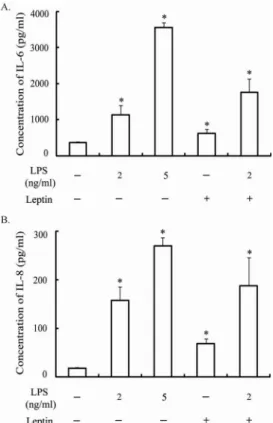
When PDL cells were treated with 2 and 5 ng/ml LPS, IL-6 and IL-8 expression increased in a dose-dependent manner (Fig.

4). When the PDL cells were treated with leptin in the presence

or absence of 2 ng/ml LPS, LPS and leptin combination trea-

ted cells showed an increase tendency of IL-6 and IL-8 expres-

sion compared to LPS-treated cells, but it was not significant.

(5)

Fig. 3. Effect of polymyxin B (poly B) on leptin-induced cytokine expression of PDL cells and gingival fibroblasts. PDL cells and gingival fibroblasts (GF) were treated with poly B for 24 h and cell viability was estimated by the MTT assay (A). Cells were cultured for 24 h in the presence of either media alone, leptin (10 µg/ml), or LPS (100 ng/ml) in the presence or absence of poly B (100 µg/ml). Levels of IL-6 (B) and IL-8 (C) in culture supernatants were assayed by ELISA. *Significant difference (p<0.05) compared to untreated cells. # Significant difference (p<0.05) compared to LPS-treated cells.

Expression of phosphorylated Akt and Erk1/2

Phosphorylation of Akt and Erk1/2 was estimated in leptin- treated PDL cells by western blot. As shown in Fig. 5, Akt phosphorylation increased at 15 min after leptin treatment, but it decreased gradually at 30 and 60 min. The Erk1/2 phos- phorylation expression pattern was similar to that of Akt.

Discussion

Leptin is mainly produced from adipocytes [18] and in

minor quantities in placenta [19], gastric mucosa [20], T

cells [21], and osteoblasts [22]. In addition, dermal fibro

(6)

Fig. 5. Phosphorylation of Akt and Erk1/2 in leptin-treated PDL cells. PDL cells were cultured in the absence or presence of leptin (10 µg/ml) for the indicated times. Cell lysates were subjected to immunoblot analysis with antibodies recognizing the phosphorylated Akt or Erk1/2 and with antibody recognizing total Akt or Erk1/2 as loading controls (A). The phosphorylation value at 0 min was set to 1 to allow comparison with the relative phosphorylation levels at subsequent time-points (B).

Fig. 4. Effect of leptin on LPS-induced cytokine expression of PDL cells. PDL cells were cultured for 24 h in the presence of leptin (10 µg/ml) or/and LPS (2 and 5 ng/ml) and levels of IL-6 (A) and IL-8 (B) in culture supernatants were assayed by ELISA. *Sig- nificant difference (p<0.05) compared to untreated cells.

blasts also express leptin and leptin receptors, suggesting that leptin produced from fibroblasts, may exert local autocrine and paracrine actions and contribute to the plasma levels of leptin [23]. PDL cells and gingival fibroblasts are repre-

sentative cells in periodontal tissues. Therefore, we exa- mined whether leptin and leptin receptors are expressed in PDL cells and gingival fibroblasts. Adipose tissue expressed leptin mRNA, but PDL cells and gingival fibroblasts did not express leptin mRNA. This indicates that PDL cells and gingival fibroblasts are not a source of leptin in periodontal tissue. PDL cells and gingival fibroblasts expressed the long and short forms of the leptin receptor similar to expression in THP-1 macrophages which express both the long and short forms of the leptin receptor [24]. Among the leptin receptors of gingival fibroblasts, expression of the short form 219.2 was weaker than that of other short forms. This pattern is similar to dermal fibroblasts and adrenal tissue [16,23]. Among the leptin receptors, long form is known to transduce the activation signal [1,4]. Taken together, it is considered that leptin may affect the function of PDL cells and gingival fibroblasts via long form of leptin receptor.

Leptin acts as a stimulator of cytokines such as IL-1,

IL-6, IL-8, and TNF in various cells including monocytes,

macrophages, and synovial fibroblasts [1,11,24,25]. In this

study, leptin increased IL-6 and IL-8 expression in PDL cells

and gingival fibroblasts. Because leptin used in this study

was are recombinant protein, we treated PDL cell and

gingival fibroblasts with leptin in the presence of polymyxin

B, an inhibitor of LPS to rule out the activity of conta-

minated LPS. Polymyxin B inhibited LPS-induced IL-6 and

IL-8 expression, but did not block the IL-6 and IL-8 exp-

ression induced by leptin in both cells. These results

indicate that leptin acts as an inducer of IL-6 and IL-8 in

(7)

PDL cells and gingival fibroblasts. In other study using PDL cells and gingival fibroblasts from same donor, concen- tration of LPS which began to increase IL-6 expression was different between PDL cells and gingival fibroblasts, sug- gesting that PDL cells and gingival fibroblasts have a dif- ferent ability to produce IL-6 [26]. Similar to the response to LPS, concentration of leptin which increased the expression of cytokines was different between PDL cells and gingival fibroblasts. However, we did not compare response of PDL cells and gingival fibroblasts cultured from same donor.

Therefore, it will be needed to confirm the different response of both cells from same donor.

In macrophages, leptin treatment not only induced TNF and IL-8 production, but also enhanced LPS-induced TNF pro- duction. However it did not alter LPS-induced IL-8 produc- tion [24]. Most representative periodontopathogens are gram negative bacteria containing LPS. Therefore, we also obser- ved the effect of leptin on cytokine expression induced by suboptimal dose of LPS in PDL cells. LPS increased the expression of IL-6 and IL-8 in PDL cells, but leptin did not change the expression of these cytokines induced by LPS.

This indicates that leptin cannot potentiate LPS-induced IL-6 and IL-8 expression in both cells.

The leptin-signaling pathways are closely related with STAT signaling pathway, MAPK signaling pathway, and Erk sig- naling pathway [3]. In this study, leptin-treated PDL cells showed increased activation of Akt and Erk1/2 as eosinop- hils, synovial fibroblasts, and adipose tissue activated by leptin [11,27,28]. These results suggest that Akt and Erk1/2 may be involved in IL-6 and IL-8 expression.

Patients with rheumatoid arthritis display increased circu- lating leptin levels in comparison with a healthy group [29].

Leptin expression in cartilage of patients with osteoarthritis is higher than that in a normal group [30]. Leptin increases IL-8 production in synovial fibroblasts cultured from pat- ients with rheumatoid arthritis and osteoarthritis [11]. These studies suggest that leptin plays an important role in inflam- mation such as rheumatoid arthritis and osteoarthritis. We found that leptin acts as pro-inflammatory cytokine in pe- riodontal tissue through induction of IL-6 and IL-8 in PDL cells and gingival fibroblasts. In contrast to the leptin level in cartilage tissue of patients with osteoarthritis, the leptin level in GC and gingival tissues in patients with perio- dontitis is lower than that in a healthy group [7-9,31]. In the future, in vivo study will be necessary to determine whether

the pro-inflammatory effect of leptin is beneficial or detri- mental to periodontal tissue.

In this study, we first showed that leptin receptors are expressed in PDL cells and gingival fibroblasts and that leptin acts as an inducer of IL-6 and IL-8 in both cell types.

These results suggest that leptin affects induction of pro- inflammatory cytokines in periodontal tissue.

Acknowledgements

This study was supported by a grant of the Korean Health Technology R&D Project, Ministry of Health & Welfare, Republic of Korea (A101630). This research was supported by Basic Science Research Program through the National Research Foundation of Korea (NRF) funded by the Ministry of Education, Science and Technology (NRF-2009-0073136)

Conflicts of interest

We have no conflicts of interest relevant to this article.

References

1. Carbone F, La Rocca C, Matarese G. Immunological func- tions of leptin and adiponectin. Biochimie. 2012;94:2082-2088.

2. Lago F, Dieguez C, Gomez-Reino J, Gualillo O. Adipokines as emerging mediators of immune response and inflam- mation. Nat Clin Pract Rheumatol. 2007;3:716-724.

3. Lam QL, Lu L. Role of leptin in immunity. Cell Mol Immunol. 2007;4:1-13.

4. Gan L, Guo K, Cremona ML, McGraw TE, Leibel RL, Zhang Y. TNF-alpha up-regulates protein level and cell surface expression of the leptin receptor by stimulating its export via a PKC-dependent mechanism. Endocrinology.

2012;153:5821-5833.

5. Jun HK, Lee LS, Lee HR, Choi BK. Binding of Tp92 homolog of Treponema denticola to fibronectin and epi- thelial cells. Int J Oral Biol. 2008;33:45-50.

6. Choi EK, Kang IC. Production of pro-inflammatory cyto- kines by Porphyromonas gingivalis in THP-1 macrophagic cells. Int J Oral Biol. 2009;34:87-95.

7. Karthikeyan BV, Pradeep AR. Leptin levels in gingival crevicular fluid in periodontal health and disease. J Periodontal Res. 2007;42:300-304.

8. Karthikeyan BV, Pradeep AR. Gingival crevicular fluid

and serum leptin: their relationship to periodontal health

(8)

and disease. J Clin Periodontol. 2007;34:467-472.

9. Bozkurt FY, Yetkin Ay Z, Sutcu R, Delibas N, Demirel R.

Gingival crevicular fluid leptin levels in periodontitis patients with long-term and heavy smoking. J Periodontol.

2006;77:634-640.

10. Gundala R, Vk C, K R. Association of leptin in perio- dontitis and acute myocardial infarction. J Periodontol. 2012.

11. Tong KM, Shieh DC, Chen CP, Tzeng CY, Wang SP, Huang KC, Chiu YC, Fong YC, Tang CH. Leptin induces IL-8 expression via leptin receptor, IRS-1, PI3K, Akt cas- cade and promotion of NF-κB/p300 binding in human syno- vial fibroblasts. Cell Signal. 2008;20:1478-1488.

12. Ezure T, Amano S. Adiponectin and leptin up-regulate ext- racellular matrix production by dermal fibroblasts. Bio- factors. 2007;31:229-236.

13. Scheres N, Laine ML, de Vries TJ, Everts V, van Win- kelhoff AJ. Gingival and periodontal ligament fibroblasts differ in their inflammatory response to viable Porphy- romonas gingivalis. J Periodontal Res. 2010;45:262-270.

14. Scheller J, Chalaris A, Schmidt-Arras D, Rose-John S. The pro- and anti-inflammatory properties of the cytokine interleukin-6. Biochim Biophys Acta. 2011;1813:878-888.

15. Baggiolini M, Walz A, Kunkel SL. Neutrophil-activating peptide-1/interleukin 8, a novel cytokine that activates neutrophils. J Clin Invest. 1989;84:1045-1049.

16. Glasow A, Haidan A, Hilbers U, Breidert M, Gillespie J, Scherbaum WA, Chrousos GP, Bornstein SR. Expression of Ob receptor in normal human adrenals: differential regulation of adrenocortical and adrenomedullary function by leptin. J Clin Endocrinol Metab. 1998;83:4459-4466.

17. Ramis JM, Bibiloni B, Moreiro J, Garcia-Sanz JM, Salinas R, Proenza AM, Llado I. Tissue leptin and plasma insulin are associated with lipoprotein lipase activity in severely obese patients. J Nutr Biochem. 2005;16:279-285.

18. Maffei M, Fei H, Lee GH, Dani C, Leroy P, Zhang Y, Proenca R, Negrel R, Ailhaud G, Friedman JM. Increased expression in adipocytes of ob RNA in mice with lesions of the hypothalamus and with mutations at the db locus.

Proc Natl Acad Sci U S A. 1995;92:6957-6960.

19. Masuzaki H, Ogawa Y, Sagawa N, Hosoda K, Matsumoto T, Mise H, Nishimura H, Yoshimasa Y, Tanaka I, Mori T, Nakao K. Nonadipose tissue production of leptin: leptin as a novel placenta-derived hormone in humans. Nat Med.

1997;3:1029-1033.

20. Bado A, Levasseur S, Attoub S, Kermorgant S, Laigneau JP, Bortoluzzi MN, Moizo L, Lehy T, Guerre-Millo M, Le Marchand-Brustel Y, Lewin MJ. The stomach is a source of leptin. Nature. 1998;394:790-793.

21. Sanna V, Di Giacomo A, La Cava A, Lechler RI, Fontana S, Zappacosta S, Matarese G. Leptin surge precedes onset of autoimmune encephalomyelitis and correlates with deve- lopment of pathogenic T cell responses. J Clin Invest. 2003;

111:241-250.

22. Reseland JE, Syversen U, Bakke I, Qvigstad G, Eide LG, Hjertner O, Gordeladze JO, Drevon CA. Leptin is expres- sed in and secreted from primary cultures of human osteo- blasts and promotes bone mineralization. J Bone Miner Res. 2001;16:1426-1433.

23. Glasow A, Kiess W, Anderegg U, Berthold A, Bottner A, Kratzsch J. Expression of leptin (Ob) and leptin receptor (Ob-R) in human fibroblasts: regulation of leptin secretion by insulin. J Clin Endocrinol Metab. 2001;86:4472-4479.

24. Kim SJ. Leptin potentiates Prevotella intermedia lipopoly- saccharide-induced production of TNF-α in monocyte-deri- ved macrophages. J Periodontal Implant Sci. 2010;40:119-124.

25. Santos-Alvarez J, Goberna R, Sanchez-Margalet V. Human leptin stimulates proliferation and activation of human cir- culating monocytes. Cell Immunol. 1999;194:6-11.

26. Morandini AC, Sipert CR, Gasparoto TH, Greghi SL, Passanezi E, Rezende ML, Sant'ana AP, Campanelli AP, Garlet GP, Santos CF. Differential production of macrop- hage inflammatory protein-1α, stromal-derived factor-1, and IL-6 by human cultured periodontal ligament and gin- gival fibroblasts challenged with lipopolysaccharide from P. gingivalis. J Periodontol. 2010;81:310-317.

27. Lappas M, Permezel M, Rice GE. Leptin and adiponectin stimulate the release of proinflammatory cytokines and prostaglandins from human placenta and maternal adipose tissue via nuclear factor-κB, peroxisomal proliferator- activated receptor-γ and extracellularly regulated kinase 1/2. Endocrinology. 2005;146:3334-3342.

28. Wong CK, Cheung PF, Lam CW. Leptin-mediated cyto- kine release and migration of eosinophils: implications for immunopathophysiology of allergic inflammation. Eur J Immunol. 2007;37:2337-2348.

29. Otero M, Lago R, Gomez R, Lago F, Dieguez C, Gomez- Reino JJ, Gualillo O. Changes in plasma levels of fat- derived hormones adiponectin, leptin, resistin and visfatin in patients with rheumatoid arthritis. Ann Rheum Dis.

2006;65:1198-1201.

30. Dumond H, Presle N, Terlain B, Mainard D, Loeuille D, Netter P, Pottie P. Evidence for a key role of leptin in osteoarthritis. Arthritis Rheum. 2003;48:3118-3129.

31. Johnson RB, Serio FG. Leptin within healthy and diseased

human gingiva. J Periodontol. 2001;72:1254-1257.

수치

Table 1. PCR primer sequences
Fig. 1. Expression of leptin and leptin receptors in periodontal  ligament (PDL) cells and gingival fibroblasts
Fig. 3. Effect of polymyxin B (poly B) on leptin-induced cytokine expression of PDL cells and gingival fibroblasts
Fig. 5. Phosphorylation of Akt and Erk1/2 in leptin-treated PDL cells. PDL cells were cultured in the absence or presence of leptin  (10  µg/ml) for the indicated times

참조

관련 문서

Effects of phase I periodontal treatment on gingival crevicular fluid levels of matrix metalloproteinase-3 and tissue inhibitor of metalloproteinase-1.

Results : The expression of p21 was increased in boderline serous tumor and serous cystadenocarcinoma in contrast to benign serous tumors. The expression of

Effect of caloric restriction on the expression of PGC-1 and PPARs mRNA in liver of Otsuka Long-Evans Tokushima Fatty Rats.. Long-lived growth hormone

4 &gt; Effects of Taro on COX-2 expression and iNOS expression(hot water) in human thyroid cancer cells. The cells were pretreated for 48hours with either

Pro-allergic cytokines were important mediators of allergic inflammation, cell recruitment and allergenic response decided to further investigate the

Effect of LRP6 on survivin expression in hypoxic cardiomyocytes (A) Expression of survivin in Ad-LRP6 and silencing LRP6 infected cardiomyocytes as determined by western

Therefore, in this study, based on the media facade expression characteristics and expression techniques, evaluation factors through satisfaction analysis on

Objective: The purpose of this study was to investigate the expression of syndecan-1, E-cadherin, and beta-catenin in tissue sections of normal sun-damaged skin,