Print ISSN: 2288-4637 / Online ISSN 2288-4645 doi:10.13106/jafeb.2021.vol8.no8.0181
Public’s Travel Intention Following COVID-19 Pandemic Constrained: A Case Study in Vietnam
Ngoc Mai NGUYEN1, Minh Quyen PHAM2, Minh PHAM3
Received: April 10, 2021 Revised: June 26, 2021 Accepted: July 04, 2021
Abstract
The COVID-19 pandemic has impacted the tourism industry due to the resulting travel restrictions as well as a slump in demand among travelers. The tourism industry has been massively affected by the spread of coronavirus, as many countries have introduced travel restrictions in an attempt to contain its spread. In Vietnam, the government has largely been credited for the country’s success in keeping COVID-19 transmission rates under control. Early awareness of the pandemic, appropriate, drastic, and people-centric measures, as well as public support, are the main factors behind the success of Vietnam. In that context, it is observed that people’s travel demand has bounced back and this research will examine factors driving the public’s travel intention in the post-crisis (pandemic) period. The survey was conducted on the Internet using questionnaires designed in the Google platform. Data was collected from April 16 to May 31, 2020, from 154 Vietnamese participants. Research findings demonstrate 4 direct and indirect determinants of travel intention. The strongest effects come from perceived behavioral control which is influenced by subjective well-being. Perceived risk negatively correlates with Self-efficacy and subjective well-being. Conducted in the context of post-COVID-19, the research implies that once the pandemic has been controlled, perceived risks, although still exist, insignificantly influence the public’s travel intention.
Keywords: COVID-19, Factors, Travel Intention, Perceived Risks, Subjective Well-being, Vietnam JEL Classification Code: M10, M19, M30
the Vietnamese government’s prompt, proactive and decisive responses including mobilization of the health care systems, security forces, economic policies, along with a creative and effective communication campaign corresponding with crucial milestones of the epidemic’s progression. At the same time, according to the statistic from World Health Organization (WHO) (2020), nearly ten million people have been infected with nearly five hundred thousand deaths.
Before COVID-19, SARS in 2002, H1N1 in 2009, and Ebola in 2014 were also a nightmare for nations that are affected by the pandemic. However, unlike the previous crises, COVID-19 has forced many countries across the globe to close boundaries and limit personal contacts because there has been no effective vaccine to prevent and control its spreading (Herwany et al., 2021). UNWTO (2020) has been monitoring the global response to COVID-19 since the start of the pandemic. The research shows that 7 destinations have eased travel restrictions for international tourism purposes.
At the same time, several more destinations are engaged in significant discussions about the re-opening of borders. The report notes that 100% of all destinations worldwide continue to have some form of COVID19-related travel restrictions
1 First Author. Lecturer, Faculty of Economics, Ho Chi Minh City University of Economics and Finance, Vietnam.
Email: [email protected]
2 Corresponding Author. Lecturer, Faculty of Economics, Thu Dau Mot University, Vietnam [Postal Address: No 6, Tran Van On Street, Phu Hoa Ward, Thu Dau Mot City, Binh Duong Province, 75000, Vietnam] Email: [email protected]
3 Lecturer, Administration Department, Faculty of Business Administration, Ho Chi Minh City Open University, Vietnam.
Email: [email protected]
© Copyright: The Author(s)
This is an Open Access article distributed under the terms of the Creative Commons Attribution Non-Commercial License (https://creativecommons.org/licenses/by-nc/4.0/) which permits unrestricted non-commercial use, distribution, and reproduction in any medium, provided the original work is properly cited.
1. Introduction
Along with the global combat in confronting COVID-19,
Vietnam is considered to have built a success story with
its fight against novel coronavirus. A nation of around 95
million population, Vietnam confirmed its first COVID-19
case on Jan. 23. However, it has so far reported 328 cases
with zero deaths and 307 recoveries. This was possible due to
in place. Furthermore, as of 18 May 2020, 75% continued to have their borders completely closed for international tourism. In 37% of all cases, travel restrictions have been in place for 10 weeks, while 24% of global destinations have had restrictions in place for 14 weeks or more (UNWTO, 2020). These strategies, although expressing their efficiency in controlling the pandemic, have placed detrimental effects on the tourism industry not only international but domestic markets also.
The tourism industry not only generates revenues for a country, but it is also one of the most important economic engines for growth and development. However, this is also one of the most sensitive industries toward environmental fluctuations (Ritchie, 2004). For instance, looking back at international tourism arrivals in 2009, which were estimated as declining by 4%, the economic crisis, currency variations, and the 2009 H1N1 pandemic were all factors depressing outbound travel (Lee et al., 2012). The outbreak of SARS created international anxiety because of its novelty, its ease of transmission in certain settings, and the speed of its spread through jet travel, combined with extensive media coverage. The psychological impacts of SARS, coupled with travel restrictions imposed by various national and international authorities, had diminished international travel in 2003. Over the months of the outbreak, there was a drop of 12 million arrivals in Asia and the Pacific, constituting a 9% drop (in 2003) compared to the previous year (Wilder- Smith, 2006). Hence, we can say tourism is one of the sectors most affected by the COVID-19 pandemic, impacting economies, livelihoods, public services, and opportunities on all continents. All parts of its vast value chain have been affected.
Several studies have been conducted to understand the relationship between a pandemic and tourist’s travel intention (Lee et al., 2012; Lehto et al., 2008). Despite the significance of perceived travel risk and destination image, relatively few studies address the effect of perceived (travel) risks on the formation of destination image (Chew & Jahari, 2014). Another determinant of travel intention is customer satisfaction and subjective well-being (Saayman et al., 2018).
Nonetheless, studies on the relationship between perceived risk, subjective well-being, and travel intention have not been conducted sufficiently, especially in the context of a global pandemic such as COVID-19. In addition, thanks to the success of Vietnam in confronting the pandemic, this research has the opportunity to examine the difference in domestic travel intention before and after the COVID-19 outbreak.
This study is conducted to quantify the effects of perceived risk on public travel intention in a country that has been successful in containing both COVID-19 and its detrimental economic effects. Vietnam has so far shown strength and stability in weathering the COVID-19 storm and
offers a successful example of how a developing country can fight a pandemic. This research contributes a research model for this study and implications for other countries - “whether economic growth or pandemic controlling should be a priority in a pandemic outbreak”. Based on research results, the study suggests some solutions for governments all over the world for minimizing crisis consequences, specifically COVID-19, and accelerate recovery of the national economy in general and the tourism industry in particular. Finally, the research clarifies some limitations in methodology and data and suggests directions for future research.
2. Literature Review and Research Model 2.1. Literature Review
2.1.1. Travel Intention
The intention is a mental state that represents a commitment to carrying out an action or actions in the future. The intention is an individual’s readiness to perform a given behavior. It is assumed to be an immediate antecedent of behavior. It is based on attitude toward the behavior, subjective norm, and perceived behavioral control, with each predictor weighted for its importance in relation to the behavior and population of interest (Ajzen, 1991).
According to the Theory of Planned Behaviour (TPB), perceived behavioral control and intention can help predict the behavior. In the tourism industry, it is complicated to predict customers’ future actions without understanding their attitudes and actions. Behavioral intention refers to the motivational factors that influence a given behavior where the stronger the intention to perform the behavior, the more likely the behavior will be performed.
Travel intentions depend on tourists’ degree of certainty toward the destination (confidence generation) and on inhibitors, which may cause tourists to respond differently from what their attitudes dictate (Lee et al., 2012). Travel intentions can be defined as the subjective probability of whether a customer will or will not take certain actions that are related to a tourist service (Schiffman & Kanuk, 2009). These intentions to travel by potential customers are their perceived likelihood of visiting the destination within a specific time period. Travel intention is a process of transforming travel motivation into travel behavior.
Customers will be affected by word of mouth (WOM), reasonable prices, convenient transportation means, safety, and attractive destinations. Travel intention will be shaped from perception or attitudes toward a particular place.
Tourist’s travel behavior includes travel intention to a destination (Schiffman & Kanuk, 2009).
Theory of Reasoned Action (TRA): Initially developed
by Fishbein and Ajzen (1975), this theory is concerned as
a pioneer in the research of social psychology. The study assumed that “a person’s intention to perform a behavior is both the immediate determinant and the single best predictor of that behavior. The intention, in turn, is held to be a function of two basic determinants: attitude towards the behavior (the person’s overall evaluation of performing the behavior) and subjective norm (the perceived expectations of important others with regard to the individual performing the behavior in question)”. Ajzen (1991) defines subjective norms as the
“perceived social pressure to perform or not perform the behavior”. According to TRA, people develop certain beliefs or normative beliefs as to whether or not certain behaviors are acceptable. These beliefs shape one’s perception of the behavior and determine one’s intention to perform or not perform the behavior.
The theory of planned behavior (TPB) is a psychological theory that links beliefs to behavior. The theory maintains that three core components, namely, attitude, subjective norms, and perceived behavioral control, together shape an individual’s behavioral intentions. In turn, a tenet of TPB is that behavioral intention is the most proximal determinant of human social behavior. The theory was elaborated by Ajzen (1991) for the purpose of improving the predictive power of the theory of reasoned action (TRA).
This research is conducted to evaluate the travel intention of tourists in the pandemic outbreak. Therefore, the alteration of the initial TPB is necessary to address research questions.
Perceived Behavioral control was suggested by Ajzen (1991) as a replacement for control beliefs but occasionally led to confusion with self-efficacy, but Conner and Armitage (1999) classified self-efficacy as a component of perceived behavioral control. Therefore, an additional objective of this research is examining whether there is the unsimilarity of these two variables in predicting people’s travel intention.
2.1.2. Perceived Risks
The concept of perceived risk was originally developed by Bauer (1960). Perceived risks refer to the spirit cost associated with customers’ purchasing behavior, which represents a kind of uncertainty about the future. This uncertainty will directly affect the consumers’ purchase intention (Dholakia, 2001). Consumers’ perceived risk, in this research, could be health risks, disease infected risks for themselves and family that affect their travel decisions.
Amongst determinants of travel intention, risks had been proved to be a critical factor hindering people’s willingness to take a trip (Amaro & Duarte, 2013). Tourists will demonstrate resistance toward travel whenever they recognize potential risks. In several studies, perceived risk has been examined as a combination of different dimensions including efficiency risk, financial risk, physical risk, psychological risk, social risk, time risk, and security risk
(Kim et al., 2009). Rimal (2001) showed that a person with high perceived risk also owns a high self-efficacy to quickly react in many circumstances. These individuals believe that they are aware of risks and possess the necessary skills to cope with threats. The research illustrated that perceived risks influence self-efficacy leading to positive behavior in searching information for preventing unexpected outcomes.
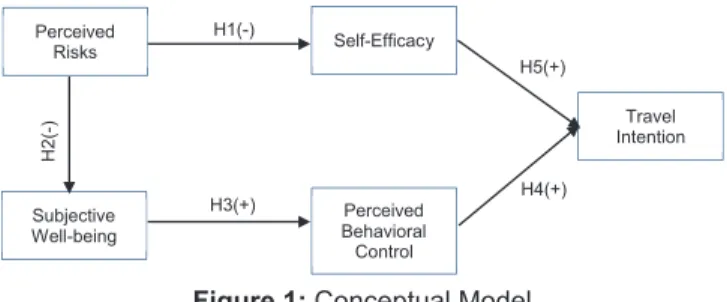
H1: Perceived risks negatively affect self-efficacy.
Sohn et al. (2016) supposed that tourists’ risk perception might relate to their satisfaction. The risks of destinations and tourists are related to the types of activities, experiences, and the existence of risk sources. Subjective well-being theory has been typically used by tourism researchers to help conceptualize and measure tourist happiness. Many dimensions of risk could affect travel intention and subjective well-being.
H2: Perceived risks negatively affect subjective well- being.
2.1.3. Subjective Well-being
According to researchers, subjective well-being (SWB) is the scientific term for happiness and life satisfaction.
A person who has a high level of satisfaction with their life, and who experiences a greater positive affect and little or less negative affect, would be deemed to have a high level of subjective well-being (Rahman et al., 2017). Subjective well- being refers to how people experience and evaluate their lives and specific domains and activities in their lives. Subjective well-being is the personal perception and experience of positive and negative emotional responses and global and (domain) specific cognitive evaluations of satisfaction with life. It has been defined as “a person’s cognitive and affective evaluations of his or her life” (Conner & Armitage, 1999).
Travel behavior affects well-being through experiences during (destination-oriented) travel, activity participation enabled by travel, activities during (destination-oriented) travel, trips where travel is the activity, and through potential travel (or motility). Therefore, subjective well-being has positive impacts on travel intention toward a particular place and customer’s feelings.
2.1.4. Perceived Behavioral Control
Perceived behavioral control refers to people’s perceptions of their ability to perform a given behavior. Bandura (1977) realized that the ability to control behavior can generate positive outcomes. Recent research has demonstrated that the overarching concept of perceived behavioral control, as commonly assessed, is comprised of two components:
self-efficacy (dealing largely with the ease or difficulty of
performing a behavior) and controllability (the extent to which performance is up to the actor) (Conner & Armitage, 1999). Perceived behavioral control can help predict intention but not behavior. Subjective well-being has a connection with perceived behavioral control in travel intention.
H3: Subjective well-being positively affects Perceived Behavioral Control.
H4: Perceived Behavioral Control positively affects Travel intention.
2.1.5. Self-Efficacy
Self-efficacy refers to an individual’s belief in his or her capacity to execute behaviors necessary to produce specific performance attainments (Bandura, 1977). Self-efficacy reflects confidence in the ability to exert control over one’s own motivation, behavior, and social environment. Negara et al. (2021) stated that self-efficacy is an individual’s level of confidence in their ability to control their motivation, behavior, or social environment. Petrick et al. (2006) assumed that self- efficacy consists of individual ability and self-confidence when dealing with difficulties. Previous studies examined tourist’s travel intention through quality, satisfaction, and value. MacInnis and Jaworski (1989) explored vacation’s intention by way of motivation, ability, and opportunity Self-efficacy could be an explanation for intention, attitudes, behaviors in general, and travel intention in particular.
H5: Self-efficacy positively affects Travel intention.
2.2. Research Model
TPB includes 3 factors of Attitude, Subjective Norms, Perceived Behavioral Control affecting Intention. Amongst these three, Subjective Norm is a reflection of social conditions.
Because this research emphasizes an individual’s internal factors, Subjective Norm from the initial TPB is excluded.
Perceived Behavioral Control and Self-Efficacy which is a component of Attitude are examined. Simultaneously, determinants of Self-Efficacy and Perceived Behavioral Control which are Perceived Risks and Subjective Well-being respectively will be investigated as well as their connection with travel intention. Based on the above hypotheses, the proposed research model is as follow (Figure 1).
3. Research Methods 3.1. Measurements
For measuring variables used in the research, a 5-point Likert scale has been used, where 1 refers to Fully disagree and 5 refers to Fully agree. Research scales are adopted
and modified from previous studies, then translated to Vietnamese to be understandable for survey participants.
Specifically, perceived risk (4 items) has been adopted from Amaro and Duarte (2013) and Cho (2004); Self Efficacy and Travel Intention (4 items) have been adopted from Hung and Petrick (2012); Subjective Well-being and Perceived Behavioral Control (3 items) have been adopted from Ajzen (1991), Amaro and Duarte (2013), Handa et al. (2014), and Su et al. (2016). A detailed questionnaire could be found in Annex 1.
Quantitative analysis is applied in this study to evaluate research hypotheses. The assessment is managed through analyzing the relationship between variables in the research model. Henseler et al. (2009) suggested a two-stage analysis to support the examination using the technique of partial least square regression (PLS). Particularly, testing the reliability and validity of the model’s variables and scales is performed in Stage 1 of ‘Evaluating measurement models’.
Stage 2 of ‘Evaluating the structural model’ includes testing hypotheses as well as predicting relevance with coefficients of determination (R
2) and path analysis using regression coefficients β.
In Stage 1, the reliability of scales will be judged along with the model’s validity assessment combined with convergent validity and discriminant validity. In Reliability analysis, Cronbach’s α and Composite reliability (CR) have to be between 0.7 and 0.95 for the qualification of scales (Hair et al., 2016). Regarding convergent validity, the average variance extracted (AVE) has to be greater than 0.5 (Chin, 1998) while outer loadings of observed variables cannot be lower than 0.7 (Götz et al., 2010). Regarding discriminant validity, the Fornell-Larcker criterion must be fulfilled with the square root of AVE larger than its components’ correlations (Fornell & Larcker, 1981). Moreover, Henseler et al. (2015) suggested that Heterotrait-Monotrait Ratio (HTMT) should not be greater than 0.9 for the distinguishability of variables.
Multi-collinearity is also appraised in this stage through variance inflation factor (VIF) that must be smaller than 5 (Hair et al., 2011).
Stage 2 of ‘Evaluating the structural model’ will be conducted after the model is qualified. To examine the model’s structure, PLS-SEM has been applied to evaluate
Figure 1: Conceptual Model
Perceived Risks
Subjective Well-being
H2(-)
Self-Efficacy
Perceived Behavioral Control
Travel Intention H1(-)
H3(+)
H5(+)
H4(+)
the relationship between latent variables through the coefficient of determination (R
2) (Hair et al., 2012) and coefficients β which are path coefficients of the model (Chin, 1998). R
2explains the variance of exogenous variables while
β demonstrates the intensity of the relationship betweenvariables in the research model. According to Cohen et al.
(2003), a model is reliable when R
2is greater than 0.26 for exogenous variables. Chin (1998), on the other hand, stated that R
2could be classified as strong, medium, or weak relative to 0.67, 0.33, and 0.19. Falk and Miller (1992) assumed that 0.10 is acceptable in deciding whether an exogenous structure can be explained by a set of endogenous structures.
In the case of unqualified R
2, the structural model could be concluded as undependable.
3.2. Data Collection
Data is collected through questionnaires designed in the Google platform where the participants were Vietnamese.
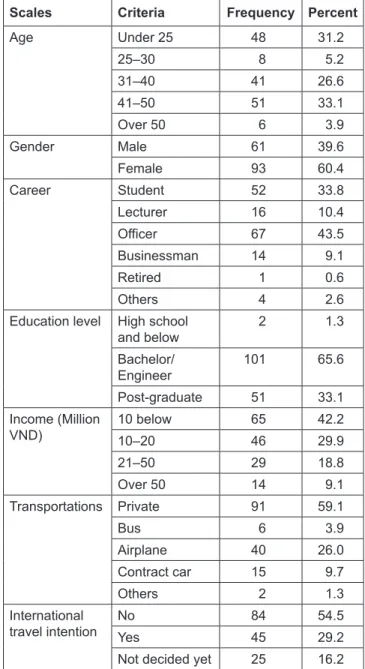
The final sample included 154 individuals participating from April 16 to May 31, 2020. Demographically, 60.4%
of answers come from women under the age of 25 years (31.2%). Then 31 to 40 years (26.6%), and 41 to 50 years (33.1%). 77.3% of participants were students or clerks.
98.7% of them have a Bachelor’s degree and higher (Table 1).
4. Results and Discussion 4.1. Measurement Model Testing
The research model includes 18 observed variables to measure 5 latent variables which are research concepts.
Table 2 demonstrates the results of the Reliability test:
Cronbach’s α falls within [0.815–0.880] interval, while CR falls within [0.891–0.918] interval. All values are with the qualified interval of [0.7; 0.95] (Hair et al., 2016) to satisfy Reliability requirements for the next stage of hypothesis testing.
All VIF values were greater than 5 and satisfied the requirement as stated in Hair et al. (2011). The VIF for Self- Efficacy was 4,650, which was still an acceptable level.
Multi-collinearity existed but did not affect the statistical analysis results. All AVE values were higher than 0.5. Outer loading values were between 0.712 and 0.928 which fulfilled the conditions of convergent validity, demonstrating that observed variables converge to represented latent structures.
Fornell and Larcker (1981) suggested criteria for evaluating discriminant validity by comparing AVE values with correlations of constructs. To be distinguishable, the root value of AVE (numbers in bold) must be higher than these correlations. Table 3 illustrates the results. Moreover, as mentioned above, HTMT (numbers in italics) in Table 3 had a maximum value of 0,819 which is under the threshold
Table 1: Descriptive Statistics
Scales Criteria Frequency Percent
Age Under 25 48 31.2
25–30 8 5.2
31–40 41 26.6
41–50 51 33.1
Over 50 6 3.9
Gender Male 61 39.6
Female 93 60.4
Career Student 52 33.8
Lecturer 16 10.4
Officer 67 43.5
Businessman 14 9.1
Retired 1 0.6
Others 4 2.6
Education level High school
and below 2 1.3
Bachelor/
Engineer 101 65.6
Post-graduate 51 33.1
Income (Million
VND) 10 below 65 42.2
10–20 46 29.9
21–50 29 18.8
Over 50 14 9.1
Transportations Private 91 59.1
Bus 6 3.9
Airplane 40 26.0
Contract car 15 9.7
Others 2 1.3
International
travel intention No 84 54.5
Yes 45 29.2
Not decided yet 25 16.2
of 0.9. With the fulfillment of the discriminant validity test, Stage 2 of Evaluating measurement model had been completed.
4.2. Structural Model Testing
Vietnam has faced several waves of diseases since 2003
and deftly contained them. Vietnam significantly succeeded
in containing the spread of the COVID-19 that kept the
number of patients low and the fatalities were few. This
success has been attributed to several key factors, including
a well-developed public health system, a decisive central government, and a proactive containment strategy based on comprehensive testing, tracing, and quarantining. However, tourism activities were completely disabled. The mobility- restriction strategy, although being able to restrain the disease from spreading in the community, influences people’s subjective well-being (Chowdhury et al., 2020) and travel intention. This research examines tourists’ travel intention in a risky environment due to the COVID-19 outbreak. The structural model was analyzed by Smart PLS 3.2.9. R
2of Travel Intention was 51,7% demonstrating the goodness-of- fit of the research model.
The results show that all 5 research hypotheses were supported (see Table 4). The Perceived Risk of tourists toward COVID-19 was proved to negatively affect Self-Efficacy and Subjective Well-being in the context of Vietnam, which is similar to Holm et al. (2017) and Sohn et al. (2016). This finding is in contrast to that in the study of Rimal (2001), which
showed the proportional connection between Perceived Risk and Self-Efficacy. The results implied that for a recovery of the tourism industry, the feelings of health safety play a critical role in forming tourists’ self-confidence in their travel decisions.
Regarding the relationship between Self-Efficacy and Travel intention, a weak relation could be concluded with a coefficient of 0.22 compared with a coefficient of 0.55 for the relation between Perceived Behavioural Control and Travel intention. During a pandemic outbreak, the belief that we cannot be infected is less important than the self-confidence that we can any unexpected circumstance.
Travelers tend to choose destinations that give them a secure feeling. This result explains why 54,5% of participants said
No to traveling abroad since COVID-19 is not restrained allover the world (See Table 1).
The results of the model’s total effect in Table 4 show a negative relation between Perceived Risk and Travel Intention, similar to Floyd et al. (2004). Floyd et al. (2004)
Table 2: Reliability, Convergent Validity, Multi-collinearity and R squaresVariables Cronbach’s α CR AVE Outer loadings VIF R2
Perceived Behavioral Control 0.819 0.892 0.734 0.841–0.880 1.652–2.113 0.389
Perceived Risks 0.855 0.900 0.694 0.747–0.863 1.802–2.242
Self-Efficacy 0.853 0.902 0.698 0.712–0.924 1.482–4.650 0.277
Subjective Well-being 0.815 0.891 0.733 0.777–0.919 1.514–2.771 0.117
Travel Intention 0.880 0.918 0.737 0.765–0.928 1.733–3.679 0.517
Table 3: Fornell-Larcker Criterion and Heterotrait-Monotrait Ratio (HTMT)
Variables Perceived
Behavioural Control Perceived
Risks Self-Efficacy Subjective
Well-being Travel Intention
Perceived Behavioural Control 0.857 0.432 0.786 0.761 0.819
Perceived Risks –0.378 0.833 0.576 0.388 0.374
Self-Efficacy 0.659 –0.526 0.836 0.785 0.673
Subjective Well-being 0.623 –0.342 0.653 0.856 0.688
Travel Intention 0.700 –0.339 0.586 0.583 0.859
Table 4: Model’s Total Effects
Paths Perceived
Behavioural Control Perceived
Risks Self-Efficacy Subjective
Well-being Travel Intention
Perceived Behavioural Control 0.555
Perceived Risks –0.213 –0.526 –0.342 –0.234
Self-Efficacy 0.220
SWB 0.623 0.346
demonstrated that travel intention for the next 12 months related to social safety perception and risk perception. Chew and Jahari (2014) also agreed with the negative relation between Perceived Risk and Travel Intention. However, Subjective Well-being, Self-Efficacy, and Perceived Behavioural Control had weakened this impact. This is true in the context of Vietnam where there is no recorded case of death due to COVID-19 so far. This helps Vietnamese to feel safe and be self-confident when traveling to domestic destinations. However, because the pandemic is not completely constrained, 89% of citizens showed the tendency to travel as a group, and 59.1% chose private transportation for traveling, which is less risky than public transportation (Vietnam National Administration of Tourism, 2020).
5. Conclusion
The tourism industry was one of the world’s greatest markets; until the world met a pandemic in the 21
stcentury, COVID-19. The tourism industry all over the world is coping with severe damages due to the COVID-19 pandemic and Vietnam is not an exception. Nevertheless, like other countries hit by COVID-19, Vietnam’s economy has also suffered significantly over the course of the outbreak.
Moreover, Vietnam’s tourism industry has been significantly affected by the pandemic.
While the situation is unprecedented, tourism is expected to rebound faster and stronger. From April 2021 until date, Vietnam has not recorded any infected cases. The research results of the Vietnam Advisory Board (TAB) reveal that 53% of respondents intend to take a trip in near future (Vietnam National Administration of Tourism, 2020). 80%
of survey participants stated that a secure destination is more attractive than an affordable one.
Vietnam chose to prevent rather than fight COVID-19, a strategy that means it has had no virus deaths. Early preparedness, contact tracing, isolation, and testing, coupled with timely border closure, physical distancing, and community adherence, have been key measures in controlling COVID-19 in Vietnam.
Vietnam can preserve human resources for post-crisis recovery. Only a month after constraining COVID-19, the Vietnam domestic tourism market has bounced back.
Every study has limitations that should be addressed in the paper. This research too has some limitations. While internal factors have been examined in this study, social factors affecting an individual’s travel intention have been ignored due to time-constraint. The period of ‘pandemic restrain’ in Vietnam is less than 2 months (the time taken for the research and online survey), which is another limitation in this research. Further studies need to be in place with advanced survey methods and a longer time horizon to analyze determinants of travel intention.
References
Ajzen, I. (1991). The theory of planned behavior. Organizational Behavior and Human Decision Processes, 50(2), 179–211.
https://doi.org/10.1016/0749-5978(91)90020-T
Amaro, S., & Duarte, P. (2013). Online travel purchasing:
A literature review. Journal of Travel and Tourism Marketing, 30(8), 755–785. https://doi.org/10.1080/10548408.2013.835227 Bandura, A. (1977). Social learning theory. Englewood Cliffs, NJ:
Prentice-Hall.
Bauer, R. (1960). Consumer behavior as risk-taking. In: R. S.
Hancock (Ed.), Dynamic marketing for a changing world (pp. 389–398). Chicago, IL: American Marketing Association.
Chew, E. Y. T., & Jahari, S. A. (2014). Destination image as a mediator between perceived risks and revisit intention: A case of post-disaster Japan. Tourism Management, 40, 382–393.
https://doi.org/10.1016/j.tourman.2013.07.008
Chin, W. W. (1998). The partial least squares approach to structural equation modeling. In G. A. Marcoulides (Ed.), Modern methods for business research (pp. 295–358). Mahwah, NJ:
Lawrence Erlbaum Associates.
Cho, J. (2004). Likelihood to abort an online transaction: influences from cognitive evaluations, attitudes, and behavioral variables.
Information and Management, 41(7), 827–838. https://doi.org/
10.1016/j.im.2003.08.013
Chowdhury, R., Heng, K., Shawon, M. S. R., Goh, G., Okonofua, D., Ochoa-Rosales, C., & Shahzad, S. (2020).
Dynamic interventions to control COVID-19 pandemic:
a multivariate prediction modeling study comparing 16 worldwide countries. European Journal of Epidemiology, 35(5), 389–399. https://doi.org/10.1007/s10654-020-00649-w Cohen, J., Cohen, P., West, S. G. & Aiken, L. S. (2003). Applied
multiple regression/correlation analysis for the behavioral sciences (3rd ed.). Mahwah, NJ: Lawrence Erlbaum Associates.
Conner, M., & Armitage, C. J. (1998). Extending the theory of planned behavior: A review and avenues for further research.
Journal of Applied Social Psychology, 28(15), 1429–1464.
https://doi.org/10.1111/j.1559-1816.1998.tb01685.x
Dholakia, U. M. (2001). A motivational process model of the product involvement and consumer risk perception. European Journal of Marketing, 35(11), 1340–1362. https://doi.org/
10.1108/EUM0000000006479
Falk, R. F., & Miller, N. B. (1992). A primer for soft modeling.
Akron, OH: University of Akron Press.
Fishbein, M., & Ajzen, I. (1975). Belief, attitude, intention, and behavior: An introduction to the theory of research. Reading, MA: Addison-Wesley.
Floyd, M. F., Gibson, H., Pennington-Gray, L., & Thapa, B.
(2004). The effect of risk perceptions on intentions to travel in the aftermath of September 11, 2001. Journal of Travel and Tourism Marketing, 15(2–3), 19–38. https://doi.org/10.1300/
J073v15n02_02
Fornell, C., & Larcker, D. F. (1981). Evaluating structural equation models with unobservable variables and measurement error.
Journal of Marketing Research, 18(1), 39–50. https://doi.
org/10.2307/3151312
Götz, O., Liehr-Gobbers, K., & Krafft, M. (2010). Evaluation of structural equation models using the partial least squares (PLS) approach. In: V. E. Vinzi, W. W. Chin, J. Hensler & H.
Wang (Eds.), Handbook of partial least squares (pp. 691–711).
Springer, Berlin, Heidelberg.
Hair Jr, J. F., Hult, G. T. M., Ringle, C., & Sarstedt, M. (2016). A primer on partial least squares structural equation modeling (PLS-SEM). Thousand Oaks, CA: Sage publications.
Hair, J. F., Ringle, C. M., & Sarstedt, M. (2011). PLS-SEM:
Indeed a silver bullet. Journal of Marketing Theory and Practice, 19(2), 139–152. https://doi.org/10.2753/MTP1069- 6679190202
Hair, J. F., Sarstedt, M., Ringle, C. M., & Mena, J. A. (2012). An assessment of the use of partial least squares structural equation modeling in marketing research. Journal of the Academy of Marketing Science, 40(3), 414–433. https://doi.org/10.1007/
s11747-011-0261-6
Handa, S., Martorano, B., Halpern, C., Pettifor, A., & Thirumurthy, H.
(2014). Subjective well-being, risk perceptions and time discounting: Evidence from a large-scale cash transfer program. (Office of Research Working Paper). UNICEF.
https://www.unicef-irc.org/publications/717-subjective-well- being-risk-perceptions-and-time-discounting-evidence-from- a-large.html
Henseler, J., Ringle, C. M., & Sarstedt, M. (2015). A new criterion for assessing discriminant validity in variance-based structural equation modeling. Journal of the Academy of Marketing Science, 43(1), 115–135. https://doi.org/10.1007/s11747-014- 0403-8
Henseler, J., Ringle, C. M., & Sinkovics, R. R. (2009). The use of partial least squares path modeling in international marketing.
In: R. R. Sinkovics & P. N. Ghauri, P.N. (Eds.), New challenges to international marketing (Vol. 20, pp. 277–319). Bingley:
Emerald Group Publishing Limited. https://doi.org/10.1108/
S1474-7979(2009)0000020014
Herwany, A., Febrian, E., Anwar, M., & Gunardi, A. (2021).
The influence of the COVID-19 pandemic on stock market returns in Indonesia stock exchange. Journal of Asian Finance, Economics, and Business, 8(3), 39–47. https://doi.
org/10.13106/jafeb.2021.vol8.no3.0039
Holm, M. R., Lugosi, P., Croes, R. R., & Torres, E. N. (2017). Risk- tourism, risk-taking and subjective well-being: A review and synthesis. Tourism Management, 63, 115–122. https://doi.org/
10.1016/j.tourman.2017.06.004
Hung, K., & Petrick, J. F. (2012). Testing the effects of congruity, travel constraints, and self-efficacy on travel intentions: An alternative decision-making model. Tourism Management, 33(4), 855–867. https://doi.org/10.1016/
j.tourman.2011.09.007
Kim, L. H., Qu, H., & Kim, D. J. (2009). A study of perceived risk and risk reduction of purchasing air tickets online.
Journal of Travel and Tourism Marketing, 26(3), 203–224. https://doi.org/10.1080/10548400902925031 Lee, C. K., Song, H. J., Bendle, L. J., Kim, M. J., & Han, H. (2012).
The impact of non-pharmaceutical interventions for 2009 H1N1 influenza on travel intentions: A model of goal-directed behavior. Tourism Management, 33(1), 89–99. https://doi.
org/10.1016/j.tourman.2011.02.006
Lehto, X., Douglas, A. C., & Park, J. (2008). Mediating the effects of natural disasters on travel intention. Journal of Travel and Tourism Marketing, 23(2–4), 29–43. https://doi.org/10.1300/
J073v23n02_03
MacInnis, D. J., & Jaworski, B. J. (1989). Information processing from advertisements: Toward an integrative framework. Journal of Marketing, 53(4), 1–23. https://doi.org/10.2307/1251376 Negara, D. J., Ferdinand, F., Meitiana, M., Astuti, M. H., Anden, T.,
Sarlawa, R., & Mahrita, A. (2021). Knowledge sharing behavior in Indonesia: An application of planned behavior theory. Journal of Asian Finance, Economics, and Business, 8(3), 1053–1064.
https://doi.org/10.13106/jafeb.2021.vol8.no3.1053
Petrick, J. F., Tonner, C., & Quinn, C. (2006). The utilization of critical incident technique to examine cruise passengers’
repurchase intentions. Journal of Travel Research, 44(3), 273–280. https://doi.org/10.1177/0047287505282944
Rahman, S. A., Taghizadeh, S. K., Ramayah, T., & Alam, M. M. D.
(2017). Technology acceptance among micro-entrepreneurs in marginalized social strata: The case of social innovation in Bangladesh. Technological Forecasting and Social Change, 118, 236–245. https://doi.org/10.1016/j.techfore.2017.01.027 Rimal, R. N. (2001). Perceived risk and self‐efficacy as
motivators: Understanding individuals’ long‐term use of health information. Journal of Communication, 51(4), 633–654.
https://doi.org/10.1111/j.1460-2466.2001.tb02900.x
Ritchie, B. W. (2004). Chaos, crises, and disasters: a strategic approach to crisis management in the tourism industry. Tourism Management, 25(6), 669–683. https://doi.org/10.1016/
j.tourman.2003.09.004
Saayman, M., Li, G., Uysal, M., & Song, H. (2018). Tourist satisfaction and subjective well‐being: An index approach.
International Journal of Tourism Research, 20(3), 388–399.
https://doi.org/10.1002/jtr.2190
Schiffman, L., & Kanuk, L. (2009). Consumer behavior (10th ed.).
Harlow, England: Prentice-Hall.
Sohn, H. K., Lee, T. J., & Yoon, Y. S. (2016). Relationship between perceived risk, evaluation, satisfaction, and behavioral intention: A case of local-festival visitors. Journal of Travel and Tourism Marketing, 33(1), 28–45. https://doi.org/10.1080 /10548408.2015.1024912
Su, L., Swanson, S. R., & Chen, X. (2016). The effects of perceived service quality on repurchase intentions and subjective well- being of Chinese tourists: The mediating role of relationship
quality. Tourism Management, 52, 82–95. https://doi.org/
10.1016/j.tourman.2015.06.012
United Nations World Tourism Organization (UNWTO). (2020).
Restrictions on tourism travel starting to ease but caution remains. https://www.unwto.org/news/COVID-19-restrictions- on-tourism-travel.
Vietnam National Administration of Tourism. (2020).
Connectivity is crucial for domestic tourism to reboot post-
COVID-19. http://vietnamtourism.gov.vn/english/index.php/
items/14945.
Wilder-Smith, A. (2006). The severe acute respiratory syndrome:
Impact on travel and tourism. Travel Medicine and Infectious Disease, 4(2), 53–60. https://doi.org/10.1016/j.tmaid.2005.04.004 World Health Organization (WHO). (2020). WHO coronavirus
disease (COVID-19) Situation Dashboard. https://COVID19.
who.int/
Appendix: Constructs Measurement
Code Perceived Risk Source
PR1 At present, I feel uncomfortable when traveling in Vietnam. Cho (2004)
Amaro and Duarte (2013) PR2 At present, I feel afraid when traveling in Vietnam.
PR3 At present, I think traveling in Vietnam is risky for my healthiness.
PR4 At present, there are too many uncertainties when traveling in Vietnam.
Self-Efficacy
SE1 I make a trip to Vietnam because I feel it is safe for my healthiness.
Hung and Petrick (2012) SE2 I make a trip to Vietnam because I feel it is safe for my family’s healthiness.
SE3 I am not alone when traveling in Vietnam.
SE4 At present, I care about traveling in Vietnam.
Subjective Well-being
SW1 At present, I feel happy when traveling in Vietnam. Handa et al. (2014)
Su et al. (2016) SW2 At present, I feel happier than others when traveling in Vietnam.
SW3 At present, I feel I can do whatever I want when traveling in Vietnam.
Perceived Behavioural Control
PBC1 When traveling in Vietnam for now, my healthiness is under my control. Ajzen (1991)
Amaro and Duarte (2013) PBC2 When traveling in Vietnam for now, it is easy to conduct health-protecting activities.
PBC3 I have resources, time, and opportunity to protect my healthiness when traveling in Vietnam for now.
Travel Intention
TI1 I will share positive comments about my trip to Vietnam. Hung and Petrick (2012) Amaro and Duarte (2013) TI2 I am going to travel to Vietnam next month.
TI3 I encourage my family members and friends to travel to Vietnam.
TI4 I am going to recommend traveling in Vietnam for others.