Print ISSN: 2288-4637 / Online ISSN 2288-4645 doi:10.13106/jafeb.2020.vol7.no12.877
Factors Affecting Activity-Based Costing Adoption in Autonomous Public Universities in Vietnam*
Thi Bich Ngoc HOANG
1, Duc Hieu PHAM
2, Thi Minh Giang NGUYEN
3, Thi Thanh Phuong NGUYEN
4Received: September 10, 2020 Revised: November 08, 2020 Accepted: November 16, 2020
Abstract
The main aim of the present study is to investigate the factors that are considered affecting the adoption of Activity-Based Costing (ABC) in the autonomous public universities in Vietnam. A quantitative research was carried out. The data was collected through an online questionnaire survey between June 2020 and September 2020 addressed to the target respondents comprising 168 managers and accountants from 23 autonomous public universities in Vietnam, which participated in the resolution project No. 77/NQ-CP of the Vietnamese government on the pilot renovation of operational mechanisms of public tertiary education institutions during the period of four years, from 2014 to 2017. The findings resulted from hypothesis testing by a binary regression analysis based on the SPSS 20.0 software show that training, competition, support of top manager, and university size are the four main factors that positively affect the adoption of Activity-Based Costing (ABC) in studied universities. On the other hand, no statistically significant impact was found on two other variables, namely the variety of services provided and the usefulness of cost information factors. From the research results, discussions and policy recommendations have been presented to promote the adoption of Activity-Based Costing (ABC) in Vietnamese autonomous public universities in the coming time.
Keywords: Activity-Based Costing, Adoption, Autonomous Public Universities, Factors, Vietnam JEL Classification Code: I28, M10, M40, M41
2011). Since its introduction, ABC has attracted the attention of many academics and accounting practitioners. ABC has emerged as an important tool in business. Gradually, ABC has penetrated into non-profit organizations including higher educational institutions. Research on ABC is mainly focused in manufacturing, and then developed into the service and public sectors (Bjørnenak & Mitchell 2002). Although the empirical evidence supports ABC’s positive role in improving firm operations, productivity and profitability, the adoption of ABC on a global scale is not high (Charaf & Bescos, 2013). The prior research results are true for both industry and education and training services. Researchers found that ABC adoption rates are higher in developed countries than in developing countries (Charaf & Bescos, 2013).
Vietnam is a country with a transition economy, which has made remarkable achievements in economic growth. In recent years, the need for integration and globalization in the educational sector has increased the competitive pressure on public universities in Vietnam. On the other hand, the policy of increasing autonomy for public universities, and the reduced funding from the State budget has forced these universities to consider changing the cost accounting system to provide useful information for decision-making.
*Acknowledgments:
1
The authors would like to thank anonymous referees for their constructive comments on the earlier version of this paper.
1
First Author. Lecturer, Department of Managerial Accounting, Thuongmai University, Vietnam. Email: [email protected]
2
Corresponding Author. Lecturer, Department of Auditing, Thuongmai University, Vietnam [Postal Address: 79 Ho Tung Mau Street, Cau Giay District, Hanoi, 122868, Vietnam]
Email: [email protected]
3
Lecturer, Department of Managerial Accounting, Thuongmai University, Vietnam. Email: [email protected]
4
Lecturer, Department of Financial Accounting, Thuongmai University, Vietnam. Email: [email protected]
© Copyright: The Author(s)
This is an Open Access article distributed under the terms of the Creative Commons Attribution Non-Commercial License (https://creativecommons.org/licenses/by-nc/4.0/) which permits unrestricted non-commercial use, distribution, and reproduction in any medium, provided the original work is properly cited.
1. Introduction
Activity-based costing (ABC) was first introduced in the late 1980s by Johnson and Kaplan. ABC has corrected serious deficiencies in traditional standard-costing systems.
ABC is considered the greatest innovation in management
accounting in the 21
stcentury (Grondskis & Sapkauskiene,
The study aims to: (1) investigate if ABC is considerate adoption in the autonomous public universities in Vietnam;
(2) identify the factors affecting ABC adoption in Vietnamese autonomous public universities; and (3) propose solutions to promote ABC adoption in autonomous public universities in Vietnam in the coming time.
The structure of the study is as follows: The next section presents a review of literature on ABC adoption in organizations, followed by research hypothesis development.
The third section presents research methodology including measurement scale, questionnaire design, target respondents and sample, and data analysis. Then, the research results are presented in the fourth section. Finally, the fifth section ends the paper with discussion and recommendations.
2. Literature Review and Research Hypotheses
2.1. Literature Review
ABC adoption in enterprises has been studied for a long time. Several studies have addressed various aspects of the ABC systems, providing insights into the use of ABC in specific sectors, examining the significance of alternative factors on adopting ABC and the impact of ABC implementation on the organizations. The focus of this review is on issues discussed by previous studies relevant to ABC adoption in organizations.
Studies on the ABC adoption show that there is a difference in the ABC adoption rate between countries globally. In the UK, Innes, Mitchell and Sinclair (2000) reported that 17.5 per cent of firms actually implemented ABC, while Tayles and Drury (2001) reported a 23 per cent diffusion rate. Bhimani et al. (2007) conducted a cross national survey in seven countries and found that the proportion of respondents using ABC across business units is as follows: Canada (39.1 per cent), France (21.6 per cent), Germany (50 per cent), Italy (26.3 per cent), UK (55.8 per cent), US (54.4 per cent), and Japan (6.1 per cent). These results cannot be compared with each other because of some differences in the authors’ approach to the studies.
According to Aldukhil (2012), the differences in results may be attributed to the differences in survey questions. Some researchers may include in the adoption rate firms that intend to implement ABC in the future or firms that have already discontinued it. Further, some researchers may investigate the extent of ABC adoption rather than a dichotomous indication of ABC adoption (Krumwiede, 1998; Aldukhil, 2012). Also, some researchers do not differentiate between ABC and ABM while others do (Aldukhil; 2012).
Research on the ABC adoption based on theories such as contingency theory (Al-omiri, 2012; Brierley, 2009;
Rankin, 2016), diffusion innovation theory, and strategic
management theory (Gosselin, 1997; Baird et al., 2004).
Theory can be used alone or in combination with others, for example of Rankin (2016) using a combination of innovation theory and strategic management, research by Al-omiri (2003) and Aldukhil (2012) using a combination of the contingency theory and diffusion innovation. Whatever the theoretical approach may be but the factors that are taken into consideration are the factors that make an effect on ABC adoption including technical factors, behavioral factors and organizational factors. Researchers have explored factors that influence ABC implementation such as top management support, linkages to competitive strategy, training and consensus, and clarity regarding ABC objectives (Shields 1995). Shields (1995) found that successful implementation of ABC is associated with behavioral and organizational factors. These factors are top management support, linkages to competitive strategies, linkages to performance evaluation and compensation, training in implementing ABC, non- accounting ownership, and adequate resources.
Anderson and Young (1999) found that ABC success is influenced by contextual and process variables, including top management and union support of the ABC project, adequacy of resources, individual commitment to the organization, the likelihood of lay-offs, and the degree to which good performance is expected to be rewarded. Anderson (1995) points out that some factors including individual, organizational, technology, task and environmental factors have different impacts among the various stages. Askarany and Smith (2004) found that the diffusion of six innovations including ABC is positively associated with employee awareness of the benefits of an innovation, employee awareness of the availability of an innovation, management commitment on implementation of an innovation, the employment of consultants to facilitate implementation of an innovation, and negatively associated with the lack of confidence in the new cost accounting technique.
ABC is a private sector innovation, which has been successfully implemented and also used in the public sector and universities (Cropper & Cook, 2000). Until now, there is not one complete statistical work on ABC research in the education sector. A very few studies were devoted to non-profit organization, especially with higher education institutions. However, the research of Sumrall (2019) shows that ABC adoption in universities globally has received limited attention. In the education and training sector worldwide, the adoption rate is reported to be just 9.7% (Aldukhil, 2012).
According to Ismail (2010) and Aldukhil (2012) most of
the applications of ABC before 2000 were in the English-
speaking world: Australia, Canada, Great Britain, Hong
Kong, and the U.S. However, this is certainly not the case as
of 2019 where several research projects have been conducted
worldwide since 2000 (Sumrall, 2019). These include survey
studies on ABC in UK universities (Al-omiri & Drury, 2007;
Cropper & Cook, 2000), in Australian universities (Ellis- Newman, 2003), in Malaysian universities (Ismail, 2010), in Estonian universities (Kont, 2011).
The studies focus on ABC adoption in specific universities so that the case study method is mainly used. An interesting observation of these studies was the choice of university departments and libraries. These include the researchs in Australia (Ellis-Newman, 2003), in UK (Goddard & Ooi, 1998), and in Estonia (Kont, 2011). ABC is ideally suited for use in academic libraries because library activities are distinct and separable. Research regarding the factors affecting on the ABC adoption among universities is quite limited. Madwe et al. (2020) reported the awareness of and attitudes towards ABC held by finance staff of six technical and vocational educating and training (TVET) colleges in KwaZulu-Natal, South Africa proposed a novel model for its successful adoption. Approach on the contingency theory, the behavioral and organizational factors as well as the technical factors are tests of factors affecting the ABC adoption at the colleges. The study points out that lack of top managers’ support, the colleges’ cost structure and technical factors are barriers to the implementation of ABC in their institutions. The study of Sumrall (2019) determines the extent of ABC implementation and examines the reasons for the implementation of ABC in Australian universities. The study points out that ABC implementers are dominated by larger universities on both counts – number of employees and annual turnover. ABC adoption and implementation benefits from top management support during both the trial period and post-implementation. Time and cost associated with ABC implementation is reported as the dominant reason for not implementing ABC. The lack of empirical studies motivates the researchers to do this study on factors that addresses ABC adoption among universities in Vietnam.
2.2. Research hypotheses
The factors proposed in the literature that might affect ABC adoption are divided into behavioral and organizational factors and technical factors. Behavioral and organizational factors consist of the size of the organization, support of top managers, cost structure, product diversity, resistance to change, the presence of an internal champion and innovation, internal resource availability, and training.
Technical factors consist of identifying activities, grouping and aggregating these activities, assigning resources and costs to these activities and objects, and selecting cost drivers of indirect costs. In this study, some predicted behavioral and organizational factors are discussed in turn.
University size (QM)
Organizational size is a factor included in most research models on ABC adoption in business organizations (Gosselin, 1997; Al-omiri, 2003; Brierley, 2009; Rankin,
2016) or in university (Madwe et al., 2020; Nguyen, 2020).
Studies have found a positive relationship between ABC adoption and organization scale. According to Moores and Chenhall (1994), there are some reasons for this relationship including: (i) the demand for management information for planning, control and coordination activities is greater in larger organizations; (ii) larger organizations are more able to commit resources to the development and implementation of activity management practices; and (iii) the more resources are available to activity management practices, the better those practices are likely to be and the higher their perceived benefits. The size of the university determines the size of the resources used, the techniques of cost allocation.
Universities with large scales often have larger cost scales and more complex cost-allocation techniques than the small universities. Hence:
H1: University size affects the adoption of ABC in autonomous public universities in Vietnam.
Competition (CT)
Many previous studies have identified a positive relationship between the competition in the market and the use of a management accounting system. Regarding product costing, it is suggested that when there is a high level of competition, companies should implement ABC (Kaplan & Cooper, 1998; Pham et al., 2020). Therefore, it can be expected that an organization facing a high level of competition will consider adopting ABC. In recent years, Vietnam has participated in the General Agreement on Trade and Services (GATS) - the Agreement to ensure free access to the education market. It has led to the Vietnamese public universities facing fierce competition. Hence:
H2: The competition positively affects the adoption of ABC in autonomous public universities in Vietnam.
Support of the top manager (HT)
The role of top manager in ABC implementation has
been studied by many authors (Aldukhil, 2012; Madwe
et al., 2020; Pham et al., 2020). In an organization, top
manager has the role of determining the vision and
policy, making decisions, solving problems, driving the
organization to growth and survival and motivating all
employees involved in the application of the accounting
system. Thus, the awareness and support of top managers
ensure the successful application of new accounting
systems such as ABC for an organization. Success is more
likely to be achieved when top managers support ABC
adoption (Aldukhil, 2012; Elagili, 2015). The support
of top managers is not only necessary in the early stages
of ABC implementation but also an ongoing process for
maintaining new systems (Aldukhil, 2012). Hence:
H3: The support of top managers affects the ABC adoption in autonomous public universities in Vietnam.
ABC Training (DT)
Training aims to provide knowledge and transfer experiences to help employees in the organization develop a positive attitude when being introduced to ABC. Training provides knowledge of designing, implementing and using ABC to organizations. Therefore, training is a prerequisite factor to ensure that employees understand the benefits of the system and help them make decisions (Elagili, 2015).
Elagili (2015) points out that it is necessary to have training and promotion programs for administrative staff, followed by implementers and users. Hence:
H4: Training positively affects the ABC adoption in autonomous public universities in Vietnam.
Variety of services provided (DD)
Empirical studies have reported on the relationship between product diversity and ABC adoption. According to Schoute (2011), product diversity is also a major factor in ABC adoption. Krumwiede (1998) found a positive association between product diversity and ABC adoption, indicating that ABC adoption is higher among firms with higher product diversity. However, Clarke, Hill and Stevens (1997) found a negative relationship between product diversity and ABC adoption. Universities providing a variety of courses will need precise cost allocation, therefore, they are more likely to adopt ABC.
Hence:
H5: The variety of services provided affects the ABC adoption in autonomous public universities in Vietnam.
Usefulness of cost information (HI)
The usefulness of cost information has been studied by (Gosselin, 1997; Baird et al., 2004; Rankin, 2016).
Information is useful if it helps managers make decisions.
Therefore, the organization will be able to adopt ABC if it creates the information system used in decision making.
ABC has corrected serious deficiencies in traditional standard-costing systems. However, organizations are only expected to adopt ABC if it will generate information that will be used in decision-making. Krumwiede (1998) said that even if ABC will reduce cost distortions substantially, it probably will not be implemented unless a company can use the better cost in its decision making. Hence:
H6: The usefulness of cost information affects the ABC adoption in public universities in Vietnam.
The research model presented below summarizes the hypotheses on factors affecting ABC adoption in public universities in Vietnam.
3. Research Method
Survey method was used in this study. Survey method was proposed by Young and Selto (1991) to develop and test theories related to changes in management accounting information. The survey method is commonly used in business studies and is consistent with previous ABC-related studies.
3.1. Measurement Scales
The measurement scales are based on original studies (Gosselin, 1997; Krumwiede, 1998; Al-omiri & Drury, 2007;
Brierley, 2009; Aldukhil, 2012; Rankin, 2016; Nguyen, 2020; Nguyen, 2020; Pham et al., 2020) and developed by the researcher for the research context in autonomous public universities.
Dependent variable (ABC adoption - KN): Respondents were asked to answer the question regarding ABC adoption in their university. The ABC adoption was obtained from a single question with responses of current ABC adoption (not-adopted or adopted). For the purposes of the binary regression analysis, a response with ABC adoption is coded as ‘1’and a response with non-adoption is coded as ‘0’.
Independent variables: The 5-point Likert scale is used to measure independent variables. Six independent variables of the study were measured through 20 questions.
Each question was presented as a statement and respondents were asked to indicate the extent to which they agree with each statement on a 5-point Likert scale, anchored on 1 for strongly disagree and 5 for strongly agree. The details of independent variables are presented as follows:
ABC adoption
University size
Competition
Support of top managers
Training
Variety of services provided
Usefulness of cost
information
Figure 1: The research model
University size (QM) is measured by the average score of 3 questions developed by the researcher, covering the number of students, the number of full-time employees, and the revenues of the university.
The usefulness of cost information (HI) is measured by the average score of 4 questions about the use of cost information for making decisions in the university. That includes cost information for short-term decisions, cost information for long-term decisions, cost information for performance evaluation decision, and cost information for pricing purposes.
The variety of services provided (DD) is measured by the average score of 3 questions, including the variety of training systems, the diversity of training degrees, and the diversity of training programs.
The support of top managers (HT) is measured by the average score of 3 questions, relating to sufficient resource provision, implementation support, and performance support.
Training (DT) is measured by the average score of 4 questions, focusing on the role of ABC, the design of ABC, the implementation of ABC, and the use of ABC.
Competition (CT) is measured by a composite scale constructed averaging the responses for 3 questions, including tuition fee, number of competitors, and prestige and reputation of the university.
The pilot questionnaire was firstly tested by a small group of managers and accountants in the University of Commerce and subsequently completed and distributed widely by email to accountants and managers at 23 autonomous public universities in Vietnam.
3.2. Questionnaire Design
The target respondents are both managers and accountants at 23 autonomous public universities in Vietnam. Generally, managers decide to adopt or not to adopt ABC and rely on information related to ABC for their making decisions.
Accountants are responsible for designing and implementing ABC in the organization. Therefore, the survey on perceptions of both managers and accountants expects to reflect accurately the extent of ABC adoption in autonomous public universities. In total, there are 250 distributed questionnaires between June 2020 and September 2020; the collected number is 168, at a rate of 67.2%.
3.3. Data Analysis
After cleaning the data, researchers use SPSS version 20.0 to analyze data. Firstly, Cronbach’s alpha is calculated to measure the internal consistency of the scale. Then, Exploratory Factor Analysis (EFA) is run to test the relatively scale, determine the model’s suitability indicators
as well as calculate and verify the reliability indicators of the scale. When the scale indicators are satisfactory, a regression analysis is carried out. The binary regression model is used with dependent variable being ABC adoption (KN), independent variables including university size (QM), training (DT), usefulness of cost information (HI), competition (CT), support of top managers (HT), and variety of services provided (DD). The regression model is as follows:
0 1 2 3
4 5 6
B B QM B DT B HI 1
B CT B HT B DD
= + + +
−
+ + +
i i
Log P P
Where: P
i: Probability of ABC adoption; B
0, B
1, B
2, B
3, B
4, B
5, B
6: Regression coefficient; and QM, DT, HI, CT, HT, DD: Independent variables.
4. Results and Discussion 4.1. Reliability Analysis
Cronbach’s alpha is used to measure the internal consistency of the scale. The final results show that among 6 independent variables, there are 5 variables which have Cronbach’s alpha greater than 0.7 and less than 9.5, only support of top managers variable receives Cronbach’s alpha of 0.636. Nunnally (1978) and Peterson (1994) suggest that Crobach’s alpha equal 0.6 or higher is usable in cases where the measurement concept or the context of the study is new for the respondents. The measurement scale of top managers’ support is not a new concept in ABC studies in the industrial sector, but for the educational sector, it is quite new. Therefore, Cronbach’s alpha at 0.636 is considered reliable. These results indicate that the initial scales ensure validity and reliability.
4.2. Exploratory Factor Analysis (EFA)
The results of exploratory factor analysis (Table 1) shows that KMO coefficient = 0.694 is suitable for factor analysis, Bartlett’s Test has sig = 0.00 <0.05, showing the correlation of the observed variables in the same factor. Using Extraction Method of Principal Component Analysis and the Rotation Method of Varimax with Kaiser Normalization for the analysis of the independent variables embraced in the model, it was found that six factors are extracted at Eigenvalue
= 1.488>1. Furthermore, since total variance extracted
= 61.148%> 50% shows the EFA model is appropriate.
Hence, the six extracted factors will explain 61.148% of the
variability of the observation.
5. Conclusion and Recommendations 5.1. Conclusion
Research results point out that ABC adoption is significantly affected by training, competition, support from top managers, and size of the university. These findings are consistent with previous studies on ABC adoption in the business sector (Kaplan & Cooper, 1998, Krumwiede, 1998; Aldukhil, 2012; Rankin, 2016). Compared with previous studies in the educational sector, the findings are consistent with Sumrall (2019), but in contradiction to Madwe et al. (2020). From this result, once again, the study confirms that training activities are very necessary for the success in application of innovations in accounting. The level of competition is also reflected in the actual operating environment of Vietnamese universities. The competition for higher education in Vietnam increased when the country became an official member of the WTO, signed the General Agreement on Trade and Services (GATS) ensuring free access to the education market that encompasses all types of educational products and educational institutions.
On the other hand, the autonomous mechanism allows universities to be more autonomous in operation, but also puts the universities in a situation of greater competition due to reduced funding by the government. Therefore, they need new tools for more accurate cost allocation to increase competitiveness. The support from top managers is one of the decisive factors for the success or failure of ABC application.
4.3. Multiple Regression Analysis
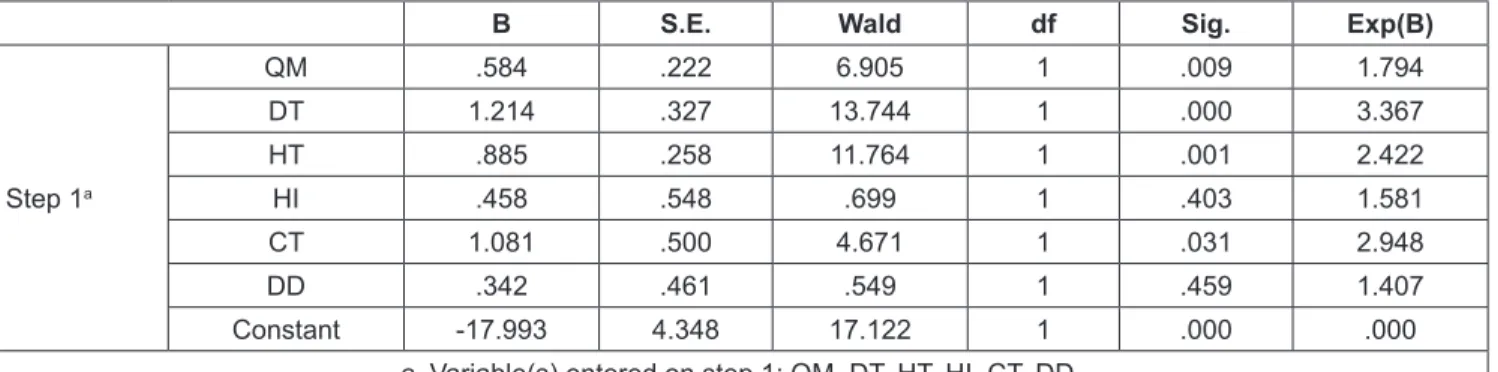
The study uses binary regression to test hypotheses about the influence of factors on ABC adoption in autonomous public universities in Vietnam. The results of the Binary Regression analysis showed that Chi-square = 50.232, Sig = 0.00 <0.05, -2 Log likelihood = 87.567 are statistically significant. Thus, the model is significant and qualified for further assessment.
Table 2 provides Binary regression results. The study finds that four variables QM, DT, HT, and HI have a significant and positive impact on the ABC adoption in the organization.
Thus, hypothesis H1, H2, H3, and H4 are accepted with significance at 5%. On the other hand, the study does not find any significant relationships for the remaining variables: DD and HI since Sig. values are 0.459 and 0.403 respectively and greater than 0.05. Hence, hypotheses H5 and H6 are not supported. Consequently, the results of Binary regression analysis can be presented as follows:
17.993 0.584QM 1.214DT 1
1.081CT 0.885HT
= − + +
−
+ +
i i