─ 70 ─ https://doi.org/10.11614/KSL.2017.50.1.070
ISSN: 2288-1115 (Print), 2288-1123 (Online)
ⓒ The Korean Society of Limnology. All rights reserved.
This is an open-access article distributed under the terms of the Creative Commons Attribution Non-Commercial License (http://creativecommons.org/licenses/by-nc/3.0/), which permits unrestricted non-commercial use, distribution, and reproduction in any medium, provide the original work is properly cited.
서 론
오리나무(Alnus japonica(Thunb.) Steud.)가 우점하는 식분은 전국적으로 보고되고 있으나(Heo et al., 2007; Kim et al., 2010, 2013; Paik, 2010), 그 면적은 제한적이다. 오리 나무의 서식처는 산지습지 및 계곡, 하천변 범람원, 배후습
지, 충적저지 등인데(Sakio and Yamamoto, 2002), 이러한 곳은 고대 선사시대로부터 잠재적 토지 자원으로서 이용 된 역사는 오래다(Kim, 2013).
오리나무 우점 식생에 대한 오리나무군락이라는 명칭이 경기도 대모산에서 기재된 바 있다(Yim and Han, 1989).
하지만 군락구조와 종조성과 습지 서식처에 대응하는 소택 림 또는 습생림으로서의 식물사회학적 첫 기재는 울산 무 제치늪의 산지 중간습원을 특징짓는 오리나무-진퍼리새군 락(Kim and Kim, 2003)에서 찾아볼 수 있다. 그 밖에 부 산 금정산에서 오리나무-찔레꽃군집(Lee and Kim, 2005),
군위군 화산습지의 식생 : 오리나무림을 중심으로
김종원·이승은
1,
*·이정아 계명대학교 생명과학과,1
국립생태원Hwasan Wetland Vegetation in Gunwi, South Korea: with a Phytosociological Focus on Alder (Alnus japonica (Thunb.) Steud.) Forests. Kim, Jong-Won (0000-0002-7698-9404), Seung-eun Lee
1,* (0000-0002-2125- 6545) and Jung-a Lee (0000-0002-1193-6248) (School of Biological Sciences, Keimyung University, Daegu 42601, Republic of Korea;
1Division of Ecological Assessment National Institute of Ecology, Seocheon-gun 33657, Republic of Korea)
Abstract The Hwasan wetland vegetation is observed at mountain basin
(644~780m a.s.l.) where had become a potential land for indigenous people since prehistoric period. We phytosociologically investigated old-growth alder(Alnus japonica) forests using the Zürich-Montpellier School’s method and analyzed their spatial distribution pattern by actual vegetation map. Species performance was determined by using coverage and r-NCD. Viburnum opulus var. calvescens-Alnus japonica community syntaxonomically belonging to the Alnetea japonicae was first described and composed of three subunits: Salix koreensis subcommunity, typical subcommunity, and Pyrus ussuriensis subcommunity. Present plant community was compared with vicariant syntaxa such as Molinia japonica-Alnus japonica community, Rhamno nipponicae-Alnetum japonicae, and Aceri-Salicetum koreensis. Hwasan’s alder forest, an alluvial terrace vegetation type on valley fan in the montane zone, is evaluated as vegetation class [I], which is a sort of benchmark plant community potentially on mountain wetlands in southeastern part of the Korean Peninsula. Simultaneously we suggested an establishment of the national strategy for habitat conservation free from hydrologically radical transform due to military utilization.Key word: Alnetea japonicae, old-growth alder forest, syntaxonomy, vegetation class, Zürich-Montpellier
SchoolManuscript received 13 December 2016, revised 29 December 2016, revision accepted 2 January 2017
* Corresponding author: Tel: +82-41-950-5935, Fax: +82-41-950-5954,
E-mail: [email protected]
민통선을 포함한 강원도 일대에서 오리나무군락, 오리나 무-버드나무군락, 오리나무-아까시나무군락, 갈대-오리 나무군락(Jeong et al., 2001; Kim et al., 2010; Lee et al., 2010, 2013), 인천 무의도에서 오리나무군락(Paik, 2010) 등의 다양한 단위식생명이 기재된 바 있다.
본 연구의 대상이 된 화산습지는 과거 고랭지 농업이 성 행했던 곳으로 일부에서는 지금까지도 농사가 이루어지고 있다(Son and Kim, 1998). 1960년대 후반 군사훈련 시설이 들어서면서 민간인 출입 제한과 휴경으로 말미암아 노령 의 오리나무가 관찰되고 있다. 이곳의 오리나무 숲은 식분 의 발달기간과 피복 면적의 관점에서 희귀한 삼림식생으 로 평가된 바 있다(Kim and Lee, 2011). 본 연구의 목적은 오리나무 우점림과 그 주변식생에 대한 군락분류와 군락 분포를 규명하고, 화산습지의 보전 및 관리방안을 제시하 는 것에 있다.
재료 및 방법
화산습지는 경상북도 군위군 고로면 일원이며, 영천시 신령면과의 경계에 위치(36°05ʹ43ʺN 128°48ʹ20ʺE)하고, 해 발고도 644~780m의 산정 분지이다(Fig. 1). 조사 대상이 된 면적은 약 1.77km
2
로 습지를 에워싸는 산지 비탈면을 포함하고, 가로 장축 약 2,100m, 세로 장축 약 1,200m의 일그러진 타원형이다. 기반암은 하양층군으로, 북쪽에 화 강암이 관입하면서 열접촉변성 작용을 받아 침식에 강한 암석(Kang and Lee, 2012)이 산재하여 산정 분지의 수자원 이 집수되고, 북서쪽 비탈면으로 물길의 출구가 있는 형상 이다. 지표면 상부 토양은 갈색삼림토이지만, 하부 토양은 투수성이 불량한 회색사질토로 쉽게 포화된다(Yang and Han, 2012). 분지 내의 수자원의 지탱가능성으로부터 고대 사회로부터 주목을 받은 입지로 추정된다. 역사 시대에는 산성(山城)으로 이용된 여러 유구가 발굴된 바 있고(CHA, 2016), 샘을 중심으로 축조된 우물 유적이 지금도 남아 있 다. 1968년 이후로 군사 훈련장으로 이용되고 있으며(Blog of Republic of Korea Army, 2016), 오래 전부터 개간촌이 형성되어 고랭지 농업이 이루어진 바 있다(Son and Kim, 1998).화산습지는 동해안으로 직선 거리로 52km 떨어진 3차 산맥(Kim and Im, 2005)의 산정부에 위치하면서 산정 기 후효과가 추정된다. 하지만 현지 기후 정보는 알려져 있지 않다. 연구 지역으로부터 최근접 지역(신령, 화북, 영천, 하 양)의 AWS(자동기상관측장비의 평균해발 약 106m, KMA, 2016)의 정보로부터 산출된 연평균기온과 강수량은 각각
12.6℃와 1,110.3mm로 나타났다. 화산습지의 평균해발고 도(712m)와 표고 상승에 따른 표준대기단열감율 0.65℃/
100m를 고려하면, 연구대상지역의 연평균기온은 약 8.7
℃가 된다. 이것은 한반도 동남단 영남알프스 산정부에 발 달한 습지 일대(Kim, 2016)와 어상반한 온도 환경이다.
현장 식생조사 및 군락분류는 서식처 환경조건과 식물 사회 종조성의 균질성과 대응성을 강조하는 Z.-M. 학파 (Braun-Blanquet, 1965)의 식물사회학적 방법을 따랐다. 식 생조사구 내 출현종을 층별로 기재하고, 양적 평가는 9계 급의 변환통합우점도(Westhoff and van der Maarel, 1978) 를 이용하였다. 유형화된 단위식생에 대한 출현종의 행동 양식은 상대기여도(r-NCD, Kim and Manyko, 1994)로 분 석하였다. 식물종명은 「국가표준식물목록」(KPNIC, 2016) 에 따랐다. 단위식생에 대한 보전 가치는 서식처 정보를 기반으로 하는 식물사회의 기원성(자연, 인공), 희귀성(광 역, 지역, 국지), 복구성(단기, 중기, 장기), 중요종의 출현 유·무 정보를 바탕으로 하는 식생평가기법(Kim et al., 2012a)에 따라 식생보존등급을 평가하였다. 식생 공간분포 는 서식처 다양성에 대응하는 단위식생을 수렴하는 경관 식생형 범례와 GIS를 이용한 정밀 현존식생도를 기반으로 분석되었다.
결 과
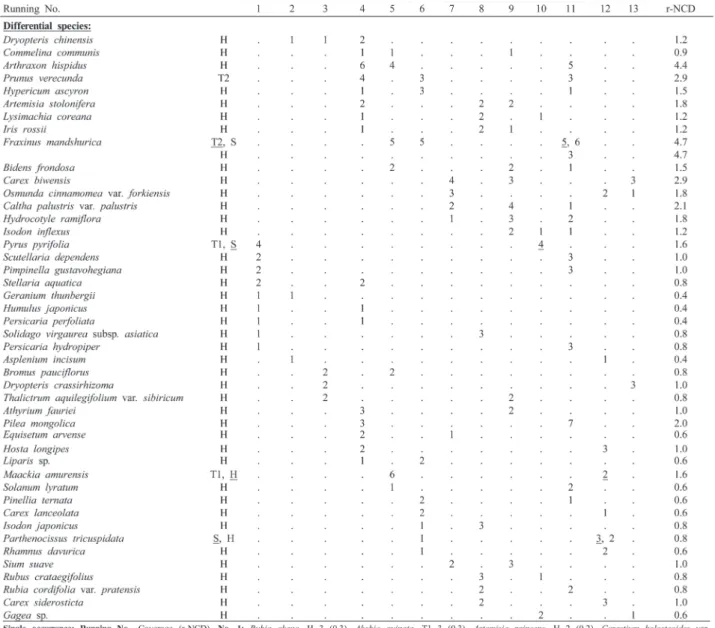
화산습지의 습생림으로 오리나무-백당나무군락이 처음 으로 기재되었다(Table 1). 화강암 기저의 지질 여건에서 산간 분지 쟁반형 선상지(扇狀地)의 넓고 평탄한 퇴적 지 형에서 습윤한 토양 환경을 유지하는 곳에 발달하였다. 군
Fig. 1. Physiognomy of typical subunit of Viburnum opulus var.
calvescens-Alnus japonica community with old-growth al-
der trees.
Table 1. Structured table of Viburnum opulus var. calvescens-Alnus japonica community.
Table 1. Continued.
락의 진단종은 오리나무, 백당나무, 신나무, 바디나물, 참당 귀, 쉽싸리 등이고, 입지의 수분 환경조건을 반영한다. 특 히 백당나무와 신나무가 고빈도로 출현하고, 식분에 따라 서는 대경목인 신나무와 물푸레나무가 섞여 난다(Fig. 1).
식생고는 평균 13m이며, 3층 또는 4층의 군락구조로 숲지 붕층(林冠)에 오리나무가 우점한다. 입지의 수분환경이 보 장되는 크고 작은 물길 언저리에 오리나무 노거수가 분포 한다. 흉고직경(DBH 50~100cm 내외)의 굵은 오리나무는 노령 개체의 전형적인 수형(Yano et al., 2010)으로 기저 부 분에서부터 굵은 줄기가 다발을 이룬다. 상당한 기간 동안 화산습지의 과습(過濕) 환경이 안정적으로 유지되었고, 오 리나무-백당나무군락이 화산습지의 잠재자연식생으로서 유적 식생의 증거 식생형(benchmark plant community)이 라는 사실을 반증한다.
화산습지의 오리나무-백당나무군락은 3개의 하위 단위 로 이루어져 있다: 버드나무하위군락, 전형하위군락, 산돌 배하위군락. 가장 습윤한 미지형에서 분포하는 버드나무하 위군락은 버드나무, 큰물통이, 낚시사초, 야산고비를 구분 종으로 한다. 반면에 산돌배하위군락은 습지의 육역화(陸 域化)가 진행된 곳과 인접 산지 식생과 연접한 곳에 위치 하는 식분으로서 상대적으로 가장 건생화가 진행된 입지 에 분포한다. 구분종은 신갈나무, 생강나무, 산돌배, 올괴 불나무 등과 같은 산지 낙엽활수림의 주요 수목종들이다. 오리나무-백당나무군락은 자연 기원의 식분으로 자연성 이 우수한 습지 서식처에서 발달하고, 훼손으로부터 원형
의 식생구조로 복구되는 데에는 장기간이 요구되며, 감시 대상식물종(동의나물, 앵초, 들메나무)이 출현함으로써 식 생보전등급 [I]의 절대 보존 대상의 국가식생자원으로 평 가되었다. 습생림의 현존 또는 잠재적 생육입지는 일반인 출입 금지 구역 내에 위치하지만, 군사 훈련과 같은 차별 적 인간간섭이 더해짐으로써 파편화가 진행되고 있는 실 정이다. 세굴과 침식에 의한 토사 유출과 유입, 부분적인 답압 등의 영향은 지표면의 미지형 변형과 그에 따른 수 리수문 환경조건의 변질을 야기한다. 이로 말미암아 오리 나무 습생림의 군락구조와 종조성의 온전성은 점차 쇠퇴 되고 있는 실정이다. 오리나무-백당나무군락에서 산지 삼 림식생 즉 신갈나무-철쭉군목(Rhododendro-Quercetalia mongolicae Kim J.-W. 1990)의 구성요소(족도리풀, 노린 재나무, 노루오줌 등)가 높은 상대기여도로 출현하는 배경 이기도 하다. 또한 버드나무하위군락에는 군사훈련에 따 른 빈번한 인간간섭으로 사위질빵, 환삼덩굴, 쇠별꽃, 며느 리배꼽, 꼭두서니, 인동덩굴, 으름덩굴 등과 같은 임연식생 또는 터주식생의 항수반종이 자주 출현한다. 따라서 오리 나무 우점림과 버드나무 우점림의 습생림 분포 지역(Fig.
2)의 보호를 위한 생태적 배려(군사훈련의 시공간적 범위 조정)가 요구된다.
한편 오리나무-백당나무군락의 언저리에서 매우 좁은 면적으로 여러해살이 습생초원식생형 꽃창포-왕비늘사초 군락과 창포-미나리군락(Table 2)이 관찰된다. 상대적으로 더욱 과습한 서식환경에서 창포-미나리군락이, 이보다 조
Fig. 2. Actual vegetation map of the Hwasan wetland.
금 더 건조한 입지에서는 꽃창포-왕비늘사초군락이 발달 한다. 창포-미나리군락의 잔존은 본 연구지역이 오래 전부 터 사람이 살았던, 그리고 잠재적으로 인간 정주가 가능한 산간 습지였다는 사실을 뒷받침한다(Kim, 2013). 화산습 지와 같이 수자원이 풍부한 고해발 산정 분지는 신석기혁 명이라고 하는 급격한 지구기후변화 시대(Lovvorn et al., 2001)에 야생동식물과 인간의 삶을 지탱하게 하는 피난처 였을 개연성이 매우 높기 때문이다.
현존식생도(Fig. 2)에서 버드나무 우점림은 오리나무-백 당나무군락의 버드나무하위군락에, 오리나무 우점림은 다 른 두 하위군락에 대응된다. 즉 오리나무-백당나무군락의 습생림은 오리나무 우점림과 버드나무 우점림의 두 개의 상관림을 포함한다. 전체 조사대상 영역 속에서 습생림은 약 28%의 면적(496,673m
2
)을 차지한다. 습지 내에서도 가장 낮은 곳(해발고도 653~773m)에서 물길을 따라 형 성된 폭넓은 계류 선상 입지에 주로 분포한다. 화산습지의 경사도는 최대 13°이지만, 50% 이상이 경사도 3° 이하의 완경사이다. 그런 지형 조건에서 군사 훈련 시설물 설치와 더불어 용이한 접근을 위해 길이 개설되면서 숲바닥의 건 생화와 세굴 현상으로 습생림의 고유 서식처 형상이 크게 일그러져 있다. 고유 습생 식물종을 대신하여 신갈나무-생 강나무아군단의 구성분자들(노린재나무, 선밀나물, 족도리 풀, 실청사초, 둥굴레, 참취 등)이 출현하는 까닭이다. 습지 의 남쪽에 경사가 급한 비탈면 입지에는 산지 삼림식생형 으로 떡갈나무, 신갈나무, 굴참나무, 소나무의 상관 우점림 (신갈나무-물푸레나무군락, 떡갈나무-노랑제비꽃군락, 굴 참나무-소나무군락)이 넓게 발달하고 있고, 그 밖에 벌채 적지 관목식생(조팝나무-큰꽃으아리군락), 건생이차초지 식생(억새군락, 잔디-꿩의밥군락), 노방식생(그령-매듭풀 군락, 산괭이사초군락) 등이 크고 작은 면적으로 출현하고 있다(Kim et al., 2012b). 이 가운데 신갈나무 우점림, 굴참나무 우점림, 조팝나무 우점의 벌채적지 관목식생이 가장 넓은 면적을 차지하고, 오리나무-백당나무군락을 둘러싸고 있음으로써 식생형 간의 종 교류가 관찰된다.
고 찰
한반도 오리나무 우점식생에 대한 군락분류와 군락지리 에 관한 연구는 빈약한 편이다. 오리나무 식분에 대한 사 실상의 식물사회학적 첫 기재는 오리나무-진퍼리새군락으 로, 진퍼리새군강으로 특징지어지는 산지 중간습원의 울 산 무제치늪에서 성취된 바 있다(Kim and Kim, 2003). 이 러한 오리나무 우점의 소택림(沼澤林) 식생의 최상급 단위 는 오리나무군강(Alnetea japonicae Miyawaki et al., 1977) 인데, 한반도를 포함한 동아시아 오리나무 습생림을 대표 한다. 우리나라에서는 울릉도와 제주도 이외에 한반도에서 의 충적저지 묵정논 식생형과 산간 계류 선상지 범람원 식 생형의 서식처에 대응한 두 가지 경관식생형이 있다. 한국 동란 이후로 방치된 민통선 내의 식분은 충적저지 묵정논 식생형의 사례이고, 본 연구의 화산습지 오리나무-백당나 무군락은 계류 선상지의 분지상(分地狀) 범람원 식생형으 로 산지의 기반암과 비탈면의 지형 형상에 의한 전혀 다른 종류의 오리나무 우점 식물사회이다. 민통선에서 자연적으 로 재생된 오리나무 우점식생(Jeong et al., 2001; Kim et al., 2010; Lee et al., 2010)은 진퍼리새, 버드나무 등이 섞여 나는 것으로부터 전형적인 소택지 잠재자연식생으로 고려 된다. 하지만 해당 식분의 식물사회학적 군락표 또는 종조 성 목록이 없기 때문에 논의에는 한계가 있다. 울산 무제 치늪의 오리나무-진퍼리새군락은 산간 분지상 범람원 식 생형으로 분류되지만, 중간습원의 진단종인 진퍼리새가 표 징종으로 출현하는 것이 화산습지의 오리나무-백당나무군
Table 2. Species composition of Carex maximowiczii-Iris ensata var. spontanea community and Oenanthe javanica-Acorus calamus com-
munity.
Differential species: Running No. 1: Scirpus wichurae var. asiaticus H1 5, Carex maximowiczii H1 7, Iris ensata var. spontanea H1 4, Thelypteris palustris H1 5, Carex biwensis H1 8, No. 2: Acorus calamus H1 8, Oenanthe javanica H2 8, Alopecurus aequalis H2 2, Persicaria thunbergii H2 5, Juncus effuusus var. decipiens H1 3.
Companions: No. 1: Miscanthus sinensis var. purpurascens H1 6, Astilbe rubra H1 4, Luzula multiflora H1 4, Lycopus lucidus H1 3, Ligustrum obtusifolium H1 3, Sium suave H1 3, Sanguisorba officinalis H1 3, Fraxinus rhynchophylla H1 3, Microstegium vimineum H1 2, Potentilla freyniana H1 2, Veratrum oxysepalum H1 2, Persicaria sagittata H1 2, Peucedanum terebinthaceum H1 2, Hypericum laxum H1 2, Galium verum var. asiaticum H1 2, Lysimachia coreana H1 1, Eupatorium lindleyanum H1 1, No. 2: Bidens frondosa H2 3, Aneilema keisak H2 3, Glyceria leptolepis H2 2, Phalaris arundinacea H2 2, Phragmites communis H2 2, Amphicarpaea bracteata subsp.
edgeworthii H2 1, Equisetum arvense H2 1.
Site environment: Running No., Species occurrence, Latitude ( ° ʹ ʺN), Longitude ( ° ʹ ʺE), Area (m
2), Altitude (m), Aspect, Slope (°), Hight
(m)/Cover (%) H1, H2, Investigation date, No. 1: 22, 36 04 51, 128 48 06, 9, 768, SWW, 20, 1/70, -, 05.31.2012, No. 2: 12, 36 05 04, 128
47 39, 4, 661, -, 0, 1/60, 0.5/80, 06.01.2012.
락과 뚜렷한 차이이다. 중간습원 고경초원식생 진퍼리새- 하늘산제비난군집(Plantanthero-Molinietum Kim et Kim, 2003)의 표징종 진퍼리새(Kim and Kim, 2003)는 이탄 (peat)의 발달이 불량하고 동시에 빛환경 조건이 통제되는 화산습지의 오리나무-백당나무군락의 노령림에서는 출현 하지 않는다. 동북아 식생지리학(Kim, 1989; 1992; 2004) 에서 해양형-태평양아형의 식생지리 영역에서 분포하는 일본의 오리나무-일본갈매나무군집(Rhamno nipponicae- Alnetum japonicae Ohno in Miyawaki, 1985)은 오리나무- 백당나무군락의 ‘지리적 대응식생형’으로 판단된다.
그런데 우리나라의 산간 계류 선상지의 분지상 범람원 에서도 기저 토양의 매질에 따라 오리나무 우점림과 천이 초기의 버드나무 우점식생이 있다. 그리고 그 특성이 전혀 다른 잠재자연식생의 물푸레나무, 느릅나무, 들메나무 등 의 낙엽활엽수림 잠재자연식생이 있다. 경남 지리산 외고 개습지에서는 물푸레나무-키버들군락, 물오리나무-버드나 무군락, 달뿌리풀 우점식분 등이 발달한다(Kim and Lee, 2007). 외고개습지는 적절한 유속(流速)을 가지며, 굵은 입 자의 토양환경이다. 외고개습지에서 가장 넓은 면적을 차 지하고 있으면서 습지경관의 기반(matrix)이 되는 달뿌리 풀군락은 생육입지의 이러한 수리수문과 토양 환경조건을 적나라하게 반영하는 키 큰 여러해살이 초본식물군락이다 (Fig. 3). 외고개습지의 식물상에서 오리나무 분포가 기재 된 바(You and Kim, 2007) 있으나, 2016년 8월 현지 답사 에서도 개체군이나 군락 수준에서 또는 습생림 내에서의
개체 수준으로도 그 실체를 확인할 수 없었다. 이러한 외 고개습지에서 오리나무 식생형의 결여는 그러한 생육입지 환경조건을 반영하는 것이다. 화산습지에서는 달뿌리풀이 나 갈대를 대신해서 물억새가 점점이 관찰되는 것도 외고 개습지의 서식환경과 대조적인 것에서 비롯한다. 화산습 지는 습생림 속에 물이 흐르는 물골이 만들어져 있으나, 우수(雨水)는 사방으로 퍼져 흐르면서 땅 속으로 스며드 는 범람원 형태이다. 서로 다른 토양이 퇴적되면서 상·하 부 토양층의 공극률과 투수계수의 차이로 말미암아 적은 강우량에도 쉽게 포화되고, 강우 시 주변을 둘러싼 산지의 지표수가 유입(Yang and Han, 2012) 되기 때문에 수자원이 풍부한 구조이다. 샘에서 비롯할 것으로 추정되는 우물터 유적이 여기저기 산재하는 까닭도 거기에 잇닿아 있다.
오리나무-백당나무군락의 버드나무하위군락은 산간 계 류에서 주로 분포하는데, 버드나무, 신나무, 찔레꽃, 달뿌 리풀 등을 진단종으로 하는 버드나무-신나무군집(Aceri- Salicetum koreensis Y.-K. Lee 2004)과 대비된다. 버드나무- 신나무군집은 버드나무군단, 선버들군목에 귀속되는 하변 연목림 식생형이지만, 화산습지의 오리나무-백당나무군락 의 버드나무하위군락은 산지 계류의 선상지 범람원의 오 리나무림 이차식생형이고, 충적저지 소택림을 포함하는 오 리나무군강에 귀속하는 식생형이다. 한편 저지대의 하천 변 범람원 소택지에서는 오리나무, 찔레꽃, 물봉선 등을 진 단종으로 하는 오리나무-찔레꽃군집(Roso-Alnetum japon- icae Y.-K. Lee 2004)이 기재된 바 있다. 이 군집은 오리나
Fig. 3. Schematic diagram of vegetation dynamics in case-studied wetlands. Solid arrows show progressive succession. Alder forest of the
Hwasan wetland has been retrogressively changed into the willow forest due to soil condition.
무군강에 귀속되는 오리나무림 가운데 대표적인 이차식생 으로 판단되는데, 터주식물종(쑥, 환삼덩굴, 고마리 등)이 풍부하게 출현하는 것이 특징이다.
적 요
화산습지는 경북 군위와 영천 경계의 산정 분지(표고 644~780m)에 위치한다. Z.-M. 학파의 식물사회학적 방법 으로 현장 식생조사가 이루어졌고, 현존식생도가 제작되었 다. 단위식생의 출현종의 행동양식은 피도와 상대기여도를 이용하여 분석하였다. 버드나무하위군락, 전형하위군락, 산돌배하위군락으로 이루어진 오리나무-백당나무군락이 처음으로 기재되었다. 오리나무 우점림에 대한 선행 기재 단위식생(오리나무-진퍼리새군락, 오리나무-일본갈매나 무군집, 버드나무-신나무군집 등)과의 군락분류학적, 군락 동태학적 대응성이 논의되었다. 본 군락은 오리나무군강 (Alnetea japonicae)에 귀속되고 산간 계류 선상지에서의 분지상(分地狀) 범람원 습생림으로 규정되었다. 화산습지 의 잠재자연식생이고 증거 식생형으로서 식생보존등급 [I]
의 자연식생으로 평가되었다. 입지의 수리수문 환경조건의 극적인 변화(건생화 및 부영양화)로부터 국가적 보호 전략 이 요구되었다.
REFERENCES
Blog of Republic of Korea Army. 2016. Armynuri. http://army nuri.tistory.com/569.(accessed 09. Nov. 2016).
Braun-Blanquet, J. 1965. Plant Sociology: The Study of Plant Communities(Fuller, G.D. and H.S. Conrad, trans.). New York.
CHA(Cultural Heritage Administration). 2016. Heritage infor- mation. http://www.cha.go.kr/(accessed 10. Nov, 2016).
Heo, S.J., Y.H. Son, M.H. Lee and N.J. Noh. 2007. Soil proper- ties of Alnus japonica stands in Heonilleung, Seoul. 2007
Conference Report of Korean Forest Society: 103-104.
Jeong, H.L., M.H. Seo and K.H. Kwon. 2001. Vegetation in Goseon-gun, Gangwon-Province. In: Technical Report on DMZ’s Natural Environment. National Institute of Envi- ronmental Research, Inchon, pp. 31-46.
Kang, H.C. and H.I. Lee. 2012. Geomorphological Features of
Alnus japonica community in Hwasan. In: 2012 Technical
Report on the Protected Area Establishment of Nationally and Representative Ecosystem and Landscape. Ministry of Environment, Seoul, pp. 15-34.Kim, C.H., K.G. Kim, Y.E. Choi, S.S. Kim and J.R. Shin. 2010.
Study of vegetation of civilian control line·DMZ area:
Focusing on the Donghae Bukbu Line. Journal of the
Korea Society of Environmental Restoration Technology 13(6): 63-74.
Kim, J.S., S.H. Hyun, S.H. Hong, H.M. Kang and J.N. Bae.
2013. The Characteristics of the vegetation of Amgok Wetland, Gyeongju National Park, Korea. Korean Journal
of Environment and Ecology 27(3): 381-395.
Kim, J.W. 1989. Phytosociology and phytogeography of sum- mer green broad-leaved forests in South Korea. Studies in
Plant Ecology 18: 141-143.
Kim, J.W. 1992. Vegetation of Northeast Asia: On the syntax- onomy and syngeography of the oak and beech forests.
PhD. diss., University of Vienna, Vienna.
Kim, J.W. 2004. Vegetation Ecology. World Science Publishing Ltd., Seoul.
Kim, J.W. 2013. The Ecological Flora of Korea. Vol. 1. Nature
& Ecology, Seoul.
Kim, J.W. 2016. Climate and Vegetation. In: A Millennium of Shilla History and Culture, Vol. 1. General Introduction of the Silla History, Chap. 1 Natural Environment of Silla. Gyeongsanbuk-do Institute of Cultural Properties, Yeongcheon, pp. 48-75.
Kim, J.W. and C.W. Lee. 2007. Vegetation of Oegogae wetland.
In: 2007 National Wetland Survey. UNDP/GEF, Seoul,
pp. 223-240.Kim, J.W. and J.A. Lee. 2011. Vegetation of Cheongsong Coun- ty and Yeongcheon City. In: The 3rd National Ecosystem Survey. National Institute of Environmental Research, Inchon, pp. 1-14.
Kim, J.W. and J.H. Kim. 2003. Vegetation of Moojechi moor in Ulsan: syntaxonomy and syndynamics. Journal of Ecolo-
gy and Environment 26(5): 281-287.
Kim, J.W. and Y.I. Manyko. 1994. Syntaxonomical and synchor- ological characteristics of the cool-temperate mixed forest in the Southern Sikhote Alin, Russian Far East. Korean
Journal of Ecology 17: 391-413.
Kim, J.W., B.K. Choi, T.B. Ryu and G.Y. Lee. 2012a. Applica- tion and Assessment of National Vegetation Naturalness.
In: Guideline for The 4th National Ecosystem Survey.
National Institute of Environmental Research, Inchon, pp.
81-172.
Kim, J.W., S.E. Lee and J.A. Lee. 2012b. Vegetation of Alnus
japonica stands in Hwasan. In: 2012 Technical Report on
the Protected Area Establishment of Nationally Represen- tative Ecosystem and Landscape. Ministry of Environ- ment, Seoul, pp. 51-79.Kim, Y.P. and S.E. Im. 2005. Restructuring mountain system in the Korean Peninsula using DEM. The Korea Spatial
Planning Review 47: 239-254.
KMA(Korea Meteorological Administration). 2016. Climate Data. http://www.kma.go.kr/(accessed 10. Nov. 2016).
KPNIC(Korean Plant Names Index Committee). 2016. Plant
List. http://www.nature.go.kr/(accessed 13. Nov. 2016).
Lee, Y.K. and J.W. Kim. 2005. Riparian Vegetation of South Korea. Keimyung University Press, Daegu.
Lee, Y.K., B.K. Choi and S.Y. Kim. 2010. Ecological Survey on the North part of DMZ. In: Technical Report on DMZ’s Natural Environment. National Institute of Environmental Research, Inchon, pp. 46-57.
Lee, Y.K., J.S. You, H.J. Kim and S.Y. Kim. 2013. Ecological Survey on the North part of DMZ. In: Technical Report on DMZ’s Natural Environment. National Institute of En- vironmental Research, Inchon, pp. 46-67.
Lovvorn, M.B., G.C. Frison and L.L. Tieszen. 2001. Paleocli- mate and Amerindians: Evidence from stable isotopes and atmospheric circulation. Proceedings of the National
Academy of Sciences of the United States of America 98:
2485-2490.
Paik, W.K. 2010. Vegetation of wetland in Mueuido(Incheon city). Korean Journal of Plant Resources 29(5): 197-205.
Sakio, H. and F. Yamamoto. 2002. Ecology of Riparian Forests.
University of Tokyo Press, Tokyo.
Son, M.W. and M.S. Kim. 1998. Geomorphical landscape in Gunwi County and Yeongcheon City. In: The 2nd Nation-
al Ecosystem Survey. National Institute of Environmental Research, Inchon, pp. 3-41.
Westhoff, V. and E. van der Maarel. 1978. The Braun-Branquet Approach. In: Ordination and Classification of Commu- nities(Whittaker, R.H. ed.). Dr. W. Junk, The Hague. pp.
287-399.
Yang, H.K. and H.K. Han. 2012. Hydraulic and hydrologic research of Alnus japonica stands in Hwasan. In: 2012 Technical Report on the Protected Area Establishment of Nationally and Representative Ecosystem and Landscape.
Ministry of Environment, Seoul, pp. 35-50.
Yano, M., S. Mizugaku, T. Hayasida and Y. Murakami. 2010.
Relation of Alnus japonica and its adaptation for inunda- tion environment in the Kushiro mire. Japanese Wetland
Research 1: 43-53.
Yim, Y.J. and C.S. Han. 1989. Structural characteristics on the forest vegetation of Mt. Daemo, Seoul. Bulletin of Con-
struction and Environment, Chung-Ang University 1: 73-
You, Y.H. and H.R. Kim. 2007. Flora of Oegogae Wetland. 93.In: 2007 Technical Report of National Wetland Survey.
UNDP/GEF, Seoul, pp. 241-256.