A Study on a Development of Automated Measurement Sensor for Forest Fire Surface Fuel Moistures 1 KOR APP
Chan-Ho YEOM 2 ⋅Si-Young LEE 2,† ⋅Houng-Sek PARK 3 ⋅Myoung-Soo WON 4
ABSTRACT
1)In this study, an automated sensor to measure forest fire surface fuel moistures was developed to predict changes in the moisture content and risk of forest fire surface fuel, which was indicators of forest fire occurrence and spread risk. This measurement sensor was a method of automatically calculating the moisture content of forest fire surface fuel by electric resistance. The proxy of forest fire surface fuel used in this sensor is pine (50 cm long, 1.5 cm in diameter), and the relationship between moisture content and electrical resistance, R(R:Electrical resistance)
=2E(E:Exponent of 10)+13X(X:Moisture content)-9.705(R 2 =0.947) was developed. In addition, using this, the software and case of the automated measurement sensor for forest fire surface fuel moisture were designed to produce a prototype, and the suitability (R 2 =0.824) was confirmed by performing field monitoring verification in the forest. The results of this study would contribute to develop technologies that can predict the occurrence, spread and intensity of forest fires, and are expected to be used as basic data for advanced forest fire risk forecasting technologies.
Keywords: forest fires, forest fuel humidity, forest fire prediction, Surface fuel, electrical resistance
1. INTRODUCTION
The moisture content of forest fire surface fuel is an important factor that affects the occurrence and in- tensity of forest fires and the rate of spread. When the moisture content is high, the probability of occur- rence of forest fire decreases, whereas when the mois- ture content is low, the rate of occurrence of the fire is high. Thus moisture in forest fire surface fuel is an important factor affecting not only the occurrence of forest fires, but also their spread and intensity
(Kwon, 2009; 2014). Therefore, in the United States and Canada, there were studies on the relationship be- tween the moisture content of forest fire surface fuels and forest fires, and they tried to develop technologies to predict it (Anderson, 1983; 1990). In the United States and Canada, where research data on forest fires has been accumulated for a long time, various types of fuels in forests are classified, and the relationship between changes in moisture and weather has been an- alyzed and investigated. A forest fire risk forecasting system was developed based on the risk of ignition
1 Date Received July 28, 2020, Date Accepted November 6, 2020
2 Professional Graduate School of Disaster Prevention, Kangwon National University, Kangwon_Do, 25913, Republic of Korea
3 Graduate School of Forestry, Dongguk University, Seoul, 06420, Republic of Korea
4 Forest Resource Management and Restoration Division, National Institute of Forest Science, Seoul, 02455, Republic of Korea
† Corresponding author: Si-Young LEE (e-mail: [email protected], ORCID: 0000-0002-0643-5289)
Original Article
and spread (Stock, 1987; Van Wagner, 1975).
In Korea, the forest fire risk forecasting system was developed in 2003 and currently being operated by Korea Forest Service which has improved its accuracy through continuous improvement, but the underlying forest fire risk index was calculated by integrated anal- ysis of weather conditions, topography, and empirical data. As a result, unlike the cases in the United States and Canada, it does not properly reflect the character- istics of the change in the moisture content of forest fire surface fuel, which is an important factor in the occurrence and spread of forest fire. In this regard, according to Lee (2007; 2010) and Kwon (2011), the forest fire surface fuels that make up the indicators in the forest include leaves, litter, and ground shrubs etc., and their moisture content determines whether forest fire will spread or extinguish when it occurs.
The pine forest fuel (diameter less than 0.64 cm) among the forest fires that make up the indicators is very importantin estimating the spread of forest fire in the early stages, but it is not reflected in the forest fire forecasting system in Korea.
Due to the importance of the moisture content in the forest fire surface fuel, in the United States and Canada, a proxy for these fine forest fire fuel was es- tablished, and the proxy was designated as a forest fire fuel moisture stick which measured the change in moisture content of forest surface fire fuel, and this lead to a development of a system to predict the mois- ture change of fuelin the forest and forecastthe risk of forest fire. For example, the U.S. Forest Service has produced a standard forest fire fuel moisture stick and predicted the risk of forest fire occurrence and spread through the change in moisture content by measuring the change in weight (Theodore, 1965), and Forest fire moisture developed by Campbell Scientific, USA can be said to be an automated equipment using this concept. In Korea, there was a case in which this forest fire fuel moisture stick was used to forecast for-
est fires in terms of the changes in the weight of the forest fire fuel moisture stick due to the change in moisture content similar to the case of the United States. However, due to the lack of prior studies on the forest fire surface fuel and the lack of interest in automation technology, the forest fire fuel moisture is not used in the forest fire forecasting system in Korea.
However, like in the cases of the United States and Canada, as the change in moisture of the forest fire surface fuel plays an important role in the occurrence and spread of forest fires, it is necessary to introduce these technologies to improve the accuracy of forest fire forecasting systems currently in operation in Korea and to develop additional forest fire related systems. In addition, In case such a technology is in- troduced, its effect can be doubled only when auto- mated measurement technology is used in parallel.
There was no case in Korea in which the application of the technology was difficult because the automated measurement technology was not implemented.
Regarding the automated measurement sensor for predicting the risk of forest fires using the change in the moisture content of forest fire surface fuels, in the United States, measuring equipment using local spe- cies has been developed, but according to a study by William (1963), there wasa difference in the moisture content indicated by the resistance value depending on species, and accordingly, there is a possibility that the moisture content of forest fire fuels in domestic forest species may be underestimated or overestimated.
Therefore, in order to predict the moisture content of forest fire fuels in domestic forests, it wasnecessary to develop a technology that can automatically meas- ure the moisture content through experiments on do- mestic species.
In order to develop these technologies, the follow-
ing three things need to be analyzed. First of all, it
wasnecessary to select materials that could reflect the
domestic forest fire surface fuelenvironment, and de-
termine a measurement method that can measure the moisture change in the forest surface fire fuel, which can be measured continuously. In addition, it was nec- essary to know whether there was relationship be- tween the changes in the moisture content in the forest fire surface fuel and the forest fire related index.
This equipment issues could be resolved, if the ex- isting wood moisture content measurement equipment was used. However, since the moisture content of for- est fire fuels showed various patterns depending on the region, topography, forest and temperature (Han, 2019; Pang, 2019), samples were needed for each spe- cific region. In addition, long-term measurement and data accumulation were required to predict the risk of forest fires, and since measurements must be made within the forest to accurately measure forest fire fuels. In order to accurately measure moisture contents in forest fire surface fuels, it was necessary to measure it within the forest, but because an access and a power supply were limited, it was necessary to develop in- dependent equipment for this. Therefore, this study was conducted to develop an automated measurement sensor for forest fire surface fuel to predict changes in the moisture content and risk of forest fires, which was indicator of the occurrence and spread risk of for- est fires.
2. MATERIALS and METHODS 2.1. Materials and methods for measuring
moisture content in forest fire fuels 2.1.1. Selection of measurement methods In this study, the method of measuring the change of the moisture of wood was used instead of oven-dry- ing, extraction, or hygrometric method. Thismethod enables fast results but, not enable to continuous meas- urement without damaging the test subject. In addi- tion, with the electrical measurement method, there is
a resistance type measurement method that measures the moisture content by using the logarithm of the di- rect current and the specific resistance of wood in a linear relationship with the moisture content of wood, and another measurement method based on the fact that the Dielectric Permittivity of wood or the dielec- tric loss is in a Linear Relationship with the moisture content. The method of using Dielectric Permittivity has a measurement range of 0 to 30% and Kang Chunwon (2017) estimated Oven-Dry Density of wood using Dielectric Constant Type Moisture Meter, but the method using electric resistance was selected be- cause although the measurement range was 7 to 25%, it was possible to measure the range of risk of forest fire surface fuel and easy access to the electric resistor on site.
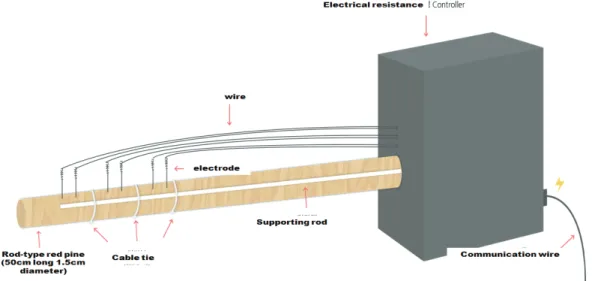
2.1.2. Selection of measuring materials For the selection of the materials, using the results in Yeom (2016), a rod shaped pine was selected with a diameter of 1.5 cm and length of 50 cm considering factors such as deformation, damage and stable amount of change in FMC (Fuel Moisture Content) of the measurement material for the fuel moisture measurement sensor.
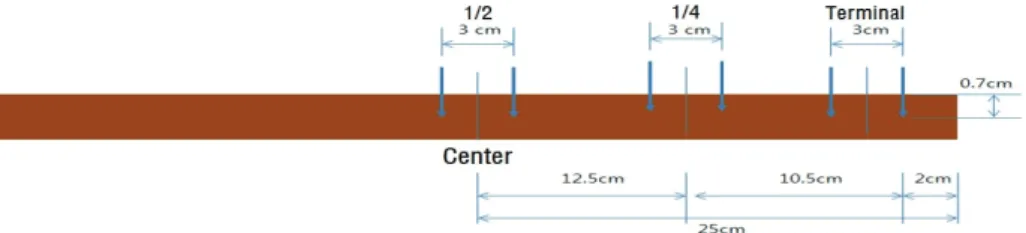
2.1.3. Production of measuring materials In order to measure the moisture content by elec- trical resistance, pointed electrodes must be inserted deeply to measure, and in this regard, the selection location and depth of the electrodes were determined by referring to the study of Lee (2005). The electrodes for measuring electric resistance, which was the meas- urement principle of measurement sensor for forest fire surface fuel moisture, were installed at one end, center, and 1/4 length point, respectively, and the end was installed from a point 2 cm away from the end, taking into account the space for electrode installation.
For the electrodes, they were made of steel and coated
Fig. 1. The standard of forest fire fuel proxy and the location of electrodes.
with chromium in order to protect them from rust as they would be exposed to air and moisture. The resist- ance of the electrode itself came out to a negligible level, and the both ends were coated with silicone in- sulation (NABAKEN's silicone insulation coating agent S-830) so that resistance could be measured at the electrode tip (Yeom, 2017). The following Fig. 1 shows the standard of forest fire fuel proxy and the location of electrodes.
2.1.4. On-site installation of forest fire fuel measuring materials
For the on-site installation of selected and elec- trode-equipped measuring materials for measuring the moisture content of forest fire fuels, they were in- stalled in Geombongsan AMOS (Automatic Meteoro- logical Observation System), which was installed and operated by Korea Forest Service, heliport AMOS and Samcheok AWS (Automatic Weather Station) currently operated by Korea Meteorological Administration.
For installation, it was installed 30 cm above the ground so that it would not be affected by the change in the weight and moisture due to foreign substances.
The equipment was installed according to Theodore (1965), as shown in Fig. 2.
2.2 Measurement procedure and period
In this study, it was necessary to establish the rela- tionship between the change in the moisture content and the electrical resistance in forest fire surface fuels.
To do that, the change in electrical resistance and weight of forest fire surface fuel was investigated in parallel. Since Stamm (1927) first proposed a method for measuring moisture content using electrical resist- ance, many researchers have analyzed the relationship between electrical resistance and wood moisture con- tent (Keane, 2015). However, thereare few studies on domestic species, particularly, on moisture content of 17% or less, which have a high risk of forest fire.
Thus, this study focused on this particular section to analyze the relationship involving moisture changes in an actual forest.
The measurement period was in spring (April) to
monitor the Geombongsan AMOS and heliport AMOS
operated by the Korea Forest Service. In fall (Septem-
ber), the measurement was taken at Samcheok 876
AWS which is operated by Korea Meteorological Ad-
ministration by using high voltage insulation/megameter
(Model: SM-8220) with total measurement number of
1,872 times; 3 times a day (3 repetition per 1 measure-
Fig. 2. An installed forest fire fuel proxy.
ment) at 1000, 1400 and 1600, respectively. Table 1 is the measurement period and location.
2.2.1. Electrical resistance meter
The electrical meter selected in this study was HIOKI's high voltage insulation/megameter (Model:
SM-8220). This equipment is capable of measuring from 5×10 4 ∼ 2×10 14 Ω which covers the target range of the pine wood rod’s electrical resistance, and meas- ured voltages of 10 V and 25 V were selected. Fig.
3 is a picture of the selected equipment.
To measure the electrical resistance, the reference voltage was measured by selecting voltages of 10 V and 25 V. The reason was that when installed in the AMOS of the weather network in the forest in the fu- ture, the AMOS would be powered by solar power, so the minimum voltage was selected in consideration of the environment in which the available power would be limited.
Fig. 3. The electrical resistance meter (HIOKI, SM- 8220).
2.2.2. Moisture content (Weight) measuring equipment
Oven-dry method was used after weighing the weight of the moisture content of the forest fire fuel, and an electronic scale (Model name: JW-1) of ACOM was used for weighing the proxy on-site; the scale can measure between 0-2,000 g with minimum unit of measurement of 0.1 g.
3. RESULTS and DISCUSSION 3.1. Relationship between moisture
content and electrical resistance in forest fire fuel
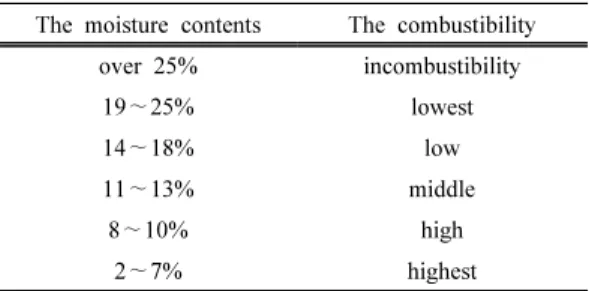
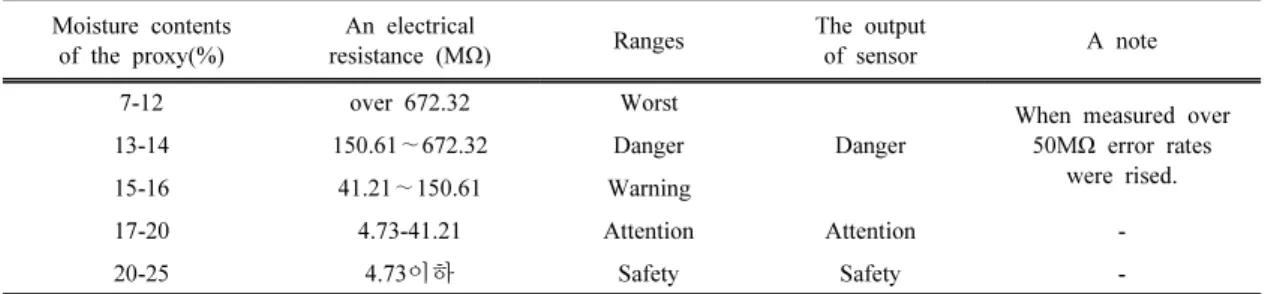
In order to develop equipmentthat predicts risk of forest fire by measuring the moisture content of forest fire fuel, which is the objective of this study, an analy- sis was conducted based on the classification of com- bustibility according to the moisture content of sedi- ments in the forest. Table 2 shows the classification of moisture content and combustibility of sediment in the forest.
The moisture contents The combustibility over 25% incombustibility
19 ∼25% lowest
14 ∼18% low
11 ∼13% middle
8 ∼10% high
2 ∼7% highest
Table 2. The relationship with the moisture of forest sediments and the combustibility
※ A reference: Forestry technique
3.1.1. Electrical resistance measurement result (10 V, 25 V)
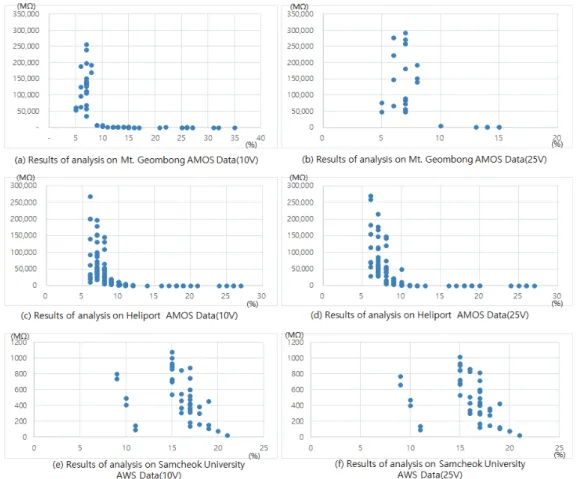
The measurements of the relationship between the electrical resistance and the moisture content in the forest fire surface fuel are shown in Fig. 4. As a result The period The Location
2017.4.3 ∼ 4.13 Mt. Geombong AMOS
2017.4.3 ∼ 4.28 Heliport AMOS
2017.9.12 ∼ 9.22 Samcheok University(876) AWS
Table 1. The period and the location of experiments
Fig. 4. The results of analysis of the relationships with forest fire fuel moisture contents and electrical resistances.
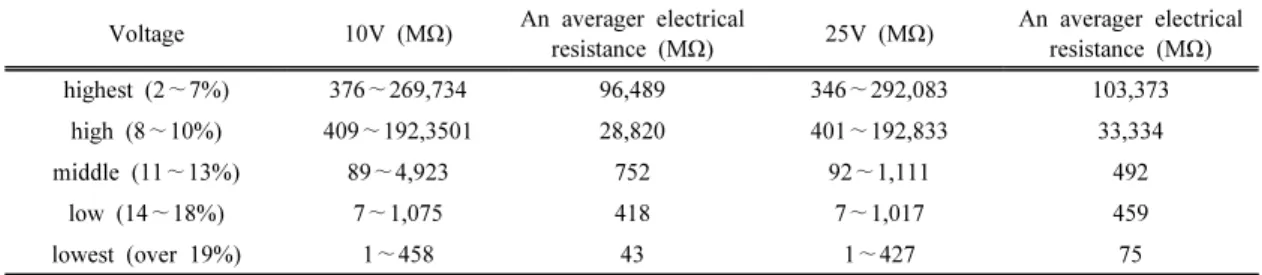
of the analysis, a conversion formula [electrical resist- ance = 2E+13(moisture content)-9.705] was derived (Yeom, 2018). According with this electric resistance conversion formula, the moisture content of the forest fire fuel was measured, which is the technology this study intends to develop. Then, to derive the forest fire risk, the electrical resistance values were analyzed according to the flammability classification that is based on the moisture content of forest fire surface fuel. As a result, the measured electrical resistance of 10V showed a distribution of resistance values of 376M Ω to 269,734MΩ at a moisture content of 2 to 7%, classified as ‘highest combustibility’, and the average resistance was 96,489M Ω. The distribution of
resistance values of 409M Ω to 192,3501MΩ was ob- served in the moisture content of 8-10%, which is the
‘high level’ category, and the average resistance was measured to be 28,820M Ω. In addition, the dis- tribution of 89 M Ω to 4,923 MΩ was shown in the moisture content of 11 to 13%, which is the ‘middle’
category, and the average resistance value was meas- ured to be 752 M Ω, and the distribution of 7 MΩ to 1,075 M Ω in the moisture content of 14 to 18%, which is the ‘low’ category, and the average resistance was measured to be 418M Ω. The distribution of 1M Ω to 458MΩ was found at a moisture content of 19%
or higher, which is classified as “lowest” to “incom-
bustibility,” and the average resistance was measured
Voltage 10V (MΩ) An averager electrical
resistance (MΩ) 25V (MΩ) An averager electrical resistance (MΩ)
highest (2 ∼7%) 376 ∼269,734 96,489 346 ∼292,083 103,373
high (8 ∼10%) 409 ∼192,3501 28,820 401 ∼192,833 33,334
middle (11 ∼13%) 89 ∼4,923 752 92 ∼1,111 492
low (14 ∼18%) 7 ∼1,075 418 7 ∼1,017 459
lowest (over 19%) 1 ∼458 43 1 ∼427 75
Table 3. The results of an electrical resistance measurement according to voltage (10V, 25V)
to be 43M Ω.
The measured electrical resistance of 25V showed a resistance distribution of 346 M Ω to 292,083 MΩ at a moisture content of 2 to 7% classified as ‘highest combustibility’, and the average resistance was 103,373 M Ω. The resistance value distribution was measured to be 401M Ω to 192,833MΩ at a moisture content of 8 to 10%, which is classified as ‘high’, and the average resistance value was measured to be 33,334M Ω. In addition, the distribution of 92 MΩ to 1,111 M Ω at the moisture content of 11 to 13%, which is the ‘middle’ category, and the average resistance value was measured to be 492 M Ω, and the distribution of 7 M Ω to 1,017 MΩ in the moisture content of 14 to 18%, which is the ‘low’ category. And the average resistance was measured to be 459 M Ω. A distribution of 1 Ω∼427MΩ was shown at a moisture content of 19% or higher, which is classified as “lowest” to
“incombustibility,” and the average resistance was measured to be 75M Ω. Table 3 below is the result of classifying electrical resistance according to incom- bustibility. In addition, in consideration of the environ- ment in which the resulting measurement materials of this study can actually be installed, it is necessary to set the voltage value for measuring the electrical re- sistance to be used for the actual moisture content measurement, so the currently investigated 10 V and 20 V environments were analyzed. The results are shown in Fig. 5. As a result of comparing the voltages of 10 V and 25 V to select the voltage given when
Fig. 5. The relationships with moisture contents in forest fire fuel and electrical resistances of forest fire fuel according to voltage changes (10 V and 20 V).
measuring resistance, the measured values of electrical resistance of 10 V and 25 V have similar slopes, and when considering the electrical facilities and environ- mental factors of the installation site, 10 V would not have any issues. Since the mountain weather observation network is currently operated by solar power, the fuel moisture must be measured with a lowest voltage.
Therefore, the measurement voltage for the equipment to be developed in this study was selected to be 10 V.
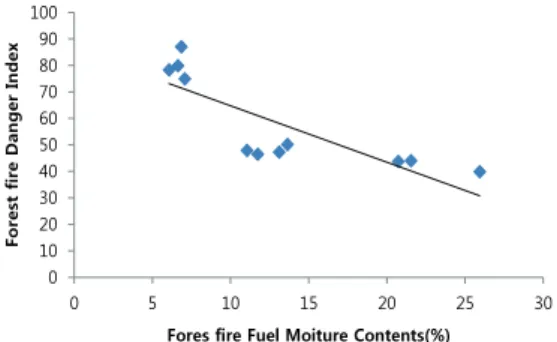
3.1.2. Verification of Forest fire fuel moisture estimated by electrical resistance The verification of the forest fire fuel moisture mea- sured by the change in electrical resistance was ana- lyzed by its correlation with the Forest Fire Danger Index of Korea Forest Service currently in operation.
As a result of applying the forest fire risk index of
the National Institute of Forest Science (NIFoS), the
average of the forest fire risk index in Wondeok-eup,
Samcheok-si, during the spring fire warning period was 47.11, which was a ‘low’ grade, and the maximum value was 87.50 (at 1300 and 1500 on April 4) and the minimum value was 20.70. The correlation between the forest fire fuel moisture (Gumbongsan AMOS, heli- port AMOS, pine forest on campus at Kangwon Natio- nal University Samcheok Campus) and the forest fire risk index (Wondeok-eup, Gyo-dong, Samcheok-si) investigated in this study is shown in Fig. 6. As a re- sult of the analysis, there was a negative correlation with 99% confidence level (R 2 =0.824). Therefore, the forest fire fuel moisturemeasured at the Geombongsan AMOS and the Heliport AMOS during the spring fire warning period and the forest fire fuel moisture meas- ured at the pine forest within Kangwon National Uni-
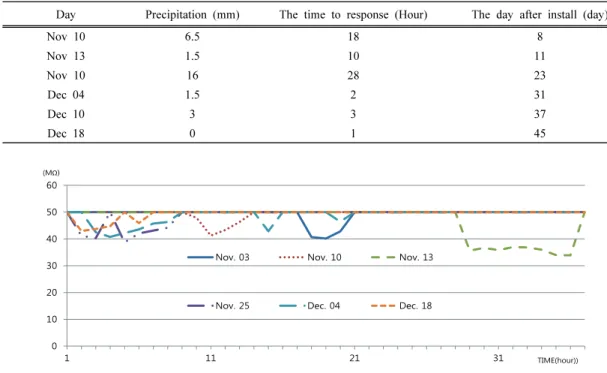
versity Samcheok Campus during the forest fire warn- ing period in the fall had a significant correlation with the forest fire risk index of the region (Wondeok-eup, Samcheok-si, Gyo-dong, Samcheok-si). This can be interpreted as having a correlation with the prediction of forest fire occurrence, which is the result of this study, and serve as basic data that can supplement the forest fire risk index in the future. In addition, the re- sults of direct comparison on whether the measured data of forest fuel moisture is related to hourly or daily changes in the actual forest fire risk index are shown in Fig. 7, Fig. 8, and Fig. 9. According to these results, the measured forest fire fuel moisture in the forest re- sponded similarly to the forest fire risk index of Korea Forest Service.
Fuel Moisture Contents (%)
5 10 15 20 25 30
F o res t F ire D a n ger I n dex
0 20 40 60 80 100