SHORT COMMUNICATION
Plant TaxonomyA newly naturalized species in Korea: Viola palmata L. (Violaceae) Kyeong-Sik CHEON, Seoung-Chun PARK1, Kyung-Ah KIM
2 and Ki-Oug YOO
2*
Department of Biological Science, Sangji University, Wonju 26339, Korea
1
Parkwon Plant Resources Laboratory, Seoul 03182, Korea
2
Department of Biological Sciences, Kangwon National University, Chuncheon 24341, Korea (Received 30 September 2019; Revised 22 November 2019; Accepted 5 December 2019)
ABSTRACT:
A newly naturalized plant, Viola palmata L., was found in Uljin-gun, Changwon-si, and Yangsan-si.
It belongs to the subsect. Boreali-Americanae (W. Becker) Gil-Ad of the sect. Nosphinium W. Becker, which is known to be from North America, with subsequent introduction into Europe. In Korea, this species is consid- ered to have been introduced by freight transportation through the port of Busan, after which its distribution area expanded. We propose the new Korean name ‘Chang-won-je-bi-kkot’ based on the location at which it was ini- tially collected in Korea. We also provide descriptions of the morphological characters along with photographs, illustrations, and a distribution map of Viola palmata.
Keywords:
Viola palmata L., Viola, Violaceae, a newly naturalized plant
The Viola L. is the largest genus in Violaceae, consisting of 583–620 species distributed mainly in temperate and tropical regions (Melchior, 1925; Clausen, 1967; Yoo and Jang, 2010;
Marcussen et al., 2015). This genus is known as one of the more difficult groups to classify owing to the very similar external morphology characters among the species and the many intermediate forms that exist due to the frequent interspecies hybridization between closely related species (Becker, 1910; Yoshida et al., 2016).
The first study of the distribution of Korean Viola was conducted by Matsumura (1886), who reported three taxa, including Viola japonica. Since then, many studies have been conducted, including those by Palibin (1899), Nakai (1916), and Maekawa (1954), and it is now known that nearly 45 taxa are distributed in Korea (Lee, 1996; Lee, 2003; Lee, 2006; Lee and Yoo, 2007; Park, 2017; Kim et al., 2019). Among the Korean Viola, two species, Viola papilionacea Pursh and Viola tricolor L., have been introduced and naturalized in Korea (Park, 2009).
Viola palmata L. is classified into the subsect. Boreali- Americanae (W. Becker) Gil-Ad (Marcussen et al., 2012, 2015) of the sect. Nosphinium W.Becker. Sect. Nosphinium contains ca. 31–50 species, distributed in North, Central, and northern
part of South America, Beringia, and Hawaii (Marcussen et al., 2015). The distribution of this section in Asia has not been reported thus far. Meanwhile, this species is considered to be a hybrid in many studies (McKinney 1992; Gil-Ad, 1997). To date, however, no study has determined accurately and conclusively whether or not it is a hybrid. For this reason, in the Flora of North America, the scientific name of this species is currently Viola palmata, and the present study follows this convention.
In this study, we collect one Viola species in subsect. Boreali- Americanae of sect. Nosphinium, Viola palmata L., at three regions (Uljin-gun in Gyeongsangbuk-do, and Changwon-si and Yangsan-si in Gyeongsangnam-do), and reported as a newly naturalized species in Korea. In addition, we provide descriptions for morphological characters, photographs, illustrations, and distribution map of Viola palmata.
Taxonomic Treatment
Viola palmata L., Sp. Pl. 2: 933, 1753 (Figs. 1, 2) V. palmata var. dilatata Elliott, Sketch Bot. S. Carolina 1:
300, 1817.
V. triloba Schwein. Am. J. Sci. 5: 57, 1822
*Author for correspondence: [email protected]
http://e-kjpt.org, © 2019 the Korean Society of Plant Taxonomists. This is an open-access article distributed under the terms of the Creative Commons Attribution Non-Commercial License (http://creativecommons.org/licenses/by-nc/4.0) which permits unrestricted non-commercial use, distribution, and reproduction in any medium, provided the original work is properly cited.
V. palmata var. triloba (Schwein.) Ging. ex DC., Prodr.
1:291, 1824.
V. congener LeConte, Ann. Lye. N. Y. 2: 140, 1826 V. falcata Greene, Pittonia 4: 3, 1899.
V. viarum Pollard, Man. Fl. N. States (Britton) 635, 1901.
V. stoneana House, Bull. Torrey Bot. Club 32: 253, 1905.
V. lovelliana Brainerd, Bull. Torrey Bot. Club 37: 526, 1910.
V. triloba var. dilatata Brainerd, Bull. Torrey Bot. Club 37:
587, 1911.
TYPE: United States, Virginia, s.n. (lectotype: LINN), seen
Fig. 1. Photographs of Viola palmata L. A. Habitat of Uljin-gun (wide view), B. Habitat of Changwon-si, C. Habitat of Yangsan-si. D. Adult plant with flowers. E. Variation of leaves. F. Front view of flower. G. Side view of flower. H. Cleistogamous.
as photo.
Plants perennial, acaulescent, not stoloniferous, 6–50 cm;
Leaves basal, 2–3, ascending to erect; stipules linear-lanceolate, margins entire, apex acute; petiole 1–20 cm, glabrous or pubescent; earliest leaf blades unlobed, mid-season blades 3–
9 lobed, lobes sometimes appearing petiolate and sometimes
further lobed; earliest leaf blades reniform to ovate, mid-season blades with middle lobe usually ovate or elliptic to widely obovate, sometimes narrowly elliptic, narrowly ovate, lanceolate, or spatulate to narrowly obovate, lateral lobes elliptic, obdeltate, or spatulate to falcate, smaller lobes similar, 1–14 × 1–10 cm, base truncate to cordate, margins serrate or
Fig. 2. Illustration of Viola palmata L. A. Adult plant with flowers. B. Front view of flower. C. Side view of flower. D. Cleistogamous. E.Variation of leaves.
entire, usually ciliate, apex acute, rounded, blunt, or obtuse, surfaces glabrous or pubescent throughout or along veins.
Peduncles 3–13 cm, glabrous or pubescent. Flowers sepals lanceolate, margins ciliate or eciliate, auricles 0.5–1.0 mm;
petals violet on both surfaces, lower 3 white basally, lower 3 and upper 2 sometimes purple-veined, lateral 2 cleistogamous flowers on prostrate to ascending peduncles. Capsules ellipsoid, 5–15 mm, glabrous. Seeds beige, mottled to bronze, 1.5–
2.5 mm.
Phenology: Flowering March to June.
Korean name: Chang-won-je-bi-kkot (창원제비꽃).
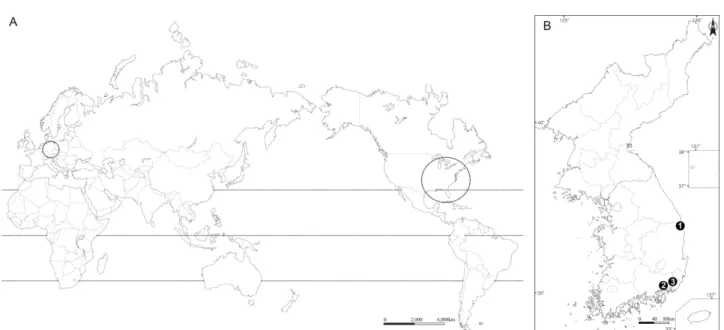
Distribution: Central and Eastern North America, Europe, Korea (Gyeongsangbuk-do; Uljin-gun, Gyeongsangnam-do;
Changwon-si, Yangsan-si) (Fig. 3).
Ecology and habitat: Dry to mesic woods, thickets, and disturbed ground. In Korea, this species grows in clearings or on the edges of forests, and shares habitats typically with Capsella bursa-pastoris (L.) Medik., Erigeron annuus (L.) Pers., Taraxacum officinale F. H. Wigg., Trigonotis peduncularis (Trevis.) Benth. ex Baker & S. Moore, and Viola verecunda A. Gray.
Specimen examined: KOREA. Gyeongsangbuk-do: Uljin- gun, Geumgangsong-myeon, Hawon-ri, Cheonchuksan Mt., 21 May 2019, K. S. Cheon 001-002 (SJUH). Gyeongsangnam-do:
Changwon-si, Anmin-dong, 18 May 2019, K. S. Cheon 003 (SJUH); Gyeongsangnam-do: Yangsan-si, Habuk-myeon, Jisan-ri, 19 May 2019, K. S. Cheon 004-007 (SJUH).
Taxonomic notes: In natural habitats, in Central and Eastern North America, this species is known to be most
morphologically similar to Viola brittoniana Pollard, Viola egglestonii Brainerd, and Viola septemloba LeConte. However, Viola palmata is distinguished from Viola brittoniana in that the earliest leaf blades are unlobed or sometimes 3-lobed, and it is distinguished from Viola egglestonii and Viola septembola by the rare presence of hair on the petiole, leaf surface, and peduncle. In Korea, meanwhile, this species is considered to be closely related with Viola chaerophylloides (Regel) W.
Becker due to its divided leaves. However, it is distinguished easily from Viola chaerophylloides owing to the character of simple leaves. Moreover, this species is differentiated from the Korean Viola species with violet petals by lobed leaves.
This newly naturalized species, Viola palmata L., was collected from three regions (Cheonchuksan Mt., Uljin-gun in Gyeongsangbuk-do; Anmin-dong, Changwon-si and Jisan-ri, Habuk-myeon, Yangsan-si in Gyeongsangnam-do) in 2019. We propose the new Korean name ‘Chang-won-je-bi-kkot’ based on the location from which was initially collected in Korea.
Viola palmata is described as from Virginia, United States (Linnaeus, 1753), and it is distributed in central, eastern North America and was introduced into Europe (Fig. 3). This species in Europe is also thought to have spread to the wild after being introduced as a horticultural species (Vitek et al., 2012). However, this species in Korea is considered to have been introduced by freight transport through a port, not as a horticultural species, as it is distributed around the Busan port areas (Park, 2017).
Meanwhile, there are approximately 10, 40, and 100 individuals growing on Cheonchuksan Mt. in Uljin-gun, Anmin-dong in Changwon-si, and Jisan-ri in Yangsan-si, respectively.
Fig. 3. Distribution of Viola palmata L. A. Global distribution. B. Collected sites from Korea. 1, Uljin-gun; 2, Changwon-si; 3, Yangsan-si.
ORCID: