• 검색 결과가 없습니다.

Characteristics of Droplet Properties in the Two-Phase Spray into a Subsonic Cross Flow

N/A
N/A
Protected

Academic year: 2021

Share "Characteristics of Droplet Properties in the Two-Phase Spray into a Subsonic Cross Flow"

Copied!
6
0
0

로드 중.... (전체 텍스트 보기)

전체 글

(1)

Characteristics of Droplet Properties in the Two-Phase Spray into a Subsonic Cross Flow

I-C Lee * , W-J Cho ** , J-Y Koo ***

Korea Aerospace University [email protected]

Keywords: two-phase spray, cross flow, ALR, SMD, volume flux

Abstract

The spray cross-section characteristics of two-phase spray that using external-mixing nozzle injected into a subsonic cross flow were experimentally studied with various ALR ratio that is 0~59.4%. Suction type wind tunnel was used and experiments were conducted to ambient environment. Several plain orifice nozzles with L/d of 30 and orifice diameter of 0.5 mm and orifice length 1.5 mm were tested. Free stream velocity profiles at the injection location were measured using hot wire. Spray images were captured to study collision point and column trajectory. Phase Doppler particle analyzer(PDPA) was utilized to quantitatively measuring droplet SMD, volume flux.

Measuring probe of PDPA positions was moved 3- way transverse machine. SMD distributions were layered structure and peaked at the top of the spray plume and low value at bottom of the spray.

Volume flux of spray was distributed to the two side region and volume flux quantity decreased when ALR ratio increased. It was found that the perpendicularly injected two-phase spray jet of external mixing into a cross flow showing that mist- like spray moved away from the test section bottom region.

Introduction

The study of liquid atomization into a cross- flow field has become an important research of ramjet/scramjet combustor and after burner. The combustion efficiency and pollutant emissions in propulsion systems will require improved technology for the distribution of specific quantities of atomized fuel to specific locations. And residence time is extremely limited in air breathing vehicle. Therefore, the fundamental physics of liquid jet-breakup processes, droplet transport dynamics, and spray structures must be investigated and understood. In order to enhance mixing efficiency, several fuel injection schemes, such as effervescent (or aerated- liquid, or barbotaged) atomization, angled injection, non-circular nozzles and ramp injectors have been studied quite extensively.

For liquid jet injection into a cross flow, it is well known that the spray field can be divided into three regimes. That is liquid column, ligament, and droplet regions. Detailed measurement of droplet size for external two-phase spray within the entire spray

plume, however, was not performed. In addition, SMD and volume flux distributions are important for the understanding of spray structures.

Liquid fuel may be injected from the combustor walls at various operating conditions. The combustion efficiency depends on fuel distribution, which is driven by fuel jet penetration and disintegration and dispersion processes. Recently, Inamura 1 and Nagai 2 and Wu 3 have shown that the liquid jet distribution is very sensitive to the jet operating conditions and may be controlled through various parameters. In general, the atomization processes are quite complicated, and they are nearly impossible to predict accurately with current computational techniques.

In view of the enhanced atomization performance for aerated-liquid jets, Lin et al. 4 applied effervescent atomization directly into a subsonic cross flow for the development of liquid-fueled combustors.

The spray penetration heights of aerated-liquid jets were studied experimentally using wide ranges of liquid properties, nozzle orifice diameters, jet-to-air momentum flux ratios, aerating gas-to-liquid mass ratios, and injection angles. Therefore, a thorough understanding of the entire process must begin with complete characterization of liquid jet behavior into cross flow. Aerated-liquid jet generated by introducing a small amount of gas into the liquid prior to injection has been demonstrated to favorably enhance liquid atomization and fuel/air mixing into a cross flow field. In the studies by Lin et al. 5 the characteristics of good spray atomization were observed in the far field of a typical aerated-liquid jet.

These spray plume include large cross sectional area, small droplet size, and fairly uniform volume flux distributions. And spray distributions deformed horseshoe-shape. Therefore, these aerated-liquid jets can be beneficial to the design of advanced vehicles powered by liquid fuels.

The objective of the current study, then, is to

experimentally investigate spray structures of external

mixing of two-phase spray into a subsonic cross flow

environment. A wide range of parameters, such as

ALR ratio were investigated. A one component PDPA

system was used to measure droplet and spray plume

properties. The results are then discussed, treating

cross-sectional contours of droplet SMD, volume flux

and trajectory.

(2)

Table 1 Test environment conditions and Nozzle properties

Parameter Water Air

Temperature (K) 293 217

Density (kg/m 3 ) 998 1.21

Surface tension(N/m) 0.0727 Orifice diameter (mm) 0.5

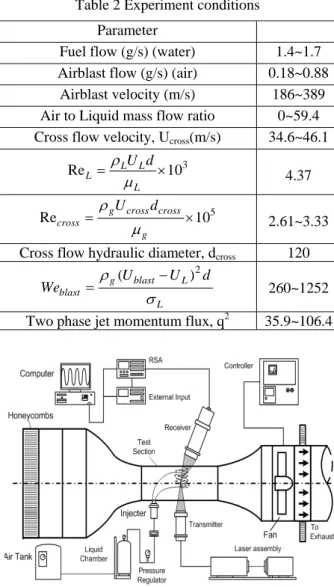
Orifice length (mm) 1.5 Table 2 Experiment conditions

Parameter Fuel flow (g/s) (water) 1.4~1.7

Airblast flow (g/s) (air) 0.18~0.88 Airblast velocity (m/s) 186~389 Air to Liquid mass flow ratio 0~59.4 Cross flow velocity, U cross (m/s) 34.6~46.1

Re L L L 10 3 L

ρ U d

= μ × 4.37

Re cross g cross cross 10 5 g

U d

ρ

= μ × 2.61~3.33

Cross flow hydraulic diameter, d cross 120

( ) 2

g blast L

blast

L

U U d

We ρ

σ

= − 260~1252

Two phase jet momentum flux, q 2 35.9~106.4

Fig. 1 Schematic of experiment system & suction type wind tunnel

Experimental Methods Appratus and Test conditions

Liquid injectors were flush mounted in the bottom plates of the subsonic wind tunnel. Fig. 1 depicts schematic of experiment system & suction type wind tunnel. And fig. 2 demonstrated in breakup process in subsonic cross flow. The test section had a rectangular shape measuring 120 mm wide, 120 mm height, 350 mm long. The test section had quartz windows in three walls as well as both sides of the test section to provide visual observation and optical instrumentation.

Fig. 2 Typical breakup process of a liquid jet in cross flow.

Fig. 3 Schematic of air assist injection system

Cross flow was supplied by turbine and heated by an air pre-heater which consists of combustors in both side walls in front of test section. Air stream velocity ranged from 12~52 m/s, pressure drop across the orifice about 13% of reservoir pressure, diameter of the orifice, 0.5 mm and length of orifice, 1.5 mm, and tapered by 45°to the exit diameter. Temperature of air stream is assumed 293.16 K. For safety experiments, cold-flow test carried out. Test liquid were filled into liquid tank and pressurized by air compressor. Liquid volumetric flow rate was controlled by pressure regulators and measured by a flow meter. The flow meter was calibrated to an uncertainty of less than 2 %.

The schematic of test environment conditions was shown in table 1 and experimental conditions were shown in table 2. A phase Doppler particle analyzer was also used to determine properties of droplets and spray plumes. Scattered light was collected at 30°from the transmitter. Droplet size, and volume flux were measured in the transverse and span wise directions across the spray plume.

Measurements were performed at several downstream

locations, Z/d=60, 100, 160. An increment of 2.54

mm was employed for measurement in the jet

injection (X/d, Y/d) direction, depending on the spray

structure. Regions with unbroken liquid core,

irregular ligaments, and non spherical drops, where

PDPA measurements can not be carried out reliably,

(3)

were avoided for the determination of detailed structures of the entire cross-sectional area. For penetration height measurement, the edge of the spray plume was probed, even though the entire spray structure is not suitable for detailed PDPA measurement. For spray plume areas with high number density, droplet properties were averaged over more than 20,000 droplets at each location to reduce the experimental uncertainties. Measurements were stopped when the measured liquid volume flux was below 0.01cc/s/cm 2 .

Visualization of the global spray structure was performed by conventional photography using CCD camera. The images captured by CCD camera were stored inside a computer using a flame grabber. Many images were averaged for each test condition to reduce the experimental uncertainty due to the unsteadiness of the spray. Two-phase spray is impinged at the nozzle exit about 3 mm. And between air to liquid are mixed at the cross flow field.

(a) ALR 0% (a) ALR 16.8%

(a) ALR 27.9% (a) ALR 59.4%

Fig. 4 Photograph images of air-assist spray for variable ALR (0~59.4%) without cross flow

(a) ALR 0%, q 1 =35.2 (b) ALR 0%, q 2 =39.7

(c) ALR 0%, q 2 =57.9 (d) ALR 0%, q 2 =106.4 Fig. 5 Photograph images for air-assist liquid jets in

subsonic cross flow

Results & Discussion

Vertical Injection & without Cross Flow

To verify shape of liquid jet, liquid jet was injected into an ambient filed. Figure 4 depicts the pure liquid jet injected into a non-cross flow filed and air assist spray for variable ALR without cross flow.

Liquid mass flow is constant value with 1.71 g/s. The characteristics of good spray atomization were observed in around field of a typical air-assist jet as increasing ALR ratio. But atomization process is limited to ALR ratio with 59.4%. For the pure liquid jet, the air-assist force helps to break the liquid column into ligaments and drops. As a result, the majority of the liquid is distributed along the column trajectory. Relatively small droplet can be easily seen in the plume of this spray.

0 20 40 60 80 100 120 140 160

0 20 40 60 80 100 120 140 160 180

Y/ d

Z/d

ALR 0.0%, q 1 = 35.2 ALR 10.7%, q 2 = 35.96 ALR 16.8%, q 2 = 39.77 ALR 27.9%, q 2 = 57.98 ALR 59.4%, q 2 = 106.46

Fig. 6 Trajectories of liquid jet in cross flow

Injected into a Cross Flow

Firstly, we assumed momentum ratio with q 1 , q 2 . The water was injected through 0.5 mm orifice from the bottom and the air stream was blow from left.

For pure liquid jet, the inertia force is greater than

liquid tension by the increased liquid pressure. As the

inertia momentum of liquid was interrupted by the

increased inertia momentum of air stream, spray

penetration of liquid jet, Y/d, was decreased and

trajectory of liquid jet had more down. Decreased

momentum ratio affects secondly breakup of droplet

which processed with more small size. As the liquid

column experiences the aerodynamic force from the

free stream and the growth of the turbulence from the

liquid column itself, the liquid column begins to bend

toward the downstream direction. Photograph images

for air assist liquid jet injected into a subsonic cross

flow were shown in fig. 5. As increase ALR ratio,

liquid breakup position was more closed at nozzle exit

location. Some of the big drops eventually go through

on the upper field of the wind tunnel, due to the

surface impinging for air. And once the liquid jet is

air assisted, the spray penetration height increases,

due to the increased effective jet-to-air momentum

flux ratio. It was found that the perpendicularly

injected two-phase spray jet of external mixing into a

cross-flow showing that mist-like spray moved away

(4)

from the test section bottom region. Fig. 6 depicts trajectory of liquid jet. The spray penetration height is also observed to be increased when ALR ratio was increased. The overall breakup process is slow, and a significant stream wise distance is needed to generate a limited number of fine droplets.

2

1 2

l l

a a

q U U ρ

= ρ (1)

2 2

2 2

( L L fuel g blast blast ) / spray

g cross

U A U A A

q U

ρ ρ

ρ

= + (2)

Liquid Properties in Cross Flow

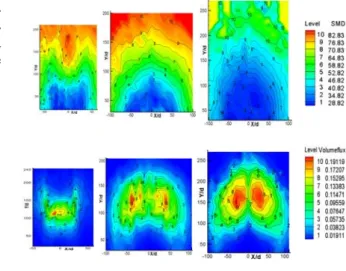
Experiment for the variable ALR ratio was conducted by using PDPA system. As the degree of ALR ratio increases, the cross-sectional area of the spray plume mainly comes from the increase in spray penetration height. While further increase in air assist can increase the spray plume size, its effectiveness is reasonable and can be compromised by the additional amount of assisted air aboard a ramjet/scramjet combustor. The spray width is somewhat dependent on ALR ratio. In order to better characterize the complex spray structures, cross sectional distributions of SMD, volume flux were measured for air assist liquid jet, as shown in fig. 7. PDPA measurements were performed at fixed position with Z/d 60. With only 16.8% air assisted into the liquid jet in fig. 7(a).

A spray plume with wider cross sectional area can be obtained for the air assisted liquid jet. Maximum value of SMD verified at the top of spray plume. And minimum value of SMD verified at the bottom of spray plume. The range of SMD is 28.82 μ m and 82.83 μ m . The Phenomenon of structured layer in the plume of the air assisted liquid jet can be seen in the SMD contour plot of Fig. 7(a), (b), (c) where large droplets with higher momentum in the jet injection direction can travel farther to the outer boundary of the spray plume, while small droplets with lower momentum are distributed in the bottom region of the spray plume. This phenomenon is different from internal mixing nozzle. Unlike the internal mixing nozzle, where mist-like droplets are concentrated within a bottom region, also there is a lower correspondence between the distributions of liquid volume flux and droplet size. Smallest droplet SMD was 28.82 μ m . And mainly distributed at inner region of the spray, where the liquid volume flux is very small. The small droplet containing region decreases in size as increasing ALR ratio.

(a)ALR 16.8% (b)ALR 27.9% (c)ALR= 59.4%

Fig. 7 Contour of SMD and volume flux of air assist spray. (Re cross =2.61x10 5 , L/d=3, Z/d=60) As will be shown in Fig. 7(c), these small droplets are produced by impinging with surface of liquid jet at nozzle exit. And then this small droplet entrained in the wake region. At the peak volume flux locations, the droplet size is around 58.82 μ m . As increasing ALR ratio, SMD of peak value is fixed about 76.3 μ m , which is outer boundary.

The spatial distribution of the liquid volume flux is more concentrated. And volume flux of center region is high value. Spray plume region of ALR 16.8% is more small area compare with ALR 27.9%.

The peak liquid volume flux is 0.1911 cc/s/cm 2 . The

horseshoe-shaped volume flux distribution is showed

at fig. 7(b) which is ALR ratio with 27.9%. For an air

assist liquid jet, however, the co-centered structure of

the two-phase flow right at the injection plane has

already dispersed as well as small ligaments, drops,

resulting in a spray plume without a highly

concentrated liquid core. With the actions of the

vortex pair induced by the presence of the large spray

plume, small droplets right on top of the spray plume

can be easily moved toward at lower periphery region

of the spray plume. As a result, liquid on top of the

spray plume is gradually make a form which is one

pair of horseshoe shape and the peak volume flux is

shifted away from the middle of center region to

center region of the two sides. This large-scale droplet

motion greatly promotes uniform distribution of the

injected liquid in the spray plume and, therefore,

significantly enhanced mixing between droplets and

ambient air. The same vortical actions, however, do

not have substantial effects on the structure of the

pure liquid jet. At ALR=16.8%, Since the vorticity

intensity is relatively weak which produced small

cross-sectional area of the spray plume, where the

liquid is highly concentrated and only a small quantity

of fine droplets is generated.

(5)

(a) Re cross =2.61(x10 5 ), d=0.5 mm, ALR=0%. SMD

(b) Re cross =2.61(x10 5 ), d=0.5 mm, ALR=0%.

Volume flux

(c) Re cross =2.61(x10 5 ), d=0.5 mm, ALR=27.9%.

SMD

(d) Re cross =2.61(x10 5 ), d=0.5 mm, ALR=27.9%.

Volume flux

Fig. 8 Total cross-sectional 3D multi-view of SMD

and volume flux on external air-assist spray

(6)

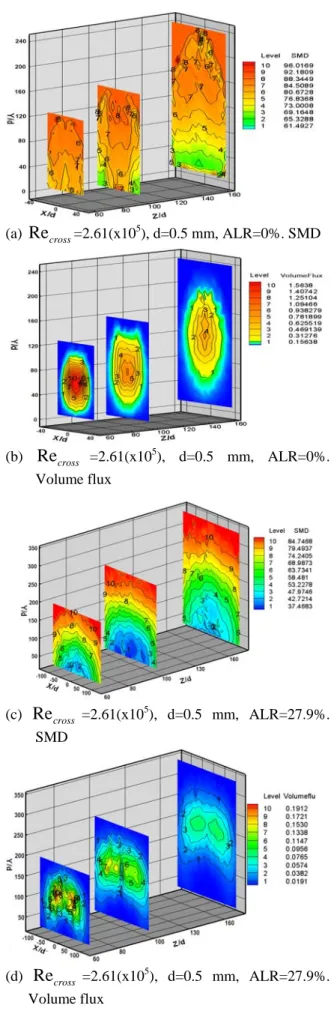
Total cross-sectional 3D multi-view of SMD and volume flux on external air assisted spray is illustrated in fig. 8. The PDPA measurement was performed at the Z/d 60, 100 and 160. Drop sizes were measured across a broad vertical distance along the spray surface for water, using 0.5 mm nozzles.

Aeration levels were in the range ALR=0~27.9%. In fig. 8(a), SMD value was peaked at upper region of spray plume with 96.01 μ m . ALR=0% has distributions of coarse SMD in comparison with ALR=27.9%. The droplet size distribution at y/d<40 is somewhat scattered due to the presence of a high- flux, low-velocity wake region, which may increase uncertainties in PDPA measurement. Nonetheless, the insensitivity of droplet size to free stream location highlights the fact that the liquid atomization process has been completed. No further droplet breakup process can occur for x/d=160. The distribution of SMD has a structured layer, which appears to fig. 8(a) and (c). The minimum droplet size appears at the y/d<40 location, where the droplet velocity appears to be the maximum. The maximum droplet size appears both ALR=0%. Somewhat SMD value of ALR=0% at upper region of is higher than ALR=27.9%.

According to the measurements in fig. 8(c), the SMD for the mist-like droplets is believed to be below 37.46 μ m . And at the inner lower portion to the each side of spray plume undergo oscillatory process. Fig.

8(b), (d) illustrates liquid volume flux. ALR=0% is elliptical shape and ALR=27.9% is horseshoe shape.

And the liquid volume flux is reduced for the air assist jets, due to the increase in spray plume size. A comparison of the ALR=0 and the ALR=27.9% cases shows that more liquid within the volume flux value is appeared in ALR=0% at the center region. At the ALR=27.9%, the spray penetration height and area of spray plume increases and the liquid core at the inner portion of the spray plume disappears as the liquid is air assisted.

Conclusion

The spray structures of air assist jet vertically injected into a subsonic cross flow were studied experimentally, using phase Doppler particle analyzer.

Water was injected into a subsonic cross flow thorough nozzles with orifice diameters of 0.5 mm and L/d ratio of 30 at various ALR ratio of 0~59.4%.

The detailed spray plume was investigated in terms of size, volume flux. The major conclusions of this study are as follows.

1) For the external mixing two phase spray, atomization process is limited to ALR ratio about 59.4%. For the pure liquid jet, the air assist force helps to break the liquid column into ligaments and drops.

2. Two phase spray breakup mechanism is manly governed by air of outer position at nozzle. And influence of cross flow is sub-breakup process.

When ALR ratio was increased, the spray penetration height was increased.

3. As the degree of ALR ratio increases, the cross- sectional area of the spray plume mainly increased by the increase in spray penetration height.

4. Spray plume undergo oscillatory process. And ALR=0% is elliptical shape and ALR=27.9% is horseshoe shape.

5. The distribution of SMD has a structured layer. At ALR=27.9~59.4, the minimum droplet size appears at the bottom region of spray. The maximum droplet size appears at the upper region which is pure liquid jet. And the SMD contour of spray jet was structured layer. It was found that the perpendicularly injected two-phase spray jet of external mixing into a cross flow showing that mist-like spray moved away from the test section bottom region and concentrated.

6. Volume flux value of the center region at Z/d=0 is higher than at Z/d=160. The center region of liquid volume flux is reduced for the air assist jets, due to the increase in spray plume size.

Acknowledgment

This work was supported by the Korea Research Foundation Grant funded by the Korean Government (MOEHRD, Basic Research Promotion Fund) (KRF- 2007-D00084)

References

1) Inamura, T., and Nagai, N., “Spray Characteristics of Liquid Jet Traversing Subsonic Air stream,”

Journal of Propulsion and Power, Vol. 10, No. 6, pp. 798-803, 1994.

2) Nguyen, T. T., and Karagozian, A. R., “Liquid Fuel Jet in Subsonic Cross flow,” Journal of Propulsion and Power, Vol. 8, No. 8, pp. 21-29, 1992.

3) Wu, P. K., Kirkendall, K. A., Fuller, R. P., and Nejad, A. S., “Breakup Processes of Liquid Jets in Subsonic Cross flows,” Journal of Propulsion and power, Vol. 13, No. 1, pp. 64-73, 1997.

4) K. C. Lin, P. J. Kennedy, T. A. Jackson., “Spray Structures of Aerated-Liquid Jets in Subsonic Cross flows,” AIAA Meeting & Exhibit, 8-11 January 2001/Reno, NV.

5) K. C. Lin, P. J. Kennedy, T. A. Jackson., “Structure Aerated-Liquid Jets in High Speed Cross-flows,”

32nd AIAA Fluid Dynamics Conference and

Exhibit, 24-16 June 2002, St. Louis, Missouri.

수치

Fig. 2 Typical breakup process of a liquid jet in  cross  flow.
Fig. 4 Photograph images of air-assist spray for  variable ALR (0~59.4%) without cross flow
Fig. 7 Contour of SMD and volume flux of air assist  spray. (Re cross =2.61x10 5 , L/d=3, Z/d=60)  As will be shown in Fig
Fig. 8 Total cross-sectional 3D multi-view of SMD  and volume flux on external air-assist spray

참조

관련 문서

 Engineering stress - The applied load, or force, divided by the original cross-sectional area of the material..  Engineering strain - The amount that a material deforms per

– Cross section of a beam in Cross section of a beam in pure bending remain plane – (There can be deformation in (There can be deformation in.

~ a volume which is fixed in space and through whose boundary matter, mass, momentum, energy can flow. ~ The boundary of control volume is

Performance evaluation of Volume PTV based on Affine Performance evaluation of Volume PTV based on Affine Performance evaluation of Volume PTV based on Affine Performance

Derive the expression for the total force per unit width exerted by the sluice gate on the fluid in terms of vertical distances shown in Fig?. Derive the equation for the

In this study the various modification of configurations of piston crown and spray impingement was attempted to attain a geometry that realize the two

First of all, when it comes to the estimation of results by cross-section model, the Korean trade of fishery products is positively related with the

- The shearing stress on a cross section at the inside surface of the shaft.. - The magnitude of the angle of twist in