Vol. 28, No. 1, 2019, 55-61
≫ 연구논문 ≪
묽은 염산용액에서 아민과 중성추출제에 의한 몰리브덴(VI)과 텅스텐(VI)의 용매추출
Minh Nhan Le*·손성호**·§이만승*
*목포대학교 신소재공학과, **한국생산기술연구원
Solvent Extraction of Mo(VI) and W(VI) from Dilute Chloride Solution by Amine and Neutral Extractants
Minh Nhan Le *, Seong Ho Son** and Man
§Seung Lee *
*Department of Advanced Materials Science & Engineering, Mokpo National University, 1666 Yeongsan-ro, Cheonggye-myeon, Muan-gun, Chonnam 58554, Korea
**Korea Institute of Industrial Technology, Incheon Technology Service Centre, 156 Gaetbeol-ro, Yeonsu-gu, Incheon 21999, Korea
요 약
묽은 염산용액의 pH를 2에서 9까지 변화시켜 아민계(Alamine 308과 TEHA)와 중성추출제(TOP)로 몰리브덴(VI)과 텅스텐(VI)의 용매추출거동을 조사하였다. 텅스텐(VI)이 몰리브덴(VI)보다 상기 세 추출제에 선택적으로 추출되었으며, TEHA로 추출시 가장 높 은 분리인자를 얻었다. 수소화처리하지 않은 3차 아민에 의한 두 금속의 추출율은 용액의 pH에 따라 지속적으로 감소하여 pH 9에 서는 전혀 추출되지 않았다. 본 논문의 실험조건에서 용매추출거동을 금속의 농도분포곡선을 이용하여 설명하였다. Alamine 308과 TEHA 는 TOP에 비해 두 금속의 추출과 분리에 효과적이다.
주제어 :
용매추출, 몰리브덴(VI), 텅스텐(VI), 화학종 분포
Abstract
The extraction behavior of Mo(VI) and W(VI) from dilute chloride solution was investigated by employing amine (Ala- mine308 and TEHA) and neutral extractants (TOP) in the solution pH range from 2 to 9. W (VI) was selectively extracted over Mo(VI) by these three extractants and TEHA led to the highest separation factor. Without the pretreatment protonation of the tertiary amines, the extraction percentage of the two metal ions decreased steadily to zero as solution pH increased to 9. The extraction behavior of the metals was discussed on the basis of the distribution diagram of each metal. Alamine 308 and TEHA were much better than TOP in extracting and separating the two metal ions.
Key words : Solvent extraction, molybdenum (VI), tungsten (VI), speciation
· Received : December 13, 2018 · Revised : December 31, 2018 · Accepted : January 10, 2019
§
Corresponding Author : Man-Seung Lee (E-mail : [email protected])
Department of Advanced Materials Science & Engineering, Mokpo National University, 1666 Yeongsan-ro, Cheonggye-myeon, Muan-gun, Chonnam 58554, Korea
ⓒThe Korean Institute of Resources Recycling. All rights reserved. This is an open-access article distributed under the terms of the
Creative Commons Attribution Non-Commercial License (http://creativecommons.org/licenses/by-nc/3.0/), which permits unrestricted
non-commercial use, distribution and reproduction in any medium, provided the original work is properly cited.
1. Introduction
Molybdenum (Mo) and tungsten (W) are strategic metals which are widely employed in many applications such as catalysts, advanced materials, electronic devices, and production of alloys1,2). Since the demand for molyb- denum and tungsten is increasing, the recovery of these metals from diverse resources is necessary. In general, hydrometallurgical processes including precipitation, solvent extraction, ion-exchange, and adsorption are frequently used to separate molybdenum and tungsten from the leaching solutions3). Solvent extraction is con- sidered to be more effective in recovering these two metals with high purity than the other methods4). Molyb- denum and tungsten belong to the same column of the periodic table, and thus the separation of these two metals from each other is very difficult due to their similar chemical properties. Numerous efforts have been made to selectively separate molybdenum and tungsten from their aqueous solution by solvent extraction. Most of the studies have focused on the removal of small amounts of molybdenum or tungsten from the mixture solution.
Acidic, neutral, and amine extractants are employed for the separation of molybdenum and tungsten from various solutions. In addition, the extraction and separation behavior of molybdenum and tungsten depends strongly on the solution pH, metal concentration and the nature of the extractants. Namely, some extraction systems could well extract molybdenum and tungsten at high acid concentration with the aid of modifiers5,6). Primary amine N1923 preferred to extract negative ion species in alkaline medium (pH > 7),1) meanwhile neutral extractants like DBSO, PSO could extract molybdenum and tungsten in the pH range of 2 to 57). On the other hand, cationic species as MoO22+ can be extracted by acidic extractants (D2EHPA, LIX 63) at low solution pH8,9). It can be said that a change in speciation of molybdenum and tungsten with solution pH has a significant effect on the selection of appropriate extractant to separate these two metals.
According to some studies, either amine or neutral extractants can interact with the hydrogen ion in the solution10,11) and thus the competition for the extraction
between the metal and hydrogen ion can occur under the change of solution pH. This may promote the separation of molybdenum and tungsten. In this work, triisooctyl- amine (Alamine 308), tri(2-ethylhexyl)amine (TEHA) and trioctylphosphine (TOP) were employed to investi- gate the effect of solution pH on the extraction and separation behavior of molybdenum (VI) and tungsten (VI). These extractants have not been employed for the separation of molybdenum (VI) and tungsten (VI) up to now. The solvent extraction data was analyzed on the basis of the speciation of both metal ions.
2. Experimental
The synthetic solutions of Mo(VI) and W(VI) were prepared by dissolving appropriate amounts of Na2MoO4 (Sigma Co., 98%) and Na2WO4 (Sigma Co., 99%) in distilled water. The concentration of Mo(VI) and W(VI) in the solution was kept at 1 g/L during the whole experiments. The acidity of the solution was adjusted by adding HCl (Daejung Co., 35%) or NaOH (Duksan Co., 93%) solution. The extractants Alamine 308 (Cognis Co., 95%), TEHA (BASF Co., 99%) and TOP (Cytec Inc., 99%) were used without further purification. Kero- sene (Samchun Pure Chemical Co.) was used as a diluent and all the other chemicals used were of analytical grade.
Solvent extraction experiments were carried out by mixing an equal volume (10 mL) of aqueous and organic phases for 30 minutes using a wrist action shaker (Burrell model 75, USA). All of the experiments were performed at room temperature. After shaking, the two phases were separated using a separation funnel. Metal ion concent- ration in the aqueous phase before and after extraction was measured by ICP-OES (Spectro Arcos). The mea- surements were performed in triplicate and then the aver- age value was taken. Metal ion concentrations in the loaded organic phase were calculated by mass balance.
3. Results and Discussion
3.1. Molybdenum (VI) and tungsten (VI) speciation in aqueous solution
In the extraction process, information on the speciation
of molybdenum (VI) and tungsten (VI) in aqueous solu- tion is necessary to select the appropriate extractant to separate the two metals. The distribution of molybdenum (VI) and tungsten (VI) species can be divided into cationic, neutral, and anionic species, which depend on the concentration of metals and solution pH. Species distribution diagrams of metal complexes were con- structed with the help of Hyperquad Simulation and Speciation (HySS) program12) and Spana-Chemical Equi- librium Diagram software13).
3.1.1. Molybdenum(VI) species
According to the equilibrium constants and complex formation of Mo(VI) species from the reported litera- ture,14-16) the distribution diagram of Mo(VI) species in aqueous solution is shown in Fig. 1. Molybdate ion MoO42− is predominant when solution pH is higher than 6. In the range of solution pH from 1 to 6, diverse polynuclear species exist such as Mo7O246−, HMo7O245−, H2Mo7O244−, H3Mo7O243−, Mo8O264−, and Mo19O594−. It has been reported that mononuclear species predominate at low molybdate concentration and a small fraction of HMoO4− exist in the pH range of 4-616). Fig. 1 also shows that cationic species such as HMoO3+, HMo2O6+, and H6Mo2O82+ are stable at pH lower than 1 due to the formation of protonation and dimerization reaction between molybdate species and hydrogen ion16), while neutral species like H2MoO4 exist in the pH range from
zero to 3.
3.1.2. Tungsten(VI) species
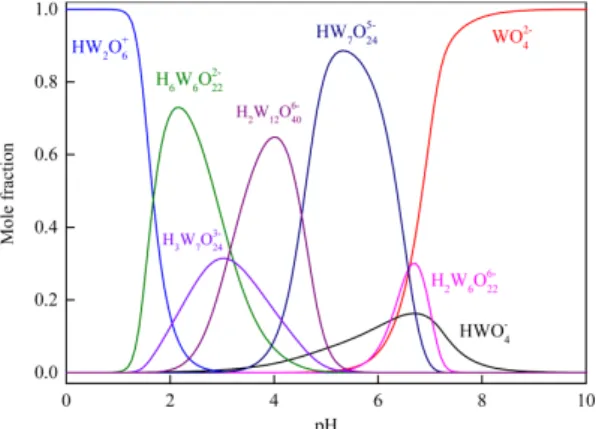
Although molybdenum and tungsten are in the same column of the periodic table, there is some difference in the chemical speciation of both metal ions. Fig. 2 shows the distribution diagram of tungsten species as a function of pH with tungsten concentration of 1.0 mM, which was calculated from the reported data17). Like Mo(VI), W(VI) species in aqueous solution is mainly present as WO42− in alkaline aqueous solution (pH > 8). Various oxoanionic species such as HWO4−, H2W6O226−, HW7O245−, H2W12O406−, H3W7O243−, and H6W6O222− are formed in the pH range between 2 and 7. Fig. 2 also indicates that cationic W(VI) species like HW2O6+ is present in the most acidic region (pH < 2).
Generally, tungsten acid and its anhydride WO3(s) have low solubility in water, but they do not precipitate from W(VI) bearing solutions during acidification, because soluble isopolytungstates are formed18). Therefore, in some solvent extraction processes, either oxidant or mask- ing reagent is added to the aqueous solutions as a modifier to prevent the precipitation of tungsten3,6).
3.2. Extraction of Mo(VI) and W(VI) by amine and neutral extractant
3.2.1. Extraction of Mo(VI) and W(VI) by amine extractant
Fig. 1. Distribution diagram of molybdenum (VI) species in aqueous solution as a function of pH. [Mo]total = 0.01 M.
Fig. 2. Distribution diagram of tungsten (VI) species in aqueous solution as a function of pH. [W]total = 0.01 M.
Experiments were performed to test the extraction behavior of Mo(VI) and W(VI) with Alamine 308 and TEHA by varying the initial pH from 2 to 9. In these experiments, the concentration of Mo(VI) and W(VI) in the aqueous solutions was kept at 1 g/L. The concent- ration of each extractant was fixed at 0.1 M in kerosene diluent, and the phase ratio of O/A was maintained at unity. The variations in the extraction percentage of the two metals by Alamine 308 and TEHA as a function of pH are presented in Figs. 3 and 4, respectively. It is seen from Fig. 3 that most of Mo(VI) and W(VI) were extracted by Alamine 308 at solution pH of 2.5.
The extraction percentage of Mo(VI) and W(VI) decreas- ed rapidly with the further increase of equilibrium pH.
For TEHA extractant, about 95% Mo(VI) and W(VI) was extracted into the organic phase at equilibrium pH 2.6. As the equilibrium pH increased from 2.6 to 5.6, the extraction percentage of Mo(VI) and W(VI) decreased steadily and then decreased slightly as equilibrium pH increased to 9.2 (see Fig. 4). The decrease in the extrac- tion percentage of both metals by Alamine 336 and TEHA in the experiment pH range might be ascribed to the protonation reaction of amines19). Alamine 308 and TEHA are tertiary extractants and thus they should be protonated to act as an anion exchanger. In this work, they were not protonated before extraction. Therefore,
as solution pH increases, the tertiary amines cannot be protonated, resulting in negligible extraction of both metal ions.
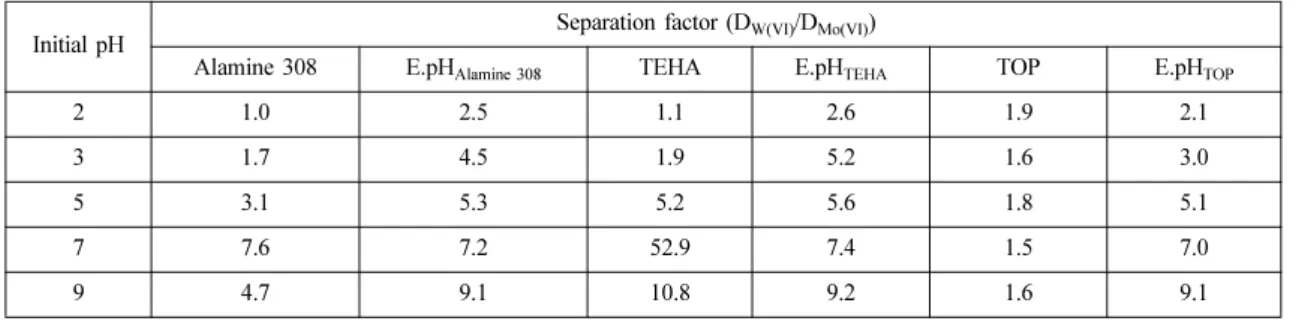
It was noticed that the extraction percentage of W(VI) was higher than that of Mo(VI) at all the initial pH range with both Alamine 308 and TEHA. This can be explained by the difference in electric charge density of the metal complex. The charge density of W6+ (566 C·mm−3) is smaller than that of Mo6+ (589 C·mm−3), resulting in a stronger interaction between tungsten species and the extractants20). Our results agreed well with the data reported when the metal components were equi- valent21). However, the difference of the charge densities between Mo(VI) and W(VI) was small. In some case, the difference in charge density would have a negative effect on the extraction behavior of Mo(VI) and W(VI) by amine22). For instance, Alamine 336 can selectively extract Mo(VI) over W(VI) at high concentration of Mo and low concentration of W in the pH range of 3-519). Table 1 shows the variation in the separation factor between W(VI) and Mo(VI) with the solution pH. The separation factor of W(VI) and Mo(VI) by Alamine 308 and TEHA increased with the increase of initial pH up to 7 in the feed. As the initial pH increased from 7 to 9, the separation factor decreased with either Alamine 308 or TEHA. The highest separation factor between Fig. 3. Effect of equilibrium pH on the extraction of Mo(VI)
and W(VI) by Alamine 308. Condition: [Mo(VI)] = [W(VI)] = 1 g/L, [Alamine 308] = 0.1 M, diluent:
kerosene, O/A = 1:1.
Fig. 4. Effect of equilibrium pH on the extraction of Mo(VI) and W(VI) by TEHA. Condition: [Mo(VI)] = [W(VI)]
= 1 g/L, [TEHA] = 0.1 M, diluent: kerosene, O/A = 1:1.
W(VI) and Mo(VI) by Alamine 308 and TEHA was 7.6 and 52.9, respectively. The results also indicated that the separation factor of W(VI) and Mo(VI) by TEHA was higher than that by Alamine 308 in all the experi- mental range. It can be said that the interaction between hydrogen ions and amine extractants has some effect on the separation of Mo(VI) and W(VI). The structure of Alamine 308 is bulkier than that of TEHA, and thus hydrogen ion would be more likely to interact with TEHA than Alamine 308.
3.2.2. Extraction of Mo(VI) and W(VI) by neutral extractant
In order to investigate the effect of initial pH on the extraction behavior of Mo(VI) and W(VI) by neutral extractant TOP, initial pH was varied from 2 to 9. The concentration of TOP was fixed at 0.1 M, while metal ions concentration was controlled at 1 g/L. In these experiments, the volume ratio of the aqueous phase to organic phase was fixed at unity. Fig. 5 shows the variation in extraction percentage of Mo(VI) and W(VI) by TOP with solution pH. As shown in this figure, the extraction percentage of both metal ions did not exceed 10% and kept almost constant in the equilibrium pH range from 2.1 to 7. Like the case of amine extractants, the extraction of two metals was very low at high solution pH. Solvation reaction is responsible for the extraction of Mo(VI) and W(VI) by TOP from aqueous solution due to the nature of a solvating extractant. Based on the distribution diagram of Mo(VI) and W(VI) species in solution pH from 2 to 6, anionic species would be
extracted into the organic phase in the presence of hydrogen ion as represented in Eq. (1).
TOPorg + nH+aq + (MexOyHz)n−aq = [TOP·H(n+z)MexOy]org (1) where Me represents the metal ions. The subscripts aq and org refer to the aqueous and organic phase, respec- tively.
In terms of separation of Mo(VI) and W(VI), W(VI) was selectively extracted over Mo(VI) but the high separation efficiency between W(VI) and Mo(VI) was not expected by using TOP in the experimental range.
The separation factor of Mo(VI) and W(VI) by TOP was even lower than that of Alamine 308 and TEHA.
Table 1. Effect of solution pH on the separation factor between Mo(VI) and W(VI) by several extractants
Initial pH Separation factor (D
W(VI)/D
Mo(VI))
Alamine 308 E.pH
Alamine 308TEHA E.pH
TEHATOP E.pH
TOP2 1.0 2.5 1.1 2.6 1.9 2.1
3 1.7 4.5 1.9 5.2 1.6 3.0
5 3.1 5.3 5.2 5.6 1.8 5.1
7 7.6 7.2 52.9 7.4 1.5 7.0
9 4.7 9.1 10.8 9.2 1.6 9.1
[Mo(VI)] = [W(VI)] = 1 g/L, [extractant] = 0.1 M, diluent: kerosene, O/A = 1:1. E.pH: equilibrium pH.
Fig. 5. Effect of equilibrium pH on the extraction of Mo(VI) and W(VI) by TOP. Condition: [Mo(VI)] = [W(VI)]
= 1 g/L, [TOP] = 0.1 M, diluent: kerosene, O/A = 1:1.
4. Conclusions
The extraction behavior of Mo(VI) and W(VI) with amine (Alamine 308, TEHA) and neutral extractant (TOP) was investigated by varying the solution pH from 2 to 9. The extraction and separation of the two metals were discussed on the basis of species distribution diagrams of metal complexes and the type of extractants. Mo(VI) and W(VI) could be well extracted by Alamine 308 and TEHA from weak acid solutions (pH 2). However, the extraction efficiency of Mo(VI) and W(VI) decreased with the further increase of solution pH. On the other hand, TOP exhibited a low extraction effect on Mo(VI) and W(VI) under the same condition. The obtained result indicated that the extraction behavior of Mo(VI) and W(VI) by the extractants is consistent with information on the distribution diagram of these metals species.
Amine extractant was found to be more effective than neutral extractant in separating the two metal ions.
Acknowledgements
This work was supported by National Research Foundation of Korea (2018R1D1A1B07044951).
References
1. Ning, P., Cao, H., and Zhang, Y., 2009 : Selective extraction and deep removal of tungsten from sodium molybdate solution by primary amine N1923, Separation and Purification Technology, 70(1), pp.27-33.
2. Saberyan, K., Maragheh, M. G., Ashtari, P., and Alam- dari, S. K., 2003 : Liquid-liquid extraction of molybde- num(VI) from acidic media with Cyanex-301, Minerals Engineering, 16(4), pp.391-393.
3. Guan, W., Zhang, G., and Gao, C., 2012 : Solvent extraction separation of molybdenum and tungsten from ammonium solution by H2O2-complexation, Hydromet- allurgy, 127-128, pp.84-90.
4. Nguyen, T. H. and Lee, M. S., 2015 : Separation of molybdenum(VI) and tungsten(VI) from sulfate solu- tions by solvent extraction with Lix 63 and PC 88A, Hydrometallurgy, 155, pp.51-55.
5. Talla, R. G., Gaikwad, S. U., and Pawar, S. D., 2010 : Solvent extraction and separation of Mo(VI) and W(VI) from hydrochloric acid solutions using cyanex-923 as
extractant, Indian Journal of Chemical Technology, 17(6), pp.436-440.
6. Mahmoud, M. H. H., Nakamura, S., and Akiba, K., 1996 : Separation of molybdenum(VI) and tungsten(VI) through a supported liquid membrane impregnated with trioctylme- thylammonium chloride, Separation Science and Tech- nology, 31(20), pp.2763-2774.
7. Dai, G. S., Xuan, B. Y., and Su, Y. F., 1984 : Separation of tungsten and molybdenum in dilute hydrochloric acid solution by extraction with sulfoxides, Hydrometallurgy, 13(2), pp.137-153.
8. Mahmoud, M. H. H., Nakamura, S., and Akiba, K., 1996 : Extraction separation of molybdenum(VI) and tung- sten(VI) by α-hydroxy oxime, Solvent Extraction and Ion Exchange, 14(2), pp.203-217.
9. Qingyuan, Z. and Huihao, F., 1986 : Separation of molybdenum from tungsten by di-2-ethylhexyl phos- phoric acid extractant, Hydrometallurgy, 16(3), pp.263- 270.
10. Banda, R., Nguyen, T. H., and Lee, M. S., 2013 : Recov- ery of HCl from chloride leach solution of spent HDS catalyst by solvent extraction, Chemical and Process Engineering - Inzynieria Chemiczna i Procesowa, 34(1), pp.153-163.
11. Le, M. N., Nguyen, T. H., and Lee, M. S., 2018 : Extraction and stripping behavior of hydrochloric acid from aqueous solution by Cyanex 923/TEHA and its mixtures, Geosystem Engineering, pp.1-9.
12. Alderighi, L., Gans, P., Ienco, A., Peters, D., Sabatini, A., and Vacca, A., 1999 : Hyperquad simulation and specia- tion (HySS): A utility program for the investigation of equilibria involving soluble and partially soluble species, Coordination Chemistry Reviews, 184(1), pp.311-318.
13. Puigdomenech, I., 26-30 March 2000 : Windows soft- ware for the graphical presentation of chemical specia- tion, in: 219th ACS National Meeting, Abstracts of Papers, Vol. 1, American Chemical Society: San Fran- cisco, CA, pages Abstract I&EC–248.
14. Baes, C. F. and Mesmer, R. E., 1976 : The hydrolysis of cations, pp.253-260, John Wiley & Sons, New York.
15. Lee, M., Sohn, S., and Lee, M., 2011 : Ionic equilibria and ion exchange of molybdenum(VI) from strong acid solution, Bulletin of the Korean Chemical Society, 32(10), pp.3687-3691.
16. Cruywagen, J. J., 1999 : Protonation, oligomerization, and condensation reactions of vanadate(V), molybdate (VI), and tungstate(VI), pp.127-182, Academic Press, Poland.
17. Torres, J., Tissot, F., Santos, P., Ferrari, C., Kremer, C., and Kremer, E., 2016 : Interactions of W(VI) and Mo(VI)
oxyanions with metal cations in natural waters, Journal of Solution Chemistry, 45(11), pp.1598-1611.
18. Redkin, A. F., and Bondarenko, G. V., 2010 : Raman spectra of tungsten-bearing solutions, Journal of Solution Chemistry, 39(10), pp.1549-1561.
19. Nguyen, T. H. and Lee, M. S., 2016 : Separation of molybdenum and tungsten from sulfuric acid solution by solvent extraction with alamine 336, J. of Korean Inst. of Resources Recycling, 25(1), pp.16-23.
20. Rayner-Canham, G., and Overton, T., 2013 : Descriptive inorganic chemistry, pp.705-706, W. H. Freeman and Company, New York.
21. Nakamura, T., Nishihama, S., and Yoshizuka, K., 2009 : A novel extractant based on δ-glucosamine for the ex- traction of molybdenum and tungsten, Solvent Extraction
Research and Development Japan, 16, pp.47-56.
22. Voropanova, L. A. and Barvinyuk, N. G., 2004 : Extrac- tion of molybdenum(VI) from aqueous-peroxide solu- tions of sodium tungstate with trialkylamine, Russian Journal of Applied Chemistry, 77(5), pp.759-762..
Minh Nhan Le
• 목포대학교 신소재공학과 학사
• 현재 목포대학교 신소재공학과 석사과정
손 성 호
• 현재 한국생산기술연구원 수석연구원
• 당 학회지 제25권 4호 참조
이 만 승
![Fig. 4. Effect of equilibrium pH on the extraction of Mo(VI) and W(VI) by TEHA. Condition: [Mo(VI)] = [W(VI)]](https://thumb-ap.123doks.com/thumbv2/123dokinfo/5296792.377521/4.892.460.763.211.458/fig-effect-equilibrium-extraction-mo-vi-teha-condition.webp)