Pseudomonas aeruginosa Exotoxin A Induces Apoptosis in Chemoresistant YD-9 Human Oral Squamous Carcinoma Cell Line Via Accumulation of p53 and Activation of Caspases
Gyoo-Cheon Kim
1and Young-Gi Gil*
Department of Anatomy College of Medicine, Kosin University, Busan 602-703, Korea
1
Department of Oral Anatomy School of Dentistry, Pusan National University, Busan 602-739, Korea, Received May 13 , 2009 /Accepted May 20, 2009
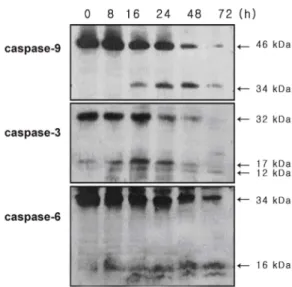
Oral squamous carcinoma (OSC) cells present resistance to chemotherapeutic agents-mediated apopto- sis in the late stages of malignancy. Advances in the understanding of bacterial toxins have produced new strategies for the treatment of cancers. It was demonstrated here that Pseudomonas aeruginosa exo- toxin A (PEA) significantly decreased the viability of chemoresistant YD-9 cells in the apoptosis mechanism. Apoptotic manifestations were evident through changes in nuclear morphology and gen- eration of DNA fragmentation. PEA treatment induced caspase-3, -6 and -9 cleavage, and activation.
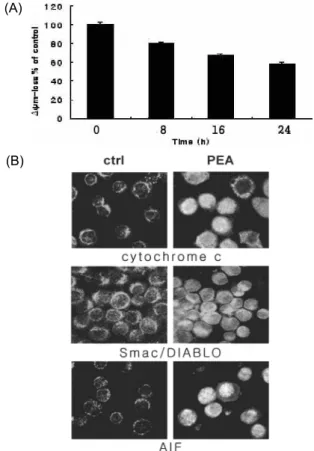
These events preceded proteolysis of the caspase substrates poly (ADP-ribose) polymerase (PARP), DNA fragmentation factor 45 (DFF45), and lamin A in YD-9 cells. The reduction of mitochondrial membrane potential, release of cytochrome c and Smac/DIABLO from mitochondria to cytosol, and translocation of AIF into nucleus were shown. While p53, p21 and 14-3-3γ were upregulated, cyclin B and cdc2 were downregulated by PEA treatment. Taken together, PEA induces apoptosis in chemo- resistant YD-9 cells via activation of caspases, mitochondrial events and regulation of cell cycle genes.
Key words : Oral squamous carcinoma, apoptosis, P. aeruginosa exotoxin A, caspase
*Corresponding author
*Tel:+82-51-990-6412, Fax:+82-51-990-6438
*E-mail : [email protected]