2012 KSDF 1229-0033/2012-12/253-259
ⓒ
〈Research Paper〉
1. Introduction
Natural indigo is the most important blue dye for textile dyeing with natural dye. At current market, indigo is used mainly for dyeing cotton yarn to produce denim. With the worldwide issue for sus- tainability and the demand for natural eco products, ‐ there has been a revival of natural dyes. Although various shades, such as red, yellow, brown, gray and so on, can be obtained from various sources of plants, there is no practical plant resource for blue shade
1,2). So, indigo is needed persistently as a source of blue color. The synthetic indigo produced annually is estimated as much as 22 thousand tons. There have been many researches to replace the chemical sy- nthesis of indigo dye by applying biotechnology
3 6)‐. On the other hand, efficient ecological production of indigo based on simple extraction method has been also performed by European researchers
7,8).
In eastern Asia, main indigo producing plant species
†
Corresponding author: Younsook Shin ([email protected]) Tel.: +82-62-530-1341 Fax.: +82-62-530-1349
is Polygonum tinctorium, a subtropical annual plant
9,10). Natural indigo is normally obtained from cultivated species by water extraction and the following alkali precipitation. In Korea, there have been two different ways of traditional indigo dyeing, i.e., the Banmul method and the Niram method. The former is the dyeing from an indigo extract by water directly in summer season and the latter is the dyeing by using an indigo alkali complex available for all season. The ‐ latter has some advantages of getting deeper color and can be stored and used without seasonal limitation.
In the Niram method, indican is extracted by steeping the plant leaves and stems for several days. As the second step of this method, the powder of oyster shell or shellfish is added onto the extract while beating for the introduction of air oxygen as much as possible until blue indigo precipitated, and then left it sunken. The sediment is collected and filtered through a cotton fabric. Thick paste obtained is called Niram, which means indigo mud. This traditional method has been used successfully in forming natural indigo, but quality and quantity of the dye is varied every time Abstract: In this work, the natural indigo production process from Polygonum tinctorium was balanced based on the traditional Niram method in Korea. A standard procedure was determined considering the conditions of indican extraction from plant material, the amount of alkali for precipitation, storage of extract, etc. The effect of experimental conditions on the yield of crude dye was investigated. The contents of indigo and indirubin of the crude dyes were analyzed by HPLC. Increase of the amount of crude dye was observed within 1 2.5 days of extraction time. Longer extraction beyond 2.5 days resulted in a slight ‐ decrease in the amount of crude dye. There was no consistency in terms of indigo content depending on extraction pH. We found that the storage of extract or harvested plants affected adversely to dye yield and dye quality. Based on the lab scale extraction, large scale extraction was performed for 2 2.5 days in water and 2.0 2.5 g/L of Ca(OH) ‐ ‐
2was applied for precipitation of indigo dye. We obtained natural indigo dye containing about 15% of pure indigo in scale up production using whole plant ‐ except root.
Keywords: Polygonum tinctorium, Niram, indican, indigo, indirubin
Process Balance of Natural Indigo Production based on Traditional Niram Method
Younsook Shin
†, Dong Il Yoo
1and Kangwha Kim
2Department of Clothing and Textiles/Human Ecology Research Institute, Chonnam National University, Gwangju, Korea
1
Department of Polymer and Fiber System Engineering, Chonnam National University, Gwangju, Korea
2
Department of Food and Nutrition, Chonnam National University, Gwangju, Korea
(Received: November 29, 2012 / Revised: December 12, 2012 / Accepted: December 13, 2012)
because the conditions for extraction and subsequent conversion into indigo have been relied on the experience of individual dyers. So, it is necessary to find more reliable process for producing relatively consistent quality of dye.
The objective of this study is to investigate the effect of process variables systematically to improve the disadvantages of traditional method. Based on the traditional Niram method, the process was balanced to get maximum indigo yield and indigo contents with less energy consumption.
2. Experimental
2.1 Indigo plants
Indigo seeds were sowed at the end of March in Naju (Chonnam Province, southwest of Korea) and indigo plants were harvested during July and August, 2008.
2.2 Extraction and crude indigo dye preparation
To obtain optimal extraction condition, lab scale extraction was carried out. Only leaves (50 g) were steeped in distilled water (1 L) at 25 26 . The ‐ ℃ extraction was made by maintaining leaves in distilled water at various time (1, 2, 2.5 and 3 day). For comparison to the extraction in distilled water (pH 6), the extraction also was performed at pH 3.5, adjusted by using acetic acid. Ca(OH)
2was added in filtered extracts with stirring for 20 min using a homo- genizer, and left it overnight for sedimentation. Clear supernatant was siphoned off and then the sediment in slurry was dried in a convection oven at 50 ℃ and weighed. The dried sediment was finely ground and used for analysis. In lab scale extraction, Ca(OH)
2and NaOH was used of analytical grade.
2.3 Scale-up extraction
Indigo plants were harvested for large scale production of indigo dye on August, 2008. Into a 1000 L stainless steel tank, ground water of 27℃
was poured over the plants with leaves and stems (80
Kg, 10 L of water to 1 Kg of plant materials). The steeped plants were weighted down with 6 stone‐
blocks (weighing 5 Kg each) to hold plants under water to exclude air for maintaining anaerobic con- dition. After steeping for 2.5 days, the extract (790 L) was pumped into three settling tanks and added different amount of Ca(OH)
2(1.5, 2.0, 2.5, and 3.0 g/L) in each tank respectively, and aerated for 30 min by using a compressor to help oxidation of indigo precursors and precipitation of indigo. The indigo was settled down for 12 hrs and the super- natant was removed. The sediment was collected and filtered through layers of a cotton fabric. After drying in a vacuum oven at 50 , the amount of crude ℃ indigo dye was weighed and pulverized for analytical tests and dyeing experiments. Ca(OH)
2was used of industrial grade.
2.4 Indigo and indirubin quantification Indigo and indirubin contents were determined acco- rding Liau et al.
11). HPLC analysis was carried out on an Agilent 1200 liquid chromatography system (Agilent technologies Inc., Waldbronn, Germany) equipped with two pumps, UV detector and Rheodyne injector (50mL loop). Chromatographic conditions were used as follows: The LC column was a Zorbax Eclipse XDB C18 (4.5 mm × 150 mm, 5m) (Palo Alto, ‐ CA, USA). Two mobile phases A and B were filtered through a 0.45 m filter and run at flow rate of 1.0 mL/min and room temperature of 25 . Mobile ℃ phase A consisted of water with 0.1% trifluoroacetic acid (TFA) and mobile phase B was acetonitrile (ACN) containing 0.1% TFA. A linear gradient was maintained from 40% B to 85% B for 15 min.
Indigo component was eluted at 9.18 min, showing
peaks at 280, 610, and 550nm. Whereas indirubin
was eluted at 10.02 min, showing peaks at 280 and
550nm. They were well separated and all the peaks
had good shape. For the quantification of indigo and
indirubin contents of the prepared indigo dye, the
peak at 280nm was used because the peak signal was
strong and also it was a common peak for two
components. The peak areas at 280nm were determined
and calculated the concentrations of indigo and in- dirubin, respectively, by using the standard calibration curves
12).
The measurement of each sample was tried and averaged in triplicate. Synthetic indigo (Vat. Blue 1, Aldrich) and indirubin (Alexis Biochemical, USA) were used of analytical grade as standard dyestuffs for calibration.
3. Results and Discussion
3.1 Effect of process variables on dye yield and indigo content
Traditional Niram method was modified by using calcium hydroxide instead of oyster shell powder and dried the Niram of mud like form into a crude dye ‐ of powder form. Some process variables, such as extraction time and pH, storing time after extraction, and calcium hydroxide concentration, were applied to optimize conditions in lab scale and then applied to scale up production. ‐
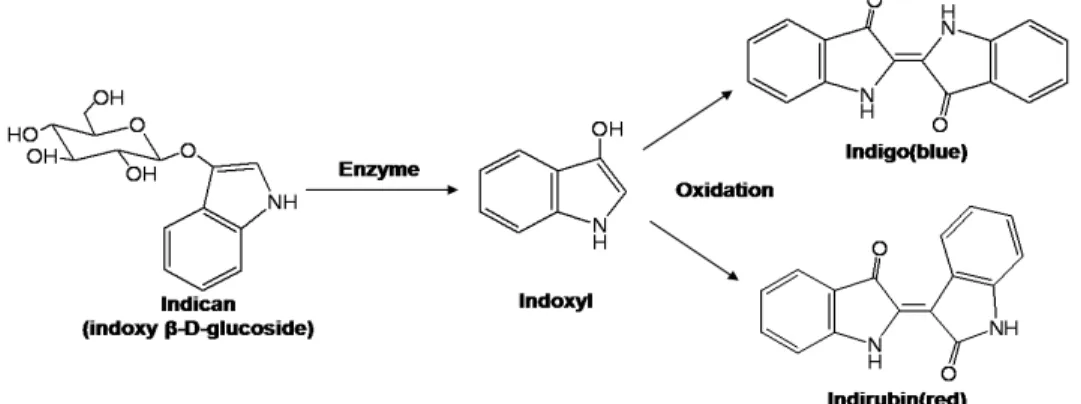
The mechanism of natural indigo formation is known very well. Indicans present in the plants are converted by enzyme ( glucosidase) present in the β‐
leaf tissues to indoxyl and glucose. Two indoxyl molecules are combined by oxygen in air to form indigo and also indirubin in side reaction (Figure 1).
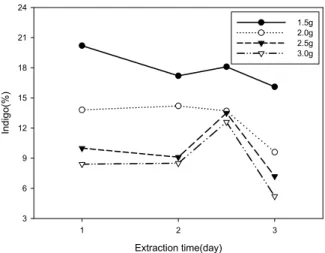
The yield of crude dye and indigo content plotted for extraction time and the amount of alkali (Ca(OH)
2) used in the precipitation step (Figure 2, 3).
Total mass of crude dye obtained was dependent on extraction time and the concentration of Ca(OH)
2.
Figure 1. The formation of indigo and indirubin from indican.
The crude dye obtained is a mixture of indigo and calcium hydroxide. Dye quality in terms of indigo content would be different with treatment conditions.
Increase of the amount of crude dye was observed within 1 2.5 days of extraction time. ‐
Longer extraction beyond 2.5 days resulted in a slight decrease in the amount of crude dye (Figure 2).
It is speculated that enzyme ( glucosidase), which β‐
converts indican to indoxyl, lost its activity in longer extraction environment and alkaline condition, resulting in the decrease of indigo formation. Maugard et al.
reported that the optimum pH of β‐ glucosidase for indican hydrolysis was 3 and the activity of glucosidase was dimished as extraction time got β‐
longer
4). The quantity of crude dye was increased with the concentration of Ca(OH)
2. But indigo content in the crude dye (% indigo/g of crude dye) decreased with the increase of the concentration of Ca(OH)
2,irrespective of extraction time (Figure 3).
Extraction time(day)
1 2 3
Crude dye(g)
0.5 1.0 1.5 2.0 2.5 3.0 3.5
1.5g 2.0g 2.5g 3.0g
Figure 2. Effect of extraction time on the amount of
crude dye depending on Ca(OH)
2concentration.
Extraction time(day)
1 2 3
Indigo(%)
3 6 9 12 15 18 21 24
1.5g 2.0g 2.5g 3.0g
Figure 3. Effect of extraction time on indigo content depending on Ca(OH)
2concentration.
This is because the extracted solution for the same extraction time contained the same quantity of indican, that is the same amount of indigo formed, and as a result, lower indigo content value when more Ca (OH)
2was added. Based on the obtained results, 2.5 days of extraction time was considered as appropriate.
Extraction pH affected to extraction efficiency differently depending on extraction time as shown in Figure 4 and 5. For 1 day extraction, more efficient extraction was led to higher yield of crude dye at pH 6.0, compared to extraction at pH 3.5. However, when extraction time extended for 2 days, the influence of pH became marginal. Ratio of indigo contained in crude dye got lower as the amount of Ca(OH)
2used got more for precipitation. There was no consistency in terms of indigo content depending on extraction pH. It is considered that the adjustment of pH for extraction is not necessary. Also, considering environ- mental and economical point of view, the addition of chemicals should be avoided during extraction.
Extraction pH Storage time (hr) Crude dye (g) Indigo (%) Indirubin (%)
3.5 0 1.25 21.7 0.000
36 0.95 8.3 0.089
6.0 0 1.00 17.8 0.005
36 0.84 10.8 0.081
1day extraction, 2.0g/L CaOH
2Table 1. Comparison of dye quality depending on storing extracts
As extracts were stored for 36 hrs, the results of the yield of crude dye and indigo contents are given in Table 1. Severe decrease in crude dye yield within 36 hrs of storage at room temperature was resulted.
And decrease in indigo content was also observed as storing extracts. We found that the storage of extract or harvested plants affected adversely to dye yield and dye quality.
Extraction time(day)
Crude dye(g)
0.0 0.5 1.0 1.5 2.0 2.5
1.5g 2.0g 2.5g
pH 3.5, 1day pH 6.0, 1day pH 3.5, 2day pH 6.0, 2day
Figure 4. Effect of pH on crude dye yield.
Extraction time(day)
Indigo(%)
0 5 10 15 20 25
1.5g 2.0g 2.5g
pH 3.5, 1day pH 6.0, 1day pH 3.5, 2day pH 6.0, 2day
Figure 5. Effect of pH on indigo content.
In the case of using extracts immediately after one day extraction at acidic condition (pH 3.5), indirubin was not detected by HPLC analysis. With the extracts stored for 36 hrs, indirubin was detected in the crude dye even if its concentration was very low. The factors for influencing indirubin formation are not completely investigated, but weak alkaline condition and elevated temperature tend to favor its formation
9).
Keeping extracts for 36 hrs decreased crude dye yield as much as 16 24% and also lowered indigo ‐ content as much of 7 13.4%. On the basis of results, ‐ it is recommended that extract solution should be used without any delay after finishing extraction.
3.2 Scale-up production
On the basis of the results obtained from small scale extraction, the production was scaled up in laboratory as well as in a farm mill near indigo plant ‐ cultivation field. We used leaves only in laboratory production, while used the plants including leaves and stems in a farm mill in Naju. Based on the lab scale ‐ extraction, scale up extraction was performed for 2 2.5 ‐ ‐ days and 2.0 g/L of Ca(OH)
2and the results of scale up production are given in Table 2. Yield in ‐ Table 2 represents that the ratio of pure indigo produced from plants.
It was reported that indigo yield is affected by light radiation and water, thereby leaf production per plant
8,13,14). A higher yield and better quality of dye was obtained by a washing leaves before extraction.
Washing increased indigo content as much as 35%, as shown in Table 2. Impurities such as soil in- fluenced indigo formation, but repeated washings adversely affected dye yield. Repeated washing may remove native enzyme which related to indigo pro- duction and adversely affect to indigo formation
4).
Plant Amt. (Kg) Crude dye (g) Indigo (%) Indirubin (%) Yield (%)
Leaves 2.8 85 16.79 0.33 0.510
Leaves
a27.8 995 22.59 0.34 0.810
Leaves+Stems 243.0 5515 15.44 0.75 0.354
a