• 검색 결과가 없습니다.

Knowledge Combination and the Usefulness of Inventions: Focusing on the Moderating Effects of Technological Change

N/A
N/A
Protected

Academic year: 2021

Share "Knowledge Combination and the Usefulness of Inventions: Focusing on the Moderating Effects of Technological Change"

Copied!
10
0
0

로드 중.... (전체 텍스트 보기)

전체 글

(1)

1. INTRODUCTION

Firms with valuable inventions can secure advantages over competitors[1]. Especially, firms with inventions greatly influencing other actors’ inventing

can not only win technological competition but also lead the technological progress of related industries[2,3]. Therefore, the usefulness of inventions, the extent to which actors use these inventions for their inventing, is closely associated with the value of

Knowledge Combination and the Usefulness of Inventions: Focusing on the Moderating Effects of Technological Change

Hee Jin Mun 1 , Yerim Chung 2*

1

Postdoctoral researcher, University-Industry Foundation, Yonsei University

2

Assistant professor, School of Business, Yonsei University

지식 조합과 발명 유용성 간의 관계에 대한 연구: 기술 변화의 조절 효과를 중심으로

문희진

1

, 정예림

2*

1연세대학교 산학협력단 전임연구원, 2연세대학교 경영대학 조교수

Abstract The study examines the effects of knowledge combination and of its interaction with technological change on the usefulness of inventions. We argue that inventing with knowledge components of prior art or with those in a variety of technical fields results in useful inventions, which changes after the emergence of dominant design because external actors’ perception of which knowledge components are appropriate in current technological environments changes. Based on data from U.S. granted optical disc patents filed from 1992 to 2000, the results show that inventions with more new knowledge components relative to their prior art are less useful but that inventions with more diversified knowledge components are more useful. Also, the empirical findings show that the negative relationship between new knowledge components of inventions and their usefulness strengthens after dominant design emerges.

Key Words : Convergence, Dominant Design, Invention, Patent, Recombinant search, Technological change

요 약 본 논문은 지식 조합과 기술 변화 간의 상호 작용이 발명 유용성에 미치는 영향을 분석한다. 본 연구는 기술 변화에 따라 외부 주체들이 현 기술 환경에 적합하다고 판단하는 지식 요소가 달라져 선행 기술 대비 새로운 지식 요소나 다양한 기술 분야의 지식 요소를 조합한 발명의 유용성이 변함을 주장한다. 1992년부터 2000년까지 미국에 출원된 광학 디스크 등록 특허들을 분석한 결과는 선행 기술 대비 새로운 지식 요소를 많이 가지는 발명의 유용성은 낮음을 보였다. 그러나 다각화된 지식 요소를 가지는 발명의 유용성은 높았다. 또한, 실증 분석 결과는 선행 기술 대비 새로운 지식 요소와 발명 유용성 간의 부의 관계는 지배적 디자인이 나타난 이후 강화됨을 보였다.

주제어 : 융합, 발명, 특허, 재조합 탐색, 기술 변화, 지배적 디자인

This work was supported by the National Research Foundation of Korea Grant funded by the Korean Government (NRF-2017S1A3A2065831).

*Corresponding Author : Yerim Chung ([email protected]) Received July 16, 2018

Accepted October 20, 2018

Revised October 1, 2018 Published October 28, 2018
(2)

the inventions[4]. To reveal the antecedents of useful inventions, scholars have focused on a recombinant search perspective that inventions are made by combining knowledge components in novel styles[5-8].

They argue that inventions based on some combination patterns may contain technological value appealing to subsequent inventing[4,8].

However, change in technological environments affects technical requirements for inventing[9-11]. If inventions have knowledge components that do not fit technical requirements of current technological environments, they are less likely to be used for future inventing[12,13]. However, previous studies have mainly focused on micro-level contingencies such as knowledge networks across inventions[8]. As a result, we have relatively little understanding of effective knowledge combination in accordance with technological environments in creating useful inventions.

This study examines the contingency effects of technological change in two ways. First, based on studies of recombinant search[4,14], we suggest two knowledge combination methods: combining new knowledge components relative to prior art and doing knowledge components in diverse technical fields.

Second, after dividing a period of technological change in terms of the emergence of dominant design, “a set of technologies and associated problem-solving heuristics embodied in a particular product design”[10, p. 790], we argue that the effects of knowledge combination ways on the usefulness of inventions change according to the emergence of dominant design.

The empirical context of this paper is the optical disc industry from 1992 to 2000. Dominant design was regarded as a technology standard, “the specifications that provide users and vendors with a common platform and ensure compatibility between components of a technological system[15, p. 1643].” The optical disc industry had undergone several technology standardizations[16,17]. This study focused on the emergence of the DVD standard in 1996. The empirical results show that inventions with more new knowledge

components relative to their prior art are less useful.

But inventions with diversified knowledge components are useful. Also, the empirical findings show that the negative relationship between new knowledge components of inventions and their usefulness strengthens after the emergence of the DVD standard.

Based on the empirical results, this study provides understanding of and managerial implications for effective inventing in terms of technological change.

2. THEORETICAL BACKGROUND

Knowledge combination is mainly conducted in two ways[14]. First, inventors can recombine knowledge components of prior art[8,14]. Second, they often consider knowledge components in various technical fields[6,8,14]. These combination methods are likely to establish linkages among knowledge components that can solve problems that prior art has not dealt, resulting in the creation of valuable inventions[6,8,14].

The value of inventions is often determined by the extent to which they are useful for the creation of future inventions[4,5,14]. By referring to preexisting inventions, inventors can find clues to improve current technologies or processes that they focus or technical gaps that these inventions have missed[6,18]. If inventions do not have technical merits to inventors, they do not receive much attention of inventors and consequently vanish[19]. Therefore, to be useful, inventions need to meet technical requirements of many inventors. In other words, the usefulness of inventions is determined by perception of inventors that inventions are appropriate for their inventing rather than by unique characteristics of each invention[4,14].

Change in technological environments is likely to

affect technical requirements of inventors. Technological

change can be defined as a repetition of technological

turbulence, the emergence of dominant design, and

incremental technological progress[9-11]. Depending on

each stage of technological change, the technical

(3)

requirements of inventors can vary[10]. Given that the usefulness of inventions determined by the extent to which they meet the technical requirements of inventors, technological change may condition the relationship between knowledge combination methods and the usefulness of inventions. This study focuses as a contingency factor on the emergence of dominant design that split technological change into technological turbulence and incremental technological progress[9-11].

3. HYPOTHESES

It can be difficult for inventors with bounded rationality[20] to discern the potential of all extant inventions[6]. By referring to the prior art of extant inventions, inventors are likely to easily comprehend the core ideas of these inventions and how to build on them because prior art has long been verified in terms of its potential and limitations[21]. Thus, inventions mainly composed of knowledge components of prior art are likely to receive much attention from inventors, increasing the possibility that they become the bases of subsequent inventing. On the other hand, when utilizing inventions with only new knowledge components, inventors may confront variable intermediate outcomes since inventing based on these inventions may be not different from inventing on the basis of uncertain knowledge. Because bounded rational individuals may avoid variable intermediate outcomes[22], inventors are less likely to utilize inventions with many new knowledge components for their inventing. Therefore, these inventions are less useful.

Hypothesis 1: As inventions are created with more new knowledge components relative to their prior art, they become less useful.

Inventors occasionally need to search for technical fields that they do not have expertise[23]. By consulting inventions with knowledge components in a variety of technical fields, inventors are likely to know technical fields that can create cross fertilization with

those in which they have expertise[8]. Also, these diversified inventions may have a higher probability to receive attention of inventors in various fields than specialized inventions[8,14]. Thus, inventions that combine diversified knowledge components are more likely to be used in future inventing.

Hypothesis 2: As inventions are created with more diversified knowledge components, they become more useful.

Disruptive innovation leads to radical technological change favoring experimentation[9-11]. During the technological turbulence, by focusing on knowledge that have not been thought before, inventors can conduct a lot of technical experiments[10]. Once dominant design emerges, the period of technological experimentation ends[9-11]. In this situation, incremental works based on dominant design are mainly conducted, and inventors are likely to regard radical inventions as being not suitable for the current technological environment[10].

Before the emergence of dominant design, inventors are less likely to have negative perception of inventions with new knowledge components relative to prior art because their evaluation criteria are not established regarding whether these inventions contain critical ideas that will serve as the basis of future dominant design[10]. However, after dominant design arises, inventors may prefer to refer to inventions mainly based on prior art because these inventions are likely to reflect gradual technology progress based on the dominant design. Therefore, the usefulness of inventions with new knowledge components relative to prior art decreases more after the emergence of dominant design.

Hypothesis 3: After the emergence of dominant design, the negative relationship between inventions’

new knowledge components and their usefulness strengthens.

After the emergence of dominant design, explorative

search for experimentation ends[9-11]. In this situation,

deep understanding and utilization of a specific

(4)

technology field are required. This may decrease the appealing of inventions with diversified knowledge components because searching diverse technical fields to create breakthrough inventions is likely to have low importance under the influence of dominant design.

Therefore, after the emergence of dominant design, the positive relationship between the diversified knowledge components of inventions and their usefulness weakens.

Hypothesis 4: After the emergence of dominant design, the positive relationship between the diversification of inventions’ knowledge components and their usefulness weakens.

4. METHODS

4.1 Patents as Inventions

Following previous research[5,7,24,25], this study regards granted patents as inventions. Patents have two advantages in the empirical analysis of the study.

First, each patent should have a list of reference patents (backward citations) representing its prior art to claim its unique value, which is examined by patent reviewers[13]. The information on citations enables us to capture the prior art and usefulness of patents. When using a list of backward citations, one empirical concern is that they may induce noisy measures because patent examiners can supplement backward citations if they think the list is incomplete[26].

However, noise resulting from supplemented citations may not be an empirical issue because there is no significant difference between the distribution of inventor citations and that of examiner citations[27].

Another concern is missing citations. However, Trajtenberg noted that any bias resulting from missing citations is slight and would not systematically affect empirical findings based on citations[28].

Second, the USPTO (United States Patent and Trademark Office) assigns classification codes to each patent in terms of its technological similarity with other

patents[29]. Each patent document must have one original classification code and can list additional ones.

A classification code is comprised of one class representing a technology field and one nested subclass indicating a knowledge component within the technological field[6,7,24]. Thus, the coexistence of subclasses in a patent provides information on the combination of knowledge components for creating this patent[6,7,24].

In sum, patents enable us to capture the prior art, usefulness, and knowledge component combination of inventions. Thus, this study used U.S. granted patents for testing our hypotheses.

4.2 Data and Sample

The empirical context is the optical disc industry during 1992-2000. This industry is appropriate for our analysis for two reasons. First, the optical disc industry shows a high level of patenting activities of actors[30].

Second, the detailed specification of an optical disc technology standard, the digital versatile disc (DVD), was published in 1996[31]. Technology standards usually act as dominant design by reducing technological uncertainty and leading to incremental technological progress in relevant technological fields[15]. Therefore, we could examine the effects of dominant design by focusing on the DVD standard.

Analyzing the DVD standard and related patents in

the optical disc industry in the 1990s would not suffer

from the criticism that empirical results based on them

are not applicable to rapidly changing current

technology environments for two reasons. First, the

representative optical disc technology standards

including the DVD are not much different from each

other in regard of the formation of enterprise

associations for the standardizations, technological

competition before the standardizations, and their

effects on the development of supplementary

technologies and products[16,17]. Also, the DVD

standard is in the same category that there are various

technological standards from Local Area Network,

(5)

Uiversal Serial Bus, Wi-Fi to ODF, the latest electronic document standard[32]. Therefore, it is difficult to state that the DVD standard is idiosyncratic relative to recent standards of the optical disc industry or of other industries. Second, because technological standards act as institutions within industries[33], they affect relevant industries for a long time. For example, the standard for automotive emissions control systems established in 1981 had affected the automotive industry for 13 years[34]. Bluetooth technology, standardized in 2004, has taken the place of short-range wireless communication standard to date.

That is, even if technological change is getting faster, the influence of modern standards can be maintained as long as that of the DVD standard in the 1990s.

Therefore, the result of our study would not be completely irrelevant to present technological environments. Due to these two reasons, recent standard studies have still focused on the DVD standard[17,35,36].

To collect optical disc patents granted in the U.S., we identified patent classes related to optical disc technologies by using data on two DVD patent pools:

the DVD3C and the DVD6C. In a patent pool, member firms aggregate their essential patents related to specific technological standards to share these patents among members as well as to license them to non-members[30]. Thus, classes that the essential patents of the DVD patent pools have are likely to be closely related to optical disc technologies.

First, all the U.S. essential patents of the two DVD patent pools were collected. Next, we identified technological classes that included more than one hundred essential patents. Three classes were identified and regarded as optical disc classes - 369: Dynamic information storage ore retrieval; 375: Pulse or digital communications; 386: Motion video signal processing for recording or reproducing. And then, we secured from the NBER database granted patents with at least one of the three optical disc classes as their own original class and filed during 1992-1995 and

1997-2000. Finally, the DVD essential patents were excluded because they may have exceptionally high usefulness due to their close association with the DVD standard. The number of sample patents is 21,313.

Finally, additional information on the sample patents was gathered from the USPTO. The information includes application years, grant years, backward citations, forward citations that are granted patents citing the sample patents, classification codes, the number of claims, and the number of inventors. This study regarded as backward citations of sample patents only granted patents with application years equal or before the grant year of the sample patents.

4.3 Dependent Variable

Given that the usefulness of inventions is the extent to which they are utilized for further inventing[4,6,8,14], patents that are referred by many other patents are likely to be highly useful. Thus, the usefulness of a patent was measured as the number of its forward citations during a period of five years since its grant year[8,9]. The time window is necessary because older patents have a higher probability of being cited than younger ones[37]. Given that patents generally receive the most forward citations after one year from their grant year[38], the five-year window may be able to capture most of all forward citations of patents.

The dependent variable showed a skewed count distribution. In this case, analyzing empirical models through linear regression can yield inconsistent, biased, and inefficient estimations[39]. Although Poisson regression is often used for modeling count dependent variables, negative binomial regression was appropriate for the study because the dependent variable’s variance was greater its mean.

4.4 Independent Variables

Patents have backward citations as their prior art. If

the subclasses of a patent differ from those of its

backward citations, its subclasses represent new

knowledge components compared to its prior art[14,40].

(6)

Thus, new knowledge components relative to prior art were measured as the ratio of the new subclasses of a patent compared with those of its backward citations to its all subclasses. If a patent has no backward citations, we assigned one to its new knowledge components.

The diversification of knowledge components refers to the extent to which they are distributed over a wide range of technical fields[14]. The concentration of knowledge components over technical fields can be measured by the Herfinhahl index[41]. Therefore, the diversification of knowledge components was measured by subtracting the Herfindahl index from one:

  

  

in which p

i

is the proportion of a patent i’s

subclasses in class c to its all subclasses.

As mentioned earlier, the optical disc industry experienced the emergence of the DVD standard in 1996. In the models, the emergence of dominant design variable has one if a patent was filed after 1996 and zero otherwise.

4.5 Control Variables

First, original class and application year dummies were used to control for differences in forward citation rate across technical fields and over years. Second, the empirical models had a dummy variable that equals one if a patent is filed by a firm or zero otherwise. As collaboration for inventing can enhance the usefulness

of inventions[25,42], the number of inventors of a patent was included in models. Also, as another indicator of patent value, the number of claims was controlled for[43]. Since this variable had high skewness, logarithm was applied to this variable.

Finally, in the case of patents with no backward citations (N = 126), the ratio of new knowledge components equals one. However, because these patents may embody ideas that extant technologies have not considered, their usefulness may be higher than patents with backward citations whose subclasses are all new relative to their backward citations. To control for this extreme radicalness, this paper made a dummy variable that has one if a sample patent has no backward citations or zero otherwise.

5. RESULTS

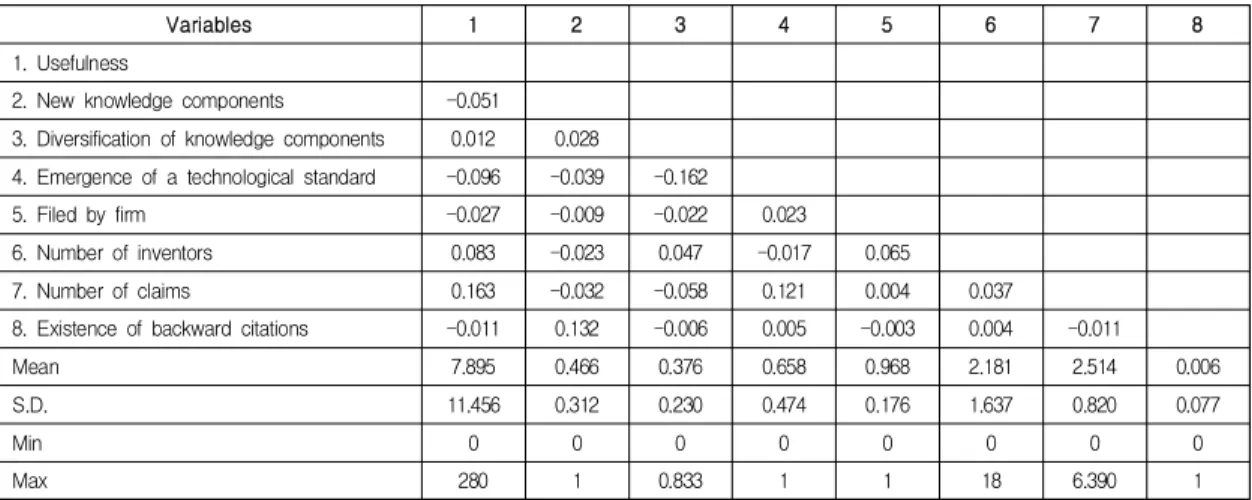
The descriptive statistics and correlation matrix are reported in Table 1. Correlations between the independent variables are relatively low. To check the possibility of multicollinearity, we computed variance inflation factors (VIFs) but found relatively small VIF values below 10 (maximum VIF = 1.08; mean VIF = 1.04), which indicates that multicollinearity may not pose major concerns to the interpretation of our empirical results[44].

Variables 1 2 3 4 5 6 7 8

1. Usefulness

2. New knowledge components -0.051

3. Diversification of knowledge components 0.012 0.028

4. Emergence of a technological standard -0.096 -0.039 -0.162

5. Filed by firm -0.027 -0.009 -0.022 0.023

6. Number of inventors 0.083 -0.023 0.047 -0.017 0.065

7. Number of claims 0.163 -0.032 -0.058 0.121 0.004 0.037

8. Existence of backward citations -0.011 0.132 -0.006 0.005 -0.003 0.004 -0.011

Mean 7.895 0.466 0.376 0.658 0.968 2.181 2.514 0.006

S.D. 11.456 0.312 0.230 0.474 0.176 1.637 0.820 0.077

Min 0 0 0 0 0 0 0 0

Max 280 1 0.833 1 1 18 6.390 1

Table 1. Descriptive statistics and correlation

(7)

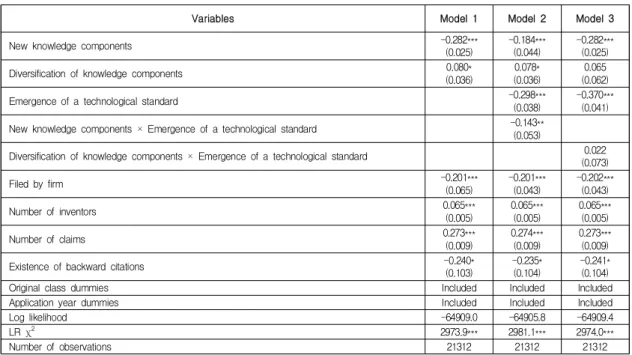
Table 2 shows the results of binomial negative models for the usefulness of inventions. Hypothesis 1 proposes that, as inventions are created with more new knowledge components relative their prior art, they become less useful. The coefficient of new knowledge components in Model 1 is statistically significant and negative ( β = -0.282; p < 0.001). Thus, Hypothesis 1 is supported. Hypothesis 2 suggests that, as inventions are created with more diversified knowledge components, they become more useful. In Model 2, the diversification of knowledge components positively affects usefulness ( β

= 0.082; p < 0.05). Hypothesis 3 proposes that, after the emergence of dominant design, the negative relationship between the new knowledge components of inventions and their usefulness strengthens. As shown in Model 3, the interaction term of new knowledge components and the emergence of a technological standard negatively affects the usefulness of inventions ( β = -0.146; p < 0.01), which is consistent with Hypothesis 3. Finally, in Model 4, the interaction term of the diversification of knowledge components and the emergence of a technological standard does not show

any significant effects. This results is inconsistent with Hypothesis 4.

6. DISCUSSION AND CONCLUSION

This study examines the influences of knowledge combination methods the usefulness of inventions, conditioned by technological change. With data from the optical disc industry, the empirical findings showed that inventions with knowledge components of their prior art or knowledge components diversified across technical fields are more useful. Also, the results revealed that, after the emergence of dominant design, the negative relationship between the new knowledge components of inventions and their usefulness strengthens.

This study makes two contributions to research on knowledge combination. First, there are two contrasting perspectives on knowledge combination for effective inventing[14]. The tension view argues that knowledge components in a variety of technical fields should be

Variables Model 1 Model 2 Model 3

New knowledge components -0.282***

(0.025)

-0.184***

(0.044)

-0.282***

(0.025)

Diversification of knowledge components 0.080*

(0.036)

0.078*

(0.036)

0.065 (0.062)

Emergence of a technological standard -0.298***

(0.038)

-0.370***

(0.041)

New knowledge components × Emergence of a technological standard -0.143**

(0.053)

Diversification of knowledge components × Emergence of a technological standard 0.022

(0.073)

Filed by firm -0.201***

(0.065)

-0.201***

(0.043)

-0.202***

(0.043)

Number of inventors 0.065***

(0.005)

0.065***

(0.005)

0.065***

(0.005)

Number of claims 0.273***

(0.009)

0.274***

(0.009)

0.273***

(0.009)

Existence of backward citations -0.240*

(0.103)

-0.235*

(0.104)

-0.241*

(0.104)

Original class dummies Included Included Included

Application year dummies Included Included Included

Log likelihood -64909.0 -64905.8 -64909.4

LR χ

2

2973.9*** 2981.1*** 2974.0***

Number of observations 21312 21312 21312

*: p < 0.05 **: p < 0.01 ***: p < 0.001.

Table 2 Regression of invention usefulness

(8)

exploited to create useful inventions[e.g.,5,45]. On the other hand, in the foundational view, the creation of useful inventions requires deep understanding and utilization of a specific technical field[42]. This study suggests that these two perspectives do not necessarily conflict. The empirical findings imply that combining various technical components within current technology trajectories represented by prior art is necessary for creating useful inventions. In order to investigate whether this interaction could actually exist, we examined the interaction effect of the diversification of knowledge components and new knowledge component.

The interaction term showed a negative impact on usefulness ( β = -0.480, p < 0.001). That is, the positive effect of diversified knowledge components on usefulness weakens as new knowledge components representing inventions beyond technological trajectories increase. These results suggest that the two perspectives may respectively describe necessary requirements for creating useful inventions rather than act as alternatives. The implication suggests that subsequent studies need to explore in depth how the combination of the two seemingly “complementary”

perspectives accounts for invention.

Second, previous studies suggest that inventors tend to combine familiar or well-known knowledge components because of technological uncertainty and that inventions created under this tendency are more useful[6,46]. However, this study argues that the usefulness of inventions may also reflect the perception of external actors to these inventions and that the external perception is likely to vary in terms of technological change. In other words, this study suggests that it is necessary to consider the combination tendency of inventors and the perception of external actors to inventions in examining knowledge combination and inventions. Interestingly, the results showed that the positive relationship between the diversification of knowledge components and usefulness is not significantly influenced by the emergence of dominant design. This may imply that,

regardless of technological change, external actors' perception of inventions with diversified knowledge elements did not change. Or, in the 1990s, inventors created optical disc inventions with great impacts on a variety of technical fields that could offset the reduced interest of relevant actors. As indicated later, this study could not examine the above two possibilities because it did not directly measure the perception of external actors. If both possibilities are examined by future research, it will make a theoretical contribution to research on technological change and knowledge combination.

The results imply that, in general technological environments, searching diverse technical fields within prior art is necessary for creating useful inventions. If not, inventing may result in useless inventions and thus cause inefficient time and resource investments. For firms to reconcile the focus on prior art and search for diverse technical fields, it is encouraged that they combine a few diversified knowledge components with atypical connections to prior art while mainly focusing on prior art[8]. Also, for effective knowledge combination during technological change, firms need to more focus on knowledge components within prior art.

The limitations of the study are as follows. First, patents cannot capture inventions that are not patented.

Therefore, interpreting the results requires caution.

Second, the paper focuses on a single industry. Thus, it may have the problem of generality. Finally, we could not measure directly actors’ perception of optical disc patents. These limitations should be addressed by future research.

REFERENCES

[1] M. B. Heeley & R. Jacobson. (2008). The recency of technological inputs and financial performance. Strategic Management Journal, 29(7), 723-744.

[2] O. Alexy, G. George & A. J. Salter. (2013). Cui bono?

The selective revealing of knowledge and its

implications for innovative activity. Academy of

(9)

Management Review, 38(2), 270-291.

[3] P. K. Toh & T. Kim. (2013). Why put all your eggs in one basket? A competition-based view of how technological uncertainty affects a firm's technological specialization. Organization Science, 24(4), 1214-1236.

[4] L. Fleming, S. Mingo & D. Chen. (2007). Collaborative brokerage, generative creativity, and creative success.

Administrative Science Quarterly, 52(3), 443-475.

[5] P. G. Audia & J. A. Goncalo. (2007). Past success and creativity over time: A study of inventors in the hard disk drive industry. Management Science, 53(1), 1-15.

[6] L. Fleming. (2001). Recombinant uncertainty in technological search. Management Science, 41(1), 117-132.

[7] L. Fleming & O. Sorenson. (2004). Science as a map in technological search. Strategic Management Journal, 25(8-9), 909-928.

[8] M. A. Schilling & E. Green. (2011). Recombinant search and breakthrough idea generation: An analysis of high impact papers in the social sciences. Research Policy, 40(10), 1321-1331.

[9] S. Grodal, A. Gotsopoulos & F. F. Suarez. (2015). The coevolution of technologies and categories during industry emergence. Academy of Management Review, 40(3), 423-445.

[10] S. Kaplan & M. Tripsas. (2008). Thinking about technology: Applying a cognitive lens to technical change. Research Policy, 37(5), 790-805.

[11] J. P. Murmann & K. Frenken. (2006). Toward a systematic framework for research on dominant designs, technological innovations, and industrial change.

Research Policy, 35(7), 925-952.

[12] R. Kapoor & R. Adner. (2012). What firms make vs.

what they know: How firms' production and knowledge boundaries affect competitive advantage in the face of technological change. Organization Science, 23(5), 1227-1248.

[13] J. B. Sørensen & T. E. Stuart. (2000). Aging, obsolescence, and organizational innovation.

Administrative Science Quarterly, 45(1), 81-112.

[14] S. Kaplan & K. Vakili. (2015). The double-edged sword of recombination in breakthrough innovation. Strategic Management Journal, 36(10), 1435-1457.

[15] S. Jain. (2012). Pragmatic agency in technology standards setting: The case of Ethernet. Research Policy, 41(9), 1643-1654.

[16] S. den Uijl, R. Bekkers & H. J. de Vries. (2013).

Managing intellectual property using patent pools:

Lessons from three generations of pools in the optical

disc industry. California Management Review, 55(4), 31-50.

[17] T. Rayna & L. Striukova. (2015). What makes patent pools successful? An analysis of optical disc and mobile phone industries. International Journal of Entrepreneurship and Innovation Management, 19(1-2), 6-29.

[18] L. G. Zucker, M. R. Darby & J. S. Armstrong. (2002).

Commercializing knowledge: University science, knowledge capture, and firm performance in biotechnology. Management Science, 48(1), 138-153.

[19] J. M. Podolny, T. E. Stuart & M. T. Hannan. (1996).

Networks, knowledge, and niches: Competition in the worldwide semiconductor industry, 1984-1991. American Journal of Sociology, 102(3), 659-689.

[20] J. G. March & H. A. Simon. (1993). Organizations (2nd Eds.). Cambridge, MA: Blackwell Publishers.

[21] R. Katila & G. Ahuja. (2002). Something old, something new: A longitudinal study of search behavior and new product introduction. Academy of Management Journal, 45(6), 1183-1194.

[22] J. Denrell & J. G. March. (2001). Adaptation as information restriction: The hot stove effect.

Organization Science, 12(5), 523-538.

[23] M. Gruber, D. Harhoff & K. Hoisl. (2013). Knowledge recombination across technological boundaries:

Scientists vs. engineers. Management Science, 59(4), 837-851.

[24] G. Carnabuci & E. Operti. (2013). Where do firms’

recombinant capabilities come from? Intraorganizational networks, knowledge, and firms’ ability to innovate through technological recombination. Strategic Management Journal, 34(13), 1591-1613.

[25] J. Singh & L. Fleming. (2010). Lone inventors as sources of breakthroughs: Myth or reality? Management Science, 56(1), 41-56.

[26] A. Nerkar & S. Paruchuri. (2005). Evolution of R&D capabilities: The role of knowledge networks within a firm. Management Science, 51(5), 771-785.

[27] J. Alcácer M. & M. Gittelman. (2006). Patent citations as a measure of knowledge flows: The influence of examiner citations. Review of Economics and Statistics, 88(4), 774-779.

[28] M. Trajtenberg. (1990). A penny for your quotes: Patent citations and the value of innovations. RAND Journal of Economics, 21(1), 172-187.

[29] M. Benner & J. Waldfogel. (2008). Close to you? Bias

and precision in patent-based measures of technological

(10)

proximity. Research Policy, 37(9), 1556-1567.

[30] A. M. Joshi & A. Nerkar. (2011). When do strategic alliances inhibit innovation by firms? Evidence from patent pools in the global optical disc industry. Strategic Management Journal, 32(11), 1139-1160.

[31] D. Dranove & N. Gandal. (2003). The Dvd-vs.-Divx standard war: Empirical evidence of network effects and preannouncement effects. Journal of Economics &

Management Strategy, 12(3), 363-386.

[32] P. M. Wiegmann, H. J. de Vries & K. Blind. (2017).

Multi-mode standardisation: A critical review and a research agenda. Research Policy, 46(8), 1370-1386.

[33] R. Garud, S. Jain & A. Kumaraswamy. (2002).

Institutional entrepreneurship in the sponsorship of common technological standards: The case of Sun Microsystems and Java. Academy of Management Journal, 45(1), 196-214.

[34] J. Lee & N. Berente. (2013). The era of incremental change in the technology innovation life cycle: An analysis of the automotive emission control industry.

Research Policy, 42(8), 1469-1481.

[35] B. Kim, E. Kim, D. J. Miller & J. T. Mahoney. (2016).

The impact of the timing of patents on innovation performance. Research Policy, 45(4), 914-928.

[36] K. Vakili. (2016). Collaboration promotion of technology standards and the impact on innovation, industry structure, and organizational capabilities: Evidence from modern patent pools. Organization Science, 27(6), 1504-1524.

[37] W. Schoenmakers & G. Duysters. (2010). The technological origins of radical inventions. Research Policy, 39(8), 1051-1059.

[38] A. Mehta, M. Rysman & T. Simcoe. (2010). Identifying the age profile of patent citations: New estimates of knowledge diffusion. Journal of Applied Econometrics, 25(7), 1179-1204.

[39] J. Stock & M. Watson. (2003). Introduction to Econometrics. Boston: Addison Wesley.

[40] M. Trajtenberg, R. Henderson & A. Jaffe. (1997).

University versus corporate patents: A window on the basicness of invention. Economics of Innovation and New Technology, 5(1), 19-50.

[41] B. H. Hall. (2005). A note on the bias in Herfindahl-type measures based on count data. Revue d'économie industrielle, 110(2), 149-156.

[42] A. Taylor & H. R. Greve. (2006). Superman or the fantastic four? Knowledge combination and experience in innovative teams. Academy of Management Journal,

49(4), 723-740.

[43] J. Bessen. (2008). The value of U.S. patents by owner and patent characteristics. Research Policy, 37(5), 932-945.

[44] R. M. O’Brien. (2007). A caution regarding rules of thumb for variance inflation factors. Quality & Quantity, 41(5), 673-690.

[45] D. J. Miller, M. J. Fern & L. B. Cardinal. (2007). The Use of Knowledge for Technological Innovation Within Diversified Firms. Academy of Management Journal, 50(2), 307-325.

[46] S. Arts & R. Veugelers. (2015). Technology familiarity, recombinant novelty, and breakthrough invention.

Industrial and Corporate Change, 24(6), 1215-1246.

문 희 진(Mun, Hee Jin) [정회원]

․2005년 8월 : 경희대학교 전자정 보학부(공학사)

․2009년 2월 : 연세대학교 기술경 영학협동과정 공학석사

․2015년 2월 : 연세대학교 기술경 영학협동과정 공학박사

․현재 : 연세대학교 산학협력단 전임연구원

․관심분야 : 기업 행동 전략, 기술 경쟁, 조직 협력

․E-Mail : [email protected]

정 예 림(Chung, Yerim) [정회원]

․2000년 8월 : 연세대학교 경영학 과 학사

․2003년 9월 : Universite-de Paris 1 - Pantheon Sorbonne 응용수학 과 학사

․2005년 9월 : Universite-de Paris 1 - Pantheon Sorbonne 응용수학과 석사

․2010년 3월 : Universite-de Paris 1 -Pantheon Sorbonne 컴퓨터공학/응용수학과 박사

․2010년 9월 ~ 2011년 2월 : 서울대학교 연구원

․2011년 3월 ~ 현재 : 연세대학교 조교수

․관심분야 : 신기술, 물류 경영, 역최적화, 네트워크

․E-Mail : [email protected]

수치

Table  1.  Descriptive  statistics  and  correlation
Table 2 shows the results of binomial negative models for the usefulness of inventions

참조

관련 문서

The proposal of the cell theory as the birth of contemporary cell biology Microscopic studies of plant tissues by Schleiden and of animal tissues by Microscopic studies of

2재화 2요소 헥셔-올린 모형에서는 어느 한 경제에서 어느 한 요소의 양이 증가하면, 그 요소를 집약적으로 사용하는 산업의 생산량은 증가하고 다른

 The Gibbs free energy of a solid or liquid changes only slightly with pressure, so we can neglect the change and use 1 for the activity of a pure solid or liquid

The index is calculated with the latest 5-year auction data of 400 selected Classic, Modern, and Contemporary Chinese painting artists from major auction houses..

It considers the energy use of the different components that are involved in the distribution and viewing of video content: data centres and content delivery networks

After first field tests, we expect electric passenger drones or eVTOL aircraft (short for electric vertical take-off and landing) to start providing commercial mobility

1 John Owen, Justification by Faith Alone, in The Works of John Owen, ed. John Bolt, trans. Scott Clark, &#34;Do This and Live: Christ's Active Obedience as the

In The Joy Luck Club, the mothers facilitate the daughters' inventions of dynamic identity by remembering the painful past, sharing their stories, and