Purification and Identification of Inhibitory Compounds on Helicobacter pylori from Cheongmoknosang Callus for Biomass
Dong-Hyuck Yun, Won-Seup Cha, Seon-Hon Lee1, Bong-Jeun An2, Jeung-Hoan Kim3, Sung-Sook Chun3, Jong-Ho Bae4 and Young-Je Cho*
Department of Food Engineering Kyungpook National University, Sangju 742-711, Korea
1The Institute of Marine biotechnology, Andong National University, Andong 760-749, Korea
2Department of Cosmeceutical Science, Daegu Hanny University, Gyeongsan 712-715, Korea
3NIP Biotech., Munkyung 745-706, Korea
4Department of Confectionery Decoration, Daegu Mirae College, Gyeongsan 712-715, Korea Received December 2, 2009 /Accepted December December 20, 2009
The objective of this research was to evaluate the inhibitory activities of phenolic compounds isolated from Cheomoknosang callus on Helicobacter pylori. Total phenolic compounds of 80% ethanol extracts from callus were 15.3 mg/g. The activity of H. pylori inhibition at 80% ethanol extracts from Cheongmoknosang callus was determined as 14 mm clear zone. Isolation of inhibitory compounds was carried out on Sephadex LH-20 and MCI-gel CHP-20 column chromatography using a gradient elution procedure of increasing MeOH in H2O. The chemical structure of the inhibitory compound against Helicobacter pylori was confirmed as protocatechuic acid, chlorogenic acid, caffeic acid and rosemarinic acid by spectroscopic analysis of FAB-MS, NMR and IR spectrum.
Key words : Cheongmoknosang callus, Helicobacter pylori, purification, identification
*Corresponding author
*Tel:+82-54-530-1265, Fax:+82-54-530-1269
*E-mail : [email protected]
서 론
식물은 식량자원으로서의 기본적인 역할 이외에도 자체에 함유된 유용물질들을 이용하여 질병의 예방과 치료에 사용되 었다. 현재 알려져 있는 유용식물은 지구상에 존재하는 250,000∼300,000 종의 식물 중 일부에 불과하며, 새로운 물질 을 찾기 위한 광범위한 탐색이 진행되고 있다[1]. 이러한 물질 의 대부분은 식물체의 벌목, 채집 및 인공 재배 등을 통하여 직접 추출하여 얻는다. 그러나 기후와 계절 등 외부 인자에 의한 영향을 받아 원료의 안정된 공급이 어렵고 식물체에 존 재하는 유용물질의 함량이 낮고 생장 속도가 느려 많은 양의 물질을 얻기가 힘들다[2]. 그 해결책으로 식물세포 배양에 의 한 유용물질의 생산을 들 수 있는데 기후, 환경 등의 외부인자 에 의한 영향을 받지 않고 기내에서 안정적으로 생산 할 수 있을 뿐 만 아니라 배양 조건이 균일하여 일정한 품질의 유용 물질을 대량 생산할 수 있다는 장점이 있다. 그러나 식물세포 배양은 미생물배양에 비해 생산성이 낮고, 성장속도가 느려 scale-up을 통한 상업화에 성공한 예가 매우 드물다.
식물세포배양공학을 이용한 유용물질 생산기술은 생명과 학분야에서 식물자원생산 이용기술의 일부로서 조직배양을 통한 종묘생산기술, 재조합 유전자를 이용한 식물개발 기술 등과 함께 식물생물공학 분야의 근간을 형성하고 있다. 이 기
술은 식물유래 유용물질의 생산을 안정적으로 대량 생산할 수 있는 것을 특징으로 한다. 식물세포공학기술은 크게 세포 배양기술, 생리-생화학 연구, 분리-정제기술, 대량배양기술로 이루어져 있다. 세포배양기술은 세포주 유도기술, 고생산 세 포주의 선발, 세포 주 보관기술, 생산성 향상기술을 포함한다.
생리적, 생화학적 연구 방법에는 세포 내 신호전달체계의 조 절을 통해 생산성을 향상시키거나 생합성 경로 연구를 통하 여 이를 대사공학으로 응용하는 분야가 있으며, 분리․정제 기술은 유용물질의 분리 동정 외에 이들을 분석하고 추출 정 제하는 기술과 scale-up 최적화기술이 포함된다. 상업적 생산 을 위한 대량배양기술에는 발효조의 디자인이나 동역학적 연 구, 시뮬레이션, 공정개발 기술 등과 같은 공학기술이 주가 된다.
뽕나무 잎에는 flavones, steroids, triterpenes, amino acids, vitamin 및 다량의 미네랄 성분이 존재하고 있으며, 또한 전통 생약으로 당뇨병을 예방, 치료하며 갈증을 해소시키는 것으로 알려져 있다[3]. Asano는 뽕나무 잎으로부터 N-containing sugars를 분리, 동정하였으며[4], Basnet 등[5]과 Kimura 등[6]
은 뽕잎의 혈당강하효과에 대한 영향을 발표하였다. 본 연구 팀은 현재 국내에 보존되어오고 있는 뽕잎 108종의 기능성 및Helicobacter pylori 억제력을 검토한 바 있고[7], 그 중 청목 노상 품종의 뽕잎에서 항산화, 항염증 작용 및H. pylori 억제력 이 우수한 것으로 보고하였다[8].
따라서 본 연구에서는 생리활성이 우수한 청목노상 뽕잎의 기능성 물질의 대량생산 방안을 위한 연구의 일환으로 청목노
상잎 세포배양을 위해 제조한 callus로 부터H. pylori 억제물질 을 분리, 동정하여H. pylori 억제물질의 biomass에 의한 대량 생산 가능성의 기초연구를 수행하였다.
재료 및 방법 재료
실험재료인 청목노상 잎은 2006년 5월 경상북도 상주시 잠 사시험장에서 수집한 신선한 잎을 세척한 후 물기를 제거하고 4oC 냉장고에 보관하면서 사용하였다.
Spot 접종, 배양 및 callus 유도
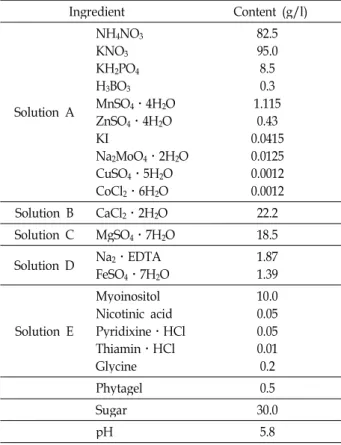
Spot 접종은 채취한 청목노상 잎 시료를 24시간 이내에 70% 에탄올을 사용하여 10초간 3회 표면 살균 후 1% sodium hypochlorite로 20분간 살균하고, 멸균수로 수회 세척하여 가 로×세로 약 1 cm 정도의 크기로 잘라 내어 고체배지에 spot 접종하였다. 이때 사용된 고체 배지는 Table 1과 같이 MS배지 를 사용하였으며[9], 27oC 암소에서 60일간 평판 배양하였다.
Callus의 유도는 MS배지에 생장조절제로서 naphthalene ace- tic acid (NAA)와 2,4-Dichlorophenoxy acetic acid (2,4-D) 같 은 hormone을 10 μM의 농도로 처리된 배지에 시료를 치상하 고 27oC에서 암배양하였다. Callus 형성배지에서 형성된 cal- lus는 4주 간격으로 계대배양하였다.
Table 1. Composition of MS medium for spot culture
Ingredient Content (g/l)
Solution A
NH4NO3
KNO3
KH2PO4
H3BO3
MnSO4․4H2O ZnSO4․4H2O KINa2MoO4․2H2O CuSO4․5H2O CoCl2․6H2O
82.5 95.08.5 1.1150.3
0.43 0.0415 0.0125 0.0012 0.0012 Solution B CaCl2․2H2O 22.2 Solution C MgSO4․7H2O 18.5 Solution D Na2․EDTA
FeSO4․7H2O 1.87
1.39
Solution E
Myoinositol Nicotinic acid Pyridixine․HCl Thiamin․HCl Glycine
10.00.05 0.050.01 0.2
Phytagel 0.5
Sugar 30.0
pH 5.8
Biomass를 위한 callus starter 제조 및 bioreactor 배양 청목노상 뽕잎으로부터 유도된 callus를 평판배양하여 배 양된 배지의 callus를 잘게 자른 후, 자른 조각을 100 ml의 액체 배지에 접종하여 증식시키고, 다시 500 ml의 액체 배지에 접종 하여 배양시켜 starter를 제조하고, starter 전량을 10 l의 bio- reactor에 접종하였다. 접종된 bioreactor는 27oC 암실에서 멸 균공기로 순환시키며 60일 정도 배양시켰다.
청목노상 callus 추출물의 조제
Bioreactor에서 수거한 청목노상 callus를 수세 및 건조, 분 쇄한 후 건조 callus 1 g에 80% ethanol 100 ml를 가하고 24시 간 동안 진탕, 추출한 후 Whatman No. 1 여과지를 이용해 여과하고 필요에 따라 농축하여 사용하였다.
Phenol성 화합물의 정량
추출시료 1 ml를 95% ethanol 1 ml와 증류수 5 ml를 첨가하 고 1 N Folin-ciocalteu reagent 0.5 ml를 넣어 잘 섞어주고, 5분간 방치한 후, Na2CO31 ml를 가한 후, 흡광도 725 nm에서 1시간 이내에 측정하여 gallic acid를 이용한 표준곡선으로 양 을 환산하였다[10].
H. pylori 배양
실험에 사용한 균주는 위, 십이지장 궤양 원인균인H. pylori 로서 표준균주인 ATCC 43504를 사용하였다.H. pylori의 배양 에는 최적배지(special peptone 0.5 g, agar 0.75 g, NaCl 0.25 g, yeast extract 0.25 g, beef extract 0.2 g 및 pyruvic acid 0.025 g)를 사용하여 미호기성 조건을 유지시켜주기 위해서 10%
CO2incubator를 이용하였으며, incubator의 습도는 항상 95%
이상으로 유지하였으며, agar plate상에서 배양은 37oC로 48∼
72시간 동안 실시하였다[11].
Callus 추출물의H. pylori 항균활성 검색
H. pylori에 대한 callus 추출물의 항균활성 검색은 disc agar diffusion method로 실시하였다[12]. Disc agar diffusion법은 H. pylori 최적배지 plate에 H. pylori균 100 μl를 분주하여 멸균 유리봉으로 도말한 다음, 멸균된 disc paper (φ8 mm)를 올리 고 0.45 μm membrane filter로 제균한 각 추출물을 vacuum evaporator로 농축한 후 멸균수로 희석하여 phenolic com- pound의 함량이 50∼200 μg/100 μl가 되도록 조절한 후 각 추출물 100 μl를 disc paper에 흡수시키고, 대조구로는 멸균수 를 흡수시킨 후 37oC의 미 호기성 조건에서 48시간 동안 in- cubation한 다음, disc 주위의 clear zone 생성 유무를 확인하였다.
H. pylori 항균활성을 가지는 callus 추출물의 분리 및 정제 Callus 추출물을 동결 건조하여 얻은 powder 500 mg을 Sephadex LH-20 column (10×105 cm)과 MCI-gel CHP 20P
column (3×45 cm)에 의해 분획하였다. 용출액은 H2O과 etha- nol 및 methanol을 사용하였으며, 분획물은 TLC상에서 phe- nolic compound의 분리 정도를 확인한 후 농축시켜 disc method로 H. pylori에 대한 항균활성을 실험하였다.
Thin layer chromatography
Column에 의해 분리된 용출액을 silical gel plate (5.0×5.0 cm)로 CHCl3: ethylfomate : ethyl acetic acid : MeOH (5:2:5:0.5, V/V/V/V)의 용매를 사용하여 전개한 다음 10% H2SO4를 분 무하여 100oC에서 발색시켜 분리정도를 확인하였다.
정제물질의 구조분석
정제물질의 구조분석은 melting point 및 [α]D를 측정하였 고, 할로겐화 알칼리 정제법을 이용한 infrared spectrum (IR) 을 측정하였으며,1H 및13C-NMR spectrum은 FT 방법(Pulse Fourier Transform method)을 이용하여 측정용매 CDCl3+ DMSO-D6-D2O에 5∼20% (W/V)비율로 용해시키고 TMS [Tertamethylsilane;(CH3)4Si]를 기준 물질로 하여 PMR (300 MHz)로 측정하였다. Mass spectrum은 negative ion FAB- mass spectrum을 이용하여 emitter전류 22∼28 eV, 이온원의 가속가압 6∼7 kV의 조건에서 질량분석을 하였으며, 원소 분 석은 자동 원소분석기로 시료에 함유된 C 및 H의 양을 분석하 였으며, O는 분자량을 기준으로 계산치에 의해 환산하였다[8].
결과 및 고찰
청목노상 callus유도를 위한 spot 배양 및 bioreactor 배양 청목노상 잎 시료를 Murashige와 Skoog [9]의 방법과 같이 MS고체배지를 이용하여 1개월간 배양한 결과 Fig. 1과 같이 잎으로부터 유도된 청목노상의 callus를 얻을 수 있었으며, 청 목노상의 callus의 대량확보을 위한 bioreactor 배양은 MS액체
Fig. 1. Spot culture of CheongmoknosangMulberry leaves.
배지를 사용하여 Fig. 2와 같이 배양하여 청목노상의 callus를 대량 확보할 수 있었다.
청목노상 callus 추출물의H. pylori 생육저해 효과 측정 청목노상 callus 추출물의 H. pylori 생육저해 결과는 Fig.
3과 같이 나타났다. Callus 추출물의 phenolic compound 농도 를 50∼200 μg/ml의 농도로 조절하여H. pylori에 대한 저해를 측정한 결과 전농도 범위에서 12∼14 mm의 선명한 clear zone이 형성되어 H. pylori 저해효과가 매우 높은 것을 확인 할 수 있었다. 조 등[13]은 쇠비름 추출물이H. pylori에 대한 저해연구에서 13 mm 내외의 clear zone을 얻은 것으로 보고 하였다. 본 연구에 사용된 청목노상 callus 추출물의H. pylori 에 대한 억제 효과는 방부작용을 하는 것으로 알려진 쇠비름 보다 우수한 항균활성을 가지는 것으로 확인되었다.
Callus 추출물의 phenol성 물질의 함량
페놀성 화합물은 식물계에 널리 분포되어 있는 2차 대사산 물의 하나로써, 다양한 구조와 분자량을 가지며, 이에 따라 이화학적 성질 및 생리적 기능도 매우 다양하게 나타난다. 한
Fig. 2. The callus ofCheongmoknosangafter culture in bioreactor with MS broth.
Fig. 3. Antimicrobial activity of 80% ethanol extracts from callus of Cheongmoknosang against Helicobacter pylori by disc method. A: 50 μg/ml phenol content, B: 100 μg/ml phenol content, C: 150 μg/ml phenol content, D: 200 μg/
ml phenol content, E: 0 μg/ml phenol content.
Table 2. Phenolic compound content inCheongmoknosangcallus extracts
Source Content of phenolic
compounds (mg/g) Cheongmoknosangcallus extracts 15.3
개 또는 두 개 이상의 수산기로 치환된 방향족 고리를 공통적 으로 갖는데, 이러한 phenolic hydroxyl group 때문에 단백질, 효소 단백질 및 기타 거대 분자들과 결합하는 성질이 있으며, 2가 금속 이온과의 결합력도 갖는다[14]. 이러한 성질로 인하 여 페놀성 화합물은 항 종양작용, ACE활성 저해작용, 항균작 용 등 많은 생리활성을 가짐이 밝혀지고 있다[15-17]. 배양된 callus 추출물이 가지는 phenol성 물질의 함량을 측정한 결과 Table 2와 같이 callus추출물의 phenol성 물질의 함량은 15.3 mg/g으로 나타났다.
청목노상 callus 추출물로 부터 column chromatography 를 이용한 H. pylori 생육저해 물질의 정제
청목노상으로부터 유도된 callus 추출물의H. pylori에 대한 항균활성 물질을 정제하기 위하여 Fig. 4와 같이 Sephadex LH-20 column으로 80% ethanol을 용매로 사용하여 분획하고 항균활성을 측정한 결과 Fig. 5에서와 같이 1차 분획물 중 F fraction을 확보한 후 저분자 phenol류 분리에 효과가 탁월한 Sephadex LH-20 dextran gel과 구조적 이성질 phenol류 분리 가 용이한 MCI-gel을 이용하여 normal phase type과 reverse phase type으로 EtOH과 MeOH을 이용한 column chroma- tography를 이용하여 정제한 결과 callus 추출물로 부터 5가지 의 순수한 compound를 분리하였고, TLC와 HPLC를 이용하 여 단일 물질임을 확인하였다.
청목노상 뽕잎 callus 정제물의 H. pylori에 대한 항균 효과 정제한 compound A, B, C, D 및 E를 사용하여H. pylori에
Fig. 4. Purification procedure for the fractions isolated from callus.
Fig. 5. Inhibition activity on Helicobacter pyloriof fractions by Sephadex LH-20 from extracts of callus.
대한 항균효과를 알아보기 위해 disc method로 측정한 결과 Table 3과 같이, compound A, B, C, D, E를 단일물질로 반응시 켰을 때 항균활성이 매우 낮게 나타났으나, compound A+C, compound A+E, compound C+D, compound C+E, com- pound D+E 등으로 혼합하여 실험하였을 때, 각각 11 mm, 11 mm, 12 mm, 12 mm, 13 mm의 clear zone을 관찰할 수 있었으며, 항균활성을 나타낸다고 판단되는 compound A, C, D 및 E를 모두 같이 혼합하여 실험한 결과, clear zone이 16 mm로 저해활성이 매우 높아지는 것을 확인할 수 있었다. 이 러한 결과는 항균활성을 가지는 compound 물질을 2가지 이 상 섞었을 때H. pylori에 대한 항균 synergy effect가 있는 것으 로 판단된다. Oregano 등 spice의 추출물에 존재하는 simple phenol 등이 단일 물질에 의한H. pylori 저해보다는 synergy effect에 의해 그 효과가 높다고 보고한 Chun 등의 결과[12]와 유사하였다.
Table 3. Inhibition activity onHelicobacter pylori by purified compounds from callus
Compounds Diameter of clear zone (mm)
Compound A Compound B Compound C Compound D Compound E Compound A + B Compound A + C Compound A + D Compound A + E Compound B + C Compound B + D Compound B + E Compound C + D Compound C + E Compound D + E Compound C + D + E Compound A + C + D + E
trace ND1) trace trace trace trace 11 trace trace11 trace trace 1212 1314 16 ND1): Not detected
Phenolic content was 200 μg/100 μl.
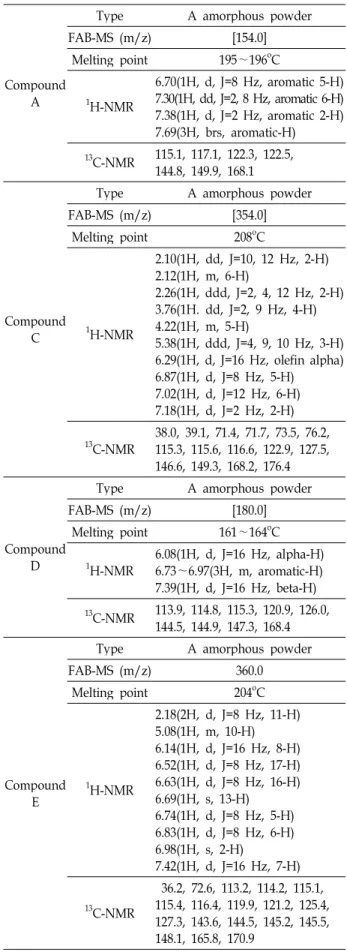
Table 4. Spectroscopic data of purified compounds with anti- microbial activity on Helicobacter pylori
Compound A
Type A amorphous powder
FAB-MS (m/z) [154.0]
Melting point 195∼196oC
1H-NMR
6.70(1H, d, J=8 Hz, aromatic 5-H) 7.30(1H, dd, J=2, 8 Hz, aromatic 6-H) 7.38(1H, d, J=2 Hz, aromatic 2-H) 7.69(3H, brs, aromatic-H)
13C-NMR 115.1, 117.1, 122.3, 122.5, 144.8, 149.9, 168.1
Compound C
Type A amorphous powder
FAB-MS (m/z) [354.0]
Melting point 208oC
1H-NMR
2.10(1H, dd, J=10, 12 Hz, 2-H) 2.12(1H, m, 6-H)
2.26(1H, ddd, J=2, 4, 12 Hz, 2-H) 3.76(1H. dd, J=2, 9 Hz, 4-H) 4.22(1H, m, 5-H)
5.38(1H, ddd, J=4, 9, 10 Hz, 3-H) 6.29(1H, d, J=16 Hz, olefin alpha) 6.87(1H, d, J=8 Hz, 5-H) 7.02(1H, d, J=12 Hz, 6-H) 7.18(1H, d, J=2 Hz, 2-H)
13C-NMR 38.0, 39.1, 71.4, 71.7, 73.5, 76.2, 115.3, 115.6, 116.6, 122.9, 127.5, 146.6, 149.3, 168.2, 176.4
Compound D
Type A amorphous powder
FAB-MS (m/z) [180.0]
Melting point 161∼164oC
1H-NMR 6.08(1H, d, J=16 Hz, alpha-H) 6.73~6.97(3H, m, aromatic-H) 7.39(1H, d, J=16 Hz, beta-H)
13C-NMR 113.9, 114.8, 115.3, 120.9, 126.0, 144.5, 144.9, 147.3, 168.4
Compound E
Type A amorphous powder
FAB-MS (m/z) 360.0
Melting point 204oC
1H-NMR
2.18(2H, d, J=8 Hz, 11-H) 5.08(1H, m, 10-H) 6.14(1H, d, J=16 Hz, 8-H) 6.52(1H, d, J=8 Hz, 17-H) 6.63(1H, d, J=8 Hz, 16-H) 6.69(1H, s, 13-H)
6.74(1H, d, J=8 Hz, 5-H) 6.83(1H, d, J=8 Hz, 6-H) 6.98(1H, s, 2-H)
7.42(1H, d, J=16 Hz, 7-H)
13C-NMR
36.2, 72.6, 113.2, 114.2, 115.1, 115.4, 116.4, 119.9, 121.2, 125.4, 127.3, 143.6, 144.5, 145.2, 145.5, 148.1, 165.8, 170.9
정제 화합물의 구조 동정
정제물의 항균효과가 가장 높은 4가지 물질에 대한 구조 동정 결과는 Table 4와 같이 나타났다. Purified compound A는 melting point가 195∼196oC이며, negative FAB-MS에서 분자량 154를 얻었다. IR spectrum은 3240에서 OH기가 1680 에서 C=O 및 1600에서 aromatic의 C=C가 확인되었으며, 또 한 6.70 ppm (d, J=8 Hz), aromatic 영역의 7.30 ppm (dd, J=2, 8 Hz), 7.38 ppm (d, J=2 Hz) 및 7.69 ppm (brs, aromatic-H) 등의1H-NMR spectrum과 13C-NMR의 spectrum은 Irwin과 Pearl [18]의 보고와 같아 compound A는 protocatechuic acid 로 동정하였다. Compound C는 melting point가 208oC이며, negative FAB-MS에서 354의 분자량을 얻었다. IR spectrum은 3250에서 OH기가 1710에서 COO기가 확인되었으며, 선광도 는 -35.2를 나타내었다.1H-NMR spectrum은 2.10 ppm (dd, J=10, 12 Hz), 2.12 ppm (m), 2.26 ppm (ddd, J=2, 4, 12 Hz), 3.76 ppm (dd, J=2, 9 Hz), 4.22 ppm (m) 및 5.38 ppm (ddd, J=4, 9, 10 Hz), 6.29 ppm (d, J=16 Hz), 6.87 ppm (d, J=8 Hz).
7.02 ppm (d, J=12 Hz) 및 7.18 ppm (d, J=2 Hz) 등으로 Barnes 등[19]이 보고한 결과와 같아 purified compound C는 chloro- genic acid로 동정하였다. Compound D는 melting point가 161∼164oC이며, negative FAB-MS에서 분자량 180을 얻었다.
IR spectrum은 3440에서 OH기가 1646에서 COOH가 확인되 었으며, 또한 1H-NMR spectrum은 6.08 ppm (d, J=16 Hz), aromatic 영역에서 3H분의 6.73∼6.97 ppm (m) 및 7.39 ppm (d, J=16 Hz) 등의1H-NMR spectrum과13C-NMR의 spectrum 은 Kelley 등[20,21]의 보고와 같아 compound D는 caffeic acid 로 동정하였다. Compound E는 melting point가 204oC이고 선광도는 +145o이며, negative FAB-MS에서 360의 분자량을 얻었다.1H-NMR spectrum은 2.18 ppm (d, J=8 Hz), 5.08 ppm (m), 6.14 ppm (d, J=16 Hz), 6.52 ppm (d, J=8 Hz), 6.63 ppm (d, J=8 Hz), 6.69 ppm (s), 6.74 ppm (d, J=8 Hz), 6.83 ppm (d, J=8 Hz), 6.98 ppm (s) 및 7.42 ppm (d, J=16 Hz) 등으로 Kelly 등[20,21]이 보고한 결과와 같아 compound E는 rose- marinic acid로 동정하였다.
이상의 실험 결과로 보아 청목노상 callus가 청목노상 뽕잎 보다H. pylori에 대한 항균효과가 더 우수함을 확인할 수 있었 으며, 이러한 결과는 조 등[8]이 청목노상 뽕잎에 존재한다고 보고한H. pylori 억제물질인 chlorogenic acid, caffeic acid 및 rosemarinic acid 등의 3종류의 항균물질뿐만 아니라 청목노 상뽕잎 callus에는 protocatechuic acid가 더 존재하는 것으로 확인되었고, 그 함량도 매우 높은 것으로 측정되어, 같은 조건 에서 청목노상 뽕잎 callus의 H. pylori 억제효과가 청목노상 뽕잎보다 더 높은 이유는 protocatechuic acid의 존재 때문인 것으로 확인되었다. 이러한 물질군의 차이는 callus 제조 시 생산되는 이차대사산물의 변화에 기인하는 것으로 판단되며, 뽕잎에서는 거의 발견되지 않는 protocatechuic acid가H. py-
lori의 세포벽에 어떠한 방식으로 작용하는지에 대해서는 향후 연구를 통하여 밝혀내어야 할 것으로 판단되었다.
References
1. Jin, H. J., H. Y. Lee, D. J. Kim, M. Y. Heo, and J. H. Lee.
2005. Genotoxicity and mutagenicity of the extracts of Morus alba L. Korean J. Medicinal Crop Sci. 13, 217-225.
2. Bae, K. H. 2000. Medicinal plant of Korea. KyoHak press.
Seoul. p. 73.
3. Chen, F., N. Nakashima, I. Kimura, and M. Kimura. 1995.
Hypoglycemic activity and mechanisms of extracts from mulberry leaves (Folium mori) and cortex mori radicis in streptozotocin-induced diabetic mice. Akugaku Zasshi115, 476-482.
4. Asano, N., E. Tomioka, H. Kizu, and K. Matsui. 1994. Sugars with nitrogen in the ring isolated from the Morus Bombysis. Carbohydr. Res. 253, 235-245.
5. Basnet, P., S. Kodota, S. Terashima, M. Shimizu, and T.
Namba. 1993. Two new 2-arylbenzofuran derivatives from hypoglycemic activity-bearing fractions of Morus insignis.
Chem. Pharm. Bull. 41, 1238-1243.
6. Kimura, M., F. Chen, N. Nakashima, I. Kimura, N. Asano, and S. Koya. 1995. Antihyperglycemic effects of N-contain- ing sugars derived from Mulberry leaves in STZ-induced diabetic mice. J. Trad. Med., 12, 214-220.
7. Cho, Y. J., I. S. ju, B. O. Kim, J. H. Kim, B. G. Lee, B. J.
Ahn, and J. W. Choo. 2007. The antimicrobial activity against Helicobacter pylori and antioxidant effect from the extracts of Mulberry leaves (Morus AlbaL.).J. Kor. Soc. Appl.
Biol. Chem., 50, 334-343.
8. Cho, Y. J., K. H. Lee, W. S. Cha, I. S. ju, D. H. Yoon, B.
J. Ahn, S. H. Lee, M. W. Kim, J. H. Kim, and S. S. Chun.
2009. Purification and identification of inhibitory com- pounds fromCheongmoknosangMulberry leaves (Morus Alba L.) on Helicobacter pylori. J. Kor. Soc. Appl. Biol. Chem.52, 65-69.
9. Murashige, T. and T. Skoog. 1962. A revised medium for rapid growth and bioassays with tobacco tissue cultures.
Physiol. Plant. 15, 473-492.
10. Folin, O. and W. Denis. 1912. On phosphotungastic-phos-
phomolybetic compounds as color reagents.J. Biol. Chem.
12, 239-249.
11. Ju, I. S. and Y. J. Cho. 2009. Purification and identification of phenol compounds with inhibitory activity on Helicobacter pylori from Rhododendron mucronulatum Flos.
extracts. J. Life Sci. 19, 1125-1131.
12. Chun, S. S., D. A. Vattem, Y. T. Lin, and K. Shetty. 2005.
Phenolic antioxidants from clonal oregano(Origanum vul- gare) with antimicrobial activity againstHelicobacter pylori. Process Biochemistry40, 809-816.
13. Cho, Y. J., O. J. Kwon, S. S. Chun, B. J. An, and J. H. Kim.
2008. Biological and antimicrobial activity of Portulaca oleacea. J. Korean Soc. Appl. Biol. Chem. 51, 49-54.
14. Lee, J. H. and S. R. Lee. 1994. Some physiological activity of phenolic substance in plant foods. Korean J. Food Sci.
Technol. 26, 317-323.
15. Lee, M. J., Y. R. Chang, and N. H. Yim. 1998. Chemical structure of Polyphenols isolated from cacao bean and their inhibitory effect on ACE. Agricultural Chemistry and Biotechnology41, 110-117.
16. Lee, M. K., Y. G. Kim, S. W. An, M. H. Kim, J. H. Lee, and H. Y. Lee. 1999. Biological activities ofHovenia dulcis THUNB. Korean J. Medicinal Crop Sci. 7, 185-192.
17. Shetty, K. 1997. Biotechnology to harness the benefits of di- etary phenolics: Focus onLaminaceae. Asia Pacific J. Clin.
Nutr. 6, 162-171.
18. Irwin, B. Y. and A. Pearl. 1946. Reactions of vaillin and its derived compounds. Ⅳ, The Caustic fusion of vaillin.J. Am.
Chem. Soc. 68, 2180-2183.
19. Barnes, H. M., J. R. Reldman, and W. V. White. 1950.
Isochlorogenic acid. Isolation from coffee and structure studies. J. Am. Chem. Soc. 72, 4178-4183.
20. Kelley, C. J., C. R. Harruff, and M. Carmack. 1976. The poly- phenolic acids ofLithospermum ruderale. 11. Carbon-13 nu- clear magnetic resonance of Lithospermic and Rosemarinic acids. J. Org. Chem.41, 449-455.
21. Kelley, C. J., J. R. Mahajan, L. C. Brooks, L. A. Neubert, W. R. Breneman, and M. Carmack. 1975. Polyphenolic acids oflithospermum ruderaleDougl. ex Lehm. (Boraginaceae). 1.
Isolation and structure determination ofLithospermic Acidla.
J. Org. Chem.40, 1804-1808.
초록:Biomass를 위해 제조한 청목노상 callus로부터 Helicobacter pylori 억제물질의 분리 및 동정 윤동혁․차원섭․이선호1․안봉전2․김정환3․천성숙3․배종호4․조영제*
(경북대학교 식품공학과,1안동대학교 해양바이오산업연구소, 2대구한의대학교 화장품약리학과,3엔아이피 바이오텍, 4대구미래대학 제과데코레이션과)
청목노상 잎 시료로부터 spot 배양 후 bioreactor에서 배양된 청목노상 뽕잎callus 추출물을 이용하여H. pylori 균에 대한 항균활성을 측정한 결과, 높은 항균활성을 나타내는 것을 알 수 있었다. 배양된 청목노상 뽕잎 callus 추출물의 H. pylori 균에 대한 항균활성 물질을 정제하여1H-NMR,13C-NMR, IR 및 FAB-MS spectrum 등을 활용하 여 구조분석 한 결과 protocatechuic acid, chlorogenic acid, caffeic acid 및 rosemarinic acid로 동정하였으며, 단일물 질 보다 혼합물질에 의한 synergy 효과에 의해 H. pylori 균에 대한 항균활성이 나타나는 것으로 판단되었다.