Antimicrobial Activity of Pseudomonas aeruginosa BCNU 1204 and Its Active Compound
Hwa Jin Shin and Woo Hong Joo*
Department of Biology and Chemistry, Changwon National University, Changwon 51140, Korea Received November 12, 2018 /Revised November 27, 2018 /Accepted December 3, 2018
Previous screening of novel antibacterial agents revealed that some bacterial isolates exhibited anti- biotic activity against both gram-positive and gram-negative bacteria and that they showed anti- bacterial activity, even against methicillin-resistant Staphylococcus aureus (MRSA). Among these iso- lates, one bacterial strain, BCNU 1204, was identified as Pseudomonas aeruginosa using phenetic and phylogenetic analysis, based on 16S ribosomal RNA gene sequences. The maximum productivities of antimicrobial substances of BCNU 1204 were obtained after being cultured at 35°C and pH 7.0 for 4 d in King’s medium B (KMB). Dichloromethane (DCM) and ethylacetate (EA) extracts of P. aeruginosa BCNU 1204 exhibited strong antimicrobial activity, particularly against gram-positive bacteria. The EA extracts exhibited broad-spectrum activity against antibiotic resistant strains. Fraction 5-2, was obtained by recycling preparative liquid chromatography (LC) and preparative thin-layer chromatography (TLC) and was identified as phenazine-1-carboxylic acid belonging to phenazines using gas chroma- tography and mass spectrometry (GC/MS). Its minimum inhibitory concentration (MIC) values were 25 μg/ml, 50 μg/ml, ≥25 μg/ml, and ≥50 μg/ml for MRSA CCARM 3089, 3090, 3091, and 3095 strains, respectively. P. aeruginosa BCNU 1204 may be a potential resource for the development of anti-MRSA antibiotics. Additional research is required to identify the active substance from P. aeruginosa BCNU 1204.
Key words : Antimicrobial activity, methicillin-resistant Staphylococcus aureus (MRSA), phenazine compounds, phenazine-1-carboxylic acid, Pseudomonas aeruginosa
*Corresponding author
*Tel : +82-55-213-3453, Fax : +82-55-213-3459
*E-mail : [email protected]
This is an Open-Access article distributed under the terms of the Creative Commons Attribution Non-Commercial License (http://creativecommons.org/licenses/by-nc/3.0) which permits unrestricted non-commercial use, distribution, and reproduction in any medium, provided the original work is properly cited.
Journal of Life Science 2019 Vol. 29. No. 1. 84~89 DOI : https://doi.org/10.5352/JLS.2019.29.1.84
서 론
미생물은 항생물질, 면역억제제 그리고 고지혈증 치료제인 스타틴류 등을 포함하는 다양한 약제를 생산하는 것으로 밝혀 져 있으나 다양한 미생물 중 일부에서 이들 물질을 생산하는 것으로 알려져 있다[6]. 특히 미생물 기원의 항생물질은 여러 종류의 병원성 세균에 의한 감염병 치료에 이용되고 있으나 각종 항생제에 대한 내성균의 증가가 전세계적으로 문제가 되고 있다. 특히 국내 분리 황색 포도알균(Staphylococcus aur- eus)의 약 70%가 메티실린 내성 황색포도알균(methicillin-re- sistant Staphylococcus aureus, MRSA)로 밝혀져 있으며 MRSA 는 병원 감염의 주요 원인균으로 조사되어 있고 MRSA 감염 과 원내 전파 경로인 비강에서의 정착을 막기 위해 사용하는 뮤피로신에 대해서도 내성을 나타내어 원내감염의 차단에 어 려움이 많다[10]. MRSA는 ciprofloxacin, clindamycin, eryth- romycin, gentamicin 및 tetracycline 등에 내성을 가지는 다약
제 내성균 (multidrug resistant bacteria)으로 특히, MRSA 치 료의 마지막 보루인 vancomycin에도 내성을 보이는 vanco- mycin-resistant S. aureus (VRSA)도 이들 MRSA에서 다수 있 는 것으로 조사되어 감염병 치료에 있어서 심각한 문제로 대 두되고 있다[7]. 현재 항생제 내성 균주에 대한 감염병 치료와 관리를 위해 새로운 항생물질의 탐색과 상용화가 절실히 요구 되고 있으나 미생물 기원의 항생물질에 대한 연구는 많이 위 축되어 있으며, 주로 방선균을 대상으로 항생물질의 탐색연구 가 이루어지고 있어 보다 다양한 세균 및 균류를 대상으로 한 항생물질 연구가 필요하다.
Pseudomonas 속 세균은 석탄과 오일 연료의 주성분인 phe- nanthrene 을 비롯한 다가방향족화합물을 분해할 수 있는 능 력을 가지고 있으므로 생물정화에 사용되는 환경미생물이며 [4], 유해물질의 분해 및 무기질화 능력 외에도 다양한 대사능 력을 가지고 있어, 식물성장을 촉진하며 식물에 있어서의 질 병저항성을 높여주기도 한다[8]. Pseudomonas 속에 속하는 균 종들은 인체병원성이 있거나 다양한 물질 분해능이 있거나 식물병원균에 대한 biocontrol을 한다고 알려져 있으나, 일부 균종은 각종 식물에 병원성도 있는 것으로 알려져 있다.
Pseudomonas 속에서 광범위하게 연구되고 있는 종으로는 P.
aeruginosa, P. fluorecens, P. putida, P. chlororaphis 그리고 식물 병원성균인 P. cichorii와 P. syringae가 있다[9]. 한편 Pseudomo- nas 속에 속하는 균종들은 작물보호 물질, 색소화합물 및 항생
물질 등 다양한 2차 대사산물들을 생산하는 것으로 보고되어 있으며[9, 11], Pseudomonas sp. 세균이 생산하는 대표적인 항 생물질로는 cepafungins, phenazines, pyo compounds 및 pyrrolnitrin 등이 알려져 있다[2, 5, 9, 11, 13, 14]. 그러나 mac- rolides, aminoglycosides, polyenes 및 quinone-type 계열의 항생물질 등은 생산하지 않는 특징을 가지고 있다[9]. 본 연구 에서는 Pseudomonas 속을 대상으로 항생물질 생산균주를 탐 색하여 그 중 MRSA에 항균활성을 가지고 있는 분리균주에서 의 활성물질의 생산조건을 확립하였으며, 나아가 항균 활성물 질의 분리 및 정제를 통하여 그 구조 및 효능을 확인하여 보고 하고자 한다.
재료 및 방법
균주 분리 선별 및 동정
강원도 청옥산 일대에서 채취한 토양 1 g을 9 ml의 phos- phate buffered saline (PBS, pH 7.2)으로 희석한 후 희석액 200 μl를 nutrient agar (NA) 배지에 도말하였고 28℃에서 24- 36 시간 동안 배양하였다. 순수분리 후, 병원성 세균에 대한 항균력을 측정하여 활성이 우수한 균주를 최종 선별하여 본 실험에 사용하였다. 보다 자세한 동정을 위해 27F (5'-AGAG TTTGATCMTGGCTCAG-3')와 1492R (5'-TACGGYTACCTT GTTACGACTT-3') primer를 사용하여 16S 리보좀 DNA를 PCR로 증폭하여 염기서열을 결정하였고, National Center for Biotechnology Information (NCBI, USA) BLAST 프로그램으 로 비교 분석하였다. 또한 bioedit (USA), clustal X 2.0 (CLC bio, Denmark), mega 4를 사용하여 상동성을 분석한 후 최종 적으로 neighbor joining method를 기반으로 계통수를 작성 하였다[15].
생리활성물질의 배양조건 검토 및 추출
생리활성물질을 안정적으로 생산할 수 있는 배양조건을 확 립하기 위해 다양한 배지(Nutrient Broth (NB), Luria-Bertani (LB), Brain heart infusion broth (BHI) 그리고 King's medium B(KMB)), 배양기간(14일), pH (6-9) 및 온도(28, 30, 35 및 37
℃)의 조건하에서 최적조건을 검토하였다. 각각의 배양액을 24시간 간격으로 회수하여 0.22 μm filter로 여과하고 70℃에 서 10분간 열처리하여 효소활성을 제거한 후 항균활성 시료로 사용하였다. 활성물질 추출은 최적 배양조건에서 배양하여 원 심분리(8,000× g, 10분, 4℃) 후, 배양상등액을 n-hexane (HX), dichloromethan (DCM) 및 ethyl acetate (EA)를 이용하여 순 차적으로 용매분획하였다.
항균활성물질의 정제 및 활성 측정
용매추출물에 대한 1차 항균활성을 조사하고 활성물질 분 리를 위하여 preparative liquid chromatography (prep LC:
LC 9104; JAI, Japan)를 사용하였다. Multi column (Jaigel-GS 310, 21.5×500 mm, JAI, Japan)을 이용하여 methanol로 전개 하였으며, 245 nm (LC-310, JAI)에서 검출하였다. 각 추출물은 S. aureus와 Escherichia coli에 대해 1차 항균력을 조사하였으며, 활성분획은 재분획한 뒤, preparative thin layer chromatog- raphy (prep TLC, 20×20 cm, 0.2 mm, silica gel 60 F254, Merck, USA)를 사용하여 DCM, EA 및 methanol의 전개비율 (5:1:0.3-1:1:0.1)을 조절하여 정제하였다. 성분 분석과 질량분석 은 gas chromatography-mass spectrometry (GC-MS, HP 6890&5973, Agilent, USA)를 이용하였으며, 활성물질에 대한 항균활성은 최종적으로 MIC를 측정함으로써 확인하였다.
항균활성측정
병원성 세균에 대한 항균활성 측정을 위한 테스트 균주로 각각 4종의 그람양성 세균(Bacillus cereus KCTC 3624, Clav- ibacter michiganensis KACC 20122, Listeria monocytogenes KACC 10764 그리고 Micrococcus luteus KACC 10488)과 그람 음성 세균(E. coli IMSNU 10080, Proteus vulgaris IMSNU 13025, Shigella sonnei KCTC 2518 및 Salmonella typhimiurium KCTC 1926) 및 항생제내성균주(S. aureus CCARM 3089, S.
aureus CCARM 3090, S. aureus CCARM 3091 및 S. aureus CCARM 3095)를 사용하였다. 각 균주는 한국생명공학연구원 생물자원센터(Korean Collection for Type Culture, KCTC), 한 국농업미생물자원센터(Korean Agricultural Culture Collection, KACC), 서울대학교 미생물연구소(Institute of Microbiology Seoul National University, IMSNU) 및 서울여자대학교 항생 제 내성균주은행(Culture Collection of Antimicrobial Resist- ant Microbes , CCARM)에서 분양받아 사용하였다.
항균효능과 최소저해농도(minimal inhibitory concen- tration, MIC)는 paper disc 법으로 측정하였다[17]. 테스트 균 주를 0.5 macfarland의 농도로 맞추어 최적배지에 100 μl 도말 한 후 그 위에 항균 활성 균주를 접종한 paper disc 또는 항균 물질(10 mg/ml)을 희석한 시료를 10 μl 접종한 paper disc를 얹었다. 이후 최적조건에서 배양 후 증식여부를 확인함으로써 측정하였다.
결과 및 고찰
균주의 선별, 동정 및 항균활성
청옥산 토양시료에서 다수의 각종 미생물을 분리하여 그 중에서 항균력이 좋은 한 균주를 선별하여 균주의 특성을 조 사한 결과 균주는 그람음성 간균으로 청녹색, 노란색 그리고 갈색 색소를 생성하는 특성을 가지고 있었다. 16S 리보좀 DNA 염기서열 분석 후 type strain과 상동성을 비교해 본 결 과, Pseudomonas aeruginosa와 99%의 상동성을 가지는 것으로 확인되었으며, 계통적으로 Pseudomonas aeruginosa임이 확인
Fig. 1. Phylogenetic position of Pseudomonas sp. BCNU 1204 based on 16S ribosomal RNA gene sequences.
되었다(Fig. 1). 또한 생리생화학적 특성 조사에서도 Pseudomo- nas aeruginosa 에 속함이 확인되었다(unpublished data). 그러 므로 최종적으로 Pseudomonas aeruginosa BCNU 1204로 명명 하였다.
그람양성 세균 4종, 그람음성 세균 4종 및 MRSA 균주 4종 을 대상으로 P. aeruginosa BCNU 1204 균주의 항균 활성을 조사한 결과, 그람음성 세균에 대하여도 항균활성을 나타내었 으나, 그람양성 세균 B. cereus, C. michiganensis, L. mono- cytogenes 그리고 M. luteus에 대하여 저해환이 각각 20 mm, 14 mm, 18 mm 및 21 mm으로 항균활성이 보다 높았다. 또한 MRSA 세균인 S. aureus CCARM 3089, CCARM 3090, CCARM 3091 및 CCARM 3095 균주에 대하여 저해환이 각각 15 mm, 11 mm, 22 mm 그리고 12 mm으로 조사되었다(Table 1).
Table 1. Antimicrobial activity of Pseudomonas aeruginosa BCNU 1204 against test bacteria
Microorganisms Zone of inhibition (mm) B. cereus
C. michiganensis L. monocytogenes M. luteus
20±1.0 14±0.5 18±0.5 21±1.0 E. coli
P. aeruginosa S. typhimurium S. sonnei
11±0.8 10±0.5 11±0.5 14±0.5 S. aureus CCARM 3089
S. aureus CCARM 3090 S. aureus CCARM 3091 S. aureus CCARM 3095
15±0.5 11±1.0 22±0.5 12±0.25
Fig. 2. Cell growth of Pseudomonas aeruginosa BCNU 1204 cul- tured in a King's medium B and antibiotic activity of its crude extract. ●: cell growth of BCNU 1204, ■: pH of culture medium, ◇: its inhibitory activity against S.
aureus CCARM 3090 , △: its inhibitory activity against S. aureus CCARM 3091, ○: its inhibitory activity against S. aureus CCARM 3115, □: its inhibitory activity against S. aureus CCARM 3561.
Table 2. Antimicrobial activity of HA, DCM and EA extract of Pseudomonas aeruginosa BCNU 1204 against test bac- teria
Microorganisms Zone of inhibition (mm)
HX DCM EA
B. cereus C. michiganensis L. monocytogenes M. luteus
- - - -
12±0.9 12±0.8 15±0.5 12±0.5
19±0.5 12±0.5 18±0.5 12±0.5 E. coli
P. aeruginosa S. typhimurium S. sonnei
- - - -
- - - 11±0.5
- - - 12±0.5 S. aureus CCARM 3089
S. aureus CCARM 3090 S. aureus CCARM 3091 S. aureus CCARM 3095
- - - 11±0.05
10±0.2 - 10.5±0.5 12±0.8
17.5±0.05 14±0.05 14.5±0.05 16±0.5 The extracts were assayed under the same concentrations (100 μg/disc).
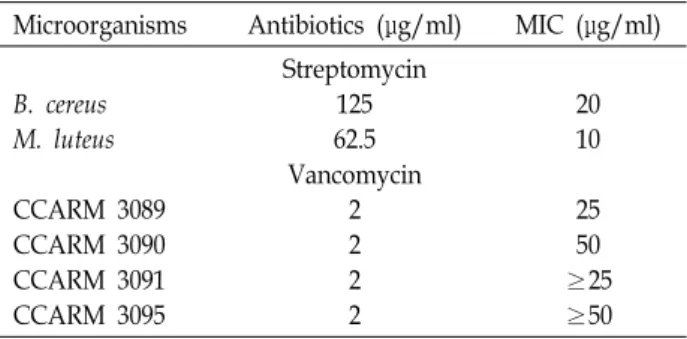
Table 3. Minimal inhibitory concentration of purified 5-2 com- pound
Microorganisms Antibiotics (μg/ml) MIC (μg/ml)
B. cereus M. luteus CCARM 3089 CCARM 3090 CCARM 3091 CCARM 3095
Streptomycin 125 62.5 Vancomycin
2 2 2 2
20 10
25 50
≥25
≥50 생리활성물질의 추출 및 항균활성
P. aeruginosa BCNU 1204 균주의 항균활성은 KMB 배지에 서 pH 7.0, 35℃에서 4일간 배양했을 때 가장 높았으며, 5일부 터 감소하는 것으로 나타났으며, 배양기간 중 pH는 7.0-6.0 내에서 변동을 보였다(Fig. 2). 그리고 HX, EA 및 DCM 추출물 은 100 μg/disc의 농도에서 항균력을 측정한 결과, EA와 DCM 추출물은 그람양성 세균과 MRSA 균주에 대해 넓은 항 균 스펙트럼을 보였으며, 특히 EA 추출물의 활성이 뛰어난 것으로 조사되었다. HX 추출물은 항균활성이 없었으며, 그람 음성 세균에 대한 활성도 대체로 낮은 것으로 확인되었다 (Table 2).
생리활성물질 정제 및 항균활성
가장 활성이 뛰어난 EA 추출물을 recycling prep LC를 이용 하여 Fr. 1-6까지 6개의 분획물로 나누었으며, 그람양성 세균 2종(B. cereus, L. monocytogenes)과 항생제내성균주 4종(S. aur- eus CCARM 3089, S. aureus CCARM 3090, S. aureus CCARM 3091, S. aureus CCARM 3095)에 대한 MIC를 조사하였다. 그 결과 Fr. 2과 Fr. 5가 적은 농도에서 MRSA균주에 대하여도 항균활성을 나타냄이 확인되었으나(unpublished data), Fr. 5 에서 prep TLC (Chloroform:methanol=10:1)를 이용하여 정제 가 성공적으로 이루어 졌다. Fr. 5의 세가지 물질중 Fr. 5-2는 밝은 노란색을 띄는 물질로 GC/MS 분석을 실시하였다. Fr.
5-2 물질은 224의 분자량을 가지며 주요 fragmentation ion 피크가 180 그리고 152 등으로 phenazine-1-carboxylic acid와
일치하여 phenazines계열의 phenazine-1-carboxylic acid로 확인되었다(Fig. 3). 정제된 phenazine-1-carboxylic acid (Fr.
5-2)는 MRSA 3089와 3090균주에 대해 MIC 값이 각각 25와 50 μg/ml로 조사되었다(Table 3).
Phezanine은 방향족 아미노산의 전구물질인 chorismic acid으로부터 생합성되며 pyocyanin, phenazine-1-carboxylic acid 그리고 phenazine-1-carboxamide와 같은 형태로 존재한 다[11]. P. aeruginosa에서 분리된 phenazine-1-carboxamide는 MRSA N315균주에 대해 MIC가 250 μg/ml인 점에서 phena- zine-1-carboxamide 보다는 phenazine-1-carboxylic acid가 MRSA에 대하여 보다 나은 항균활성을 나타내었다[3]. Phena- zine 계열 물질들의 항균력과 항균 스펙트럼은 잘 보고되어 있으며, phenazine-1-carboxylic acid의 Fusarium 등의 식물병 원균에 대한 biocontrol 인자로써의 중요성은 보고되고 있으 나[18], phenazine-1-carboxylic acid의 항생제 내성균주에 대 한 항균효과는 보고된 바가 없어 본 연구는 학문적으로 의의 가 있다고 판단된다. P. aeruginosa BCNU 1204 균주의 EA 추
A
B
Fig. 3. Gas chromatographic and gas chromatographic-mass spectrometric (GC-MS) analysis of purified phenazine-1-carboxylic acid.
(A) Gas chromatogram of purified phenazine-1-carboxylic acid, (B) GC-MS chromatogram of purified phenazine-1-carboxylic acid.
출물은 그람양성 세균과 특히 항생제내성 균주에 넓은 항균스 펙트럼을 가지고 있으며, 추후 유효 물질의 보다 정확한 구조 규명 나아가 기능과 구조 상관관계에 대한 검토가 이루어져야 할 것으로 사료된다.
References
1. Borrero, N. V., Bai, F., Perez, C., Duong, B. Q., Rocca, J.
R., Jin, S. and Huigens III, R. W. 2014. Phenazine antibiotic inspired discovery of potent bromophenazine antibacterial agents against Staphylococcus aureus and Staphylococcus epidermidis. Org. Biomol. Chem. 12, 881-886.
2. Brisbane, P. G. and Rovira, A. D. 1988. Mechanism of in- hibition of Gaeumannomyces graminis var. tritici by Fluorescent Pseudomonads. Plant Pathol. 37, 104-111.
3. Cardozo, V. F., Oliveira, A. G., Nishio, E. K., Perugini, M.
R., Andrade, C. G., Silveira, W. D., Durán, N., Andrade, G., Kobayashi, R. K. T. and Nakazato, G. 2013. Antibacterial activity of extracellular compounds produced by a Pseudo- monas strain against methicillin-resistant Staphylococcus aur- eus (MRSA) strains. Ann. Clin. Microb. Anti. 12, 12.
4. Chebbi, A., Hentati, D., Zaghden, H., Baccar, N., Rezgui, F., Chalbi, M., Sayadi, S. and Chamkha, M. 2017. Polycyclic aromatic hydrocarbon degradation and biosurfactant pro- duction by a newly isolated Pseudomonas sp. strain from used motor oil-contaminated soil. Int. Biodeter. Biodegr. 122, 128-140.
5. Chin-A-Woeng, T. F. C., Bloemberg, G. V., van der Bij, A.
J., van der Drift, K. M. G. M., Schripsema, J., Kroon, B., Scheffer, R. J., Keel, C., Bakker, P. A. H. M., Tichy, H. V.,
de Bruijin, F. J., Thomas-Oates, J. and Lugtenberg, B. 1998.
Biocontrol by phenazine-1-carboxamide-producing Pseudo- monas chlororaphis PCL1391 of tomato root rot caused by Fusarium oxysporum f. sp. radicis-lycopersici. Mol. Plant Microbe Interact. 11, 1069-1077.
6. Harney, A. 2000. Strategies for discovering drugs from pre- viously unexplored natural products. Drug Discov. Today 5, 294-300.
7. Hasan, R., Acharjee, M. and Noor, R. 2016. Prevalence of vancomycin resistant Staphylococcus aureus (VRSA) in methi- cillin resistant S. aureus (MRSA) strains isolated from burn wound infections. Tzu. Chi. Med. J. 28, 49-53.
8. Jain, R. and Pandey, A. 2016. A phenazine-1-carboxylic acid producing polyextremophilic Pseudomonas chlororaphis (MCC 2693) strain, isolated from mountain ecosystem, possesses biocontrol and plant growth promotion abilities. Microbiol.
Res. 190, 63-71.
9. Leisinger, T. and Margraff, R. 1979. Sencondary metabolites of the fluorescent Pseudomonads. Microbiol. Rev. 43, 422-442.
10. Lee, A. J., Suh, H. S., Jeon, C. H. and Kim, S. G. 2011. Preva- lence and clinical characteristics of mupirocin-resistant Staphylococcus aureus. Kor. J. Clin. Microbiol. 14, 18-23.
11. Mishra, J. and Arora, N. K. 2018. Secondary metabolites of fluorescent pseudomonads in biocontrol of phytopathogens for sustainable agriculture. Appl. Soil Ecol. 125, 35-45.
12. Murray P. R., Baron, E. J., Pfaller, M. A., Tenover, F. C. and Yolke, R. H. 1999. Manual of Clinical Microbiology, pp.
1527-1539, 7th ed., ASM: Washington, DC, USA.
13. Shoji, J., Hinoo, H., Kato, T., Hattori, T., Hirooka, K., Tawara, K., Shiratori, O. and Terui, Y. 1989. Isolation of cepafungins I, Ⅱ and Ⅲ from Pseudomonas species. J. Antibiot. 23, 783-
초록:Pseudomonas aeruginosa BCNU 1204의 항균활성과 활성 물질
신화진․주우홍*
(창원대학교 생물학화학융합학부)
신규 항세균물질을 탐색하는 사전조사에서 몇몇 분리균주들이 그람양성 세균과 그람음성 세균 모두에 항균활 성을 보이며, 심지어 methicillin내성 Staphylococcus aureus (MRSA)에도 항균활성을 나타내었다. 이들 균주 중에서 한 균주가 표현형과 계통분석을 이용하여 특히 16S 리보좀 RNA 유전자 염기서열에 기초하여 Pseudomonas aeru- ginosa로 동정되었다. BCNU 1204 균주의 항균물질은 King's medium B (pH 7.0)에서 35℃의 온도 조건으로 4일 배양 후 가장 최대로 생산되었다. 항균물질을 각종 유기용매로 분획한 결과, P. aeruginosa BCNU 1204의 dichloro- methane (DCM)분획과 ethylacetate (EA) 분획이 그람 양성 세균에 강력한 항균활성을 보였으며, 특히 ethyl- acetate (EA) 분획이 methicillin내성 Staphylococcus aureus (MRSA)에 대하여 강한 항균활성을 나타내었다.
Recycling preparative LC와 preparative TLC 로 활성물질 하나(분획 5-2)를 분리하여 GC-MS 분석한 결과 phena- zine 화합물에 속하는 phenazine-1-carboxylic acid 로 동정하였다. 그리고 MRSA 균주에 대한 최소저해농도 (minimum inhibitory concentration, MIC)가 MRSA균주인 CCARM 3089, 3090, 3091 그리고 3095 균주에 대하여 각각 25 μg/ml, 50 μg/ml, ≥25 μg/ml 그리고 ≥50 μg/ml 임을 확인하였다. 그러므로 P. aeruginosa BCNU 1204 분리균주는 항 MRSA 항생물질을 개발하기 위한 잠재 가치가 높은 생물자원으로 기대되며, P. aeruginosa BCNU 1204 균주로부터 리더 화합물을 획득하기 위한 보다 많은 연구가 요구된다.
787.
14. Thomashow, L. S. and Weller, D. M. 1988. Role of phenazine antibiotic from Pseudomonas fluorescens in biological control of Gaeumannomyces graminis var. tritici. J. Bacteriol. 170, 3499- 3508.
15. Saito, N. and Nei, M. 1987. The neighbor-joining method, a new method for reconstructing phylogenetic trees. Mol.
Biol. Evol. 79, 426-434.
16. Shanmugaiah, V., Mathivanan, N. and Varghese, B. 2009.
Purification, crystal structure and antimicrobial activity of phenazine-1-carboxamide produced by a growth-promoting
biocontrol bacterium, Pseudomonas aeruginosa MML2212. J.
Appl. Microbiol. 108, 703-711.
17. Sutter, V. L., Kwok, Y. Y. and Finegold, S. M. 1973. Suscepti- bility of Bacteroides fragilis to six antibiotics determined by standardized antimicrobial disc susceptibility testing. Anti- microb. Agents Chemother. 3, 188-193.
18. Upadhyay, A. and Srivastava, S. 2011. Phenazine-1-carbox- ylic acid is a more important contributor to biocontrol Fusarium oxysporum than pyrrolnitrin in Pseudomonas fluo- rescens strain Psd. Microbiol. Res. 166, 323-335.