Res. Plant Dis. 19(1) : 31−35 (2013)
© The Korean Society of Plant Pathology
http://dx.doi.org/10.5423/RPD.2013.19.1.031국내 콩 씨스트선충의 HG type 분석
김동근1*·최인수2·한원영3·류영현1·김명식4·배창환5
1유기농업연구소, 2부산대학교 생명자원과학대학, 3농진청 국립식량과학원, 4경상대학교 농업생명과학대학,
5국립생물자원관 생물자원연구부
Studies on HG Type of Heterodera glycines in Korea
Donggeun Kim1*, Insoo Choi2, Wonyoung Han3, Younghyun Ryu1, Myungsik Kim4 and Changhwan Bae5
1Organic Agriculture Research Institute, Uiseong, Gyeongbuk 769-803, Korea
2Department of Plant Bioscience, College of Natural Resources & Life Science, Pusan National University, Samrangjin, Miryang 627-706, Korea
3National Institue of Crop Science, Rural Development Administration, Miryang, Gyeongnam 627-803, Korea
4Division of Applied & Life Science, Gyeongsang National University, Jinju, Gyeongnam 660-701, Korea
5Wild Life Genetic Resource Center, National Institute of Biological Resources, Environment Research Complex, Incheon 404-708, Korea
(Received on October 31, 2012; Revised on March 18, 2013; Accepted on March 20, 2013)
Thirteen soybean cyst nematode (SCN) (Heterodera glycines) populations collected in Korea were examined in their HG type by their reproductivity on 7 Plant Introduction indicators for the identification of HG type.
Six HG types were identified, HG type 0, 2, 5, 2.5, 1.2.7, and 2.5.7. HG type 2.5 was the most frequent (4 samples, 30.8%), followed by HG type 2.5.7 (3 samples, 23.0%). About 76.9% of SCN populations were reproduced on PI 88788, followed by PI 209332 (61.5%), PI 548316 (‘Cloud’) (30.8%), and PI 548402 (‘Peking’) (7.7%). No population could reproduce on PI 90763, PI 437654, thus, they could be used for resistant source for developing SCN resistant soybean in Korea.
Keywords : Breeding, Heterodera glycines, Resistance, Soybean-cyst nematode
서 론
콩 씨스트선충(Heterodera glycines Ichinohe)은 한국, 중 국, 일본, 미국, 브라질, 아르헨티나 등 전 세계 콩 주산 지에 모두 감염되어 있으며, 콩에 발생하는 병해충 중에 서 가장 중요하게 취급된다. 예를 들어, 미국에서 2008년 부터 2010년에 콩 씨스트선충으로 인한 피해는 약 3.7백 만톤이며(http://aes.missouri.edu/delta/research/soyloss.stm), 많게는 30%의 수량감소가 발생되기도 한다(Donald 등, 2006). 콩 씨스트선충의 피해 증상은 콩밭의 한 부분에서 둥근 황색으로 나타나, 일명 月夜病(moonnight disease) 또
는 萎黃病이라고 불리며, 우리나라에서는 1936년 처음으 로 기록되었다(Yokoo, 1936).
콩 씨스트선충은 알들이 딱딱한 껍질인 씨스트로 보호 되어 있어 건조, 고온, 약제 처리 등 불량환경에 대한 저 항성이 강하므로 방제가 매우 어려워져 저항성 품종을 이 용하는 것이 일반적이다. 콩 씨스트선충 저항성 품종은 1957년 Ross와 Brim(1957)에 의하여 처음 연구가 시작되 어, 1966년에는 Pickett가 처음으로 육성되었으며(Brim과 Ross, 1966), 현재 콩 씨스트선충의 여러 가지 race에 대 하여 현재 약 1,400여 저항성 품종들이 육성되어 있다 (http://web.extension.illinois.edu).
포장의 콩 씨스트선충 집단은 생리, 생태, 형태적으로 조금씩 다른 다양한 유전적 변이를 가진 개체들의 집합 이며(Riggs, 1982), 이들 중에는 저항성 품종에 기생할 수
*Corresponding author
Phone) +82-54-832-9669, Fax) +82-54-833-1359 Email) [email protected]
Research Article Open Access
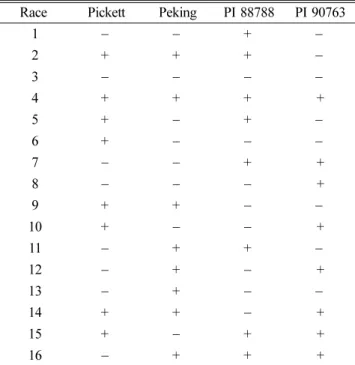
있는 유전자를 가진 개체도 포함되어 있다. 그러므로 저 항성 콩 품종이더라도 포장에 심으면 수년 내 이들 저항 성 콩에 기생 가능한 콩 씨스트선충 집단이 나타나게 된 다. 저항성 콩 품종에 기생할 수 있는 이들 집단을 서로 구분하기 위하여 Golden 등(1970)은 race system을 도입 하였고, 현재까지 미국에서는 16개의 race 중에서(Table
1) 12개의 race가 발견되었다(Riggs와 Schmitt, 1988). 그 러나 콩 저항성 유전의 복잡성, 콩 씨스트선충 집단의 다 양성 등으로 인하여 기존의 race 체계가 포장내 콩 씨스 트선충 집단의 변이를 해석하는데 충분하지 못하다는 판 단으로 2002년 Niblack 등은 HG type를 제시하였다. HG type 검정은 콩 씨스트선충 개체의 유전자 변이를 나타내 는 것이 아닌 포장내 콩 씨스트선충 집단의 변이를 나타 낸다(Niblack 등, 2002).
국내 콩 씨스트선충의 유전적 변이 연구로는 1983년 race 1, 5, 6이 발견되었고, 1986년 race 3이 발견되어 국 내에는 4개의 race가 존재하는 것으로 알려졌다(Choi 등, 1987; Kim과 Choi, 1983; Kim 등, 1999). 그러나 국내 콩 씨스트선충에 대한 HG type는 아직 연구되지 않았다. 이 연구는 국내에 분포하고 있는 콩 씨스트선충의 HG type 을 조사하고 그 분포를 밝혀 콩 저항성 품종 육성의 기 초자료로 이용하고자 실시하였다.
재료 및 방법
토양시료는 2011년 9−10월경에, 전국 8개도 콩 재배 포 장에서 포장 당 약 2 kg의 흙을 채집하였다. 채집된 토 양을 조사하고 씨스트의 밀도가 높은 13개의 토양을 선 발하여 온실 내에서 ‘Lee74’를 이용하여 증식하였다.
HG type test는 직경 10 cm 토화분에 살균된 사양토를 담고 vermiculite에서 발아시킨 8종의 판별품종, Lee74, PI 548402(‘Peking’), PI 88788, PI 90763, PI 437654, PI 209332, PI 89772, PI 548316(Table 2)를 화분 당 각 1포 기씩 심었으며, 뿌리 주위에 약 8,000−15,000개의 콩 씨 스트선충 알과 유충을 접종하였다(Riggs와 Schmitt, 1991).
콩 씨스트선충의 알과 유충은 증식된 씨스트를 분리하여 Table 1. Races of the soybean cyst nematode, Heterodera
glycines, according to the race determination schemes of Golden et al. (1970) and Riggs and Schmitt (1988)
Race Pickett Peking PI 88788 PI 90763
1 − − + −
2 + + + −
3 − − − −
4 + + + +
5 + − + −
6 + − − −
7 − − + +
8 − − − +
9 + + − −
10 + − − +
11 − + + −
12 − + − +
13 − + − −
14 + + − +
15 + − + +
16 − + + +
aRace determination is made on the basis of the pattern of “+” and “−”
ratings for each race. A “+” rating is given if the number of females produced by an H. glycines population on each soybean differential is equal to or greater than 10% of the number produced on the standard susceptible cultivar ‘Lee’. If the number of females is less than 10%, a “−” rating is given.
Table 2. Indicator lines for HG Type classification of genetically diverse populations of Heterodera glycines (Niblack et al. 2002) Indicator
number Linea Comment
1 PI 548402 Along with several other PI’s, also known as ‘Peking’; included in original SCNb race test, Brim and Ross, 1966
2 PI 88788 Source of resistance in most SCN-resistant cultivars; included in original SCN race test, Hartwig and Epps, 1978
3 PI 90763 Included in original SCN race test, Hartwig and Young, 1990 4 PI 437654 Source of resistance in ‘Hartwig’ and CystXTM, Anand, 1992a 5 PI 209332 Resistance is similar to PI 88788 and PI 548316, Anand, 1992b 6 PI 89772 Resistance is similar to PI 548402, Nickell et al., 1994a 7 PI 548316 Also known as ‘Cloud’, Nickell et al., 1994b
aPlant Introduction.
bSoybean cyst nematode.
tissue grinder(Pyrex, Corning, NY)로 분쇄하여 접종에 사용하였다. 시험은 각 3반복으로 하였으며 온실에서 약 45일간 재배하였다.
재배 약 45일 후, 화분의 흙과 뿌리를 약 10리터의 물 에 넣고 잘 씻은 후, 세게 휘저어, 그 물을 빠르게 20 mesh 와 60 mesh 체를 통과시켰다. 20 mesh 체에 걸린 찌꺼기 는 버리고, 60 mesh 체에 걸린 씨스트는 사각의 ‘씨스트 counting dish’(100 mm× 15 mm, Falcon grid dish)에 넣어 20배 해부현미경하에서 씨스트의 숫자를 헤아렸다. HG type 판별 품종은 미국 Arkansas 대학으로부터 분양받았 고 HG type 판별은 Niblack 등(2002)의 기준을 따랐다.
결과 및 고찰
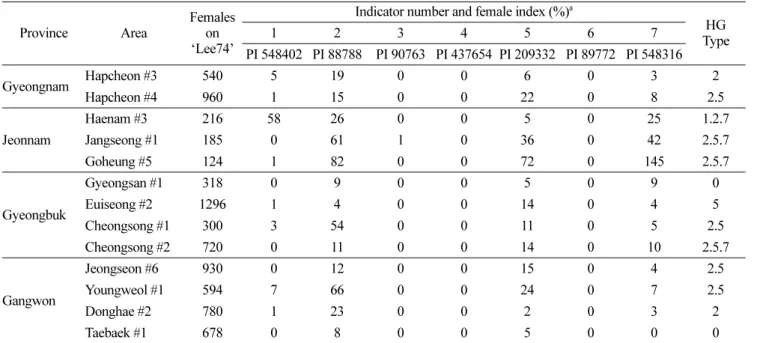
이번 HG type test에서 Lee 74에서 증식된 씨스트의 수 는 124−1,296개이며 평균 588개로 채집 장소별로 차이가 있었으나 HG type 판정에는 충분한 밀도였다(Table 3).
국내 콩 씨스트선충 HG type는 0, 2, 5, 2.5, 1.2.7, 2.5.7 로 총 6개의 HG type가 발견되었다. 그중 HG type 2.5 가 30.8%로 가장 많았으며 다음으로 HG type 2.5.7(23.0%) 이었다(Table 4). HG type 2.5와 2.5.7은 PI88788과 PI209332 를 가해할 수 있는 선충 집단인데, 이들의 비율이 53.8%
로 과반수를 차지하였다. PI88788은 미국에서 개발된 대 부분 저항성 품종들의 모본으로 사용되는 품종으로 기존 race 판별품종에 포함되어 있었으며, PI 209332는 PI 88788
및 PI 548316(‘Cloud’)과 유사한 저항성을 가지는 것으로 알려져 있다(Table 2).
각 indicator 별로는 PI 88788 가해 집단이 76.9%, PI 209332 집단이 61.5%, PI 548316(‘Cloud’) 가해 집단이 30.8%, PI 548402(‘Peking’) 집단이 7.7%였고 PI 90763, PI 437654, PI 89772를 가해할 수 있는 콩 씨스트선충 집 단은 없었다.
이전 연구에서 국내에는 race 1, 3, 5, 6이 알려졌는데, 이들 중 race 3, 6은 PI 88788을 가해하지 않으며, race 1, 5는 PI 88788을 가해하는 집단이다. 이번 연구에서도 PI 88788을 가해할 수 있는 콩 씨스트선충 집단이 76.9%
로 가장 많아 과거의 조사 결과(43%)와 유사하였다(Kim 과 Choi, 1983; Kim 등, 1999). PI 88788에서의 콩 씨스
Table 3. Soybean cyst nematode (SCN) profiles for different soybean fields in Korea
Province Area
Females on
‘Lee74’
Indicator number and female index (%)a
HG
1 2 3 4 5 6 7 Type
PI 548402 PI 88788 PI 90763 PI 437654 PI 209332 PI 89772 PI 548316
Gyeongnam Hapcheon #3 540 5 19 0 0 6 0 3 2
Hapcheon #4 960 1 15 0 0 22 0 8 2.5
Jeonnam
Haenam #3 216 58 26 0 0 5 0 25 1.2.7
Jangseong #1 185 0 61 1 0 36 0 42 2.5.7
Goheung #5 124 1 82 0 0 72 0 145 2.5.7
Gyeongbuk
Gyeongsan #1 318 0 9 0 0 5 0 9 0
Euiseong #2 1296 1 4 0 0 14 0 4 5
Cheongsong #1 300 3 54 0 0 11 0 5 2.5
Cheongsong #2 720 0 11 0 0 14 0 10 2.5.7
Gangwon
Jeongseon #6 930 0 12 0 0 15 0 4 2.5
Youngweol #1 594 7 66 0 0 24 0 7 2.5
Donghae #2 780 1 23 0 0 2 0 3 2
Taebaek #1 678 0 8 0 0 5 0 0 0
aFemale index is calculated as follows: (Ni/Ns)
× 100, where Ni = average number of females produced by SCN population on the indicator plant
introduction (PI), and Ns = average number of females on the standard susceptible cultivar, ‘Lee74’.Table 4. HG type of soybean-cyst nematode identified from Korea
HG type SCN populations No. of sample percentage
0 2 15.4
2 2 15.4
5 1 7.7
2.5 4 30.8
1.2.7 1 7.7
2.5.7 3 23.0
Total 13 100
트선충의 증식률도 매우 높아 전남 고흥에서 채집된 콩 씨스트선충 집단의 경우 감수성인 ‘Lee74’ 대비 82% 정 도까지 증식되었다. 이번 연구가 지난번 연구와 다른 점 은 PI 548402 (‘Peking’)를 가해하는 콩 씨스트선충 집단 이 발견된 점이다(Kim 등, 1999). 전남 해남에서 분리된 1개의 콩 씨스트선충 집단은 PI 548402(‘Peking’)에서 감 수성인 ‘Lee74’ 대비 58% 정도까지 증식되었다(Table 3).
또한, 비록 감수성인 ‘+’로 판정 가능한 10%에는 미치지 못하지만, 약 60% 집단은 어느 정도까지(1−7%) PI 548402 (‘Peking’)에서 증식이 가능한 것으로 나타났다. 따라서 국 내 콩 씨스트선충 집단은 PI 548402(‘Peking’)을 가해할 가능성이 있다.
PI 90763, PI 437654, PI 89772는 국내 모든 콩 씨스트 선충 집단에 대해 저항성이었으며 아직 국내에는 이 품 종들에 기생할 수 있는 콩 씨스트선충 집단은 없었다. 따 라서 국내에서는 PI 90763, PI 437654, PI 89772 세 품종 을 저항성 품종 육성 교배 모본으로 이용하는 것이 바람 직할 것으로 보인다. 이들 중 PI 437654 품종은 미국에 서 콩 씨스트선충 저항성품종으로 잘 알려진 ‘Hartwig’와
‘CystXTM’의 저항성 source이다(Anand, 1992b). PI 89772 에는 콩 씨스트선충이 기생하지 않았으나, 이 품종의 저 항성 기작은 PI 548402(‘Peking’)과 유사함으로 육종모본 으로 사용함에 있어서 고려가 필요하다. PI 88788, PI 209332, PI 548316 (‘Cloud’) 등 세 품종은 국내 콩 씨스트선충 집 단에 감수성으로 나타나 저항성 품종 육성모본으로 부적 합하였다.
전국의 콩 재배포장의 선충을 조사한 결과, 전국적으로 선충의 피해가 상당할 것으로 추정된다. 육안상 생육이 불량한 콩밭을 조사하였을 때 많은 포장들이 콩 씨스트 선충 혹은 뿌리혹선충의 피해를 받고 있었다. 미국 중부 지방에서는 콩밭이 육안상 생육에 차이가 없어 보이더라 도, 콩 씨스트선충의 감염구와 비감염구 사이에 약 20−
30%의 수량 감수가 있다고 하였으며(Noel, 1992), 국내 연구에서는 피해가 육안으로 구분될 경우, 콩 씨스트선충 의 피해 중심부와 가장자리 사이에는 약 70−80%의 수량 차이가 있다고 한 보고에 미루어(Cho와 Choi, 1984; Choi 와 Choi, 1983), 국내 콩들이 선충에 의해 상당히 심한 피 해를 받고 있는 것으로 추정할 수 있다. 이러한 피해가 나타나는 포장에는 반드시 콩 씨스트선충 비기주 작물과 윤작을 하든가 아니면 콩 씨스트선충 저항성 콩 품종을 심어야 할 것이다(Choi 등, 1986). 최근의 국내 콩 육성 품종들은 아직 콩 씨스트선충 저항성에 대한 검토가 없 음으로 빠른 시일 내 국내에서 육성된 콩 장려 품종을 대 상으로 콩 씨스트선충에 대한 저항성 검정이 필요할 것
으로 생각된다.
미국의 경우, 콩 씨스트선충의 race는 저항성 품종을 몇 년간 계속하여 심은 후 발견되었다. 그러나 국내에는 콩 씨스트선충 race에 대한 저항성 품종 선발이 없었지만 포 장에는 이미 6개의 HG type(4개의 race)가 존재하고 있 었다. 이러한 현상은 한국 재래종 콩 품종 중에 콩 씨스 트선충에 대한 저항성 특성이 있다는 해석이 가능한데, 한국은 콩의 원산지에 속하여 콩의 유전적 변이가 풍부 함으로 조상들에 의한 콩 씨스트선충 저항성 혹은 내성 품종(tolerance) 들의 자연선발을 가정할 수 있다. 예를 들 어, 미국에서 가장 우수한 내성품종이라고 알려진 PI 97100 은 한국 재래종이다(Boerma와 Hussey, 1984). 지금의 세 계적인 추세인 품종 보호법에 대비하여, 국내 재래종 콩 들의 콩 씨스트선충 저항성에 대한 전반적인 재검토를 통 하여 우수한 유전자원을 확보하는 것이 UPOV를 대비하 는 방안이 될 것이다.
요 약
콩 저항성품종 육성의 기초자료로 이용하고자 국내 13개 콩 씨스트선충 집단을 대상으로 HG type를 조사하였다.
국내 콩 씨스트선충 HG type는 0, 2, 5, 2.5, 1.2.7, 2.5.7 로 총 6개의 HG type가 발견되었다. 그중 HG type 2.5 가 30.8%로 가장 많았으며 다음으로 HG type 2.5.7(23.0%) 이었다. 각 indicator별로는 PI 88788 가해 집단이 76.9%, PI 209332 가해 집단이 61.5%, PI 548316(‘Cloud’) 가해 집단이 30.8%, PI 548402(‘Peking’) 가해 집단이 7.7%였 고 PI 90763, PI 437654, PI 89772를 가해할 수 있는 콩 씨스트선충 집단은 없었다. PI 90763, PI 437654, PI 89772 은 국내 모든 콩 씨스트선충 집단에 대해 저항성으로 나 타나 저항성품종 육성 교배 모본으로 이용될 수 있을 것이다.
Acknowledgement
This work was supported by Rural Development Administration (Project No. PJ907098), Suwon, Republic of Korea.
References
Anand, S. C. 1992a. Registration of ‘Hartwig’ soybean. Crop Sci.
32: 1069−1070.
Anand, S. C. 1992b. Registration of ‘Delsoy 4710’ soybean.
1992. Crop Sci. 32: 1294.
Boerma, H. R. and Hussey, R. S. 1984. Tolerance to Heterodera
glycines in soybean. J. Nematol. 16: 289−296.
Brim, C. A. and Ross, J. P. 1966. Registration of pickett soybeans.
Crop Sci. 6: 305.
Cho, H. J. and Choi, D. R. 1984. Selection of resistant soybean lines against Heterodera glycines. Agr. Tech. Inst. Res. Reptr.
432−437.
Choi, D. R., Lee, Y. B. and Han, S. C. 1987. Race distribution of soybean cyst nematode (Heterodera glycines) in Korea.
Korean J. Plant Prot. 26: 203−207. (In Korean)
Choi, Y. E. and Choi, D. R. 1983. Survey on soybean parasitic nematodes. Korean J. Plant Prot. 22: 251−261. (In Korean) Choi, Y. E., Kim, D. G. and Choi, D. R. 1986. Selection of soybean cultivars resistant to soybean cyst nematode, Heterodera glycines. Korean J. Plant Prot. 25: 53−61. (In Korean)
Donald, P. A., Pierson, P. E., St. Martin, S. K., Sellers, P. R., Noel, G. R., MacGuidwin, A. E., Faghihi, J., Ferris, V. R., Grau, C.
R., Jardine, D. J., Melakeberhan, H., Niblack, T. L., Stienstra, W. C., Tylka, G. L., Wheeler, T. A. and Wysong, D. S. 2006.
Assessing Heterodera glycines-resistant and susceptible cultivar yield response. J. Nematol. 38: 76−82.
Golden, A. M., Epps, J. M., Riggs, R. D., Duclos, L. A., Fox, J. A.
and Bernard, R. L. 1970. Terminology and identity of infraspecific forms of the soybean cyst nematode (Heterodera glycines). Plant Dis. Reptr. 54: 544−546.
Hartwig, E. E. and Epps, J. M. 1978. Registration of Bedford soybeans. Crop Sci. 18: 915.
Hartwig, E. E. and Young, L. D. 1990. Registration of ‘Cordell’
soybean. Crop Sci. 30: 231.
http://web.extension.illinois.edu/lmw/downloads/26154.pdf Kim, D. G. and Choi, Y. E. 1983. Studies on the resistance and
races of soybean-cyst nematode, Heterodera glycines, in Korea. Korean J. Plant Prot. 22: 208−212. (In Korean) Kim, D. G., Lee, J. K. and Lee, Y. K. 1999. Distribution of races
of soybean-cyst nematodes in Korea. Korean J. Appl.
Entomol. 38: 249−253. (In Korean)
Niblack, T. L., Arelli, P. R., Noel, G. R., Opperman, C. H., Orf, J.
H., Schmitt, D. P., Shannon, J. G. and Tylka, G. L. 2002. A revised classification scheme for genetically diverse populations of Heterodera glycines. J. Nematol. 34: 279−288.
Nickell, C. D., Noel, G. R., Bernard, R. L., Thomas, D. J. and Frey, K. 1994a. Registration of soybean germplasm line
‘LN89-5699’ resistant to soybean cyst nematode. Crop Sci.
34: 1133−1134.
Nickell, C. D., Noel, G. R., Bernard, R. L., Thomas, D. J. and Pracht, J. 1994b. Registration of soybean germplasm line
‘LN89-5612’ moderately resistant to soybean cyst nematode.
Crop Sci. 34: 1134.
Noel, G. R. 1992. History, distribution and economics. pp. 1−13.
in Biology and management of the soybean cyst nematode, eds. by R. D. Riggs and J. A. Wrather. 186 pp. APS Press, Minnesota.
Riggs, R. D. 1982. Cyst nematodes in southern region of the United States. In: Nematology in the Southern Region of the United States. ed. by R. D. Riggs. pp. 77−95. South. Coop.
Ser. Bull. No. 276.
Riggs, R. D. and Schmitt, D. P. 1988. Complete characterization of the race scheme for Heterodera glycines. J. Nematol. 20:
392−395.
Riggs, R. D. and Schmitt, D. P. 1991. Optimization of the Heterodera glycines race test procedure. J. Nematol. 23: 149−
154.
Ross, J. P. and Brim, C. A. 1957. Resistance of soybeans to the soybean cyst nematode as identified by double-row method.
Plant Dis. Reptr. 41: 923−924.
Yokoo, T. 1936. Host plants of Heterodera schachtii Schmidt and some instructions. Korea Agric. Exp. Stn. Bull. 8: 47−174.