Genetic Diversity and Population Structure of Korean Soybean Collection Using 75 Microsatellite Markers
Gi-An Lee*, Yu-Mi Choi*, Jung-Yoon Yi*, Jong-Wook Chung*, Myung-Chul Lee*, Kyung-Ho Ma*, Sok-young Lee*, Jin-Woong Cho**
†, and Jung-Ro Lee*
†*National Agrobiodiversity Center, National Academy of Agricultural Science, RDA, Jeonju-si, Jeollabuk-do, Korea
**College of Agricultural and Life Science, Chungnam National University, Daejeon 305-764, Korea
492
†
Corresponding author: (Phone) +82-63-238-4880 (E-mail) [email protected] (Phone) +82-42-821-5725 (E-mail) [email protected]
<Received 22 September 2014; Accepted 22 October 2014>
한작지(Korean J. Crop Sci.), 59(4): 492~497(2014) DOI : http://dx.doi.org/10.7740/kjcs.2014.59.4.492
ABSTRACT Soybean (Glycine max L.) is crucial legume crop as source of high quality vegetable protein and oil, and Korea is regarded as a part of center of soybean origin. To expand the information of conserved genetic diversity, we analyzed the genetic variability of soybean collection mainly introduced Korean accessions using 75 microsatellite markers.
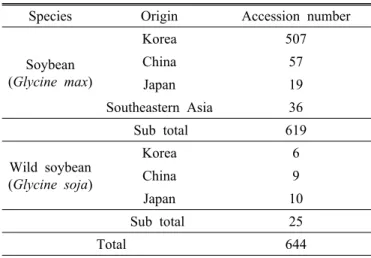
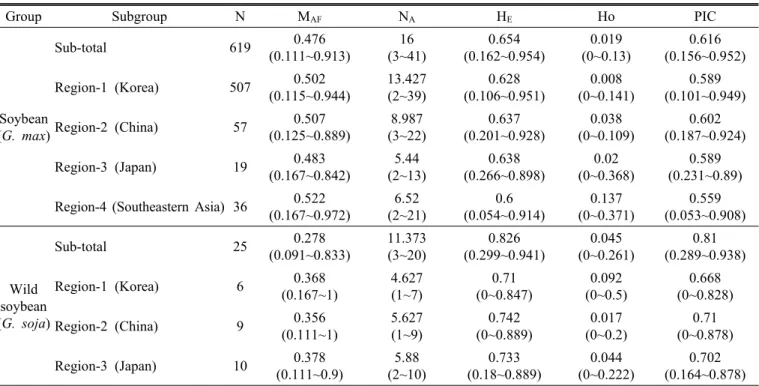
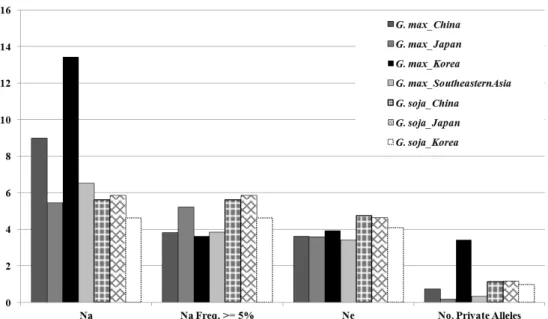
A total of 1,503 alleles with an average value of 20.0 alleles were detected among 644 accessions. Korean collection revealed average allele number of 13.4 while Chinese, Japanese and Southeast Asian accessions showed 9.0, 5.4 and 6.5 mean alleles, respectively. Especially, Korean accessions showed more number of private allele per locus as 3.4 contrary to other geographical groups. The mean expected heterozygosity and polymorphic information content was 0.654 and 0.616, respectively, and expected heterozygosity values were not significantly distinguished according to the geographical groups.
The phylogenetic dendrogram and deduced population structure based on DNA profiles of 75 SSR loci showed Korean ac- cessions formed distinct gene pool against Chinese accessions, and could be divided into five subpopulations. Korean soybean accessions have specific genetic diversity and might be serve the valuable alleles for bio-industry as a part of the center of soybean origin.
Keywords : microsatellites, genetic diversity, soybean, Glycine max L.
Soybean (Glycine max L.) is cultivated over the world and especially has been a crucial legume crop in eastern Asia region including Korea, China, and Japan because this crop has been important source of high quality vegetable protein and oil for food products. Recently, the usage of soybean for biodiesel has made this crop more economically important,
and the whole-genome sequencing of Williams 82 (G. max) and IT182932 (G. soja) have been completed accordingly (Hisano et al., 2007; Kim et al., 2010; Schmutz et al., 2010).
Yu & Kiang (1993) reported that Korea might be one of the major center of soybean origins based on electrophoretic assays of wild soybean (G. soja) and cultivated soybeans (G.
max). Lee et al. (2008) also suggested that Korea is a major center of diversity for wild soybean and potentially could serve useful alleles not found in other parts of the world while Dong et al. (2004) regarded northeastern region of China as major center of soybean origin. Furthermore, the collection of Korea and China revealed divergent genotypes while accessions of Japan was genetically similar to Korean accessions (Lee et al., 2011; Li & Nelson, 2001).
The soybean cultivars, derived from a few accessions, show narrow genetic background, and this means cultivated varieties might be vulnerable to new biotic and abiotic stress along with global environmental changes (Hyten et al., 2006; Mulato et al., 2010). The genetic diversity of soybean including landraces and wild relatives is needed for breeding program and bio- industry as a valuable allele source. Especially, landraces collected in center of origins are useful for genetic improvement of cultivars in that wild relatives generally reveal many unwanted traits and show low introgression rate (Song et al., 2013).
Genetic analysis using molecular markers have been consistently studied to understand the genetic variability of soybeans, and have revealed the genetic structure and diversity of various soybean collections (Choi et al., 1999; Dong et al., 2004;
Guan et al., 2010; Lee et al., 2008; Li et al., 2008; Wang et al., 2006; Yoon et al., 2009).
ISSN 2287-8432(Online)