Comparisons of Pericarp Thickness And Sugar Content on New Waxy Corn Hybrids
Moon-Sub Lee*, Wong-Hyeun Na**, Ji-hyung Ha**, Jae-Hyeon Yang**, and Hee-Bong Lee**†
*Department of Crop Sci. University of Illinois, Urbana-Champaign, IL, USA
**Department of Crop Sci., College of Agriculture & Life Science, Chungnam National University, Daejeon 305-764, Korea
180
†Corresponding author: (Phone) +82-42-821-5727 (E-mail) [email protected]
<Received 26 April, 2015; Accepted 25 May, 2015>
한작지(Korean J. Crop Sci.), 60(2): 180~184(2015) DOI : http://dx.doi.org/10.7740/kjcs.2015.60.2.180
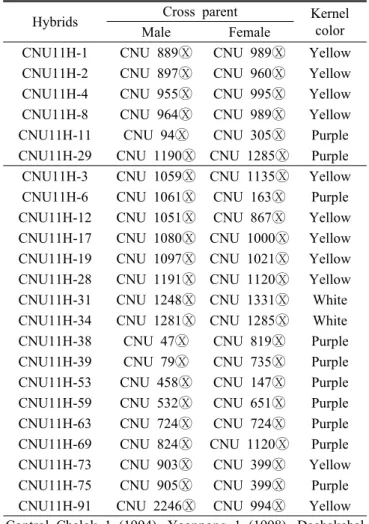
Table 1. Hybrids and their parents of waxy corn hybrids.
Hybrids Cross parent Kernel
color
Male Female
CNU11H-1 CNU 889Ⓧ CNU 989Ⓧ Yellow CNU11H-2 CNU 897Ⓧ CNU 960Ⓧ Yellow CNU11H-4 CNU 955Ⓧ CNU 995Ⓧ Yellow CNU11H-8 CNU 964Ⓧ CNU 989Ⓧ Yellow CNU11H-11 CNU 94Ⓧ CNU 305Ⓧ Purple CNU11H-29 CNU 1190Ⓧ CNU 1285Ⓧ Purple CNU11H-3 CNU 1059Ⓧ CNU 1135Ⓧ Yellow CNU11H-6 CNU 1061Ⓧ CNU 163Ⓧ Purple CNU11H-12 CNU 1051Ⓧ CNU 867Ⓧ Yellow CNU11H-17 CNU 1080Ⓧ CNU 1000Ⓧ Yellow CNU11H-19 CNU 1097Ⓧ CNU 1021Ⓧ Yellow CNU11H-28 CNU 1191Ⓧ CNU 1120Ⓧ Yellow CNU11H-31 CNU 1248Ⓧ CNU 1331Ⓧ White CNU11H-34 CNU 1281Ⓧ CNU 1285Ⓧ White CNU11H-38 CNU 47Ⓧ CNU 819Ⓧ Purple CNU11H-39 CNU 79Ⓧ CNU 735Ⓧ Purple CNU11H-53 CNU 458Ⓧ CNU 147Ⓧ Purple CNU11H-59 CNU 532Ⓧ CNU 651Ⓧ Purple CNU11H-63 CNU 724Ⓧ CNU 724Ⓧ Purple CNU11H-69 CNU 824Ⓧ CNU 1120Ⓧ Purple CNU11H-73 CNU 903Ⓧ CNU 399Ⓧ Yellow CNU11H-75 CNU 905Ⓧ CNU 399Ⓧ Purple CNU11H-91 CNU 2246Ⓧ CNU 994Ⓧ Yellow Control Chalok 1 (1994), Yeonnong 1 (1998), Daehakchal Gold (2010), Miheukchal (2004), Ilmichal (2002)
ABSTRACT For waxy corn hybrid development, 23 waxy corn hybrids were planted and surveyed in both pericarp thickness and sugar content. Pericarp thickness showed average 50 to 49 μm in field and greenhouse. Results like these advanced than previous other hybrids. Also, sugar content in developed waxy corn evaluated as 13.6 to 15.3 brix. Here, we concluded that edible quality of waxy corn depended on combing of two factors. Especially, CNU11H8 hybrid at field and CNU11H-38 at greenhouse were good in both factors. Accordingly, these hybrids will be planted in next time for productivity and area adaptation.
Keywords : pericarp thickness, sugar content, waxy corn, hybrids
Waxy
corn, a single recessive gene (wx) was located on the short arm of chromosome 9, codes for the waxy endosperm of the kernel(Collins, 1909).These fresh waxy corn was a very popular food in Asian countries including Korea.Hong (1994) suggested that it is necessary to study on waxy corn hybrids in order to improve its quality and nutritional composition cultivated traditionally. Zhu et al. (2014) reported that the pericarp mechanical properties of waxy corn inbred lines is one of important factors affecting the fresh corn eating quality. Besides, Lee et al. (2009) reported sugar content is also one among factors for increasing quality of edible waxy corn. Therefore, this study was conducted to gain the prospective hybrids through basic informations and to identify possible hybrids by assessing agronomic characteristics and physico- chemical traits for the development of waxy cornhybrid with high table quality.
MATERIALS & METHODS
Plant Materials
This experiment used 23 hybrids developed in Genetics and Breeding Lab. of Chungnam Nat’l Univ. and five controls including Yeonnong1 as shown in Table 1.
ISSN 2287-8432(Online)
Table 2. Agronomic characteristics of waxy corn hybrids cultivated at the field in 2011 Characters
Hybrids
Stem height (cm)
Ear height (cm)
Ear length (cm)
Ear dia.
(mm)
Kernel setting (%)
Day to tassel.
(days)
Kermel color
CNU11H-1 182ab±2.9* 48bc±2.7 18.2abc±0.1 42.2ab±0.9 95 65 Yellow
CNU11H-2 172ab±3.2 47bc±1.0 16.4a-d±0.7 38.4ab±0.5 97 68 Yellow
CNU11H-4 183ab±3.9 46bcd±3.3 16.3a-d±1.3 36.8b±1.2 87 63 Yellow
CNU11H-8 152c±5.0 35d±3.7 18.4ab±0.7 38.4ab±0.7 71 61 Yellow
CNU11H-11 168bc±5.0 50bc±4.6 13.3cd±0.4 37.6ab±0.6 93 62 Purple
CNU11H-29 171ab±4.4 52b±2.8 13.1d±1.1 37.8ab±1.3 75 70 Purple
Chalok 1† 150c±4.4 55ab±4.2 16.5a-d±1.1 37.0b±1.3 95 56 White
Yeonnong1† 177ab±0.8 39cd±1.2 14.8bcd±0.2 31.2c±0.4 98 67 White
Daehackchal Gold† 187a±6.0 58ab±2.4 21.2a±0.9 40.7ab±0.9 98 70 Yellow Mihuekchal† 181ab±1.4 68a±2.3 17.4a-d±0.6 42.9a±0.5 97 68 Purple
Mean 172.7 50.1 16.5 38.3 90.6 64 -
CV(%) 6.11 15.18 10.82 4.53 - - -
In a column, means followed by a common letter are not significantly different at the 5% level by DMRT
*Mean±Standard Error
†Control hybrids
Cultivation methods
In order to identify the botanical characteristics of colored corn hybrids, three kernels per hill were planted at Corn Genetic & Breed. Farm on April 28 and August 1 in 2011, respectively. Plant density was 70cm x 30cm. Herbicides after sowing and pesticides were applied at 5th leaf stage for ear worm control, and then followed by mulching. Also, they were thinned remaining one plant per hill at the 3th leaf stage.
Fertilizer level of N-P2O2-K2O per 10a was 20-15-10kg. For pest control pesticides were injected at approximately 30 days after sowing.
Examination of botanical characteristics
Botanical characteristics such as stem height and ear height were examined in 23 waxy corn hybrids. Ear characteristics as ear length, ear diameter, kernel setting ratio, pericarp thickness and sugar content were examined about 30 days after fertilization.
Statistical analysis
Comparison of traitsrelated to yield and other components were analysised using SAS (v. 9.2).
RESULTS & DISCUSSION
Botanical characteristics
The major agronomic characteristics of the cultivated 23 hybrids are presented in Table 2 and 3. The stem height showed a range from 152.8 to 248.3cm. Those of CNU11H-4 and CNU11H-63 showed the highest value of 183.7cm at field and 248.3cm at greenhouse, respectively. But that of CNU11H- 8 was 152.8cm at field and CNU11H-6 was 191.6cm at greenhouse, which was the lowest value. Days to tasseling had average 65 days in hybrids grown at field, but that of hybrids grown at greenhouse was remarkably fast as 49days. About these facts, we thought that short days to tasseling results from increasing temperature of the greenhouse. Meanwhile, Chalok1 as a check which is representative of early maturing cultivar in 2000s, was average 56 days at the field and 41 days at the greenhouse. Compared to Chalok 1, other hybrids were approximately 8 days later than the field and the greenhouse.
However, those of CNU11H-8 and CNU11H-11 were about 5-6 days faster than Yeonnong 1 as a control at the field.
CNU11H-6 and CNU11H-31 grown in the greenhouse were similar to Chalok 1, About these facts, we thought that this hybrid will be advantageous in terms of cropping system.
Range of ear height of used hybrids showed 35 to 107 cm. The
Table 3. Agronomic characteristics of waxy corn hybrids cultivated at greenhouse in 2011 Characters
Hybrids
Stem height (cm)
Ear height (cm)
Ear length (cm)
Ear dia.
(mm)
Kernel setting (%)
Day to tassel.
(days)
Seed color CNU11H-3 208b-g±4.1 63gh±2.4 12.6f-i±0.3 41.1a-e±1.1 95 43 Yellow
CNU11H-6 191g±2.0 67e-h±4.9 13.1e-i±0.0 38.0c-h±0.2 70 42 Yellow
CNU11H-12 205c-g±9.4 80d-h±4.2 9.9i±1.3 41.0a-e±1.2 82 45 Yellow
CNU11H-17 230a-e±2.8 84c-h±3.7 18.1abc±0.2 41.5a-d±0.6 88 43 Yellow CNU11H-19 201fg±9.9 64fgh±0.6 17.1a-d±0.6 41.7abc±0.4 90 44 Yellow CNU11H-28 220a-g±9.5 95bcd±3.9 16.1b-e±0.1 37.8e-h±0.2 96 44 Yellow CNU11H-31 212a-g±3.4 80d-h±1.8 15.5c-f±0.2 39.4b-g±0.5 97 41 Yellow
CNU11H-34 233a-d±2.8 62h±1.2 16.0b-f±0.7 43.3ab±0.2 77 43 Yellow
CNU11H-38 209b-g±8.4 69e-h±2.6 15.3c-g±0.8 40.6a-f±1.1 98 48 Purple CNU11H-39 226a-f±0.3 84c-h±2.3 16.5b-e±0.5 41.1a-e±0.7 98 43 Purple CNU11H-53 226a-g±9.1 86b-g±2.5 12.0ghi±0.7 36.7fgh±0.9 86 56 Purple CNU11H-59 202d-g±4.4 82d-h±4.0 13.6e-h±0.5 39.6b-g±0.8 80 43 Purple CNU11H-63 248a±9.5 94bcd±2.1 15.0c-g±0.5 39.1b-g±0.4 73 46 Purple CNU11H-69 247a±1.4 107ab±5.6 15.0c-g±0.5 40.4b-f±0.4 92 48 Purple CNU11H-73 236ab±2.6 88b-e±2.1 14.3d-h±0.1 35.3gh±0.9 84 49 Yellow CNU11H-75 224a-g±1.1 87b-f±1.0 13.8d-h±0.1 37.8d-h±0.3 93 49 Yellow CNU11H-91 222a-g±6.3 98bcd±3.7 18.3abc±3.7 40.4b-f±0.2 88 50 Yellow Chalok 1† 202efg±5.5 66e-h±10.3 11.1hi±1.4 38.9c-g±0.7 91 41 White Yeonnong1† 221a-g±6.0 106abc±8.0 18.9ab±0.1 34.0h±0.3 95 48 White Daehackchal Gold† 234abc±0.3 127a±7.8 20.3a±1.0 44.9a±0.5 92 49 Yellow Mihuekchal† 216a-g±3.5 125a±5.5 17.8abc±0.4 39.8b-f±0.3 90 48 White
Mean 220 86 15.2 39.6 88 45 -
CV(%) 5.97 9.30 7.96 3.79 - - -
In a column, means followed by a common letter are not significantly different at the 5% level by DMRT
*Mean±Standard Error
†Control hybrids
Remark :1: CNU11H-1 2: CNU11H-2 3: CNU11H-4 4: CNU11H-8 5: CNU11H-11 6: CNU11H-29 7: CNU11H-3 8: CNU11H-6 9 : CNU11H-12 10: CNU11H-17 11: CNU11H-19 12: CNU11H-28 13: CNU11H-31 14: CNU11H-34 15: CNU11H-38 16: CNU11H-39 17 :CNU11H-48 18: CNU11H-53 19: CNU11H-59 20: CNU11H-63 21: CNU11H-69 22: CNU11H-73 23: CNU11H-75 24: CNU11H-91 25: Yeonnong1 26: Daehackchal Gold
Fig. 1. Comparison of stem and ear height of waxy corn hybrids at field in 2011.
ear height of CNU11H-8 at the field and CNU11H-34 at the greenhouse were lower than that of other hybrids. Meanwhile, the ear height of CNU11H-29 at the field and CNU11H-69 at the greenhouse were higher than other check. About these results, Ryu et al. (2001) suggested that stability to lodging of corn was good approximately 50% below in terms of the ratio of stem height to ear height.
Conclusion gained from this study was also evaluated as lodging resistance in most of hybrids grown in the field and the greenhouse. The relationships of stem height and ear height in 23 waxy corn hybrids are presented in Fig. 1.
In order to compare productivity of used hybrids, ear length, ear diameter, and kernel setting were examined after drying
Table 4. Sugar content and pericarp thickness of waxy corn hybrids cultivated at the field
Characters Hybrids
Sugar content (brix%)
Pericarp thickness (μm) CNU11H-1 11.6c±.0.1* 48abc±1.0
CNU11H-2 11.0c±0.7 52ab±2.0
CNU11H-4 13.2bc±0.4 42c±1.0
CNU11H-8 18.4a±0.8 49bc±0.0
CNU11H-11 15.9ab±0.9 58a±2.0 CNU11H-29 12.9bc±1.4 49bc±1.0 Chalok 1† 13.1bc±0.4 59a±1.0 Yeonnong1† 13.6bc±0.1 46bc±0.0 DaehakchalGold† 13.0bc±0.1 51ab±1.0
Mean 13.6 50
CV(%) 7.80 7.37
In a column, means followed by a common letter are not significantly different at the 5% level by DMRT
*Mean±Standard Error
†Control hybrids
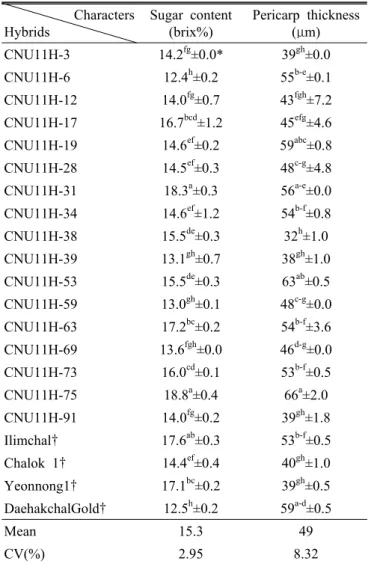
Table 5. Sugar content and pericarp thickness of waxy corn hybrids cultivated at the greenhouse
Characters Hybrids
Sugar content (brix%)
Pericarp thickness (μm) CNU11H-3 14.2fg±0.0* 39gh±0.0 CNU11H-6 12.4h±0.2 55b-e±0.1 CNU11H-12 14.0fg±0.7 43fgh±7.2 CNU11H-17 16.7bcd±1.2 45efg±4.6 CNU11H-19 14.6ef±0.2 59abc±0.8 CNU11H-28 14.5ef±0.3 48c-g±4.8 CNU11H-31 18.3a±0.3 56a-e±0.0 CNU11H-34 14.6ef±1.2 54b-f±0.8 CNU11H-38 15.5de±0.3 32h±1.0 CNU11H-39 13.1gh±0.7 38gh±1.0 CNU11H-53 15.5de±0.3 63ab±0.5 CNU11H-59 13.0gh±0.1 48c-g±0.0 CNU11H-63 17.2bc±0.2 54b-f±3.6 CNU11H-69 13.6fgh±0.0 46d-g±0.0 CNU11H-73 16.0cd±0.1 53b-f±0.5
CNU11H-75 18.8a±0.4 66a±2.0
CNU11H-91 14.0fg±0.2 39gh±1.8 Ilimchal† 17.6ab±0.3 53b-f±0.5 Chalok 1† 14.4ef±0.4 40gh±1.0 Yeonnong1† 17.1bc±0.2 39gh±0.5 DaehakchalGold† 12.5h±0.2 59a-d±0.5
Mean 15.3 49
CV(%) 2.95 8.32
In a column, means followed by a common letter are notsignificantlydifferent at the 5% level by DMRT
*Mean±Standard Error
†Control hybrids the hybrids matured. The kernel setting ratio showed a range
of 71~97% in hybrids grown in the field, and 70~98% at the greenhouse, respectively. That of CNU11H-2 among hybrids grown in the field was 97%, which was similar CNU11H-38 and CNU11H-39 grown in the greenhouse. Accordingly, we expected that productivity of these hybrids will be good at next planting. Pericarp thickness showed average 50 μm and 49 μm in hybrids grown at field (Table 4) and greenhouse (Table 5), respectively. The sugar content estimated average 13.6 brix and 15.3 brix in hybrids grown at the field(Table 4) and the greenhouse (Table 5). Among the hybrids, sugar contents of CNU11H-8 grown at the field and CNU11H-31 and CNU11H-75 grown at the greenhouse were higher than Yeonnong1 check hybrid.
A pericarp thickness of CNU11H-4 was the thinnest as 42 μm among the hybrids grown at the field and had high sugar contentsas 13.2 brix (Table 4). Meanwhile, pericarp thickness of CNU11H-38 grown at the greenhouse had 32μm and sugar content was 15.5 brix. Zhu et al. (2014) and Teri et al. ( 2004) reported that the pericarp mechanical properties of waxy corn inbred lines are important factors affecting the fresh corn eating quality. We also estimated that these two hybrids will be good for the new cultivar of colored corn hybrid.
Edible corns including waxy corn go through many physical and chemical changes during silking and harvest stage, which greatly influences flavor and also keeping quality of the kernels (Garwood et al., 1976; Lee et al., 1987a). Sweet corn hybrids are harvested in 20 days after silking when sugar content is highest (Kientz et al., 1965). Generally, according to maturation advances, sugar content of sweet corns decreases, starch accumulates, and pericarp thickens. Kang et al. (1988), Lee et al. (1999) and Creech (1965) reported that waxy corn between 21 and 27 days after silking contained about 4% total sugars and decreased thereafter. But these results in CNU
waxy hybrids showed large difference in both increased sugar contents and decreased pericarp thickness by the advanced methods.
REFERENCES
Collins, G. N., 1909. A new type of Indian corn from China.
Bureau Plant Ind(Bull.) 161 : 1-30.
Creech, R. G., 1965. Genetic control of carbohydrate syntyesis in maize endosperm. Genetics. 52 : 1175-1186.
Garwood, D. L., I. J. Mcardle, S. F. Vanderslice, and J. C.
Shanom. 1976. Postharvest carbohydrate transformation and processed quality of high sugar maize genotypes. J. Amer.
Soc. Hort. Sci. 101 : 400-404.
Kang, Y. K., Y. H. Cha, S. D. Kim, and K. Y. Park. 1988.
Maturity effects on moisture, total sugar contents and flavor of fresh waxy corn. Korean J. Crop Sci. 33(1) : 70-73.
Kientz, J. F., J. K. Greig, and H. L. Mitchell. 1965. Sugar components of sweet corn cultivars as influenced by maturity.
Proc. Amer. Soc. Hort. Sci. 87 : 33-317.
Lee, S. S., T. J. Kim, and J. S. Park. 1987a, Sugars, soluble solids and flavor as influenced by maturity of sweet corn. Korean J.
Crop Sci. 32(1) : 86-91.
Lee, H. B., Y. P. Choi, H. J. Cha, M. S. Lee, H. G. Choi, J. I. Joo, M. K. Kim, and H. C. Ji. 2009. A new yellow waxy corn hybrid with high yield “Daehakchal Gold1” for edible. Korean J.
Breed. Sci. 41(3) : 279-283.
Ryu, S. H., J. Y. Park, N. K. Huh, and H. K. Min. 2011.
Relationship between genetic distance and hybrid performance of black waxy corn (Zeamays L.). Korean J. Breed. Sci. 33(2) : 95-103.
Teri, A. H., L. H. Richard, P. Tyron, and H. Elizabeth. 2004.
Penetrometer and taste panel perception of pericarp tenderness in su, se, and sh2 sweet corn at three maturities. Hort.
Technology 14(4) : 521-52.
Zhu, M., F. Li, and Z. Shi. 2014. Correlation between the lignin content and mechanical properties of waxy corn pericarp.
Scientiahorticulturae / v. 179 : 266-270.