Globally Optimal Solutions for Cross-Layer Design in Fast-Fading Lossy Delay-Constrained MANETs
Quoc-Viet Pham
†, Hoon Kim
††, Won-Joo Hwang
†††ABSTRACT
To increase the overall utility and decrease the link delay and power consumption, a joint optimal cross-layer design of congestion control at the transport layer, link delay at the data link layer and power allocation at the physical layer for mobile ad hoc networks is considered in this paper. As opposed to previous work, the rate outage probability in this work is based on exactly closed-form; therefore, the proposed method can guarantee the globally optimal solutions to the underlying problem. The non-convex formulated problem is transformed into a convex one, which is solved by exploiting the duality technique.
Finally, simulation results verify that our proposal achieves considerable benefits over the existing method.
Key words: Rate Control, Link Delay, Power Allocation, Lossy Links, Rayleigh-faded Channels.
※ Corresponding Author : Won-Joo Hwang, Address:
607 Obang-dong, Gimhae, Gyeongnam 621-749, Korea, TEL : +82-55-320-3847, FAX : +82-55-322-6275, E-mail
: [email protected]
Receipt date : Dec. 18, 2014, Approval date : Jan. 15, 2015
†
Dept. of Information and Communication System, Inje University, Gimhae, Gyeongnam, Korea
(E-mail : [email protected])
†††
Dept. of Emergency Medicine, Inje University, Ilsan Paik Hospital, Goyang, Gyeonggi, Korea
(E-mail : [email protected])
†††
Dept. of Information and Communications Engineering, HSV-TRC, Inje University, Gimhae, Gyeongnam, Korea
※ This research was supported by the MSIP (Ministry of Science, ICT and Future Planning), Korea, under the Global IT Talent support program (NIPA-2014-H0904- 14-1006) supervised by the NIPA (National IT Industry Promotion Agency).
1. INTRODUCTION
Traditionally, protocols for wireless networks are relied on the strictly-layered structure and im- plemented isolatedly. Followed from the seminal work on resource allocation in wired networks proposed by Kelly [1], a lot of researches have been studied and devoted to showing the significant benefits of cross-layer designs (CLDs). Unlike wired networks, resource allocation in wireless networks is critical due to, e.g., scare resource, in- terference and environment disturbance. Network Utility maximization (NUM) framework has been seen as the efficient and versatile tool to deal with CLD problems, for example, routing at the network layer, congestion control at the transport layer and power control at the physical layer. By jointly us- ing NUM and CLD, the problem can be decoupled
and the algorithm can be implemented in a dis- tributed manner.
The lossy feature was first taken into consid- eration in the effective network utility max- imization (ENUM) framework [2], where the transmission rate at the source is called the
“injection rate” and the correctly received data rate at the destination is called the “effective rate”.
Nevertheless, since ENUM does not consider the
effects of the transmission power and take it into
account of the optimization objective, transmit
powers are not adjusted dynamically according to
the channel conditions. Followed from [2], in [3],
the authors considered the problem of congestion
control in interference-limited wireless networks
with power control, namely ENUM with power
control (ENUMP). ENUMP, however, still does not
integrate the power control and consider the link
delay in the optimization objective. In [4], the au- thors examined the effects of lossy features on the power control and link delay as well, namely rate-effective NUM (RENUM), with constraints on rate outage probability, data rate reduction and delay-constrained traffics, by taking them into consideration of the objective function. In [4], the rate outage probability is, however, based on ap- proximated form; therefore, RENUM may produce suboptimal solutions to the problem [5].
In this paper, we propose a novel RENUM (nRENUM) which can generate the globally opti- mal solutions to RENUM, in fast-fading lossy de- lay-constrained mobile ad hoc networks (MANETs).
Summarily, Our main contributions and the con- siderable differences of this paper can be listed, as follows:
∙ In section 3, we show the network model and then formulate a joint optimization problem of congestion control, link delay and power alloca- tion with constraints on rate outage probability, link delay and lossy rate. As opposed to RENUM, in nRENUM, the rate outage proba- bility is based on exactly closed form; therefore, nRENUM can guarantee the globally optimal solutions to the underlying problem. nRENUM is solved by the duality techniques in section 4.
∙ In section 5, we investigate the numerical simu- lation to further verify the outperformance of nRENUM compared to RENUM.
2. RELATED WORK
Recent researches whose principles focus on de- signing optimal CLD policies have been proposed [2-10], ranging from wired networks to wireless networks. The seminal work on network resource allocation was first proposed by Kelly et al. in [1].
In [8], the authors analyzed a joint design of opti- mal congestion and power control and made use of the high-SIR regime to transform the non-con- vex underlying problem to a convex one. Due to
assuming that link transmissions are orthogonal, this design is not suitable for interference wireless networks. A survey on and challenges of CLDs in wireless networks can be found in [6]. A frame- work of congestion control and power allocation with an outage probability in fast-faded wireless channels has been studied in [5]. Like [10], the non-convex underlying problem is transformed in- to a new convex problem and then solved by the duality method. In addition, the authors proposed a successive convex approximation method in or- der to turn the original problem to approximated convex problems and keep the TCP stack.
In [2], the authors first investigated the “leaky- pipe” flow model, called ENUM, where the trans- mission rate of a flow decreases along its route.
Henceforth, two schemes: ENUM with link outage probability and ENUM with path outage proba- bility have been considered to examine the effects of lossy wireless links. However, power control is not examined and just fixed regardless what the current channel quality is. In addition, ENUM is not suitable for interference-limited wireless envi- ronments. Followed from [7], S. Guo et al. proposed RENUM framework in which the overall trans- mission power and the link average delay are also used in the optimization objective with a constraint on the link delay requirement. Nonetheless, RENUM may just produce the suboptimal points. Our goal in this paper is to present a design that can provide the accurately optimal solutions to the RENUM problem.
3. SYSTEM MODEL
3.1 Network Model
We consider a multi-hop wireless networks consisting of logical links and sources. Let
and
denote sets of sources and links, respectively. Let be the set of links used by flow , and ∊ ∊
be the set of sources using link .
Each flow is associated with a utility function which is assumed to be strictly concave, non-de- creasing, continuously differentiable. We consider a family of utility functions which have been thor- oughly discussed in [11].
The instantaneous capacity on link is modeled by the Shannon capacity
log
where is a power allocation vector, is the baseband bandwidth, is a constant value depend- ing on particular modulation, coding scheme and bit-error-rate and
is the instantaneous sig- nal-to-interference-plus-noise ratio (SINR) at link
, which is
≠
,
where
is the thermal noise power at the receiver on link ,
≠
is the interference experienced at the receiver on link . Similar to [5], we consider the non-light-of-sight propagation and the aver- age link SINR and capacity by utilizing the sta- tistics of
. Then,
≠
≠
,
where exponentially random variables
are assumed to be independent and identically dis- tributed (i.i.d) and
∀ . Accordingly,
log
.
3.2 Average Delay
We consider the average link delay as a criteria in the optimization problem. Followed from [4], each link is modeled as a queuing system.
Let be the sum of the transmission delay and queuing delay on link . The link average delay [4], [13] on link is
∊
,
where is the mean of exponentially distributed rate of the input process and
is the transmission
rate of flow . For delay-sensitive applications, it is required that the upper bound on the link delay is lower than a threshold, i.e. ≤
. Therefore,
∊
≤
(1)
3.3 Rate Outage Probability and Link Effective Rate
It is required to re-track the instantaneous SINR and compelled to rerun the algorithm to seek the optimal solutions when channel states change. It is not efficient and impractical, especially, for the fast-fading environments. To overcome this issue, we consider the term of outage probability [14], which is Pr
where
is a target minimum SINR that below which performance becomes unacceptable.
We formulate the outage probability, as follows:
Pr
(2) where
can be viewed as reduction of data rate over link . In Rayleigh fading model, the exactly closed-form expression [5], [12] of
is given as
exp
≠
(3)
Let
is the maximal outage probability of link
. Then, a combination of (2) and (3) leads to the following equation
≠
≤
(4)
where
exp
.
We consider the leaky-pipe flow model [2],
where the transmission rate of each flow changes
hop by hop and decrease along its route. The effec-
tive rate
at the destination is calculated as the
multiplication of the outage probability on links
that flow s traverses and the injection rate
of
fl ow , as
∊
Pr
. We assume that
data generated by source travels through
hops before reaching the receiver. The data rate at link
of flow is
and specified, as follows:
Pr
(5) where Pr denotes the outage probability on link .
3.4 Optimization Problem
We formulate a joint cross-layer problem with the optimization objective of maximizing the total effective utility and minimizing the transmission consumption and total link delay, as follows:
max
∊
∊
∊
m i n≤
≤
m ax∀
m i n≤
≤
m ax∀
≠
≤
∀
∊
≤
∀
Pr
(6)
where
and
are the costs per unit of consumed power and suffered delay, respectively. The above optimization problem can be explained as follows.
The first and second constraint are feasible sets of flow rate and transmission power, respectively.
The third one is the constraint on the rate outage probability. The fourth constrain is the requirement on the link average delay while the last one is a constraint due to the lossy nature of wireless links.
The problem (6) is not a joint convex problem due to the existence of the third and fifth con- straints. Therefore, KKT conditions are just nec- essary, not sufficient solution optimality [15]. To ease the problem, we transform it into new one, as follows:
max
∊
∊
∊
≠ log
≤ log
∀
∊
≤
∀
(7)
where
log
m i n ≤
≤ log
m ax ∀
log
m i n ≤
≤ log
m ax ∀
and
log . In order to make the problem (7) convex, we assume the following as- sumption
.
Then, the problem (7) is the convex optimization problem. Furthermore, strong duality also holds for this problem. The proof of convexity and strong duality of (7) is omitted due to the limited space of the paper.
4. nRENUM DISTRIBUTED ALGORITHM In this section, we will apply the Langrangian dual method to solve the problem (7). Here, let
be dual variables which associate with the first, second and third constrains in (7), re- spectively. The Lagrangian function is defined, as follows:
log
≠ log
∊
(8)
The Lagrangian dual function is given as
max
Accordingly, the dual problem is, as follows:
min
(9)
Due to the separable nature of the Lagrangian (8), we can make use of the decomposition method to derive subfunctions, as follows:
,
where
∊
∈
(10)
∊
(11)
log
≠ log
(12)
The subfunction (10) is the congestion control problem which intends to determine flow rates at each link and at the destination. The subfunction (11) is the delay-constrained problem which aims at specifying link delays. The last one subfunction (12) is the resource allocation problem which de- termines the transmission power of each link. The subproblems are all interacted through the dual variables.
The dual problem (9) can be solved by the gra- dient method, from which the proposed method can be implemented in a distributed manner. Let
be a positive scalar step size.
Data rate: the flow rate of flow on link is updated via
+∇
(13)
where ∇
is the gradient of with respect to
. We have
∇
(14)
for
. For
,
∇
′
(15) where
′
is the first derivative of the utility function.
Link delay: the link delay is updated as
(16)
Link transmit power: the transmission power is
updated, as follows:
≠
min
max
(17) where
maxmin and
From above updates, we propose an iterative al- gorithm as illustrated in Algorithm 1. In addition, we make several remarks on the nRENUM iter- ative algorithm.
Lagrange multipliers:
∇
,
where
max and ∇
is the gradient of with respect to
and given by
∇
log
≠ log
∊
Algorithm 1 nRENUM iterative algorithm Initialization
1) Initialize ,
,
,
,
,
,
which are required to be non-negative.
Iteration
1) At each link of flow , the link transmits with date rate
. The transformed link rate and
transformed effective rate are updated via (13)
with gradients computed by (14) and (15),
respectively. Then, it is come back to the solution
space as
exp
.
Fig. 1. Network topology used for numerical examples.
2) At each link , for a given dual price
, the link delay is updated based on (16).
3) At each link , the link transmitter use power
and for given , the transmission power is updated by Eq. (17).
4) The Lagrange multipliers are updated via (18), (19), and (20).
5) Set increase by 1, , and go to the next step. The iteration stops when satisfying the termination condition.
Remark 1.
∙ As mentioned in the section 1, the rate outage probability constraint in nRENUM is in rightly and explicitly closed-form; therefore, nRENUM can provide exactly optimal solutions. In a meanwhile, that of RENUM is based on ap- proximated form, so there is no guarantee of the globally optimal solutions.
∙ The proposal can be implemented in a dis- tributed manner through message passing among links. At each link, message-passing components (e.g.,
,
,
and
) are computed and then broadcast to the other links. The transmitter on link l receives broad- cast message passing from all the other links, estimates the channel gain and then updates its transmission power via (17).
Theorem 1. Convergence of the nREN U M algorithm: let , , , , and
are initial values. Here, let , , ,
, and are the sequences generated by (13), (16), (17), (18), (19), and (20). If the step size
satisfies the diminishing rule (i.e.,
,
∞
∞ ,
∞
∞ ) and be positive, there ac- tually exists a sufficiently large
that ∀ ≥
,
, , , , and converge to the globally optimal points.
PROOF: the proof is omitted, see [16], [17].
5. SIMULATION RESULTS
This section represents examinations of the per- formance of the proposed method in comparison with the alternative framework [4].
5.1 Simulation settings
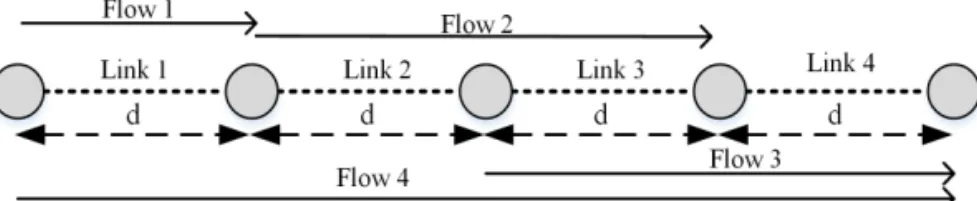
We consider a MANET composed of five nodes, four links and four flows with the network topology as illustrated in Fig. 1. Nodes are separated and placed equidistantly at d = 50 meters. The outage probability thresholds and SINR thresholds for links are set to (0.20, 0.20, 0.20, 0.20) and (1.0, 1.0, 1.0, 1.0), respectively. The fast-fading channel gain is assumed to be i.i.d. while the slow-fading chan- nel gain is assumed to be
, where
is the distance between transmitter of link and receiver of link , is the path loss attenuation factor, and
is the reference channel gain at a distance 50 meters and meets a condition that the average receive SINR at 50 meters is 30 dB.
Without loss of generality, weights
and
are assumed to be 1.
5.2 Performance of nRENUM and compared framework
We now compare the proposed method with the
Fig. 2. Fairness: nRENUM vs RENUM.
(a) (b)
(c) (d)
(e)
Fig. 3. The performance comparison between nRENUM and RENUM. (a) injection rates, (b) effective rates, (c) total transmission power, (d) flow delays, (e) link delays.
framework [4]. We use the Jain’s index, which is one of the most widely studied fairness measures and defined as