ISSN 1225-7842 / eISSN 2287-402X http://dx.doi.org/10.7779/JKSNT.2016.36.2.149
Third Harmonic Generation of Shear Horizontal Guided Waves Propagation in Plate-like Structures
Weibin Li*, Chunguang Xu** and Younho Cho***
Abstract The use of nonlinear ultrasonics wave has been accepted as a promising tool for monitoring material states related to microstructural changes, as it has improved sensitivity compared to conventional non-destructive testing approaches. In this paper, third harmonic generation of shear horizontal guided waves propagating in an isotropic plate is investigated using the perturbation method and modal analysis approach. An experimental procedure is proposed to detect the third harmonics of shear horizontal guided waves by electromagnetic transducers. The strongly nonlinear response of shear horizontal guided waves is measured. The accumulative growth of relative acoustic nonlinear response with an increase of propagation distance is detected in this investigation. The experimental results agree with the theoretical prediction, and thus providing another indication of the feasibility of using higher harmonic generation of electromagnetic shear horizontal guided waves for material characterization.
Keywords: Third Harmonic Generation, Shear Horizontal Guided Waves, Magnetostrictive Transducer, Perturbation Method
[Received: March 29, 2016, Revised: April 19, 2016, Accepted: April 20, 2016] *School of Aerospace Engineering, Xiamen University, Xiamen 361005, China **School of Mechanical Engineering, Beijing Institute of Technology, Beijing, 100081, China ***School of Mechanical Engineering, Pusan National University, Busan 46241, Korea
Corresponding Author: [email protected] 2016, Korean Society for Nondestructive Testing
1. Background
Guided waves have demonstrated their ability as an attractive alternative for rapid inspection of large areas of structure. Possibility to inspect inaccessible or hidden area and great cost- effectiveness are the key advantages of guided wave-based damage detection approaches [1].
Shear horizontal (SH) guided wave, in which the particle displacement is in parallel to the surface of specimen, is an attractive technique for surface defect characterization. Theoretical studies and exploration of SH guided wave applications have got increasingly concern.
However, most SH guided wave technologies which based on linear acoustic features, are sensitive to gross defects, but much less sensitive to material micro-damages or degradation [2-5].
The use of nonlinear ultrasonic wave has been
accepted as one of the most promising methods for evaluating material micro-structural changes in early stage [6-8]. One of the typical nonlinear phenomena of ultrasonic propagation is the generation of higher harmonics. Higher harmonic generation of SH guided waves, combines the great advantages of SH guided waves with the sensitivity of nonlinear ultrasonic techniques, is an attractive option for monitoring states related to microstructural changes.
However, although nonlinear ultrasonic
measurement has been a subject of considerable
interest, most of the researches were about the
nonlinear bulk and surface waves [9-11]. There
is rarely investigation of nonlinear SH guided
waves in plate-like structure. In addition,
generation and detection of SH guided waves
are not as easy as other guided wave modes for
the reason that the particle displacements of SH
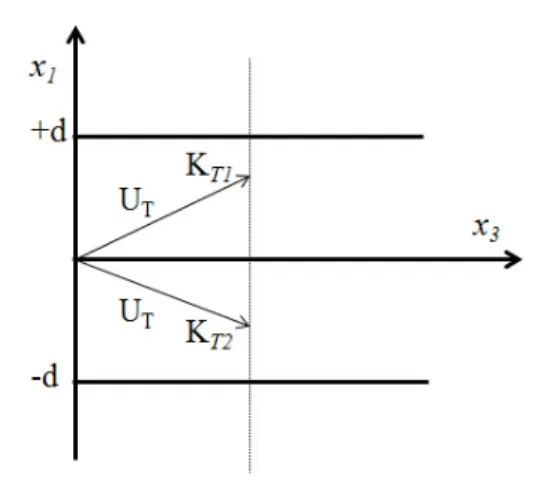
Fig. 1 Acoustic fields of SH mode propagation in a solid plate
waves are parallel to the surface of waveguide.
Recently, the interaction of SH0 guided wave mode with Rayleigh Lamb waves in weakly nonlinear plates were investigated in [12]. The cumulative second-harmonic generation accompa- nying nonlinear shear horizontal mode propaga- tion in a solid plate was reported in [13].
In this paper, theoretical studies and experimental observations of higher harmonic generation of SH guided waves propagation in an isotropic plate are presented. Electromagnetic transducers are designed to generate and detect the nonlinear SH guided waves. Measurement of the strongly nonlinear response of shear horizontal guided waves is conducted to verify the accumulative growth of relative acoustic nonlinear response with propagation distance.
The experimental results have a good agreement with the theoretical prediction, and thus provide another indication of the feasibility of using higher harmonic generation of electromagnetic shear horizontal guided waves for material characterization.
2. Theory
The shear horizontal waves caused the particle vibrations (displacement and velocities) are in plane that is parallel to the surface of the layer. A Cartesian coordinate system is shown in Fig. 1, in which the
axis coincides with the center of the solid plate, and the
axis is normal to the boundaries of the plate. The acoustic fields of SH guided waves can be decomposed into two oblique shear wave components that with self-inactions and cross- inactions in the plate.
The distinguishing feature of nonlinearity in shear waves is that is primarily cubic rather than quadratic, so, the shear wave propagation generally does not permit second harmonic generation directly by the fundamental. Thus, energy amplitude of third harmonic is higher
than the second harmonics in this investigation.
Referenced our earlier work [14], nonlinear parameters of SH guided wave in isotropic plate can be represented as,
3
3 3
1
2 4
S
A F k x A
β
=(1)
where
is nonlinear parameter;
and
are fundamental wave and higher harmonic wave amplitude, respectively;
is wave number of SH guided wave;
is wave propagation distance; is nonlinear feature function of SH guided wave. In this work, since the identical wave mode is chosen to detect acoustic non- linearity in the specimens with same thickness at a fixed input fundamental frequency, the influence of the feature function is neglected since the interest is focused on the acoustic nonlinearity of SH0 mode at 0.5 MHz only.
In the experimental work, the relative
acoustic nonlinear response can be represented
as the ratio of the third harmonic amplitude
divided by the cubic of the fundamental wave
amplitude, (
/
), which corresponds to the
slope of the line correlating the actual acoustic
nonlinear parameter,
with wave propagation
distance,
, for a fixed wave number
and the
nonlinearity feature function . Then, the
relative acoustic nonlinear response is,
Fig. 3 Block diagram of experimental measurement system (a) and (b) the differences of generator and receiver
3 3 1
= A
SA x
β ∝ β (2)
It is found that, the measured amplitude ratio of fundamental and higher harmonic waves is a function of wave propagation distance, thus if the material nonlinearity is fixed, the acoustic nonlinear response of amplitude ratio (
/
) will have accumulative effect with propagation distance (
).
The cumulative effect of the higher harmonic amplitude is of great advantage for detection in experimental work to measure the nonlinear effect with sufficient signal-to-noise ratio. The higher harmonic amplitude grows linearly with propagation direction, when non- zero power flux and phase matching conditions are satisfied.
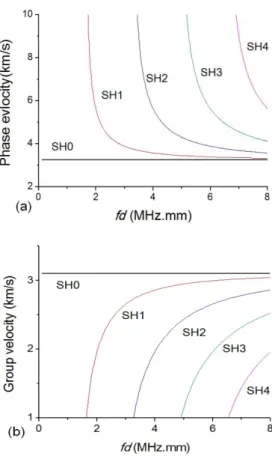
Fig. 2 Phase velocity (a) and group velocity (b) dispersion curves for SH guided waves in an aluminum plate
To choose the guided wave mode which satisfies the phase matching condition, we use numerical dispersion curves to find the “phase matching” modes. As shown in Fig. 2, the SH0 mode is selected in this work for several reasons: (1) the SH0 guided wave modes have no mode conversion and are non-dispersive, so it is relatively easy to excite and detect by magnetostricitve transducers; (2) the SH0 guided wave modes have high resolution and combination of high velocities; (3) both the phase and group velocity of the fundamental and higher harmonic SH0 wave modes are identical.
3. Experiments
The specimens used in this study are aluminum plate with 1 mm thickness. The dimensions are 500 mm × 500 mm. From the dispersion curves, the SH0 guided mode at fd = 0.5 MHz ⋅ mm with the phase velocity of 3.14 km/s is chosen. Since the thickness of the specimen is 1 mm, therefore the generated fundamental frequency is 0.5 MHz. And the wavelength can be calculated as,
3.14 6.3 0.5
Cp mm mm
λ = f = ≈ (3)
The equipment setup to measure the
nonlinear ultrasonic wave is shown in Fig. 3. A
high voltage sinusoidal tone burst system with
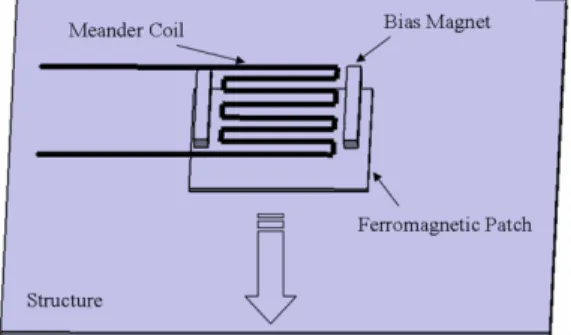
Fig. 4 Magnetostrictive transducer bonded onto a plate-like structure
MS sensors is employed to generate the ultrasonic signal of 10 cycles at 0.5 MHz. The attenuator and receiver unit are equipped with an amplifier connected to the generator.
Consistent loading is applied on the transducers to ensure consistent bonding conditions between transducers and specimens. The frequency bandwidth can readily be limited by windowed tone burst signals that generated by the measurement system. A meander coil is placed over each foil and then a permanent magnet placed over the coil to form a MS transducer.
The spacing of the coils dictates the wavelength to be excited or received. To detect the corres- ponding third harmonic frequency components primarily, the spacing of the coils in receivers is designed as one third of that of generator.
The use of MS patch transducer is an efficient method to generate and measure SH waves [15]. The cross-sectional diagram of MS transducer module is shown in Fig. 4. This novel small-sized SH guided wave transducer can be used to generate and detect SH guided wave signals efficiently. It is composed of ferromagnetic element made by Fe-Co alloy to detect magnetic field from ferromagnetic elements. The periodic planar solenoid is used in the transducer module. When the applied dynamic magnetic field is orthogonal to the static bias magnetic field in the MS patch, shear deformation will be developed. Therefore, small
rectangular elements in the path will have shearing deformations. The transducers can be installed without any coupling media. The transducers can be applied to non-ferromagnetic structures as well as ferromagnetic ones.
Another advantage is that the transducers can be applied to either plate or the structures with curved surface.
To generate expected wave mode, the frequency of wave signal is emitted by the function generator, while the wavelength is controlled by the spacing of adjacent coil. The adjacent coil distance is half of the wavelength of expected wave mode. This is the principle of magnetostrictive transducer design for generate and measure the expected guided wave mode.
4. Results and Discussions
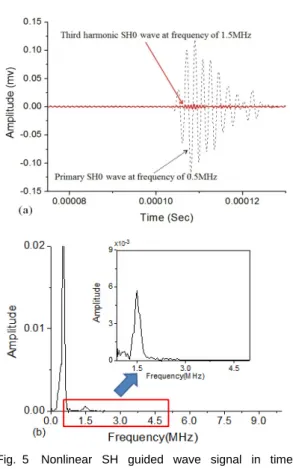
The physical effect of nonlinear ultrasonic technique is the generation of higher harmonic waves. After the SH guided wave propagating in the specimen with material nonlinearity, the waveform will be distorted and thus the higher harmonic could be generated. As shown in Fig.
5, a typical distorted waveform of nonlinear SH
guided wave propagation a certain distance is
provided in both time domain and frequency
domain. In the frequency spectrum of the signal,
it can find the third harmonic waves at triple
frequency at 1.5 MHz in the Fig. 5(b). Since it
has been widely recognized that the cubic
nonlinearity will be induced by shear ultrasonic
wave propagation, the experimental results have
a good agreement with the prediction. It is
important to note that the receiving signal at
triple frequency of fundamental wave mode is
the primary higher harmonic generation of SH0
guided wave propagation. So, the differences
between nonlinear SH guided wave and other
types of guided waves, such Rayleigh surface
wave or Lamb wave, is that: the centre
frequency of detector is triple of that of
Fig. 5 Nonlinear SH guided wave signal in time domain (a) and (b) frequency domain
Fig. 6 Relative acoustic nonlinear response (/) versus propagation distance