Dimensional Stability of Korean Red Pine Wood Treated with Water-Soluble Melamine-Formaldehyde Resin1
Gyu-Seong Han2
ABSTRACT
The objective of this study was the dimensional stabilization of Korean red pine (Pinus densiflora) wood by the water-based thermosetting resin. A commercial melamine-formaldehyde resin was impregnated into wood samples and cured. The weight and dimensional change of woods treated by the resin, and the absorption and dimensional behavior of treated woods were investigated. The melamine-formaldehyde resin treatment improved significantly the dimensional stability of pine wood and showed about 40% of antiswelling efficiency. The mechanism of dimensional stabilization was interpreted as the complicated reason, such as bulking effect by the resin in cell wall, mechanical restraint and/or blocking of hygroscopic site by the resin in lumen.
Key words: dimensional stability, Korean red pine, melamine-formaldehyde resin, antiswelling efficiency.
1. Introduction
Solid wood has been the most versatile material for buildings, constructions, or furniture, because of its superior material properties, e.g. pleasing optical appearance, favorable mass/strength ratio, and low thermal conductivity. However, there are some negative properties, such as dimensional instability with changing moisture content and low natural durability. Therefore the chemical modification has been adapted as a promising way to improve wood properties.
Water-based resins have been tested by several researchers as agents for improving wood properties such as dimension stability, hardness, or the resistance to fungal attack of wood.
Melamine resins have been investigated to improve the dimensional stability of wood.
Inoue et al. (1993) showed that the treated specimens at a 25% concentration (WPG: 58%) had bulking efficiency and antiswelling efficiency of about 5 and 42%, respectively. Pittman et al.
(1994) reported that the southern yellow pine wood treated with two commercial melamine-formaldehyde resins or with a synthesized melamine-ammeline-formaldehyde resin exhibited greatly enhanced dimensional stability, fire resistance and resistance to weathering. Deka and Saikia (2000) reported that dimensional stability efficiencies of 70.59%, 68.23% and 48.5%
were obtained at about 33-35 levels of weight percent gain for phenol-formaldehyde, melamine-formaldehyde and urea-formaldehyde resins, respectively. Lukowsky (2002) reported that the dimensional stabilization caused by resin molecules that penetrated the wooden cell wall correlated with the molar mass of the resins used for impregnation, and the changes in the sorption
Received for publication: Mar 5, 2009 ; Reviewed: Apr 20, 2009 ; Accepted: May 15, 2009.
1) This work was supported by the research grant of Chungbuk National University in 2007.
2) Department of Wood and Paper Science, Chungbuk National University, Cheongju 361-763, Korea. E-mail:
isotherms were attributed to a bulking effect. Deka et al. (2007) reported that the modified wood, at 22.9 level of weight percent gain possessed increase in dimensional stability in terms of antiswelling efficiency and surface hardness by 17.5% and 124% over untreated, control. Cai et al.
(2007) reported that the antiswelling efficiency was also improved from 63.3% to 125.6% for the nanofiller/melamine-urea-formaldehyde-treated wood.
The present study examines the effect of melamine-formaldehyde treatment on the moisture absorption and dimensional stability of Korean red pine wood and evaluates the efficiency of different impregnation degree.
2. Materials and Methods
Materials
Korean red pine (Pinus densiflora S. et Z., ‘Sonamu’ in Korean) logs, used in this work were felled at Bonghwa, Kyeongsangbukdo. The green log was cut into lumber and high temperature kiln-dried. Samples with dimensions in tangential, radial, and longitudinal of 3×3×0.5 cm were prepared from defect-free dimension lumber. Oven-dry specific gravity of sample was 0.43.
A commercially available melamine-formaldehyde (MF) resin (Parez Resin 613 of Cytec Ind.
Inc.) with a viscosity of 600-1000cps at 25℃ and a solid content of 80% was used in this study.
MF resin was diluted to designated concentration with water before impregnation.
Treatment of samples
Impregnation procedure was applied at room temperature as follows. Ten samples were immersed into the diluted resin solution and evacuated to 20 mbar for 2 hours. The reestablishing air pressure for 24 hours after breaking the vacuum forced the resin into the cavities of the wood structure.
After the resin impregnation, all samples were pre-dried at 40℃ for 4 hours. And the MF resin was cured at double-step condition, i.e., at 80℃ for 1 hour and at 120℃ for 2 hours.
Weight percent gain
The weight percent gain (WPG) after resin treatment is an expression of degree of treatment. It was calculated by Equation (1):
WPG(%) = (Wt-W0)/W0 × 100 (1)
where Wt is the weight of the sample after treatment and W0 is the weight of the sample before treatment.
Bulking efficiency
The bulking efficiency (B) is an expression of volume expansion by resin impregnation. It was calculated by comparing the volume of untreated and treated samples according to Equation (2):
B(%) = (Vt-V0)/V0 × 100 (2)
where Vt is the dry volume of the sample after resin treatment and V0 is the dry volume of the sample before resin treatment.
Reduction in water absorptivity
The oven-dried controls and resin treated samples were soaked in water at 20℃ for a week.
Before soaking, the samples were humidified at chamber of 95% relative humidity for 24 hours.
The moisture content (MC, that is water absorptivity) of each sample was measured after water absorption.
The reduction in water absorptivity (RWA) was calculated by comparing the water absorptivity of untreated and treated samples according to Equation (3):
RWA(%) = (MCc-MCt)/MCc × 100 (3)
where MCc is the water absorptivity of the control sample and MCt is the water absorptivity of the resin treated sample.
Antiswelling efficiency
The antiswelling efficiency (ASE) was determined after test samples being soaked in water at 20℃ for a week. Before soaking, the samples were humidified at chamber of 95% relative humidity for 24 hours.
The volumetric swelling coefficient (S) was calculated by the Equation (4):
S(%) = (V2-V1)/V1 × 100 (4)
where V2 is the volume of the water-saturated sample and V1 is the dry volume of the sample.
The ASE was calculated by Equation (5):
ASE(%) = (Sc-St)/Sc × 100 (5)
where Sc is the volumetric swelling coefficient of the control sample and St is the volumetric swelling coefficient of the resin treated sample.
3. Results and Discussion
Weight percent gain
The impregnation of MF resin used was relatively smooth and easy. With increasing the resin concentration, the weight percent gain (WPG) after curing increased linearly (Fig. 1). The highest WPG of 86.8% was achieved at 40% solid resin content.
Impregnation at higher resin content of 60% did not show uniform values of resin uptake, and then the obtained values of WPG showed large deviation. Also the thick resin layers were shown at the faces of some samples. Increased viscosity at the higher solid content may result in the unequal resin uptake.
Fig. 1. Weight percent gain (WPG) of melamine-formaldehyde resin treated Korean red pine wood.
0 20 40 60 80 100
0 10 20 30 40 50
Solid resin content, %
WPG, %
Bulking efficiency
If the water-based resin penetrates into the cell wall, it swells the cell wall. Gindl et al. (2003) showed that MF resin penetrates into secondary walls and middle lamella of softwood. High cell wall moisture content, high water content of the resin used for impregnation, and low extractive content are factors that promote MF resin uptake into cell wall.
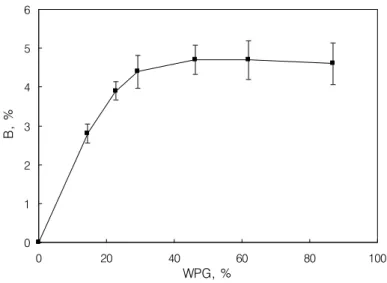
The bulking efficiency (B) resulting from resin penetration increased according to the resin uptake and leveled off over 30% WPG (Fig. 2). This may be resulted from the restricted resin penetration into the cell wall at high resin concentration. At the higher resin concentration, the increased viscosity may cause the slower resin uptake at cell wall, and the resin may be accumulated abundantly at the cell lumen. Because this lumen resin has no effect on the cell wall bulking, the bulking efficiency levels off at a certain value.
Fig. 2. Bulking efficiency (B) of melamine-formaldehyde resin treated Korean red pine wood.
Reduction in water absorptivity
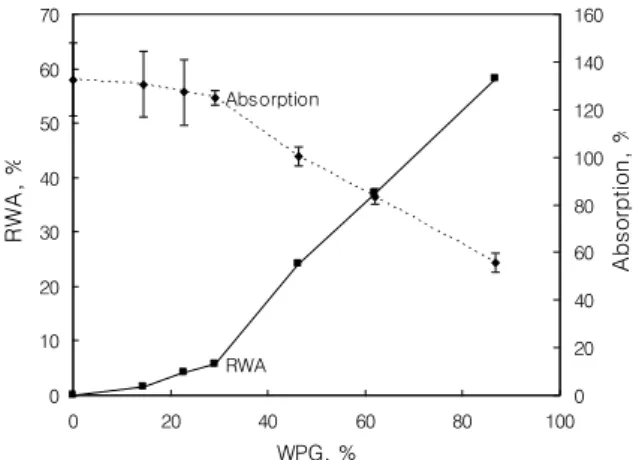
The water absorption of the treated and untreated wood samples was measured, and the reduction in water absorptivity (RWA) of treated wood samples was calculated (Fig. 3). The untreated wood absorbed water around 132% after a week immersion.
The absorption of MF resin treated wood decreased in stages with increasing of WPG of the sample. At the extent of 0 to 30% WPG, there was such a little decrease in water absorption of about 8%. The slope of the graph was gentle. However at the extent of over 30% resin uptake, the water absorption was remarkably lessened and the slope of the graph was steep. The water absorption of the MF resin treated wood decreased to 55.6% at 86.8% WPG.
The calculated RWA graph showed the mirror image of the absorption graph. Although the RWA at the 30% WPG was only 5.8%, the RWA value became drastically larger at the extent of over 30% resin uptake and reached up to 67.3% at 86.8% WPG.
Consequently, this can be interpreted that most of the MF resin at lower WPG extent (below ca.
30%) exists in the cell wall, and the excess resin at higher WPG exists in the cell lumen.
0 1 2 3 4 5 6
0 20 40 60 80 100
WPG, %
B, %
RWA Absorption
0 10 20 30 40 50 60 70
0 20 40 60 80 100
WPG, %
RWA, %
0 20 40 60 80 100 120 140 160
Absorption, %
Fig. 3. Absorption and reduction in water absorptivity (RWA) of melamine-formaldehyde resin treated Korean red pine wood.
Antiswelling efficiency
The volumetric swelling coefficient (S) of untreated sample was 10.7%. The S values of MF resin treated wood samples linearly decreased with increase of WPG and showed the minimum of 6.5% at 62% WPG (Fig. 4). However the S value was reversely increased to 8.2% at very high WPG of 86.8%.
The antiswelling efficiency (ASE) graph showed the reverse image of the volumetric swelling coefficient graph. The dimensional stability was significantly improved by the MF resin treatment, and the maximum ASE of 39.3% was achieved at 62.0% WPG. However, the reason of the lowered ASE at 86.8% WPG was not clear. It requires further study.
Generally the dimensional stabilization is achieved by means of mechanical restraint, bulking effect, chemical blocking of hydroxyl groups, and crosslinking of cell wall components, etc. In this study, the mechanism of dimensional stabilization may be interpreted as the following two reasons.
The bulking effect may be the main factor of the first stage dimensional stabilization up to 30%
resin uptake. And the mechanical restraint and/or the blocking of hygroscopic site by the MF resin accumulated in the lumen may be the factors of the second stage dimensional stabilization.
Fig.4. Volumetric swelling coefficient (S) and antiswelling efficiency (ASE) of melamine-formaldehyde resin treated Korean red pine.
ASE S
0 10 20 30 40 50
0 20 40 60 80 100
WPG, %
ASE, %
0 2 4 6 8 10 12
S, %
4. Conclusions
The treatment with a commercial melamine-formaldehyde resin improved the dimensional stability of Korean red pine wood. The bulking efficiency resulting from resin penetration increased according to the resin uptake and leveled off over 30% weight percent gain. The treatment improved volumetric swelling and water absorption after water soaking at 20℃ for a week. The maximum antiswelling efficiency was 39.3% in this study. The mechanism of dimensional stabilization was interpreted as the complicated reason. The bulking effect may be the main factor of the first stage stabilization up to 30% resin uptake. The mechanical restraint and/or the blocking of hygroscopic site by the resin accumulated in the lumen may be the factors of the second stage stabilization.
5. References
Cai, X., Riedl, B., Zhang, S., Wan, H. 2007. Effects of nanofillers on water resistance and dimensional stability of solid wood modified by melamine-urea-formaldehyde resin. Wood and Fiber Science 39(2): 307-318.
Deka, M., Saikia, C.N. 2000. Chemical modification of wood with thermosetting resin: effect on dimensional stability and strength property. Bioresource Technology 73(2):179-181.
Deka, M., Gindl, W., Wimmer, R., Dhristian, H. 2007. Chemical modification of Norway spruce(Picea abies (L) Karst) wood with melamine formaldehyde resin. Indian J. Chemical Technology 14(2): 134-138.
Gindl, W., Yaghubi, F., Wimmer, R. 2003. Impregnation of softwood cell walls with melamine formaldehyde resin. Bioresource Technology 87: 325-330.
Inoue, M., Ogata, S., Nishikawa, M. Otsuka, Y., Kawai, S., Norimoto, M., 1993. Dimensional stability, mechanical properties, and color changes of a low-molecular-weight melamine-formaldehyde resin impregnated wood. Mokuzai Gakkaishi 39(2): 181-189.
Lukowsky, D. 2002. Influence of the formaldehyde content of waterbased melamine formaldehyde resins on physical properties of Scots pine impregnated therewith. Holz als Roh- und Werkstoff 60(5):349-355.
Pittman, C., Kim, M., Nicholas, D., Wang, L., Kabir, F., Schultz, T., Ingram, L. 1994. Wood enhancement treatment. 1. Impregnation of southern yellow pine with melamine-formaldehyde and melamine-ammeline-formaldehyde resins. J. Wood Chemistry and Technology 14(4):
577-603.
Submission Information
Submission of Korean paper can be accepted for next Korean volume 20(4) before May 29, 2009.
Chief Editor, Journal of the Korea Furniture Society