• 검색 결과가 없습니다.

Effect of Central Line Bundle Compliance on Central Line-Associated Bloodstream Infections

N/A
N/A
Protected

Academic year: 2022

Share "Effect of Central Line Bundle Compliance on Central Line-Associated Bloodstream Infections"

Copied!
7
0
0

로드 중.... (전체 텍스트 보기)

전체 글

(1)

INTRODUCTION

Indwelling central venous catheters (CVCs) have the potential to cause bloodstream infections, and the prevention of central line-associated bloodstream infections (CLABSIs) can reduce adverse outcomes, such as excessive medical costs, risk of

mortality, and long-term hospitalization.

1-3

For these reasons, the importance of catheter management is emphasized through- out the literature.

4-8

In our hospital, a tertiary center in South Korea, the incidenc- es of CLABSIs in patients of the intensive care unit (ICU) were 4.8 episodes per 1000 catheter days in 2008, 5.9 in 2009, and 7.8 in 2010. These values remain higher than those of other hos- pitals of similar scale.

9

After providing new updated prevention guidelines in 2011 for intravascular catheter-related infections,

10

working groups, including the Centers for Disease Control and Prevention (CDC), emphasized the importance of educating and training health care personnel in CVC placement, namely using maxi- mal sterile barrier precautions (MBPs), chlorhexidine skin prep- aration, avoiding the femoral vein as an access site, avoiding routine replacement of CVCs, and using antiseptic/antibiotic impregnated short-term CVCs when inserting CVCs. Based Received: October 18, 2017 Revised: February 6, 2018

Accepted: February 6, 2018

Corresponding author: Dr. Young Goo Song, Division of Infectious Diseases, De- partment of Internal Medicine, Gangnam Severance Hospital, Yonsei University College of Medicine, 211 Eonju-ro, Gangnam-gu, Seoul 06273, Korea.

Tel: 82-2-2019-3319, Fax: 82-2-3463-3882, E-mail: [email protected]

•The authors have no financial conflicts of interest.

© Copyright: Yonsei University College of Medicine 2018

This is an Open Access article distributed under the terms of the Creative Com- mons Attribution Non-Commercial License (http://creativecommons.org/licenses/

by-nc/4.0) which permits unrestricted non-commercial use, distribution, and repro- duction in any medium, provided the original work is properly cited.

Effect of Central Line Bundle Compliance on Central Line-Associated Bloodstream Infections

Kyoung Hwa Lee

1,2

, Nan Hyoung Cho

2

, Su Jin Jeong

1,2

, Mi Na Kim

2

, Sang Hoon Han

1,2

, and Young Goo Song

1,2

1

Division of Infectious Diseases, Department of Internal Medicine, Gangnam Severance Hospital, Yonsei University College of Medicine, Seoul;

2
Department of Infection Control, Gangnam Severance Hospital, Seoul, Korea.

Purpose: The present study aimed to evaluate the effect of central line (CL) bundle compliance on central line-associated blood- stream infections (CLABSIs) in different departments of the same hospital, including the intensive care unit (ICU) and other de- partments.

Materials and Methods: The four components of the CL bundle were hand hygiene, use of maximal sterile barrier precautions, chlorhexidine use, and selection of an appropriate site for venous access. Compliance of the CL bundle and CLABSIs were mea- sured for every department [emergency room (ER), ICU, general ward (GW), and operating room (OR)]. A total of 1672 patients were included over 3 years (August 2013 through July 2016).

Results: A total of 29 CLABSI episodes (1.73%) were identified, and only 53.7% of the patients completed CL bundles. The perfor- mance rates of all components of the CL bundle were 22.3%, 28.5%, 36.5%, and 84.6% for the ER, ICU, GW, and OR, respectively.

The highest CLABSI rate was observed in patients of the ICU, for whom all components were not performed perfectly. Conversely, the lowest CLABSI rate was observed for patients of GWs, for whom all components were performed. Among individual compo- nents, femoral insertion site [relative risk (RR), 2.26; 95% confidence interval (CI), 1.09−4.68], not using a full body drape (RR, 3.55;

95% CI, 1.44−8.71), and not performing all CL bundle components (RR, 2.79; 95% CI, 1.19−6.54) were significant variables associ- ated with CLABSIs.

Conclusion: This study provides direct evidence that completing all CL bundle components perfectly is essential for preventing CLABSIs. Customized education should be provided, according to specific weaknesses of bundle performance.

Key Words: Central venous catheter, catheter-associated infection, central line bundle

pISSN: 0513-5796 · eISSN: 1976-2437 Yonsei Med J 2018 May;59(3):376-382

https://doi.org/10.3349/ymj.2018.59.3.376

(2)

on these guidelines, we previously began using chlorhexidine and antiseptic impregnated CVCs,

11,12

and in 2012, we modi- fied our in-hospital instructions related to MBPs.

The most recent studies that have reported improvements in CLABSI rates have drawn their comparisons from data be- fore and after specific interventions and have primarily tar- geted patients of the ICU.

13-20

In the studies that have included patients who were not from the ICU, only certain parts of the central line (CL) bundle had been included in the reported an- alyses.

21-23

To address these limitations, we evaluated CLABSIs according to the rates of completion of CL bundle components, rather than performing a comparison of rates before and after the intervention. In addition, we investigated CLABSI rates for multiple departments, including the ICU, general ward (GW), emergency room (ER), and operating room (OR).

The aim of this study was to evaluate the direct effect of com- pleting all CL bundle components on CLABSI rates, according to the department, after modifying our in-hospital instruc- tions based on updated prevention guidelines.

10

In addition, we sought to identify commonalities among weak areas of CL bun- dle performance between departments. To the best of our knowledge, this is the first study to evaluate rates of CL bundle performance and CLABSIs according to individual hospital departments.

MATERIALS AND METHODS

Study populations and CL bundle components

Data were collected over 3 years (from August 2013 through July 2016) from patients who underwent new CVC insertions during the first week of every month. Patients less than 2 years of age or those with missing data were excluded from the study.

We measured CL bundle performance compliance accord- ing to a check list based on CDC guidelines.

10

Among the CL bundle components, education and training were conducted uniformly for all medical personnel at our hospital.

24

Educa- tion and training for infection control were conducted at least twice a year. We regularly promoted the CVC insertion and maintenance guidelines through e-mail. The missing bundle result was sent immediately to the physician who inserted the catheter by mobile text message, and bundle performance check list feedback was reported to the senior staff. Likewise, antimicrobial/antiseptic-impregnated catheters were used exclusively during the study period.

CL bundle performance monitoring consisted of the follow- ing four components: hand hygiene, use of MBPs, use of chlorhexidine skin preparation, and selection of an appropri- ate site for central venous access. All CVC catheters were in- serted by a skilled physician, and a third-person nurse, who was not an assistant nurse, reviewed the checklist at the time of catheter insertion.

Definitions

We defined bloodstream infection (BSI) as newly developed primary BSIs without definite evidence of another infection based on the United States National Healthcare Safety Network (NHSN) system.

25

In cases where blood cultures were positive for normal skin flora, the identification of the offending organ- ism was based on at least two pairs of blood cultures and the presence of at least one of the following clinical symptoms: fe- ver, chills, or hypotension. The CVC must have been present for at least two additional days, and the CLABSI was defined as the present CVC on either the date when the BSI occurred or the day before the BSI occurred, according to the Korean Nosoco- mial Infections Surveillance System (KONIS) definition.

26,27

Catheter day was calculated as the interval between catheter removal and insertion dates, and the CLABSI rate was expressed as the number of CLABSI episodes per 1000 catheter days (Epi- sodes of CLABSI/total sum of catheter day×1000). We reviewed electrical medical records up to 48 hours after CVC removal.

Central venous catheter

We used the ARROW

®

central venous catheterization set for this study (ARROWg+ard Blue

®

Catheter with Blue FlexTip

®

, ARROW International Inc., Reading, PA, USA). Catheters un- derwent external surface treatment using sulfa antimicrobials, chlorhexidine acetate, and sulfadiazine.

Ethics statement

The protocol for this retrospective study was reviewed and ap- proved by the Institutional Review Board at the Gangnam Sev- erance Hospital of the Yonsei University Health System in Seoul, Korea (Reg. No. 3-2017-0043). The board waived the require- ment for informed consent. All procedures were conducted in accordance with the guidelines of the Declaration of Helsinki.

Statistical analysis

Statistical analyses were performed using SPSS statistics, ver- sion 23 (IBM Corp., Armonk, NY, USA). Categorical variables are expressed as the frequency and number of CLABSI epi- sodes per 1000 catheter days. Statistical differences among in- fection rate trends were analyzed using the chi square test.

Comparative analysis with the Poisson regression test was used to identify the most important factors associated with CLABSI rates. Results are described as relative risk (RR) with 95% con- fidence intervals (CIs). p-values <0.05 were considered statis- tically significant.

RESULTS

Overall CLABSI rates according to CL bundle performance rates

A total of 1672 patients (ICU, n=371; ER, n=376; OR, n=769; GW,

n=156) were enrolled over the 3-year study period, and the me-

(3)

dian length of catheterization was 6.0 [interquartile range (IQR) 3−12] days. Our analysis included a total of 14829 catheter-days, of which we identified 29 (1.73%) CLABSI episodes. All four components of the CL bundle were performed on a total of 898 (53.7%) patients, while one or more components of the CL bundle were omitted for 774 (46.3%) patients. Among patients for whom all four components of the CL bundle were per- formed, there were 7 (0.77%) CLABSI episodes, with a CLABSI rate of 1.0. On the other hand, there were 22 (2.84%) CLABSI episodes among patients who missed a component of the CL bundle, with a resulting CLABSI rate of 2.80 (p=0.013) (Table 1).

Performance rates of each component of the CL bundle according to department

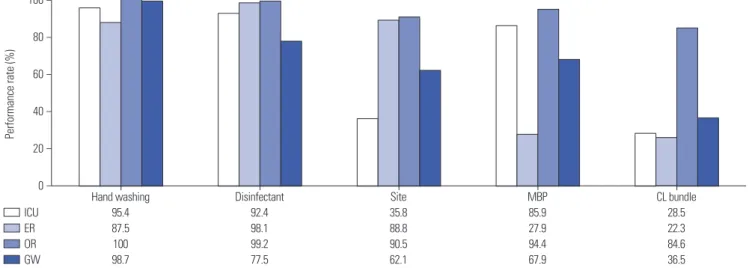
The department-specific rates of performance for each com- ponent of the CL bundle are shown in Fig. 1. Notably, the per-

centage of non-femoral site insertions was 35.8% in patients admitted to ICUs, and the percentage of full MBP compliance was only 27.9% in patients admitted to the ER. The percentages of patients for whom all four components of the CL bundle were performed were 22.3%, 28.5%, and 36.5% for the ER, ICU, and GW cohorts, respectively. Conversely, for the OR co- hort, the rate of total compliance with the CL bundle compo- nents was 84.6% (Table 1).

Department-specific CLABSI rates according to CL bundle performance

In the ICU, 1.8% of patients who underwent all four compo- nents of the CL bundle had a CLABSI, with a resulting CLABSI rate of 1.45. On the other hand, 4.9% of patients for whom one or more components of the CL bundle were omitted had a CLABSI, with a resulting CLABSI rate of 3.73 (p=0.197). A sim-

Performance rate (%)

100

80

60

40

20

0 ICU ER OR GW

Hand washing 95.4 87.5 100 98.7

Disinfectant 92.4 98.1 99.2 77.5

Site 35.8 88.8 90.5 62.1

MBP 85.9 27.9 94.4 67.9

CL bundle 28.5 22.3 84.6 36.5

Fig. 1. Performance of each component of the CL bundle by individual department. Bars represent the rates for hand washing, use of chlorhexidine, selection of a non-femoral insertion site, performing all components of MBPs, and performing all components of the CL bundle. The CL bundle consists of four components: hand hygiene, use of MBPs, use of a chlorhexidine skin preparation, and selection of an appropriate site for central venous ac- cess. MBP, maximal sterile barrier precaution; CL, central line; ICU, intensive care unit; ER, emergency room; OR, operating room; GW, general ward.

Table 1. CLABSI Rates According to Performance of the CL Bundle

Department CL bundle* Performance CLABSI episodes Catheter day CLABSI rate p value

Total 4 898 (53.7) 7/898 (0.77) 6980 1.00

0.013

0−3 774 (46.3) 22/774 (2.84) 7849 2.80

ICU (n=371) 4 106 (28.5) 2/106 (1.8) 1378 1.45

0.197

0.120

0−3 265 (71.4) 13/265 (4.9) 3488 3.73

ER (n=376) 4 84 (22.3) 1/84 (1.1) 671 1.49

0.696

0−3 292 (77.6) 5/292 (1.7) 2195 2.28

OR (n=769) 4 651 (84.6) 4/651 (0.6) 4099 0.98

0.901

0−3 118 (15.3) 1/118 (0.8) 892 1.12

GW (n=156) 4 57 (36.5) 0/57 (0) 832 0.00

0.161

0−3 99 (63.4) 3/99 (3.0) 1274 2.35

CL, central line; CLABSI, central line associated blood stream infection; ICU, intensive care unit; ER, emergency room; OR, operating room; GW, general ward.

Data are expressed as frequencies (percentages). The CLABSI rate is expressed as the number of CLABSI episodes per 1000 catheter days (episodes of CLABSI / total sum of catheter days×1000).

*Number of performed components of the CL bundle. The CL bundle consists of four components: hand hygiene, use of maximal sterile barrier precautions, use

of a chlorhexidine skin preparation, and selection of an appropriate site for central venous access.

(4)

ilar trend was noted for patients of the ER (CLABSI episodes;

1.1% vs. 1.7%, CLABSI rates; 1.49 vs. 2.28, p=0.696), patients of the OR (0.6% vs. 0.8%; 0.98 vs. 1.12; p=0.901), and patients of the GW (0% vs. 3.0%, 0 vs. 2.35, p=0.161). In general, CLABSI rates were highest in patients for whom one or more compo- nents of the CL bundle were not performed; however, among this subset of patients, there were no significant differences in CLABSI rates between departments (Table 1).

CLABSI rates according to performance of individual CL bundle components

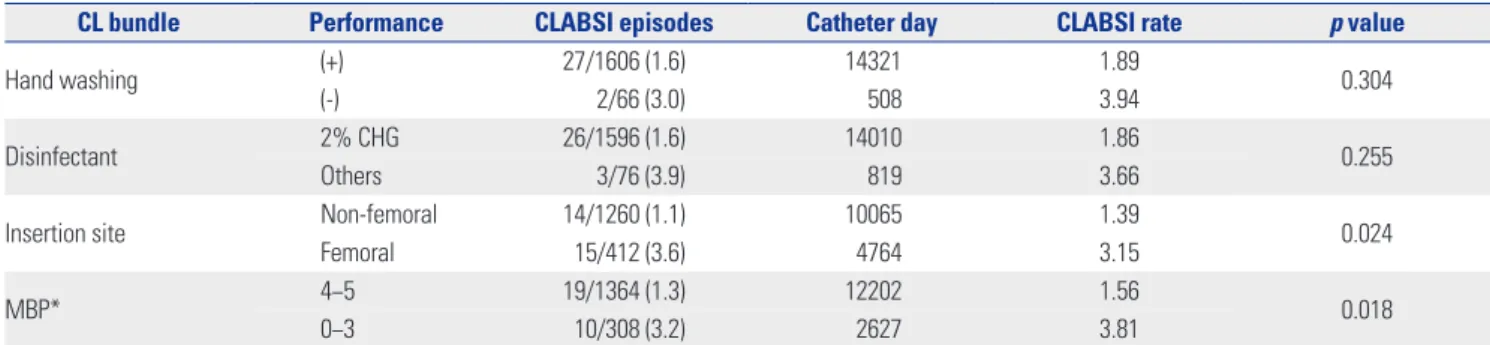
We next examined CLABSI rates according to the perfor- mance of each component of the CL bundle (Table 2). The CLABSI rate was lower in patients for whom complete hand washing than in patients for whom hand washing was not performed (1.89 vs. 3.94, p=0.304). Similarly, the CLABSI rate was lower in patients for whom 2% chlorhexidine was used compared to patients for whom another disinfectant was used (1.86 vs. 3.66, p=0.255). The CLABSI rate was also lower in pa- tients with a non-femoral catheter insertion site than in pa- tients with a femoral catheter (1.39 vs. 3.15, p=0.024). For this

study MBPs consisted of five components, including a mask, gown, hat, gloves, and full drape. The CLABSI rate was lower in patients for whom at least four of the five MBP components was used than in patients for whom zero to three of the five MBP components were used (1.56 vs. 3.81, p=0.018).

Relative risk for variables associated with CLABSIs Lastly, the four components of the CL bundle were analyzed using the Poisson regression test. Among the bundle compo- nents, it was necessary to exclude gloves from the MBP analy- sis, which otherwise consists of a mask, gown, gloves, hat, and full drape, as no CLABSIs occurred among the four cases where gloves were not used (Supplementary Table 1, only online). An insertion site in the femoral area [RR, 2.26 (95% CI, 1.09−4.68);

p=0.028], not using a full drape [RR, 3.55 (95% CI, 1.44−8.71);

p=0.006], use of only zero to three MBP components [RR, 2.44 (95% CI, 1.13−5.25); p=0.022], and not performing all four components of the CL bundle [RR, 2.79 (95% CI, 1.19−6.54);

p=0.018] were identified as significant variables associated with an increased risk of CLABSIs (Table 3).

Table 2. CLABSI Rates According to Performance of Each Component of the CL Bundle

CL bundle Performance CLABSI episodes Catheter day CLABSI rate p value

Hand washing (+) 27/1606 (1.6) 14321 1.89

0.304

(-) 2/66 (3.0) 508 3.94

Disinfectant 2% CHG 26/1596 (1.6) 14010 1.86

0.255

Others 3/76 (3.9) 819 3.66

Insertion site Non-femoral 14/1260 (1.1) 10065 1.39

0.024

Femoral 15/412 (3.6) 4764 3.15

MBP* 4−5 19/1364 (1.3) 12202 1.56

0.018

0−3 10/308 (3.2) 2627 3.81

CL, central line; CLABSI, central line associated blood stream infection; CHG, chlorhexidine gluconate; MBP, maximal sterile barrier precaution.

Data are expressed as frequencies (percentages). The CLABSI rate is expressed as the number of CLABSI episodes per 1000 catheter days (episodes of CLABSI / total sum of catheter days×1000).

*Number of components of MBPs performed, consisting of mask, gown, glove, hat, and full drape.

Table 3. RR for Variables of CLABSIs

Variable Performance RR (95% CI) p value

CL bundle

Hand washing (-)/(+) 2.08 (0.49−8.78) 0.315

Disinfectant Others/CHG 1.97 (0.59−6.52) 0.265

Insertion site Femoral/non-femoral 2.26 (1.09−4.68) 0.028

MBP

Mask (-)/(+) 2.37 (0.96−5.82) 0.059

Gown (-)/(+) 1.30 (0.53−3.20) 0.563

Hat (-)/(+) 1.92 (0.87−4.22) 0.104

Full drape (-)/(+) 3.55 (1.44−8.71) 0.006

MBP* 0−3/4−5 2.44 (1.13−5.25) 0.022

CL bundle* 0−3/4 2.79 (1.19−6.54) 0.018

CLABSI, central line associated blood stream infection; RR, relative risk; CI, confidence interval; MBP, maximal sterile barrier precaution; CHG, chlorhexidine glu- conate; CL, central line.

*Number of components of MBPs and CL bundles performed. MBPs consist of a mask, gown, glove, hat, and full drape. The CL bundle consists of four components:

hand hygiene, use of maximal sterile barrier precautions, use of a chlorhexidine skin preparation, and selection of an appropriate site for central venous access.

(5)

DISCUSSION

While many previous studies on CLABSIs have focused on patients of the ICU,

13-19

we also included patients from non- ICU departments in the present study. In addition, we ana- lyzed individual components of the CL bundle, including the five components of MBP. The performance rate for complet- ing all four components of the CL bundle was 53.7%, which was lower than expected, based on previously reported rates of 60−80%.

28-30

The performance rate for the CL bundle, when including cases where only one component was omitted, was 90.4%. However, post-hoc analysis showed that the CLABSI rates for cases wherein only three of the four CL bundle com- ponents were used, as well as in cases where only zero to two of the four components were used, were both twice as high as cases wherein all components of the CL bundle were used (Supplementary Table 2, only online). Therefore, in contrast to previous studies showing that CLABSI rates are reduced by partial compliance with the CL bundle,

14,21

our results suggest that physicians should perform all aspects of the CL bundle completely and without exception.

According to individual departments, the CLABSI rate was the highest among patients in the ICU, where all components of the CL bundle were not performed perfectly, and the CLABSI rate was zero for patients of the GW, where all components of the CL bundle were performed. With respect to each compo- nent of the CL bundle, hand washing was generally performed well in all departments, especially in the OR, for 100% of pa- tients. The performance rate of chlorhexidine skin prepara- tion was relatively low in patients of the GW, compared to other departments, which was thought to be due to insufficient prep- aration and dissemination of information. The reason for the use of a femoral insertion site, which was most prevalent in patients of the ICU, was likely due to the ease of this approach for patients who were immobile and the desire to reduce the risk of pneumothorax.

6,31

However, many previous studies have shown that the femoral approach is associated with a higher risk of CLABSIs, compared to subclavian or internal jugular approaches.

6,31-33

Thus, the continued education of physicians to avoid femoral access for infection control over convenience of insertion is necessary. Lastly, the performance rate for MBPs was significantly lower in patients of the ER, compared to those in other departments.

Notably, among individual components of MBPs, the rate of gown (36.4%) and hat (30.8%) use was lower than the other MBP components. Indeed, the performance rate for using ster- ile gloves was 100% in all hospital departments except the ER, although the performance rate of this department was still relatively high (98.9%) compared to other MBP components (Supplementary Table 1, only online). In contrast, with respect to the overall performance rate of the entire CL bundle, the rate of compliance of patients of the OR was very high (84.6%).

This result likely reflects characteristics of the OR department,

which is sensitive to infection control. Based on these results, we believe that a customized strategy and education plan to address department-specific weakness will be useful (Fig. 1, Table 1).

The CLABSI rate according to individual components of the CL bundle confirmed that the site and use of MBPs were sig- nificant factors. Among the individual components of MBPs, failure to use a full drape carried the highest risk of CLABSI.

Therefore, it is important to approach a non-femoral site

6,31-33

when inserting a CVC and to always use MBPs,

22,34,35

especially a full body, sterile drape. Furthermore, it is important to make efforts to perform all aspects of the CL bundle, as doing so re- duces the rate of CLABSIs.

There were some limitations to this study. First, there were very few CLABSI episodes (n=29) among the 1672 patients who were enrolled in this study. Owing to this low event rate, there were possibly no significant differences in CLABSI rates ac- cording to CL bundle performance. Thus, larger-scale studies that are capable of evaluating more CLABSI episodes will be necessary. On the other hand, because infection management has now become an apparent strength of our hospital, after modifying our in-hospital instructions and education in 2012, our results can serve as a baseline for comparison with other institutions and departments. A second limitation of this study was the relationship between variables. For example, a full drape was one of the components of MBPs, while MBPs were themselves a component of the CL bundle. Therefore, since many of the study variables were related to each other, a multi- variate analysis could not be performed. A third limitation was that the factors that may affect CLABSI rates, such as severity of diseases, catheterization days, removal of unnecessary cath- eter, and catheter maintenance care, were not investigated.

The median catheterization time in patients for whom the bun- dle was performed perfectly was 5.0 (IQR 3−9) days, while this duration was 7.0 (IQR 3−14) days in patients for whom at least one or more components of the CL bundle was not performed.

This difference can affect the CLABSI rate, and we focused on the CL ‘insertion’ bundle rather than CL ‘maintenance’ bun- dle. These factors should be investigated in future studies.

During the 3-year period, we monitored physicians who in- serted CVCs using checklists and provided feedback through mobile texts and e-mails. If the CVC was inserted at the femo- ral site in the ICU or if a gown and hat were not used in the ER, immediate feedback should be provided, and CLABSI rates can be improved through department-customized training.

In conclusion, the results of this study provide direct evi-

dence that completing all components of the CL bundle per-

fectly in each patient is essential for preventing CLABSIs. Our

results support the possibility that infection prevention can be

improved through customized education and training of each

department, according to individual areas of weak CL bundle

performance.

(6)

ACKNOWLEDGEMENTS

We wish to extend our gratitude to the nurses and clinical staff of the Infection Control Unit of Gangnam Severance Hospital, Seoul, Korea.

ORCID

Kyoung Hwa Lee https://orcid.org/0000-0003-0033-1398 Young Goo Song https://orcid.org/0000-0002-0733-4156

REFERENCES

1. Stevens V, Geiger K, Concannon C, Nelson RE, Brown J, Dumyati G. Inpatient costs, mortality and 30-day re-admission in patients with central-line-associated bloodstream infections. Clin Micro- biol Infect 2014;20:O318-24.

2. Ziegler MJ, Pellegrini DC, Safdar N. Attributable mortality of cen- tral line associated bloodstream infection: systematic review and meta-analysis. Infection 2015;43:29-36.

3. Al-Rawajfah OM, Hewitt JB, Stetzer F, Cheema J. Length of stay and charges associated with health care-acquired bloodstream infections. Am J Infect Control 2012;40:227-32.

4. Umscheid CA, Mitchell MD, Doshi JA, Agarwal R, Williams K, Brennan PJ. Estimating the proportion of healthcare-associated infections that are reasonably preventable and the related mortal- ity and costs. Infect Control Hosp Epidemiol 2011;32:101-14.

5. Marschall J, Mermel LA, Fakih M, Hadaway L, Kallen A, O’Grady NP, et al. Strategies to prevent central line-associated bloodstream infections in acute care hospitals: 2014 update. Infect Control Hosp Epidemiol 2014;35 Suppl 2:S89-107.

6. McGee DC, Gould MK. Preventing complications of central ve- nous catheterization. N Engl J Med 2003;348:1123-33.

7. Blot K, Bergs J, Vogelaers D, Blot S, Vandijck D. Prevention of cen- tral line-associated bloodstream infections through quality im- provement interventions: a systematic review and meta-analysis.

Clin Infect Dis 2014;59:96-105.

8. Martínez-Morel HR, Sánchez-Payá J, Molina-Gómez MJ, García- Shimizu P, García Román V, Villanueva-Ruiz C, et al. Catheter-re- lated bloodstream infection: burden of disease in a tertiary hospi- tal. J Hosp Infect 2014;87:165-70.

9. Choi JY, Kwak YG, Yoo H, Lee SO, Kim HB, Han SH, et al. Trends in the incidence rate of device-associated infections in intensive care units after the establishment of the Korean Nosocomial In- fections Surveillance System. J Hosp Infect 2015;91:28-34.

10. O’Grady NP, Alexander M, Burns LA, Dellinger EP, Garland J, Heard SO, et al.; Healthcare Infection Control Practices Advisory Committee (HICPAC). Guidelines for the prevention of intravas- cular catheter-related infections. Clin Infect Dis 2011;52:e162-93.

11. Maki DG, Stolz SM, Wheeler S, Mermel LA. Prevention of central venous catheter-related bloodstream infection by use of an anti- septic-impregnated catheter. A randomized, controlled trial. Ann Intern Med 1997;127:257-66.

12. Wang H, Huang T, Jing J, Jin J, Wang P, Yang M, et al. Effectiveness of different central venous catheters for catheter-related infec- tions: a network meta-analysis. J Hosp Infect 2010;76:1-11.

13. Pronovost P, Needham D, Berenholtz S, Sinopoli D, Chu H, Cos- grove S, et al. An intervention to decrease catheter-related blood- stream infections in the ICU. N Engl J Med 2006;355:2725-32.

14. Jeong IS, Park SM, Lee JM, Song JY, Lee SJ. Effect of central line bundle on central line-associated bloodstream infections in in-

tensive care units. Am J Infect Control 2013;41:710-6.

15. Furuya EY, Dick A, Perencevich EN, Pogorzelska M, Goldmann D, Stone PW. Central line bundle implementation in US intensive care units and impact on bloodstream infections. PLoS One 2011;6:e15452.

16. Longmate AG, Ellis KS, Boyle L, Maher S, Cairns CJ, Lloyd SM, et al.

Elimination of central-venous-catheter-related bloodstream infec- tions from the intensive care unit. BMJ Qual Saf 2011;20:174-80.

17. Ong A, Dysert K, Herbert C, Laux L, Granato J, Crawford J, et al.

Trends in central line-associated bloodstream infections in a trauma-surgical intensive care unit. Arch Surg 2011;146:302-7.

18. McLaws ML, Burrell AR. Zero risk for central line-associated blood- stream infection: are we there yet? Crit Care Med 2012;40:388-93.

19. Furuya EY, Dick AW, Herzig CT, Pogorzelska-Maziarz M, Larson EL, Stone PW. Central line-associated bloodstream infection re- duction and bundle compliance in intensive care units: a national study. Infect Control Hosp Epidemiol 2016;37:805-10.

20. Conrick-Martin I, Foley M, Roche FM, Fraher MH, Burns KM, Morrison P, et al. Catheter-related infection in Irish intensive care units diagnosed with HELICS criteria: a multi-centre surveillance study. J Hosp Infect 2013;83:238-43.

21. Apisarnthanarak A, Thongphubeth K, Yuekyen C, Warren DK, Fraser VJ. Effectiveness of a catheter-associated bloodstream in- fection bundle in a Thai tertiary care center: a 3-year study. Am J Infect Control 2010;38:449-55.

22. Lee DH, Jung KY, Choi YH. Use of maximal sterile barrier precau- tions and/or antimicrobial-coated catheters to reduce the risk of central venous catheter-related bloodstream infection. Infect Control Hosp Epidemiol 2008;29:947-50.

23. Kocazeybek B, Tokman HB. Prevalence of primary antimicrobial resistance of H. pylori in Turkey: a systematic review. Helicobacter 2016;21:251-60.

24. Comer A, Harris AD, Shardell M, Braun B, Belton BM, Wolfsthal SD, et al.; Attaining Safety for Patients through Interdisciplinary Risk Reduction Efforts (ASPIRRE) Subgroup. Web-based training improves knowledge about central line bloodstream infections.

Infect Control Hosp Epidemiol 2011;32:1219-22.

25. Horan TC, Andrus M, Dudeck MA. CDC/NHSN surveillance defi- nition of health care-associated infection and criteria for specific types of infections in the acute care setting. Am J Infect Control 2008;36:309-32.

26. Choi JY, Kwak YG, Yoo H, Lee SO, Kim HB, Han SH, et al. Trends in the distribution and antimicrobial susceptibility of causative pathogens of device-associated infection in Korean intensive care units from 2006 to 2013: results from the Korean Nosocomial Infec- tions Surveillance System (KONIS). J Hosp Infect 2016;92:363-71.

27. Kwak YG, Lee SO, Kim HY, Kim YK, Park ES, Jin HY, et al. Risk fac- tors for device-associated infection related to organisational char- acteristics of intensive care units: findings from the Korean Noso- comial Infections Surveillance System. J Hosp Infect 2010;75:195-9.

28. Osorio J, álvarez D, Pacheco R, Gómez CA, Lozano A. [Implemen- tation of an insertion bundle for preventing central line-associat- ed bloodstream infections in an Intensive Care Unit in Colombia].

Rev Chilena Infectol 2013;30:465-73.

29. Leung PO, Lin HL, Lin YH, Lai CC. Different compliance with central line insertion bundle between intensivist and noninten- sivist staff in intensive care units. Infect Control Hosp Epidemiol 2014;35:601-3.

30. Liang HW, Lin HL. Compliance with central line insertion bun- dles in an intensive care unit. Am J Infect Control 2014;42:581-2.

31. Parienti JJ, Mongardon N, Mégarbane B, Mira JP, Kalfon P, Gros A,

et al.; 3SITES Study Group. Intravascular complications of central

venous catheterization by insertion site. N Engl J Med 2015;373:

(7)

1220-9.

32. Arvaniti K, Lathyris D, Blot S, Apostolidou-Kiouti F, Koulenti D, Haidich AB. Cumulative evidence of randomized controlled and observational studies on catheter-related infection risk of central venous catheter insertion site in ICU patients: a pairwise and net- work meta-analysis. Crit Care Med 2017;45:e437-48.

33. Ling ML, Apisarnthanarak A, Jaggi N, Harrington G, Morikane K, Thu le TA, et al. APSIC guide for prevention of Central Line Asso- ciated Bloodstream Infections (CLABSI). Antimicrob Resist Infect

Control 2016;5:16.

34. Raad II, Hohn DC, Gilbreath BJ, Suleiman N, Hill LA, Bruso PA, et al. Prevention of central venous catheter-related infections by us- ing maximal sterile barrier precautions during insertion. Infect Control Hosp Epidemiol 1994;15(4 Pt 1):231-8.

35. Tang HJ, Lin HL, Lin YH, Leung PO, Chuang YC, Lai CC. The im-

pact of central line insertion bundle on central line-associated

bloodstream infection. BMC Infect Dis 2014;14:356.

수치

Table 1. CLABSI Rates According to Performance of the CL Bundle
Table 2. CLABSI Rates According to Performance of Each Component of the CL Bundle

참조

관련 문서

 The Dutch physicist Pieter Zeeman showed the spectral lines emitted by atoms in a magnetic field split into multiple energy levels...  With no magnetic field to align them,

Modern Physics for Scientists and Engineers International Edition,

If both these adjustments are considered, the resulting approach is called a bootstrap-BC a -method (bias- corrected-accelerated). A description of this approach

Five days later, on 15 January 1975, the Portuguese government signed an agreement with the MPLA, FNLA and UNITA providing for Angola to receive its independence on 11

웹 표준을 지원하는 플랫폼에서 큰 수정없이 실행 가능함 패키징을 통해 다양한 기기를 위한 앱을 작성할 수 있음 네이티브 앱과

 The PL bundle is hidden behind the AM bundle and becomes visible during flexion as the femoral insertion moves

_____ culture appears to be attractive (도시의) to the

【판결요지】[1] [다수의견] 동일인의 소유에 속하는 토지 및 그 지상 건물에 관하여 공동저 당권이 설정된 후 그 지상 건물이 철거되고 새로 건물이 신축된 경우에는