Association between Alcohol Consumption and Hypertension
Myoung Kyun Son, MD
Department of Internal Medicine, Planned Population Federation of Korea, Incheon, Korea 2)
❙ABSTRACT❙
Background: Heavy alcohol consumption increases the risk of hypertension, but the effect of light to moderate alcohol consumption on the risk of hypertension remains controversial. In this cross-sectional study we aimed to identify the association between alcohol consumption and hypertension, and verify whether this association is influenced by age. Methods:
Study participants were 498 men and 610 women, aged 23 to 88 years, who underwent periodic health examinations at one institute in Incheon, Korea. Results: Compared with nondrinkers, multivariate-adjusted odds ratio (OR) (95% confidence interval, CI) for hypertension according to the number of standard drinks consumed weekly was as follows: 1 to 3 drinks, OR
= 1.13 (95% CI, 0.56–2.29); 4 to 10 drinks, OR = 0.51 (95% CI, 0.27–0.97); 11 to 18 drinks, OR = 1.11 (95% CI, 0.55–2.20); ≥ 19 drinks per week, OR = 1.97 (95% CI, 1.18–3.29). A positive association between the prevalence of hypertension and alcohol consumption of ≥ 19 drinks per week was found for patients aged ≥ 60 years (OR = 2.47; 95% CI, 1.21–5.05), but not in patients aged < 60 years (OR = 1.54; 95% CI, 0.72–3.32). Light to moderate alcohol consumption from 4 to 10 drinks per week was significantly associated with a decreased risk of hypertension in subjects aged < 60 years (OR = 0.32; 95% CI, 0.11–0.97), but not in subjects aged ≥ 60 years (OR = 0.70; 95% CI, 0.31–1.58). Conclusions: Light to moderate alcohol consumption can decrease the risk of hypertension, whereas heavy alcohol intake is associated with an increased risk of hypertension. The association between alcohol consumption and hypertension may be changed by age. (J Korean Soc Hypertens 2011;17(2):65-73)
Key Words: Alcohol drinking; Hypertension; Age factors; Coronary disease
Introduction
Numerous studies have established a close relationship between alcohol consumption and hypertension.1,2) Heavy alcohol consumption has been demonstrated to be associated with an increased risk of hypertension.1,3-7) A meta-analysis of randomized controlled trials reported that a reduction in alcohol intake among heavy drinkers significantly re-
논문접수일: 2011. 2. 5, 심사완료일: 2011. 4. 25, 게재승인일: 2011. 4. 29 교신저자: Myoung Kyun Son, MD
주소: Department of Internal Medicine, Planned Population Federation of Korea, Ganseok 3-dong, Namdong-gu, Incheon 405-800, Korea Tel: +82-32-451-4027, +82-10-9946-4771, Fax: +82-32-451-4099 E-mail: [email protected]
duces systolic and diastolic blood pressure.8) However, the association between light to moderate alcohol consumption and hypertension is unclear. Some studies have shown that light to moderate alcohol intake can decrease the risk of hypertension.2,9) Others have indicated that the effect of light to moderate alcohol intake on the risk of hypertension may be harmful or insignificant.3,4,7,10,11)
It has been suggested that there are differences in patho- physiology and pattern of hypertension between young and elderly hypertensive patients.12-15) Therefore, it is needed to verify whether the relationship between alcohol consumption and hypertension is affected by age. A few
studies have shown that the association between alcohol intake and hypertension may be different between age groups.11,16,17) Other studies, however, have indicated that heavy drinking is positively associated with hypertension irrespective of age.6)
The aim of this study is to identify the relationship be- tween alcohol consumption and blood pressure, and to de- termine whether this relationship is changed by age.
Subjects and methods
1. Study population
Study participants were Korean adults who underwent their periodic health check-up at one institute in Incheon, Korea between April 2010 and December 2010. Among 1,712 participants, subjects who reported a history of hy- pertension or antihypertensive treatment were excluded.
The patients diagnosed with heart disease including coro- nary heart disease were also excluded. They were ex- cluded to rule out the possible influence of a diagnosis of hypertension and heart disease on the pattern of alcohol consumption. A total of 1,108 subjects remained eligible for analysis. The study group consisted of 498 men and 610 women aged between 23 and 88 years (median 58 years).
2. Methods
Alcohol consumption was ascertained by means of self-administered questionnaires. Subjects were asked how often they usually drank alcohol on a weekly basis and how many standard drinks they usually consumed on a dai- ly basis. A standard drink was considered any drink that contains about 10 g of pure alcohol. Patients were catego- rized according to the number of standard drinks consumed weekly: none, 1 to 3 per week, 4 to 10 per week, 11 to 18 per week, and 19 or more per week. A few studies
have shown that the effect of alcohol consumption on the risk of hypertension starts with consumption of more than threshold amount.2,7) A prospective study of young women reported that light drinkers who consumed more than 0.25 drink per day showed a decrease in the risk of hyperten- sion.2) In this study, therefore, the consumption in the 1 to 3 drinks per week category was included to see whether there is a threshold level for the association between alco- hol consumption and the risk of hypertension. In addition, drinking frequency was categorized as none, 1 to 2 days per week, and 3 or more days per week. Drinking quantity was categorized as none, 1 to 6 drinks per day, and 7 or more drinks per day.
Self-administered questionnaires were also used to exam- ine the status of cigarette smoking and physical activity.
Individuals were categorized as nonsmoker, ex-smoker, and current smoker. Weekly frequency of moderate- or vigo- rous-intensity physical activity was asked. Regular exercise was defined as getting at least 20 minutes of vigorous-in- tensity physical activity or at least 30 minutes of moder- ate-intensity physical activity three or more days per week.
Blood pressure was measured after the subject had been seated for 5 minutes. Trained nurses measured sitting blood pressure by use of a standard mercury sphygmomanometer.
Systolic and diastolic blood pressures were defined as the first and fifth-phase Korotkoff sounds. Subjects were cate- gorized as having hypertension if they had systolic blood pressure ≥ 140 mm Hg or diastolic blood pressure ≥ 90 mm Hg.
Body weight with light clothing and height without shoes were measured. Body mass index (BMI) was calcu- lated as the weight in kilograms divided by the square of height in meters.
Laboratory tests included fasting blood sugar (FBS), high density lipoprotein-cholesterol (HDL-C), and low density lipoprotein-cholesterol (LDL-C). Blood specimens were
Variables Hypertension (n = 236) Normotension (n = 872) p-value
Men/women 128/108 (54.2/45.8) 370/502 (42.4/57.6) 0.001*
Age (yr) 62.6 ± 11.2 56.2 ± 11.6 <0.001†
FBS (mg/dL) 105.3 ± 27.2 99.8 ± 24.4 0.003†
HDL‐C (mg/dL) 48.5 ± 12.2 51.4 ± 12.8 0.002†
LDL‐C (mg/dL) 118.7 ± 31.3 116.4 ± 32.2 0.326†
BMI (kg/m2) 24.3 ± 3.1 23.6 ± 3.0 <0.001†
Alcohol intake (drink/wk) 0.007*
0 161 (68.2) 602 (69.0)
1-3 12 (5.1) 47 (5.4)
4-10 13 (5.5) 95 (10.9)
11-18 13 (5.5) 51 (5.8)
≥19
Drinking frequency (day/wk) 0
1-2 ≥3
37 161 33 42
(15.7) (68.2) (14.0) (17.8)
77 602 163 107
(8.8) (69.0) (18.7) (12.3)
0.038*
Drinking quantity (drink/day) 0
1-6 ≥7 Smoking Nonsmoker
161 38 37 143
(68.2) (16.1) (15.7) (60.6)
602 141 129 593
(69.0) (16.2) (14.8) (68.0)
0.944*
0.056*
Ex-smoker 45 (19.1) 118 (13.5)
Current smoker 48 (20.3) 161 (18.5)
Regular exerciser 46 (19.5) 172 (19.7) 0.936*
Values were presented by mean ± standard deviation or number (%).
FBS, fasting blood sugar; HDL‐C, high density lipoprotein-cholesterol; LDL‐C, low density lipoprotein cholesterol; BMI, body mass index.
p-values were obtained by *Pearson's chi-square test or†Student t test.
Table 1. Comparison of clinical characteristics between the subjects with and without hypertension sampled after an overnight fasting. Laboratory analysis was
performed with an automated chemistry analyzer (Imola, Randox).
3. Statistical analysis
Clinical characteristics were compared between the sub- jects with and without hypertension using Student’s t-test or Pearson’s chi-square test. The association between alco- hol consumption and the risk of hypertension was analyzed by logistic regression analysis. For all analyses, nondrinkers were considered the referent category. Multivariate-ad- justed odds ratio (OR) and 95% confidence interval (CI) for hypertension was calculated. This study examined age and sex-adjusted models, then adjusted for BMI, FBS, HDL-C, LDL-C, smoking status, and physical activity.
Age-specific logistic regression analysis was used to de- termine whether there is a difference in the effect of alcohol consumption on the risk of hypertension between young and old subjects. Old subjects were defined as those aged 60 or over. All analyses were performed with SPSS stat- istical software. A p-values < 0.05 were considered statisti- cally significant.
Results
Of the 1,108 subjects, 236 cases (21.3%) of hypertension were identified (148, aged ≥ 60 years; 88, aged < 60 years).
Mean (± standard deviation) blood pressure was 120.4 (±
9.6)/74.4 (± 5.9) mm Hg in normotensive subjects and 142.7 (± 10.4)/90.7 (± 48.1) mm Hg in hypertensive subjects.
The number of hypertensive subjects in categories accord-
Alcohol intake (drink/wk)
Unadjusted Model 1* Model 2††
OR (95% CI) p-value‡ OR (95% CI) p-value‡ OR (95% CI) p-value‡ 0§
1-3 4-10 11-18
≥19 (n=763) (n=59) (n=108) (n=64) (n=114)
1.00
0.96 (0.50-1.84) 0.890 0.51 (0.28-0.94) 0.030 0.95 (0.51-1.80) 0.882 1.80 (1.17-2.76) 0.007
1.00
1.06 (0.54-2.11) 0.865 0.49 (0.26-0.93) 0.028 0.98 (0.50-1.90) 0.943 1.79 (1.11-2.90) 0.018
1.00
1.13 (0.56-2.29) 0.726 0.51 (0.27-0.97) 0.040 1.11 (0.55-2.20) 0.777 1.97 (1.18-3.29) 0.010 OR, odds ratio; CI, confidence interval.
*Adjusted for age and sex.
†Adjusted for age, sex, BMI, FBS, HDL‐C, LDL‐C, smoking status, and physical activity.
‡P values were obtained by logistic regression analysis.
§Reference category.
Table 2. Association between alcohol consumption and risk of hypertension by logistic regression analysis
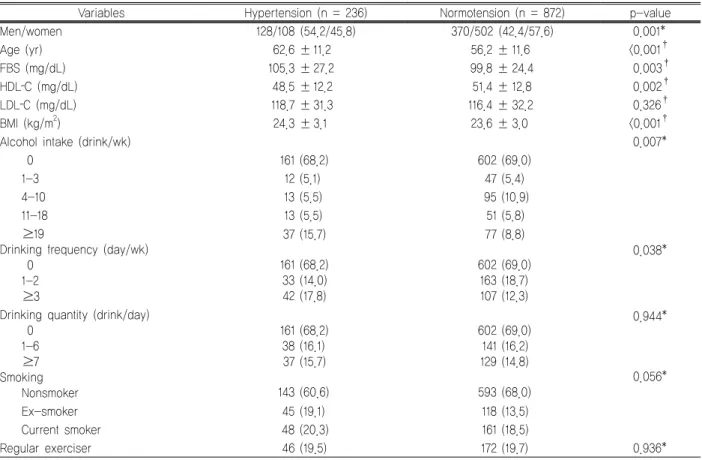
ing to blood pressure was as follows: a systolic of 140-159 and/or a diastolic of 90–99 mm Hg, n = 206; a systolic of 160–179 and/or a diastolic of 100–109 mm Hg, n = 29; a systolic greater than or equal to 180 and/or a diastolic great- er than or equal to 110 mm Hg, n = 1. The characteristics according to blood pressure are presented in Table 1. Men and old patients were more likely to be hypertensive.
HDL-C was lower and FBS was higher among hypertensive subjects than normotensive subjects. Hypertensive patients showed higher BMI. The proportion of individuals who were hypertensive varied significantly by level of drinking frequency. On the other hand, the percentage of hyper- tensive subjects did not appear to differ by drinking quantity in univariate analysis.
Logistic regression analysis of the relationship between alcohol consumption and hypertension is presented in Table 2. In unadjusted model, light to moderate alcohol consumption from 4 to 10 drinks per week was associated with significant reductions in the risk of hypertension (OR
= 0.51; 95% CI, 0.28–0.94; p = 0.030). Alcohol consumption in the 1 to 3 drinks per week category did not have a sig- nificant effect on the risk of hypertension (OR = 0.96; 95%
CI, 0.50–1.84; p = 0.890). The risk of hypertension was significantly increased when consuming ≥ 19 drinks per week (OR = 1.80; 95% CI, 1.17–2.76; p = 0.007). This pat- tern of association persisted after adjustment for sex, age,
BMI, FBS, HDL-C, LDL-C, smoking status, and physical activity. Compared with nondrinkers, OR of hypertension was lowest among subjects drinking 4 to 10 drinks per week (OR = 0.51; 95% CI, 0.27–0.97; p = 0.040) and highest among subjects drinking 19 or more drinks per week (OR
= 1.97; 95% CI, 1.18–3.29; p = 0.010). To evaluate inter- action between covariates described previously, interaction terms between these covariates were included in this mod- el, but none reached statistical significance except that be- tween FBS and LDL-C (p-value for interaction = 0.03).
Addition of this interaction term to the multivariate model did not change the results substantially (data not shown).
Additionally, the association between alcohol consumption and blood pressure when the exposure to alcohol was strati- fied according to drinking frequency and quantity was ana- lyzed by means of multivariate logistic regression analysis.
Compared with nondrinkers, OR (95% CI) of hypertension was as follows: 1 to 2 days per week and 1 to 6 drinks per day, 0.87 (0.50–1.50); 1 to 2 days per week and 7 or more drinks per day, 0.81 (0.41–1.59); 3 or more days per week and 1 to 6 drinks per day, 1.39 (0.73–2.64); 3 or more days per week and 7 or more drinks per day, 1.56 (0.87–2.78). Interestingly, alcohol consumption of 1 to 2 days per week did not appear to increase the risk of hyper- tension even when the subjects drank 7 or more drinks per day. This finding can strengthen the interpretation that
Alcohol intake (drink/wk)
Unadjusted Model 1* Model 2††
OR (95% CI) p-value‡ OR (95% CI) p-value‡ OR (95% CI) p-value‡ Age ≥60 yr
0§ (n=357) 1-3 (n=17) 4-10 (n=40) 11-18 (n=29)
≥19 (n=45) Age <60 yr
0§ (n=406) 1-3 (n=42) 4-10 (n=68) 11-18 (n=35)
≥19 (n=69)
1.00
1.70 (0.63-4.59) 0.293 0.71 (0.33-1.54) 0.380 0.77 (0.32-1.87) 0.569 2.13 (1.14-3.99) 0.018
1.00
0.83 (0.31-2.19) 0.703 0.38 (0.13-1.09) 0.072 1.27 (0.50-3.19) 0.615 1.85 (0.99-3.45) 0.054
1.00
1.68 (0.62-4.56) 0.313 0.69 (0.31-1.54) 0.362 0.76 (0.31-1.86) 0.544 2.07 (1.06-4.05) 0.034
1.00
0.77 (0.29-2.05) 0.600 0.30 (0.10-0.89) 0.029 1.00 (0.38-2.60) 1.000 1.40 (0.70-2.78) 0.340
1.00
1.77 (0.63-4.95) 0.280 0.70 (0.31-1.58) 0.387 0.82 (0.32-2.09) 0.679 2.47 (1.21-5.05) 0.013
1.00
0.88 (0.33-2.39) 0.807 0.32 (0.11-0.97) 0.043 1.20 (0.44-3.26) 0.728 1.54 (0.72-3.32) 0.268 OR, odds ratio; CI, confidence interval.
*Adjusted for sex.
†Adjusted for sex, BMI, FBS, HDL‐C, LDL‐C, smoking status, and physical activity.
‡p‐values were obtained by logistic regression analysis.
§Reference category.
Table 3. Association between alcohol consumption and risk of hypertension by age-specific logistic regression analysis
frequent drinking is a stronger risk factor for hypertension than binge drinking.
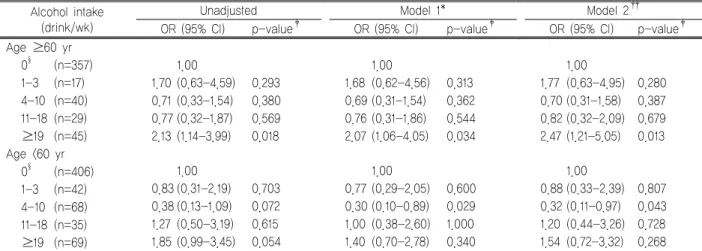
Age-specific logistic regression analysis is presented in Table 3. By age-specific analysis, the effect of alcohol con- sumption in the range of 4 to 10 drinks per week on hyper- tension became more protective in young patients (OR = 0.32; 95% CI, 0.11–0.97; p = 0.043 in the model including all the confounders). On the other hand, consumption of
≥ 19 drinks per week was not significantly associated with an increased risk of hypertension in young patients (OR
= 1.54; 95% CI, 0.72–3.32; p = 0.268 in the model includ- ing all the confounders). In old patients, high alcohol intake (≥ 19 drinks per week) was more strongly associated with an increased risk of hypertension by age-specific analysis (OR = 2.47; 95% CI, 1.21–5.05; p = 0.013 in the model in- cluding all the confounders), with no evidence of sig- nificant benefit in the light to moderate drinking from 4 to 10 drinks per week (OR = 0.70; 95% CI, 0.31–1.58; p
= 0.387 in the model including all the confounders).
Discussion
This cross-sectional study confirmed that heavy alcohol
intake increases hypertension risk, whereas light to moder- ate alcohol intake can decrease hypertension risk. In ac- cordance with previous studies,2,7) there was a threshold level for this association. Light to moderate alcohol con- sumption had a protective effect on the prevalence of hy- pertension when consuming ≥ 4 drinks per week in this study. Heavy alcohol intake was significantly associated with an increased risk of hypertension for subjects who consumed ≥ 19 drinks per week. However, several studies have reported different thresholds.18) In old subjects, alco- hol consumption from 1 to 3 drinks per week seemed to increase the risk of hypertension though not statistically significant. It is difficult to conclude that light alcohol in- take can increase the risk of hypertension in old subjects from this result. The cause of this result is uncertain, but it may have been due to the small number of participants in this category. Activation of the sympathetic nervous system and alteration of vascular tone have been hypothe- sized as the probable mechanisms explaining the relation- ship between heavy alcohol intake and an increased risk of hypertension.1,19,20) Some studies have suggested that al- cohol has a direct effect on blood pressure, but others have
indicated that repeated withdrawal from alcohol is at least as likely an explanation for elevated blood pressure.9,18) It has been proposed that the effect of heavy alcohol intake on blood pressure may be mediated by the actions of hor- mones such as norepinephrine and cortisol.1,18,21) The mechanism by which light to moderate alcohol con- sumption decreases the risk of hypertension is uncertain.
A few studies have suggested that depressor effects of al- cohol on blood pressure may predominate over withdrawal effects at low levels of intake, especially if the frequency of intake is low.9,22) In addition, it has been suggested that light to moderate alcohol consumption may reduce anxiety that is considered to be associated with hypertension.9,23) This study founded that the association between alcohol consumption and the risk of hypertension differed in young and old patients. Although the mechanism underlying this difference remains largely unknown, the pathophysiologic changes of aging such as increased peripheral vascular re- sistance, decreases in plasma renin activity, and reduced beta-adrenergic function14,15) may be the key to clarifying the mechanism. It has been suggested that the difference in the pattern of alcohol use and hormonal status may be one of the likely mechanisms.16)
Light to moderate drinking has been shown to be asso- ciated with a reduced risk of ischemic stroke, coronary heart disease, and mortality.24-29) It has been suggested that the beneficial influences of alcohol intake on lipids and haemostatic factors may explain this association.30-33) Some authors have indicated that red wine may enhance endothe- lial nitric oxide synthase function and antagonize the devel- opment of endothelial dysfunction and atherosclerosis.34,35) A few studies have speculated that the protective effect of light to moderate alcohol consumption on the risk of hypertension may reflect an additional pathway by which light to moderate alcohol intake reduces the risk of coro- nary heart disease and death.9) However, there is counter evidence to this hypothesis. Some studies have shown that
older people at high risk of coronary heart disease and is- chemic stroke are more likely to have survival benefit from light to moderate alcohol consumption.36-38) But, the present study has shown that the protective effect of light to moder- ate alcohol intake on hypertension appears confined to the patients aged < 60 years. A few studies have suggested that light drinking significantly increased blood pressure only in the older groups.11,17) In addition, it has been suggested that the protection against coronary heart disease afforded by moderate alcohol consumption may be mediated by an increase in HDL-C and a decrease in LDL-C, but counter- balanced by an increase in risk due to increased systolic blood pressure.31) It is speculated that the mechanisms un- derlying the association between light to moderate alcohol consumption and hypertension may differ from those for coronary heart disease and ischemic stroke. Although this study has indicated that light to moderate alcohol con- sumption can decrease the risk of hypertension in young patients as previous studies have reported,9) some studies have shown that light to moderate alcohol consumption may have unassociated or deleterious effects on the risk of coronary heart disease, ischemic stroke, and mortality in young patients.36-38) Therefore, a comprehensive analysis of the risk of hypertension and other diseases such as coro- nary heart disease and ischemic stroke is needed to assess the effect of light to moderate alcohol consumption.
Heavy alcohol intake has been shown to be associated with an increased risk of hypertension, coronary heart dis- ease, stroke, and death.2,4,39,40) In the current study, how- ever, heavy alcohol intake appeared to be unassociated with an increased risk of hypertension in young patients. A few studies have reported that the elevating effect of alcohol drinking on blood pressure was more prominent in the eld- erly than in the young,11,16) in accordance with the result of the current study. Although the mechanism underlying this result needs to be clarified, alcohol intake seems to be more harmful to old patients than young patients in
terms of increasing the risk of hypertension.
This study lacked details on beverage-specific intake and drinking patterns. This limitation of the present study de- serves mention since some studies have reported the rela- tionship between pattern of alcohol use and hypertension risk.41) However, several studies have shown that the effect of alcohol consumption on hypertension risk can be in- dependent of the type of alcoholic beverage and drinking patterns.5,24) An additional limitation of the study is that data on potential factors explaining the difference in the effect of alcohol on blood pressure between young and eld- erly patients such as postmenopausal status and post- menopausal hormone use were unavailable. It has been speculated that estrogen use may affect the relationship be- tween alcohol consumption and blood pressure.16) Further studies including these factors will be useful for confirm- ing the mechanism underlying the effect of age on the rela- tionship between alcohol intake and blood pressure. Third, analyses of the current study were restricted to the subjects from one institute. Therefore, selection bias could be in- troduced, and caution is warranted in generalizing these findings beyond the population of the current study.
Fourth, this study cannot establish cause-effect relationship between exposure to alcohol and hypertension because of the cross-sectional nature of the study. Finally, single blood pressure measurement could introduce bias into this study. Several studies have indicated that the combination of the second and third blood pressure reading seems to be favorable over single blood pressure reading.42) On the other hand, it was suggested that one measurement of blood pressure may be reliable data in the cross-sectional study.43)
In conclusion, this study has indicated that light to mod- erate alcohol consumption can be associated with a de- creased risk of hypertension, whereas heavy alcohol intake can increase the risk of hypertension. It is suggested that the effect of alcohol consumption on the risk of hyper-
tension may be influenced by age. There should be a con- sideration of age when assessing the relationship between alcohol consumption and blood pressure. However, further studies are needed to verify these results since the present study is limited to cross-sectional design.
Summary
연구배경: 과다음주가 혈압을 증가시킨다는 것은 잘 알
려져 있는 반면에, 소량음주가 혈압에 미치는 영향에 대해
서는 아직 논란의 여지가 있다. 본 연구는 음주와 고혈압
의 관계를 밝히고, 그것이 음주자의 연령에 영향을 받는지
를 밝히고자 하였다.
방법: 인천의 한 건강검진기관에서 검사를 받은 한국인 들을 대상으로 하였다. 498명의 남자, 610명의 여자가 연 구대상이었고, 나이는 23세에서 88세까지로 분포되었다.
결과: 다변량 로지스틱 회귀분석에서 비음주자에 비해, 주당 19잔 이상의 과다음주자는 고혈압의 유병률이 더 높 았고, 주당 4잔에서 10잔의 음주자는 고혈압의 유병률이 더 낮았다. 60세 이상의 고령자에서는 비음주에 비해, 과다 음주가 높은 고혈압의 유병률과 관계있는 것으로 나타났 지만, 60세 미만의 연령군에서는 그렇지 않았다. 주당 4잔 에서 10잔의 음주는 60세 미만의 대상자에서는 낮은 고혈 압의 유병률을 보였지만, 고령군에서는 그렇지 않았다.
결론: 과다음주자는 비음주자에 비해 고혈압의 유병률 이 높았지만, 소량음주자는 고혈압의 유병률이 더 낮았다.
음주와 혈압의 관계는 음주자의 연령에 따라 달라질 수 있었다.
References
1. MacMahon S. Alcohol consumption and hypertension.
Hypertension. 1987;9:111-21.
2. Thadhani R, Camargo CA Jr, Stampfer MJ, Curhan GC, Willett WC, Rimm EB. Prospective study of moderate al- cohol consumption and risk of hypertension in young women. Arch Intern Med. 2002;162:569-74.
3. Klatsky AL, Koplik S, Gunderson E, Kipp H, Friedman GD. Sequelae of systemic hypertension in alcohol ab-
stainers, light drinkers, and heavy drinkers. Am J Cardiol.
2006;98:1063-8.
4. Fuchs FD, Chambless LE, Whelton PK, Nieto FJ, Heiss G.
Alcohol consumption and the incidence of hypertension:
The Atherosclerosis Risk in Communities Study. Hyper- tension. 2001;37:1242-50.
5. Klatsky AL. Alcohol and hypertension. Clin Chim Acta.
1996;246:91-105.
6. Marmot MG, Elliott P, Shipley MJ, Dyer AR, Ueshima H, Beevers DG, et al. Alcohol and blood pressure: the INTERSALT study. BMJ. 1994;308:1263-7.
7. Witteman JC, Willett WC, Stampfer MJ, Colditz GA, Kok FJ, Sacks FM, et al. Relation of moderate alcohol con- sumption and risk of systemic hypertension in women. Am J Cardiol. 1990;65:633-7.
8. Xin X, He J, Frontini MG, Ogden LG, Motsamai OI, Whelton PK. Effects of alcohol reduction on blood pres- sure: a meta-analysis of randomized controlled trials.
Hypertension. 2001;38:1112-7.
9. Gillman MW, Cook NR, Evans DA, Rosner B, Hennekens CH. Relationship of alcohol intake with blood pressure in young adults. Hypertension. 1995;25:1106-10.
10. Ohmori S, Kiyohara Y, Kato I, Kubo M, Tanizaki Y, Iwamoto H, et al. Alcohol intake and future incidence of hypertension in a general Japanese population: the Hisayama study. Alcohol Clin Exp Res. 2002;26:1010-6.
11. Wakabayashi I, Araki Y. Influences of gender and age on relationships between alcohol drinking and athero- sclerotic risk factors. Alcohol Clin Exp Res. 2010;34 Suppl 1:S54-60.
12. Canonico V, De Caprio L, Vigorito C, Forgione L, Tedeschi C, Guarini P, et al. Differences in blood pressure profile be- tween young and elderly hypertensive patients. J Hum Hypertens. 1990;4:405-9.
13. Chobanian AV. Treatment of the elderly hypertensive patient. Am J Med. 1984;77:22-7.
14. Folkow B. Pathophysiology of hypertension: differences between young and elderly. J Hypertens Suppl. 1993;11:
S21-4.
15. Furmaga EM, Murphy CM, Carter BL. Isolated systolic hypertension in older patients. Clin Pharm. 1993;12:347- 58.
16. Fortmann SP, Haskell WL, Vranizan K, Brown BW,
Farquhar JW. The association of blood pressure and dietary alcohol: differences by age, sex, and estrogen use. Am J Epidemiol. 1983;118:497-507.
17. Wakabayashi I, Kobaba-Wakabayashi R. Effects of age on the relationship between drinking and atherosclerotic risk factors. Gerontology. 2002;48:151-6.
18. Criqui MH. Alcohol and hypertension: new insights from population studies. Eur Heart J. 1987;8 Suppl B:19-26.
19. Potter JF, Beevers DG. Pressor effect of alcohol in hypertension. Lancet. 1984;1:119-22.
20. Potter JF, Watson RD, Skan W, Beevers DG. The pressor and metabolic effects of alcohol in normotensive subjects.
Hypertension. 1986;8:625-31.
21. Arkwright PD, Beilin LJ, Vandongen R, Rouse IL, Masarei JR. Plasma calcium and cortisol as predisposing factors to alcohol related blood pressure elevation. J Hypertens.
1984;2:387-92.
22. Abe H, Kawano Y, Kojima S, Ashida T, Kuramochi M, Matsuoka H, et al. Biphasic effects of repeated alcohol in- take on 24-hour blood pressure in hypertensive patients.
Circulation. 1994;89:2626-33.
23. Markovitz JH, Matthews KA, Kannel WB, Cobb JL, D'Agostino RB. Psychological predictors of hypertension in the Framingham Study. Is there tension in hypertension?
JAMA. 1993;270:2439-43.
24. Beilin LJ, Puddey IB, Burke V. Alcohol and hyper- tension--kill or cure? J Hum Hypertens. 1996;10 Suppl 2:S1-5.
25. Britton A, Marmot M. Different measures of alcohol con- sumption and risk of coronary heart disease and all-cause mortality: 11-year follow-up of the Whitehall II Cohort Study. Addiction. 2004;99:109-16.
26. Palmer AJ, Fletcher AE, Bulpitt CJ, Beevers DG, Coles EC, Ledingham JG, et al. Alcohol intake and car- diovascular mortality in hypertensive patients: report from the Department of Health Hypertension Care Computing Project. J Hypertens. 1995;13:957-64.
27. Cleophas TJ. Wine, beer and spirits and the risk of my- ocardial infarction: a systematic review. Biomed Pharma- cother. 1999;53:417-23.
28. Rimm EB, Klatsky A, Grobbee D, Stampfer MJ. Review of moderate alcohol consumption and reduced risk of coro- nary heart disease: is the effect due to beer, wine, or spirits.
BMJ. 1996;312:731-6.
29. Stampfer MJ, Colditz GA, Willett WC, Speizer FE, Hennekens CH. A prospective study of moderate alcohol consumption and the risk of coronary disease and stroke in women. N Engl J Med. 1988;319:267-73.
30. Hansen AS, Marckmann P, Dragsted LO, Finne Nielsen IL, Nielsen SE, Gronbaek M. Effect of red wine and red grape extract on blood lipids, haemostatic factors, and other risk factors for cardiovascular disease. Eur J Clin Nutr. 2005;
59:449-55.
31. Langer RD, Criqui MH, Reed DM. Lipoproteins and blood pressure as biological pathways for effect of moderate al- cohol consumption on coronary heart disease. Circulation.
1992;85:910-5.
32. Naissides M, Mamo JC, James AP, Pal S. The effect of chronic consumption of red wine on cardiovascular disease risk factors in postmenopausal women. Atherosclerosis.
2006;185:438-45.
33. Rimm EB, Williams P, Fosher K, Criqui M, Stampfer MJ.
Moderate alcohol intake and lower risk of coronary heart disease: meta-analysis of effects on lipids and haemostatic factors. BMJ. 1999;319:1523-8.
34. Leighton F, Miranda-Rottmann S, Urquiaga I. A central role of eNOS in the protective effect of wine against meta- bolic syndrome. Cell Biochem Funct. 2006;24:291-8.
35. Leikert JF, Rathel TR, Wohlfart P, Cheynier V, Vollmar AM, Dirsch VM. Red wine polyphenols enhance endothe- lial nitric oxide synthase expression and subsequent nitric oxide release from endothelial cells. Circulation. 2002;
106:1614-7.
36. Bulpitt CJ. How many alcoholic drinks might benefit an
older person with hypertension? J Hypertens. 2005;23:
1947-51.
37. Fuchs CS, Stampfer MJ, Colditz GA, Giovannucci EL, Manson JE, Kawachi I, et al. Alcohol consumption and mortality among women. N Engl J Med. 1995;332:
1245-50.
38. Jackson R, Beaglehole R. Alcohol consumption guide- lines: relative safety vs absolute risks and benefits. Lancet.
1995;346:716.
39. Hart CL, Smith GD, Hole DJ, Hawthorne VM. Alcohol consumption and mortality from all causes, coronary heart disease, and stroke: results from a prospective cohort study of scottish men with 21 years of follow up. BMJ. 1999;
318:1725-9.
40. McKee M, Britton A. The positive relationship between al- cohol and heart disease in eastern Europe: potential physio- logical mechanisms. J R Soc Med. 1998;91:402-7.
41. Stranges S, Wu T, Dorn JM, Freudenheim JL, Muti P, Farinaro E, et al. Relationship of alcohol drinking pat- tern to risk of hypertension: a population-based study.
Hypertension. 2004;44:813-9.
42. Schulze MB, Kroke A, Bergmann MM, Boeing H.
Differences of blood pressure estimates between consec- utive measurements on one occasion: implications for in- ter-study comparability of epidemiologic studies. Eur J Epidemiol. 2000;16:891-8.
43. Ahn JH, Shin CS, Kim SY, Park YB, Cho BY, Lee HK, et al. Prevalence and associated factors of elevated blood pressure in Yonchon county. J Korean Soc Hypertens.
1997;3:77-83.