INTRODUCTION
Bell’s palsy is a form of temporary facial paralysis resulting from a damage or dysfunction of the cranial nerve VII (the facial nerve). As a result, person becomes unable to control facial muscles on the affected side. It is also called ‘facial nerve palsy’ or ‘peripheral facial palsy’ [1].
When no specific cause can be identified, the condition is called ‘idio- pathic Bell’s palsy’ or just ‘Bell’s palsy’. Bell’s palsy occurs about 20 per 100,000 persons worldwide a year [2]. The number of patients who are
hospitalized for facial paralysis as a main sick has been increasing every year (4,597 patients in 2010, 5,135 in 2011, and 5,634 in 2012) [3].
The first look on the face gives impression about the person. The per- son’s character, mental state, health state, and more [4] are shown on the facial look. Bell’s palsy may cause excessive stress during personal rela- tions because of the obvious manifestation of the face. The obviousness causes depression in many cases. Given the societal interest on aesthet- ics, the importance of early recovery from the Bell’s palsy increases [5].
Although Bell’s palsy has a high cure rate, it is not always complete.
Effect of Acupressure Massage on Temperatures of Acupoints, Severity of Facial Paralysis, Subjective Symptoms, and Depression in Bell’s Palsy Patients
Jeongsoon Lee
1, Younghae Chung
21
Department of Nursing, Christian College of Nursing, Gwangju;
2Department of Nursing, Dongshin University, Naju, Korea
Purpose: Bell’s palsy is a nerve paralysis disease that causes functional impairments and affects psychological and aesthetical parts.
This study aimed to examine whether acupressure massage had positive effects on facial paralysis, subjective symptoms, and depres- sion in Bell’s palsy patients. Methods: This study was conducted by a nonequivalent control group pretest-posttest design. Partici- pants were 60 patients with Bell’s palsy. 30 patients were assigned to the experimental group and the remaining 30 patients were as- signed to the control group. The period of the study was from October 1, 2008 to July 30, 2009. Acupressure massage was offered to the experimental group for 20 minutes per day for two weeks (a total of six times). A SPSS/Win 12.0 program was used for data analy- sis. Results: A difference in Digital Infrared Thermographic Imaging (DITI) between affected and unaffected sides was less in the ex- perimental group having acupressure massage than in the control group and the score of the recovery of facial paralysis was also in- creased in the experimental group. The Facial Nerve Grade Systems by Brackmann score that is a more objective index showed a sig- nificant difference between two groups (F= 26.81, p< .001). Subjective symptom and depression scores were more decreased in the acupressure massage group than in the control group. Conclusion: Based on the results, it is considered that acupressure massage can be applied to Bell’s palsy patients as an alternative therapy. It can be used as an evidence-based East-West nursing intervention to improve patients’ physical and mental functions.
Key Words: Bell’s palsy, Facial Paralysis, Symptoms, Depression
Corresponding author: Jeongsoon Lee
Department of Nursing, Christian College of Nursing, 70 Bungil 6 Bacseo-ro, Nam-gu, Gwangju 503-711, Korea Tel: +82-62-650-8056 Fax: +82-62-650-5806 E-mail: [email protected]
* Dongshin University of Nursing doctoral thesis summary, February, 2010.
Received: January 23, 2015 Revised: April 3, 2015 Accepted: April 28, 2015
This is an Open Access article distributed under the terms of the Creative Commons Attribution Non-Commercial License (http://creativecommons.org/licenses/by-nc/3.0) which permits
unrestricted non-commercial use, distribution, and reproduction in any medium, provided the original work is properly cited.
When recovery is incomplete, it causes patient anxiety and pain and has a bad influence on the person’s social relationship. In particular, if the fa- cial nerve is regenerated abnormally, its aftereffect continues for a long time, resulting in much greater suffering than facial nerve palsy itself [6].
Symptoms of Bell’s palsy may include dysarthria, inability to close the eyelid, decreased tearing, difficulty chewing, drooling, spilling food, mastoid process pain, migraine, and facial numbness. Since these prob- lems are closely related to basic physiological activities, patients have many difficulties in meeting their basic needs. Thus, complete recovery of facial nerve palsy and prevention against its aftereffect is very impor- tant in treatment and care of Bell’s palsy patients [1].
Acupressure massage is a complementary method that combines me- ridian and collateral, a traditional Korean medicine concept, with mas- sage. Acupressure massage is more than just a general massage that eases muscle and connective tissues. In acupressure massage, acupoints (or acupuncture points) are stimulated by finger pressure and/or rubbing so that the meridian and collateral can control blood circulation of the whole body and physiological functions of five viscera and six vowels and can promote natural treatment effect on pathologic changes, in a more effective way [7]. It can be applied to treatment of diseases in a vari- ety of ways. It has long history in traditional nursing intervention and will continue to serve as a nursing intervention for long [8].
Especially acupressure massage had a relaxation effect and is very good to improve facial paralysis. It was reported that acupressure massage con- tributed to decreased depression and improved sleeping quality [9].
The positive effects of massage were examined in various intervention researches since 1990s [10]. In Korea, partial effects were reported using acupressure massage of the face [11, 12]. Ko [13] argued that massage was the most effective treatment in facial skin exercises. The acupressure massage of facial acupoints may promote the recovery of facial paralysis in facial nerve palsy patients and give psychological stability. It has also no side effects [14]. Moreover it is non-invasive and less painful com- pared to acupuncture therapy and easy to apply without special equip- ment by clinical nurses.
According to the most basic and important theory of Digital Infrared Thermographic Imaging (DITI), normal adults’ thermographic pattern is always symmetrical [15]. The America Medical Association (AMA) also considers an asymmetrical pattern of bilateral thermography distri- bution as the most important element in reading DITI [16]. In normal physiology, body temperature is maintained by feedback mechanism
through the cerebral center for temperature control of hypothalamus and closely associated with bilateral body. Thus, themography appears symmetrical and temperature difference in the left and right of normal body is within 0.3˚C on average [17].
Skin temperature is controlled by an autonomic nerve action. In a pathological state, the distribution of body temperature causes the change of several manifestation modes. Thus, when certain parts get sick, the metabolic rate and thermal conduction become high or low, re- sulting in difference in skin temperature [18]. Pressing acupoints located on the body surface by fingers in Bell’s palsy patients is effective to pre- vent and heal diseases by circulating blood and endocrine secretion and making a nervous system active [13].
There are few researches applying acupressure massage to Bell’s palsy patients and investigating its effects, especially on the changes in infra- red thermography, facial paralysis status, subjective symptoms, and de- pression. Detection of thermal changes by DITI is easy, non-invasive and objective. This is the first attempt to objectively verify the effects of acu- pressure massage through thermal changes in the nursing society.
The purpose of the study was to verify the effects of acupressure mas- sage on the recovery of Bell’s palsy. To be specific, the effect of the acu- pressure massage applied to acupoints that are related to recovery of fa- cial paralysis through DITI, facial paralysis status, subjective symptoms, and depression in idiopathic Bell’s palsy patients. The results may con- tribute to evidence based nursing practice.
METHODS
1. Study design
This was a quasi-experimental study using a nonequivalent control group, non-synchronized design.
2. Study subjects
The subjects of the study were idiopathic Bell’s palsy patients hospital- ized and treated in D University Oriental Hospital located in G Metro- politan City from October 1, 2008 to July 30, 2009 and met selection cri- teria. The selection criteria are as follows;
1) Diagnosed as idiopathic Bell’s palsy within 5 days from onset; Re- search shows that the facial paralysis worsens rapidly within 24~48 hours and becomes worst within 5 days [18].
2) Have no injuries or infectious diseases in the face; only idiopathic
Bell’s palsy were included.
3) Have no other known diseases at entry;
4) Can verbally communicate and complete a questionnaire; and 5) Provide consent to participate in the study.
The qualified subjects were identified with help of an Oriental medi- cal ophthalmology &. otolaryngology & dermatological surgery doctor.
Patients with a thermal difference in face acupoints of ≥ 0.3°C from DITI were selected. The subjects selected were given explanation about the purpose of the study and asked to complete an informed consent.
Patient were asked to refrain from using intradermal needles or Western medicines so that the effects of exogenous variables could be controlled as much as possible. For ethical matters, the control group subjects were given an ample opportunity to learn about acupoints and acupressure massage along with an acupoint picture so that they could do acupres- sure massage at home after discharge.
Necessary sample size to attain study objectives was estimated using Cohen [19] power analysis based on the results of Lee and Kim [8] and Kim and Jung [12]. The number of subjects needed for a one-sided test was 26 per group at the significance level of 5%, the effect size of 0.7, and the power of 80% but 30 subjects per group were recruited in this study.
Non-synchronized allocation was used because of not enough number of Bell’s palsy patients to allocate into two groups at the same time and preventing the diffusion of experiment. The experimental subjects were selected after the pre-test and post-test were completed for the control group to prevent an error.
3. Ethical consideration
The study was approved by D Oriental Medicine center review board (IRB: DSGOH-005).
4. Definition of the terminology 1) Acupoint and acupressure massage
Acupoints which are body surface reflex points of meridian and col- lateral in traditional Korean medicine [13]. Massage is a hand technique of Western medicine. Acupressure massage is an combination of orien- tal and western medicine. In this study, facial acupoints that are relevant to Bell’s palsy were pressed by hand to make the circulation of meridian smooth, which relaxes and stimulates muscle.
2) Digital infrared thermologic imaging
DITI is a method to objectify the physiologic state of the musculoskel-
etal system and pain. It digitalizes body’s micro thermal changes using a computer, and expresses by various color [20]. DITI (IRIS-5000, Medi- core. Korea) [21] was used in this study. A test room was isolated from the light and heat from outside to maintain low humidity (50%) with a constant temperature (21-23˚C) and keep the air current still. The sub- jects were asked to refrain from acupuncture, physical therapy, drinking, or smoking within 4 hours before the test was performed. It was con- firmed that they had no external stimuli such as massage, sensitive exer- cise, or medication. Before the test, they had time to adapt themselves to test environment for 15 minutes for psychological stabilization. For the experimental measurements were tested after massage DITI post 4 hours.
DITI temperature measurement was parts where risorius and bucci- nator muscles were located were selected. For correct measurement of muscle parts and minimized error, average temperature was measured by circling the line from the angle of mouth to submental region in the direction of muscle movement. Acupoint temperature difference was measured between unaffected and affected sides. According to the theo- ry of Kim et al. [15] ≥ 0.3˚C was significant and <0.3˚C was normal. As- sessment was made whether the affected side was 0.3˚C higher or lower than the unaffected side.
Thermal measurement was made in such acupoints as Chanjuk (BL2), Sabaek (ST2), Georyo (ST3), Yeonghyang (LI20), Jichang (ST4), and Hyeopgeo (ST6) of the affected and unaffected sides located on the face. The smaller the difference between the two sides, the more im- provement in facial paralysis. As the temperature of the affected side could become higher or lower than that of the unaffected side [15], a thermal difference between the two sides was used as an absolute value.
3) Recovery of facial paralysis status
The recovery of facial paralysis status refers to the degree of improved facial nerve palsy, such as normal recovery of facial muscle, recovery of conduction disorder, a prevention against degeneration, and facial nerve regeneration [21]. Two measurement tools are used in this study.
(1) The House-Brackmann Grading System (H-B Grading System)
was first developed by House and Brackmann [22] and modified and
complemented by Kim et al. [23]. H-B Grading System grades facial ap-
pearances, symmetry and strain during repose, and forehead, eyes, and
mouth status during exercise. The System uses a 6-point scale: normal
(1), mild paralysis (2), moderate paralysis (3), moderate-severe paralysis
(4), severe paralysis (5), and profound paralysis (6). The lower the score, the better.
The H-B grading system is widely used by medical professionals to evaluate facial nerve function. But the system is criticized for its subjec- tive nature. The evaluation of the intentional movement of the facial muscle depends totally on how the scoring physician ‘feels’. However, decent overall reliability and ease of use has made this scale popular among medical professionals.
(2) The Facial Nerve Grade Systems (FNGS) refers to the score mea- sured by an objective indicator presented by House and Brackmann [22]
to complement the subjective aspects of the H-B Grading System. For eyebrow movements, vertical movement was measured in centimeter (cm) scale. 1cm was divided into four 0.25cm, thus converting the move- ment into a 4 point scale. Same procedure was followed for the lips, ex- cept that horizontal movement was measured. The sum is then convert- ed into a 6 point scale from normal to profound paralysis, as presented by House and Brackmann [22]. The System uses a 8 points summing eyes and mouth were converted in a 6-point scale: G1 (1): normal move- ment, G2 (2): Slight asymmetry of facial movement compared with the unaffected, G3 (3): Decreased facial movement, closed eyes, and some forehead movement compared with the unaffected side, G4 (4): Synki- nesis and mass action without forehead movement, G5 (5): Slight move- ment without forehead movement and profound paralysis (6). The lower the score, the better [23].
4) Subjective symptoms
Subjective symptoms refer to symptoms felt by patients themselves [24]. The facial nerve palsy scale was developed by Lee et al. [25], modi- fied and complemented by Jung and Kang [11], and further complement- ed by the researchers after consulting with specialist in Oriental medical ophthalmology &. otolaryngology & dermatological surgery. An item
‘difficulty in breathing through the affected nose’ which is frequently ob- served among the patients was added to the original nine items.
The instrument consisted of then items (post-auricular pain, lacrimal hypersecretion, dry eye, stiff painful nape, headache, facial pain, loss of taste, hyperacusis, language disorder, and difficulty in breathing through the affected nose). Each item was measured in a 4-point scale, ranging from ‘not at all (1)’ to ‘always (4)’. The higher the score, the severer the subjective symptoms. Cronbach’s α reliability coefficients for Jung and Kang [11]’s study using nine items was .81 and that for this study was .85.
5) Depression
Depression is an emotional state of anxiety, melancholy, failure, help- lessness, and worthlessness that causes a pathologic state [26]. In this study, depression was measured by Self-Rating Depression Scale (SDS) developed by Zung, Richards and Short [26]. The scale consisted of 20 emotional, psychological, and physical items, each with a 4 point scale.
10 reverse items were reversely scored, ranging from 20 to 80. The higher the score, the severer the depression. In this study, the depression cutoff values are no depression (<50), mild depression (50-59), and moderate to severe depression (> = 60) by Zung, Richards and Short study [26].
Cronbach’s α reliability coefficients for Zung, Richards and Short study [26] was .73 and that for this study was .83.
5. Data collection
A pilot study was conducted to verify the feasibility of the study and grasp problems. Acupressure massage was given and DITI, the recovery of facial paralysis, subjective symptoms, and depression were measured in 3 idiopathic Bell’s palsy patients who were hospitalized in D Oriental Medi- cine center from September 10 to 30, 2008. The order of massage and ex- perimental hours were adjusted based on the results of the pilot study.
All participants received a method to feel acupoints by hands for two hours from an Oriental doctor for elaborate experimental treatment.
After they fully trained the technique, two people gave acupressure mas- sage to one person, so that they could have a view of the same feeling, skill, and strength and remove a measurement error.
The experimental treatment of this study consisted of four steps:
warm-up massage, relaxation massage, reflex zone massage, and cool- down massage.
During the warm-up massage, the face was gently pressed using both hands after a warm, wet towel was placed on the face. Generous portion of jojoba oil was applied during the relaxation massage and the face was gently massaged with fingers so that the oil was well saturated. The re- flex zone massage was the main body of the massage course.
Eight acupoints related to facial paralysis such as Jichang (ST4), Hy-
eopgeo (ST6), Yangbaek (GB14), Sabaek (ST2), Chanjuk (BL2), Yeonghy-
ang (LI20), Georyo (ST3), and Sajukgong (TE23) [15] and twelve acu-
points related to facial meridian massage including Joksamni (ST36)
and Hapgok (LI4) to dispel wind and remove obstruction of collaterals
and Pungji (GB20) and Yepung (TE17), remote acupoints, were stimu-
lated according to the flow of meridians. Techniques such as friction of circling and touching with the middle finger, compression of pressing the skin tenderly, and kneading of rubbing and touching the skin like lifting) were used (Figure 1).
The experimental group had a total of six facial acupressure massages and no massage was given to the control group for 2 weeks. General characteristic, DITI, the recovery of facial paralysis status, subjective symptoms, and depression of both groups were measured before and af- ter the treatment.
6. Data analysis
Data collected were analyzed using SPSS WIN 12.0. General charac- teristics of two groups were analyzed by frequency and percent (%) and a homogeneity test between two groups was analyzed by X
2test, Fisher’s exact test, and t-test. ANCOVA were also used. Cronbach’s α was used to analyze the reliability of instruments
RESULTS
1. Homogeneity of the experimental group and the control
group
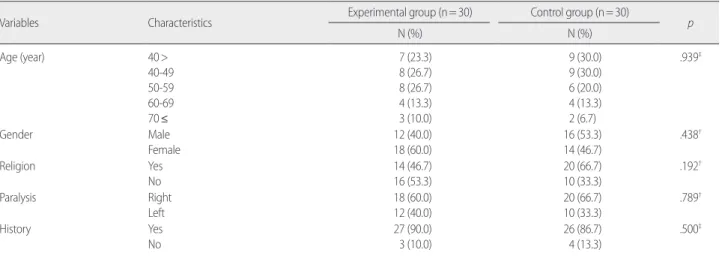
Homogeneity of general characteristics and dependent variables was tested between the experimental group and the control group. There were no statistically significant differences at 5% significance level. The two groups were found to be homogeneous (Tables 1, 2).
2. Effect on DITI
From the ANCOVA results using the pre-test score as covariate, sig- nificant difference between the two groups was found (F = 8.56, p =.005). The experimental group showed less difference in DITI be- tween the affected and the unaffected sides after the acupressure mas- sage. The difference decreased from 0.31˚C (pre-experiment) to 0.14˚C (post-experiment) while the difference in the control group changed from 0.25˚C to 0.20˚C (Table 3).
3. Effect on recovery of facial paralysis status
Inconsistent results were obtained according to the measuring tools.
The change in facial paralysis status measured by H-B grading system, no significant difference was found between the two groups (F=1.99, p =.164). The average score of the experimental group decreased from 4.77 (pre-experiment) to 3.57 (post-experiment) while the score de- Figure 1. Acupressure massages method.
A B C D
E F G H
Jichang 8 beat three massage
Younghyang 8 beat three massage
Yangbac 8 beat three massage
Georvo 8 beat three massage
Sabaek 8 beat three massage
Saiukkong 8 beat three massage
Chaniuk 8 beat three massage
Yepung 8 beat three massage
Table 1. Homogeneity of the General Characteristics
Variables Characteristics Experimental group (n= 30) Control group (n= 30)
N (%) N (%) p
Age (year)
40>
40-49 50-59 60-69 70≤
7 (23.3) 8 (26.7) 8 (26.7) 4 (13.3) 3 (10.0)
9 (30.0) 9 (30.0) 6 (20.0) 4 (13.3) 2 (6.7)
.939
‡Gender
Male Female
12 (40.0) 18 (60.0)
16 (53.3) 14 (46.7)
.438
†Religion
Yes No
14 (46.7) 16 (53.3)
20 (66.7) 10 (33.3)
.192
†Paralysis
Right Left
18 (60.0) 12 (40.0)
20 (66.7) 10 (33.3)
.789
†History
Yes No
27 (90.0) 3 (10.0)
26 (86.7) 4 (13.3)
.500
‡†
p-value from X
2test,
‡p-value from Fisher's exact test Table 2. Homogeneity of the Outcome Variables
Variables Characteriatics
Experimental group
(n= 30) Control group (n= 30)
t p
N (%) N (%)
DITI ( ˚C )
Total Chanjuk Sabaek Georyo Younghyang Jichang Hyeopgeo
0.30± 0.211 0.55± 0.225 0.71± 0.393 0.62± 0.280 0.29± 0.274 0.60± 0.261 0.43± 0.360
0.25± 0.153 0.46± 0.121 0.58± 0.331 0.48± 0.244 0.27± 0.214 0.33± 0.215 0.35± 0.255
1.10 1.24 0.48 0.68 1.87 2.50 0.37
.278 .220 .630 .501 .066 .015 .710 Recovery
†H-B FNGS
4.77± 0.626 4.50± 1.225
4.50± 0.777 4.43± 1.135
1.46 0.22
.149 .828
Subjective symptoms 2.48± 0.474 2.57± 0.624 0.65 .517
Depression 45.90± 8.603 48.23± 5.223 1.27 .209
†
Recovery= Recovery of facial paralysis, H-B= House-Brackmann Grading System; FNGS= Facial Nerve Grade Systems by Brackmann;
DITI= Digital infrared thermographic imaging
Table 3. Comparisons of DITI between Groups
Variables ( ˚C ) Group Before After F
†p
Mean± SD Mean± SD
Total
Experimental group (n= 30) Control group (n= 30)
0.31± 0.212 0.25± 0.153
0.14± 0.117 0.20± 0.125
8.56 .005
Chanjuk
Experimental group (n= 30) Control group (n= 30)
0.55± 0.225 0.46± 0.121
0.18± 0.118 0.37± 0.131
43.71 < .001
Sabaek
Experimental group (n= 30) Control group (n= 30)
0.71± 0.393 0.58± 0.331
0.27± 0.335 0.30± 0.292
1.22 .275
Georyo
Experimental group (n= 30) Control group (n= 30)
0.62± 0.280 0.48± 0.244
0.20± 0.147 0.30± 0.220
11.85 .001
Younghyang
Experimental group (n= 30) Control group (n= 30)
0.29± 0.274 0.27± 0.214
0.25± 0.217 0.37± 0.286
2.92 .093
Jichang
Experimental group (n= 30) Control group (n= 30)
0.60± 0.261 0.33± 0.215
0.20± 0.187 0.25± 0.193
8.62 .005
Hyeopgeo
Experimental group (n= 30) Control group (n= 30)
0.43± 0.360 0.35± 0.255
0.31± 0.335 0.12± 0.185
8.23 .006
†
ANCOVA was conducted using the pre-score of the subjects as covariate, DITI= Digital infrared thermographic imaging
creased from 4.50 to 3.73 in the control group.
A statistically significant difference was found between the two groups when it was measured by FNGS (F=26.81, p<.001). The average score of the experimental group decreased from 4.50 (pre-experiment) to 2.87 (post-experiment) and the score decreased from 4.43 to 3.67 in the control group (Table 4).
4. Effect on subjective symptoms
Subjective symptom score decreased from 2.48 (pre-experiment mean) to 1.92 (post-experiment mean) in the experimental group mean, while it decreased from 2.58 to 2.18 in the control group mean. This re- sult was statistically significant from an ANCOVA using the pre-score as the covariate (F= 6.13, p=.016) (Table 5).
5. Effect on depression
Depression scores decreased from 45.90 (pre-experiment) to 42.13 (post-experiment) and from 48.23 to 47.93 in the experimental and the
control group, respectively. This result was statistically significant (F=16.39, p<.001) (Table 5).
Paired-t-test was done to the lower part depression members and the result showed that there was some difference in no depression part from 41.73 (pre-experiment) to 38.32 (post-experiment) in the experimental group (n=21) and in the control group (n=21), there was little change from 45.43 (pre-control) to 45.95 (post-control). So only the result of ex- perimental group was significant (t= 4.62, p<.001). In mild depression group (n=9), there was some difference from 55.78 (pre-experiment) to 51.00 (post-experiment) in the experimental group and in the control group (n=9), there was a little change from 54.78 (pre-control) to 52.55 (post-control). So only the result of experimental group was significant (t=5.25, p=.001) (Table 6).
Table 4. Comparisons of Recovery of Facial Paralysis between Groups
Variables Group Before After
F
†p
Mean± SD Mean± SD
H-B Experimental group (n= 30)
Control group (n= 30)
4.77± 0.626 4.50± 0.777
3.57± 0.774 3.73± 0.691
1.99 .164
FNGS Experimental group (n= 30)
Control group (n= 30)
4.50± 1.225 4.43± 1.135
2.87± 0.860 3.67± 0.994
26.81 < .001
†
ANCOVA was conducted using the pre-score of the subjects as covariate,
H-B= House-Brackmann Grading System; FNGS= Facial Nerve Grade Systems by Brackmann
Table 5. Comparisons of Subjective Symptoms & Depression between Groups
Variables Group Before After
F
†p
Mean± SD Mean± SD
Subjective symptoms
Experimental group (n= 30) Control group (n= 30)
2.48± 0.474 2.58± 0.624
1.92± 0.424 2.18± 0.527
6.13
.016 Depression
Experimental group (n= 30) Control group (n= 30)
45.90± 8.602 48.23± 5.223
42.13± 8.485 47.93± 5.356
16.39 < .001
†