D I A B E T E S & M E T A B O L I S M J O U R N A L
This is an Open Access article distributed under the terms of the Creative Commons At- tribution Non-Commercial License (http://creativecommons.org/licenses/by-nc/3.0/) which permits unrestricted non-commercial use, distribution, and reproduction in any medium, provided the original work is properly cited.
The Effect of DPP-4 Inhibitors on Metabolic Parameters in Patients with Type 2 Diabetes
Eun Yeong Choe1,*, Yongin Cho1,*, Younjeong Choi1, Yujung Yun1, Hye Jin Wang2, Obin Kwon1,3, Byung-Wan Lee1, Chul Woo Ahn1,4, Bong Soo Cha1,2,4, Hyun Chul Lee1,4, Eun Seok Kang1,2,4
1Division of Endocrinology and Metabolism, Department of Internal Medicine, 2Brain Korea 21 Plus Project for Medical Science, 3Department of Pharmacology, 4Institute of Endocrine Research, Yonsei University College of Medicine, Seoul, Korea
Background: We evaluated the effects of two dipeptidyl peptidase-4 (DPP-4) inhibitors, sitagliptin and vildagliptin, on metabol- ic parameters in patients with type 2 diabetes mellitus.
Methods: A total of 170 type 2 diabetes patients treated with sitagliptin or vildagliptin for more than 24 weeks were selected. The patients were separated into two groups, sitagliptin (100 mg once daily, n=93) and vildagliptin (50 mg twice daily, n=77). We compared the effect of each DPP-4 inhibitor on metabolic parameters, including the fasting plasma glucose (FPG), postprandial glucose (PPG), glycated hemoglobin (HbA1c), and glycated albumin (GA) levels, and lipid parameters at baseline and after 24 weeks of treatment.
Results: The HbA1c, FPG, and GA levels were similar between the two groups at baseline, but the sitagliptin group displayed a higher PPG level (P=0.03). After 24 weeks of treatment, all of the glucose-related parameters were significantly decreased in both groups (P=0.001). The levels of total cholesterol and triglycerides were only reduced in the vildagliptin group (P=0.001), although the sitagliptin group received a larger quantity of statins than the vildagliptin group (P=0.002).The mean change in the glucose- and lipid-related parameters after 24 weeks of treatment were not significantly different between the two groups (P=not significant). Neither sitagliptin nor vildagliptin treatment was associated with a reduction in the high sensitive C-reactive protein level (P=0.714).
Conclusion: Vildagliptin and sitagliptin exert a similar effect on metabolic parameters, but vildagliptin exerts a more potent beneficial effect on lipid parameters.
Keywords: Diabetes mellitus; DPP-4 inhibitor; Glycated serum albumin; Lipids
Corresponding author: Eun Seok Kang
Department of Internal Medicine, Yonsei University College of Medicine, 50 Yonsei-ro, Seodaemun-gu, Seoul 120-752, Korea
E-mail: [email protected]
* Eun Yeong Choe and Yongin Cho contributed equally to this study as first
INTRODUCTION
The increasing prevalence of diabetes mellitus is increasing the economic burden of controlling blood glucose levels and treating complications [1,2]. Diabetes mellitus patients also exhibit a more than 3-fold greater risk of cardiovascular dis- ease (CVD) and mortality than nondiabetic subjects [3]. To prevent CVD, patients with diabetes mellitus require compre- hensive treatment that includes the control of glucose, blood
pressure and cholesterol levels. The UK Prospective Diabetes Study demonstrated that intensive glucose control of type 2 diabetes could prevent microvascular complications [4]. How- ever, large follow-up clinical studies revealed that intensive treatment increases the risk of CVD and mortality due to hy- poglycemia and weight gain [5-7]. Therefore, a variety of po- tential drugs have been developed to control the glucose levels and reduce severe hypoglycemia. Among these drugs, dipepti- dyl peptidase-4 (DPP-4) inhibitors have been proven effective http://dx.doi.org/10.4093/dmj.2014.38.3.211
pISSN 2233-6079 · eISSN 2233-6087
for glucose control without inducing hypoglycemia and are widely used as the primary therapeutic option. Sitagliptin is the first DDP-4 inhibitor that was commercially approved for use.
Many clinical trials demonstrated that sitagliptin reduces the level of glycated hemoglobin (HbA1c) by 0.6% to 1.5% com- pared to placebo in subjects of various ages and ethnicities [8- 10]. Vildagliptin, the second DPP-4 inhibitor developed, also effectively reduces the plasma glucose levels [11,12]. Although both sitagliptin and vildagliptin belong to the same class of DPP-4 inhibitors, these two drugs display many different prop- erties, including structure, pharmacokinetics and mechanism of action to inhibit DPP-4 [13-15]. Sitagliptin is a 523.32 Da compound that contains a pyrimidine structure and displays a 12.4-hour half-life. It is primarily metabolized by cytochrome p450 3A4 and eliminated by renal excretion [13]. Alternatively, vildagliptin is a 303 Da compound that contains a cyanopyri- dine structure and displays a 2-hour half-life. Because of its low protein binding affinity (9%), vildagliptin is rapidly absorbed, reaching its peak plasma concentration within 1 hour, and then rapidly eliminated [14]. However, despite its short half-life, vildagliptin exerts a potent inhibitory effect for 24 hours by co- valently binding to the DPP-4 receptor if administered at a dose of 50 mg twice daily [15,16]. Generally, the effect of both drugs on the plasma glucose level and the glucose indices is similar. Vildagliptin exerts a more potent beneficial effect on the levels of oxidative stress and inflammation markers [17,18].
However, few patients were examined for only a short dura- tion, so the long-term effects of both drugs on metabolic pa- rameters have not been well studied.
This study investigated the effects of two DPP-4 inhibitors, sitagliptin and vildagliptin, on metabolic parameters in pa- tients with type 2 diabetes mellitus.
METHODS
This retrospective study reviewed patients who had been diag- nosed with type 2 diabetes mellitus from January 2008 to De- cember 2012 at Severance Hospital Diabetes Center. Patients who were receiving 100 mg of sitagliptin once daily or 50 mg of vildagliptin twice daily were selected and the dosage of each patient’s previous medications was maintained. The exclusion criteria were as follows: 1) any change in prior medications just before (the past 12 weeks) or during the period of DPP-4 inhibitor treatment, including any alteration in dose, composi- tion, or frequency; 2) chronic liver (Child-Pugh C) or kidney
disease (stage ≥IV); or 3) any medications that could affect the plasma glucose levels, such as a steroid, thyroid hormone, or herbal drug. The enrolled patients were separated into the sitagliptin group or the vildagliptin group according the drug that they were receiving. The metabolic parameters, including the levels of fasting plasma glucose (FPG), postprandial 2-hour glucose (PPG), HbA1c, glycated albumin (GA), total cholesterol, high density lipoprotein cholesterol (HDL-C), low density lipoprotein cholesterol (LDL-C), triglyceride (TG), and creatinine, were measured at baseline and every 12 weeks during the 24-week study. The high sensitivity C-reactive pro- tein (hsCRP) assay was also performed. The prevalence of hy- pertension, coronary artery occlusive disease (CAOD), pe- ripheral artery occlusive disease (PAOD) and stroke and the medical history of statin administration were recorded using the medical records. The FPG levels were determined via the standard glucose oxidase method using a 747 automatic ana- lyzer (Hitachi, Tokyo, Japan). The HbA1c levels were mea- sured via high performance liquid chromatography. The se- rum GA level was determined via an enzymatic method using an albumin-specific proteinase, ketoamine oxidase, and albu- min assay reagent (LUCICA GA-L; Asahi Kasei Pharma Co., Tokyo, Japan), as well as a Hitachi 7699 Pmodule autoanalyzer (Hitachi Instruments Service, Tokyo, Japan). The fasting and postprandial 2-hour insulin and C-peptide levels were mea- sured via a radioimmunoassay method at baseline. To analyze insulin resistance and insulin secretion, homeostatic model as- sessment-insulin resistance (HOMA-IR) and the change in the C-peptide level were calculated as follows: HOMA-IR= fasting insulin (μU/mL)×FPG (mmol/L)/22.5, and ∆C-peptide=
postprandial 2-hour C-peptide–fasting C-peptide. The body mass index (BMI) was also calculated according to the follow- ing equation: BMI=weight (kg)/height2 (m2). The mean change (∆) in each metabolic parameter was calculated using following formula: level after 24 weeks of treatment–level at baseline.
Statistical analysis
All descriptive data were expressed as the means±standard deviation. Continuous variables of the sitagliptin group and the vildagliptin group were compared and analyzed using t- tests. Nominal variables were compared using the chi-square test. Analyses of more than three measured parameters were performed using repeated measures analysis of variance. P val- ues of less than 0.05 were considered to be statistically signifi- cant. Pearson correlation coefficient (r) was used to assess the
strength of the relationships between the clinical and laborato- ry variables. Variables displaying P<0.05 based on univariate analysis were subjected to multivariate analysis. SPSS version 17.0 (SPSS Inc., Chicago, IL, USA) was used for the analyses.
RESULTS
Baseline characteristics
A total of 170 patients suffering from type 2 diabetes mellitus who had received sitagliptin or vildagliptin for more than 24 weeks were selected. Ninety-three patients were taking sita- gliptin, and 77 patients were taking vildagliptin. The baseline characteristics of both groups are presented in Table 1. The mean age of the subjects was 61.3±12.9 years in the sitagliptin group and 58.7±12.2 years in the vildagliptin group (P=
0.186). The diabetes mellitus duration was over 6 years in both groups (P=0.642). There was no difference in the metabolic parameters of the FPG, HbA1c, GA, creatinine, estimated glo- merular filtration rate, TG or total, and LDL-C or HDL-C level at baseline. However, the PPG level was significantly higher in the sitagliptin group than in the vildagliptin group (P=0.030).
Although HOMA-IR was not different between the groups (P=0.480), the postprandial 2-hour C-peptide level and the change in the C-peptide level were significantly higher in the subjects taking vildagliptin than in those taking sitagliptin (P=0.030). There was no significant difference in the preva- lence of hypertension, CAOD, PAOD, or stroke (P=not signif- icant) between the groups. Statins were more frequently ad- ministered in the sitagliptin group than in the vildagliptin group (P=0.002).
Change in the metabolic parameters after 24 weeks of treatment
After 24 weeks of DPP-4 inhibitor treatment, all of the glucose parameters were significantly decreased compared to baseline in both groups (Table 2). The HbA1c and GA levels were sig- nificantly decreased compared to the premedication levels (Fig. 1A and B). The ratio of GA to HbA1c was significantly reduced from 2.5 to 2.3 (P=0.001). There were changes in both the FPG and PPG levels (Fig. 1C and D). However, there was no significant difference between the groups in the mag- nitude of the change in the glucose parameters (Table 2). The total cholesterol and TG levels were significantly decreased in the vildagliptin group (P=0.001) (Fig. 1E and F) regardless of statin use (Supplementary Table 1). The LDL-C level was also
reduced, although this result was not statistically significant (P=0.077). There was no significant change in the lipid pa- rameters in the sitagliptin group (Table 2). Although the mean changes in the lipid parameters were not significantly different between the two groups, vildagliptin displayed a trend to re- duce the total cholesterol levels further than sitagliptin (P=
0.071). The hsCRP level was 1.9±1.2 mg/L in the sitagliptin Table 1. Baseline characteristics of the patients
Characteristic Sitagliptin
(n=93) Vildagliptin
(n=77) P value
Age, yr 61.3±12.9 58.7±12.2 0.186
Sex, male/female 33/60 31/46 0.315
BMI, kg/m2 25.3±3.5 25.3±3.8 0.986
Waist-hip ratio 0.92±0.05 0.92±0.05 0.371 Diabetes duration, yr 6.6±6.7 6.1±4.7 0.642 FPG, mg/dL 144.6±47.3 135.5±32.4 0.153 PPG, mg/dL 240.2±63.2 219.0±60.5 0.030a
HbA1c, % 7.8±1.0 7.6±1.2 0.194
GA, % 19.8±4.2 19.0±4.9 0.304
GA:HbA1c ratio 2.5±0.4 2.5±0.5 0.770
Creatinine, mg/dL 1.0±0.4 1.0±0.4 0.750 eGFR, mL/min/1.73 m2 79.4±20.4 81.4±21.5 0.558 Cholesterol, mg/dL 166.6±72.7 175.9±40.3 0.329 Triglyceride, mg/dL 207.0±27.2 176.7±16.4 0.367 Insulin, μU/mL 11.4±0.9 13.8±2.1 0.240
HOMA-IR 4.0±0.3 4.5±0.6 0.480
C-peptide, ng/mL
Fasting 2.8±1.5 2.9±1.1 0.764
Postprandial 2-hour 6.1±2.6 7.1±2.9 0.035a
∆C-peptide 3.3±2.2 4.2±2.6 0.030a
HTN 59 (63.4) 46 (59.7) 0.368
CAOD 27 (29.0) 16 (20.8) 0.146
PAOD 3 (3.2) 4 (5.2) 0.396
Stroke 14 (15.1) 11 (14.3) 0.532
Statin 63 (67.6) 34 (44.2) 0.002a
Values are presented as mean±standard deviation or number(%).
Student t-test was performed.
BMI, body mass index; FPG, fasting plasma glucose; PPG, postpran- dial glucose; HbA1c, glycated hemoglobin; GA, glycated albumin;
eGFR, estimated glomerular filtration rate; HOMA-IR, homeostatic model assessment-insulin resistance; HTN, hypertension; CAOD, coronary artery occlusive disease; PAOD, peripheral artery occlusive disease.
aP<0.05.
group and 1.5±1.4 mg/L in the vildagliptin group at baseline.
There was no statistical significance difference in the hsCRP level after DPP-4 inhibitor treatment.
Proportion of subjects that reached the treatment target goal
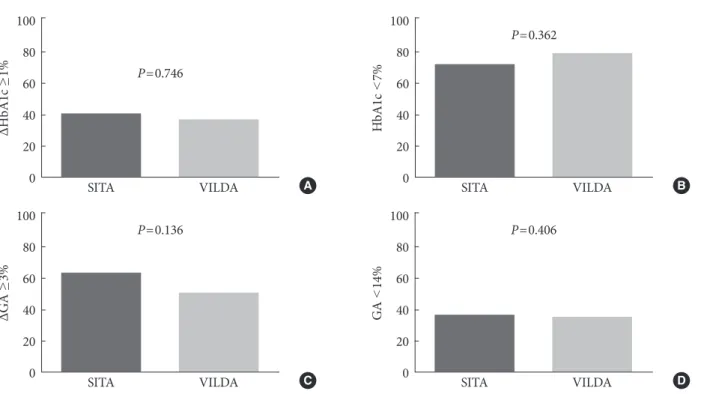
A decrease in the HbA1c level of over 1% from baseline was achieved in 39.8% of the patients administered sitagliptin and 36.4% of the patients administered vildagliptin (P=0.746) (Fig.
2A). The proportion of patients exhibiting an HbA1c level of less than 7% was 73% in the sitagliptin group and 79.5% in the vildagliptin group (P=0.362) (Fig. 2B). There was no signifi- cant difference between the two groups in terms of glucose control. The proportion of patients who achieved a reduction in the GA level of over 3% from baseline was 63.6% in the sita-
gliptin group and 50.8% in the vildagliptin group (P=0.136) (Fig. 2C). The proportion of patients displaying a GA level of less than 14% was 37% in the sitagliptin group and 35% in the vildagliptin group (P=0.406) (Fig. 2D).
DISCUSSION
This study compared the effects of sitagliptin and vildagliptin on metabolic parameters. The efficacy of sitagliptin and vilda- gliptin were directly compared based on various glucose and lipid parameters over the course of 24 weeks of treatment. We found that vildagliptin exerts a similar effect on glucose con- trol to that of sitagliptin, but vildagliptin exerts more potent beneficial effect on the lipid profiles. The metabolic parame- ters could be easily and consistently measured in most outpa- Table 2. Drug effects on metabolic parameters after 24 weeks of treatment
Parameter Sitagliptin (n=93) Vildagliptin (n=77)
Baseline 24 weeks P value Baseline 24 weeks P value
FPG, mg/dL 144.6±47.3 115.7±25.5 0.001 135.5±32.4 115.8±34.3 0.001a
∆FPG –28.9±38.9 –17.8±31.4 0.050
PPG, mg/dL 240.2±63.2 194.8±60.5 0.001 219.0±60.5 174.4±61.5 0.001a
∆PPG –45.3±72.4 –48.7±68.9 0.764
HbA1c, % 7.8±1.0 6.8±0.8 0.001 7.6±1.2 6.7±0.9 0.001a
∆HbA1c –1.0±0.9 –0.9±0.9 0.393
GA, % 19.8±4.2 15.6±3.8 0.001 19.0±4.9 15.4±3.4 0.001a
∆GA –4.1±3.8 –3.5±3.7 0.378
GA:HbA1c ratio 2.5±0.4 2.3±0.4 0.001 2.5±0.5 2.3±0.4 0.001a
∆GA:HbA1c ratio –0.2±0.3 –0.2±0.3 0.405
Cholesterol, mg/dL
Total 166.6±72.7 157.4±42.2 0.105 175.9±40.3 160.7±39.6 0.001a
∆Total –5.4±34.2 –14.0±30.5 0.071
HDL 42.1±11.1 41.7±11.2 0.648 44.6±9.5 44.4±10.7 0.103
∆HDL –0.3±6.7 –1.4±6.9 0.343
LDL 81.6±39.4 83.2±32.0 0.935 96.1±34.1 87.7±26.8 0.077
∆LDL 0.1±4.01 –7.4±4.1 0.208
Triglyceride, mg/dL 207.0±27.8 170.8±150.7 0.111 176.7±16.4 128.6±68.9 0.001a
∆Triglyceride –33.1±19.2 –44.0±13.6 0.656
hsCRP, mg/dL 1.9±1.2 1.4±2.5 0.929 1.5±1.5 1.2±1.1 0.747
∆hsCRP –0.3±1.4 –0.1±0.2 0.964
Values are presented as mean±standard deviation. Student paired t-test or t-test was performed.
FPG, fasting plasma glucose; ∆, level at 24 weeks to level at baseline for the given parameter; PPG, postprandial glucose; HbA1c, glycated he- moglobin; GA, glycated albumin; HDL, high density lipoprotein; LDL, low density lipoprotein; hsCRP, high sensitive C-reactive protein.
aP<0.05.
tient clinics. There were no significant differences in the changes in the glucose parameters. Additionally, a similar pro- portion of the enrolled patients attained the target glucose range after treatment with the DPP-4 inhibitor in both medi- cation groups. Significant changes in the lipid parameters fol- lowing sitagliptin treatment were not detected. However, with vildagliptin treatment, the total cholesterol and TG levels were significantly decreased compared to baseline, although the vildagliptin group received a lower amount of statin drug compared to the sitagliptin group.
There are many studies that investigated the clinical efficacy
of DPP-4 inhibitors [19-24]. Many studies reported an im- provement in the glucose status compared to placebo when administered as a supplement to the existing treatment or as a combination therapy with various drugs, including metfor- min, sulfonylurea, thiazolidinedione, or insulin, in patients suffering from type 2 diabetes mellitus with impaired glucose control. In addition, the clinical parameters that could affect glycemic control were evaluated [10,25,26]. In this study, the GA level was used to evaluate the change in glucose metabo- lism over the course of 2 to 3 weeks as an of index short-dura- tion glucose control [27]. The GA level is currently widely Fig. 1. (A-F) Change in the metabolic parameters during dipeptidyl peptidase-4 (DPP-4) inhibitor treatment. Values are pre- sented as mean±standard error. SITA, sitagliptin; VILDA, vildagliptin; GA, glycated albumin; HbA1c, glycated hemoglobin;
FPG, fasting plasma glucose; PPG, postprandial glucose. aP<0.05, compared to baseline.
SITAVILDA 30
20
10
0
GA (%)
Month
0 3 6 A 200
150 100 50
0
FPG (mg/dL)
Month
0 3 6
a a
a
a
C
10 8 6 4 2 0
HbA1c (%)
Month
0 3 6 B 300
200
100
0
PPG (mg/dL)
Month
0 3 6
a
a
a
a
D 200
150
100
50
Total cholesterol (mg/dL) 0
Month
0 3 6
a a
E Month
250 200 150 100 50 0
Triglyceride (mg/dL)
0 3 6
a a
F SITAVILDA
SITAVILDA SITAVILDA
SITAVILDA
SITAVILDA
used as an index of glycemic control during intensive diabetes treatment as a more rapid glycation index than HbA1c for glu- cose control and excursion [27-29]. In many studies, both drugs exerted a similar effect on glucose reduction compared to placebo, but some studies reported that vildagliptin may ex- ert a more potent effect to reduce of oxidative stress and glu- cose fluctuations, which may play a role in its protection against vascular damage [17,30,31]. Recently, a prospective randomized control trial reported that sitagliptin and vilda- gliptin treatment resulted in a reduction in the carotid artery intra media thickness (IMT) by decreasing the oxidative stress and inflammation marker levels [18]. In that study, there was no significant change in the lipid parameters and no difference between the two groups in the reduction in the glucose pa- rameters over the course of 12 weeks of treatment. However, vildagliptin induced a stronger reduction in the IMT than si- tagliptin. Predictors of the IMT change were only found for glucose fluctuations, measured as the mean amplitude of glu- cose excursion and the LDL levels. In our study, there was no difference in the change in the glucose parameters, including the GA level and the GA to HbA1c ratio. However, there was a significant reduction in the lipid parameters in the vildagliptin group. Some studies reported this effect of DPP-4 inhibitor
ΔGA ≥3%
P=0.136
SITA VILDA
100 80 60 40 20
0 C
GA <14%
P=0.406
SITA VILDA
100 80 60 40 20
0 D
ΔHbA1c ≥1% P=0.746
SITA VILDA
100 80 60 40 20
0 A
HbA1c <7%
P=0.362
SITA VILDA
100 80 60 40 20
0 B
Fig. 2. (A-D) Proportion of subjects that reached the target glucose range. Student t-test was performed. SITA, sitagliptin; VIL- DA, vildagliptin; HbA1c, glycated hemoglobin; ∆HbA1c ≥1, greater than 1% decrease in the HbA1c level from baseline; GA, glycated albumin; ∆GA ≥3, greater than 3% decrease in the GA level from baseline.
treatment on the lipid parameters [17,26,32,33] and found an association between DPP-4 inhibitor treatment and reduced total cholesterol levels. We investigated the change in lipid pa- rameters during a 24-week DPP-4 inhibitor treatment period and compared the efficacy of the two drugs. Although there was no significant difference in the magnitude of the mean change between the two groups, vildagliptin treatment result- ed in significantly reduced levels of total cholesterol and TG.
This study has some limitations. Because it was not a ran- domized clinical trial, there were biochemical differences be- tween the two groups at baseline. We could not exclude the possibility of differences in drug compliance between the two medications. The number of enrolled patients was relatively small because there were few subjects who had not changed other oral hypoglycemic medications. Although we continu- ously followed up for up to 24 weeks, we did not detect a direct effect of either drug on the development of CVD. Therefore, long-term follow-up studies of diabetes using DPP-4 inhibi- tors are needed to obtain additional evidence of their benefits.
In conclusion, vildagliptin exerts a similar effect on meta- bolic profiles to that of sitagliptin, but vildagliptin exerts a more potent beneficial effect on lipid profiles.
CONFLICTS OF INTEREST
No potential conflict of interest relevant to this article was re- ported.
ACKNOWLEDGMENTS
This study was financially supported by the “Kiturami” Faculty Research Assistance Program of Yonsei University College of Medicine (6-2012-0148).
REFERENCES
1. Chen L, Magliano DJ, Zimmet PZ. The worldwide epidemiol- ogy of type 2 diabetes mellitus: present and future perspec- tives. Nat Rev Endocrinol 2012;8:228-36.
2. Ginter E, Simko V. Diabetes type 2 pandemic in 21st century.
Bratisl Lek Listy 2010;111:134-7.
3. Fox CS, Coady S, Sorlie PD, D’Agostino RB Sr, Pencina MJ, Vasan RS, Meigs JB, Levy D, Savage PJ. Increasing cardiovas- cular disease burden due to diabetes mellitus: the Framingham Heart Study. Circulation 2007;115:1544-50.
4. UK Prospective Diabetes Study (UKPDS) Group. Intensive blood-glucose control with sulphonylureas or insulin com- pared with conventional treatment and risk of complications in patients with type 2 diabetes (UKPDS 33). Lancet 1998;352:
837-53.
5. Zoungas S, Patel A, Chalmers J, de Galan BE, Li Q, Billot L, Woodward M, Ninomiya T, Neal B, MacMahon S, Grobbee DE, Kengne AP, Marre M, Heller S; ADVANCE Collaborative Group. Severe hypoglycemia and risks of vascular events and death. N Engl J Med 2010;363:1410-8.
6. ADVANCE Collaborative Group, Patel A, MacMahon S, Chalmers J, Neal B, Billot L, Woodward M, Marre M, Cooper M, Glasziou P, Grobbee D, Hamet P, Harrap S, Heller S, Liu L, Mancia G, Mogensen CE, Pan C, Poulter N, Rodgers A, Wil- liams B, Bompoint S, de Galan BE, Joshi R, Travert F. Intensive blood glucose control and vascular outcomes in patients with type 2 diabetes. N Engl J Med 2008;358:2560-72.
7. ACCORD Study Group, Gerstein HC, Miller ME, Genuth S, Ismail-Beigi F, Buse JB, Goff DC Jr, Probstfield JL, Cushman WC, Ginsberg HN, Bigger JT, Grimm RH Jr, Byington RP, Rosenberg YD, Friedewald WT. Long-term effects of intensive glucose lowering on cardiovascular outcomes. N Engl J Med 2011;364:818-28.
8. Barzilai N, Guo H, Mahoney EM, Caporossi S, Golm GT, Langdon RB, Williams-Herman D, Kaufman KD, Amatruda JM, Goldstein BJ, Steinberg H. Efficacy and tolerability of sita- gliptin monotherapy in elderly patients with type 2 diabetes: a randomized, double-blind, placebo-controlled trial. Curr Med Res Opin 2011;27:1049-58.
9. Iwamoto Y, Taniguchi T, Nonaka K, Okamoto T, Okuyama K, Arjona Ferreira JC, Amatruda J. Dose-ranging efficacy of sita- gliptin, a dipeptidyl peptidase-4 inhibitor, in Japanese patients with type 2 diabetes mellitus. Endocr J 2010;57:383-94.
10. Kim SA, Shim WH, Lee EH, Lee YM, Beom SH, Kim ES, Yoo JS, Nam JS, Cho MH, Park JS, Ahn CW, Kim KR. Predictive clinical parameters for the therapeutic efficacy of sitagliptin in korean type 2 diabetes mellitus. Diabetes Metab J 2011;35:159- 65.
11. Keating GM. Vildagliptin: a review of its use in type 2 diabetes mellitus. Drugs 2010;70:2089-112.
12. Garber AJ, Foley JE, Banerji MA, Ebeling P, Gudbjornsdottir S, Camisasca RP, Couturier A, Baron MA. Effects of vildagliptin on glucose control in patients with type 2 diabetes inadequately controlled with a sulphonylurea. Diabetes Obes Metab 2008;10:
1047-56.
13. Herman GA, Stevens C, Van Dyck K, Bergman A, Yi B, De Smet M, Snyder K, Hilliard D, Tanen M, Tanaka W, Wang AQ, Zeng W, Musson D, Winchell G, Davies MJ, Ramael S, Gottes- diener KM, Wagner JA. Pharmacokinetics and pharmacody- namics of sitagliptin, an inhibitor of dipeptidyl peptidase IV, in healthy subjects: results from two randomized, double-blind, placebo-controlled studies with single oral doses. Clin Phar- macol Ther 2005;78:675-88.
14. Golightly LK, Drayna CC, McDermott MT. Comparative clin- ical pharmacokinetics of dipeptidyl peptidase-4 inhibitors.
Clin Pharmacokinet 2012;51:501-14.
15. He YL. Clinical pharmacokinetics and pharmacodynamics of vildagliptin. Clin Pharmacokinet 2012;51:147-62.
16. He YL, Serra D, Wang Y, Campestrini J, Riviere GJ, Deacon CF, Holst JJ, Schwartz S, Nielsen JC, Ligueros-Saylan M. Phar- macokinetics and pharmacodynamics of vildagliptin in pa- tients with type 2 diabetes mellitus. Clin Pharmacokinet 2007;
46:577-88.
17. Rizzo MR, Barbieri M, Marfella R, Paolisso G. Reduction of oxidative stress and inflammation by blunting daily acute glu- cose fluctuations in patients with type 2 diabetes: role of dipep- tidyl peptidase-IV inhibition. Diabetes Care 2012;35:2076-82.
18. Barbieri M, Rizzo MR, Marfella R, Boccardi V, Esposito A, Pan-
sini A, Paolisso G. Decreased carotid atherosclerotic process by control of daily acute glucose fluctuations in diabetic patients treated by DPP-IV inhibitors. Atherosclerosis 2013;227:349-54.
19. Derosa G, Maffioli P, Salvadeo SA, Ferrari I, Ragonesi PD, Querci F, Franzetti IG, Gadaleta G, Ciccarelli L, Piccinni MN, D’Angelo A, Cicero AF. Effects of sitagliptin or metformin added to pioglitazone monotherapy in poorly controlled type 2 diabetes mellitus patients. Metabolism 2010;59:887-95.
20. Nauck MA, Meininger G, Sheng D, Terranella L, Stein PP; Si- tagliptin Study 024 Group. Efficacy and safety of the dipeptidyl peptidase-4 inhibitor, sitagliptin, compared with the sulfonyl- urea, glipizide, in patients with type 2 diabetes inadequately controlled on metformin alone: a randomized, double-blind, non-inferiority trial. Diabetes Obes Metab 2007;9:194-205.
21. Charbonnel B, Karasik A, Liu J, Wu M, Meininger G; Sita- gliptin Study 020 Group. Efficacy and safety of the dipeptidyl peptidase-4 inhibitor sitagliptin added to ongoing metformin therapy in patients with type 2 diabetes inadequately con- trolled with metformin alone. Diabetes Care 2006;29:2638-43.
22. Lyseng-Williamson KA. Sitagliptin. Drugs 2007;67:587-97.
23. Karagiannis T, Paschos P, Paletas K, Matthews DR, Tsapas A.
Dipeptidyl peptidase-4 inhibitors for treatment of type 2 dia- betes mellitus in the clinical setting: systematic review and me- ta-analysis. BMJ 2012;344:e1369.
24. Kothny W, Foley J, Kozlovski P, Shao Q, Gallwitz B, Lukashev- ich V. Improved glycaemic control with vildagliptin added to insulin, with or without metformin, in patients with type 2 di- abetes mellitus. Diabetes Obes Metab 2013;15:252-7.
25. Yoshioka K, Isotani H, Ohashi S, Imamura M. Efficacy of vildagliptin on glucose fluctuation in Japanese type 2 diabetic patients with ongoing sulfonylurea based oral glycemic agent therapy. Diabetes Metab Syndr 2013;7:32-4.
26. Oh TJ, Jung HS, Bae JH, Kim YG, Park KS, Cho YM, Park KS, Kim SY. Clinical characteristics of the responders to dipeptidyl peptidase-4 inhibitors in Korean subjects with type 2 diabetes.
J Korean Med Sci 2013;28:881-7.
27. Koga M, Kasayama S. Clinical impact of glycated albumin as another glycemic control marker. Endocr J 2010;57:751-62.
28. Kim KJ, Lee BW. The roles of glycated albumin as intermediate glycation index and pathogenic protein. Diabetes Metab J 2012;
36:98-107.
29. Shen Y, Pu LJ, Lu L, Zhang Q, Zhang RY, Shen WF. Glycated albumin is superior to hemoglobin A1c for evaluating the pres- ence and severity of coronary artery disease in type 2 diabetic patients. Cardiology 2012;123:84-90.
30. Signorovitch JE, Wu EQ, Swallow E, Kantor E, Fan L, Gruen- berger JB. Comparative efficacy of vildagliptin and sitagliptin in Japanese patients with type 2 diabetes mellitus: a matching- adjusted indirect comparison of randomized trials. Clin Drug Investig 2011;31:665-74.
31. Sakamoto M, Nishimura R, Irako T, Tsujino D, Ando K, Utsu- nomiya K. Comparison of vildagliptin twice daily vs. sita- gliptin once daily using continuous glucose monitoring (CGM):
crossover pilot study (J-VICTORIA study). Cardiovasc Diabe- tol 2012;11:92.
32. Lim S, An JH, Shin H, Khang AR, Lee Y, Ahn HY, Yoon JW, Kang SM, Choi SH, Cho YM, Park KS, Jang HC. Factors pre- dicting therapeutic efficacy of combination treatment with si- tagliptin and metformin in type 2 diabetic patients: the COS- METIC study. Clin Endocrinol (Oxf) 2012;77:215-23.
33. Monami M, Lamanna C, Desideri CM, Mannucci E. DPP-4 inhibitors and lipids: systematic review and meta-analysis. Adv Ther 2012;29:14-25.
Supplementary Table 1. Lipid profile changes according to statin treatment
Sitagliptin (n=93) Vildagliptin (n=77)
Baseline 24 weeks P value Baseline 24 weeks P value
Statin–
Total, mg/dL 182.4±40.5 182.0±36.5 0.962 184.9±29.6 173.8±29.3 0.002a
∆Total –0.33±36.5 –11.1±21.3 0.175
HDL, mg/dL 41.6±12.7 42.5±11.6 0.619 46.2±11.2 44.6±10.9 0.184
∆HDL 0.9±8.5 –1.6±7.3 0.227
LDL, mg/dL 90.4±34.5 100.0±32.5 0.105 98.6±30.9 97.6±26.9 0.850
∆LDL 9.6±28.0 –0.9±30.6 0.177
Triglyceride, mg/dL 213.8±44.6 194.4±41.5 0.494 189.4±26.2 138.6±12.1 0.030a
∆Triglyceride 0.65±20.3 –18.1±58.6 0.359
Statin+
Total, mg/dL 162.2±80.7 146.3±40.1 0.091 166.5±51.1 145.8±39.2 0.010a
∆Total –7.7±33.2 –20.0±39.6 0.124
HDL, mg/dL 42.0±11.1 41.1±10.5 0.279 45.2±7.9 44.1±10.5 0.359
∆HDL –0.8±5.8 –1.13±6.6 0.824
LDL, mg/dL 79.8±39.8 75.6±29.2 0.426 90.8±37.6 74.9±21.5 0.025
∆LDL –4.2±38.9 –15.9±36.2 0.182
Triglyceride, mg/dL 199.9±34.9 161.3±14.7 0.123 150.1±84.8 115.1±57.4 0.003a
∆Triglyceride –11.5±57.7 –31.2±55.1 0.137
Values are presented as mean±standard deviation. Student paired t-test or t-test was performed.
∆, level at 24 weeks to level at baseline for the given parameter; HDL, high density lipoprotein; LDL, low density lipoprotein.
aP<0.05, compared to baseline.