INTRODUCTION
Sleep disturbance in patients with probable Alzheimer’s dis- ease (AD) are frequent and disabling features, affecting ap- proximately 25–60% of all patients. The most common sleep related complaints are insomnia, sleep fragmentation and ex- cessive daytime sleepiness, frequently accompanied by sleep apnea in patients with probable AD.1 Change in sleep precedes the onset of cognitive symptoms in patients with AD, and a strong association exists between disrupted sleep and the de- velopment of AD.2 Cholinergic neuronal loss of Meynert nu- cleus in the basal forebrain is a pathophysiological hallmark
of AD, and cholinergic activity in the central nervous system influences upper airway opening via the central and peripheral mechanism. Decreased thalamic pontine cholinergic projec- tions may affect the respiratory drive, leading to both central and obstructive apnea in neurodegenerative diseases, includ- ing AD.3,4 The primary pharmacological treatments approved for AD are central acting cholinesterase inhibitors, and riv- astigmine transdermal patches are frequently used in mild to moderate AD. The aim of this study was to evaluate the effects of rivastigmine transdermal patches on sleep architectures and sleep apnea in patients with probable AD.
METHODS
Patient population
Nineteen patients with probable mild to moderate Alzheim- er’s disease were consecutively recruited from the neurocog-
The Effect of Rivastigmine Transdermal Patch on Sleep Apnea in Patients with Probable Alzheimer’s Disease
Hyeyun Kim,1 Hyun Jeong Han2
1Department of Neurology, Catholic Kwandong University International St. Mary’s Hospital, Incheon, Korea
2Department of Neurology, Myongji Hospital, Seonam University College of Medicine, Goyang, Korea
Background and Purpose This study was designed to evaluate the effect on sleep of rivastigmine transdermal patch in patients with probable Alzheimer’s disease (AD).
Methods Patients with probable AD underwent a sleep questionnaire, overnight polysomnography and neuropsychological tests before and after rivastigmine transdermal patch treatment. We analyzed the data from enrolled patients with AD.
Results Fourteen patients with probable AD were finally enrolled in this study. The respiratory disturbance index after the rivastigmine patch treatment was improved in patients with probable AD and sleep breathing disorder, compared with that of before treatment (p<0.05).
Conclusions Rivastigmine transdermal patch application are expected to improve the symptoms of sleep disordered breathing in patients with probable AD. Further placebo controlled studies are needed to confirm these results.
Key Words Alzheimer’s disease, respiratory disturbance index, rivastigmine patch.
Received: October 26, 2016 Revised: December 14, 2016 Accepted: December 14, 2016
Correspondence: Hyun Jeong Han, MD, PhD, Department of Neurology, Myongji Hospital, Seonam University College of Medicine, 55 Hwasu-ro 14beon-gil, Deogyang-gu, Goyang 10475, Korea
Tel: +82-31-810-5403, Fax: +82-31-969-0500, E-mail: [email protected]
cc This is an Open Access article distributed under the terms of the Cre- ative Commons Attribution Non-Commercial License (http://creative- commons.org/licenses/by-nc/3.0) which permits unrestricted non-com- mercial use, distribution, and reproduction in any medium, provided the ori- ginal work is properly cited.
DND
ORIGINAL ARTICLE
Hyeyun Kim et al.
Rivastigmine and Sleep Apnea
nitive and dementia center at Myongji hospital. Patients who met the criteria for probable AD, established by the National Institute of Neurological and Communicative Disorders and Stroke-Alzheimer’s Disease and Related Disorders Association,5 were included in the present study. They ranged from 50 to 90 years of age, and had a Korean Mini-Mental State Exami- nation (K-MMSE)6 score of 10 to 20. The brain computed to- mography or magnetic resonance imaging showed no clinical evidence of other diseases (i.e., normal pressure hydrocepha- lus, brain tumor, cerebrovascular disease) capable of produc- ing a dementia syndrome. They had reliable caregivers who met the patient at least twice a week, and was sufficiently fa- miliar with the patient to provide the investigator accurate in- formation. We enrolled those patients with dementia, where the reliable caregivers observed and reported snoring and stopping of breathing during the night. The exclusion criteria included any primary neurodegenerative or psychiatric dis- orders other than AD (i.e., Parkinson’s disease, schizophrenia, or major depressive disorder); clinically significant laborato- ry abnormalities (such as an abnormal thyroid function test, abnormally low levels of vitamin B12 or folate, or positive Ve- nereal Disease Research laboratory test); any history of drug or alcohol addiction; any severe or unstable medical disease;
any hearing or visual impairment that could disturb the effi- cient evaluation of the patient; any active skin lesion; a history of allergy to topical products containing any of the constitu- ents of the patches; and an involvement in other clinical trials or treated by any an experimental drug within the past three months. Participants should not be taking any acetylcholin- esterase inhibitors (ChEIs) or other anti-dementia drugs for at least four weeks prior to the baseline visit. Subjects were able to visit an outpatient clinic and to perform sleep study and cognitive function tests with walkers, canes or wheelchairs accompanied by their caregivers. The study was conducted in accordance with the Declaration of Helsinki and good clinical reporting practices. The study protocol and informed consent form were reviewed and approved by the institutional review board before commencement of the study. Prior to participa- tion in the study, both the patients and their legal guardians or representatives gave their written informed consent to par- ticipate.
Sleep study and parameters
Enrolled patients took part in a sleep questionnaire to eval- uate their sleep problems and sleep environments. They were also rated on the Epworth Sleepiness Scale (ESS)7 and the Stan- ford Sleepiness Scale (SSS)8 to measure daytime sleepiness, as well as the Beck Depression Inventory (BDI)9 to evaluate de- pressive moods. After completing the questionnaire, the sub-
jects underwent two overnight polysomnographies (PSG), be- fore and after rivastigmine transdermal patch application. PSG recorded the electroencephalography (EEG), electrooculogra- phy (EOG), chin electromyography (EMG), leg EMG, electro- cardiography, and microphone for recording the sounds of sn- oring, plethysmography for evaluating respiratory airflow and effort, and oximetry for checking arterial oxygen saturation.
PSG was performed overnight in a sleep laboratory with a sleep technologist in attendance. The scoring and staging followed the American Academy of Sleep Medicine clinical guidelines.10 Hypopnea was defined ≥50% airflow reduction and ≥3%
desaturation or arousal. Sleep stages were based on 3 sources of data coming from 7 channels: EEG, EOG, and chin EMG.
Sleep architecture considered the following variables: propor- tion of non-rapid eye movement (REM) sleep period; N1, N2, N3, and REM sleep periods from PSG data. Breathing event during sleep was evaluated as the Apnea Hypopnea In- dex (AHI) and Respiratory Disturbance Index (RDI), which included AHI and respiratory event related arousal. Sleep dis- ordered breathing (SDB) was defined by AHI or RDI of 5 or higher, in association with excessive daytime somnolence. Oth- er variables, including periodic limb movement during sleep (PLMS), total sleep time (TST), total wake time (TWT), wake time after sleep onset (WASO) and sleep onset latency (SL), and sleep efficiency (SE), were calculated from data of over- night PSG.
Neuropsychological tests
The K-MMSE was administrated at the screening, baseline and at the end of the study. The clinical dementia rating (CDR)11 and Korean version of AD assessment scale-cognitive (ADAS- cog) subscale12 were collected at the baseline and at end of the study. All of the above neuropsychological tests were per- formed with the same clinical psychologist for the entire pe- riod of the clinical trial.
Statistical analysis
Sleep variables, such as the proportion of N1, N2, N3, and REM, TST, TWT, WASO, SL, SE, RDI, AHI, PLMS index from overnight PSG and ESS, SSS, BDI from the sleep ques- tionnaire and K-MMSE, CDR ADAS-cog score were com- pared with baseline and at 12 weeks after rivastigmine patch- es were applied. Comparative analysis between the data from the baseline study and the data from follow up studies for all enrolled patients with AD were analyzed by the chi-square test to compare categorical variables, and the paired t-test to com- pare continuous variables, using SPSS v 17.0 software (SPSS for Windows, SPSS Inc., Chicago, IL, USA).
DND
RESULTS
Study population and disposition
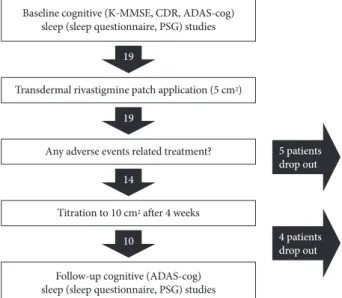
Nineteen patients with probable AD with SDB were initially recruited in this study. Sleep and neurocognitive studies were performed at the baseline level for these nineteen patients with AD. After the baseline study, all enrolled patients were adminis-
trated 5 cm2 rivastigmine patch per day for 4 weeks. In the ab- sence of any adverse events related with the patch, patients were treated to 10 cm2 rivastigmine patch for three months. Howev- er, five patients reported skin eruptions or erythema and itch- ing at the site of application during the run-in period of four weeks. They were excluded from this study because of skin problems attributed to rivastigmine transdermal patch. Finally, fourteen patients achieved a target patch size of 10 cm2 riv- astigmine patch from the initial patch application (Fig. 1). Af- ter 12 weeks from baseline sleep and neurocognitive studies, a follow up sleep and neurocognitive study was performed in these fourteen patients. They were 68.4±4.3 [mean±standard deviation(SD)] years old, and included five males and nine fe- males. Their body mass index was 23.8±2.9 (mean±SD) kg/m2. Education status of enrolled patients was 4.02±3.04 (mean±
SD) years, and K-MMSE was 19±3.0 (mean±SD) at the base- line level. ADAS-cog was 31±10.1 (mean±SD) at baseline lev- el. All these patients did not consume coffee or caffeine con- taining tea. Three patients (two males, one female) reported initiation insomnia as well as SDB. One of these patients was on antihypertensive drug for 10 years. The other patients had no vascular risk factors such as diabetes, hyperlipidemia and hypertension, stroke or cardiac problems.
Effect of rivastigmine transdermal patches on sleep and cognitive function
TST, TWT and proportion of N1, N2, N3 and REM sleep showed no statistical difference between the baseline and fol- low up values after rivastigmine patch application. The WASO, SL, SE, and PLMS index also did not show any difference from Table 1. Polysomnographic and cognitive outcome measures
Parameter Baseline After treatment Interaction p
Total sleep time (mins) 283.3±62.7 249.9±85.7 0.288
Stage 1 sleep (%) 21.9±14.6 18.6±13.1 0.394
Stage 2 sleep (%) 53.3±18.7 55.9±13.1 0.863
Stage 3 sleep (%) 17.0±2.5 12.0±14.1 0.571
REM sleep (%) 14.9±9.5 22.3±25.2 0.367
Total wake time (mins) 142.0±56.2 168.9±77.1 0.481
WASO (mins) 113.8±60.2 172.5±114.6 0.170
Latency to sleep onset (mins) 28.2±26.8 37.5±39.8 0.942
Sleep efficiency (%) 66.4±13.3 59.0±20.1 0.347
Respiratory Disturbance Index (/hr) 45.3±18.4 28.4±14.4 0.023
Apnea Hypopnea Index (/hr) 41±12.4 24.76±18.2 0.018
PLMS Index (/hr) 34.0±36.0 29.9±36.4 0.053
Epworth Sleepiness Scale 7.3±4.8 9.3±4.0 0.491
Stanford Sleepiness Scale 2.5±1.9 2.3±1.7 0.849
ADAS-cog score 31±10.1 22.5±5.9 0.199
ADAS-cog: Alzheimer’s disease assessment scale-cognitive, PLMS: periodic limb movement during sleep, REM: rapid eye movement, WASO: wake time after sleep onset.
Fig. 1. Study schedule. Nineteen patients enrolled and underwent baseline cognitive and sleep studies. Five patients dropped out due to adverse events related to transdermal treatment. Four pa- tients dropped out for refusal of additional overnight PSG study.
Finally, 10 patients were compared, before and after transdermal rivastigmine treatment. ADAS-cog: Alzheimer’s disease assess- ment scale-cognitive, CDR: clinical dementia rating, MMSE: Mini- Mental State Examination, PSG: polysomnographies.
Baseline cognitive (K-MMSE, CDR, ADAS-cog) sleep (sleep questionnaire, PSG) studies
Transdermal rivastigmine patch application (5 cm2)
Any adverse events related treatment?
Titration to 10 cm2 after 4 weeks
Follow-up cognitive (ADAS-cog) sleep (sleep questionnaire, PSG) studies
19
5 patients drop out
4 patients drop out 19
14
10
Hyeyun Kim et al.
Rivastigmine and Sleep Apnea
the baseline levels after treatment. However, RDI and AHI (28.4±14.4 and 24.76±28.2, respectively) markedly decreased after the rivastigmine patch treatment (p<0.05) compared to RDI and AHI at baseline level (45.3±18.4 and 41± 12.4, re- spectively). ESS and SSS from the sleep questionnaire showed no differences between baseline and after treatment. The sleep study findings are summarized in Table 1. The K-MMSE and CDR were 19±3.0 and 1.2±0.4 (mean±SD) at the baseline level, and 18±3.0 and 1.3±0.66 (mean±SD) after rivastigmine patch application, respectively. ADAS-cog scores were 31±10.1 (mean±SD) at baseline and 22.5±5.9 (mean± SD) after treat- ment. However, there was no statistical significance of cogni- tion and in the functional state before and after rivastigmine transdermal patch treatment. These results are outlined in Table 1.
DISCUSSION
Several studies support the association between sleep apnea and AD.2,3 SDB reported a high prevalence (33% to 60%) of patients with AD, and is considered as an important non-cog- nitive symptom contributing to three clinical courses of AD.2 SDB is often reported to have an association with agitation or day time somnolence, other than cardiovascular risk, in pa- tients with AD.13,14 Therefore, treatment of SDB is considered to be a significant issue in the management of patients with AD. Ancoli-Israel et al.15 reported that continuous positive airway pressure (CPAP) reduced daytime somnolence in pa- tients with mild to moderate AD with SDB. Cooke et al.16 re- ported that the long-term CPAP treatment for patients with AD and SDB may result in improvements of sleep and mood, as well as a slowing cognitive deterioration. Especially for pa- tients with dementia, it is difficult to maintain CPAP therapy because most of the cognitive behavioral problems are aggra- vated during night time sleep. In contrast to previous studies on physical and surgical treatment for SDB, there is a dearth of effective pharmacological approaches.17 Very few studies have examined the effects of cholinergic treatment on sleep in patients with AD. A study on the effects of tacrine on REM sleep was not conclusive, probably since doses higher than 100 mg per day could not be administered due to hepa- totoxicity.18 PSG data by Moraes et al.19 reported that donepe- zil inhibits acetylcholinesterase improved obstructive sleep ap- nea and increased REM sleep density and periods in patients with AD. No evidence of worsening sleep or nightmares were found in the above study. Suckys-Claudino et al.20 showed that donepezil treatment improved RDI, oxygen de- saturation, and sleepiness. These studies with donepezil sup- port the conceptual opinion that cholinergic transmission
might influence breathing regulation in patients with AD/
SDB. Meanwhile, rivastigmine transdermal patches are an- other form of acetylcholinesterase and butyrylcholinesterase inhibitors, which are currently approved for the treatment of patients with probable AD.21 A transdermal form of rivastig- mine has several advantages, including continuous delivery with reduced fluctuation of plasma drug levels, improved tol- erability, easy administration of optimal doses, and preference for caregivers.22-24 We expect and focus the stable cholinergic properties of rivastigmine patches be tolerated by our en- rolled subjects; however, adverse events, such as skin rash or itching sensation, developed in a few patients after rivastig- mine patch application. The present study demonstrated that rivastigmine patch treatment has the potential to reduce RDI and improve sleep apnea or hypopnea, but did not changed other sleep parameters, namely sleep latency, SE, WASO or REM sleep density and periods. Another finding is that im- proved RDI of patients with AD on rivastigmine patch treat- ment was not statistically significant when correlated to cog- nitive function measured by ADAS-cog. To the best of our knowledge, this is the first PSG study on the effect of rivastig- mine transdermal patches in patients with probable AD. Until now, most cholinergic drugs mainly increase the REM densi- ty and decrease the latency of REM onset. However, several studies have shown contradictory results, depending on the subjects or drugs enrolled in each study.25,26 In particular, a re- cent study of rivastigmine in elderly persons significantly re- duced the REM latency, while there was no effect on REM sleep proportion.27 In our study, the rivastigmine patch treat- ment did not affect the proportion of REM sleep or latency to REM onset, and REM density. We suggest that a large sample longitudinal study would be appropriate to estimate the ef- fect of rivastigmine during REM sleep. In degenerative con- ditions such as dementia, the decreased thalamo-pontine cholinergic projections may affect the respiratory drive, lead- ing to both central and obstructive sleep apnea.3,28 Based on this mechanism, increasing the cholinergic tone by ChEIs in thalamopontine cholinergic projections could improve SDB.
We consider that the cholinergic action of rivastigmine trans- dermal patch is the main mechanism for improving SDB. In contrast, enhancing REM sleep of ChEIs might affect sleep apnea in a negative way, in spite of its positive effect to impaired cognitive functions. Such conflicting effects make it difficult to understand the actual mechanisms. A possible explanation is that rivastigmine increases the central cholinergic transmission in areas related to different tasks, including cognitive function, REM sleep generation and regulation. We suggest that further studies for the cholinergic effects of ChEIs on REM sleep and SDB should be conducted to confirm our conclusion. In our
DND
study, follow up scores of ADAS-cog improved, compared to the baseline study. However, a small size of subjects could not generate a statistical significance. In another randomized dou- ble blind study, rivastigmine showed increasing ADAS-cog score with improved cognitive function, and participation in activities of daily living in patients with mild to moderately se- vere AD.22,23,27 Anatomic structures affected by AD, to some degree, overlap with those related to the genesis and control of REM sleep. This made some researchers to speculate that there might be a functional relationship between REM sleep and the pathogenesis of AD.28 The relationship between REM sleep and cognition still requires complex interpretation. The role played by REM sleep disturbances in the cognitive impair- ment of patients with AD continues to be a promising research field. For clinicians who prescribe drugs to patients with de- mentia, including probable AD patients, many have consid- erable comorbidity, including psychiatric or behavioral symp- toms, other than sleep disturbance. Among the comorbidity findings, SDB is an important factor that could contribute to cognitive decline in patients with dementia. Clinicians some- times have enemies on all sides to manage patients with AD and SDB. Fortunately, ChEIs are expected to aid in this issue based on studies that support the positive effects of ChEIs on patients with SDB, including our current study. There are some limitations of small size, short duration of study, and no control group to make a confirmative result from this data. Therefore, further large randomized double-blinded controlled studies are needed to conclude the effect and action of ChEIs on SBD in patients with probable AD.
Conflicts of Interest
The authors have no financial conflicts of interest.
REFERENCES
1. Moran M, Lynch CA, Walsh C, Coen R, Coakley D, Lawlor BA.
Sleep disturbance in mild to moderate Alzheimer’s disease. Sleep Med 2005;6:347-352.
2. Bliwise DL. Sleep disorders in Alzheimer’s disease and other demen- tias. Clin Cornerstone 2004;6 Suppl 1A:S16-S28.
3. Bellingham MC, Ireland MF. Contribution of cholinergic systems to state-dependent modulation of respiratory control. Respir Physiol Neu- robiol 2002;131:135-144.
4. Gilman S, Koeppe RA, Nan B, Wang CN, Wang X, Junck L, et al. Ce- rebral cortical and subcortical cholinergic deficits in parkinsonian syn- dromes. Neurology 2010;74:1416-1423.
5. McKhann G, Drachman D, Folstein M, Katzman R, Price D, Stadlan EM. Clinical diagnosis of Alzheimer’s disease: report of the NINCDS- ADRDA Work Group under the auspices of department of health and human services task force on Alzheimer’s disease. Neurology 1984;
34:939-944.
6. Kang Y, Na DL, Hahn S. A validity study on the Korean Mini-Mental State Examination (K-MMSE) in dementia patients. J Korean Neurol Assoc 1997;15:300-308.
7. Johns MW. A new method for measuring daytime sleepiness: the Ep- worth Sleepiness Scale. Sleep 1991;14:540-545.
8. Herscovitch J, Broughton R. Sensitivity of the stanford sleepiness scale to the effects of cumulative partial sleep deprivation and recov- ery oversleeping. Sleep 1981;4:83-91.
9. Beck AT, Ward CH, Mendelson M, Mock J, Erbaugh J. An inventory for measuring depression. Arch Gen Psychiatry 1961;4:561-571.
10. Iber C, Ancoli-Israel S, Chesson A, Quan SF. The AASM manual for the scoring of sleep and associated events: rules, terminology, and technical specification. 1st ed. Westchester: American Academy of Sleep Medicine; 2007.
11. Choi SH, Na DL, Lee BH, Hahm DS, Jeong JH, Yoon SJ, et al. Esti- mating the validity of the Korean version of expanded clinical de- mentia rating (CDR) scale. J Korean Neurol Assoc 2001;19:585-591.
12. Rosen WG, Mohs RC, Davis KL. A new rating scale for Alzheimer’s disease. Am J Psychiatry 1984;141:1356-1364.
13. Gehrman PR, Martin JL, Shochat T, Nolan S, Corey-Bloom J, Ancoli- Israel S. Sleep-disordered breathing and agitation in institutionalized adults with Alzheimer disease. Am J Geriatr Psychiatry 2003;11:426- 14. Peppard PE, Young T, Palta M, Skatrud J. Prospective study of the 433.
association between sleep-disordered breathing and hypertension. N Engl J Med 2000;342:1378-1384.
15. Ancoli-Israel S, Palmer BW, Cooke JR, Corey-Bloom J, Fiorentino L, Natarajan L, et al. Cognitive effects of treating obstructive sleep apnea in Alzheimer’s disease: a randomized controlled study. J Am Geriatr Soc 2008;56:2076-2081.
16. Cooke JR, Ayalon L, Palmer BW, Loredo JS, Corey-Bloom J, Natara- jan L, et al. Sustained use of CPAP slows deterioration of cognition, sleep, and mood in patients with Alzheimer’s disease and obstructive sleep apnea: a preliminary study. J Clin Sleep Med 2009;5:305-309.
17. White DP. Pharmacologic approaches to the treatment of obstructive sleep apnea. Sleep Med Clin 2016;11:203-212.
18. Riemann D, Lis S, Fritsch-Montero R, Meier T, Krieger S, Hohagen F, et al. Effect of tetrahydroaminoacridine on sleep in healthy subjects.
Biol Psychiatry 1996;39:796-802.
19. Moraes W, Poyares D, Sukys-Claudino L, Guilleminault C, Tufik S.
Donepezil improves obstructive sleep apnea in Alzheimer disease: a double-blind, placebo-controlled study. Chest 2008;133:677-683.
20. Sukys-Claudino L, Moraes W, Guilleminault C, Tufik S, Poyares D.
Beneficial effect of donepezil on obstructive sleep apnea: a double- blind, placebo-controlled clinical trial. Sleep Med 2012;13:290-296.
21. Winblad B, Machado JC. Use of rivastigmine transdermal patch in the treatment of Alzheimer’s disease. Expert Opin Drug Deliv 2008;5:
1377-1386.
22. Kurz A, Farlow M, Lefèvre G. Pharmacokinetics of a novel transder- mal rivastigmine patch for the treatment of Alzheimer’s disease: a re- view. Int J Clin Pract 2009;63:799-805.
23. Han HJ, Lee JJ, Park SA, Park HY, Kim JE, Shim YS, et al. Efficacy and safety of switching from oral cholinesterase inhibitors to the riv- astigmine transdermal patch in patients with probable Alzheimer’s disease. J Clin Neurol 2011;7:137-142.
24. Schredl M, Weber B, Braus D, Gattaz WF, Berger M, Riemann D, et al. The effect of rivastigmine on sleep in elderly healthy subjects. Exp Gerontol 2000;35:243-249.
25. Kanbayashi T, Sugiyama T, Aizawa R, Saito Y, Ogawa Y, Kitajima T, et al. Effects of donepezil (Aricept) on the rapid eye movement sleep of normal subjects. Psychiatry Clin Neurosci 2002;56:307-308.
26. Schredl M, Weber B, Leins ML, Heuser I. Donepezil-induced REM sleep augmentation enhances memory performance in elderly, healthy persons. Exp Gerontol 2001;36:353-361.
27. Grossberg GT, Schmitt FA, Meng X, Tekin S, Olin J. Reviews: effects of transdermal rivastigmine on ADAS-cog items in mild-to-moderate
Hyeyun Kim et al.
Rivastigmine and Sleep Apnea
Alzheimer’s disease. Am J Alzheimers Dis Other Demen 2010;25:627- 28. Lim AS, Ellison BA, Wang JL, Yu L, Schneider JA, Buchman AS, et 633.
al. Sleep is related to neuron numbers in the ventrolateral preoptic/in- termediate nucleus in older adults with and without Alzheimer’s dis- ease. Brain 2014;137(Pt 10):2847-2861.