Facile Synthesis of MoS 2 -C 60 Nanocomposites and Their Application to Catalytic Reduction and Photocatalytic Degradation
Jiulong Li * and Weon Bae Ko *,**,†
* Department of Convergence Science, Graduate School,
** Department of Chemistry, Sahmyook University, Seoul 139-742, South Korea (Received November 21, 2016, Revised December 9, 2016, Accepted December 13, 2016)
Abstract: MoS
2precursors were synthesized by reacting thioacetamide (C
2H
5NS) with sodium molybdate dihydrate (Na
2MoO
4·2H
2O) in aqueous HCl solution. MoS
2nanoparticles were prepared from dried MoS
2precursors by calcination in an electric furnace at 700°C for 2 h under an inert argon atmosphere. MoS
2-C
60nanocomposites were obtained by heating MoS
2nanoparticles and fullerene (C
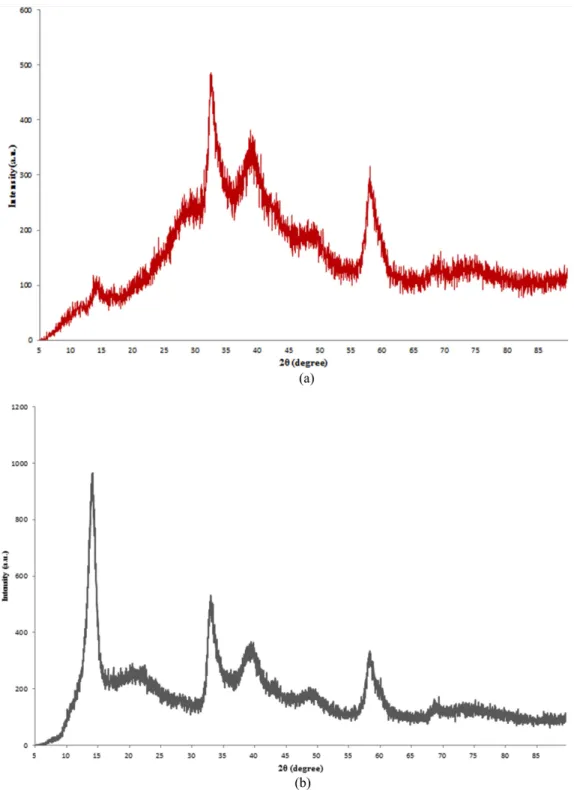
60) together in an electric furnace at 700°C for 2 h. Their morphological and the struc- tural properties were characterized by powder X-ray diffraction and scanning electron microscopy. The MoS
2nanoparticles and MoS
2-C
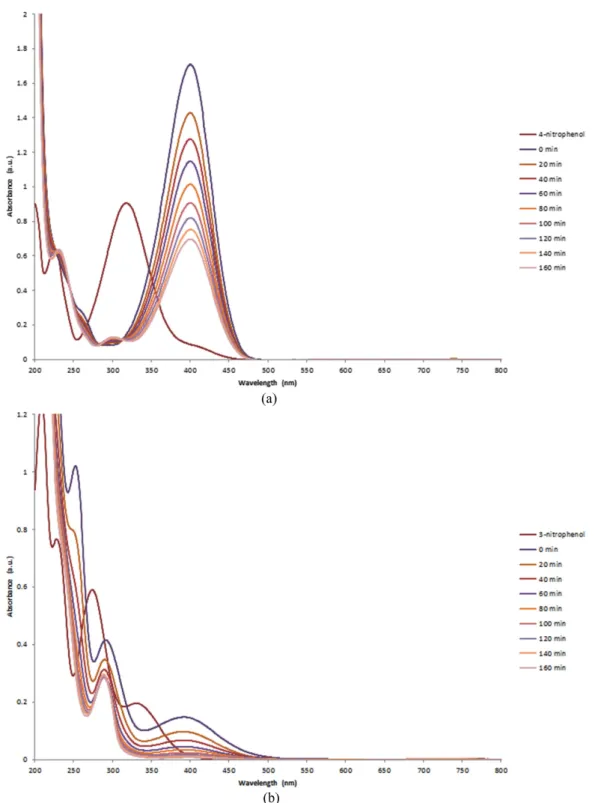
60nanocomposites were used as catalysts in the reductions of 2-, 3-, and 4-nitrophenol in the presence of sodium borohydride. The photocatalytic activities of the MoS
2nanoparticles and MoS
2-C
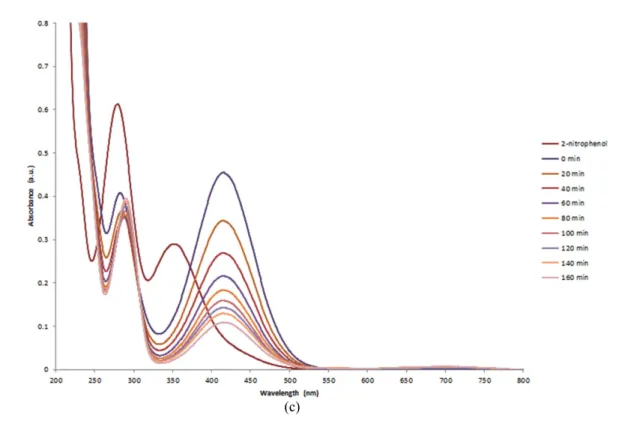
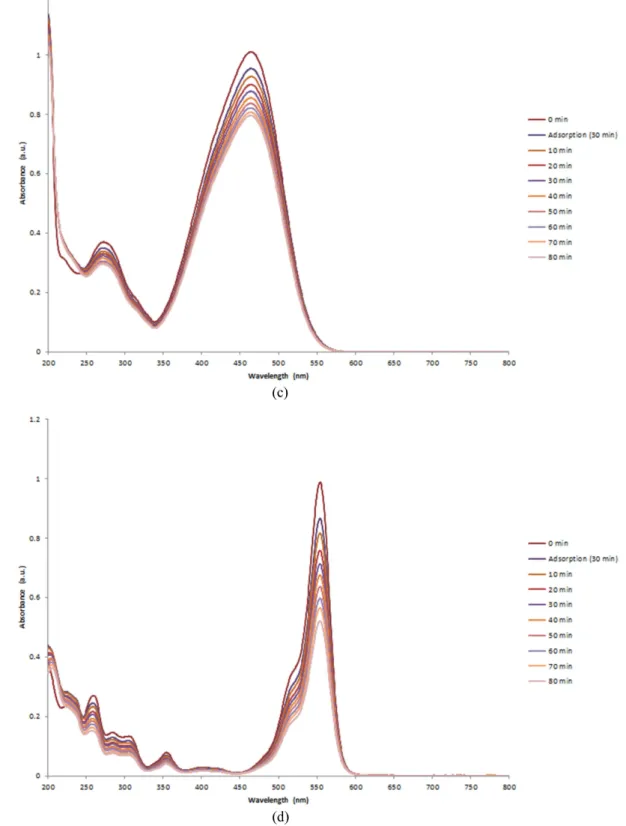
60nanocomposites were evaluated in the degradation of organic dyes (brilliant green, methylene blue, methyl orange, and rhodamine B) under ultraviolet light (254 nm).
Keywords: MoS
2nanoparticles, MoS
2-C
60nanocomposites, reductions, photocatalytic activities
Introduction
In past decades, water pollution has become a significant environmental problem. Consequently, wastewater treatment techniques are attracting attention worldwide, with extensive research efforts devoted to improving the efficiency of water- treatment. 1-3 The removal of pigments and synthetic dyes from industrial wastewater is challenging because of their solubility and chemical stability in aqueous solution. 4 Aro- matic nitro compounds are one of the severe water pollutants, and so the development of effective decontamination tech- nology is necessary to decrease their presence in the envi- ronment. 5
To remove aromatic nitro compounds, reduction using sodium borohydride (NaBH 4 ) in the presence of a suitable catalyst is considered as an excellent method. 6 The reduction of aromatic nitro compounds can be used to produce amin- ophenol, which is an important intermediate in the synthesis of antipyretic and analgesic drugs. 7 Therefore, reduction methods could be used not only to reduce pollution, but also to produce useful reactants for the pharmaceutical industry.
Many metal and metal oxide materials, such as Au, Ag, Ni, and CuO, have been used as catalysts in these reduction reac- tions. 8-11
Photocatalytic degradation using semiconductor photocat- alysts is an effective method for reducing the pollution caused by pigments and synthetic dyes. 12,13 As the most promising photocatalyst, titanium dioxide (TiO 2 ) has attracted much attention, and many photocatalysts composed of semi- conductors, such as ZnO, CdS, and WO 3 , coupled with TiO 2 have been synthesized. 14,15 However, TiO 2 band gap is about 3.2 eV, which limits its photocatalytic activity. Therefore, much effort has been focused on developing highly efficient photocatalysts that are more applicable. 1,12
Molybdenum disulfide (MoS 2 ) has a layered graphite-like structure. 16 Because of its unique optoelectronic, catalytic, photocatalytic, and electronic properties, MoS 2 has been used in wide-ranging applications in many fields. 17,18 The unit cell of MoS 2 contains molybdenum atoms sandwiched between layers of two sulfur atoms. Multi-layer of molybdenum disul- fide is maintained by weak van der Waals interactions between the two-dimensional S–Mo–S structures, and the resultant MoS 2 thin layers show excellent catalytic and optical adjust- ability. 19,20 MoS 2 is a newly emerging semiconductor, with a
†