Catalytic Activity of BiVO 4 -graphene Nanocomposites for the Reduction of Nitrophenols and the Photocatalytic Degradation of Organic Dyes
Jiulong Li * , Jeong Won Ko * , and Weon Bae Ko *,**,†
* Department of Convergence Science, Graduate School, Sahmyook University, Seoul 139-742, South Korea
** Department of Chemistry, Sahmyook University, Seoul 139-742, South Korea (Received September 5, 2016, Revised September 19, 2016, Accepted September 19, 2016)
Abstract: BiVO
4nanomaterial was synthesized from bismuth (III) nitrate pentahydrate [Bi(NO
3)
3·5H
2O] and ammonium vanadate (V) [NH
4VO
3]. The BiVO
4-graphene nanocomposite was fabricated by calcining the BiVO
4nanomaterial and graphene under an oxygen-free atmosphere at 700
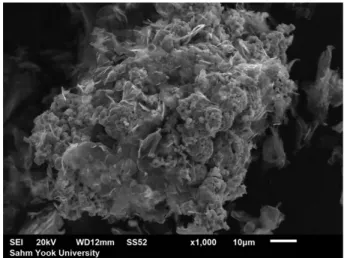
oC. X-ray diffraction (XRD) and scanning electron microscopy (SEM) were employed to characterize structural and morphological properties of samples. The catalytic activity of the BiVO
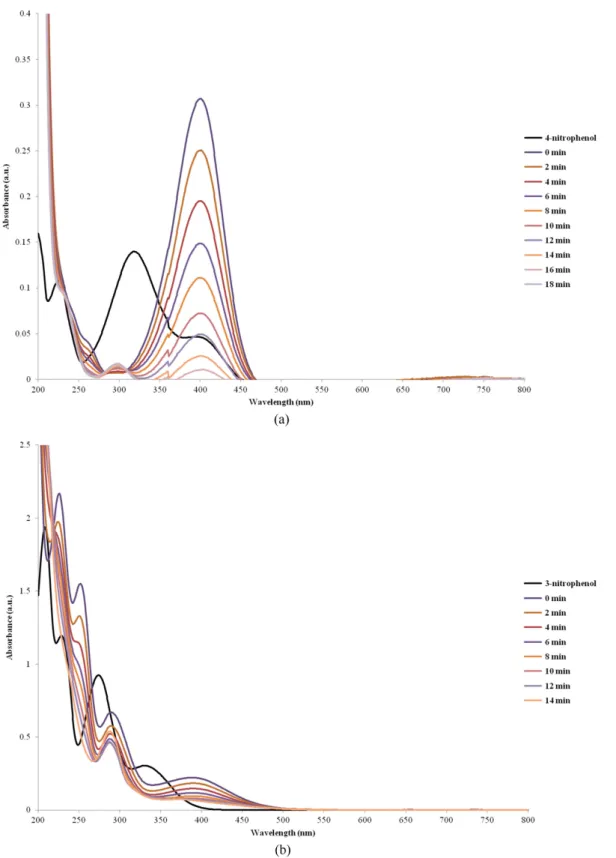
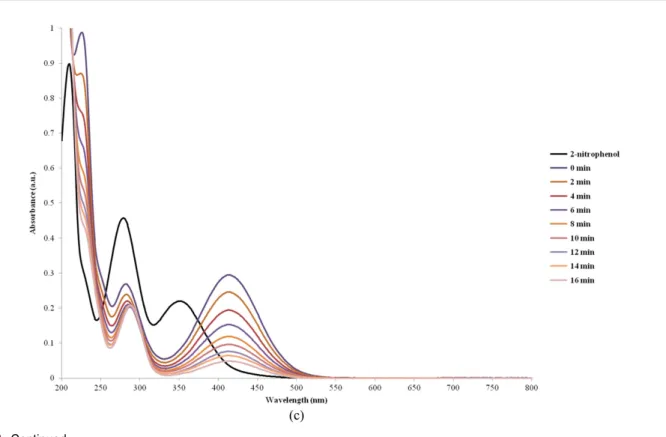
4- graphene nanocomposite was studied for the reduction of 4-nitrophenol, 3-nitrophenol and 2-nitrophenol by sodium boro- hydride [NaBH
4]. The photocatalytic activity of the BiVO
4-graphene nanocomposite was demonstrated by the degradation of organic dyes like BG, MB, MO and RhB under irradiation at 365 nm. The catalytic and photocatalytic activity were stud- ied by UV-vis spectrophotometry.
Keywords: BiVO
4-graphene Nanocomposites, catalytic activities, photocatalytic activities, UV-vis spectrophotometer
Introduction
Progress in industrialization has gradually improved the quality of human life, but has also brought upon a series of environmental problems. In recent decades, wastewater treat- ment techniques have attracted much attention. 1 Aromatic nitro compounds represented by nitrophenols and synthetic dyes are major water pollution sources, owing to their sol- ubility, and biological and chemical stability in water. 2-5
Aminophenol is an important intermediate in the synthesis of analgesic and antipyretic drugs such as phenacetin, acet- anilide and acetaminophen. 6 A reducing agent, aminophenol is also utilized as a photographic developer and as an anti- corrosion lubricant in fuels. 7 Therefore, it is necessary to con- vert nitrophenols in wastewater to aminophenols, which can then be used for industrial production. Many studies have been focused on the reduction by NaBH 4 in the presence of a suitable catalyst to solve this problem. 1,7 Due to their unique electrical, optical, and catalytic performances in com- parison to bulk particles, metal and metal oxide nanoparticles such as Ag, 8 Au, 9 Cu, 10 Ni 11 and CuO 12 have been developed as catalysts for the reduction of nitrophenols. A large number
of individual studies of catalysts have been reported for the reduction of nitrophenols and their use as photocatalysts for the degradation of organic dyes; however, the study of com- mon catalysts for both reduction and photocatalytic degra- dation is scarce. We fabricated BiVO 4 nanoparticles and decorated them on graphene to obtain a BiVO 4 -graphene nanocomposite. The catalytic reduction of 4-nitrophenol to 4- aminophenol in the presence of NaBH 4 was carried out on the BiVO 4 -graphene nanocomposite in an aqueous solution.
Other nitrophenols like 3-nitrophenol and 2-nitrophenol were also tested under the same conditions.
Studies of semiconductor photocatalysts reveal important results that could help to solve the problem of pollution caused by synthetic dyes. TiO 2 is a well-known early semi- conductor photocatalyst used for the degradation of organic dyes. 13 However, the photocatalytic activity of TiO 2 is limited because of its relatively wide band gap (3.2 eV). 14,15 Many efforts have been made to improve this deficiency by mod- ifying TiO 2 with other semiconductors; many novel semi- conductor materials with narrow band gaps have been explored. 13 Among the photocatalysts explored, metal oxide semiconductors such as WO 3 , 16 Fe 2 O 3 , 17 Bi 2 O 3 , 18 Ag 3 VO 4 , 19 and BiVO 4 , 20 have been developed. Particularly, BiVO 4 has attracted interest due to its non-toxicity, non-corrosiveness,
†