Ⅰ. INTRODUCTION
Enamel adhesion is one of the important factors for the longevity of restorations because failure of sealing in the enamel margin leads to leakage of oral fluid and bacterial invasion, and finally results in hypersensitivity and secondary caries.
Marginal discoloration and recurrent caries are
Effects of one or two applications of all-in-one adhesive on microtensile bond strength to unground enamel
Chang-Yong Son, Hyeon-Cheol Kim, Bock Hur, Jeong-Kil Park*
Department of Conservative Dentistry, College of Dentistry, Pusan National University, Busan, Korea
The purposes of this study were to compare the effects of one or two applications of all-in-one adhesives on microtensile bond strengths (μTBS) to unground enamel and to investigate the morphological changes in enamel surfaces treated with these adhesives using a scanning electron microscopy (SEM).
Twenty-five noncarious, unrestored human mandibular molars were used. The unground enamel surfaces were cleansed with pumice. The following adhesives were applied to lingual, mid-coronal surfaces according to manufacture’s directions; Clearfil SE bond in SE group, Adper Prompt L-PopTM1 coat in LP1 group, 2 coats in LP2 group, Xeno�Ⅲ1 coat in XN1 group, and 2 coats in XN2 group. After application of the adhe- sives, a hybrid light-activated resin composite was built up on the unground enamel. Each tooth was sec- tioned to make a cross-sectional area of approximately 1.0 ㎜2 for each stick. The microtensile bond strength was determined. Each specimen was observed under SEM to examine the morphological changes.
Data were analyzed with one-way ANOVA.
The results of this study were as follows;
1. The microtensile bond strength values were; SE (19.77 2.44 MPa), LP1 (13.88 3.67 MPa), LP2 (14.50 2.52 MPa), XN1 (14.42 2.51 MPa) and XN2 (15.28 2.79 MPa). SE was significantly higher than the other groups in bond strength (p < 0.05). All groups except SE were not significantly different in bond strength (p < 0.05).
2. All groups were characterized as shallow and irregular etching patterns. [J Kor Acad Cons Dent 31(6):445-451, 2006]
Key words: Unground enamel, All-in-one adhesive, Microtensile bond strength, Morphological change
- Received 2006.9.13., revised 2006.10.27., accepted 2006.10.30. - ABSTRACT
* Corresponding Author: Jeong-Kil Park Department of Conservative Dentistry
College of Dentistry, Pusan National University, 1-10, Ami-dong, Seo-gu, 602-739, Busan, Korea Tel: 82-51-240-7454
E-mail: [email protected]
the most frequent reasons for replacement of resin composite restorations1).
Opdam et al.2) reported that the Class Ⅱ resin composite restorations placed in vivo are fre- quently found (i.e., 43%) to have overextended cervical margins. It is often difficult to remove the overextended cervical margins of approximal restorations without damaging the gingival tis- sues. In addition, some operators preferred to etch and bond materials over the existing enamel without removing any tooth structure when per- forming a laminated veneer restoration or diastema closure work3). Thus, optimal bonding to unground enamel, as well as ground enamel, is important to obtain good clinical performance of resin composite restorations. Most of the adhesive restorative materials are developed through bond- ing tests to ground enamel surfaces4). However, not all enamel margins are prepared. Therefore, the bonding performance of the current adhesive systems should be evaluated on the unground enamel surfaces.
Many types of resin bonding systems have been developed in the last decade, however, current resin bonding systems can generally be divided into etch and rinse, self-etching primer and self- etching adhesive in terms of means to achieve the goal of micromechanical retention between resin and dentin5). Contemporary self-etching primers and the recently introduced all-in-one adhesives are attractive additions to the clinician’s bonding armamentarium. They are user-friendly in that the number of steps required in the bonding pro- tocol is reduced.
Introduced in 1955 by Buonocore6), enamel etch- ing is conventionally achieved by phosphoric acid conditioning to cause preferential dissolution of interprismatic enamel, allowing micro-mechanical retention by adhesive resins7). Bond strength is reported to correspond to intraprismatic penetra- tion of resin tags, highlighting the importance of a successful etching regimen8). However, in most studies, when self-etching adhesives are used, shallow and irregular etching patterns are observed on intact enamel9, 10). Also Kanemura et al.11) concluded that the self-etching adhesives
had low bond strengths to intact enamel. On the other hand, self-etching adhesives have been reported to bond well to normal dentin and ground enamel12). In addition, multiple consecu- tive applications of adhesives on dentin surface have increased bond strengths13).
The purposes of this study were to compare the effects of one or two applications of all-in-one adhesive on microtensile bond strengths(μTBS) to unground enamel and to investigate the morpho- logical changes in enamel surfaces treated with these adhesives using a scanning electron microscopy (SEM).
Ⅱ. MATERIALS AND METHODS
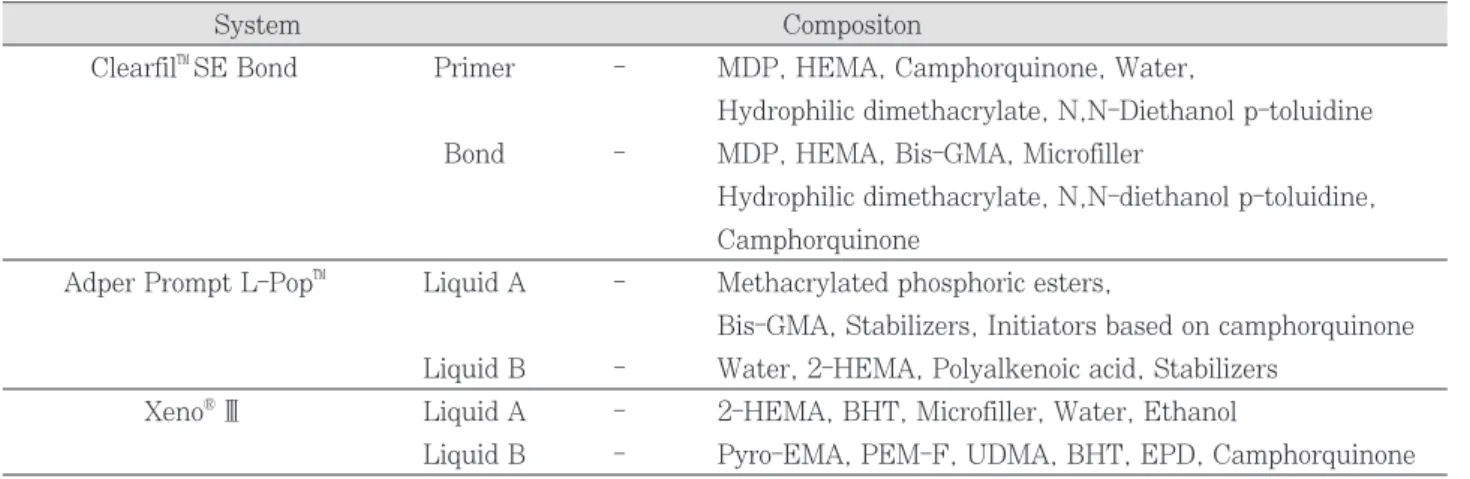
The two adhesives evaluated were an unfilled, all-in-one adhesive, Adper Prompt L-Pop™ (3M Dental Products, St. Paul, MN, USA) and a filled, all-in-one adhesive, Xeno� Ⅲ (Densply Caulk, Milford, DE, USA). In addition, two-step self-etching primer, Clearfil™ SE Bond (Kurarary Medical Inc., Okayama, Japan) was used as a control. The compositions of these adhesives are shown in Table 1.
Twenty-five noncarious, unrestored human mandibular molars that were extracted for peri- odontal problems were used in this study. The unground enamel surfaces were cleansed with pumice using a rubber cup engaged in a slow speed dental handpiece. Because of the need for a flat enamel surface, the mid-coronal portion of lingual surface of these teeth was utilized for all bonding experiments.
1. Microtensile bond strength evaluation
Fifteen molars were used for this part of the experiment. All teeth were randomly divided into five groups so that each group contained three teeth. In group SE, Clearfil™ SE Bond was applied. In group LP1, Adper Prompt L-Pop™was applied and light-cured. In group LP2, after light- curing the first layer, the adhesive was re- applied. In group XN1, Xeno�Ⅲ was applied and light-cured. And in group XN2, after light-curing
the first layer, the adhesive was re-applied and light-cured. The five groups were etched and bonded in the manner described in Table 2. A hybrid light-activated resin composite, Z100 (A2;
3M Dental Products, St. Paul, MN, USA) was built up incrementally in five layers. Each incre- ment was 2 ㎜ and light-cured for 20 s. The bond- ed teeth were then stored in distilled water at 37
℃ for 24 h prior to sectioning.
Each tooth was sectioned using a high speed precision cut-off machine (Accutom-50; Struers, Ballerup, Denmark) under water lubrication to make a cross-sectional area of approximately 1.0
㎜²for each stick. Ten sticks for each group were used for μTBS test. The stick was fixed to the test bed using cyanoacrylate adhesive (Zapit; DVA, Corona, CA, USA). The sticks were pulled to fail- ure under tension using a Micro Tensile Tester (Bisco inc., Schaumburg, IL, USA) at a crosshead speed of 1 ㎜/min.
2. Statistics
Bond strength data obtained for the five groups (SE, LP1, LP2, XN1 and XN2) were analyzed with the SPSS 12.0K for Windows (SPSS Inc., Chicago, IL, USA). A one-way analysis of vari- ance (ANOVA) followed by Duncan’s post-hoc test was computed.
Table 1.Components of the adhesive systems used in this study
System Compositon
Clearfil™SE Bond Primer - MDP, HEMA, Camphorquinone, Water,
Hydrophilic dimethacrylate, N,N-Diethanol p-toluidine Bond - MDP, HEMA, Bis-GMA, Microfiller
Hydrophilic dimethacrylate, N,N-diethanol p-toluidine, Camphorquinone
Adper Prompt L-Pop™ Liquid A - Methacrylated phosphoric esters,
Bis-GMA, Stabilizers, Initiators based on camphorquinone Liquid B - Water, 2-HEMA, Polyalkenoic acid, Stabilizers
Xeno�Ⅲ Liquid A - 2-HEMA, BHT, Microfiller, Water, Ethanol
Liquid B - Pyro-EMA, PEM-F, UDMA, BHT, EPD, Camphorquinone
Table 2. Adhesive systems tested in the study and application protocoly
Treatment groups Application protocol Dry enamel.
Apply primer. Leave for 20 sec.
SE Gentle air dry.
Apply bond. Air thin slightly.
Light cure for 10 sec.
Apply scrubbing continuously for 15 sec.
LP1 Gentle air dry.
Light cure for 10 sec.
Apply 1 coat.
Apply consecutive coat.
Gentle air dry.
LP2 Light cure for 10 sec.
Apply 2 coats.
Mix for 5 sec.
Apply mixture onto surface.
Leave for 20 sec.
XN1 Uniformly spread adhesive by a gentle blow of air.
Light cure for 10 sec.
Apply 1 coat.
Apply consecutive coat.
Gentle air dry.
XN2 Light cure for 10 sec.
Apply 2 coats.
SE; Clearfil™SE Bond LP; Adper Prompt L-Pop™ XN; Xeno�Ⅲ
3. Scanning electron microscopy examination
Lingual enamel surfaces of the two teeth from each group were conditioned with the self-etching adhesives, in a same manner described in Table 2. In LP2 and XN2 groups, however, the enamel surfaces were applied consecutive coat without light-curing the first layer. Enamel etched with self-etching adhesive was rinsed with acetone for 10 s to remove the self-etching adhesive. Then, the specimens were dehydrated with an ascending series of ethanol (70, 80, 90 and 100%) for 1 min each. All the teeth were allowed to air-dry. They were secured to aluminum stubs, sputtered coat- ed with gold/palladium and examined using a scanning electron microscope (S-4200; HITACHI, Tokyo, Japan) operation at 15 kV. The mid-coro- nal part of the lingual etched surface of each tooth was examined (× 1000).
Ⅲ. RESULTS 1. Microtensile bond strength
Table 3 lists the μTBS of the all-in-one adhe- sives (Group LP1, LP2, XN1 and XN2) as well as the control two-step self-etching primer (Group SE) on unground enamel. The mean bond strength of the SE group was 19.77 MPa and that
Table 3.Microtensile bond strengths (MPa, Mean ± SD)
Groups μTBS
SE 19.77 ± 2.44a
LP1 13.88 ± 3.67b
LP2 14.50 ± 2.52b
XN1 14.42 ± 2.51b
XN2 15.28 ± 2.79b
Different superscripts are significantly different (p < 0.05).
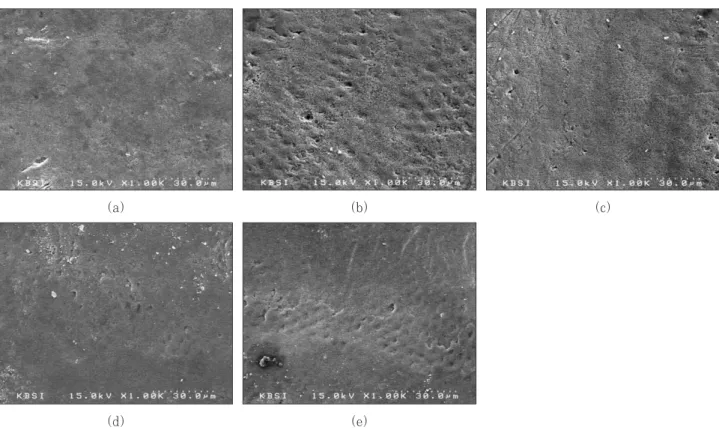
(a) (b) (c)
(d) (e)
Figure 1. The SEM photographs show unground enamel surface treated with the two-step self-etching primer, Clearfil™ SE Bond (a), the unfilled, all-in-one adhesive, Adper Prompt L-Pop™(b; 1 coat, c; 2 coats) and the filled, all-in-one adhesive, Xeno�Ⅲ (d; 1 coat, e; 2 coats) (× 1000).
of the other groups varied between 13.88 and 15.28 MPa. Statistically significant differences were found between group SE and the other groups (p < 0.05).
2. Ultrastructural features
SEM images of unground enamel surfaces, treated with the adhesives, are shown in Figure 1.
Unground enamel surfaces did not have different surface morphologies depending on whether they were etched one or two times. A non-uniform etched pattern was exhibited with the use of all adhesives. Prismatic structures of enamel were not clearly observed.
Ⅳ. DISCUSSION
Bonding to the unground enamel surface is important to prevent marginal microleakage and for the retention of pit and fissure sealants. In addition, clinically, not all enamel margins are prepared11). Therefore, we have to test about bond strength to the unground enamel surfaces as well as ground surfaces.
Recently introduced all-in-one adhesives simpli- fied clinical applications and reduced post-opera- tive sensitivity and technique sensitivity.
However, recent studies showed that some all-in- one adhesives exhibited relatively low bond strengths when compared with phosphoric acid etching9) and two-step self-etching systems14). In dentin bonding, this problem was overcome by multiple applications of adhesives15).
Therefore, in this study, we investigated the effects of one or two applications of all-in-one adhesive on microtensile bond strength to unground enamel. According to the result of this study, there were significant differences in the microtensile bond strength to unground enamel treated with either Clearfil™ SE bond or Prompt L-Pop™, Xeno� Ⅲ. Our results confirmed those of Senawongse et al.3), who reported significant dif- ferences between unground enamel-resin bonds produced following two-step self-etching primers versus all-in-one adhesives. Nikaido et al.16) sug-
gested that double application of a self-etching primer improved the bond strength of paste-type resin-modified glass ionomer cements and resin composite to enamel. According to our results, however, there were no significant differences in the effects of one or two coats of all-in-one adhe- sive on microtensile bond strength to unground enamel. Consequently, in contrast to multiple applications increased the bond strength in dentin surfaces, there were no increase in unground enamel bond strength.
The unground enamel surface is hypermineral- ized and contains more fluoride than ground enamel. This infers that saturated calcium phos- phate in the saliva might hypermineralize the enamel, and fluorine ions can convert the hydrox- yapatite into fluoroapatite17). Hence, in this layer, the etching effects relatively were less than those on ground enamel and dentin surface18).
The abilities of etching the aprismatic enamel surface were affected by the pH and the etching time of acid19). However, a thick prismless enamel layer may prevent the permeation of all-in-one adhesives, thus leaving some areas partially unetched20). Because the etching abilities of all-in- one adhesives are insufficient, penetration of the adhesive resin into microporosities of unground enamel surface are deficient. In addition, the manufacturer-recommended etching time was short to demineralize the enamel surface21). Ferrari et al.22) concluded that the performance of the all-in-one adhesive provided adequate mar- ginal seals of Class Ⅴ cavities both in vitro and in vivo when the all-in-one adhesive is applied for 60 s instead of the manufacturer-recommended 30 s etch. For this reasons, we concluded that all-in-one adhesives did not have sufficient bond strength at the initial adhesive layer, thus the second application of these adhesives did not affect to the bond strength on unground enamel surface.
Miyazaki et al.23) concluded that the adequate filler level (i.e., 10 wt%) in bonding agent opti- mized the dentin bond strength. In our study, however, there were statistically no significant differences between unfilled groups and filled
groups. It may be related to the chemical and micromorphologic differences between intact unground enamel and ground enamel24).
Kanemura et al.11)showed that the etching pat- tern of all-in-one adhesives was not deep enough to obtain good penetration of bonding resin when applied to unground enamel. Similarly, the SEM evaluation of this study revealed that the etching patterns in all groups were shallow, poorly defined, and structurally incomplete.
Ⅴ. CONCLUSIONS
Within the limits of this study, it may be con- cluded that the two all-in-one adhesives exam- ined produced low microtensile bond strengths to unground enamel. There was no correlation between their number of application times and the strength of their bonds to unground enamel.
In addition, the etching pattern of all-in-one adhesives was shallow and irregular.
Therefore, improvements may be necessary in the formulations of all-in-one adhesives or in the instructions for their use in order to achieve opti- mal bond strengths to unground enamel surface.
REFERENCES
1. Friedl KH, Hiller KA, Schmalz G. Placement and replacement of composite restorations in Germany.
Oper Dent 20:34-38, 1995.
2. Opdam NJM, Roeters FJM, Feilzer AJ, Smale I. A radiographic and scanning electron microscopic study of apporximal margins of Class Ⅱ resin composite restorations placed in vivo. J Dent 26:319-327, 1998.
3. Senawongse P, Sattabanasuk V, Shimada Y, Otsuki M, Tagami J. Bond strengths of current adhesive systems on intact and ground enamel. J Esthet Restor Dent 16:107-116, 2004.
4. Chigira H, Yukitani W, Hasegawa T, Manabe A, Itoh K, Hayakawa T, Debari K, Wakmoto S, Hisamitu H.
Self-etching dentin primers containgin Phenyl-P. J Dent Res 73:1088-1095, 1994.
5. Pashley DH, Carvalho RM. Dentine permeability and dentine adhesion. J Dent 25:355-372, 1997.
6. Buonocore MG. A simple method of increasing the adhesion of acrylic filling materials to enamel surfaces.
J Dent Res 34:849-853, 1955.
7. Pilecki P, Stone DG, Sherriff M, Watson TF.
Microtensile bond strengths to enamel of self-etching
and one bottle adhesive systems. J Oral Rehabil 32:531-540, 2005.
8. Ten Cate JM, Keizer S, Arends J. Polymer adhesion to enamel. The influence of viscosity and penetration. J Oral Rehabil 4:149-156, 1977.
9. Perdigao J, Geraldeli S. Bonding characteristics of self- etching adhesives to intact versus prepared enamel. J Esthet Restor Dent 15:32-41, 2003.
10. Oh SK, Hur B, Kim HC. The etching effects and microtensile bond strength of total etching and self- etching adhesive system on unground enamel. J Kor Acad Cons Dent 29:273-280, 2004.
11. Kanemura N, Sano H, Tagami J. Tensile bond strength to and SEM evaluation of ground and intact enamel surfaces.J Dent 27:523-530, 1999.
12. Perdigao J, Duarte Jr S. Enamel bond strengths of pairs of adhesives from the same manufacturer. Oper Dent 30:492-499, 2005.
13. Hashimoto M, Sano H, Yoshida E, Hori M, Kaga M, Oguchi H, Pashley DH. Effects of multiple adhesive coatings on dentin bonding. Oper Dent 29:416-423, 2004.
14. Fritz UB, Finger WJ. Bonding efficiency of single-bot- tle enamel/dentin adhesives. Am J Dent 12:277-282, 1999.
15. Frankenberger R, Perdigao J, Rosa BT, Lopes M. No- bottle vs. Multi-bottle dentin adhesives-a microtensile bond strength and morphological study. Dent Mater 17:373-380, 2001.
16. Nikaido T, Nakajima M, Higashi T, Kanemura N, Pereira P, Tagami J. Shear bond strength of a single- step bonding system to enamel and dentin. Dent Mater J 16:40-47, 1997.
17. Sturdevant CM, Barton RE, Sockwell CL, Strickland WD. The art and science of operative dentistry. 2nd ed., The C.V. Mosby Co., St. Louis, Missouri, p54-55, 1985.
18. Nathanson D, Bodkin JL, Evans JR. SEM of etching patterns in surface and subsurface enamel. J Pedod 7:11-17, 1982.
19. Cehreli ZC, Altay N. Effects of a non-rinse conditioner and 17% ethylenediaminetetraacetic acid on the etch pattern of intact human permanent enamel. Angle Orthodont 70:22-27, 2000.
20. Gwinnett AJ. The ultrastructure of prismless enamel of permanent teeth. Arch Oral Biol 12:381-386, 1967.
21. Finger WJ, Fritz U. Laboratory evaluation of one-com- ponent enamel/dentin bonding agents. Am J Dent 9:206-210, 1996.
22. Ferrari M, Mannocci F, Vichi A, Davidson C. Effect of two etching times on the sealing ability of Clearfil Liner Bond 2 in Class Ⅴ restorations. Am J Dent 10:66-70, 1997.
23. Miyazaki M, Ando S, Hinoura K, Onose H, Moore BK.
Influence of filler addition to bonding agents on shear bond strength to bovine dentin. Dent Mater 11:234- 238, 1995.
24. Ibarra G, Vargas MA, Armstrong SR, Cobb DS.
Microtensile bond strength of self-etching adhesives to ground and unground enamel. J Adhes Dent 4:115- 124, 2002.
Unground enamel에 대한 all-in-one adhesive의 1회 또는 2회 적용이 미세인장 결합강도에 미치는 영향
손창용∙김현철∙허 복∙박정길*
부산대학교 치과대학 치과보존학교실
이 연구에서는 미세인장결합강도 실험과 주사전자현미경을 이용하여 unground enamel에 대한 all-in-one adhesive의 1회 또는 2회 적용에 따른 효과를 평가하였다.
발거된 하악 대구치의 설측 치관부를 사용하여 3개씩 5개의 군으로 분류하였다. SE군은 Clearfil™SE Bond를 적용하였다. LP1 군, LP2 군은 Adper Prompt L-Pop™을 각각 1회, 2회 적용하였다. XN1 군, XN2 군은 Xeno�Ⅲ 를 각각 1회, 2회 적용하였다. 그런 다음 복합 레진 Z100을 적층 충전하였다. 법랑질 표면의 접착제를 아세톤으로 제거하고 주사 전자 현미경을 이용하여 산 부식 양상을 관찰하였다. 미세인장결합강도 측정을 위해 표본을 절단하 여 레진과 치아의 접착 계면이 1 ㎜²이 되도록 하여 실험하였다. 실험의 결과는 One-way ANOVA를 사용해 분석 한 다음 Duncan’s post-hoc test로 사후 검정 하였다.
본 연구의 결과 all-in-one adhesive의 1회와 2회 적용간에는 유의한 차이가 나타나지 않았으며 two-step self-etching adhesive와 all-in-one adhesive의 산 부식 양상 모두 얕고 불규칙 하였다.
주요어: Unground enamel, All-in-one adhesive, 미세인장결합강도, 산 부식 양상 국문초록