http://dx.doi.org/10.3988/jcn.2012.8.1.58 J Clin Neurol 2012;8:58-64
Itemized Hospital Charges for Acute Cerebral Infarction Patients Influenced by Severity in an Academic Medical Center in Korea
Sung Sang Yoon,a Hyejung Chang,b Young Dae Kwonc
aDepartment of Neurology, Kyung Hee University College of Medicine, Seoul, Korea
bDepartment of Health Services Management, Kyung Hee University School of Management, Seoul, Korea
cDepartment of Humanities and Social Medicine, College of Medicine, The Catholic University of Korea, Seoul, Korea
Received January 31, 2011 Revised September 14, 2011 Accepted September 14, 2011 Correspondence Young Dae Kwon, MD, PhD Department of Humanities and Social Medicine, College of Medicine, The Catholic University of Korea, 224 Banpo-daero, Seocho-gu, Seoul 137-701, Korea Tel +82-2-2258-8251 Fax +82-2-2258-8257 E-mail [email protected]
Background and PurposezzStroke imposes a major burden on patients, their families, and the national healthcare system. The purpose of this study was to determine the itemized hospital charges in acute ischemic stroke patients according to their severity by partitioning the charges in detail and then examining whether stroke severity was a significant contributor to these charges.
MethodszzThis study analyzed data of first-time acute ischemic stroke patients who had been admitted to an academic medical center between September 2003 and April 2009. The patients’
demographic and clinical characteristics were analyzed descriptively, and then eight categorized hospital charges as well as the total charge were compared among patients grouped according to stroke severity, using analysis of variance. Multiple regression analyses were conducted to test the influence of stroke severity on itemized hospital charges as well as the total charge, while con- trolling for other related factors.
ResultszzMore-severe strokes were associated with a higher total charge. Significantly higher charges were associated with patients with more-severe strokes regarding all charged items except imaging studies. The charges for imaging studies were similar across all severities of stroke. While controlling for other factors, a significant impact of stroke severity was found in both the total hos- pital charge and most itemized charges.
ConclusionszzItemized hospital charges for inpatients with acute ischemic stroke varied ac- cording to stroke severity. Stroke severity was a significant factor influencing the itemized charg- es of acute hospitalization of ischemic stroke patients. J Clin Neurol 2012;8:58-64 Key Wordszz ischemic stroke, hospital charges, severity.
Open Access
cc This is an Open Access article distributed under the terms of the Cre- ative Commons Attribution Non-Commercial License (http://creative- commons.org/licenses/by-nc/3.0) which permits unrestricted non-com- mercial use, distribution, and reproduction in any medium, provided the ori- ginal work is properly cited.
Introduction
The economic burden of stroke on the healthcare system has been studied in several countries.1-5 Typically more than half of the economic burden is attributed to direct medical costs,1,4 and a major component of this burden is inpatient services for acute hospital admission.3,6 Previous studies found that the to- tal cost of hospitalization due to stroke was significantly asso- ciated with the length of stay (LOS), stroke severity, clinical
subtype, and certain sociodemographic factors,3,6-10 of which LOS was found to be the most decisive factor in determining the total cost of hospitalization of stroke patients.3,7,11 This has led to suggestions that shortening the LOS would be an effec- tive and critical strategy for managing healthcare costs.12,13
With regard to the clinical factors, stroke severity was clear- ly observed to have a significant impact on hospital charges in stroke patients.6,9,10,14-18 Thus, it is recommended that stroke severity should be included in any decisions regarding the al- location of healthcare resources, especially when the impact of certain therapeutic approaches is assessed in stroke patients.9 Although stroke severity is known to be an important factor in determining the total charges of acute hospitalization for isch- emic stroke patients, the detailed pattern of itemized charges
relative to stroke severity has not been fully explored; more specifically, there needs to be a greater understanding of how stroke severity differentiates specific items of charges and how this influences the distribution of itemized charges.
Thus, this study focused on investigating the itemized hos- pital charges in ischemic stroke patients according to stroke severity by dividing the charges in greater detail, and then de- termining whether the stroke severity was a significant con- tributor to these itemized hospital charges when the major factors influencing those charges were controlled.
Methods
Study subjects
This was a retrospective study that involved analyzing the itemized hospital charges of cerebral infarction patients hos- pitalized in an academic medical center. The subjects com- prised 1600 consecutive patients with acute, first-time isch- emic stroke, who were admitted within 7 days of stroke onset to the neurology ward between September 2003 and April 2009. The patients were diagnosed based on the results of an- amnesis, neurological testing, computed tomography, magnet- ic resonance imaging, magnetic resonance angiography, and other neuroradiological findings. The study was approved by the institutional review board of the Kyung Hee University Medical Center, Seoul, Korea. The board permitted a waiver of informed consent because the study involved anonymous data collected for nonresearch purposes.
Data sources and variables
The data comprised two parts: 1) each patient’s demographic and clinical characteristics, and 2) information on hospital charges. The data for the first part were collected from a data- base of the hospital’s stroke registry, and those for the second part were retrieved from the hospital’s Patient Management Information.
The demographic characteristics included age, gender, and risk factors (e.g., prior history of transient ischemic attack, smoking, and comorbid conditions such as hypertension, dia- betes mellitus, and heart diseases). The clinical characteristics consisted of the severity of each patient’s stroke at admission, treatment methods, admission and discharge route, intensive care unit (ICU) admission, and LOS at the hospital. These variables were selected based on previous studies finding that they directly impact on the hospital charges of stroke patients.
At the time of admission, each patient’s stroke severity was evaluated using the National Institutes of Health Stroke Scale (NIHSS) and was classified into one of three groups using the criteria reported by Schlegel et al.:19 mild (NIHSS score ≤5), moderate (NIHSS score 6-13), or severe (NIHSS score >13).
With regard to the stroke subtype, each patient was classified according to the Trial of Org 10172 in Acute Stroke Treatment criteria.
The data on hospital charges were categorized into 24 de- tailed items that were then grouped into the following 8 cate- gories to simplify the analysis and subsequent comparisons:
physicians’ fees, room and board, medication, injections, op- erations and procedures, laboratory tests, imaging studies, and other charges.
Statistical analysis
The patients’ demographic and clinical characteristics were analyzed descriptively using frequencies, percentages, means, and medians. The means of total and itemized hospital charg- es among stroke severity groups were compared using analy- sis of variance. Multiple regression models, which controlled for other factors influencing inpatient charges such as the pa- tients’ gender, age, treatment methods, LOS, and referral sta- tus at both admission and discharge were developed. The re- gression models excluded other charges due to heterogeneous properties. In the multiple regression analysis, the logarithm of the hospital charges was a dependent variable because the hospital charges showed an asymmetric distribution, with a large difference between the mean and median. The variance inflation factor for each predictor for all given cases was com- puted to detect the existence of multicollinearity. All analyses were performed using the Statistical Analysis System (ver- sion 9.1).
Along with the analysis, inpatient charges were converted to US dollars to enable comparison of the results of this study with those of others, with the exchange rate US$ 1=1192 Ko- rean won (valid in December 2003) being used. In addition, based on the official medical fee schedules from 2003 to 2009, all monetary values were adjusted to their 2003 equivalents.
Results
Patient characteristics
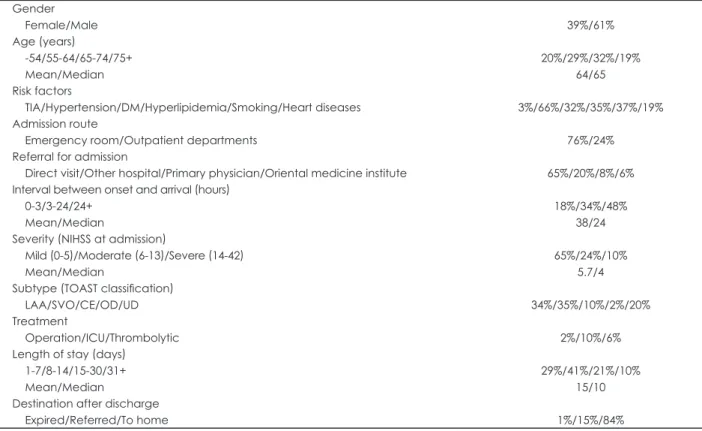
The mean and median NIHSS scores at admission were 5.7 and 4, respectively; 65% of strokes were mild, 24% of strokes were moderate, and 10% of strokes were severe. The strokes were distributed among the different subtypes of the Trial of Org 10172 in Acute Stroke Treatment classification as fol- lows: large-artery sclerosis (34%), small-vessel occlusion (35%), cardioembolism (10%), undetermined etiology (20%), and other determined etiology (2%). The mean and median LOSs were 15 and 10 days, respectively. Deaths during hos- pitalization occurred in 1% of the cases, and 15% and 84%
were referred to other medical institutions and returned to home at discharge, respectively (Table 1).
Hospital charges of acute ischemic stroke patients
The mean total charge for a hospital stay was US$ 3595 (me- dian US$ 2787). This was divided into room and board charges (30.7%), imaging studies (29.9%), laboratory tests (13.2%), injections (11.4%), operations and procedures (7.7%), medication (3.8%), and physicians’ fees (1.1%) (Table 2).
Hospital charges stratified according to stroke severity
The total charge differed significantly with the stroke severity
(F=122.9; p<0.001): US$ 2859 for mild stroke, US$ 4444 for moderate stroke, and US$ 6242 for severe stroke (Table 2).
Detailed analysis also showed that significantly higher charg- es were associated with patients with more-severe strokes for all charge items except for imaging studies. The charges for imaging studies were similar across the patient stroke severity groups (F=1.4; p=0.242): US$ 1069 for mild strokes, US$
1110 for moderate strokes, and US$ 1029 for severe strokes.
Accordingly, the proportion of the total charge attributable to imaging studies decreased significantly with increasing stroke severity: 37.4% for mild strokes, 25.0% for moderate strokes, Table 1. Demographic and clinical characteristics of acute ischemic stroke patients
Gender
Female/Male 39%/61%
Age (years)
-54/55-64/65-74/75+
Mean/Median
20%/29%/32%/19%
64/65 Risk factors
TIA/Hypertension/DM/Hyperlipidemia/Smoking/Heart diseases 3%/66%/32%/35%/37%/19%
Admission route
Emergency room/Outpatient departments 76%/24%
Referral for admission
Direct visit/Other hospital/Primary physician/Oriental medicine institute 65%/20%/8%/6%
Interval between onset and arrival (hours) 0-3/3-24/24+
Mean/Median
18%/34%/48%
38/24 Severity (NIHSS at admission)
Mild (0-5)/Moderate (6-13)/Severe (14-42) Mean/Median
65%/24%/10%
5.7/4 Subtype (TOAST classification)
LAA/SVO/CE/OD/UD 34%/35%/10%/2%/20%
Treatment
Operation/ICU/Thrombolytic 2%/10%/6%
Length of stay (days) 1-7/8-14/15-30/31+
Mean/Median
29%/41%/21%/10%
15/10 Destination after discharge
Expired/Referred/To home 1%/15%/84%
TIA: transient ischemic attack, DM: diabetes mellitus, NIHSS: National Institutes of Health Stroke Scale, LAA: large artery atherosclerosis, SVO: small vessel occlusion, CE: cardioembolism, OD: other determined etiology, UD: undetermined etiology, ICU: intensive care unit.
Table 2. Total and itemized charges according to stroke severity (unit: $) Variable All (n=1600) Mild (n=1045) Moderate (n=390) Severe (n=165) F-test Total charges 3595 (100.0%) 2859 (100.0%) 4444 (100.0%) 6242 (100.0%) 122.9‡
Physicians’ fees 38 (1.1%) 36 (1.3%) 42 (0.9%) 44 (0.7%) 31.2‡
Room and board 1105 (30.7%) 839 (29.4%) 1478 (33.3%) 1900 (30.5%) 114.5‡
Medication 137 (3.8%) 114 (4.0%) 166 (3.7%) 213 (3.4%) 43.0‡
Injection 411 (11.4%) 250 (8.7%) 531 (12.0%) 1153 (18.5%) 104.5‡
Operation/procedure 276 (7.7%) 127 (4.4%) 451 (10.1%) 813 (13.0%) 116.0‡ Laboratory test 475 (13.2%) 373 (13.0%) 560 (12.6%) 915 (14.7%) 111.9‡ Imaging studies 1075 (29.9%) 1069 (37.4%) 1110 (25.0%) 1029 (16.5%) 1.4
Other charges 77 (2.1%) 51 (1.8%) 105 (2.4%) 174 (2.8%) 3.5*
LOS (mean/median) 15/10 days 11/9 days 20/15 days 29/21 days
*p<0.05, ‡p<0.001.
LOS: length of stay.
and 16.5% for severe strokes. The proportions of the charges associated with injections and with operations and procedures relative to the total charge increased noticeably for patients with more-severe strokes.
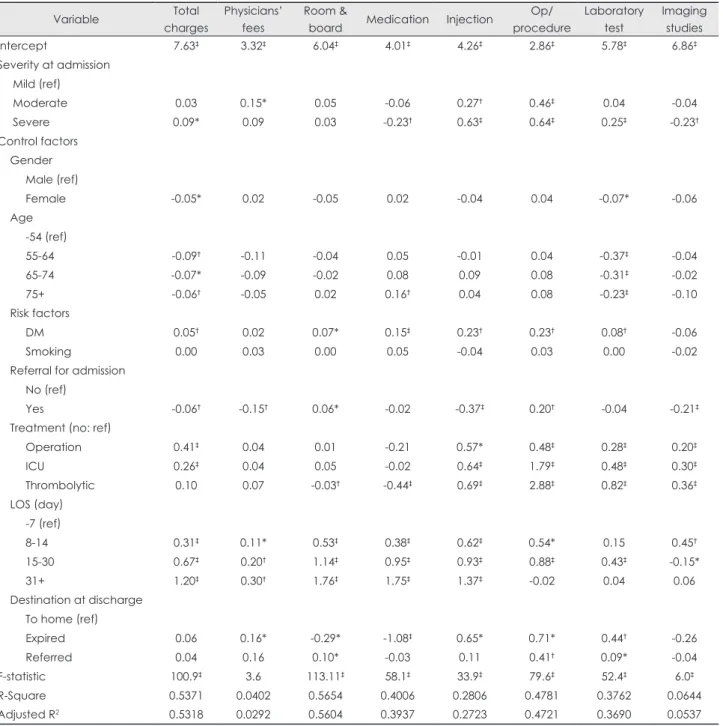
Impact of stroke severity on hospital charges After controlling for other factors influencing inpatient charg- es, stroke severity at admission was a significant factor related to increasing the total charge, as were diabetes mellitus, surgi-
cal operation, ICU admission, and LOS; in contrast, gender (female), age, and referral for admission were significant fac- tors in reducing the total charge (Table 3).
Multiple regression models for itemized charges revealed that stroke severity was a significant factor for charges involv- ing physicians’ fees, medication, injections, operations and procedures, laboratory tests, and imaging studies. Higher charges were imposed on patients with higher stroke severity in four models, with the exceptions of medication and imag-
Table 3. Multiple regression models for the total and itemized hospital charges
Variable Total
charges
Physicians’
fees
Room &
board Medication Injection Op/
procedure
Laboratory test
Imaging studies
Intercept 7.63‡ 3.32‡ 6.04‡ 4.01‡ 4.26‡ 2.86‡ 5.78‡ 6.86‡
Severity at admission Mild (ref)
Moderate 0.03 0.15* 0.05 -0.06 0.27† 0.46‡ 0.04 -0.04
Severe 0.09* 0.09 0.03 -0.23† 0.63‡ 0.64‡ 0.25‡ -0.23†
Control factors Gender
Male (ref)
Female -0.05* 0.02 -0.05 0.02 -0.04 0.04 -0.07* -0.06
Age -54 (ref)
55-64 -0.09† -0.11 -0.04 0.05 -0.01 0.04 -0.37‡ -0.04
65-74 -0.07* -0.09 -0.02 0.08 0.09 0.08 -0.31‡ -0.02
75+ -0.06† -0.05 0.02 0.16† 0.04 0.08 -0.23‡ -0.10
Risk factors
DM 0.05† 0.02 0.07* 0.15‡ 0.23† 0.23† 0.08† -0.06
Smoking 0.00 0.03 0.00 0.05 -0.04 0.03 0.00 -0.02
Referral for admission No (ref)
Yes -0.06† -0.15† 0.06* -0.02 -0.37‡ 0.20† -0.04 -0.21‡
Treatment (no: ref)
Operation 0.41‡ 0.04 0.01 -0.21 0.57* 0.48‡ 0.28‡ 0.20‡
ICU 0.26‡ 0.04 0.05 -0.02 0.64‡ 1.79‡ 0.48‡ 0.30‡
Thrombolytic 0.10 0.07 -0.03† -0.44‡ 0.69‡ 2.88‡ 0.82‡ 0.36‡
LOS (day) -7 (ref)
8-14 0.31‡ 0.11* 0.53‡ 0.38‡ 0.62‡ 0.54* 0.15 0.45†
15-30 0.67‡ 0.20† 1.14‡ 0.95‡ 0.93‡ 0.88‡ 0.43‡ -0.15*
31+ 1.20‡ 0.30† 1.76‡ 1.75‡ 1.37‡ -0.02 0.04 0.06
Destination at discharge To home (ref)
Expired 0.06 0.16* -0.29* -1.08‡ 0.65* 0.71* 0.44† -0.26
Referred 0.04 0.16 0.10* -0.03 0.11 0.41† 0.09* -0.04
F-statistic 100.9‡ 3.6 113.11‡ 58.1‡ 33.9‡ 79.6‡ 52.4‡ 6.0‡
R-Square 0.5371 0.0402 0.5654 0.4006 0.2806 0.4781 0.3762 0.0644
Adjusted R2 0.5318 0.0292 0.5604 0.3937 0.2723 0.4721 0.3690 0.0537
*p<0.05, †p<0.01, ‡p<0.001.
Ref: reference, Op: operation, DM: diabetes mellitus, LOS: length of stay, ICU: intensive care unit.
ing studies.
Female gender and old age were significant factors reducing both the total charge and the laboratory test charge, but old age was also a significant factor associated with increasing the medication charge. Diabetes mellitus was a significant factor in increasing the total charge as well as all itemized charges, with the exception of physicians’ fees and the charge for imag- ing studies. Surgery and ICU admission were found to be sig- nificant factors increasing the total charge and four of the itemized charges. Although thrombolytics use was a signifi- cant factor in reducing the charge for medication while in- creasing the charges for injections, operations and procedures, laboratory tests, and imaging studies, it did not have a measur- able impact on the total charge. A longer LOS was associated with an increased total charge as well as all itemized charges except those related to imaging studies. Death at discharge was a significant factor in reducing the charges for room and board and for medication, while increasing those for physi- cians’ fees, injections, operations and procedures, and labora- tory tests. Referral after hospital discharge increased the charges for room and board, operations and procedures, and laboratory tests.
With regard to the variance inflation factors for the multiple regression models, there was no indication of the presence of multicollinearity - a value greater than 10 is often regarded as indicating multicollinearity, but the largest value was 1.87 in this study. This value satisfies the condition that estimated re- gression coefficients will not reveal any linear dependencies between variables.
Discussion
This study found that the total inpatient charge and itemized hospital charges differed according to stroke severity in first- ever acute ischemic stroke patients, and that stroke severity was a significant determinant of several itemized hospital charges as well as the total charge after controlling for the ma- jor factors influencing hospital charges.
Higher stroke severity was associated with a higher total hospital charge, and patients with severe strokes paid 2.2 times more in total inpatient charges than did patients with mild strokes. This variation in the total hospital charge with stroke severity was consistent with the findings of previous stud- ies.6,7,9,10,15,18
The charges and their distribution among eight of the cate- gories varied with the stroke severity, with only the charge for imaging studies not varying significantly. The proportion of the total charge allocated to imaging studies decreased con- siderably in the moderate and severe groups. This finding sug- gests that most imaging studies are performed for diagnostic
purposes at a very early stage of hospitalization regardless of stroke severity. Further studies are needed to obtain a greater in-depth understanding of the utilization of major imaging techniques such as computed tomography, magnetic reso- nance imaging, and sonography.
Stroke severity was a significant determinant of the total charge and six itemized charges, with a higher stroke severity increasing the total and the itemized charges. The exceptions were the charges for room and board, medication, and imag- ing studies. Results from bivariate analysis suggest that in spite of a trend toward increasing charge for room and board with increasing stroke severity, the impact of severity on charge for room and board was not statistically significant when LOS was included in the multivariate regression model.
The charge related to medication decreased in the severe- stroke group in multivariate analysis, while it was observed to increase in the same patients in bivariate analysis. The same routine imaging studies tended to be applied to evaluate and diagnose the condition of patients regardless of stroke severity.
The elderly were found to pay lower total and laboratory test charges. This could have been due to younger stroke pa- tients requiring more examinations.20 Diabetes mellitus and smoking have previously been found to be significant factors in determining medical costs,9,10 and their inclusion in the re- gression model revealed that smoking did not significantly in- crease medical charges, while diabetes mellitus increased the total hospital charge and all itemized charges except for the physicians’ fees and imaging studies charge.
The findings of this study are consistent with those of previ- ous studies,3,7,11 in that LOS was found to be the most impor- tant factor in influencing the hospital charges of stroke pa- tients. LOS was a significant factor in increasing not only the total charge but also all itemized charges other than that for imaging studies. ICU admission and surgery, which were sig- nificant determinants of the medical cost along with the LOS and stroke severity in previous studies,10,15,17,18 were also sig- nificant factors increasing the total and four of the itemized hospital charges. The imaging studies and laboratory test cat- egories followed room and board as the next largest inpatient charges. These two categories contributed more than 40% of the total inpatient charges for ischemic stroke patients.
While it is difficult to directly compare this study with pre- vious studies due to the use of different categories of charge (or cost) data,3,7,12,18,21 comparison was made possible by reor- ganizing the charges of similar items. In particular, three cate- gories - pharmaceutical care, laboratory tests, and imaging studies - were comparable. Along with the variation in total charge per patient across countries, there were different pro- portional distributions of itemized charges for pharmaceutical care (3-49%), laboratory tests (5-13%), and imaging studies
(9-30%). The present study revealed a higher proportional charge for these three items, and especially for imaging stud- ies. These discrepancies may be at least partial due to health- care delivery systems differing between countries, in terms of the medical reimbursement system, utilization pattern of heal- thcare services, and categories of hospital charges. This is par- ticularly true of Korea, whose special characteristic of a reg- ulated fee-for-service system has a significant impact on the composition of hospital charges. Other special characteristics include unusually low physicians’ fees, relatively high labora- tory test charges, and high-priced uninsured medical services and high-technology imaging studies.22 Furthermore, pharma- ceutical care represents a higher proportion of the total charge in Korea. The differences in healthcare and reimbursement systems between countries warrant more detailed studies of itemized hospital charges for the purposes of international comparison to achieve a greater understanding of healthcare in different countries (Table 4).
Despite the large included sample, the subjects in this study were from only one hospital. This might have adversely af- fected the external validity, preventing us from making gener- alizations to other populations. Therefore, expanded research conducted across multiple hospitals is necessary. The utiliza- tion of charge data, rather than cost data, might not be a short- coming of this study. Although Finkler indicated a potential problem of using charge data as a proxy of costs in efficiency- related research,23 the present study focused only on the level of healthcare utilization and charges, not those related to effi- ciency. In addition, the findings of this study are consistent with those of previous studies that analyzed the charge data of ischemic stroke patients in Japan and China.3,16 Moreover, especially in the fee-for-service reimbursement system of Ko- rea, using charge data is considered to be permissible in com- parative studies of healthcare utilization because hospital charges are itemized in detail.
This analytical study has detailed the hospital charges of the inpatient services of our local population with acute isch- emic stroke. The findings (from a small study cohort) sug- gest that hospital charges differ according to stroke severity and that stroke severity is a significant contributing factor in several itemized charges as well as the total charge. More specifically, the findings suggest that stroke severity is a sta- tistically significant factor influencing the composition of hospital charges for ischemic stroke patients, after control- ling for major factors such as treatment methods, LOS, and other demographic factors. The results suggest that severity levels should be considered when developing fee schedules for health insurance reimbursement, when planning more-ef- ficient and effective treatment strategies, and when evaluat- ing the appropriateness of healthcare resource utilization, es- Table 4. International comparison of hospital charges distribution for ischemic stroke patients This study
(2011 ) Korea
Ma Y et al.12 China Gioldasis G et al.18 Greece Dodel RC et al.21 GermanyTu F et al.3 Japan Diringer MN et al.7 USA Room and board31%Accommodation7%Bed and staff60%Basal charge28%Board8%Room charges50% Physician’s fees1%Physician19%Fundamental charges42% Diagnostics2%Pre-hospital6%Pre-admission3% Medication & injection15%Drugs49%Medications4%Drugs3%Drugs & injection ns20%Medication5% Laboratory test13%Laboratory analysis9%Laboratory tests13%Laboratory analysis15%Examinations & diagnostics11%Labs5% Imaging studies30%Imaging9%Imaging10%Imaging10%Radiological tests13%Imaging19% Operation/procedure8%Operations3% Therapeutics8%Physiotherapy2%Rehab & other tx13% Nursing care4%Supportive nursing7%Nursing care12% Other charges2%Others11%Others1%Others13%Others3%Others6% Total costs3595 USDTotal costs1200 USDTotal costs3125 EuroTotal costs3480 EuroTotal costs9164 USDTotal costs4408 USD USA: United States of America, rehab: rehabilitation, tx: treatment, USD: United States dollar.
pecially for ischemic stroke patients.
Conflicts of Interest
The authors have no financial conflicts of interest.
REFERENCES
1. Matchar DB, Duncan PW. Cost of stroke. Stroke Clin Updates 1994;
5:9-12.
2. Dewey HM, Thrift AG, Mihalopoulos C, Carter R, Macdonell RA, McNeil JJ, et al. Cost of stroke in Australia from a societal perspec- tive: results from the North East Melbourne Stroke Incidence Study (NEMESIS). Stroke 2001;32:2409-2416.
3. Tu F, Anan M, Kiyohara Y, Okada Y, Nobutomo K. Analysis of hospi- tal charges for ischemic stroke in Fukuoka, Japan. Health Policy 2003;
66:239-246.
4. Gerzeli S, Tarricone R, Zolo P, Colangelo I, Busca MR, Gandolfo C.
The economic burden of stroke in Italy. The EcLIPSE Study: Econom- ic Longitudinal Incidence-based Project for Stroke Evaluation. Neurol Sci 2005;26:72-80.
5. Lim SJ, Kim HJ, Nam CM, Chang HS, Jang YH, Kim S, et al. [Socio- economic costs of stroke in Korea: estimated from the Korea national health insurance claims database]. J Prev Med Public Health 2009;42:
251-260.
6. Caro JJ, Huybrechts KF, Duchesne I. Management patterns and costs of acute ischemic stroke: an international study. For the Stroke Eco- nomic Analysis Group. Stroke 2000;31:582-590.
7. Diringer MN, Edwards DF, Mattson DT, Akins PT, Sheedy CW, Hsu CY, et al. Predictors of acute hospital costs for treatment of ischemic stroke in an academic center. Stroke 1999;30:724-728.
8. Claesson L, Gosman-Hedström G, Johannesson M, Fagerberg B, Blomstrand C. Resource utilization and costs of stroke unit care inte- grated in a care continuum: a 1-year controlled, prospective, random- ized study in elderly patients: the Göteborg 70+ Stroke Study. Stroke 2000;31:2569-2577.
9. Chang KC, Tseng MC. Costs of acute care of first-ever ischemic stroke in Taiwan. Stroke 2003;34:e219-e221.
10. Chang H, Yoon SS, Kwon YD. Determinants of inpatient charges of acute stroke patients in two academic hospitals: comparison of intra- cerebral hemorrhage and cerebral infarction. J Korean Neurol Assoc
2009;27:215-222.
11. Mamoli A, Censori B, Casto L, Sileo C, Cesana B, Camerlingo M. An analysis of the costs of ischemic stroke in an Italian stroke unit. Neu- rology 1999;53:112-116.
12. Ma Y, Liu Y, Fu HM, Wang XM, Wu BH, Wang SX, et al. Evaluation of admission characteristics, hospital length of stay and costs for cere- bral infarction in a medium-sized city in China. Eur J Neurol 2010;17:
1270-1276.
13. Wei JW, Heeley EL, Jan S, Huang Y, Huang Q, Wang JG, et al. Varia- tions and determinants of hospital costs for acute stroke in China.
PLoS One 2010;5. pii: e13041.
14. Caro JJ, Huybrechts KF, Kelley HE. Predicting treatment costs after acute ischemic stroke on the basis of patient characteristics at presen- tation and early dysfunction. Stroke 2001;32:100-106.
15. Reed SD, Blough DK, Meyer K, Jarvik JG. Inpatient costs, length of stay, and mortality for cerebrovascular events in community hospitals.
Neurology 2001;57:305-314.
16. Tu F, Tokunaga S, Deng Z, Nobutomo K. Analysis of hospital charges for cerebral infarction stroke inpatients in Beijing, People’s Republic of China. Health Policy 2002;59:243-256.
17. Sekimoto M, Kakutani C, Inoue I, Ishizaki T, Hayashida K, Imanaka Y. Management patterns and healthcare costs for hospitalized patients with cerebral infarction. Health Policy 2008;88:100-109.
18. Gioldasis G, Talelli P, Chroni E, Daouli J, Papapetropoulos T, Ellul J.
In-hospital direct cost of acute ischemic and hemorrhagic stroke in Greece. Acta Neurol Scand 2008;118:268-274.
19. Schlegel D, Kolb SJ, Luciano JM, Tovar JM, Cucchiara BL, Liebe- skind DS, et al. Utility of the NIH Stroke Scale as a predictor of hospi- tal disposition. Stroke 2003;34:134-137.
20. Putaala J, Metso AJ, Metso TM, Konkola N, Kraemer Y, Haapaniemi E, et al. Analysis of 1008 consecutive patients aged 15 to 49 with first- ever ischemic stroke: the Helsinki young stroke registry. Stroke 2009;
40:1195-1203.
21. Dodel RC, Haacke C, Zamzow K, Paweilik S, Spottke A, Rethfeldt M, et al. Resource utilization and costs of stroke unit care in Germany.
Value Health 2004;7:144-152.
22. Kwon S. Payment system reform for health care providers in Korea.
Health Policy Plan 2003;18:84-92.
23. Finkler SA. The distinction between cost and charges. Ann Intern Med 1982;96:102-109.