대한내분비외과학회지:제 8 권 제 4 호
□ 증 례 □
Vol. 8, No. 4, December 2008
266
Correspondence: Ki Young Sung, Department of Surgery, The Catholic University of Korea College of Medicine, 2, Sosa-dong, Wonmi- gu, Bucheon 420-717, Korea
Tel: +82-32-340-2114, Fax: +82-32-340-7025 E-mail: [email protected]
게재승인일:2008년 12월 18일
Fig. 1. Colonofiberscope finding. Ulcero-fungating mass located in rectum.
Synchronous Carcinoma Showing Thymus-like Elements (CASTLE) of the Thyroid Combined with Rectal Carcinoma:
Report of a Case and Review of the Literature
Jun Hyun Lee, M.D., Do Sang Lee, M.D., Jong Min Baek, M.D., Bo Sung Son, M.D., Il Young Park, M.D.
and Ki Young Sung, M.D.
Department of Surgery, The Catholic University of Korea College of Medicine, Bucheon, Korea
Carcinoma showing thymus-like elements (CASTLE) is a rare neoplasm arising from the thyroid gland. This tumor is thought to originate from ectopic thymic tissue or rem- nants related to thymic development in or adjacent to the thyroid gland and usually located in the lower two-thirds of the thyroid gland. The patient was a 66-year-old man admit- ted to our hospital with rectal carcinoma for surgery. He had undergone a right upper lobectomy of the lung for the pulmonary tuberculosis 35 years previously. He underwent a chest computed tomography (CT) pre-operatively, and an incidental nodule of the thyroid gland was detected. Based on aspiration cytology of the nodule, the lesion was sus- pected to be an anaplastic carcinoma. He underwent a low anterior resection and thyroid lobectomy for a double pri- mary neoplasm. On the final pathologic examination, the thyroid lesion was shown to be CASTLE. Therefore, com- pletion thyroidectomy with lymph node dissection of the central compartment and radiotherapy were performed, and there was no evidence of recurrence 15 months post- operatively. (Korean J Endocrine Surg 2008;8:266-268) Key Words: Carcinoma showing thymus-like elements
(CASTLE), Rectal carcinoma, Double primary neoplasm, Thyroid lobectomy, Completion thyroidectomy
INTRODUCTION
CASTLE is histologically similar to anaplastic and squamous cell thyroid carcinomas, however, it has a favorable prognosis over them. Therefore, distinction of CASTLE from anaplastic car-
cinoma or squamous cell carcinoma of thyroid gland is important.
CASTLE is an uncommon neoplasm. In medical literatures, less than 30 cases have been reported,(1,2) and in domestic research few cases were reported.(3,4) Furthermore, as far as we know, synchronous neoplasm with CASTLE has never been reported.
We experienced a case of CASTLE accompanied with rectal carcinoma. Initially, we didn’t suspect likelihood of CASTLE, and hence this was regarded as anaplastic carcinoma of thyroid gland or metastatic lesion of rectal carcinoma. Later, the thyroid lesion was proven as CASTLE. So we report our experience.
CASE REPORT
A 66-year-old man was admitted to the hospital for evaluation of rectal adenocarcinoma which had been detected by routine health examination (Fig. 1). According to his medical history, he underwent right upper lobectomy of lung due to pulmonary
Jun Hyun Lee, et al:Synchronous Carcinoma Showing Thymus-like Elements (CASTLE) of the Thyroid Rectal Carcinoma: Report of a Case and Review of the Literatures 267
Fig. 2. An incidental mass located in right thyroid gland. A white arrow indicates incidental thyroid mass.
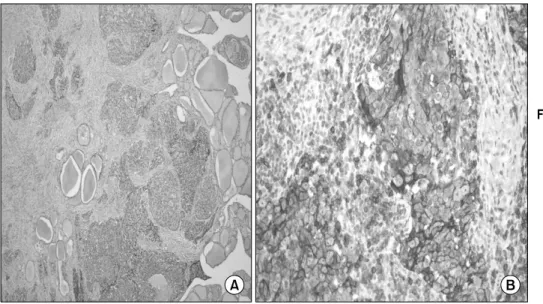
Fig. 4. Histopathologic section shows as follows. (A) Hematoxylin- Eosin stain shows lobular growth pattern of tumor cells with thick fibrous septa (original magnification, ×400).
(B) Immunohistochemical stain shows that the tumor exhibits CD5 immunoreac- tivity (original magnification,
×400).
Fig. 3. Ultrasonography of right thyroid gland. Shows two solid nodules with heterogenous echo.
tuberculosis. So, we prepared preoperative studies including chest CT. In the chest CT, an incidental mass was detected in the right lower lobe of thyroid gland (Fig. 2). Thyroid scan, ultrasonography (Fig. 3), and fine-needle aspiration cytology were carried out accordingly. According to pathologic reports, thyroid nodule was suspicious of anaplastic, and it is less likely metastatic carcinoma.
Moreover, radiologic study conducted preoperatively suggested that rectal lesion was not progressive, we gave a priority to syn- chronous tumor over metastatic lesion and planned operation.
The patient underwent a curative low anterior resection for rectal carcinoma. However, a palliative lobectomy of right thyroid gland was performed because operative view showing severe conglom- eration of right lobe of thyroid gland with adjacent tissue and lymph nodes was suspicious for metastatic lesion and following the frozen section biopsy suggested the possibility of metastatic carcinoma. In permanent pathologic examination, rectal carcinoma invaded serosa without lymph node involvement, and the thyroid
lesion was reported as CASTLE exhibiting lobular growth pattern of tumor cells with thick fibrous septa in Hematoxylin-Eosin stain and CD5 immunoreactivity in immunohistochemical stain, and there was no retrieved lymph node in tissue pathology (Fig. 4).
So, we performed completion thyroidectomy with lymph node dis- section of central compartment after one month. In 2nd operation, several lymph node enlargement was observed, however, there was no lymph node metastasis (0/3) in tissue pathology, and pa- tients underwent radiotherapy.
DISCUSSION
CASTLE neoplasm is first reported by Miyauchi et al in 1985.(5) It is a slow-growing tumor and has a favorable prognosis. Although it grows slowly, metastasis to regional lymph
268 대한내분비외과학회지:제 8 권 제 4 호 2008
nodes, invasion to adjacent structure and distant metastasis to other organs were informed.(1,2) and approximately half of the cases represented metastatic lymph nodes at initial finding.(6) Its clinical symptoms usually include painless neck mass or hoarse- ness; however, our case did not present any symptoms. Because the prognosis of CASTLE was better than anaplastic or squamous cell thyroid carcinoma, it is important to distinguish CASTLE from squamous cell and anaplastic thyroid carcinoma. CASTLE shows immunoreactivity to CD5, and hence, this is a useful maker in differential diagnosis.(7) Other markers, such as high molecular weight keratin (HMWK), carcinoembryonic antigen (CEA), and p63 may be useful in distinguishing CASTLE from other neoplasms.(8) Surgery is considered as a treatment of choice.(1,2,9) It is known that lymph node metastasis is important for evaluating out- come, so total thyroidectomy with selective modified neck lymph node dissection is necessary.(1,9) Additional radiotherapy is re- quired for patients with lymph node metastasis or unknown nodal status.(1,9) In case of local recurrence or distant metastasis, vari- ety of treatment can be attempted. Kakudo et al. reported a minor response in a patient with lung metastasis treated with adriamy- cin, endoxan.(10) Chow et al. reported that combination therapy composed of neoadjuvant chemotherapy (etoposide+carboplatin), radiotherapy and surgery was effective in locally advanced cases.(2) But, other cases reported that chemotherapy was no effective in recurrence.(1) Because of the rarity of CASTLE, use- fulness of adjuvant or palliative chemotherapy is not clear.
Radiotherapy is known to be effective in local control.(1,2,7,11) On review of literatures, even though tumor is not completely re- sected, local control can be obtained by radiotherapy.(1,2) In our case, because the possibility of metastasis to thyroid was consid- ered very low, we performed operation on the assumption that thyroid neoplasm was a synchronous neoplasm.
In conclusion, if fine needle aspiration cytology for thyroid nod- ule reported poorly differentiated carcinoma such as anaplastic or squamous cell carcinoma, possibility of CASTLE should be considered. Moreover, in case of concurrent thyroid neoplasm with other malignancies, careful evaluation and differentiation for primary neoplasm from metastatic lesion may be important to avoid unnecessary operation.
REFERENCES
1) Kusada N, Hara Y, Kobayashi S, Weihua T, Nakamura Y, Kakudo K, et al. A case of aggressive carcinoma showing thymus-like differentiation with distant metastasis. Thyroid 2005;
15:1383-8.
2) Chow SM, Chan JKC, Tse LLY, Tang DLC, Ho CM, Law SCK.
Carcinoma showing thymus-like elements (CASTLE) of thyroid:
Combined modality treatment in 3 patients with locally advanced disease. Eur J Surg Oncol 2007;33:83-5.
3) Gu MJ, Shim YR, Choi JH, Choi WH. Carcinoma showing thymus-like differentiation (CASTLE) of the thyroid gland. Korean J Pathol 1999;33:460-2.
4) Kim EH, Jeong JY, Kim EY, Lee SA, Kim KM, Yim JH, et al. A case of carcinoma showing like thymus-like differentiation (CASTLE) in the thyroid. J Korean Soc Endocrinol 2008;23:272-6.
5) Miyauchi A, Kuma K, Matsuzuka F, Matsubayashi S, Kobayashi A, Tamai H, et al. Intrathyroidal epithelial thymoma: A entity distinct from squamous cell carcinoma of the thyroid. World J Surg 1985;9:128-35.
6) Chan JKC, Rosai J. Tumors of the neck showing thymic or related branchial pouch differentiation: a unifying concept. Hum Pathl 1991;22:349-67.
7) Dorfman DM, Shahsafaei A, Miyauchi A. Intrathyroidal epithelial thymoa (ITET)/carcinoma showing thymus-like differentiation (CASTLE) exhibits CD5 immunoreactivity: new evidence for thymic differentiation. Histopathology 1998;32:104-9.
8) Reimann JDR, Dorfman DM, Nosé V. Carcinoma showing thymus-like differentiation of the thyroid (CASTLE): A com- parative study: Evidence of thymic differentiation and solid cell nest origin. Am J Surg Pathol 2006;30:994-1001.
9) Roka S, Kornek G, SchÜller J, Ortmann E, Feichtinger J, Armbruster C. Carcinoma showing thymus-like elements- a rare malignancy of the thyroid gland. Br J Surg 2004;91:142-5.
10) Kakudo K, Mori I, Tamaoki N, Watanabe K. Carcinoma of possible thymic origin presenting as a thyroid mass: a new subgroup of squamous cell carcinoma of the thyroid. J Surg Oncol 1988;38:187-92.
11) Piacentini MG, Romano F, Fina SD, Sartori P, Leone EB, Rubino B, et al. Carcinoma of the neck showing thymic-like elements (CASTLE): report of a case and review of the literature. Int J Surg Pathol 2006;14:171-5.
직장암과 동반된 갑상선의 CASTLE 1예
이준현ㆍ이도상ㆍ백종민ㆍ손보성ㆍ박일영ㆍ성기영
CASTLE은 갑상선에서 발생하는 드문 종양이다. 이 종양은 이 소성 갑상선 조직이나 갑상선 주위 또는 갑상선에서 가슴샘 발 생과 관련된 잔류물에서 발생하며 일반적으로 갑상선 하부 2/3 부위에 위치한다. 환자는 66세 남자환자로 직장암 수술을 위해 입원하였다. 과거력에서 35년 전에 폐결핵으로 우상부 폐엽절 제술을 받았다. 수술 전 시행한 흉부 전산화 단층촬영에서 갑상 선 결절이 우연히 발견되었다. 결절 흡인세포검사에서 역형성 암종이 의심되었다. 원발성 종양에 대해 저위전방절제술과 갑 상선 일엽절제술을 시행하였다. 최종 병리진단에서 CASTLE로 진단되어 잔여 갑상선 절제술, 중심구획 임파선 곽청술 및 방사 선 치료를 시행하였다. 수술 후 15개월간 재발은 없었다. (Ko- rean J Endocrine Surg 2008;8:266-268)
중심 단어: CASTLE, 직장암, 갑상선 가톨릭대학교 의과대학 성가병원 외과학교실