123
© Copyright The Korean Academy of Asthma, Allergy and Clinical Immunology • The Korean Academy of Pediatric Allergy and Respiratory Disease http://e-aair.org INTRODUCTION
The drug rash with eosinophilia and systemic symptoms (DRESS) syndrome, previously referred to as the ‘drug hyper- sensitivity syndrome’, is an adverse drug reaction characterized by skin rash, fever, lymph-node enlargement and internal organ involvement.1 The definition of DRESS is flawed in that it does not characterize the nature of the cutaneous rash. Aromatic an- ticonvulsants (phenytoin, phenobarbital, carbamazepine) and sulfonamides are the most common causes of DRESS.2
The differential diagnosis includes Stevens-Johnson syndrome (SJS), which is a rare, life-threatening, cutaneous adverse reac- tion. SJS is characterized by targetoid cutaneous lesions affect- ing less than 10% of the body surface area. There is mucous membrane involvement in approximately 90% of the affected patients.3 The risk factors for SJS include infection, vaccination, drugs, systemic diseases, physical agents and food. SJS has been associated with more than 100 drugs based on case reports and studies.4
DRESS and SJS are similar in that the clinical manifestations
Comparison of the Causes and Clinical Features of Drug Rash With Eosinophilia and Systemic Symptoms and Stevens-Johnson
Syndrome
Yun-Jin Jeung,
1Jin-Young Lee,
1Mi-Jung Oh,
2Dong-Chull Choi,
1Byung-Jae Lee
1*
1Department of Medicine, Samsung Medical Center, Sungkyunkwan University School of Medicine, Seoul, Korea
2Department of Medicine, Bundang Jesaeng Hospital, Seongnam, Korea
typically occur within 2 to 6 weeks after initiating drug therapy.1 However, the two syndromes have different characteristics, treatments and prognoses. Here, we compare the causes and clinical features of DRESS and SJS.
MATERIALS AND METHODS Patients and methods
Records of the patients who were hospitalized with a diagno- sis of DRESS or SJS from April 2004 to March 2008 were re- viewed. The diagnosis of DRESS or SJS was based on the pres- ence of a relationship between drug intake and the time to cu- taneous adverse reactions. Moreover, the diagnosis of DRESS
Original Article
Allergy Asthma Immunol Res. 2010 April;2(2):123-126.
doi: 10.4168/aair.2010.2.2.123 pISSN 2092-7355 • eISSN 2092-7363
Purpose: Drug rash with eosinophilia and systemic symptoms (DRESS) and the Stevens-Johnson syndrome (SJS) are both severe drug reactions.
Their pathogenesis and clinical features differ. This study compared the causes and clinical features of SJS and DRESS. Methods: We enrolled 31 patients who were diagnosed with DRESS (number=11) and SJS (number=20). We retrospectively compared the clinical and laboratory data of pa- tients with the two disorders. Results: In both syndromes, the most common prodromal symptoms were itching, fever, and malaise. The liver was commonly involved in DRESS. The mucosal membrane of the oral cavity and eyes was often affected in SJS. The most common causative agents in both diseases were antibiotics (DRESS 4/11 (37%), SJS 8/20 (40%)), followed by anticonvulsants (DRESS 3/11 (27%), SJS 7/20 (35%)). In addition, dapsone, allopurinol, clopidogrel, sulfasalazine and non-steroidal anti-inflammatory drugs (NSAIDs) were sporadic causes. Conclusions: The most common causes of DRESS and SJS were antibiotics, followed by anticonvulsants, NSAIDs and sulfonamides. The increase in the use of antibiotics in Korea might explain this finding.
Key Words: Drug hypersensitivity; DRESS syndrome; Stevens-Johnson syndrome
This is an Open Access article distributed under the terms of the Creative Commons Attribution Non-Commercial License (http://creativecommons.org/licenses/by-nc/3.0/) which permits unrestricted non-commercial use, distribution, and reproduction in any medium, provided the original work is properly cited.
Correspondence to: Byung-Jae Lee, MD, PhD, Division of Allergy, Depart- ment of Medicine, Samsung Medical Center, 50 Irwon-dong, Gangnam-gu, Seoul 135-710, Korea.
Tel: +82-2-3410-3427; Fax: +82-2-3410-3849; E-mail: [email protected] Received: November 28, 2009; Accepted: January 29, 2010
•There are no financial or other issues that might lead to conflict of interest.
Allergy Asthma Immunol Res. 2010 April;2(2):123-126. doi: 10.4168/aair.2010.2.2.123
Jeung et al. Volume 2, Number 2, April 2010
124 http://e-aair.org
was based on the existence of associated systemic involvement and the presence of eosinophilia (>500/mm3 or >10%).5,6 The diagnosis of SJS was based on severe skin lesions (mucous membrane erosions, target lesions and epidermal necrosis with skin detachment) affecting less than 10% of the total body sur- face, regardless of the laboratory findings. The diagnosis was confirmed by a histopathological analysis of focal tissue (vacu- olization of basal layer keratinocytes associated with lympho- cytes).5,7,8
DRESS and SJS are differentiated by the nature of the skin le- sions and extent of body surface area involvement over other criteria. Considering an appropriate differential diagnosis in patients with mucocutaneous erosions can help prevent misdi- agnoses associated with cutaneous adverse drug reactions.
Statistics
Statistical analysis was performed using SPSS version 17.0 for Windows (SPSS, Chicago, IL, USA). Data are expressed as the mean and standard error of the mean. Fisher’s exact test and the Mann-Whitney U-test were used for categorical and contin- uous variables, respectively. Personal characteristics and dis- ease-related factors were compared between the disorders. The association of laboratory tests with the two disorders was ad- justed for the 95% confidence interval as the effect measure. A P value of less than 0.05 was considered statistically significant.
RESULTS
Patient characteristics
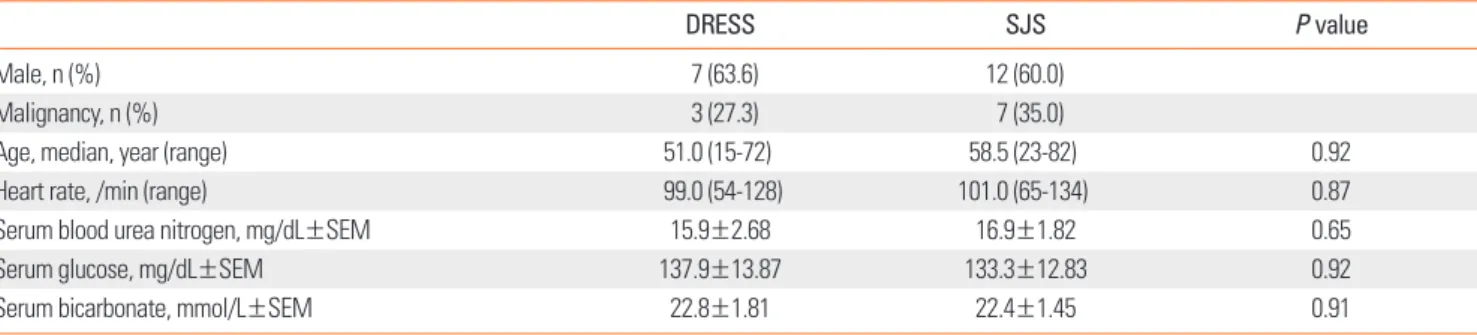
The study included 31 adults hospitalized with a diagnosis of DRESS or SJS. Eleven patients (4 men, 7 women; median age 51.5 years) had DRESS and 20 patients (12 men, 8 women; median age of 58.5 years) had SJS. There were no significant differences in the baseline values between the two disorders (Table 1).
Clinical findings
For DRESS syndrome, patients had prodromal symptoms of itching, fever and facial edema. Patients with SJS commonly had prodromal symptoms of fever and malaise. The first skin lesions appeared on the extremities and face in DRESS and on
the trunk in SJS (Table 2). The trunk lesions in SJS were tender.
The mucosal membranes of the oral cavity and eyes were com- monly affected in SJS. The genitalia (2/19, 10.5%) and anus (2/19, 10.5%) were also affected (Table 3A).
The results of laboratory tests
The liver was involved in DRESS, and all patients with DRESS had elevated liver enzymes. The kidneys (2/11, 18.2%) were also involved (Table 3B).
In differentiating between DRESS and SJS, the skin lesions are considered first. Two patients with SJS had eosinophilia (>500/
mm3 or >10%) and 17 had elevated liver enzymes (ALT or AST
>40 U/L).
Causative drugs
The most common causative drugs were antibiotics, which were identified as the cause in 4 of 11 patients (36%) with DRESS and 8 of 20 patients (40%) with SJS. From most to least common, the four antibiotics that were involved most frequent- ly were vancomycin, ceftriaxone, rifampin, ciprofloxacin and Bactrim. Anticonvulsants were the second most common drugs involved; 3 (27%) cases of DRESS and 7 (35%) of SJS were asso- ciated with anticonvulsants. From most to least common, the four anticonvulsants that were involved most frequently were lithium, carbamazepine, lamotrigine and oxcarbazepine. The remaining drugs involved in both disorders were herbal medi-
Table 1. Clinical characteristics of study subjects
DRESS SJS P value
Male, n (%) 7 (63.6) 12 (60.0)
Malignancy, n (%) 3 (27.3) 7 (35.0)
Age, median, year (range) 51.0 (15-72) 58.5 (23-82) 0.92
Heart rate, /min (range) 99.0 (54-128) 101.0 (65-134) 0.87
Serum blood urea nitrogen, mg/dL±SEM 15.9±2.68 16.9±1.82 0.65
Serum glucose, mg/dL±SEM 137.9±13.87 133.3±12.83 0.92
Serum bicarbonate, mmol/L±SEM 22.8±1.81 22.4±1.45 0.91
Table 2. Clinical data
DRESS SJS
Prodromal symptoms, n (%) Fever
Facial edema Malaise Urticaria
5 (45.5) 2 (18.2) 2 (18.2) 8 (72.7)
13 (65.0) 5 (25.0) 11 (55.0) 7 (35.0) Area of first skin lesions, n (%)
Extrimity Face Trunk Back
7 (63.6) 6 (54.5) 5 (45.5) 2 (18.2)
7 (35.0) 4 (20) 9 (45) 5 (25.0)
Allergy Asthma Immunol Res. 2010 April;2(2):123-126. doi: 10.4168/aair.2010.2.2.123
Comparison of DRESS Syndrome and SJS AAIR
125 http://e-aair.org cations (10%), allopurinol, clopidogrel and sulfonamide. In ad-
dition, dapsone (18%) and NSAIDs were associated with the development of DRESS (Table 4).
Treatment and outcome
Patients with DRESS with internal organ involvement were treated with corticosteroids (7 patients, 64%) and dramatic im- provement was observed. Most patients recovered in the ab- sence of specific treatment after eliminating the causative drug.
Most patients with SJS were successfully treated conservatively or with corticosteroids. Six patients (30%) were treated with an- tibiotics and one patient relapsed and died.
DISCUSSION
This study compared the causes and clinical features of DRESS and SJS. DRESS is a major cause of hospitalization for dermato- logical complications in patients treated with anticonvulsants.10 The clinical manifestations typically occur within 2 to 6 weeks after initiating drug therapy and most cases resolve without se- quelae when the drug is discontinued. The outcome is fatal in 5-10% of cases. The most common clinical presentation of DRESS includes fever, eruption and lymphadenopathy. The most common hematological abnormalities are eosinophilia, leukocytosis and lymphocytosis. Liver involvement in patients with DRESS may range from a transitory increase in liver en- zymes to liver necrosis with fulminant hepatic failure. Only transitory hepatitis was observed in our study, and the patients recovered without sequelae. Other potentially fatal complica- tions are hypersensitivity myocarditis, pericarditis, pneumoni- tis and nephritis.6,11,12
Although there are a variety of etiologies, such as infections and underlying malignancies, drugs remain the predominant cause of SJS. The most commonly implicated drugs are anti-
convulsants, sulfa derivatives, NSAIDs, penicillins, cepha- losporins and allopurinols.1,9 The characteristic skin lesions seen in SJS are diffuse erythematous macules with purpuric, necrotic centers, and overlying blistering. These cutaneous le- sions often demonstrate a positive Nikolsky sign, which is fur- ther detachment of the epidermis with slight lateral pressure.
Painful erosions of the mucous membranes are common and may affect the lips, oral cavity, conjunctiva, nasal cavity, ure- thra, vagina, gastrointestinal tract and respiratory tract during the course of the illness. The mucosal membranes most often affected in our study were the oral cavity and eyes. SJS is fatal in 5-15% of cases.3,8 Both the incidence of the condition and the associated mortality appear to be increased in immunocom- promised patients.
DRESS and SJS are part of a spectrum of adverse cutaneous drug reactions. However, the pathophysiology of DRESS and SJS has not been elucidated fully. Various theories have been proposed, including both immunological and non-immuno- logical mechanisms.3,13 The current pathophysiological expla- nation for DRESS is immunological. Drugs with reactive me- tabolites can modify cellular proteins and target an autoim- Table 3. Mucosal involvement in SJS and systemic manifestations in DRESS
syndrome (A)
Mucosal involvement SJS
Oral cavity, n (%) 17 (89.5)
Eyes, n (%) 17 (89.5)
Genitalia, n (%) 2 (10.5)
Anus, n (%) 2 (10.5)
(B)
Systemic involvement DRESS
Nephritis, n (%) 2 (18.2)
Adenopathy, n (%) 2 (18.2)
Hepatitis, n (%) 11 (100)
Eosinophilia, n (%) 11 (100)
Table 4. Causative drugs (A) DRESS
Drugs n (%)
Antibiotics 4 (37)
Vancomycin Ciprofloxacin Ceftriaxon
2 1 1
Anticonvulsants 3 (27)
Lithium Carbamazepine Lamotriagine,
1 1 1
Etc. 4 (37)
Ibuprofen, dapsone, carvediol, allopurinol 4 (B) SJS
Drugs n (%)
Antibiotics 8 (40)
Vancomycin Ciprofloxacin Ceftriaxon Rifampin Bactrim
2 2 2 1 1
Anticonvulsants 7 (35)
Lithium Carbamazepine Oxcarbazepin
3 3 1
Etc. 5 (25)
Clopidogrel, herb, sulfonamide, allopurinol 5
Allergy Asthma Immunol Res. 2010 April;2(2):123-126. doi: 10.4168/aair.2010.2.2.123
Jeung et al. Volume 2, Number 2, April 2010
126 http://e-aair.org
mune response against the skin or liver cells.11 It now appears that the immunological mechanisms associated with SJS are initiated by the Fas antigen, a cell surface molecule that can mediate apoptosis.3
Laboratory testing can help to identify internal organ involve- ment, which may not be evident clinically. A skin biopsy may help to confirm the diagnosis, but is usually not specific. The suspected drug should be discontinued immediately when these two syndromes are being considered.1,8,12 Delaying this measure may be associated with a poor outcome. For patients with extensive mucocutaneous involvement, prompt referral to a burn unit is recommended.
Corticosteroids remain the agents most widely used for treat- ing DRESS, although the doses used vary widely across case re- ports.8 Favorable results have been reported with their use. In the absence of a well-established therapy, primary and second- ary prevention have key roles in the management of these two syndromes.1,8 Milder cases of SJS can be managed in an inpa- tient setting using the same fundamental therapeutic protocol used for the treatment of burns. The use of medications to treat SJS remains controversial. Treatment with corticosteroids, while effective in most other acute inflammatory disorders, is contro- versial.
The most important diagnostic clues are the mucosal lesions and eosinophilia, characteristic of both syndromes. Age and gender were not helpful in differentiating SJS from DRESS. Ele- vated liver enzymes suggest the DRESS syndrome, well known to affect internal organs. As in a previous study, the liver was commonly involved in our DRESS patients. However, some ear- lier studies reported that up to 75% of the patients with SJS had elevated liver enzymes, similar to patients with DRESS.14 Hepa- titis was observed in 85% of the patients with SJS in our study.
Anticonvulsants were once the most common cause although, more recently, antibiotics have been reported to be the most common cause of both disorders.6,8,9 The increase in the use of antibiotics in Korea might explain this finding. After prompt withdrawal of the offending drug, conservative treatment or combination corticosteroid treatment has been used to treat patients with both syndromes, and most patients have im- proved clinical symptoms and laboratory findings with this ap- proach. In the absence of specific treatment, the elimination of the causative drug and proper symptomatic treatment are the best management approaches for both SJS and DRESS.
REFERENCES
Wolf R, Davidovici B, Matz H, Mahlab K, Orion E, Sthoeger ZM. Drug 1.
Rash with eosinophilia and systemic symptoms versus Stevens- Johnson Syndrome—a case that indicates a stumbling block in the current classification. Int Arch Allergy Immunol 2006;141:308-10.
Gruchalla RS. 10. Drug allergy. J Allergy Clin Immunol 2003;111:
2.
S548-59.
Abe R. Toxic epidermal necrolysis and Stevens-Johnson syndrome:
3.
soluble Fas ligand involvement in the pathomechanisms of these diseases. J Dermatol Sci 2008;52:151-9.
Lee JH, Park HK, Heo J, Kim TO, Kim GH, Kang DH, Song GA, Cho 4.
M, Kim DS, Kim HW, Lee CH. Drug Rash with Eosinophilia and Systemic Symptoms (DRESS) syndrome induced by celecoxib and anti-tuberculosis drugs. J Korean Med Sci 2008;23:521-5.
Roujeau JC, Kelly JP, Naldi L, Rzany B, Stern RS, Anderson T, Auquier 5.
A, Bastuji-Garin S, Correia O, Locati F, Mockenhaupt M, Paoletti C, Shapiro S, Shear N, Schöpf E, Kaufman DW. Medication use and the risk of Stevens-Johnson syndrome or toxic epidermal necrolysis. N Engl J Med 1995;333:1600-7.
Maoz KB, Brenner S. Drug rash with eosinophilia and systemic 6.
symptoms syndrome: sex and the causative agent. Skinmed 2007;6:
271-3.
Roujeau JC, Stern RS. Severe adverse cutaneous reactions to drugs.
7.
N Engl J Med 1994;331:1272-85.
Hazin R, Ibrahimi OA, Hazin MI, Kimyai-Asadi A. Stevens-Johnson 8.
syndrome: pathogenesis, diagnosis, and management. Ann Med 2008;40:129-38.
Lazarou J, Pomeranz BH, Corey PN. Incidence of adverse drug reac- 9.
tions in hospitalized patients: a meta-analysis of prospective stud- ies. JAMA 1998;279:1200-5.
Ganeva M, Gancheva T, Lazarova R, Troeva J, Baldaranov I, Vassilev 10.
I, Hristakieva E, Tzaneva V. Carbamazepine-induced drug reaction with eosinophilia and systemic symptoms (DRESS) syndrome: re- port of four cases and brief review. Int J Dermatol 2008;47:853-60.
Ichiche M, Kiesch N, De Bels D. DRESS syndrome associated with 11.
HHV-6 reactivation. Eur J Intern Med 2003;14:498-500.
Tas S, Simonart T. Management of drug rash with eosinophilia and 12.
systemic symptoms (DRESS syndrome): an update. Dermatology 2003;206:353-6.
Castaneda CP, Brandenburg NA, Bwire R, Burton GH, Zeldis JB.
13.
Erythema multiforme/Stevens-Johnson syndrome/toxic epidermal necrolysis in lenalidomide-treated patients. J Clin Oncol 2009;27:
156-7.
Umebayashi Y, Enomoto H, Ogasawara M. Drug eruption due to 14.
peplomycin: an unusual form of Stevens-Johnson syndrome with pustules. J Dermatol 2004;31:802-5.