Optimal Time to Start Peripheral Blood Stem Cell Collection in Children with High-Risk Solid Tumors
In order to clarify the optimal timing for peripheral blood stem cell (PBSC) collection, PBSC collection records of 323 children who were scheduled to undergo autologous stem cell transplantation from two study periods differing in the timing of PBSC collection were analyzed. In the early study period (March 1998 to August 2007, n = 198), PBSC collection was initiated when the peripheral WBC count exceeded 1,000/μL during recovery from chemotherapy. Findings in this study period indicated that initiation of PBSC collection at a higher WBC count might result in a greater CD34+ cell yield. Therefore, during the late study period (September 2007 to December 2012, n = 125), PBSC collection was initiated when the WBC count exceeded 4,000/μL. Results in the late study period validated our conclusion from the early study period. Collection of a higher number of CD34+ cells was associated with a faster hematologic recovery after transplant in the late study period.
Initiation of PBSC collection at WBC count > 4,000/μL was an independent factor for a greater CD34+ cell yield. In conclusion, PBSC collection at a higher WBC count is associated with a greater CD34+ cell yield, and consequently a faster hematologic recovery after transplant.
Keywords: High-Dose Chemotherapy; Autologous Stem Cell Transplantation; Peripheral Blood Stem Cell Collection
Ki Woong Sung,1* Hee Won Chueh,2* Na Hee Lee,1 Dong Hwan Kim,1 Soo Hyun Lee,1 Keon Hee Yoo,1 Hong Hoe Koo,1 Eun Suk Kang,3 and Dae Won Kim3
1Department of Pediatrics, Samsung Medical Center, Sungkyunkwan University School of Medicine, Seoul; 2Department of Pediatrics, Dong-A University Medical Center, Dong-A University College of Medicine, Busan; 3Department of Laboratory Medicine, Samsung Medical Center, Sungkyunkwan University School of Medicine, Seoul, Korea
*Ki Woong Sung and Hee Won Chueh contributed equally to this work.
Received: 6 July 2013 Accepted: 6 November 2013 Address for Correspondence:
Dae Won Kim, MD
Department of Laboratory Medicine, Samsung Medical Center, Sungkyunkwan University School of Medicine, 81 Irwon-ro, Gangnam-gu, Seoul 135-710, Korea
Tel: +82.2-3410-2701, Fax: +82.2-3410-2719 E-mail: [email protected]
http://dx.doi.org/10.3346/jkms.2014.29.1.110 • J Korean Med Sci 2014; 29: 110-116
INTRODUCTION
In children with high-risk or recurrent solid tumors, a treatment strategy involving high-dose chemotherapy and autologous stem cell transplantation (HDCT/autoSCT) has shown the po- tential to improve outcomes (1, 2). Dose escalation using tan- dem HDCT/autoSCT may further improve outcomes in patients with high-risk or recurrent solid tumors (3-6). Although it is dif- ficult to define the minimum number of stem cells needed for hematologic recovery after SCT, the rate of hematologic recov- ery is positively associated with CD34+ cell number (7-9) and transplantation of > 5 × 10⁶/kg CD34+ cells improves outcomes (8, 9). When performing tandem HDCT/autoSCT, half of the collected stem cells are infused for bone marrow (BM) rescue during each HDCT/autoSCT session. Therefore, more stem cells are generally needed for successful hematologic recovery when performing tandem HDCT/autoSCT than for single HDCT/au- toSCT (10).
The most common method used to mobilize stem cells in children with solid tumors who were scheduled to undergo HDCT/autoSCT is the administration of granulocyte-colony stimulating factor (G-CSF) during the recovery phase of che-
motherapy. In a significant proportion of patients (5% to 40%), however, this conventional method induces an insufficient yield of stem cells (11-14). This is of particular concern for patients scheduled to undergo tandem HDCT/autoSCT because this procedure requires larger numbers of stem cells (10).
Various clinical and biological factors may affect stem cell mobilization and collection (15-17), including the time point during recovery after chemotherapy at which PBSC collection begins. However, the optimal time to start PBSC collection has not been established, particularly in children (18). Recently, the number of CD34+ cells in the peripheral blood (PB) is used to decide the timing to start PBSC collection because it can pre- dict PBSC collection yield. However, the number of CD34+ cells in PB may be persistently lower than the threshold level at which PBSC collection begins in poor mobilizers. Therefore, the strat- egy to start PBSC collection at a certain or higher level of CD34+ cell number in PB might be difficult to apply in poor mobilizers.
Therefore, many institutions still consider WBC count in PB as one of valid surrogates. While some studies have suggested ini- tiating PBSC collection when the WBC count in PB exceeds 1,000/μL (19, 20), other studies indicate that waiting until the WBC count is greater than 2,000-10,000/μL may be advanta- Pediatrics
geous (18, 21). For this reason, we performed this study to clari- fy the optimal timing for PBSC collection in children with high- risk or recurrent solid tumors.
MATERIALS AND METHODS Patients
First, records of PBSC mobilization and collection between March 1998 and August 2007 for patients with high-risk or re- current solid tumors who were scheduled to undergo HDCT/
autoSCT at Samsung Children’s Cancer Center were analyzed to determine the optimal time to initiate PBSC collection. In this early study period, PBSC collection was initiated when the WBC count in PB exceeded 1,000/μL during recovery phase af- ter conventional chemotherapy. Results of this retrospective analysis suggested that initiation of PBSC collection at a higher WBC count in PB might result in a greater CD34+ cell yield. There- fore, during the late study period between September 2007 and December 2012, PBSC collection was initiated only when the WBC count exceeded 4,000/μL during the recovery phase after chemotherapy. Records of patients with hematologic disease, including lymphoma, and of patients treated with G-CSF alone to mobilize stem cells in steady state were excluded from the analysis. In addition, records retrieved during the second col- lection round in patients who failed to yield a sufficient number of CD34+ cells during the first collection round were also ex- cluded.
Stem cell mobilization and collection
G-CSF was administered starting from the day when absolute neutrophil count (ANC) fell below 500/μL after conventional chemotherapy until the completion of PBSC collection. In the early study period, leukapheresis for PBSC collection was start- ed if the WBC count in PB exceeded 1,000/μL during the recov- ery phase as described above. In general, leukapheresis was performed using three times the patient’s total blood volume through a dual-lumen central catheter unless this presented significant clinical risks for the patient. The aim was to collect at least 2 × 10⁶ CD34+ cells/kg, preferably > 5 × 10⁶ CD34+ cells/
kg. Irradiated RBCs and platelet concentrates were transfused to maintain a hemoglobin level of 10 g/dL and a platelet count of 50,000/μL during stem cell collection. In the late study peri- od, all collection procedures were identical to those used in the early study period except that PBSC collection was initiated only when the WBC count in PB exceeded 4,000/μL.
Statistical analysis
Differences in the proportions of patients between early and late study periods were analyzed using a chi-square test. Differ- ences in continuous variables between three or more groups were analyzed using the Kruskal-Wallis test. Differences in con-
tinuous variables between two groups were analyzed using the Mann-Whitney U test. Multivariate analysis was performed us- ing linear regression analysis to test factors affecting CD34+ cell yield. P values < 0.05 were considered statistically significant.
Ethics statement
The institutional review board (IRB) of the Samsung Medical Center approved this study and waived the requirement for in- formed consent (IRB 2013-04-082).
RESULTS
Patient characteristics
During the early study period, 257 patients underwent PBSC collection. From these patients, we excluded 30 with hemato- logic disease, 23 in whom stem cell mobilization was induced using G-CSF alone in steady state, and 6 who were treated with GM-CSF for stem cell mobilization. The preliminary analysis of optimal PBSC collection time therefore included 198 patients.
During the late study period, 145 patients underwent PBSC col- lection. From these patients, we excluded 11 with hematologic disease and 9 who were treated with G-CSF alone in steady state.
Thus, data of 125 patients were used to confirm results from the early study period.
PBSC collection during the early study period
In the early study period, leukapheresis for PBSC collection was performed for 2-3 days in 75 (37.9%) patients, 4-5 days in 60 (30.3%) patients, and 6-11 days in 63 (31.8%) patients. As ex- pected, PBSC collection was extended when CD34+ cell yield was lower. The WBC count in PB increased as the number of leukapheresis days increased (Fig. 1A). The number of CD34+ cells in PB was positively associated with the WBC count in PB with borderline significance (Fig. 1B). Accordingly, the daily CD34+ cell yield was higher when the WBC count in PB before leukapheresis was higher, specifically at > 4,000/μL (Fig. 1C), and the daily CD34+ cell yield increased with the number of leukapheresis days. When assuming PBSC collection had been initiated at peripheral WBC counts exceeding 1,000/μL, 2,000/
μL, and 4,000/μL in patients who underwent PBSC collection for 6-11 days, CD34+ cell yield for the first 3 days was highest for initiation at > 4,000/μL peripheral WBC (Fig. 1D). A higher G- CSF dose was not associated with a greater CD34+ cell yield.
Collectively, these findings suggest that initiation of PBSC col- lection at a WBC count of 1,000/μL may be too early for optimal yield and that waiting until WBC count exceeds 4,000/μL may be advantageous.
PBSC collection during the late study period
Therefore, in the late study period, we initiated PBSC collection when the WBC count in PB exceeded 4,000/μL. Data of patients
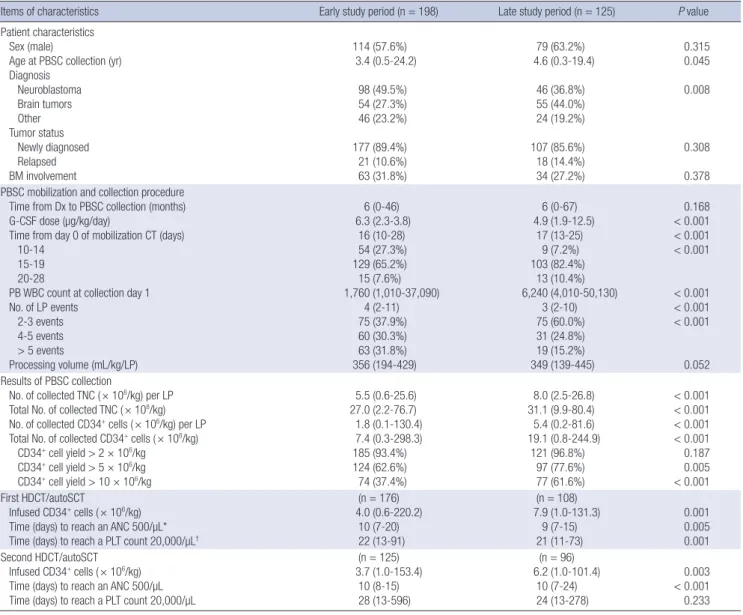
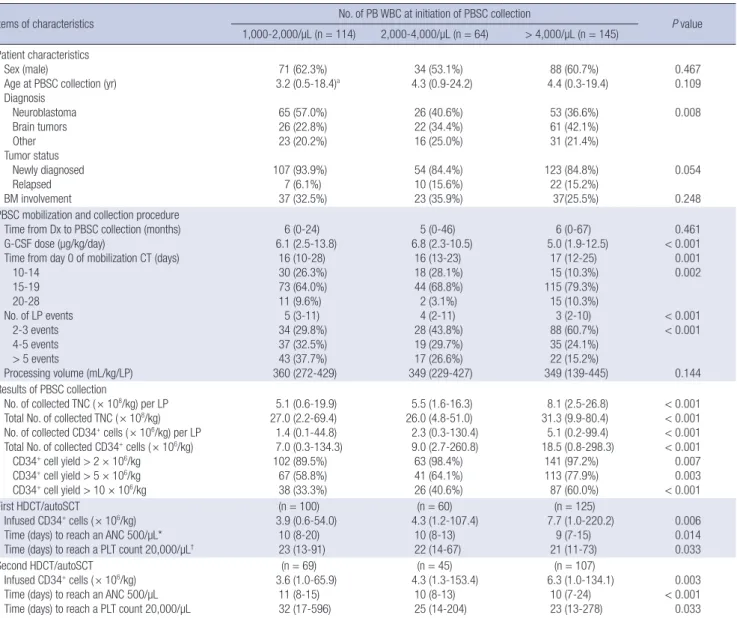
treated in this period were analyzed to test preliminary conclu- sions derived from the early study period. Patients in the late study period were older than those in the early study period (Table 1). The most frequent diagnosis was neuroblastoma; how- ever, the proportion of brain tumors was higher and a lower dose of G-CSF was used in the late study period. The two study groups did not differ in the proportion of patients with relapsed tumor, the proportion with BM involvement at diagnosis, the interval between initial diagnosis and PBSC collection, and the processed blood volume during leukapheresis. As results, there were fewer leukapheresis events in the late study period than in the early study period (median 3 [range 2-10] vs median 4 [range 2-11], P < 0.001). Daily yields of total nucleated cells and CD34+ cells were higher in the late study period, and the total yields of total nucleated cells and CD34+ cells were higher despite the shorter collection period in the late study period. Similarly, the proportions of patients from whom > 5 × 10⁶ CD34+ cells/kg and > 10 × 106 CD34+ cells/kg were collected were higher in the late study period than in the early study period. When the analysis was performed according to the number of PB WBC at initiation of PBSC collection during both early and late study periods, results were similar (Table 2). When hematologic re- covery after mobilization chemotherapy was delayed, in other
words, when the interval between initiation of mobilization che- motherapy and initiation of PBSC collection increased, CD34+ cell yield decreased (P < 0.001).
Multivariate analysis for factors affecting CD34+ cell yield was performed using data from all patients during both early and late study periods (Table 3). In the multivariate analysis, tumor relapse and longer chemotherapy before mobilization chemo- therapy (> 3 cycles) independently predicted poor CD34+ cell yield. Initiation of PSBC collection after the WBC count in PB exceeded 4,000/μL was independently associated with a greater CD34+ cell yield. Age, BM involvement of tumor at diagnosis, and G-CSF dose were not independently associated with CD34+ cell yield.
Hematologic recovery after HDCT/autoSCT
In the early study period, 176 patients underwent the first HDCT/
autoSCT, and 125 of these underwent the second HDCT/au- toSCT. In the late study period, 108 patients underwent the first HDCT/autoSCT, and 96 of these underwent the second HDCT/
autoSCT. The numbers of CD34+ cells infused in the first and second HDCT/autoSCT were higher in the late study period than those in the early study period. Accordingly, neutrophil recovery in both the first and second HDCT/autoSCT and plate- Fig. 1. Results of PBSC collection in the early study period. (A) PB WBC counts increase as the number of leukapheresis days increased. (B) The number of CD34+ cells in PB is positively associated with the WBC count in PB with borderline significance. (C) Thus, daily CD34+ cell yields reflect the WBC counts before leukapheresis, with the highest yields obtained for WBC counts > 4,000/µL. (D) When assuming PBSC collection had been initiated at PB WBC counts exceeding 1,000/µL, 2,000/µL, and 4,000/µL in patients who underwent PBSC collection for 6-11 days, CD34+ cell yield for the first 3 days is highest for initiation at > 4,000/µL PB WBC. Median values are presented with bars.
PB WBC (×103/µL)
Leukapheresis day
1 2 3 4 5 6 7 8 16
14 12 10 8 6 4 2 0
A
CD34+ cells/µL in PB
PB WBC ( × 103/µL)
1 10 100 1,000
100
10
1
0.1
r2 = 0.015 P = 0.07
B
CD34+ cells (×106/kg)
PB WBC ( × 103/µL)
1-2 2-4 4-8 > 8
1,000 100 10 1 0.1 0.01
P < 0.001
C
CD34+ cells (×106/kg)
PB WBC ( × 103/µL)
1-2 2-4 > 4
10
1
0.1
P < 0.001
D
let recovery in the first HDCT/autoSCT were faster in the late study period than in the early study period (Table 1).
DISCUSSION
Although the number of CD34+ cells in PB can predict PBSC collection yield, many institutions still consider WBC count in PB as one of valid surrogates to decide the timing to start PBSC collection because the number of CD34+ cells in PB may be per- sistently lower than the threshold at which PBSC collection be- gins in poor mobilizers, and therefore, the strategy using the number of CD34+ cells in PB as valid surrogate to decide the timing to start PBSC collection might be difficult to apply in poor mobilizers. However, the optimal WBC count in PB to start PBSC collection has not been systematically tested, particularly
in children with high-risk solid tumors (18). In this context, we retrospectively reviewed data of PBSC collections conducted during two study periods that differed in the threshold WBC count in PB at which leukapheresis was initiated. Our findings indicated that deferring PBSC collection until the WBC count in PB exceeds 4,000/μL may be advantageous for CD34+ cell yields.
Results in the late study period validated our conclusion from the early study period. Collection of a higher number of CD34+ cells was associated with a faster hematologic recovery after transplant in the late study period. Multivariate analysis showed that initiation of PBSC collection after the WBC count in PB ex- ceeded 4,000/μL independently predicted a higher CD34+ cell yield.
The use of tandem HDCT/autoSCT to treat high-risk or re- current solid tumors in children is currently increasing (3-6).
Table 1. Characteristics related to stem cell mobilization/collection and hematologic recovery according to the study period
Items of characteristics Early study period (n = 198) Late study period (n = 125) P value
Patient characteristics Sex (male)
Age at PBSC collection (yr) Diagnosis
Neuroblastoma Brain tumors Other Tumor status
Newly diagnosed Relapsed BM involvement
114 (57.6%) 3.4 (0.5-24.2)
98 (49.5%) 54 (27.3%) 46 (23.2%) 177 (89.4%) 21 (10.6%) 63 (31.8%)
79 (63.2%) 4.6 (0.3-19.4)
46 (36.8%) 55 (44.0%) 24 (19.2%) 107 (85.6%) 18 (14.4%) 34 (27.2%)
0.315 0.045 0.008
0.308 0.378 PBSC mobilization and collection procedure
Time from Dx to PBSC collection (months) G-CSF dose (µg/kg/day)
Time from day 0 of mobilization CT (days) 10-14
15-19 20-28
PB WBC count at collection day 1 No. of LP events
2-3 events 4-5 events
> 5 events
Processing volume (mL/kg/LP)
6 (0-46) 6.3 (2.3-3.8)
16 (10-28) 54 (27.3%) 129 (65.2%) 15 (7.6%) 1,760 (1,010-37,090)
4 (2-11) 75 (37.9%) 60 (30.3%) 63 (31.8%) 356 (194-429)
6 (0-67) 4.9 (1.9-12.5)
17 (13-25) 9 (7.2%) 103 (82.4%)
13 (10.4%) 6,240 (4,010-50,130)
3 (2-10) 75 (60.0%) 31 (24.8%) 19 (15.2%) 349 (139-445)
0.168
< 0.001
< 0.001
< 0.001
< 0.001
< 0.001
< 0.001
0.052 Results of PBSC collection
No. of collected TNC ( × 108/kg) per LP Total No. of collected TNC ( × 108/kg) No. of collected CD34+ cells ( × 106/kg) per LP Total No. of collected CD34+ cells ( × 106/kg)
CD34+ cell yield > 2 × 10⁶/kg CD34+ cell yield > 5 × 10⁶/kg CD34+ cell yield > 10 × 106/kg
5.5 (0.6-25.6) 27.0 (2.2-76.7) 1.8 (0.1-130.4) 7.4 (0.3-298.3) 185 (93.4%) 124 (62.6%) 74 (37.4%)
8.0 (2.5-26.8) 31.1 (9.9-80.4) 5.4 (0.2-81.6) 19.1 (0.8-244.9)
121 (96.8%) 97 (77.6%) 77 (61.6%)
< 0.001
< 0.001
< 0.001
< 0.001 0.187 0.005
< 0.001 First HDCT/autoSCT
Infused CD34+ cells ( × 106/kg) Time (days) to reach an ANC 500/µL*
Time (days) to reach a PLT count 20,000/µL†
(n = 176) 4.0 (0.6-220.2)
10 (7-20) 22 (13-91)
(n = 108) 7.9 (1.0-131.3)
9 (7-15) 21 (11-73)
0.001 0.005 0.001 Second HDCT/autoSCT
Infused CD34+ cells ( × 106/kg) Time (days) to reach an ANC 500/µL Time (days) to reach a PLT count 20,000/µL
(n = 125) 3.7 (1.0-153.4)
10 (8-15) 28 (13-596)
(n = 96) 6.2 (1.0-101.4)
10 (7-24) 24 (13-278)
0.003
< 0.001 0.233
*The first day when the absolute neutrophil count exceeded 500/µL for three consecutive days; †The first day when the platelet count exceeded 20,000/µL without a transfu- sion for the previous seven days. PBSC, peripheral blood stem cell; Dx, diagnosis; CT, chemotherapy; BM, bone marrow; LP, leukapheresis; TNC, total nucleated cells; HDCT/
autoSCT, high-dose CT and autologous stem cell transplantation; ANC, absolute neutrophil count; PLT, platelet.
For this procedure, the number of CD34+ cells collected is of particular concern because the number of cells transplanted during each session may be lower than the number transplant- ed when only a single HDCT/autoSCT is performed. In our ex- perience, platelet and RBC recoveries are significantly delayed
in the second HDCT/autoSCT compared with the first HDCT/
autoSCT, but this delay may be overcome if a sufficient number of CD34+ cells (> 5 × 10⁶ cells/kg) can be transplanted in each session of tandem HDCT/autoSCT (10). The present study show- ed that the proportions of patients from whom > 5 × 10⁶ CD34+ cells/kg and > 10 × 106 CD34+ cells/kg were collected were sig- nificantly higher when PBSC collection was delayed until WBC counts exceeded 4,000/μL.
The patient groups analyzed in the two study periods pre- sented some clinical differences that may potentially have in- fluenced CD34+ cell yields. However, initiation of PBSC collec- tion at a higher WBC count independently predicted higher CD34+ cell yield in the multivariate analysis of data from all pa- tients included in both early and late study periods. In addition, tumor relapse and extended chemotherapy before PBSC col- Table 2. Characteristics related to stem cell mobilization/collection and hematologic recovery according to the number of WBC at initiation of PBSC collection
Items of characteristics No. of PB WBC at initiation of PBSC collection
P value 1,000-2,000/µL (n = 114) 2,000-4,000/µL (n = 64) > 4,000/µL (n = 145)
Patient characteristics Sex (male)
Age at PBSC collection (yr) Diagnosis
Neuroblastoma Brain tumors Other Tumor status
Newly diagnosed Relapsed BM involvement
71 (62.3%) 3.2 (0.5-18.4)a
65 (57.0%) 26 (22.8%) 23 (20.2%) 107 (93.9%) 7 (6.1%) 37 (32.5%)
34 (53.1%) 4.3 (0.9-24.2)
26 (40.6%) 22 (34.4%) 16 (25.0%) 54 (84.4%) 10 (15.6%) 23 (35.9%)
88 (60.7%) 4.4 (0.3-19.4)
53 (36.6%) 61 (42.1%) 31 (21.4%) 123 (84.8%) 22 (15.2%) 37(25.5%)
0.467 0.109 0.008
0.054 0.248 PBSC mobilization and collection procedure
Time from Dx to PBSC collection (months) G-CSF dose (µg/kg/day)
Time from day 0 of mobilization CT (days) 10-14
15-19 20-28 No. of LP events
2-3 events 4-5 events
> 5 events
Processing volume (mL/kg/LP)
6 (0-24) 6.1 (2.5-13.8)
16 (10-28) 30 (26.3%) 73 (64.0%) 11 (9.6%)
5 (3-11) 34 (29.8%) 37 (32.5%) 43 (37.7%) 360 (272-429)
5 (0-46) 6.8 (2.3-10.5)
16 (13-23) 18 (28.1%) 44 (68.8%) 2 (3.1%) 4 (2-11) 28 (43.8%) 19 (29.7%) 17 (26.6%) 349 (229-427)
6 (0-67) 5.0 (1.9-12.5)
17 (12-25) 15 (10.3%) 115 (79.3%) 15 (10.3%) 3 (2-10) 88 (60.7%) 35 (24.1%) 22 (15.2%) 349 (139-445)
0.461
< 0.001 0.001 0.002
< 0.001
< 0.001
0.144 Results of PBSC collection
No. of collected TNC ( × 108/kg) per LP Total No. of collected TNC ( × 108/kg) No. of collected CD34+ cells ( × 106/kg) per LP Total No. of collected CD34+ cells ( × 106/kg)
CD34+ cell yield > 2 × 10⁶/kg CD34+ cell yield > 5 × 10⁶/kg CD34+ cell yield > 10 × 106/kg
5.1 (0.6-19.9) 27.0 (2.2-69.4) 1.4 (0.1-44.8) 7.0 (0.3-134.3) 102 (89.5%)
67 (58.8%) 38 (33.3%)
5.5 (1.6-16.3) 26.0 (4.8-51.0) 2.3 (0.3-130.4) 9.0 (2.7-260.8)
63 (98.4%) 41 (64.1%) 26 (40.6%)
8.1 (2.5-26.8) 31.3 (9.9-80.4) 5.1 (0.2-99.4) 18.5 (0.8-298.3)
141 (97.2%) 113 (77.9%) 87 (60.0%)
< 0.001
< 0.001
< 0.001
< 0.001 0.007 0.003
< 0.001 First HDCT/autoSCT
Infused CD34+ cells ( × 106/kg) Time (days) to reach an ANC 500/µL*
Time (days) to reach a PLT count 20,000/µL†
(n = 100) 3.9 (0.6-54.0)
10 (8-20) 23 (13-91)
(n = 60) 4.3 (1.2-107.4)
10 (8-13) 22 (14-67)
(n = 125) 7.7 (1.0-220.2)
9 (7-15) 21 (11-73)
0.006 0.014 0.033 Second HDCT/autoSCT
Infused CD34+ cells ( × 106/kg) Time (days) to reach an ANC 500/µL Time (days) to reach a PLT count 20,000/µL
(n = 69) 3.6 (1.0-65.9)
11 (8-15) 32 (17-596)
(n = 45) 4.3 (1.3-153.4)
10 (8-13) 25 (14-204)
(n = 107) 6.3 (1.0-134.1)
10 (7-24) 23 (13-278)
0.003
< 0.001 0.033
*The first day when the absolute neutrophil count exceeded 500/µL for three consecutive days; †The first day when the platelet count exceeded 20,000/µL without a transfu- sion for the previous seven days. PB, peripheral blood; PBSC, PB stem cell; BM, bone marrow; Dx, diagnosis; CT, chemotherapy; LP, leukapheresis; TNC, total nucleated cells;
HDCT/autoSCT, high-dose CT and autologous stem cell transplantation; ANC, absolute neutrophil count; PLT, platelet.
Table 3. Multivariate analysis for factors affecting CD34+ cell yield
Parameters t-score 95% CI P value
Age > 4 yr -0.08 -12.45~11.53 0.939
BM involvement at diagnosis -0.90 -19.10~7.10 0.368
Tumor relapse -5.36 -60.11~-27.82 < 0.001
> 3 cycles of CT before mobilization CT -9.01 -71.16~-45.65 < 0.001 G-CSF dose < 5 µg/kg/day 1.18 -5.43~21.59 0.240 PB WBC > 4,000/µL at initiation of
PBSC collection 3.38 7.72~29.17 0.001
BM, bone marrow; CT, chemotherapy; PB, peripheral blood; PBSC, PB stem cell.
lection were independently associated with a lower CD34+ cell yield. These findings suggest that early collection of stem cells may be preferred if the possibility of tumor cells in circulation can be ruled out. It is also interesting that bone marrow involve- ment of the tumor at diagnosis and G-CSF dose were not inde- pendently associated with CD34+ cell yield in the present study.
While our analysis shows that a higher initial WBC count promotes a higher stem cell yield, collection of CD34+ cells in therapeutic numbers presents a challenge in some patients. For patients recognized as “poor mobilizers”, the macrocyclic com- pound plerixafor may boost CD34+ cell yield. In adults, more CD34+ cells could be collected with G-CSF + plerixafor than with G-CSF alone (22-26); however, the efficacy and toxicity of plerixafor have not been established in children with solid tu- mors. Furthermore, most studies describe the use of plerixafor in the steady state without mobilization chemotherapy. There- fore, if plerixafor is to be used during hematologic recovery fol- lowing mobilization chemotherapy, it may be necessary to de- termine not only the optimal time to initiate PBSC collection, but also the time to start plerixafor treatment.
In conclusion, delay in the initiation of PBSC collection until the WBC count in PB exceeds 4,000/μL is associated with a high- er CD34+ cell yield, and consequently a faster hematologic re- covery after HDCT/autoSCT, particularly in tandem HDCT/au- toSCT. Further studies to confirm our findings may be justified.
ACKNOWLEDGEMENTS
We would like to thank Miss So Yeon Lee for her assistance with data collection.
DISCLOSURE
The authors declare no competing financial interest.
REFERENCES
1. Matthay KK, Villablanca JG, Seeger RC, Stram DO, Harris RE, Ramsay NK, Swift P, Shimada H, Black CT, Brodeur GM, et al. Treatment of high- risk neuroblastoma with intensive chemotherapy, radiotherapy, autolo- gous bone marrow transplantation, and 13-cis-retinoic acid: Children’s Cancer Group. N Engl J Med 1999; 341: 1165-73.
2. Berthold F, Boos J, Burdach S, Erttmann R, Henze G, Hermann J, Klinge- biel T, Kremens B, Schilling FH, Schrappe M, et al. Myeloablative mega- therapy with autologous stem-cell rescue versus oral maintenance che- motherapy as consolidation treatment in patients with high-risk neuro- blastoma: a randomised controlled trial. Lancet Oncol 2005; 6: 649-58.
3. George RE, Li S, Medeiros-Nancarrow C, Neuberg D, Marcus K, Sham- berger RC, Pulsipher M, Grupp SA, Diller L. High-risk neuroblastoma treated with tandem autologous peripheral-blood stem cell-supported transplantation: long-term survival update. J Clin Oncol 2006; 24: 2891-6.
4. Kletzel M, Katzenstein HM, Haut PR, Yu AL, Morgan E, Reynolds M,
Geissler G, Marymount MH, Liu D, Kalapurakal JA, et al. Treatment of high-risk neuroblastoma with triple-tandem high-dose therapy and stem- cell rescue: results of the Chicago Pilot II Study. J Clin Oncol 2002; 20: 2284- 92.
5. Sung KW, Lim do H, Son MH, Lee SH, Yoo KH, Koo HH, Kim JH, Suh YL, Joung YS, Shin HJ. Reduced-dose craniospinal radiotherapy followed by tandem high-dose chemotherapy and autologous stem cell transplan- tation in patients with high-risk medulloblastoma. Neuro Oncol 2013;
15: 352-9.
6. Sung KW, Son MH, Lee SH, Yoo KH, Koo HH, Kim JY, Cho EJ, Lee SK, Choi YS, Lim DH, et al. Tandem high-dose chemotherapy and autolo- gous stem cell transplantation in patients with high-risk neuroblastoma:
results of SMC NB-2004 study. Bone Marrow Transplant 2013; 48: 68-73.
7. Siena S, Schiavo R, Pedrazzoli P, Carlo-Stella C. Therapeutic relevance of CD34 cell dose in blood cell transplantation for cancer therapy. J Clin Oncol 2000; 18: 1360-77.
8. Klaus J, Herrmann D, Breitkreutz I, Hegenbart U, Mazitschek U, Egerer G, Cremer FW, Lowenthal RM, Huesing J, Fruehauf S, et al. Effect of CD34 cell dose on hematopoietic reconstitution and outcome in 508 pa- tients with multiple myeloma undergoing autologous peripheral blood stem cell transplantation. Eur J Haematol 2007; 78: 21-8.
9. Mavroudis D, Read E, Cottler-Fox M, Couriel D, Molldrem J, Carter C, Yu M, Dunbar C, Barrett J. CD34+ cell dose predicts survival, posttrans- plant morbidity, and rate of hematologic recovery after allogeneic mar- row transplants for hematologic malignancies. Blood 1996; 88: 3223-9.
10. Son MH, Kim DH, Lee SH, Yoo KH, Sung KW, Koo HH, Kim JY, Cho EJ, Kang ES, Kim DW. Hematologic recovery after tandem high-dose che- motherapy and autologous stem cell transplantation in children with high-risk solid tumors. J Korean Med Sci 2013; 28: 220-6.
11. Sugrue MW, Williams K, Pollock BH, Khan S, Peracha S, Wingard JR, Moreb JS. Characterization and outcome of “hard to mobilize”’ lympho- ma patients undergoing autologous stem cell transplantation. Leuk Lym- phoma 2000; 39: 509-19.
12. Gordan LN, Sugrue MW, Lynch JW, Williams KD, Khan SA, Wingard JR, Moreb JS. Poor mobilization of peripheral blood stem cells is a risk factor for worse outcome in lymphoma patients undergoing autologous stem cell transplantation. Leuk Lymphoma 2003; 44: 815-20.
13. Kuittinen T, Nousiainen T, Halonen P, Mahlamäki E, Jantunen E. Pre- diction of mobilisation failure in patients with non-Hodgkin’s lympho- ma. Bone Marrow Transplant 2004; 33: 907-12.
14. Pusic I, Jiang SY, Landua S, Uy GL, Rettig MP, Cashen AF, Westervelt P, Vij R, Abboud CN, Stockerl-Goldstein KE, et al. Impact of mobilization and remobilization strategies on achieving sufficient stem cell yields for autologous transplantation. Biol Blood Marrow Transplant 2008; 14:
1045-56.
15. Hester J. Peripheral blood stem cell collection: the interaction of technol- ogy, procedure, and biological factors. Transfus Sci 2000; 23: 125-32.
16. Ikeda K, Kozuka T, Harada M. Factors for PBPC collection efficiency and collection predictors. Transfus Apher Sci 2004; 31: 245-59.
17. Carral A, de la Rubia J, Martín G, Mollá S, Martínez J, Sanz GF, Soler MA, Jarque I, Jiménez C, Sanz MA. Factors influencing the collection of pe- ripheral blood stem cells in patients with acute myeloblastic leukemia and non-myeloid malignancies. Leuk Res 2003; 27: 5-12.
18. Ho AD, Glück S, Germond C, Sinoff C, Dietz G, Maruyama M, Corring- ham RE. Optimal timing for collections of blood progenitor cells follow-
ing induction chemotherapy and granulocyte-macrophage colony-stim- ulating factor for autologous transplantation in advanced breast cancer.
Leukemia 1993; 7: 1738-46.
19. Weaver CH, Hazelton B, Birch R, Palmer P, Allen C, Schwartzberg L, West W. An analysis of engraftment kinetics as a function of the CD34 content of peripheral blood progenitor cell collections in 692 patients af- ter the administration of myeloablative chemotherapy. Blood 1995; 86:
3961-9.
20. Elias AD, Ayash L, Anderson KC, Hunt M, Wheeler C, Schwartz G, Tepler I, Mazanet R, Lynch C, Pap S, et al. Mobilization of peripheral blood progenitor cells by chemotherapy and granulocyte-macrophage colony- stimulating factor for hematologic support after high-dose intensifica- tion for breast cancer. Blood 1992; 79: 3036-44.
21. Dreger P, Marquardt P, Haferlach T, Jacobs S, Mülverstedt T, Eckstein V, Suttorp M, Löffler H, Müller-Ruchholtz W, Schmitz N. Effective mobili- sation of peripheral blood progenitor cells with ‘Dexa-BEAM’ and G- CSF: timing of harvesting and composition of the leukapheresis product.
Br J Cancer 1993; 68: 950-7.
22. DiPersio JF, Micallef IN, Stiff PJ, Bolwell BJ, Maziarz RT, Jacobsen E, Na- demanee A, McCarty J, Bridger G, Calandra G. Phase III prospective ran- domized double-blind placebo-controlled trial of plerixafor plus granu- locyte colony-stimulating factor compared with placebo plus granulo- cyte colony-stimulating factor for autologous stem-cell mobilization and
transplantation for patients with non-Hodgkin’s lymphoma. J Clin On- col 2009; 27: 4767-73.
23. DiPersio JF, Stadtmauer EA, Nademanee A, Micallef IN, Stiff PJ, Kauf- man JL, Maziarz RT, Hosing C, Früehauf S, Horwitz M, et al. Plerixafor and G-CSF versus placebo and G-CSF to mobilize hematopoietic stem cells for autologous stem cell transplantation in patients with multiple myeloma. Blood 2009; 113: 5720-6.
24. Devine SM, Flomenberg N, Vesole DH, Liesveld J, Weisdorf D, Badel K, Calandra G, DiPersio JF. Rapid mobilization of CD34+ cells following administration of the CXCR4 antagonist AMD3100 to patients with mul- tiple myeloma and non-Hodgkin’s lymphoma. J Clin Oncol 2004; 22:
1095-102.
25. Flomenberg N, Devine SM, Dipersio JF, Liesveld JL, McCarty JM, Row- ley SD, Vesole DH, Badel K, Calandra G. The use of AMD3100 plus G- CSF for autologous hematopoietic progenitor cell mobilization is superi- or to G-CSF alone. Blood 2005; 106: 1867-74.
26. Calandra G, McCarty J, McGuirk J, Tricot G, Crocker SA, Badel K, Grove B, Dye A, Bridger G. AMD3100 plus G-CSF can successfully mobilize CD34+ cells from non-Hodgkin’s lymphoma, Hodgkin’s disease and mul- tiple myeloma patients previously failing mobilization with chemother- apy and/or cytokine treatment: compassionate use data. Bone Marrow Transplant 2008; 41: 331-8.