380
pISSN 2288-6575 • eISSN 2288-6796 https://doi.org/10.4174/astr.2017.92.5.380 Annals of Surgical Treatment and Research
CASE REPORT
Postoperative mechanical small bowel obstruction induced by V-Loc barbed absorbable suture after laparoscopic distal gastrectomy
Sung Ho Jang, Yun Kyung Jung, Sung Ji Choi, Tae Kyung Ha
Department of Surgery, Hanyang University College of Medicine, Seoul, Korea
INTRODUCTION
Laparoscopic suturing can be one of the most challenging skills to master in minimally invasive surgery, and the use of V-Loc (Covidien, New Haven, CT, USA) barbed absorbable suture allows surgeons to perform laparoscopic suturing faster and more easily. However, there are reported complications associated with improper use of V-Loc devices. Here we present the case of a patient with postoperative mechanical small bowel obstruction (SBO) after total laparoscopic distal gastrectomy performed using V-Loc barbed absorbable suture. We then discuss how the barbed suture device acted as the underlying mechanism for the SBO and emphasize the need for careful attention to technique in the use of new suture methods.
CASE REPORT
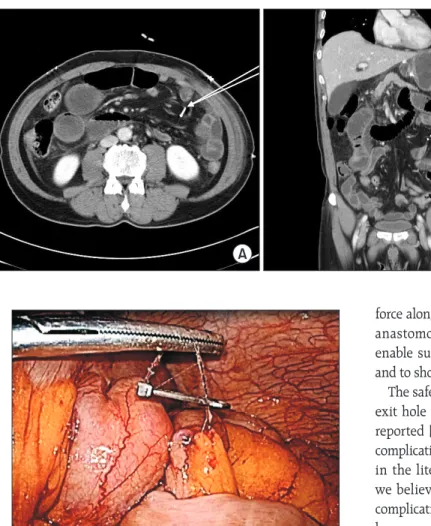
A 64-year-old male developed abdominal pain and distension four days after total laparoscopic distal gastrectomy with Roux-en-Y anastomosis performed for gastric cancer. A CT scan of the abdomen subsequently revealed herniated small bowel between the Roux-limb and the distal bowel requiring immediate surgical intervention (Fig. 1). An elevated C-reactive protein level and leukocytosis were identified on laboratory tests, and an increase in patient’s heart rate was monitored.
Laparoscopic abdominal exploration was performed and the cause of the acute herniation and SBO was identified.
Intraoperative findings included the discovery that the proxi- mal small bowel had herniated through the space created by V-Loc barbed absorbable suture after jejunojejunostomy (Fig. 2).
The herniated portion of the small bowel was pulled out of this When performing laparoscopic gastrectomy, suturing the intestinal anastomosis presents one of the greatest challenges.
The V-Loc unidirectional barbed suture has been introduced to eliminate the need to tie knots during closure. This device offers a fast, secure, and effective alternative to conventional suture repair during laparoscopic surgery. However, there have been reported cases of surgical complications associated with the use of barbed suture devices. We describe here a case of small bowel obstruction resulting from improper use of barbed suture during total laparoscopic distal gastrectomy performed for gastric cancer. Following diagnosis of small bowel obstruction, the patient underwent immediate lapar os- copic repair that identified the cause and relieved the small bowel obstruction. This case highlights the need for surgeons to carefully perform proper suturing technique in order to prevent complications. Surgeons should maintain a high index of suspicion for diagnosing and treating potentially severe complications when using barbed sutures.
[Ann Surg Treat Res 2017;92(5):380-382]
Key Words: Laparoscopy, Stomach neoplasms, Intestinal obstruction, Suture techniques, V-loc
Reviewed January February March April May June JulyAugust September October November December
Received August 25, 2016, Revised October 22, 2016, Accepted October 26, 2016
Corresponding Author: Tae Kyung Ha
Department of Surgery, Hanyang University College of Medicine, 222-1 Wangsimni-ro, Seongdong-gu, Seoul 04763, Korea
Tel: +82-2-2290-8443, Fax: +82-2-2281-0224 E-mail: [email protected]
Copyright ⓒ 2017, the Korean Surgical Society
cc Annals of Surgical Treatment and Research is an Open Access Journal. All articles are distributed under the terms of the Creative Commons Attribution Non- Commercial License (http://creativecommons.org/licenses/by-nc/4.0/) which permits unrestricted non-commercial use, distribution, and reproduction in any medium, provided the original work is properly cited.
Annals of Surgical Treatment and Research 381 space using gentle progressive traction and completely closed
laparoscopically. After removal of the surgical clip and the end of the V-Loc, no resection of small bowel was required. The cut suture ends were then embedded into the serosa of the small bowel. The patient was advanced to a regular diet two days after surgery and uneventfully discharged five days postoperatively.
All procedures performed in studies involving human partici pants were in accordance with the ethical standards of the institutional and/or national research committee and with the 1964 Helsinki declaration and its later amendments or comparable ethical standards. For this type of study formal consent is not required.
DISCUSSION
V-Loc unidirectional barbed suture was developed as a de- vice aimed at making laparoscopic suturing easier and more effi cient. With its unique barbed design, knot-tying is not needed to anchor these sutures to tissue. Furthermore, another proposed benefit of V-Loc closure is a uniform distribution of
force along the suture line, which ensures security of intestinal anastomosis and decreases blood loss [1]. This device may enable surgeons to effectively perform laparoscopic suturing and to shorten the anastomosis time.
The safety and efficacy of barbed suture use for closure of the exit hole after gastroduodenostomy in gastrectomy has been reported [2]. In addition to the benefits of barbed suture use, complications following use of these devices have been reported in the literature for several other surgeries [1,3,4]. However, we believe there has not been a reported case presenting a complication of internal herniation and mechanical SBO after laparoscopic gastrectomy using barbed sutures. We report here a case of improper application of a V-Loc device resulting in internal herniation and mechanical SBO after laparoscopic gastrectomy.
Patients undergoing gastrectomy are at a high risk of de- veloping intestinal obstruction. Therefore, intraoperative pre ventive techniques are recommended [5]. In our case, the bowel obstruction was likely due to the presence of a long and redundant length of wire following the use of barbed suture.
To prevent bowel obstruction, the length for the end of the exposed barbed suture during surgery should be kept to a minimum. In summary, surgeons performing laparoscopic gastrectomy using V-Loc suture should consider that improperly deployed barbed suture may induce postoperative mechanical SBO or other complications.
The lesson from this case is that surgeons must be aware of the proper usage of new devices, as well as their potential hazards. This case highlights the need for surgeons to increase their attention to the technical details of new closure materials.
CONFLICTS OF INTEREST
No potential conflict of interest relevant to this article was reported.
Sung Ho Jang, et al: Acute intestinal obstruction by V-Loc
Fig. 2. Laparoscopic intraoperative image shows small bowel was internally herniated between V-Loc (Covidien, New Haven, CT, USA) wire end and surgical clip.
A B
Fig. 1. (A) Preoperative contrast enhanced abdomen CT scan showed stomach and duodenal stump dilatation with surgical clip (arrow) right under the ana- stomosis site. (B) The coronal view of CT scan showed small bowel was rotated on the axis of V-Loc wire end and surgical clip (arrow).
382
Annals of Surgical Treatment and Research 2017;92(5):380-382
1. Sakata S, Kabir S, Petersen D, Doudle M, Stevenson AR. Are we burying our heads in the sand? Preventing small bowel ob- struc tion from the V-loc® suture in lapar- oscopic ventral rectopexy. Colorectal Dis 2015;17:O180-3.
2. Lee SW, Nomura E, Tokuhara T, Kawai M, Matsuhashi N, Yokoyama K, et al. Lapar- oscopic technique and ini tial experience with knotless, uni di rec tional barbed su-
ture closure for staple-conserving, delta- shaped gas tro duo deno stomy after distal gas trectomy. J Am Coll Surg 2011;213:e39- 45.
3. Filser J, Reibetanz J, Krajinovic K, Germer CT, Dietz UA, Seyfried F. Small bowel vol vulus after transabdominal pre peri to- neal hernia repair due to improper use of V-LocTM barbed absorbable wire - do we always “read the instructions first”? Int J
Surg Case Rep 2015;8C:193-5.
4. Donnellan NM, Mansuria SM. Small bowel obstruction resulting from lapar os- copic vaginal cuff closure with a bar bed su ture. J Minim Invasive Gynecol 2011;
18:528-30.
5. Hayashi S, Fujii M, Takayama T. Pre ven- tion of postoperative small bowel ob struc- tion in gastric cancer. Surg Today 2015;45:
1352-9.