Organizational Culture And Emotional Intelligence As
Predictors Of Job Performance Among Library Personnel
In Academic Libraries In Edo State, Nigeria
Open Access
Accepted date: April 19, 2016 Received date: February 2, 2016
*Corresponding Author: Magnus O. Igbinovia Graduate student
Department of Library, Archival and Information Studies University of Ibadan, Ibadan-Nigeria
E-mail: [email protected]
All JISTaP content is Open Access, meaning it is accessible online to everyone, without fee and authors’ permission. All JISTaP content is published and distributed under the terms of the Creative Commons Attribution License (http:/ creativecommons. org/licenses/by/3.0/). Under this license, authors reserve the copyright for their content; however, they permit anyone to unrestrictedly use, distribute, and reproduce the content in any medium as far as the original authors and source are cited. For any reuse, redistribution, or reproduction of a work, users must clarify the license terms under which the work was produced. ABSTRACT
This study was designed to investigate organizational culture and emotional intelligence as predictors of job per-formance among library personnel in Edo state, Nigeria. The survey research design was employed for the study with a population size of 181 library personnel in the 15 academic libraries under study, and due to the manage-able population size, total enumeration was adopted as the sampling technique. The questionnaire was used to elicit data from the respondents. Of the 181 copies of the questionnaire administered, 163 copies were retrieved and found valid for analysis constituting a 90% response rate. Four research questions and four null hypotheses (tested at 0.05 level of significance) were formulated to guide the study. The tool used to analyze the research question was descriptive statistics (percentage, mean, and standard deviation) and inferential statistics (correlation and multiple regression) for testing the hypotheses. The findings of the study revealed that there is a high level of job performance, good organizational culture, and high level of emotional intelligence among the personnel. Organizational culture and emotional intelligence jointly and significantly predict job performance of personnel. There is significant positive correlation between organizational culture and job performance. The linear combi-nation of emotional intelligence and organizational culture predict job performance of library personnel in the academic libraries under study. The research concludes that there is a need for high job performance in libraries which is predicted by the organizational culture of the library and the level of emotional intelligence of the library personnel.
Keywords: Academic libraries, emotional intelligence, job performance, organizational culture
S.O. Popoola
Department of Library, Archival and Information Studies University of Ibadan, Ibadan-Nigeria
E-mail: [email protected]
Magnus O. Igbinovia *
Department of Library, Archival and Information Studies University of Ibadan, Ibadan-Nigeria
E-mail: [email protected]
1. INTRODUCTION
Academic libraries as information-based institutions are set up to meet the information needs of their par-ent institutions which could be universities, polytech-nics, colleges, and other post-secondary institutions. They are established to provide materials that support the objectives of their parent institution which in most cases are teaching, learning, and research. Academic libraries need highly performing individuals in their quest to meet set goals and objectives vis-a-vis effec-tive service delivery, and as such maintain relevance in the 21st century characterized by high influx of
infor-mation and communication technologies (ICTs) and its attendant information explosion. Performance is important to the library as an organization and to the personnel as individuals in an organization. In view of this, Saetang, Sulumnad, Thampitak, and Sungkaew (2010) opine that success or failure of an organization depends, to a large extent, on the job performance of the individuals working there. Sonnentag and Frese (2001) note that accomplishing tasks and performing at a high level can be a source of satisfaction, with feel-ings of mastery and pride. Also, that performance if recognized by others within the organization is often rewarded by financial and other benefits. These as-sertions are suggestive of the fact that performance is important to the institution and to the individual.
The term performance is a multidimensional con-cept and several attempts have been made by scholars to give an understanding of it. Several authors (Viswes-varan & Ones, 2000; Muchinsky, 2003; Ferris, Brown, Pang, & Keeping, 2010) have defined the concept of performance and central to these definitions is that performance is a measurable concept which entails sets of actions, behavior, and outcomes that employees engage in that is directed towards contributing to and achieving the goals of an organization.
Performance on its most basic level has been broad-ly considered either as task or contextual performance. While task performance refers to the proficiency with which an individual performs activities which contribute to an organization’s “technical core,” con-textual performance refers to activities which do not contribute to the technical core but which support the organizational, social, and psychological environment in which organizational goals are pursued (Borman &
Motowidlo, 1993). Johari and Yahya (2009) note that job performance has become one of the most signif-icant indicators in managing organizational perfor-mance, and they add that emphasis has been laid on employees’ job performance as a source of competitive advantage in order to promote responsiveness in en-hancing overall organizational effectiveness. Notably, the shared values, beliefs, and ideology of any orga-nization can affect the job performance of personnel in that organization, which is inclusive of the library. This is in line with the assertions of Dwirantwi (2012) that culture is the premier competitive advantage of high-performance organizations and that organiza-tional culture and productivity are closely related. Thus, one could assert from the foregoing that a ma-jor criterion for high performance in organizations is the organizational culture, and as such favorable organizational culture is a prerequisite for high perfor-mance at the individual and organizational level. The importance of understanding organizational culture is demonstrated through the congruence hypothesis, which states that individuals are more effective when their personal competences align with the culture of the organizations in which they work (Abbett, Cold-ham, & Whisnant, 2010).
Like most workplaces, academic libraries contend with problems of unhealthy competition, inappropri-ate behavioral patterns, ethical issues, individual val-ues, unfavorable working conditions, jealousy, anger, hatred, lack of self-control, and lack of understanding, which adversely affect job performance of workers and subsequently the library’s objectives. This places a question on the fulfillment of the library’s objectives and hence, the relevance of the library as an institution charged with the responsibility of providing informa-tion to its target audience.
consideration. As a result of this he/she must have knowledge as regards how to manage emotions and render effective services to these “wonderful” library users that consult collections for information (Ogung-beni, Ogungbo, & Yahaya, 2013).
Therefore, the focus of this study is on investigat-ing how the independent variables of organizational culture and EI of personnel with diverse cultural backgrounds and varying degrees of EI will affect their ability to perform job tasks effectively, which will in turn help the library meet its objectives and ultimately help in the actualization of the objectives of the parent institution in particular and the nation in general.
In line with this, the following research questions were raised:
1. What is the level of job performance among personnel in academic libraries in Edo State, Nigeria?
2. What is the level of organizational culture among personnel in academic libraries in Edo State, Nigeria?
3. What is the level of EI among personnel in ac-ademic libraries in Edo State, Nigeria?
4. What is the relative contribution of organization-al culture and EI on job performance of person-nel in academic libraries in Edo State, Nigeria? The following null hypotheses guided the conduct of the study and were tested at 0.05 level of significance.
Ho1: There is no significant relationship between or-ganizational culture and job performance of per-sonnel in academic libraries in Edo State, Nigeria. Ho2: There is no significant relationship between EI
and job performance of personnel in academic libraries in Edo State, Nigeria.
Ho3: There is no significant relationship between organizational culture and EI of personnel in academic libraries in Edo State, Nigeria. Ho4: The linear combination of EI and
organiza-tional culture does not significantly predict job performance of personnel in academic librar-ies in Edo State, Nigeria.
2. STATEMENT OF THE PROBLEM
The 21st century academic libraries in Nigeria have
experienced a declined level of use as a result of poor services rendered by library personnel; is a direct outcome of poor job performance as documented in previous studies. Observations have shown that li-brary personnel engage in task and non-task behaviors that negate their chances of performing very well on their jobs and impact negatively on the job perfor-mance of others with whom they work. This poor job performance has negatively affected the provision of effective service delivery to library users, questioning the relevance of libraries in this information age. Job performance is not an isolated phenomenon but one predicted by factors like EI and organizational culture. On the aspect of EI, notice has been made of library personnel’s display of anger, lack of self-control, and lack of capacity to understand and manage users’ feelings about an information need, which are all manifestations of poor EI. This poor level of EI is also manifested by heads of libraries as seen in their lack of ability to manage their emotions and that of library personnel. Another common problem among librar-ies is the poor or unfavorable organizational culture. This poor organizational culture often manifests in unhealthy competition, unfavorable working condi-tion, poor leadership style, and so on, and deters the job performance of library personnel. It is against this background that this study sets out to examine wheth-er organizational culture and EI could predict the job performance of personnel in academic libraries in Edo State, Nigeria.
3. LITERATURE REVIEW
applica-ble to be taught to new members of the library as the current way to perceive, think, and feel in relation to organizational problems; while emotional intelligence is the ability of academic library personnel to effective-ly manage one’s emotions and those of others in a way that will boost job performance and in turn help in the actualization of a library’s objectives. The dependent variables of job performance refer to all work related behaviors personnel in academic libraries engage in at the workplace, and how those behaviors affect the goals and objectives of the organization.
3.1. Organizational Culture and Job
performance of Employee in an Organization Deal and Kennedy, in Shahzad et al. (2013) state that strong culture in an organization is very helpful in enhancing the performance of employees; this leads to goal achievement and increases the overall performance of the organization. Dugguh and Dennis (2014) note that while performance is a multi-dimen-sional construct, it may be defined as the record of an individual’s accomplishment, and employee perfor-mance therefore is the job-related activities expected of an employee and how those activities are executed. Awadh and Alyahya (2013) carried out research on the study of organizational culture on employee per-formance and assert that the job perper-formance of an organization has a strong impact on strong organiza-tion culture as it leads to enhanced productivity. They however recommend that the strong culture of an or-ganization based upon managers and leaders helps in improving levels of performance. Managers relate or-ganizational performance and culture to each other as they help in providing competitive advantage to firms. This corroborates Shahzad, Luqman, Khan, and Shab-bir (2012), that organizational culture has a positive impact on employees’ job performance. According to Calori and Sarnin, in Naicker (2008), strong cultures could be linked with high growth performance. They also found that the intensity of the company’s culture is positively correlated with its relative growth.
According to Shahzad, Luqman, Khan, and Shabbir (2012), claims that organizational culture is attached to performance are initiated on the apparent role that culture can play in competitive advantage. Naicker (2008) posits that organizational culture has assumed considerable importance in the 21st century, because
of its impact on employee performance. It is impera-tive for every organization to understand its dynamic culture so that managers can capitalize on the insights generated by the cultural perspective, in order to wield greater control over their organizations. Hence, the culture of an organization has an important impact on its performance.
Ogbonna and Harris carried out a study in 2000 on “leadership style, organizational culture, and perfor-mance: empirical evidence from UK companies,” and they conclude that competitive and innovative cultures which are sensitive to external conditions have a strong and positive impact on organizational performance. 3.2. Emotional Intelligence and Job
Performance of Employees in an Organization Managers’ emotional intelligence had a stronger pos-itive correlation with job performance of employees (Sy, Tram, & O’Hara, 2006). According to the authors, some managers who are technically and academically brilliant but deficient in emotional intelligence may fail woefully to handle stress and manage feelings of success or failures. Therefore, emotionally intelligent managers and heads of university libraries should be able to recognize negative dysfunctional emotions when they occur and be able to replace them with positive and functionally useful ones, thereby turning workers’ sadness to happiness, anxiety to acceptance, and fear to comfort. Thus, a university library that is lucky to have a high level emotionally intelligent uni-versity librarian may certainly experience improved collegiality and communication among the workforce, less workplace conflict, a better work environment, happier and committed library employees, and happi-er and more satisfied library clientele. In this scenario, the university library will be in a vantage position to boost the webometric ranking of the parent institution thus helping the university to rank high among the world universities ranking (Aboyade, 2013).
organizational change, which can be engaging and stimulating and can also arouse strong emotions as a result of perceived losses and conflicting values; librar-ians are experiencing a range of emotions including optimism, cynicism, anxiety, and apathy. He adds that on university campuses libraries have traditionally been highly valued, but the changes occurring in aca-demic libraries now may question the role of libraries. Individuals facing reorganizations, budget cuts, and altered job duties as well as anticipating or experi-encing change, especially change that is outside their control, will likely have feelings of wariness, anxiety, or concern—variations of fear. Unmanaged emotions can be contagious to others and detrimental to the change process and to the individual, hence the need for emotional intelligence among employee in academic libraries.
3.3. Organizational Culture and Emotional Intelligence of Employees in an Organization
Downey, Roberts, and Stough (2011) carried out re-search on “Workplace culture, emotional intelligence, and trust in the prediction of workplace outcomes” using an Australian council variously comprised of senior management to individual contributors, and in their introductory part of the work made remarks from the work that
Although culture has been proven to be a power-ful force in organizations, as it can shape people’s thoughts, behaviors, and emotions within their workplace (Pizer & Hartel, 2005), scholarly dis-course has largely ignored the role of emotions in organizational culture (Beyer & Nino, 2001). Re-cently it has been argued that the power of culture is largely due to the emotional needs of individuals (Pizer & Hartel, 2005), and how these needs are ful-filled by leaders (Downey, Papageorgiou, & Stough, 2006), groups (Jordan, Ashkanasy, Hartel, & Hooper, 2002) and by association, organizations as a whole. Emotions are processes that result from the social context in which they are elicited and that, in turn, influence how people feel and act in this social con-text (De Dreu, West, Fischer, & MacCurtain, 2002). Indeed, culture provides a social medium within which members can identify and form emotional bonds with each other (Beyer & Nino, 2001); which
can satisfy their need for belonging (De Dreu et al., 2002), commitment to organizations (Schein, 2004), trust in leaders (Gardner, Fisher, & Hunt, 2009), and job satisfaction (Shiu & Yu, 2010). Given this recent focus on the emotional needs of employees, this study aimed to identify how groups express, un-derstand, use, manage and control emotions and the trust engendered by the leader of teams was predic-tive of organizational outcomes.
Rude (2014) proposed that emotional intelligence and organizational culture affiliation is reciprocal in nature. In that regard, and as a complement to the knowledge boundary-spanning effects of EI, culture has tremendous influence on emotional process: “Culture…. Influences the selection of an action or be-havior as a response to the event” (Herkenhoff, 2004). Danaeefard et al. (2012) carried out research on emo-tional intelligence and organizaemo-tional culture and state that principally, it is expected that the creation of emo-tional intelligence paves the way for the development of organizational culture in an organization.
4. THEORETICAL FRAMEWORK
administrative performance, relates to emotional intel-ligence which is another construct to be measured in this work.
On the independent variable of emotional intel-ligence, the mixed model theory will be pivotal to the study. The theory as postulated by Goleman in 1995 outlines four main clusters of general emotional intelligence abilities which include: self-awareness, self-management, social awareness, and relationship management. The theory is particularly of relevance to this study as it addresses EI from the perspective of performance, since the model gives attention to the competence and skills that drive performance of li-brary personnel and lili-brary management.
On the aspect of organizational culture, the Edgar Schein model of organizational culture will be con-sidered central to this work as it expresses the gradual formation of culture within an organization. Schein’s model presents three interrelated levels of an organi-zational culture which in order of their visibility are: Artefacts, Espoused values, and Underlying assump-tions. This model relates to this study as the library as a formal organization is characterized by culture at these three different levels.
5. METHODOLOGY
For the purpose of this work, the survey research de-sign will be employed to aid the elicitation of respons-es on the variablrespons-es under study (organizational culture, emotional intelligence, and job performance) in order to determine the current status of the population with regards to the variables. The target population of the study will comprise professional librarians and library officers, male and female, in academic libraries in Edo State. Hence, the population of study for this work is 181 employees, professional librarians, and library of-ficers. Professional librarians number 76 while that of library officers are 105 within the 15 academic libraries (attached to universities, polytechnics, colleges, and institutes) in Edo State used for the study. Total enu-meration will be adopted as the sampling technique as a result of the small and manageable population. Hence, the sample size of the study will be 181 library employees consisting of professional librarians and library officers.
5.1. Research Instrument
The research instrument or tool that was used to elicit data for this study was the closed ended question-naire. The instrument, which was titled “Organizational Culture, Emotional Intelligence and Job Performance Questionnaire (OEJPQ)” consists of two parts and four sections. The first part of the questionnaire is to be filled in by the respondents, which includes Section A (Demographic Information of Respondents), Sec-tion B (OrganizaSec-tional Culture Scale), and SecSec-tion C (Emotional Intelligence Scale). The second part of the questionnaire will be completed by the respondents’ immediate boss or supervisor and this part contains Section D (Job Performance Scale) only. Likert scale was used with corresponding scoring formants for each scale.
The details of the constituting sections of the re-search instrument are discussed below:
Section A: Demographic Information of Respondents
This section of the instrument contains the demo-graphic information of the respondents which includes name of institution, name of library, gender, age, sec-tion of placement in the library, marital status, highest educational qualification, and job tenure.
Section B: Organizational Culture Scale
Human Factors International (www.hfi.com) has designed a measuring scale for organizational culture called Organizational Culture Questionnaire (OCQ) which was used for the study. This section of the in-strument contains 26 items that measure the organi-zational culture of the respondents’ place of work. The organizational culture questionnaire explores the pre-vailing culture within an organization using these 26 items across 13 dimensions, with an original reliability coefficient for the overall scale giving a Cronbach al-pha of 0.81.
Section C: Emotional Intelligence Scale
dimensions a Cronbach alpha of 0.88 was observed for perception dimension, a Cronbach alpha of 0.89 for the comprehension dimension and a Cronbach alpha of 0.86 was observed for the regulation dimension. Thus, it was asserted that the items are homogeneous and the scale consistently measures the characteristics for which it was created.
Section D: Job Performance Scale
The job performance scale for this research work was an adopted copy of Aboyade (2013), “Influence of Job Motivation, Emotional Intelligence and Self-Con-cept on Job Performance among Library Workers in Federal Universities in Nigeria,” where the author had a reliability coefficient of 0.94 for the job performance scale. However, the original scale designed by Popoola (2002), “Assessment of actual performance standards/ general abilities,” has a reliability coefficient of 0.87. The 21 item scale is met to ascertain performance of individuals from the opinion of their immediate boss or supervisor.
To determine the reliability of the instrument con-taining the three scales, 30 copies of the questionnaire were pretested in the Kenneth Dike Library, Univer-sity of Ibadan and some of its outreach libraries. The Cronbach alpha method was used to determine the reliability of each scale in the questionnaire which gave the following results: 0.95 for organizational culture, 0.90 for EI (where perception dimension had 0.74, comprehension dimension had 0.75, and regulation dimension had 0.79), and 0.72 for job performance. 5.2. Method of Data Collection and Analysis
The data set collected was analyzed using descrip-tive statistics such as percentage (%) and mean and standard deviation for the research questions, while inferential statistics such as correlation and multiple regression will be used for the hypothesis, which will be tested at 0.05 level of significance with the aid of statistical package for social sciences (SPSS).
6. RESULTS AND DISCUSSION
A total of 181 copies of the research instrument were distributed, out of which 163 were retrieved and used for analysis, representing a 90% response rate. The
response rate of 90% is considered adequate for anal-ysis since the standard acceptable for most research work is 60% (Dulle, Minish-Majanja, & Cloete, 2010). A total of 181 copies of the research instrument were distributed, out of which 163 were retrieved and used for analysis, representing a 90% response rate. The re-sponse rate of 90% is considered adequate for analysis since the standard acceptable for most research work is 60% (Dulle, Minish-Majanja, & Cloete, 2010).
6.1. Answers to Research Questions
Four research questions were generated for this study to find out the level of job performance, organizational culture, emotional intelligence, and the relationship be-tween organizational culture and emotional intelligence, as well as the relative influence of organizational culture and emotional intelligence on job performance of per-sonnel in academic libraries in Edo State, Nigeria.
Research Question One: What is the level of job
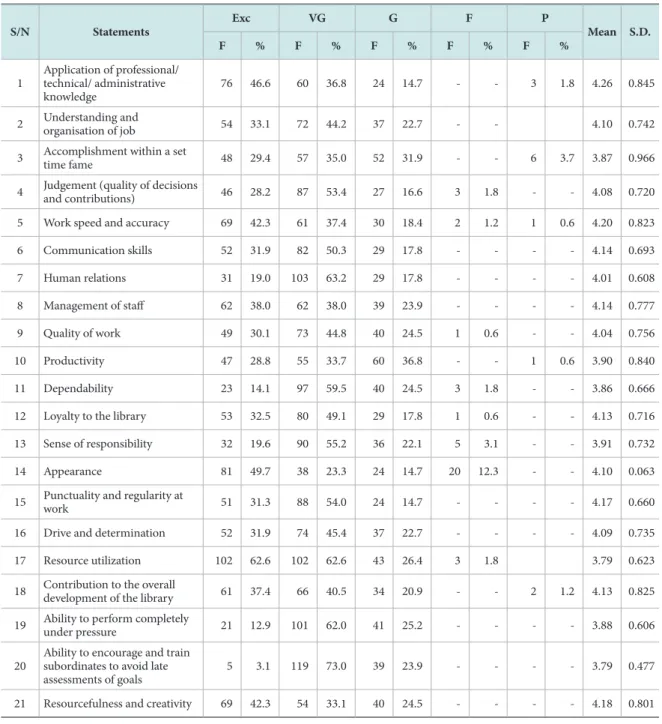
performance among personnel in academic libraries in Edo State? (See Table 1)
Test of norm was conducted to determine the level of job performance among personnel in academic libraries in Edo State. The scale between 1 and 35 shows that the level is low, and scale 36 to 70 shows a moderate level, while 71 to 105 shows a high level of job performance. Thus, the overall mean for job performance of the li-brary personnel is 84.79 which falls between the scale “71 and 105”; therefore, it could be inferred that the level of job performance among personnel in academic libraries in Edo State is high.
Research Question Two: What is the level of
organi-zational culture among personnel in academic libraries in Edo State? (See Table 2)
Table 1. Job Performance of Personnel in Academic Libraries in Edo State
S/N Statements Exc VG G F P Mean S.D.
F % F % F % F % F %
1 Application of professional/technical/ administrative
knowledge 76 46.6 60 36.8 24 14.7 - - 3 1.8 4.26 0.845
2 Understanding and organisation of job 54 33.1 72 44.2 37 22.7 - - 4.10 0.742 3 Accomplishment within a set time fame 48 29.4 57 35.0 52 31.9 - - 6 3.7 3.87 0.966 4 Judgement (quality of decisions and contributions) 46 28.2 87 53.4 27 16.6 3 1.8 - - 4.08 0.720
5 Work speed and accuracy 69 42.3 61 37.4 30 18.4 2 1.2 1 0.6 4.20 0.823
6 Communication skills 52 31.9 82 50.3 29 17.8 - - - - 4.14 0.693 7 Human relations 31 19.0 103 63.2 29 17.8 - - - - 4.01 0.608 8 Management of staff 62 38.0 62 38.0 39 23.9 - - - - 4.14 0.777 9 Quality of work 49 30.1 73 44.8 40 24.5 1 0.6 - - 4.04 0.756 10 Productivity 47 28.8 55 33.7 60 36.8 - - 1 0.6 3.90 0.840 11 Dependability 23 14.1 97 59.5 40 24.5 3 1.8 - - 3.86 0.666
12 Loyalty to the library 53 32.5 80 49.1 29 17.8 1 0.6 - - 4.13 0.716
13 Sense of responsibility 32 19.6 90 55.2 36 22.1 5 3.1 - - 3.91 0.732
14 Appearance 81 49.7 38 23.3 24 14.7 20 12.3 - - 4.10 0.063
15 Punctuality and regularity at work 51 31.3 88 54.0 24 14.7 - - - - 4.17 0.660
16 Drive and determination 52 31.9 74 45.4 37 22.7 - - - - 4.09 0.735
17 Resource utilization 102 62.6 102 62.6 43 26.4 3 1.8 3.79 0.623
18 Contribution to the overall development of the library 61 37.4 66 40.5 34 20.9 - - 2 1.2 4.13 0.825 19 Ability to perform completely under pressure 21 12.9 101 62.0 41 25.2 - - - - 3.88 0.606 20 Ability to encourage and train subordinates to avoid late
assessments of goals 5 3.1 119 73.0 39 23.9 - - - - 3.79 0.477
Table 2. Organizational Culture among Personnel in Academic Libraries in Edo State
S/N Statements SA A UN D SD Mean S.D.
F % F % F % F % F %
1 The performance of library staff is emphasised as an important
goal 55 33.7 77 47.2 10 6.1 13 8.0 8 4.9 3.97 0.080
2 Actions are taken whenever individuals or procedures seem
to be unproductive 33 20.2 106 65.0 8 4.9 8 4.9 8 4.9 3.91 0.942
3
The leadership of the library communicate clearly the goals and culture of the library to members of staff
72 44.2 57 35.0 8 4.9 5 3.1 21 12.9 3.85 0.292
4 Library personnel are respected for their expertise 41 25.2 90 55.2 28 17.2 1 0.6 3 1.8 4.01 0.786 5 The library user’s needs are actively identified and future
needs anticipated 67 41.1 86 52.8 - - - - 10 6.1 4.23 0.958
6
Library users’ views and opinions are sought and listened to and feedback is used to make improvement
105 64.4 7 4.3 4 2.5 2 1.2 - - 4.15 0.713
7
Responsibilities are clearly defined and individuals understand their role and the extent of their authority
70 42.9 88 54.0 - - 5 3.1 - - 4.37 0.647
8
Personnel are clear about the structure of the library and that changes to it are made as and when necessary
103 63.2 48 29.4 11 6.7 1 0.6 - - 4.55 0.649
9
Library management and subordinates communicate readily on an informal basis and meetings are held when necessary
116 71.2 40 24.5 1 0.6 6 3.7 - - 4.63 0.685
10
People say what they really think and information on future plans, etc is readily accessible
29 17.8 85 52.1 44 27.0 2 1.2 3 1.8 3.83 0.798
11
Subordinates as well as management are encouraged to volunteer their views, and disagreement is seen as a positive attempt to improve things
11 6.7 26 16.0 84 51.5 16 9.8 26 16.0 2.88 0.076
12
If there is rivalry between divisions, then every efforts is made to ensure that the outcome is positive to all concerned
26 16.0 119 73.0 16 9.8 2 1.2 - - 4.04 0.554
13
The right people are selected in the appropriate places and effort is made to help them develop their skills
64 39.3 79 48.5 17 10.4 3 1.8 4.25 0.714
14 Promotion decisions are fair and objective and good people
S/N Statements SA A UN D SD Mean S.D.
F % F % F % F % F %
15
Ideas are welcomed from any level in the library and everyone’s views are taken into account before important decisions are made
45 27.6 65 39.9 45 27.6 2 1.2 6 3.7 3.87 0.959
16
People feel their views are valuable and that they will be considered carefully and acted on if they are appropriate
17 10.4 119 73.0 19 11.7 8 4.9 3.89 0.638
17 Time and money are committed to exploring new ideas 46 28.2 80 49.1 24 14.7 7 4.3 6 3.7 3.94 0.967 18
Ideas are encouraged from everyone in the organisation and there are always plenty forthcoming
56 34.4 63 38.7 34 20.9 6 3.7 4 2.5 3.99 0.962
19 Decisions are made promptly and on the basis of the facts, not
personal prejudices or self interest 47 28.8 89 54.6 5 3.1 22 13.5 - - 3.99 0.930
20
People take responsibilities for their decisions and are not penalised if the results are not as they expected, so long as the decision was soundly based on facts available at the time
70 42.9 66 40.5 8 4.9 16 9.8 3 1.8 4.13 0.013
21
Colleagues cooperate with each other to achieve standards of excellence and do not allow personal feelings to interfere
65 39.9 83 50.9 12 7.4 1 0.6 2 1.2 4.28 0.731
22 Individuals are well qualified for the jobs they do and their
technical knowledge is valued 94 57.7 50 30.7 17 10.4 - - 2 1.2 4.44 0.778 23 The overall library goal is clearly understood by all personnel 46 28.2 84 51.5 23 14.1 3 1.8 7 4.3 3.98 0.942
24
Individual and group performance targets, reward systems and trainings all emphasised the library’s objectives and it’s achievements
85 52.1 40 24.5 37 22.7 1 0.6 4.28 0.835
25 Library personnel look forward to going to work and enjoy the
work they do 46 28.2 88 54.0 16 9.8 - - 13 8.0 3.94 0.050
26 The library organises social and other events for the enjoyments
of its employees 12 7.4 16 9.8 9 5.5 46 28.2 80 49.1 1.98 0.269
N=163
Research Question Three: What is the level of
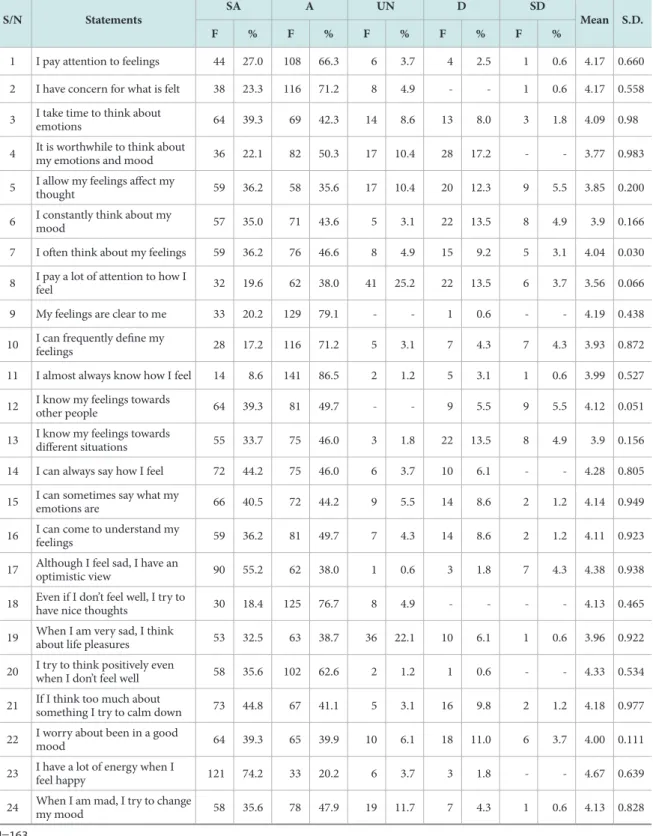
emo-tional intelligence among personnel in academic librar-ies in Edo State? (See Table 3)
Test of norm was conducted to determine the level of
Table 3. Emotional Intelligence of Personnel in Academic Libraries in Edo State
S/N Statements SA A UN D SD Mean S.D.
F % F % F % F % F %
1 I pay attention to feelings 44 27.0 108 66.3 6 3.7 4 2.5 1 0.6 4.17 0.660 2 I have concern for what is felt 38 23.3 116 71.2 8 4.9 - - 1 0.6 4.17 0.558 3 I take time to think about emotions 64 39.3 69 42.3 14 8.6 13 8.0 3 1.8 4.09 0.98 4 It is worthwhile to think about my emotions and mood 36 22.1 82 50.3 17 10.4 28 17.2 - - 3.77 0.983 5 I allow my feelings affect my thought 59 36.2 58 35.6 17 10.4 20 12.3 9 5.5 3.85 0.200 6 I constantly think about my mood 57 35.0 71 43.6 5 3.1 22 13.5 8 4.9 3.9 0.166 7 I often think about my feelings 59 36.2 76 46.6 8 4.9 15 9.2 5 3.1 4.04 0.030 8 I pay a lot of attention to how I feel 32 19.6 62 38.0 41 25.2 22 13.5 6 3.7 3.56 0.066
9 My feelings are clear to me 33 20.2 129 79.1 - - 1 0.6 - - 4.19 0.438
10 I can frequently define my feelings 28 17.2 116 71.2 5 3.1 7 4.3 7 4.3 3.93 0.872 11 I almost always know how I feel 14 8.6 141 86.5 2 1.2 5 3.1 1 0.6 3.99 0.527 12 I know my feelings towards other people 64 39.3 81 49.7 - - 9 5.5 9 5.5 4.12 0.051 13 I know my feelings towards different situations 55 33.7 75 46.0 3 1.8 22 13.5 8 4.9 3.9 0.156
14 I can always say how I feel 72 44.2 75 46.0 6 3.7 10 6.1 - - 4.28 0.805
intelligence. Thus, the overall mean for emotional in-telligence of the library personnel is 98.01 which falls between the scale “81 and 120.” Therefore, it could be inferred convincingly that the level of emotional intel-ligence among personnel in academic libraries in Edo State is very high.
Research Question Four: What is the relative
con-tribution of organizational culture and emotional intel-ligence on job performance of personnel in academic libraries in Edo State? (See Table 4)
Table 4 reveals the relative contribution of the two independent variables to the dependent variable, ex-pressed as beta weights, vis: Organizational Culture (β = 0.437, P <0.01), and Emotional Intelligence (β = 0.186, P <0.05), hence organizational culture and emotional intelligence jointly and significantly predict job performance of personnel in academic libraries in Edo State.
6.2. Presentation of Hypothesis
The literature was extensively surveyed on the vari-ables and previous findings showed a positive relation-ship among the variables. In view of this, the authors raised null hypotheses which contradict such previous findings in order to place a burden of proof on such previous findings in a bid to arrive at a better judgment. This is in line with Clin (1982) that null hypotheses are used to verify that multiple experiments are producing consistent results, while Ifidon and Ifidon (2007) assert that a null hypothesis concerns a judgment as to wheth-er apparent diffwheth-erences are real diffwheth-erences or whethwheth-er they merely result from sampling errors. Therefore, since our surveyed literature showed positive correlation between variables used, it is best to use null hypotheses to verify previous findings.
This section of the work thus reports the results of four null hypotheses for this research work and they were tested at 0.05 level of significance. (See Table 5)
Table 4. Multiple Regression Analysis of the Relative Contribution of Organizational Culture and EI to Job Performance of Personnel in Academic Libraries in Edo State
Variables Unstandardised Coefficient
Stand. Coefficient
T Sig.p
B Std. Error ContributionBeta
(Constant) 21.275 11.348 1.875 0.000
Organizational Culture 0.437 0.109 0.336 3.998 0.000
Emotional Intelligence 0.186 0.120 0.130 1.547 0.024
Table 5. Correlation Matrix of Organizational Culture, Emotional Intelligence, and Job Performance of Respondents
S/N Variable List Mean DeviationStd. N 1 2 3
1 Organizational Culture 103.51 8.467 163 1
2 Emotional Intelligence 98.01 7.694 163 sigp=0.010.521** 1
Table 6. ANOVA of the Linear Combination of EI and Organizational Culture in Predicting the Job Performance of Personnel in Academic Libraries in Edo State, Nigeria
R R Square Adjusted R Square Std. Error of the Estimate
0.419a 0.176 0.165 10.061
A N O V A
Model Sum of Squares DF Mean Square F- ratio Sig. P
Regression Residual Total 3448.814 16194.671 19643.485 2 160 162 1724.407 101.217 17.037 0.000
Ho1: There is no significant relationship between organizational culture and job performance of personnel in academic libraries in Edo State, Nigeria.
Table 5 shows there is significant positive correlation (r = 0.404**; p< 0.05) between organizational culture and job performance of personnel in academic libraries in Edo State. This means that as organizational culture improves, job performance of personnel also improves; therefore, Ho1 is rejected.
Ho2: There is no significant relationship between emotional intelligence and job performance of personnel in academic libraries in Edo State, Nigeria.
As seen in Table 5, there is significant positive cor-relation (r = 0.305**; p< 0.05) between emotional intel-ligence and job performance of personnel in academic libraries in Edo State. This means that as emotional in-telligence improves, job performance of personnel also improves; therefore, Ho2 is rejected.
Ho3: There is no significant relationship between or-ganizational culture and emotional intelligence of personnel in academic libraries in Edo State, Nigeria.
As seen in Table 5, there is significant positive cor-relation (r = 0.521**; p< 0.05) between organizational culture and emotional intelligence of personnel in academic libraries in Edo State. This means that as or-ganizational culture improves, emotional intelligence of personnel also improves; therefore, Ho3 is rejected.
Ho4: The linear combination of emotional intelli-gence and organizational culture does not
sig-nificantly predict job performance of personnel in academic libraries in Edo state, Nigeria. Table 6 shows the linear combination of emotional intelligence and organizational culture as it predicts job performance of personnel. The result shows R= 0.419, R²= 0.176, Adj R²= 0.165, and F-ratio= 17.04 at P<0.05. This means that 16.5% of the variance was accounted for by emotional intelligence and organizational culture; therefore Ho4 is rejected
6.3 Discussion of Findings
It was discovered that the level of job performance among these personnel is high. This finding on the high job performance of the respondents under study is in line with previous studies (Aboyade, 2013; Bello & Mansor, 2012). It is germane to state at this juncture that while libraries are faced with technological changes that question their place in this present information age, the job performance of library personnel is more than ever imperative in a bid to provide users with excellent library services and thus retain a place of pride in the education sector and beyond.
assertion of Tepeci (2001). Another key finding that the high level of organizational culture among these library personnel depicts is that the library rewards individual and group performance, which corroborates Ng’ang’a and Nyongesa (2012).
The level of emotional intelligence of personnel in academic libraries in Edo State is high. This implies that the personnel in these libraries, while managing their emotions and those of co-workers and library users, are able to discharge their duties towards high performance, which corroborates Khan and Ullah (2014). In line with this, Sutton (2006) asserts that emotional intelligence expands our possibilities for personal impact; it is con-tagious, creating inspiration and energy. The library as a social and service oriented institution definitely needs personnel with high levels of emotional intelligence since they serve the information needs of diverse people with varying emotions at different points in time. With this they can perceive, understand, and better manage their emotions and those of their clientele hence render-ing effective library services. It is therefore pertinent to state here that personnel in the libraries studied are well equipped to keep their jobs and grow in their chosen profession (librarianship) and as such there is hope for a better set of librarians in the state who will help move the profession into the limelight.
The study shows that organizational culture and emo-tional intelligence jointly and significantly predict job performance. Though there is literature that links orga-nizational culture with emotional intelligence (Pizer & Hartel, 2005), there was no literature that discussed the influence of both (organizational culture and emotional intelligence) on job performance. This is a major area this research work intends to contribute to knowledge, as it has made it explicit that when organizational cul-ture and emotional intelligence are considered together, they will have collective influence on job performance, particularly that of academic library personnel. The importance of this finding therefore is that academic libraries like every other institution will marry both developing suitable organizational culture to ensuring high emotional intelligence of personnel so as to ensure effective job performance of their personnel, which in turn helps the library achieve its goals and objectives.
Hypothesis one reveals there is significant positive correlation between organizational culture and job performance of personnel in academic libraries in Edo
State. This is in agreement with the findings of Olani-pekun, Aje, and Abiola-Falemu (2013); Parthasarathy and Ramalingam (2015); Azhar (2003); and Ng’ang’a and Nyongesa (2012). Prior to this finding and previous work that linked organizational culture with perfor-mance, it was expected that management of libraries, especially academic libraries, should do all they can to provide or build an organizational culture that will ensure effective job performance of personnel, there-fore making the library a productive branch within any academic institution it is attached to. In view of this, it can be extrapolated that in the academic libraries under study, this organizational culture is tantamount to a competitive weapon that can give competitive advantage in the form of better performances.
Hypothesis two reveals there is significant positive correlation between emotional intelligence and job performance of personnel in academic libraries in Edo State. This corroborates Shahhosseini, Silong, Ismail, and Uli (2012); Suan, Anantharaman, and Kin (2015); and Akhtar, Ibrahim, Riaz, and Hussain (2015). Ahuja (2015) notes that because of the influence of emotional intelligence on each form of one’s work life, employees who possess high-level emotional intelligence are con-sidered “star performers”; as a result there exists a clear correlation between emotional intelligence and job performance. The implication is that as the emotional intelligence of personnel in the libraries under study continues to increase, there will be a corresponding in-crease in their ability to perform their job better. These findings have pertinent implications for library person-nel considering the fact that the nature of their work is service oriented and requires frequent interaction with users who have information needs, placing intellectual demands on these personnel. Service orientation, an in-dicator of social awareness, is essential for librarianship as there is always librarian-user interaction for intellec-tual benefits (Khan & Ullah, 2014). They note that
in their information needs.
In view of the dramatic changes libraries face in this era, emotional intelligence has come to give library per-sonnel adaptive features to accommodate and strive in the midst of such changes.
On hypothesis three, findings show that there is sig-nificant positive correlation between organizational cul-ture and emotional intelligence of personnel in academ-ic libraries in Edo State and the implacadem-ication of this is that as the organizational culture of these libraries improves, the emotional intelligence of personnel in the libraries will also improve accordingly. On the other hand, the aggregate emotional intelligence of workers will ensure the development of effective organizational culture. This positive relationship between organizational culture and emotional intelligence supports Danaeefard et al. (2012), Danquah (2014), and Sin and Yazdanifard (2014). The creation and development of emotional intelligence in the library will enhance the development of organiza-tional culture and vice versa.
Hypothesis four shows that the linear combination of emotional intelligence and organizational culture predicts the job performance of the respondents. This means 16.5% of the variance was accounted for by emo-tional intelligence and organizaemo-tional culture. The impli-cation of this is that the linear combination of emotional intelligence and organizational culture will predict the job performance of personnel in academic libraries in Edo State, Nigeria. Balazs (2015) notes that in order to achieve the opportunities provided by human intellect, enhancing individual performance, organizations have to promote the balance of emotional skills as well as supporting values [culture] that imply the richness of human experience. On the same footing, Akhtar et al. (2015) in “Impact of organizational culture and emo-tional intelligence on educaemo-tional sector performance” found that emotional intelligence greatly impacts edu-cational sector employees’ performance in Pakistan and that they never engaged in any kind of conflict within the organization; this shows cohesiveness amongst em-ployees and encourages them to do their best for their organizations.
Knowing that culture is important in shaping organi-zational practice and performance (O’Donnell & Boyle, 2008), the head librarians and other management staff of academic libraries should pay utmost attention to
creating the right organizational culture for members of staff. In library management, consideration of factors that influence the job performance of personnel, the organizational culture of the library, and emotional in-telligence of personnel should be factors given adequate attention.
7. CONCLUSION AND RECOMMENDATIONS
The job performance of personnel in academic li-braries like other institutions are influenced by factors which could be demographic, psychological, and in-stitutional. However, this research work investigated organizational culture and emotional intelligence as predictors of job performance among personnel in academic libraries in Edo State, Nigeria and concludes that these two independent variables, organizational culture and emotional intelligence, greatly influence the job performance of personnel in the libraries un-der study. It was discovered that these libraries have high levels of organizational culture and high emo-tional intelligence among their workers and thus high job performance of personnel. It therefore implies that organizational culture and emotional intelligence pre-dict the job performance of academic libraries in Edo State, Nigeria.
in fulfilling their vision and mission thus placing them at the pinnacle nationally and internationally.
In view of this the following recommendations are made:
1. Management of academic libraries must con-tinually strive to build an organizational cul-ture that will enhance high job performance of their employees; and put in place capacity building like organizing workshops, seminars, and conferences to help library personnel develop a high level of EI: a factor required to perform optimally in their jobs.
2. At the level of personnel recruitment, man-agement of academic libraries should give preference to individuals with high emotional intelligence who have traits of self-awareness, self-management, self-motivation, empathy, and social skills so as to recruit personnel who are well able to handle their emotions and those of others for high job performance. This is in line with Hernon and Rossiter (2006) who investigated recruitment efforts to hire staff with EI skills.
3. Management of academic libraries must ensure that they put in place structures and systems that are fair and without discrimination and nepotism towards personnel regardless of gen-der, ethnicity, religiosity, or personal proximity. Therefore reward systems, disciplinary actions, and such must be carried out in equity, devoid of preferential treatment.
4. Management of academic libraries should em-brace change in culture that is in favor of the li-brary and introduce such changes to personnel in a way that will be well received, since culture is not static but dynamic and influenced great-ly by civilization.
5. Personnel in academic libraries should carry out self-development on themselves in aspects of emotional intelligence, communication, interpersonal relations, and so on rather than wait for the library to train or develop them. They must be proactive in taking up training and any such programs that can improve their job performance.
6. Regulatory bodies of librarianship in Nigeria and other countries should include in the
study syllabus a compulsory course that will equip library students with knowledge of psy-chological constructs that can be blended into librarianship. Such psychological concepts include but are not limited to emotional intel-ligence, self-esteem, self-concept, motivation, and satisfaction.
REFERENCES
Abbett, L., Coldham, A., & Whisnant, R. (2010).
Or-ganizational culture and the success of corporate sustainability initiatives: An empirical analysis using the competing values framework (unpublished M.Sc
dissertation). University of Michigan.
Aboyade, W.A. (2013). Influence of job motivation,
emotional intelligence and self-concept on job perfor-mance among library workers in federal universities in Nigeria (unpublished Ph.D. thesis). University of
Ibadan.
Afolabi, O. A., Awosola, R. K., & Omole, S.O. (2010). Influence of emotional intelligence and gender on job performance and job satisfaction among Nige-rian policemen. Current Research Journal of Social
Sciences, 2(3), 147-154.
Ahuja, S. (2015). Job performance: Getting influenced by emotional intelligence. American International
Journal of Research in Humanities, Arts and Social Sciences, 15(1), 258-263.
Akhtar, S., Ibrahim, M., Riaz, M., & Hussain, S.M. (2015). Impact of organizational culture and emo-tional intelligence on educaemo-tional sector perfor-mance. Research on Humanities and Social Sciences,
5(15), 91-95.
Awadh, A.M., & Saad, A.M. (2013). Impact of orga-nizational culture on employee performance.
International Review of Management and Business Research, 2(1), 168-175.
Balaz, L. (2015). Study of emotional intelligence pat-terns with teachers working in public education.
Practice and Theory in Systems of Education, 10(1),
46-56.
unl.edu/libphilprac/829
Beyer, J., & Niño, D. (2001). Culture as a source,
expres-sion, and reinforcer of emotions in organizations.
Chichester, UK: John Wiley and Sons.
Borman, W.C., & Motowidlo, S. J. (1993). Expanding the criterion domain to include elements of con-textual performance. In N. Schmitt, W. C. Borman, & Associates (Eds.), Personnel selection in
organiza-tions (71-98). San Francisco, CA: Jossey-Bass.
Campbell, J. P. (1990). Modelling the performance pre-diction problem in industrial and organizational psychology. In M.D. Dunnette & L. M. Hough (Eds.), Handbook of industrial and organizational
psychology (Vol. 1, 2nd ed.). Palo Alto, CA:
Consult-ing Psychologists Press.
Clin, Br. J. (1982). Statistical Significance Tests.
Phar-mac. 14, 325-331.
Danaeefard, H., Salehi, A., Hasiri, A., & Noruzi, M.R. (2012). How emotional intelligence and organi-zational culture contribute to shaping learning organization in public service organization. African
Journal of Business Management, 6(5), 1921-1931.
Danquah, E. (2014). The effects of elements of culture and personality on emotional intelligence levels in service delivery: A banking service providers per-spective. International Journal of Business
Manage-ment and Research, 4(3), 23-40.
De Dreu, C. K. W., West, M. A., Fischer, A. H., & Mac-Curtain, S. (2002). Origins and consequences of
emotions in organizational teams. Chichester, UK:
Wiley.
Downey, L. A., Papageorgiou, V., & Stough, C. (2006). Examining the relationship between leadership, emotional intelligence and intuition in senior fe-male managers. Leadership and Organization
De-velopment Journal, 27(4), 250-264.
Downey, L.A., Roberts, J., & Stough, C. (2011). Work-place culture emotional intelligence and trust in the prediction of workplace outcomes. Int. Journal
of Business Science and Applied Management, 6(1),
30-40.
Dugguh, S.I., & Dennis, A. (2014). Job satisfaction theories: Traceability to employee performance in organizations. IOSR Journal of Business and
Man-agement, 16(5), 11-18.
Dulle, F.W., Minish-Majanja, M.K., & Cloete, L.M. (2010). Factors influencing the adoption of open
access scholarly communication in Tanzanian pub-lic universities. Proceedings from World Library
and Information Congress: 76th IFLA General
Con-ference and Assembly, August 10-15, Gothenberg,
Sweden. Retrieved from http://www.ifla.org/files/ hg/papers/ifla76/138-dulle-en.pdf.
Dwirantwi, E.A. (2012). Organizational culture and its
effect on productivity: The case study of La com-munity bank (thesis for commonwealth executive
masters of Public Administration). Kwame Nkru-mah University of Science and Technology 30. Ferris, D.L., Lian, H., Pang, F.X.J., Brown, D.J., &
Keep-ing, L.M. (2010). Self-esteem and job performance: The moderating role of self-esteem contingencies.
Personnel Psychology, 63, 561-593.
Goleman, D. (1995). Emotional intelligence: Why it can
matter more than IQ for character, health and life-long achievement. New York: Bantam Books.
Hendrix, D. (2013). Emotional intelligence and the winds of change in academic libraries. ACRL
Pro-ceedings of the American Library Association,
In-dianapolis, IN, April 10-13 (pp. 173-180).
Herkenhoff, L. (2004). Culturally tuned emotionally intelligence: An effective change management tool?
Strategic Change, 13, 73-81.
Hernon, P., & Rossiter, N. (2006). Emotional intelli-gence: Which traits are most prized? College and
Research Libraries, 67(3), 260-275.
Human Factors International (2011). An introduction to the organizational culture questionnaire (OCQ). London: UK. Retrieved from www.hfi.com. Johari, J., & Yahya, K. (2009). Linking organizational
structure, job characteristics and job performance construct: A proposed framework. International
Business Management, 4(3), 145-152.
Jordan, P. J., Ashkanasy, N. M., & Härtel, C. E. (2002). Emotional intelligence as a moderator of emotional and behavioral reactions to job insecurity.
Acade-my of Management Review, 273, 361-372.
Khan, A., & Ullah, I. (2014). Emotional intelligence of library professionals in Pakistan: A descriptive analysis. PUTAJ- Humanities and Social Sciences,
21(2), 89-96.
Journal of Academic Research and Social Sciences, 2(6), 73-83.
Muchinsky, P. M. (2003). Psychology applied to work (7th ed.). Belmont, CA: Wadsworth.
Naicker, N. (2008). Organizational culture and employ-ee commitment: A case study (unpublished disser-tation). Durban University Of Technology.
Ng’ang’a, M.J., & Nyongesa. W.J. (2012). The impact of organizational culture on performance of educa-tional institutions. Internaeduca-tional Journal of Business
and Social Sciences, 8(3), 211-217.
Nous Group (2013). Exploring organizational culture-
findings report. The University of Queensland.
O’Donnell, O., & Boyle, R. (2008). Understanding and
managing organizational culture. CPMR discussion
paper 40. Institute of Public Administration, Dub-lin, Ireland.
Ogbonna, E., & Harris, L.C. (2000). Leadership style, organizational culture and performance: Empirical evidence from UK companies. Int. J. of Human
Re-source Management, 11(4), 766-788.
Ogungbeni, J., Ogungbo, W., & Yahaya, J. (2013). Emo-tional intelligence, job satisfaction and librarians’ performance. Journal of Research in Education and
Society, 4(1), 53-61.
Olanipekun, A.O., Aje, I.O., & Abiola-Falemu, J.O. (2013). Effects of organizational culture on the performance of quality surveying firms in Nigeria.
International Journal of Humanities and Social Sci-ence, 3(5), 206-215.
Parthasarathy, K., & Ramalingam, S. (2015). An empir-ical study on organizational culture and its impact on employee motivation with reference to industri-al estate in Chennai. IJABER, 13(1), 287-294. Pizer, M., & Härtel, C. E. J. (2005). For better or for
worse: Organizational culture and emotions.
Mah-wah, NJ: Lawrence Erlbaum Associates.
Popoola, S. O. (2002). Evaluation of job performance of employees in public sector organization. Journal of
Management Studies, 24(2), 120-134.
Rude, D.A. (2014). The emotionally intelligent orga-nization: A practice and theory-based approach for culture and learning. Proceedings from EITRI:
Emotional Intelligence Training and Research Insti-tute, Waco, TX, Feb. 20-21.
Saetang, J., Sulumnad, K., Thampitak, P., & Sungkaew, T. (2010). Factors affecting perceived job
perfor-mance among staff: A case study of Ban Karuna ju-venile vocational training centre for boys. Journal
of Behavioral Science, 5(1), 33-45.
Salovey, P., Mayer, J., Goldman, S., Turvey, C., & Palfai T. (1995). Emotional attention, clarity, and repair: Exploring emotional intelligence using the trait meta-mood scale. In J.W. Pennebaker (ed.),
Emo-tion, disclosure, and health. Washington D.C.: APA
Science Volume Series (pp. 125-54.)
Schein, E.H. (2004). Organizational culture and
leader-ship. San Francisco, CA: John Wiley and Sons.
Shahhosseini, M., Silong, A. D., Ismaill, I.A., & Uli, J. N. (2012). The role of emotional intelligence on job performance. International Journal of Business and
Social Science, 3(21), 241-246.
Shahzad, F., Iqbal, Z., & Gulzar, M. (2013). Impact of organizational culture on employee performance: An empirical study of software houses in Pakistan.
Journal of Business Studies Quarterly, 5(2), 56.
Shahzad, F., Luqman, R.A., Khan, A.R., & Shabbir, L. (2012). Impact of organizational culture on organi-zational performance: An overview.
Interdisciplin-ary Journal Of ContemporInterdisciplin-ary Research In Business, 3(9), 975-985.
Shiu, Y. M., & Yu, T. W. (2010). Internal marketing, organizational culture, job satisfaction, and organi-zational performance in non-life insurance. Service
Industries Journal, 30(6), 793-809.
Sin, J.L.K., & Yazdanifard, R. (2014). The relationship between emotional intelligence, transformational leadership and organizational culture.
Research-Gate. Retrieved from https://www.researchgate.
net/publication/256296337_The_Relationship_be-tween_Emotional_Intelligence_Transformational_ Leadership_and_Organizational_Culture. Sonnentag, S., & Frese, M. (2001). Performance
con-cepts and performance theory. In Psychological
management of individual performance. Chichester,
UK: John Wiley and Sons.
Suan, S.C.T., Anantharaman, R.N., & Kin, D.T.Y. (2015). Emotional intelligence and organizational perfor-mance: A framework. Global Business and
Manage-ment Research: An International Journal, 7(2),
37-43.
Sutton, M. (2006). Emotional intelligence and compe-tence in a knowledge citizen’s world. South African
Sy, T., Tram, S., & O’Hara, L. (2006). Relation of em-ployee and manager emotional intelligence to job satisfaction and performance. Journal of Vocational
Behavior, 68(3), 461-473.
Tepeci, M. (2001). The effect of personal values, orga-nizational culture, and person-orgaorga-nizational fit on individual outcomes in the restaurant industry (unpublished Ph.D. thesis). Pennsylvania State University.
Viswesvaran, C., & Ones, D.S. (2000). Perspectives on Models of Job Performances. International Journal