J Korean Surg Soc 2012;83:162-170 http://dx.doi.org/10.4174/jkss.2012.83.3.162
ORIGINAL ARTICLE
Journal of the Korean Surgical Society
JKSS
pISSN 2233-7903ㆍeISSN 2093-0488
Received April 23, 2012, Revised June 21, 2012, Accepted July 23, 2012 Correspondence to: Young-Wook Kim
Division of Vascular Surgery, Department of Surgery, Samsung Medical Center, Sungkyunkwan University School of Medicine, 81 Irwon-ro, Gangnam-gu, Seoul 135-710, Korea
Tel: +82-2-3410-3469, Fax: +82-2-3410-0040, E-mail: [email protected]
cc Journal of the Korean Surgical Society is an Open Access Journal. All articles are distributed under the terms of the Creative Commons Attribution Non-Commercial License (http://creativecommons.org/licenses/by-nc/3.0/) which permits unrestricted non-commercial use, distribution, and reproduction in any medium, provided the original work is properly cited.
Renal and abdominal visceral complications after open aortic surgery requiring supra-renal aortic cross
clamping
Shin-Seok Yang, Keun-Myoung Park, Young-Nam Roh, Yang Jin Park, Dong-Ik Kim, Young-Wook Kim
Division of Vascular Surgery, Department of Surgery, Samsung Medical Center, Sungkyunkwan University School of Medicine, Seoul, Korea
Purpose: The aim of this study was to assess renal or abdominal visceral complications after open aortic surgery (OAS) re- quiring supra-renal aortic cross clamping (SRACC). Methods: We retrospectively reviewed the medical records of 66 patients who underwent SRACC. Among them, 17 followed supra-celiac aortic cross clamping (SCACC) procedure, 42 supra-renal, and 7 inter-renal aorta. Postoperative renal, hepatic or pancreatic complications were investigated by reviewing levels of se- rum creatinine and hepatic and pancreatic enzymes. Preoperative clinical and operative variables were analyzed to de- termine risk factors for postoperative renal insufficiency (PORI). Results: Indications for SRACC were 25 juxta-renal aortic occlusion and 41 aortic aneurysms (24 juxta-renal, 12 supra-renal and 5 type IV thoraco-abdominal). The mean duration of renal ischemic time (RIT) was 30.1 ± 22.2 minutes (range, 3 to 120 minutes). PORI developed in 21% of patients, including four patients requiring hemodialysis (HD). However, chronic HD was required for only one patient (1.5%) who had pre- operative renal insufficiency. RIT ≥ 25 minutes and SCACC were significant risk factors for PORI development by univariate analysis, but not by multivariate analysis. Serum pancreatic and hepatic enzyme was elevated in 41% and 53% of the 17 pa- tients who underwent SCACC, respectively. Conclusion: Though postoperative renal or abdominal visceral complications developed often after SRACC, we found that most of those complications resolved spontaneously unless there was preexist- ing renal disease or the aortic clamping time was exceptionally long.
Key Words: Renal insufficiency, Visceral ischemia, Abdominal aortic aneurysm, Aortic occlusive disease, Suprarenal aortic cross clamping
INTRODUCTION
Recently, the widespread use of endovascular proce-
dures for the treatment of abdominal aortic aneurysm (AAA) or aortic occlusive disease (AOD) has increased the proportion of OAS requiring supra-renal aortic cross
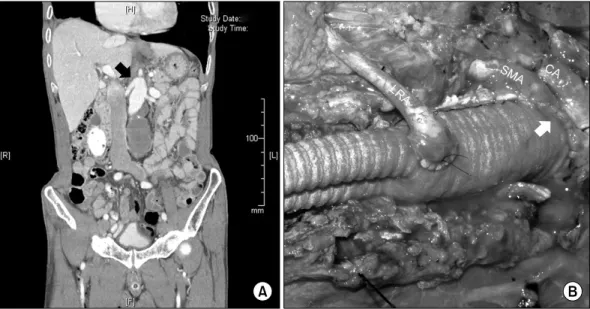
Fig. 1. (A) Computed tomography angiogram of supra-renal abdominal aortic aneurysm (AAA) (black arrow), which involves the origin of both renal arteries. (B) Surgical photograph showing suprarenal AAA repair, which includes the proximal aortic anastomosis performed via the inclusion technique (white arrow) and concomitant left renal artery reimplantation to the aortic prosthetic graft. CA, celiac artery; SMA, superior mesenteric artery; LRA, left renal artery.
clamping (SRACC) [1-3]. For the majority of patients un- dergoing open aortic surgery (OAS), proximal aortic con- trol can be achieved at the infra-renal aorta. When OAS is selected for patients with juxta-renal aortic occlusion (JRAO) or para-renal AAAs, SRACC is essential for prox- imal aortic control during surgery [4,5]. Postoperative re- nal or abdominal visceral complications are important considerations in patients who undergo SRACC [6].
The assumed pathogenesis of renal or visceral compli- cations includes ischemia/reperfusion injury of the renal or splanchnic organs, atheroembolism from the aortic wall around the renal or splanchnic artery ostia during aortic clamping or declamping, and hypotension due to peri- operative hemorrhage. During the last few decades, many authors have reported improved surgical results after SRACC using prophylactic measures to reduce renal or visceral ischemia, improved surgical techniques, and postoperative care [7-9]. The purpose of the present study was to report the frequency and clinical course of post- operative renal and abdominal visceral complications fol- lowing OAS requiring SRACC, and we attempted to iden- tify risk factors for postoperative renal insufficiency (PORI).
METHODS
We retrospectively reviewed a database of 473 patients who underwent OAS due to AAA or AOD between October 2003 and February 2012 at a single institute. For this study, we included 66 consecutive patients (14%) who had undergone OAS requiring SRACC. OAS was per- formed through either a transperitoneal (n = 61) or thor- acoabdominal (n = 5) approach. In patients requiring su- pra-celiac aortic cross clamping (SCACC), left medial vis- ceral rotation was performed to expose the upper abdomi- nal aorta. Prior to aortic clamping, heparin, mannitol (12.5 g/L) and/or furosemide (20 mg) were routinely ad- ministered intravenously. In cases where a longer aortic clamping time was expected, such as with type IV thor- acoabdominal aortic aneurysm (TAAA), we infused cold heparinized saline into the renal orifices to induce renal hypothermia.
The methods of aortic reconstruction included aortic in- terposition, or aorto-biliac or bifemoral reconstruction us- ing a prosthetic graft (Hemashield; Maquet Cardiovascu- lar, Wayne, NJ, USA or GORE-TEX, W. L. Gore & Asso- ciates, Inc., Flagstaff, AZ, USA). In the cases of an infected aneurysm, we used cryopreserved aortic allografts in two
Variable No. of patients (%) Age (yr)
Mean ± SD 61.2 ± 10.7
Median (range) 62 (32-85)
Male sex 53 (80)
Underlying disease
Aneurysm 41 (62)
Atherosclerotic occlusive disease 25 (38) Coexisting risk or morbidities
Smokinga) 25 (38)
Coronary artery diseaseb) 22 (33) Cerebrovascular diseasec) 7 (11) Chronic obstructive pulmonary diseased) 4 (6)
Hypertensione) 47 (71)
Diabetes mellitusf) 18 (27)
Chronic renal insufficiencyg) 4 (6)
a)Current or quit smoking <1 year. b)History of myocardial infarction or coronary intervention or coronary artery bypass grafting. c)History of stroke with an ischemic event at least 24 hours after onset or transient ischemic attack. d)Forced expiratory volume in 1 second <75% on pulmonary function test or pO2 < 60%, pCO2 >50% on arterial blood gas analysis. e)Diastolic blood pressure >90 mmHg on at least two occasions or currently taking antihypertensive medication. f)History of diabetes diagnosed or fasting blood glucose >126 mg/dL. g)Serum creatinine ≥2.0 mg/dL, dialysis, or history of kidney transplantation.
Table 1. Demographic and coexisting morbidities of 66 patients who underwent open aortic surgery requiring supra-renal aortic cross clamping (n = 66)
patients and polytetrafluorethylene (PTFE) grafts in the other patients. In cases of type IV TAAA or supra-renal AAA, we formed a proximal aortic anastomosis using the inclusion technique between the beveled prosthetic graft and the proximal aorta including the celiac axis, superior mesenteric artery and right renal artery, and then left renal artery revascularization was separately performed (Fig.
1).
To identify risk factors for the development of PORI (defined as serum creatinine [sCr] ≥1.5 mg/dL in associa- tion with sCr ≥150% of preoperative level), we analyzed demographics (age, gender), preexisting comorbidities, indications for aortic surgery (aneurysm vs. JRAO), and intraoperative variables (renal ischemic time [RIT], aortic clamping site, renal protective measure, and concomitant renal artery reconstruction). RIT was defined as the time interval from SRACC to both renal artery reperfusions. In patients who underwent SCACC, postoperative hepatic and pancreatic enzyme levels were investigated in addi- tion to sCr level. According to the suggestions of Michalo- poulos et al. [10], hepatic dysfunction was defined as clin- ical jaundice associated with the level of hepatic enzymes (aspartate aminotransferase [AST]/alanine aminotrans- ferase [ALT]) elevated to more than twice the norm.
Postoperative acute pancreatitis was defined as elevation of the level of serum pancreatic enzymes (lipase and amy- lase) to more than three times the norm and a positive ab- dominal computed tomography scan [11].
Continuous variables are presented as mean ± SD and categorical variables are presented as frequencies (%).
Binary logistic regression models were used to identify risk factors for PORI. Differences were considered sig- nificant when the P-value was less than 0.05. Patient sur- vival after surgery was calculated using Kaplan-Meier analysis.
RESULTS
Among 473 OAS which performed during the study pe- riod, 66 patients (14 %; 53 males vs. 13 females; mean age, 61.2 ± 10.7 years; range, 32 to 85 years) required SRACC intraoperatively. The baseline demographics and coexist-
ing risk and morbidities of the patients are summarized in Table 1.
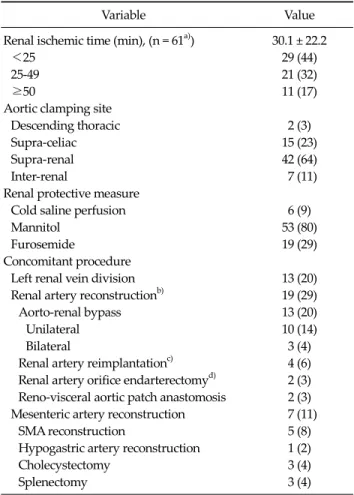
Four patients (7%) had preexisting chronic renal in- sufficiency (sCr ≥2.0 mg/dL), but no patients were on di- alysis or had undergone kidney transplantation pre- viously. Table 2 shows the surgical indications for aortic surgery requiring SRACC including 25 cases of JRAO and 41 aortic aneurysms (24 juxta-renal, 12 supra-renal and 5 type IV TAAA). Among the aortic aneurysms involving abdominal aorta, 15 (23%) were uncommon types of aneurysm which included 5 (8%) infected aneurysms, 4 (6%) inflammatory AAAs, 4 (6%) Marfan’s syndrome and 2 (3%) Takayasu’s arteritis. Four patients (9.8%) presented with a ruptured aortic aneurysm revealing normal blood pressure (Table 2).
The sites of SRACC were the distal descending thoracic aorta in 2 patients (3%), supra-celiac in 15 patients (23%), supra-renal in 42 patients (64%) and inter-renal (aortic
Indication No. of patients (%)
Aortic aneurysm 41 (62)
Location
Juxtra-renal AAA Supra-renal AAA Type IV TAAA
24 (36) 12 (18) 5 (8) Etiology
Degenerative Infected Inflammatory Marfan’s syndrome Takayasu’s arteritis
26 (39) 5 (8) 4 (6) 4 (6) 2 (3)
Ruptured 4 (6)
Juxta-renal aortic occlusive disease 25 (38) Juxta-renal abdominal aortic aneurysm (AAA) was defined as an AAA extended up to the lower renal artery orifice, but not involving it. Supra-renal AAA was defined as an AAA from which one or both main renal arteries come out. Type IV thora- coabdominal aortic aneurysm was defined as an aortic aneurysm involving the whole abdominal aorta up to the diaphragm.
Juxta-renal aortic occlusive disease was defined as chronic infrarenal aortic occlusion up to the level of renal artery, in which suprarenal or interrenal aortic clamping was needed for proximal aortic control during aortic reconstructive surgery.
Table 2. Indications for open aortic surgery requiring suprarenal aortic cross clamping (n = 66)
Variable Value Renal ischemic time (min), (n = 61a)) 30.1 ± 22.2
<25 29 (44)
25-49 21 (32)
≥50 11 (17)
Aortic clamping site
Descending thoracic 2 (3)
Supra-celiac 15 (23)
Supra-renal 42 (64)
Inter-renal 7 (11)
Renal protective measure
Cold saline perfusion 6 (9)
Mannitol 53 (80)
Furosemide 19 (29)
Concomitant procedure
Left renal vein division 13 (20)
Renal artery reconstructionb) 19 (29)
Aorto-renal bypass 13 (20)
Unilateral 10 (14)
Bilateral 3 (4)
Renal artery reimplantationc) 4 (6) Renal artery orifice endarterectomyd) 2 (3) Reno-visceral aortic patch anastomosis 2 (3) Mesenteric artery reconstruction 7 (11)
SMA reconstruction 5 (8)
Hypogastric artery reconstruction 1 (2)
Cholecystectomy 3 (4)
Splenectomy 3 (4)
Values are presented as mean ± SD or no. of patients (%).
IMA, inferior mesenteric artery; SMA, superior mesenteric artery.
a)Renal ischemic time was unclear in five patients. b)Four pro- cedures in two patients. c)All procedures were unilateral. d)All procedures were bilateral.
Table 3. Intraoperative variables during aortic surgery requiring supra-renal aortic cross clamping (n = 66)
cross clamping between 2 renal arteries) in 7 patients (11%). Aortic reconstructions were performed using 12 pa- tients (18%) prosthetic aortic tube grafts, 50 patients (76%) bifurcated grafts (48 prosthetic and 2 cryopreserved allog- rafts), 2 aortic patch closures of the aneurysmal neck and 1 primary aortic aneurysmal neck closure. In a patient who had juxta-renal AAA with aortoduodenal fistula, aneur- ysm resection under the SRACC site was performed form- ing an aortic stump, followed by axillo-bifemoral bypass.
With aortic reconstructions, 21 renal artery, 7 mesenteric and 1 hypogastric artery reconstructions were con- comitantly performed. Details of the surgical procedures and adjunctive or concomitant procedures are summar- ized in Table 3.
The mean RIT was 30.1 ± 22.1 minutes (range, 3 to 120 minutes). Data for RIT were available in 61 patients (92%).
The mean duration of RIT was 15.5 ± 1.4 minutes in JRAO, 35.1 ± 23.3 minutes in juxta-renal AAA (JRAA), 43.8 ± 21.6 minutes in supra-renal AAA (SRAA), and 51.3 ± 6.3 mi- nutes in type IV TAAA. PORI developed in 14 of 66 pa- tients (21%) (21% in JRAO, 21% in JRAA, 37% in SRAA and
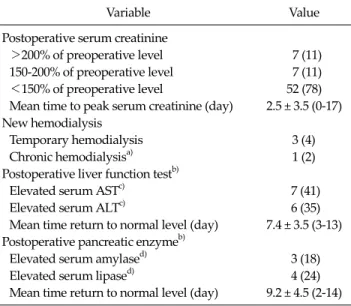
21% in type IV TAAA). Four patients required HD, but chronic HD was required in one patient. The mean time to the postoperative peak level of sCr was 2.5 ± 3.5 days. Fig.
2 demonstrates scatter plots of postoperative sCr change according to the RIT. We found no correlations between postoperative sCr change and RIT (R2 = 0.166).
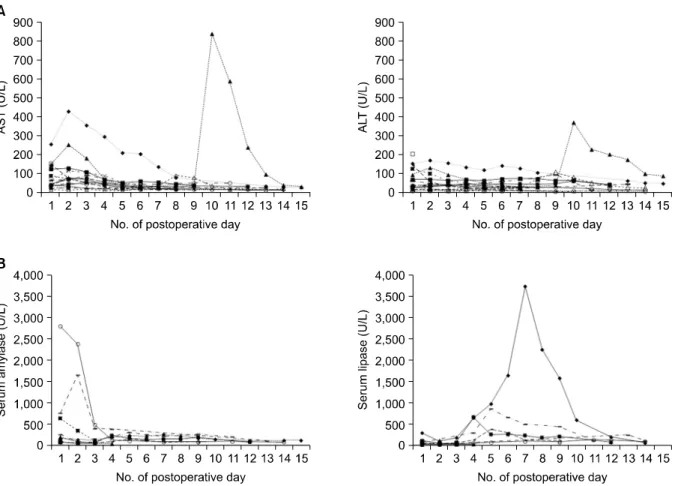
The elevation of hepatic or pancreatic enzymes was ob- served in 17 patients (26%) who underwent SCACC dur- ing the surgery. Though we have observed transient pan- creatic (n = 7, 41%) and hepatic (n = 9, 53%) enzyme ele- vation after SCACC, there was no patients who shows di- agnostic criteria of postoperative pancreatic or hepatic dysfunction suggested by Hashimoto and Walsh [11] and Michalopoulos et al. [10]. The serum pancreatic enzyme level
Variable Value Postoperative serum creatinine
>200% of preoperative level 7 (11)
150-200% of preoperative level 7 (11)
<150% of preoperative level 52 (78)
Mean time to peak serum creatinine (day) 2.5 ± 3.5 (0-17) New hemodialysis
Temporary hemodialysis 3 (4)
Chronic hemodialysisa) 1 (2)
Postoperative liver function testb)
Elevated serum ASTc) 7 (41)
Elevated serum ALTc) 6 (35)
Mean time return to normal level (day) 7.4 ± 3.5 (3-13) Postoperative pancreatic enzymeb)
Elevated serum amylased) 3 (18)
Elevated serum lipased) 4 (24)
Mean time return to normal level (day) 9.2 ± 4.5 (2-14) Values are presented as no. of patients (%) or mean ± SD (range).
a)In a patient with preexisting renal insufficiency. b)Patients undergoing supra-celiac aortic cross clamping (n = 17). c)Elevation more than twice the normal level (normal ranges: aspartate aminotransferase [AST], 0 to 40 IU/L; alanine aminotransferase [ALT], 0 to 40 IU/L). d)Elevation more than three times the normal level (normal ranges: amylase, 13 to 100 U/L; lipase, 13 to 60 U/L).
Table 4.Postoperative renal, hepatic and pancreatic dysfunctions (n
= 66)
Fig. 2. A scatter plots showing postoperative change of the serum creatinine level according to the renal ischemic time. Empty circles (○) denote patients who did not undergo renal hypothermia; solid circles (●) denote patients who underwent renal hypothermia during the suprarenal aortic cross clamping. sCr, serum creatinine.
returned to normal range within two weeks for all but one patient who exhibited prolonged elevation. Table 4 summa- rizes the postoperative blood test results for renal, hepatic and pancreatic enzymes. Fig. 3 shows the postoperative courses of serum AST, ALT, amylase and lipase levels.
On univariate analysis, SCACC (supra-celiac vs. in- fra-celiac aortic cross clamping, P = 0.035) and prolonged RIT (≥25 minutes vs. <25 minutes, P = 0.026) were pre- dictors of developing PORI. However, they were not stat- istically significant for predicting PORI on multivariate analysis (Table 5).
There was one (1.5%) instance of operative mortality following aortic reconstruction in a patient with type IV TAAA infected with Listeria. Postoperative follow-up data was available in 82% of patients for a mean duration of 37.0
± 31.9 months (range, 1 to 101 months). Patient survival at one, three, and five years after surgery was 90%, 79% and 79%, respectively (Fig. 4).
DISCUSSION
Endovascular aneurysm repair currently has a limited role for the treatment of aortic disease around the visceral-renal arteries. Therefore, OAS is still the gold standard treatment for patients with para-renal or
para-visceral aortic disease. OAS is also challenging because it requires more extensive surgical exposure, has an increased risk of ischemic injury to renal and visceral organs or the spinal cord, and increased cardiac and pulmonary demands during SRACC. Therefore, OAS requiring SRACC carries a higher morbidity and mortality than infra-renal aortic surgery.
Greenberg et al. [12] recently reported excellent treat- ment results in patients with JRAA or TAAA using branched aortic stent grafts. However, the use of these de- vices is still not allowed in Korean or even in the United States, except in clinical trials. The results achieved by a few specialized centers cannot be generalized. As an alter- native method to branched aortic stent grafting, aortic stent grafting with viscera and/or renal revascularization with a chimney technique can be used for the treatment of para-renal aortic aneurysms [13]. However, it remains to be determined whether the long-term results of the chim- ney procedure are equivalent to those of branched aortic stent grafting or OAS.
Factor No. PORIa), n (%) Univariateb) Multivariatec)
P-value OR (95% CI) P-value
Age ≥75 yr 7 4 (29) 0.060 2.747 (0.423-17.853) 0.290
Non-degenerative etiology aneurysm 17 5 (36) 0.999 0.441 (0.081-2.412) 0.345
Ruptured aneurysm 4 2 (14) 0.130 1.389 (0.052-36.847) 0.844
RIT ≥25 min 32 11 (79) 0.026 3.354 (0.549-20.471) 0.190
SCACC 17 7 (50) 0.035 2.905 (0.567-14.882) 0.201
Preoperative sCr ≥2.0 mg/dL 4 1 (7) 0.999 0.525 (0.012-22.234) 0.736
Concomitant renal artery reconstruction 19 6 (43) 0.203 0.939 (0.166-5.310) 0.944
Left renal vein division 13 3 (21) 0.999 1.268 (0.245-6.557) 0.777
PORI, postoperative renal insufficiency; OR, odds ratio; CI, confidence interval; RIT, renal ischemic time; SCACC, supra-celiac aortic cross clamping; sCr, serum creatinine.
a)Postoperative renal insufficiency (>150% increase in sCr compared to the preoperative level). b)Fisher’s exact test. c)Binary logistic regression.
Table 5. Risk factor analysis for the development of postoperative renal insufficiency
Fig. 3. Postoperative serum hepatic (A) and pancreatic enzyme (B) levels in patients who underwent aortic surgery requiring supra-celiac aortic cross clamping (n = 17). AST, aspartate aminotransferase; ALT, alanine aminotransferase.
Since endovascular treatment for AAA and AOD are be- ing more frequently performed, a greater proportion of OASs have become more complex [14]. Though the fre- quency of OAS requiring SRACC varies from center to
center, it has a referral pattern to large centers. During the study period, 14% of patients undergoing OAS required SRACC in our hospital.
Some may argue against including type IV TAAA as an
Fig. 4. Postoperative survival of 66 patients who underwent supra-renal aortic cross clamping (Kaplan-Meier curve).
AAA. Though it is classified as a type of TAAA, it is appa- rent that type IV TAAA does not affect the thoracic aorta, but it does affect the abdominal aorta. Therefore, we in- cluded type IV TAAA as an AAA requiring SRACC.
Renal insufficiency is one of the most serious complica- tions after SRACC. The reported incidence of PORI after OAS requiring SRACC ranges from 7.9 to 38%, which de- pends on the definition of PORI [15,16]. In this study, 21%
(14/66) of patients developed PORI, which was defined as sCr elevated greater than 50% over the preoperative level.
New HD was required in 4 (6%) of these patients; however most required temporary HD, while one patient (1.5%) who developed chronic renal failure required chronic HD.
That patient presented with ruptured type IV TAAA and preexisting renal insufficiency. Numerous authors have reported that PORI develops more often in females, and patients with preoperative renal insufficiency, intra- operative hypotension, concomitant renal artery re- construction and prolonged RIT [17-20]. In the present study, SCACC and RIT ≥25 minutes were identified as risk factors of PORI on univariate analysis.
The optimal site of aortic cross clamping is usually de- termined by the extension of the aortic lesion, associated arterial disease requiring concomitant repair, body hab- itus, etc. Green et al. [21] reported that SCACC carries a lower risk of PORI than aortic clamping just proximal to the renal arteries, which can prevent atheroembolism
from the para-renal aortic lesion. Shortell et al. [17] also re- ported the merit of SCACC in patients with JRAA, includ- ing a reduced incidence of complications related to prox- imal aortic cuff disease. However, many previous authors have reported that SCACC is an independent predictor of PORI [20,22]. At our institution, we prefer aortic clamping at the inter-renal or supra-renal aorta to supra-celiac aorta, unless there is significant aortic calcification or mural thrombus around the renal artery orifices.
In addition to atheroembolism, acute tubular necrosis due to interruption of renal perfusion is a well-known pathogenesis of PORI. In an experimental rat model of re- nal ischemia, renal blood flow to the outer medullary area decreased dramatically during the first 30 minutes of renal ischemia and showed transient recovery to 50% of base- line blood flow for a three-hour period [23]. Prolonged RIT is a well-known independent risk factor for PORI.
However, tolerable time duration to irreversible damage of the renal tissue was not well established after renal per- fusion was stopped. Wahlberg et al. [18] reported the fre- quency of PORI according to the total RIT. According to them, PORI was very rare when the RIT was shorter than 25 minutes. The odds ratio increased to 2.2 (95% con- fidence interval [CI], 0.5 to 8.8) and 12 (95% CI, 1.0 to 141.3) when RIT lasted 26 to 50 minutes and >50 minutes, respectively. In the present study, RIT >25 minutes was a significant predictor of PORI on univariate analysis, but not on multivariate analysis.
Various protective measures and adjunctive surgical procedures are performed to reduce renal or visceral is- chemic injury in patients with supra-renal or type IV TAAA. Though Cochrane Collaboration [24] recently re- ported that there is insufficient evidence to support the routine use of renal protective measures during aortic sur- gery, renal parenchymal cooling by the infusion of cold solution into the renal artery and prophylactic intra- venous administration of mannitol and/or furosemide are frequently used to reduce renal ischemic injury. Our poli- cy is to administer mannitol and furosemide intravenou- sly before SRACC, and to infuse cold heparinized solution into the renal artery when prolonged RIT is anticipated. A typical example is cooling of the left kidney when a sepa- rate left renal artery reconstruction is planned after the
completion of proximal aortic anastomosis. According to Knott et al. [19], 12% of juxta-renal AAA patients required renal artery revascularization during OAS. In the present series, renal artery revascularization was performed in 29% of patients who required suprarenal aortic clamping during OAS. These findings are similar to those of Chong et al. [7] who found the frequency of concomitant renal ar- tery revascularization was 32% in patients who under- went OAS requiring SRACC.
SCACC is required in cases of type IV TAAA and some cases of suprarenal AAA. The amount of blood flow to the gastrointestinal tract, splanchnic organs and both kidneys is known to account for 55% of cardiac output [25].
Therefore, SCACC causes an increased cardiac afterload in addition to the renal, splanchnic and lower extremity ischemia. Major adverse effects can occur with SCACC, re- sulting in ischemia-reperfusion injury of the visceral organs. One of the most dreaded complications after pro- longed SCACC is the development of intraoperative bleeding. Anagnostopoulos et al. [26] described the mech- anisms underlying intraoperative bleeding tendency in an animal model that underwent SCACC for longer than 30 minutes. They explained that these mechanisms involved systemic intravascular thrombosis resulting in con- sumption coagulopathy and decreased fibrinolytic activ- ity (“fibrinolytic shutdown”) following ischemia-re- perfusion of visceral organs. Hepatic hypoperfusion can cause decreased clearance of tissue plasminogen activator (t-PA) in the liver while increased t-PA production by the ischemic gut. Nypaver et al. [27] reported that post- operative complications related to organ ischemia devel- oped in 14% of patients who underwent SCACC longer than 45 minutes during an elective OAS concomitant with renal or visceral artery revascularization.
Acute pancreatitis is a very rare complication after OAS [28]. The possible mechanisms of acute pancreatitis after SCACC include systemic or regional hypoperfusion of the pancreas, atheroembolism of the arteries supplying the pancreas, and mechanical injury to the pancreas. Howev- er, clinical features of postoperative pancreatitis can be ob- scured due to abdominal wound pain and gastrointestinal dysfunction in the immediate postoperative period. When we adopted the elevation of serum pancreatic enzymes by
three times or more compared to the preoperative level as the definition of postoperative pancreatitis, the incidence was very rare after SCACC. Though SCACC can cause vis- ceral organ ischemia, morbidity due to splanchnic organ hypoperfusion is often reported to be minimal [29,30].
Elevation of pancreatic and/or hepatic enzymes was ob- served after SCACC, but most returned to normal levels within two weeks.
To summarize our observations, OAS requiring SRACC or SCACC can result in renal or visceral com- plications. However, if the RIT is shorter than 25 minutes, SRACC is considered a safe procedure. Though we were unable to identify independent risk factors for PORI, we found that preexisting renal disease can progress to chron- ic renal failure after SRACC. We have encountered good short-term and long-term results after OAS with supra-re- nal or SCACC.
CONFLICTS OF INTEREST
No potential conflict of interest relevant to this article was reported.
REFERENCES
1. Costin JA, Watson DR, Duff SB, Edmonson-Holt A, Shaffer L, Blossom GB. Evaluation of the complexity of open ab- dominal aneurysm repair in the era of endovascular stent grafting. J Vasc Surg 2006;43:915-20.
2. Park YJ, Kim N, Kim YW. Investigation of current trend of AAA treatment in Korea. J Korean Surg Soc 2011;80:125-30.
3. Kim TH, Ko YG, Kim U, Kim JS, Choi D, Hong MK, et al.
Outcomes of endovascular treatment of chronic total oc- clusion of the infrarenal aorta. J Vasc Surg 2011;53:1542-9.
4. Sharp WJ, Bashir M, Word R, Nicholson R, Bunch C, Corson J, et al. Suprarenal clamping is a safe method of aortic control when infrarenal clamping is not desirable.
Ann Vasc Surg 2008;22:534-40.
5. Giulini SM, Bonardelli S, Portolani N, Giovanetti M, Galvani G, Maffeis R, et al. Suprarenal aortic cross clamp- ing in elective abdominal aortic aneurysm surgery. Eur J Vasc Endovasc Surg 2000;20:286-9.
6. Marrocco-Trischitta MM, Melissano G, Kahlberg A, Vezzoli G, Calori G, Chiesa R. The impact of aortic clamp- ing site on glomerular filtration rate after juxtarenal aneur- ysm repair. Ann Vasc Surg 2009;23:770-7.
7. Chong T, Nguyen L, Owens CD, Conte MS, Belkin M.
Suprarenal aortic cross-clamp position: a reappraisal of its effects on outcomes for open abdominal aortic aneurysm repair. J Vasc Surg 2009;49:873-80.
8. Kirby LB, Rosenthal D, Atkins CP, Brown GA, Matsuura JH, Clark MD, et al. Comparison between the trans- abdominal and retroperitoneal approaches for aortic re- construction in patients at high risk. J Vasc Surg 1999;
30:400-5.
9. Martin GH, O'Hara PJ, Hertzer NR, Mascha EJ, Krajewski LP, Beven EG, et al. Surgical repair of aneurysms involving the suprarenal, visceral, and lower thoracic aortic seg- ments: early results and late outcome. J Vasc Surg 2000;31:851-62.
10. Michalopoulos A, Alivizatos P, Geroulanos S. Hepatic dys- function following cardiac surgery: determinants and consequences. Hepatogastroenterology 1997;44:779-83.
11. Hashimoto L, Walsh RM. Acute pancreatitis after aortic surgery. Am Surg 1999;65:423-6.
12. Greenberg R, Eagleton M, Mastracci T. Branched endog- rafts for thoracoabdominal aneurysms. J Thorac Cardio- vasc Surg 2010;140(6 Suppl):S171-8.
13. Bruen KJ, Feezor RJ, Daniels MJ, Beck AW, Lee WA.
Endovascular chimney technique versus open repair of juxtarenal and suprarenal aneurysms. J Vasc Surg 2011;53:
895-904.
14. Barshes NR, McPhee J, Ozaki CK, Nguyen LL, Menard MT, Gravereaux E, et al. Increasing complexity in the open sur- gical repair of abdominal aortic aneurysms. Ann Vasc Surg 2012;26:10-7.
15. Wahlgren CM, Piano G, Desai T, Shaalan W, Bassiouny H.
Transperitoneal versus retroperitoneal suprarenal cross- clamping for repair of abdominal aortic aneurysm with a hostile infrarenal aortic neck. Ann Vasc Surg 2007;21:
687-94.
16. Sasaki T, Ohsawa S, Ogawa M, Mukaida M, Nakajima T, Komoda K, et al. Postoperative renal function after an ab- dominal aortic aneurysm repair requiring a suprarenal aortic cross-clamp. Surg Today 2000;30:33-6.
17. Shortell CK, Johansson M, Green RM, Illig KA. Optimal operative strategies in repair of juxtarenal abdominal aort- ic aneurysms. Ann Vasc Surg 2003;17:60-5.
18. Wahlberg E, Dimuzio PJ, Stoney RJ. Aortic clamping dur- ing elective operations for infrarenal disease: the influence of clamping time on renal function. J Vasc Surg
2002;36:13-8.
19. Knott AW, Kalra M, Duncan AA, Reed NR, Bower TC, Hoskin TL, et al. Open repair of juxtarenal aortic aneur- ysms (JAA) remains a safe option in the era of fenestrated endografts. J Vasc Surg 2008;47:695-701.
20. West CA, Noel AA, Bower TC, Cherry KJ Jr, Gloviczki P, Sullivan TM, et al. Factors affecting outcomes of open sur- gical repair of pararenal aortic aneurysms: a 10-year experience. J Vasc Surg 2006;43:921-7.
21. Green RM, Ricotta JJ, Ouriel K, DeWeese JA. Results of su- praceliac aortic clamping in the difficult elective resection of infrarenal abdominal aortic aneurysm. J Vasc Surg 1989;9:124-34.
22. Sarac TP, Clair DG, Hertzer NR, Greenberg RK, Krajewski LP, O'Hara PJ, et al. Contemporary results of juxtarenal aneurysm repair. J Vasc Surg 2002;36:1104-11.
23. Regner KR, Roman RJ. Role of medullary blood flow in the pathogenesis of renal ischemia-reperfusion injury. Curr Opin Nephrol Hypertens 2012;21:33-8.
24. Zacharias M, Conlon NP, Herbison GP, Sivalingam P, Walker RJ, Hovhannisyan K. Interventions for protecting renal function in the perioperative period. Cochrane Database Syst Rev 2008;(4):CD003590.
25. Folkow B, Neil E. Circulation. New York: Oxford Universi- ty Press; 1971.
26. Anagnostopoulos PV, Shepard AD, Pipinos II, Raman SB, Chaudhry PA, Mishima T, et al. Hemostatic alterations as- sociated with supraceliac aortic cross clamping. J Vasc Surg 2002;35:100-8.
27. Nypaver TJ, Shepard AD, Reddy DJ, Elliott JP Jr, Ernst CB.
Supraceliac aortic cross clamping: determinants of out- come in elective abdominal aortic reconstruction. J Vasc Surg 1993;17:868-75.
28. Burkey SH, Valentine RJ, Jackson MR, Modrall JG, Clagett GP. Acute pancreatitis after abdominal vascular surgery. J Am Coll Surg 2000;191:373-80.
29. Achouh PE, Madsen K, Miller CC 3rd, Estrera AL, Azizzadeh A, Dhareshwar J, et al. Gastrointestinal compli- cations after descending thoracic and thoracoabdominal aortic repairs: a 14-year experience. J Vasc Surg 2006;44:
442-6.
30. Gullo L, Cavicchi L, Tomassetti P, Spagnolo C, Freyrie A, D'Addato M. Effects of ischemia on the human pancreas.
Gastroenterology 1996;111:1033-8.