총 설
대사산물 과량생산을 위한 미생물 균주의 시스템 생물학 연구 및 대사특성 개량
홍 순 호† 울산대학교 생명화학공학부 680-749 울산시 남구 무거2동 산29 (2007년 7월 10일 접수, 2007년 9월 6일 채택)
Systems Biology Studies and Metabolic Modification of Metabolites Producing Bacteria
Soon Ho Hong†
School of Chemical Engineering & Bioengineering, University of Ulsan, San 29 Mugeo 2-dong, Nam-gu, Ulsan 680-749, Korea (Received 10 July 2007; accepted 6 September 2007)
요 약
최근 DNA microarray, 2-D gel, MS/MS 등 다양한 high-throughput 기술의 발달에 힘입어 생명체의 복잡한 대사특 성을 종합적으로 분석하려는 시도가 이루어지고 있으며, 이를 시스템 생물학이라 칭하고 있다. 특히 근래에 들어 고유 가 등 산업환경의 변화에 따라 미생물의 대사특성을 개량하여 다양한 화학물질들을 생물학적으로 생산하려는 연구가 최근 많은 관심을 얻고 있으며, 이를 위하여 다양한 시스템 생물학 혹은 시스템 생물공학 연구가 수행되어져 왔다. 본 총설에서는 시스템 생물공학 연구에 대한 소개 및 사용되는 여러 연구전략들을 소개하고, 이러한 시스템 생물공학 연 구들이 실제 대사산물 생산균주의 개량에 어떻게 적용되었는지 살펴보고자 한다.
Abstract − Recently, an attempt to analyze and modify metabolic networks of living organisms in global level emerged with the benefit of development of high-throughput techniques, and it is generally called systems biology. Var- ious systems biology studies have been carried out for the development of enhanced metabolite production systems. By modification of metabolic characteristics of microorganisms, metabolite productivities and yields obtained with meta- bolically engineered bacteria increased significantly compare with that obtained with wild type bacteria.
Key words: Systems Biology, Systems Biotechnology, Metabolic Engineering, Metabolism Modification
1. 서 론
20세기는 석유화학기술이 중심이 되어 산업의 발전을 주도하는 시 기였으나, 21세기는 BT 기술이 중심이 되어 산업 및 기술의 발전을 주도하는 시기가 될 것이다. 특히, 석유화학 제품의 사용으로 야기되 는 공해 문제 및 석유자원의 고갈 등을 고려할 경우 석유화학공학 공정의 생명공학 공정으로의 대체는 필연적이라 할 수 있다. 향후 의 약품을 포함한 생명공학 관련 제품의 시장규모는 급속한 성장을 보 일 것이라 예측되며, 이러한 요구 및 필요성을 바탕으로 세계 각국 은 생명공학 및 화이트바이오(white biotechnology)로 통칭되는 산업 바이오 분야에 아낌없는 투자를 하고 있는 실정이다. 그러나, 기존의 생명공학적 접근법은 시간 ·자본 ·노동력의 집중적인 투자를 필요로 하여 이러한 급증하는 요구를 만족시키기에는 부족하므로, 보다 효 율적인 생명공학 연구의 필요성이 더욱 더 부각되어지고 있다[1-3].
1980년대 이후 재조합 유전자 기술을 이용하여 특정 유전자를 조 작함으로서 균주의 대사특성을 원하는 방향으로 조절하는 대사공학
(metabolic engineering)이 생물공학 연구의 주류를 이루어왔으며, 이 러한 대사공학 연구를 통하여 다양한 대사산물을 과량생산하는 생 물공정 및 균주가 개발되어져 왔다[4-6]. 최근에 완료된 인간 genome 프로젝트 및 여러 genome 프로젝트의 성공을 바탕으로, 수 백 종의 생물체에 대한 전체 염기서열 정보가 완전히 밝혀지고 transcriptome, proteome 데이터의 양도 지속적으로 증가할 것으로 예측되고 있다.
이러한 여러 high-throughput 기술을 바탕으로 현재 생물학적 데이 터의 축적이 놀라운 속도로 이루어지고 있으며, 이러한 데이터를 바 탕으로 생명체의 신비를 밝히고 개량하는 시스템 생물학(systems biology) 혹은 시스템 생명공학(systems biotechnology) 연구가 새로 운 생명공학 연구의 패러다임으로서 각광받고 있다[7-8]. 본 리뷰에 서는 이러한 다양한 시스템 생물공학 및 대사공학적 기법들이 어떻 게 실제 생물공정 및 균주에 적용되어 생산 균주 및 시스템을 개량 하는데 활용되었는지 살펴보고자 한다.
2. 시스템 생물학 tools
생명체의 시스템은 단순한 생화학반응들의 결합이 아니라,
†To whom correspondence should be addressed.
E-mail: [email protected]
화학공학 제45권 제6호 2007년 12월
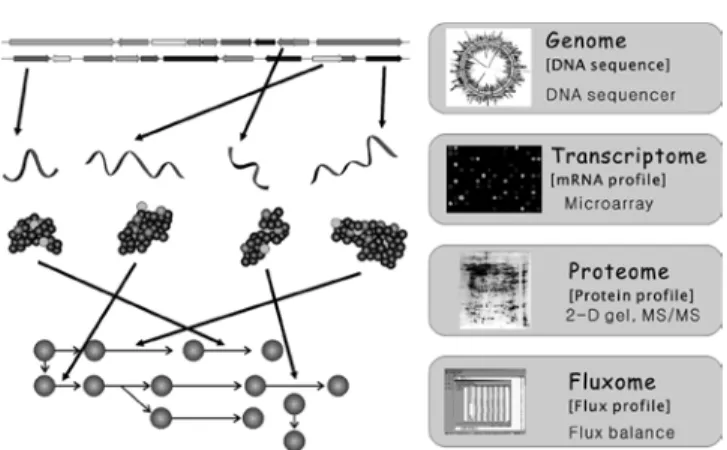
transcription, translation, metabolic reaction 등 복합적이고 다차원 적인 반응들로 이루어져 있다. 따라서, 기존의 단편적인 분석 방법 이 아니라 genome, transcriptome, proteome, fluxome 등의 다양한 데이터의 종합적이고 체계적인 분석을 통한 시스템 생물학적 분석 이 필수적이다. Genome, transcriptome과 proteome 분석 및 이들 상 호간에 일어나는 조절(control and regulation) 기작을 시스템 수준 에서 규명하기 위하여, 여러 가지 tool들이 개발되어져 왔다(Fig. 1).
최근 자동 염기서열분석기기(automatic high speed genome sequencer)의 개발 및 보급에 따라, 다양한 생명체의 전체 염기서열 이 빠르게 밝혀지고 있다. 1995년 세계 최초로 유전체 염기서열 완 전해독에 성공한 후[9], 최근까지 수 백여종의 미생물과 선충, 초파 리 등에 대한 전체 염기서열 정보가 완전히 밝혀졌다. 그리고, 마침 내 2003년도에 인간에 대한 유전체 염기서열 분석이 완료되어 발표 되었다[10]. Genome sequencing 프로젝트의 결과물로서 엄청난 양 의 유전정보가 축적되어졌고 현재도 생성되어지고 있으므로, 유전 자들의 기능을 high-throughput으로 분석하는 기술이 필수적이다. 빠 르고 자동화된 유전자 기능예측기술은 거대 제약회사 등을 포함한 대부분의 생물공학 회사들이 관심을 가지고 있는 기술이다. 그러나 유전자의 기능예측은 사용되는 알고리즘, 전략 등 다양한 인자에 영 향을 받는다. 따라서 유전체 염기서열의 결과물로부터 방대한 생물 학적 데이터를 확보하기 위해서는 유전자 및 기능예측기술의 발전 이 필수적이며, 이렇게 예측된 결과는 실제실험을 통하여 검증되어 져야 할 것이다. 유전체 서열분석은 생명체의 전체 metabolism을 분 석하는 과정에서 매우 중요하고 효율적인 시작점이 될 것이라는 점 은 변함이 없다.
살아있는 생명체는 외부의 환경변화 등에 반응하여 체내의 mRNA 발현량이 급격히 변화하고 궁극적으로 세포의 대사상태의 변화를 야기하는 소위 대사반응 기작을 가지고 있으므로, 이의 분 석을 통한 균주 대사상태 분석이 가능하다. 기존에는 특정 상황에 서 각 유전자의 발현 형태를 유전자별로 각각 분석하는 SAGE(serial analysis of gene expression) 등의 방법이 사용되었으나, 최근에는 보다 효과적인 데이터의 처리를 위해 DNA microarray, high- throughput northern analysis 등의 high-throughput 방법을 사용한 연 구가 본격화되었다. 이러한 high-throughput 기술의 개발에 힘입어 다양한 균주의 transcriptome 혹은 유전자 발현 데이터가 축적되어 지고 있으나, 방대한 양의 transcriptome 데이터에 비하여 상대적으 로 느린 데이터분석 과정이 문제가 되었다[11]. 이러한 문제를 해결 하기 위하여 최근에는 clustering 등 다양한 분석방법 및 전략이 사
용되어지고 있다[12-13].
Transcription, translation 과정을 통하여 합성된 전체 단백질들의 발현량을 측정함으로써 균주내부의 대사상황 및 각 단백질의 기능 을 분석하는 proteome 연구도 systems biotechnology 연구의 중요 한 부분으로서 활발한 연구가 진행 중이다. Proteome 연구를 위하 여 2D-PAGE 등의 다양한 방법을 통하여 여러 단백질들을 그 크기 와 전기적 특성에 의하여 분리하고, 분리한 단백질이 어떠한 단백 질인지를 확인하기 위하여 질량분석기(mass spectrometry, MS)를 이 용하여 단백질 혹은 펩타이드의 분자량을 측정함으로써 질량, 아미 노산 서열, 단백질 특성 등을 알아내고 있다. Proteome 분석을 통하 여 균주내부에 존재하는 단백질들을 파악하고, 이들 단백질들의 발 현량이 주변상황의 변화에 따라 어떻게 변화하는지 정량적으로 관 찰할 수 있다. Proteome 분석은 drug 타깃의 발견, diagnostic maker 의 개발, 균주내 metabolism 모니터링 등 생명공학분양에 다양하게 응용되어 질 수 있다.
3. Systems modification of metabolites producing systems
전술한 다양한 시스템 생물학적 도구들을 이용하여 대사산물을 생산하는 미생물 시스템을 개량하려는 다양한 연구들이 수행되어져 왔다. 한 예로, human insulin-like growth factor I fusion protein (IGF-I)을 생산하는 E. coli 균주의 tramscriptome profile을 분석하 였다[14]. Transcriptome 분석결과 IGF-1을 생산하는 E. coli 균주에 서 529개 유전자의 발현량이 증가하고 200개 유전자의 생산량은 감 소함을 확인하였다. 특히 phosphoribosyl pyrophosphate synthase와 glycerol transporter를 코딩하는 prsA, glpF 유전자들의 발현량이 심 각하게 감소하였으며, prsA, glpF 유전자들을 과다발현하였을 경우 IGF-I의 생산량이 2배 증가하는 결과를 얻을 수 있었다[14].
Serine-rich한 인간 leptin 단백질을 생산하는 E. coli의 proteome 분석을 수행하였으며, 인간 leptin 단백질의 과량생산에 의하여 아 미노산 합성 등에 관련된 단백질의 발현량은 감소하는 반면 heat shock 단백질의 발현량이 증가하는 결과를 얻을 수 있었다[15].
특이하게도 serine 계열 아미노산의 생합성에 관련된 대사회로 효 소들의 발현량이 심각하게 감소됨을 확인하였으며, 이로부터 균주 내부의 serine 계열 아미노산이 부족하다는 가설을 세웠다. 이 가 설을 확인하기 위하여 cysteine synthase A 효소를 코딩하는 cysK 유전자를 과다발현하였으며, 균체의 성장과 leptin 단백질의 생산 량이 각각 2배, 4배 증가하는 결과를 얻을 수 있었다[15]. Leptin 외에 interleukin-12 β chain 등의 다른 serine-rich 단백질을 생산 하는 미생물에 cysK 유전자를 과량발현 하였을 경우에도 단백질 의 생산량이 증가하는 결과를 얻을 수 있었으며, 이로부터 cysK 유전자 과량발현은 다른 단백질 생산시스템의 개량에도 적용가능 함을 확인하였다.
단백질 이외에 생분해성 고분자인 poly(3-hydroxybutyrate)를 생 산하는 재조합 E. coli의 가상 대사네트워크(In silico metabolic network)를 구축하고, 이를 이용하여 균주의 대사특성을 분석하는 연구가 수행되어졌다. 분석결과 실험에 사용된 균주의 경우 Entner- Doudoroff (ED) pathway가 poly(3-hydroxybutyrate)의 생산에 중심 적인 역할을 수행함이 예상되어졌으며, 분석결과를 ED pathway 넉 아웃(knockout) 균주를 사용하여 검증하였다[16].
Fig. 1. Tools for Systems biotechnology.
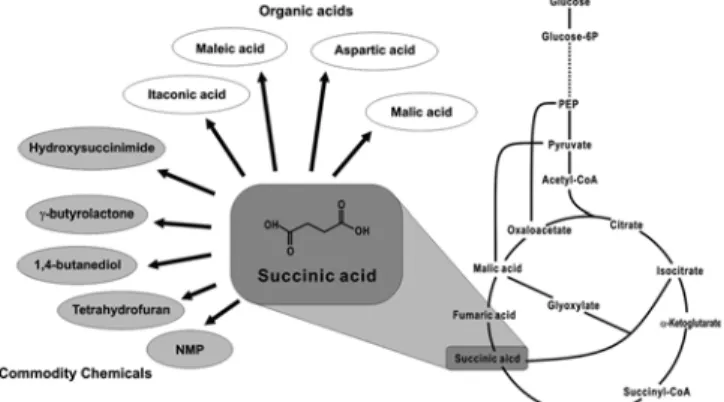
3-1. Succinic acid 생산시스템의 시스템 생물학적 개량 Succinic acid(숙신산)는 탄소 4개로 이루어진 C4-dicarboxylic acid 에 속하며, 1,4-butanediol, tetrahydrofuran, γ-butyrolactone과 생 분해성 고분자 등 다양한 정밀화학물질의 전구체로서 활용될 수 있 다(Fig. 2)[17]. 현재 미생물 발효 등 생물공학적인 방법을 통하여는 미량의 succinic acid만이 생산되고 있는 실정이지만, 석유의 고갈위 험성 및 고유가 등 국내외 상황의 변화에 따라 재생가능한 (renewable) 원료로부터 생물학적인 방법으로 생산하려는 시도가 활 발히 이루어지고 있다[18-23].
A. succiniciproducens와 A. succinogenes 균주가 대표적인 succinic acid 생산균주로 알려져 왔으며, 이들 균주를 이용한 다양한 succinic acid 생산연구가 수행되어져 왔다[24-25]. A. succiniciproducens 균 주를 연속배양 하였을 경우, 최대 6.1 g succinic acid/L/h의 succinic acid 생산능(productivity)을 얻었으며, 0.83~0.88 g/g glucose의 높은 succinic acid 수율(yield)을 유지하였다[26]. A. succinogenes 130Z 균주는 glucose 이외에 fructose, lactose, maltose, mannitol, mannose, sucrose, xylose 등 다양한 탄소원으로부터 고농도의 succinic acid를 을 생산할 수 있다. A. succinogenes 130Z 균주의 fluoroacetate 저 항성 돌연변이 균주의 경우, 110 g/L의 높은 농도의 succinic acid를
생산 할 수 있음이 보고되었다[27]. 최근 새로운 succinic acid 생산 균주인 Mannheimia succiniciproducens MBEL55E가 소의 반추위 (rumen)로부터 발견되었다[28]. M. succiniciproducens 균주는 비병 원성 그람음성균이며, 충분한 양의 CO2가 존재하는 조건에서 배양 될 경우에는 균형잡히고 왕성한 균체성장과 함께 succinic acid, acetic acid, formic acid를 2:1:1의 고정된 비율로 생산하였다[28].
Succinic acid 수율도 0.76 g/g glucose의 높은 수준이었다. 이러한 succinic acid 친화적인 대사특성을 고려하여 M. succiniciproducens 균주는 가장 유망한 succinic acid 생산균주 중의 하나로서 많은 관 심을 얻고있다.
Succinic acid는 TCA cycle상의 중간대사산물로서 호기조건에서 는 대부분의 succinic acid가 fumaric acid로 전환되므로 균체외부로 생산되지 않으며 혐기조건에서도 매우 소량의 succinic acid만이 생 산된다(Fig. 2). 따라서 succinic acid의 생산량을 증가시키기 위해서 는 다양한 시스템 생물학적 방법을 이용하여 균주의 대사특성을 개 량함으로서, acetic acid 및 lactic acid pathway의 carbon flux를 succinic acid pathway로 유도하는 대사특성 개량이 필요하다. 대표적인 succinic acid pathway를 Fig. 2에 나타내었다. Phosphoenolpyruvate (PEP) cerboxylation, pyruvate carboxylation, glyoxylate bypass의 3개의 succinic acid pathway를 통하여 succinic acid를 생산하고자 하는 연구가 진행되어 왔다(Fig. 3). 이러한 metabolic pathway들을 이용한 succinic acid 균주의 대사특성 개량연구들을 각각의 대사경 로를 중심으로 살펴보고자 한다.
PEP carboxylation pathway는 대부분의 succinic acid 생산균주들 이 succinic acid를 생산하기 위하여 활용하고 있는 일반적인 succinic acid pathway이다(Fig. 3A). PEP carboxylation pathway는 PEP carboxylase와 PEP carboxykinase의 두 효소에 의하여 촉매된다. 보 다 많은 carbon flux를 succinic acid pathway로 유도하기 위하여 PEP carboxylation pathway상의 효소를 증폭하는 연구들이 수행되었 다. 대장균(Escherichia coli) PEP carboxylase를 E. coli 내에서 과다 발현 하였을 경우 succinic acid 생산량이 3.27 g/L에서 4.44 g/L로 증 가되는 결과를 얻었으나, E. coli PEP carboxykinase의 과다발현은 succinic acid 생산량에 아무런 영향을 미치지 못하였다(Table 1)[29].
Fig. 2. Applications of succinic acid and central metabolic network of microorganisms.
Fig. 3. Succinic acid production pathways. Succinic acid can be produced via (a) PEP carboxylation, (b) pyruvate carboxylation and (c) glyoxylate bypass. Enzyme coded by the genes shown are: ppc, PEP carboxylase; pckA, PEP carboxykinase; mdh, Malate dehydrogenase; fumB, Fumarase B; frdABCD, Fumarate reductase; pyk, Pyruvate kinase; sfcA, Malic enzyme; maeB, Malic enzyme B; pdh, Pyruvate dehydroge- nase, gltA, Citrate synthase; acn, Aconitase; aceA, Isocitrate lyase; aceB, Malate synthase.
화학공학 제45권 제6호 2007년 12월
PEP가 oxaloacetate로 변환되는 과정에서 ATP를 생산하는 A.
succiniciproducens의 PEP carboxykinase 유전자(pckA)를 재조합 E.
coli에 도입하여, E. coli의 succinic acid 생산량을 증가시키고자 시 도하였다. 그러나 예측과는 달리 A. succiniciproducens의 PEP carboxykinase의 과다발현에 의한 succinic acid 생산량의 증가는 관 찰되어지지 않았다[30]. 대부분의 succinic acid 생산 박테리아의 regulation mechanism과 유사하게 PEP carboxylase 유전자를 제거 하고 PEP carboxykinase를 과다발현 하였을 경우, E. coli의 succinic acid 생산량이 증가하는 결과를 얻을 수 있었다[31-32].
새로운 succinic acid 생산균주인 M. succiniciproducens 균주가 발견된 후, genome sequencing project를 통하여 2,314,078 base pair 에 이르는 염기서열이 해독되었다[33]. 밝혀진 2,384개의 open reading frame(ORF)을 바탕으로 373개의 대사반응으로 이루어진 metabolic pathway가 구축되었고, 이를 이용하여 균주의 대사특성 을 파악하는 대사흐름분석연구(metabolic flux analysis)가 수행되었 다. 대사흐름분석결과 M. succiniciproducens 균주는 CO2의 농도에 종속적인 대사특성을 가지고 있으며, PEP carboxylation을 succinic acid pathway로 사용하고 있음을 파악하였다. CO2를 공급하여 주었 을 경우 CO2가 존재하지 않을 경우와 비교하여 succinic acid의 생 산량이 7.7배 증가하는 결과를 얻을 수 있었으며, CO2 이외에 H2를 추가로 공급하여 주었을 경우 succinic acid의 생산량이 30% 추가 로 증가하는 결과를 보여주었다[33].
M. succiniciproducens 균주의 염기서열 분석결과와 대사흐름분석 결과를 바탕으로 succinic acid의 생산량을 증가시키기 위한 새로운 대사공학전략이 도입되었다. M. succiniciproducens 균주의 ldhA, pflB, pta, ackA 유전자를 넉아웃 시켜 lactic acid, acetic acid, formic acid pathway를 불활성화함으로서 부산물의 생산을 억제하고자 하 였다. 재조합 M. succiniciproducens LPK7 균주(ldhA::Kmr pflB::Cmr pta-ackA::Spr)는 20 g/L의 glucose로부터 13.4 g/L의 succinic acid 를 최소한의 부산물과 함께 생산하였으며, succinic acid 생산 수율은 0.97 mol/mol glucose이었다. 재조합 M. succiniciproducens LPK7 균주를 이용하여 유가식배양(fed-batch)을 수행한 결과, 52.4 g/L의 고농도의 succinic acid를 얻을 수 있었다(Table 1)[34]. Succinic acid 생산균주인 M. succiniciproducens의 metabolic network을 모사하기
위하여 E. coli의 ptsG, pykF, mqo, sdhABCD, aceBA 유전자들을 넉 아웃 시켰으나 succinic acid의 생산량은 증가하지 않는 결과를 얻 었다[35]. 대사흐름분석결과 pyruvate 대사회로의 불활성화가 중요 함을 확인하고 ptsG, pykF, pykA 유전자를 넉아웃 시킨 결과 17.4 g/L 의 최종 succinic acid 농도를 얻을 수 있었다[35].
E. coli의 PEP carboxylase는 PEP의 에너지를 방출하므로, PEP의 에너지를 ATP 형태로 활용하여 에너지 효율을 높이기 위하여 pyruvate carboxylation이 새로운 succinic acid pathway로서 연구되 었다(Fig. 3B). 최적의 succinic acid pathway를 파악하기위하여 E.
coli의 가상 대사회로를 이용하여 대사흐름분석을 수행한 결과, PEP, pyruvate, malic acid를 거치는 대사회로가 최적의 succinic acid pathway로서 제안되었다[36]. 이 대사회로를 통하면 pyruvate kinase 의 작용에 의하여 PEP의 에너지가 ATP의 형태로 전환된다. Pyruvate 를 succinic acid pathway로 유도하기 위하여 succinic acid pathway 와 경쟁관계에 있는 acetic acid 및 lactic acid pathway를 제거한 E. coli NZN111 (ldhA::Kmr pfl::Cmr) 균주를 사용하였다. ldhA와 pfl 유전자의 넉아웃에 의하여 혐기조건에서 pyruvate가 lactic acid 및 acetic acid로 전환되지 못하고 내부에 축적되며, 축적된 pyruvate를 malic enzyme을 이용하여 malic acid로 전환시킴으로서 succinic acid pathway로 유도하고자 하였다. 재조합 NZN111 균주의 발효결과, 1.2 g succinic acid/g glucose의 높은 수율로 12.8 g/L의 succinic acid가 생산되었다(Table 1)[37]. E. coli의 malic enzyme이외에 succinic acid 생산균주인 Ascaris summ의 malic enzyme도 NZN111 균주에 도입되어 succinic acid 생산능의 변화를 관찰하였으며, 그 결과 succinic acid의 최종농도가 2.06 g/L에서 7.07 g/L로 증가하는 결과 를 얻을 수 있었다[38]. E. coli를 이용한 succinic acid 생산시스템 의 대사흐름분석을 수행한 결과, malic acid로부터 succinic acid로 전환되는 pathway가 속도결정단계라는 결과를 얻었다[39]. Malic acid의 전환을 돕기위하여 malic enzyme과 함께 혐기 fumarase를 NZN111 균주에서 과다발현하였으나 succinic acid 농도 증가를 유 도하지 못하였다[40]. Succinic acid 생산에 영향을 미치는 인자들에 대한 정량적 분석을 위하여 대사조절분석(metabolic control analysis) 기법이 활용되었으며, succinic acid의 생산에는 fumarate reductase 의 활성 및 redox balance에 매우 민감하다는 결과를 얻었다. 재조 Table 1. Metabolic engineering studies of succinic acid producing microorganisms
Metabolic modifications Results Ref.
PEP carboxylation
Overexpression of E. coli PEP carboxylase and PEP carboxykinase in E. coli
Overexpression of PEP carboxylase : increase of succinic acid concentration from 3.27 to 4.44 g/L
Overexpression of PEP carboxykinase : no effect.
[21]
Mutation of ldhA, pflB, pta and ackA genes in M.
succiniciproducens
Final succinic acid concentration : 52.4 g/L Succinic acid yield : 1.16 mole/mole glucose
[26]
Mutation of ptsG, pykF and pykA genes in E. coli Final succinic acid concentration : 17.4 g/L [27]
Pyruvate carboxylation
Mutation of pfl and ldhA genes, and overexpression of E. coli malic enzyme in E. coli
Final succinic acid concentration : 12.8 g/L from glucose [29]
Final succinic acid concentration : 10 g/L from sorbitol Succinic acid yield : 1.1 g/g sorbitol
[33]
Glyoxylate bypass
Mutation of sdhAB, ackA-pta, poxB, iclR and ptsG genes in E. coli Final succinic acid concentration : 58.3 g/L
Succinic acid yield : 0.94 mole/mole glucose [34-35]
Mutation of adhE, ldhA, ackA and pta genes in E. coli Final succinic acid concentration : 16 g/L
Succinic acid yield : 1.7 mole/mole glucose [38]
합 E. coli NZN111을 sorbitol을 이용하여 발효하였을 경우, 부산물 없이 10 g/L의 succinic acid가 생산되었으며 succinic acid의 생산 효율은 1.1 g/g glucose이었다(Table 1)[41].
최근 glyoxylate bypass를 새로운 succinic acid pathway로 이용하 여, 호기조건에서 succinic acid를 생산할 수 있는 재조합 E. coli 시스 템이 개발되었다(Fig. 3C). Glyoxylate bypass는 isocitrate를 succinic acid와 glyoxylate로 전환하는 isocitrate lyase와, glyoxylate와 acetyl- CoA로부터 malic acid를 합성하는 malate synthase의 두 효소반응 으로 이루어져 있다. 호기조건에서 TCA cycle의 중간산물인 succinic acid를 fumaric acid로 전환하는 succinate dehydrogenase(sdhA)를 불 활성화 하여 succinic acid를 최종산물로 생산하도록 개량하였으며, isocitrate를 α-ketoglutarate로 전환하는 isocitrate dehydrogenase (icd)를 불활성화하여 isocitrate를 glyoxylate bypass로 유도하였다.
부산물인 acetic acid의 생산을 방지하기위하여 poxB 유전자와 ackA- pta 유전자를 넉아웃 시켰으며, 호기조건에서 glyoxylate bypass 유 전자들을 발현시키기 위하여 aceBAK 오페론의 repressor인 iclR 유 전자 역시 넉아웃 되었다[42]. 돌연변이 E. coli 균주 HL27615k를 이용하여 succinic acid 발효를 수행한 결과, 호기조건에서 다른 부 산물 및 TCA cycle 중간산물의 생산없이 5.1 g/L의 succinic acid가 생산되었다. 위의 유전자들 이외에 ptsG 유전자를 추가로 넉아웃 시 켰을 경우, succinic acid의 생산량이 더욱 증가하여 최종적으로 58.3 g/L 의 succinic acid을 생산하였으며 succinic acid의 생산능은 1.08 g/L/h 이 었다(Table 1)[42-44].
Glyoxylate bypass를 혐기조건에서 succinic acid pathway로 활용 하려는 연구도 함께 수행되었다. 혐기조건에서 succinic acid 생산시 스템의 대사흐름분석을 수행한 결과, glyoxylate bypass와 pyruvate carboxylation 대사회로를 동시에 succinic acid pathway로 활용하면, succinic acid의 생산이 최적화되어 궁극적으로 1.6 mol succinic acid/
mol glucose의 높은 수율을 얻을 수 있다는 예측결과를 얻었다[45].
이러한 예측 결과를 검증하기 위하여 adhE, ldhA, ackA, pta 유전자 들이 넉아웃 된 E. coli SBS990MG 균주를 이용하여 발효를 수행 한 결과, 1.7 mol succinic acid/mol glucose의 succinic acid 수율을 얻을 수 있었다(Table 1)[46]. 이러한 결과로부터 glyoxylate bypass 는 호기 및 혐기조건에서 모두 succinic acid pathway로 활용이 가 능함을 확인할 수 있었다.
4. 결 론
최근 고유가, 환경오염 등 다양한 사회·경제적 필요성에 의하여 산업바이오 및 이를 통한 유용 화학물질의 친환경생산공정의 개발 이 많은 관심을 얻고 있다. 그러나 집중적인 연구에도 불구하고 미 생물을 이용한 유용 화학물질의 생산공정의 상업화 실적은 아직 미 비한 실정이며, 재조합 미생물 균주의 불안정성, 생물학적 생산공정 의 낮은 효율 및 높은 생산단가 등이 요인으로 여겨지고 있다. 따라 서 균주의 대사특성을 개량하여 보다 효율적으로 유용 화학물질을 생산하는 것이 매우 중요하며, 이에 관한 연구가 지속적으로 이루 어지고 있다.
본 총설에서는 시스템 생물공학적 전략을 통하여 다양한 대사산 물을 생산하는 미생물을 개량한 연구들을 살펴보았다. 이러한 시스 템 생물공학 및 대사공학적 균주개량 전략은 위에 언급한 대사산물 이외에 다른 다양한 대사산물 생산시스템에 적용이 가능하며, 현재
이러한 산업바이오 및 시스템 생물공학 연구가 전세계적으로 활발 히 이루어지고 있다. 이러한 시스템 생물공학연구들을 통하여 미생 물 균주들의 대사공학연구가 더욱더 가속화될 것이라 예상되며, 궁 극적으로는 다양한 생물학적 생산시스템의 가격 경쟁력을 확보할 수 있을 것이라 예상된다.
감 사
이 논문은 과학기술부 시스템생물학 연구(M10503020001-07N0302- 00112)에 의하여 지원되었음.
참고문헌
1. Ideker, T., Galitski, T. and Hood, L., “A New Approach to Decoding Life: Systems Biology,” Annu. Rev. Genomics Hum. Genet., 2, 343-372(2001).
2. Kitano, H., “Computational Systems Biology,” Nature, 420(6912), 206-210(2002).
3. Kitano, H., “Systems Biology: A Brief Overview,” Science, 295 (5560), 1662-1664(2002).
4. Lee, S. Y. and Papoutsakis, E. T., 1999. in S. Y. Lee and E. T.
Papoutsakis (Ed.), Metabolic Engineering, Marcel Dekker, New York, USA, 1-12(1999).
5. Nielsen, J., Villadsen, J., in J. Nielsen and J. Villadsen (Ed.), Bioreaction engineering principles, Plenum press, New York, USA, 97-161(1994).
6. Edwards, J. S., Ramakrishna, R., Schilling, C. H., Palsson. B. O., Lee, S. Y. and Papoutsakis, E. T., Metabolic Engineering, Mar- cel Dekker, New York, USA, 13-57(1999).
7. Lee, S. Y., Lee, D. Y. and Kim, T. Y., “Systems Biotechnology for Strain Improvement,” Trends Biotechnol., 23(7), 349-358(2005).
8. Lee, S. Y., Woo, H. M., Lee, D. -Y., Choi, H. S., Kim, T. Y. and Yun, H., “Systems-Level Analysis of Genome-Scale In Silico Metabolic Models Using Meta Flux Net,” Biotechnol. Biopro- cess Eng., 10, 425-431(2005).
9. Fleischmann, R. D., Adams, M. D., White, O., Clayton, R. A., Kirkness, E. F., Kerlavage, A. R., Bult, C. J., Tomb, J. F., Dougherty, B. A., Merrick, J. M., McKenney, K., Sutton, G., Fitzhugh, W., Fields, C., Gocyne, J. D., Scott, J., Shirley, R., Liu, L., Glodek, A., Kelley, J. M., Weidman, J. F., Phillips, C. A., Spriggs, T., Hedblom, E., Cotton, M. D., Utterback, T. R., Hanna, M. C., Nguyen, D. T., Saudek, D. M., Brandon, R. C., Fine, L. D., Fritchman, J. L., Fuhrmann, J. L., Geoghagen, N. S. M., Gnehm, C. L., McDonald, L. A., Small, K. V., Fraser, C. M., Smith, H. O. and Venter, J. C.,
“Whole-genome Random Sequencing and Assembly of Haemo- philus influenzae Rd,” Science, 269(5223), 496-512(1995).
10. Collins, F. S., Green, E. D., Guttmacher, A.E. and Guyer, M. S., US National Human Genome Research Institute., “A Vision for the Future of Genomics Research,” Nature, 422(6934), 835-847 (2003).
11. Berkum, N. L. and Holstege, F. C., “DNA Microarrays: Raising the Profile,” Curr. Opin. Biotechnol., 12(1), 48-52(2001).
12. Eisen, M. B., Spellman, P. T., Brown, P. O. and Botstein, D.,
“Cluster Analysis and Display of Genome-wide Expression Pat- terns,” Proc. Natl. Acad. Sci. USA, 95(25), 14863-14868(1998).
13. Sherlock, G., “Analysis of Large-scale Gene Expression Data,”
화학공학 제45권 제6호 2007년 12월
Curr. Opin. Immunol., 12(2), 201-205(2000).
14. Choi, J. H., Lee, S. J., Lee, S. J. and Lee, S. Y., “Enhanced Pro- duction of Insulin-like Growth Factor I Fusion Protein in Escher- ichia coli by Coexpression of the Down-regulated Genes Identified by Transcriptome Profiling,” Appl. Environ. Microbiol., 69(8), 4737-4742(2003).
15. Han, M. J., Jeong, K. J., Yoo, J. S. and Lee, S. Y. “Engineering Escherichia coli for Increased Productivity of Serine-rich Pro- teins Based on Proteome Profiling,” Appl. Environ. Microbiol., 69(10), 5772-5781(2003).
16. Hong, S. H., Park, S. J., Moon, S. Y., Park, J. P. and Lee, S. Y.,
“In silico Prediction and Validation of the Importance of the Ent- ner-Doudoroff Pathway in poly(3-hydroxybutyrate) Production by Metabolically Engineered Escherichia coli,” Biotechnol. Bioeng., 83(7), 854-863(2003).
17. Zeikus, J. G., Jain, M. K. and Elankovan. P., “Biotechnology of Succinic Acid Production and Markets for Derived Industrial Products,” Appl. Microbiol. Biotechnol., 51, 545-552(1999).
18. Bryant, M. P. and Small, N., “Characteristics of Two New Gen- era of Anaerobic Curved Rods Isolated from the Rumen of Cat- tle,” J. Bacteriol., 72(1), 22-26(1956).
19. Bryant, M. P., Bouma, C. and Chu, H., “Bacteroides Ruminicola n. sp. and the New Species Succinomonas Amylolytica. Species of Succinic Acid Producing Anaerobic Bacteria by the Bovine Rumen,” J. Bacteriol., 76(1), 15-23(1958).
20. Davis, C. P., Cleven, D., Brown, J. and Balish, E., “Anaerobiospiril- lum, A New Genus of Spiral-shaped Bacteria,” Int. J. Syst. Bac- teriol., 26, 498-504(1976).
21. Guettler, M. V., Rumler, D. and Jain, M. K., “Actinobacillus suc- cinogenes sp. nov., A Novel Succinic Acid Producing Strain from the Bovine Rumen,” Int. J. Syst. Bacteriol., 49, 207-216(1999).
22. Scheifinger, C. C. and Wolin, M. J., “Propionate Formation from Cellulose and Soluble Sugars by Combined Cultures of Bacteroi- des Succinogenes and Selenomonas Ruminantium,” Appl. Micro- biol., 26(5), 789-795(1973).
23. Van der Werf, M. J., Guettler, M. V., Jain, M. K. and Zeikus, J.
G., “Environmental and Physiological Factors Affecting the Suc- cinate Product Ratio During Carbohydrate Fermentation by Act- inobacillus sp. 130Z,” Arch. Microbiol., 167(6), 332-342(1997).
24. Lee, P. C., Lee, W. G., Kwon, S. H., Lee, S. Y. and Chang, H. N.,
“Succinic Acid Production by Anaerobiospirillum Succinicipro- ducens: Effects of the H2/CO2 Supplying and Glucose Concen- tration,” Enzyme. Microb. Technol., 24, 549-554(1999).
25. Samuelov, N. S., Lamed, R., Lowe, S. and Zeikus, J. G., “Influ- ence of CO2-HCO3- level and pH on Growth, Succinate Production, and Enzyme Activities of Anaerobiospirillum Succiniciproducens,”
Appl. Environ. Microbiol., 57(10), 3013-3019(1991).
26. Lee, P. C., Lee, W. G., Kwon, S. H., Lee, S. Y. and Chang, H. N.,
“Batch and Continuous Fermentation of Anaerobiospirillum suc- ciniproducens for the Production of Succinic Acid From Whey:, Appl. Microbiol. Biotechnol., 54(1), 23-27(2000).
27. Guettler, M. V., Jain, M. K. and Rumler, D., “Method for Mak- ing Succinic Acid, Bacterial Variants for Use in the Process, and Methods for Obtaining Variants,” U.S. Patent No. 5,573,931(1996).
28. Lee, P. C., Lee, S. Y., Hong, S. H. and Chang, H. N., “Isolation and Characterization of a New Succinic Acid-producing Bacte- rium, Mannheimia succiniciproducens MBEL55E, from Bovine
rumen,” Appl. Microbiol. Biotechnol., 58(5), 663-668(2002).
29. Millard, C. S., Chao, Y., Liao, J. C. and Donnelly, M. I., “Enhanced Production of Succinic Acid by Overexpression of Phosphoe- nolpyruvate Carboxylase in Escherichia coli,” Appl. Environ.
Microbiol., 62(5), 1808-1810(1996).
30. Laivenieks, M., Vieille, C. and Zeikus, J. G., “Cloning, Sequenc- ing, and Overexpression of the Anaerobiospirillum Succinicipro- ducens Phosphoenolpyruvate Carboxykinase (pckA) gene,” Appl.
Environ. Microbiol., 63(6), 2273-2280(1997).
31. Kwon, Y. D., Lee, S. Y. and Kim, P., “Influence of Gluconeo- genic Phosphoenolpyruvate Carboxykinase (PCK) Expression on Succinic Acid Fermentation in Escherichia coli Under High Bicarbonate Condition,” J. Microbiol. Biotechnol., 16, 1448-1452 (2006).
32. Kim, P., Laivenieks, M., Vieille, C. and Zeikus, J. G., “Effect of Overexpression of Actinobacillus Succinogenes PhosphoeNolpyruvate Carboxykinase on Succinate Production in Escherichia coli,”
Appl. Environ. Microbiol., 70(2), 1238-1241(2004).
33. Hong, S. H., Kim, J. S., Lee, S. Y., In, Y. H., Choi, S. S., Rih, J.
K., Kim, C. H., Jeong, H., Hur, C. G. and Kim, J. J., “The Genome Sequence of the Capnophilic Rumen Bacterium Mannheimia succiniciproducens,” Nature Biotechnology, 22(10), 1275-1281(2004).
34. Lee, S. J., Song, H. and Lee, S. Y., “Genome-Based Metabolic Engineering of Mannheimia Succiniciproducens for Succinic Acid Production,” Appl. Environ. Microbiol., 72(3), 1939-1948(2006).
35. Lee, S. J., Lee, D. -Y., Kim, T. Y., Kim, B. H., Lee, J. and Lee, S.
Y., “Metabolic Engineering of Escherichia coli for the Enhanced Production of Succinic Acid Based on Genome Comparison and in Silico Gene Knock-out Simulation,” Appl. Environ. Microbiol., 71(12), 7880-7887(2005).
36. Hong, S. H., Moon, S. Y. and Lee, S. Y., “Prediction of the Max- imum Yields of Metabolites and Optimal Pathways for Their Production by Metabolic Flux Analysis,” J. Microbiol. Biotechnol., 13, 571-577(2003).
37. Stols, L. and Donnelly, M. I., “Production of Succinic Acid Through Overexpression of NAD+-Dependent Malic Enzyme in an Escherichia coli Mutant,” Appl. Environ. Microbiol., 63(7), 2695-2701(1997).
38. Stols, L., Kulkarni, G., Harris, B. G. and Donnelly, M. I. “Expres- sion of Ascaris Suum Enzyme in a Mutant Escherichia coli Allows Production of Succinic Acid from Glucose,” Appl. Biochem. Biotech- nol., 63-65, 153-158(1997).
39. Hong, S. H. and Lee, S. Y., “Metabolic Flux Analysis for Suc- cinic Acid Production by Recombinant Escherichia coli with Amplified Malic Enzyme Activity,” Biotechnol. Bioeng., 74(2), 89-95(2001).
40. Hong, S. H. and Lee, S. Y., “Enhanced Production of Succinic Acid by Metabolically Engineered Escherichia coli with Ampli- fied Activities of Malic Enzyme and Fumarase,” Biotechnol. Bio- process Eng., 9, 252-255(2004).
41. Hong, S. H. and Lee, S. Y., “Importance of Redox Balance on the Production of Succinic Acid by Metabolically Engineered Escherichia coli,” Appl. Microbiol. Biotechnol., 58(3), 286-290(2002).
42. Lin, H., Bennett, G. N. and San, K. Y., “Genetic Reconstruction of the Aerobic Central Metabolism in Escherichia coli for the Absolute Aerobic Production of Succinate,” Biotechnol. Bioeng., 89(2), 148-156(2005).
43. Lin, H., Bennett, G. N. and San, K. Y., “Metabolic Engineering of Aerobic Succinate Production Systems in Escherichia coli to Improve Process Productivity and Achieve the Maximum Theo- retical Succinate Yield,” Metab. Eng., 7(2), 116-127(2005).
44. Lin, H., Bennett, G. N. and San, K. Y., “Fed-Batch Culture of A Metabolically Engineered Escherichia coli Strain Designed for High-level Succinate Production and Yield Under Aerobic Con- ditions,” Biotechnol. Bioeng., 90(6), 775-779(2005).
45. Cox, S. J., Shalel Levanon, S., Sanchez, A., Lin, H., Peercy, B., Bennett, G. N. and San, K. Y., Development of A Metabolic Net- work Design and Optimization Framework Incorporating Imple- mentation Constraints: A Succinate Production Case Study,” Metab.
Eng., 8(1), 46-57(2006).
46. Sanchez, A. M., Bennett, G. N. and San, K. Y., “Batch Culture Characterization and Metabolic Flux Analysis of Succinate-pro- ducing Escherichia coli strains,” Metab. Eng., 8(3), 209-226(2006).