I
n the past decade, the glass-ceramic has been used as a material with variable crystals that affect the appearance, characteristics, and mechan- ical properties of metal-free fixed restorations. Since 1990, the IPS Empress glass-ceramic has been successfully used to fabricate veneers, inlays,onlays, and anterior and posterior crowns for dental esthetics.1,2 However, the IPS Empress glass-ceramic was not suitable for the fabrication of bridges because the flexural strength of the ceramic was about 200 MPa.3To overcome this lim- itation, the lithium disilicate glass-ceramic of IPS Empress 2 was recently developed to sig-
MECHANICAL PROPERTIES OF REUSED LITHIUM DISILICATE GLASS-CERAMIC OF IPS EMPRESS 2 SYSTEM
Sang-Chun Oh, D.D.S., M.S.D., Ph.D.
Department of Prosthodontics, School of Dentistry, Wonkwang University
This investigation was designed to estimate the biaxial flexure strength and fracture toughness of lithium disilicate glass-ceramics of IPS Empress 2 system pressed with as-received ingots and their sprue buttons. Two groups of the lithium disilicate glass-ceramics were prepared as follows: group 1 is ingot-pressed group; group 2 is sprue button-pressed group. A ball-on-three- ball test was used to determine biaxial flexure strength (BFS) of disks in wet environment. Scanning electron microscopy(SEM) analysis was conducted to observe the microstructure of the ceramics. Unpaired t-test showed that there were no differences in the mean biaxial flexure strength (BFS) and KIC values between group 1 and 2 (p > 0.05). Two groups showed similar values in the KIC and the strength at 5% failure probability. The SEM micrographs of the IPS Empress 2 glass-ceramic showed a closely packed, multi-directionally interlocking pattern of numer- ous lithium disilicate crystals protruding from the glass matrix. The lithium orthophosphate crystals could not be observed on the fracture surface etched. There was no a marked differ- ence of the microstructure between group 1 and 2. Although there were no tests including col- or stability, casting accuracy, etc., the results of this study implied that we could reuse the sprue button of the pressed lithium disilicate glass-ceramic of IPS Empress 2 system.
Key Words
Biaxial flexure strength, Fracture toughness, Ceramic microstructure, Lithium disilicate glass-ceramics, IPS Empress 2 system
J Korean Acad Prosthodont : Volume 40, Number 6, 2002
※This paper was supported by Wonkwang University in 2001.
nificantly elevate the strength beyond the origi- nal leucite material of the IPS Empress and enable the fabrication of 3-unit fixed partial denture in the anterior and premolar region.4The IPS Empress 2 glass-ceramic replaced the conven- tional IPS Empress layering ceramic.
Heat-pressing technique is widely employed as the fabrication method of all ceramic restora- tion because of its convenience and good dimen- sional accuracy. The lithium disilicate glass- ceramic is one of the heat-pressable materials using lost wax technique. Ceramic sprue but- ton which is necessarily remained after the heat- pressing procedure can be reused like a noble met- al sprue button in economic reason. The pur- pose of this study was to estimate biaxial flexure strength and fracture toughness of lithium disilicate glass-ceramic pressed with as-received ingots and their sprue buttons.
MATERIALS AND METHODS
The lithium disilicate glass-ceramic ingots (IPS Empress 2 ingot, shade no. 500, Ivoclar) were used for this investigation. The disk specimens were divided into two groups: group 1 is ingot- pressed group; group 2 is sprue button-pressed group.
For group 1, the paraffin wax disks were made a little bigger than the required dimension that is 15mm in diameter and 1.4mm in thickness. One wax wire (2.8 mm×7.0 mm) was attached at the end of the specimen for spruing. Investment was carried out with the IPS Empress 2 special investment powder(200 g) and liquid(44 mL).
After setting time(1 hour), the stabilizer ring, ring base, and paper ring were removed, and the bottom of the investment cylinder was trimmed with a plaster knife and sand paper.
Without ingots, the investment ring and AlOX
plunger were preheated in a furnace(MicroThurm,
Fink and Hilburg). After preheating, the invest- ment ring positioned the cold ingot and AlOX
plunger were transferred from a preheating fur- nace to a special heat-press furnace(EP500, Ivoclar) that was already preheated at 500℃. The invest- ment cylinder was immediately removed from the furnace and allowed to cool to room temperature on an elevated grid after the program was auto- matically completed. After divesting and sprue cut- ting, the final preparation of all specimens(n=20) were done with careful grinding to ensure the required fine surface and uniform thickness using a metallurical grinding machine (Knuth- Rotor, Stuers) with SiC disks (grit size 320 to 1200). For group 2, the specimens(n=20) were made with ceramic sprue buttons that were rem- nants of the heat-pressing for group 1 by the same procedure.
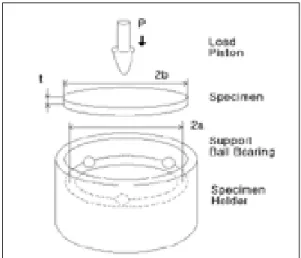
A ball-on-three-ball test was used to deter- mine biaxial flexure strength (BFS) of disks in wet environment. The specimens were loaded in a uni- versal testing machine (Z020, Zwick) at a crosshead speed of 1.0 mm/min until fracture (Fig. 1). The
Fig. 1.Schematic illustration of ball-on-three-ball bi-axi- al flexure test. a: the radius of the support circle; b: the radius of disc specimen; c :is radius of the region of uni- form loading at the center (c = t/3); t:: the thickness of the specimen.
fracture load was used to calculate the biaxial flex- ure strength with the following formula:
S(BFS) = - 0.2387 P(X-Y) / t2
Where P = fracture load (N), X = (1+1、)ln(c/b)2 + [(1-1、)/2](c/b)2, Y = (1+1、)[1+ln(a/b)2] + [(1-1、) (a/b)2〕, 1、is Poissons ratio (0.25), A is radius of the supporting circle (10 mm), B is radius of the disk (mm), C is radius of the region of uniform loading at the center (c = t/3), and T is specimen thickness (mm).
Fracture toughness (KIC) was measured on 10 disk pieces per group by an indentation method.
Seven indentations on each piece were made with a Vickers indenter (MXT-70, Matsuzawa Seiki) at a load of 9.8 N for 15 seconds. The KIC was calculated by the following equation:
KIC = 0.016(E/H)0.5(P/C 1.5)
Where E/H is the elastic-modulus-to-hardness ration, P is the load applied, C is the crack length measured from the center of indentation. The E/H ratio was determined from three Knoop indentations on each specimen. Biaxial flexure strength and KIC data were analyzed by unpaired t-test.
The Weibull distribution on the strength data was described by following formula:
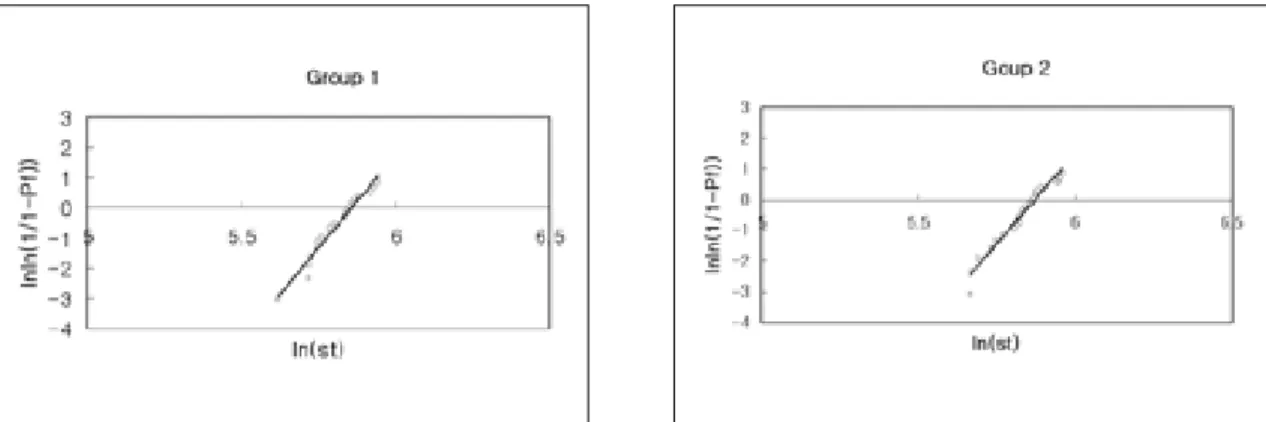
Pf = 1-exp[-(σ/ σo)m], Pf = Rank/(N+1) where Pf is the probability of failure, σis the strength at a given Pf, σo is the characteristic strength, m is Weibull modulus, and N is the number of specimens. The Weibull regression analysis provided the Weibull modulus (m) and
their 95% confidence intervals, and strength pre- dicted at the 5% level of failure.
For observation of the microstructure using a scanning electron microscope (LEO 145VP, LEO, England), the polished surface was etched with the watery mixture containing 30% H2SO4and 4%
HF for 10�15 seconds and immediately cleaned with water and ethanol, and coated by gold sputtering.
RESULTS
Mean biaxial flexure strength and fracture toughness of the groups are shown in Table 1.
Unpaired t-test showed that there were no dif- ferences in the mean biaxial flexure strength (BFS) and KIC values between the group 1 and 2 (p > 0.05).
The results of Weibull analysis are listed in Table 1. Weibull plot of the groups is displayed in Fig. 2. Two groups showed similar values in the m-value and the strength (σ0.05) at 5% failure prob- ability.
In SEM observation, IPS Empress 2 glass-ceram- ic showed rod-shaped lithium disilicate crystals.
This crystals exhibited a closely packed, multi-direc- tionally interlocking pattern of numerous lithium disilicate crystals protruding from the glass matrix.
However, the lithium orthophosphate crystals could not be observed on the fracture surface etched. In the microstructure, there was no a marked difference between group 1 and 2 (Fig. 3).
Table Ⅰ.Mean Biaxial Flexure Strength(BFS) and Fracture Toughness Values of the Specimens
1 20 334.2±27.6 12.4 275.4 3.19±0.19 2 20 338.5±29.3 11.8 276.1 3.10±0.12 Group No BFS (MPa) m-value σ0.05 (MPa) KIC (MPa∙m1/2)
DISCUSSION
Glass-ceramics are polycrystalline materials consisting of a glassy matrix and one or more crys- tal phases produced by the controlled nucle- ation and growth of crystals in the glass.5The first lithium disilicate glass-ceramics were developed as early as in the fifties by Stookey.6Following his fundamental discovery, lithium disilicate glass- ceramic became the subject of a considerable amount of research. Although the ceramics of IPS Empress and IPS Empress 2 are a glass-ceramic produced by the Ivoclar company7,8, they have com- pletely different chemical compositions as follows:
1) IPS Empress ceramic (leucite reinforced glass- ceramic): 63 SiO2, 17.7 Al2O3, 11.2 K2O, 4.6 NaO2, 0.6 B2O3, 0.4 CeO2, 1.6 CaO, 0.7 BaO, and 0.2 TiO2in wt%. 2) IPS Empress 2 ceramic (lithium dis- ilicate glass-ceramic): 57.0�80.0 SiO2, 11.0�19.0 Li2O, 0�13.0 K2O, 0�11.0 P2O5, 0�8.0 ZnO, 0�
5.0 MgO, 0.1�6.0 La2O3, 0�5.0 Al2O3, and 0�8.0 additional components in wt%.4This means they have different physical properties. That is, the IPS Empress 2 ceramic has much higher flexure strength than IPS Empress ceramic.9This high strength of IPS Empess 2 ceramic could be explained by the high crystal content of more than 60 vol%, the multi-directionally, densely Fig. 2. This Weibull plot shows two groups have similar values in the m-value and the strength at 5% failure prob- ability
Fig. 3. The SEM micrograph of IPS Empress 2 glass-ceramic pressed with as-received ingots(group 1) and their sprue buttons(group2). A: group 1; B: group 2 (Original magnification × 5,000).
packed interlocking microstructure of elongated rod-shaped crystals, and the increase in the size of the lithium disilicate crystals after the heat-press- ing operation.
The IPS Empress 2 glass-ceramic is a heat- pressed, lithium disilicate material using the
"lost-wax" principle.7The heat-press procedure is conducted in the EP500 heat-press furnace. A pressing temperature of 920℃ at a holding time of 20 min and an effective pressure of 20 bar lead to viscous flow of the glass-ceramic ingot. The flexure strengths of IPS Empress 2 glass-ceram- ic pressed with as-received ingots(334 MPa) and their sprue buttons(338 MPa) were a little lower than the results estimated by Frank et al(350 MPa)10, Fischer and Marx11, and Oh et al(357 MPa).9This difference was result depending on the test method and fabrication of the test spec- imens. In the present study, the fracture toughness of both group was no significant difference and was in agreement with the result(3.2 MPa∙m1/2) found by Kappert.12
The SEM micrograph of IPS Empress 2 glass- ceramic pressed with as-received ingots and their sprue buttons showed no difference and exhibited a similar microstructure as Frank et al10reported. The IPS Empress 2 glass-ceramic has two kind of cystal: the main rod- shaped lithium disilicate crystals (length up to 6 ㎛; diameter up to 1㎛) and the secondary lithium orthophos- phate crystals (0.1 to 0.3 ㎛). We observed the lithi- um disilicate crystal with an interlocking pat- tern, but could not observed the lithium orthophosphate crystals. This result might be explained as the glass matrix dissolving the thin surface layer during the etching procedure.
CONCLUSION
In the respect of mechanical property, this study demonstrated the reliability of reused lithi-
um disilicate glass-ceramic of IPS Empress 2.
Although there were no tests including color stability, casting accuracy, etc., the result of this study implied that we could reuse the sprue button of the pressed lithium disilicate glass- ceramic of IPS Empress 2 system.
REFERENCES
1. Studer S, Lehner C, Schrer P. Seven-year results of leucite-reinforced glass-ceramic inlays and on- lays. IADR, Nice 1998, abstract 1375.
2. Lehner CR, Studer S, Schrer P. Seven-year results of leucite-reinforced glass-ceramic crowns. IADR, Nice 1998, abstract 1368.
3. Dong JK, Lu¨thy H, Wohlwend A, Scha¨rer P. Heat- pressed ceramics: Technology and Strength. Int J Prosthodont 1992;9(5):9-16.
4. Ho¨land W. Materials science fundamentals of the IPS Empress 2 glass-ceramic. Ivoclar-Vivadent- Report 1998;12:3-10.
5. Anusavice KJ, Zhang NZ, Moorhead JE. Influence of colorants on the crystallization and mechanical properties of lithia-based glass-ceramics. Dent Mater 1994;10:141-146.
6. Stooky SD. Catalyzed crystallization of glass in the- ory an practice. Ind Eng Chem 1959;51:805-808.
7. IPS-Empress working procedures, lvoclar AG, Schaan, Liechtenstein, 1991.
8. IPS-Empress 2 working procedures, lvoclar AG, Schaan, Liechtenstein, 1998.
9. Oh SC, Dong JK, Luthy H, Scha¨rer P. Strength and microstructure of IPS Empress 2 Glass-Ceramic after different treatments. Int J Prosthodont 2000;13:468-472.
10. Frank M, Schweiger M, Rheinberger V, Hland W. High-strength translucent sintered glass-ce- ramic for dental restorations. Proceedings of the 6thInternational Otto Schott Colloquium in Jena, Glastech. Ber. Glass Sci. Technol. 71C (1998), P.345-348.
11. Fischer H, Marx R. Mechanical properties of Empress 2(in German). Acta Med Dent Helv 1999;
4:141-145.
12. Kappert HF. Empress Brucke / in-vitro Studie.
Untersuchungsbericht an Ivoclar AG, Schaan, Januar 1998.
Reprint request to:
DR. SANG-CHUNOH
DEPT. OFPROSTHODONTICS,COLLEGE OFDENTISTRY,WONKWANG
UNIVERSITY
1126-1 SANBON-DONG, KUNPO,KYUNGKI-DO,KOREA 435-040