524
©The Korean Society of Food Science and Technology
밀기울의 유산균 발효: 향기성분 및 유리아미노산 변화를 통한
제빵 소재로서의 가능성
나예림
1·박성훈
1,*
1SPC식품생명공학연구소
Fermentation of wheat bran through lactic acid bacteria: Changes in flavor
components and free amino acids and potential applications in baking
Yerim Na1 and Sung Hoon, Park1,*
1Research Institute of Food and Biotechnology, SPC group
Abstract The aim of this study was to enhance the use of wheat bran in lactic acid bacteria (LAB) fermentation. LAB fermentation of wheat bran and the flavor components and amino acids of fermentation products were analyzed using gas chromatography-mass spectrometry (GC/MS) and high-performance liquid chromatography (HPLC). The results showed that total flavor components increased by 93% and 73% in the animal-based LAB mixture (T2) and plant-based LAB mixture (T3), respectively, after fermentation. Among these components, 2,3-butanedione (diacetyl), known for its buttery flavor, was detected at concentrations of 18.44 ng/g (T2) and 16.95 ng/g (T3). Levels of hexanal and nonanal, which causes off-flavor components in wheat bran, dramatically decreased after T2 fermentation; similarly, levels of total free amino acids decreased by 37.6% (T2) and 36.7% (T3) after fermentation. This may explain why some components were bound to volatile compounds during LAB fermentation. These results suggest that LAB-fermented wheat bran is a potential value-added food material.
Keywords: wheat bran, flavor, volatile compounds, amino acids, lactic acid bacteria
서
론
밀기울은 밀의 제분 부산물로써 일반적으로 제분 공정에서 15-20%가 생산되며 과거에는 버려지거나 사료로 이용되는 경우가 많았으나, 최근에는 밀기울에 존재하는 알류론 층에 있는 각종 영양기능성과 질병예방 효과가 알려지면서 천연 식이섬유 소재 로 각광 받으며 식품 소재에 대한 연구가 활발히 진행되고 있다 (Vetrimani와 Haridas Rao, 1990). 밀기울의 조성은 40-50%가 cel-lulose, hemicelcel-lulose, lignin과 같은 불용성 식이섬유로 구성되어 있으며, 1% 이하의 수용성 식이섬유도 포함하고 있다(Stevenson 등, 2012). 또한 Anderson(1985)는 식이섬유는 수분보유력이 뛰어 나 식품 제조 시 부피를 증가시켜 포만감을 증대시키고, 장내에 서 전분을 비롯한 영양성분의 소화 흡수를 느리게 하고 혈중 콜 레스테롤 함량을 저하 시킨다고 보고하였다. 그러나 밀기울은 이 취, 거친 조직감, 어두운 색상 등으로 인해 식품 제조 시 품질에 부정적인 영향을 끼친다(Galliard와 Gallagher 1988; Zhang와 Moore 1999). 밀기울 품질개선을 위한 여러가지 물리적 연구가 진행 되고 있고 있는데, Hwang 등(1995)은 열처리를 통해 밀기 울의 품질개선과 저장성을 증진시킬 수 있다고 보고하였고, Kim 등(1996)은 압출가공 시 스크류 조합과 공정변수 조절에 따른 밀 기울 물성 변화에 대해 보고하였다. 최근 An 등(2014)은 고압균 질처리를 통해 밀기울의 보수력, 팽창력 등을 증가시킬 수 있다 고 보고하였다. 하지만 이러한 물리적인 가공 방법은 설비나 장 비의 제약이 따르므로, 본 연구에서는 생물학적 공법인 발효를 통하여 밀기울의 식품소재로서의 한계점을 극복하고자 연구를 진 행하였다. 유산균은 발효를 통해 오랫동안 유제품 및 김치 등 식 품에 다양하게 이용되어 온 안전한 GRAS (Generally Recognized As Safe)균으로서 유해균 억제, 콜레스테롤 저하, 유당 이용률 증 대, 항암 효과 등 인체 건강에 다양한 이점이 있다(Gilliland, 1990). 유산균의 직접 섭취 또한 장내 미생물 활성화를 통해 음 식물 소화 흡수 증대, 면역력 증강 등의 효과가 입증되었다. 최 근 프로바이오틱스와 프리바이오틱스에 대한 관심이 높아짐에 따 라 식이섬유 및 유산균에 대한 연구가 활발히 진행 되고 있으며, Zubaidah 등(2012)은 쌀겨의 유산균 발효를 통한 신바이오틱스 효 과에 대한 연구결과를 보고 하였고, Salmenkallio-Marttila 등(2001) 과 Katina 등(2012)은 발효를 통해 밀기울의 영양 기능적 효과 증 대에 대한 연구를 진행하였다. 본 연구에서는 제분부산물로 부가 가치가 낮았던 밀기울을 다양한 유산균 발효를 통해 식품소재로 서의 이용가치를 높일 수 있는 연구를 진행하였고, 발효에 따른 이취 감소 효과를 확인하였으며, 풍미의 특성 변화를 파악함으로 써 고부가가치 식품소재로서의 가능성을 확인하였다.*Corresponding author: Sung Hoon, Park, SPC Research Institute of Food and Biotechnology, SPC group, Seoul 08826, Korea
Tel: +82-2-870-7425 Fax: +82-2-870-7420 E-mail: [email protected]
Received June 11, 2020; revised July 30, 2020; accepted July 31, 2020
밀기울의 유산균 발효: 향기성분 및 유리아미노산 변화를 통한 제빵 소재로서의 가능성 525
재료 및 방법
밀기울과 우유 및 유산균 본 실험에 사용된 밀기울은 (주)밀다원(Sejong, Korea)에서 제 공받은 미국산 Soft Wheat (SW)원맥 제분부산물을 입도 사이즈 600 µm 이하로 선별하여 사용하였으며, 우유는 시중 우유(Seoul Daily Co., Ansan, Korea)를 구매하여 사용하였다. 밀기울은 발효 하기 전 30분 동안 가열처리 하여 식힌 후 사용하였다. 동물 유 래 유산균은 Bifidobacterium BB-12, Lactobacillus acidophilus LA-5, Streptococcus thermophilus, Lactobacillus delbruecki sub sp. bulgaricus 균이 혼합되어 있는 ABY-3 (Chr. Hansen, Den-mark)를 사용하였고, 식물 유래 유산균은 Lactobacillus curvatus SNU 70-3 (KCTC 12778BP), Lactobacillus plantarum SPC-SNU 72-1 (KCTC 13314BP), Lactobacillus brevis SPC-SPC-SNU 70-2 (KCTC 170-2777BP), Lactobacillus sanfranciscensis SPC-SNU 70-4 (KCTC 12779BP)균이 혼합 되어있는 헬스가드(SPC Co., Ltd, Seongnam, Korea) 유산균을 사용하였다. 발효물 제조 유산균 종류에 따른 발효특성을 비교하기 위해 열처리 한 밀 기울 200 g과 40oC로 예열한 우유 500 mL을 멸균된 비이커에 넣 고, 헬스 가드 단독 접종(T1), ABY-3 단독 접종(T2), 헬스 가드 와 ABY-3 동시 접종(T3)으로 세 가지 발효물을 제조하였다. 접 종 시 유산균은 모두 1.0×10⁸ CFU/mL로 접종하였다. 발효는 초 기 품온 37oC로 맞추어 밀봉 상태로 37oC 배양기에 넣어 pH 4.8 이하가 될 때까지 발효하였다.고체상 미량추출(Solid-phase microextration, SPME)을 이용 한 향기성분 추출
발효 전 시료, 헬스 가드 단독(T1), ABY-3 단독(T2), 헬스 가 드와 ABY-3 동시 접종 발효물(T3), 4가지 샘플 각 1 g을 15 mL Clear headspace vial (Supelco, Bellefonte, PA, USA)에 넣고 내 부표준물질 ethyl benzoate 0.5 µg를 넣고 PTFE/silicone septa cap (Supelco, Bellefonte, PA, USA)으로 밀봉하여 37oC에서 30분 동 안 SPME fiber (65 µm PDMS/DVB, Supelco, Bellefonte, PA, USA)에 향기 성분을 흡착시킨 후 GC-MS (7890A GC5975C, Agilent Technology, Palo Alto, CA, USA)로 분석하였다. 모든 분 석은 3반복하였다.
GC-MS를 이용한 향기성분 정량 및 정성분석
향기성분 정량 및 정성 분석은 GC-MS (7890A GC5975C, Agilent Technology)를 사용하고 Column은 DB-WAX (60 m×0.250 mm×0.25 µm, J&W Scientific, Folsom, CA, USA)를 사용하였다. GC 주입부 온도는 230oC이고 주입 모드는 splitless였으며 초기 오븐 온도는 40oC로 5분간 유지 한 후 8/min으로 승온하여 최종 온도 230oC로 도달하여 10분간 유지하였다. MS 이온화는 70 eV 로 하였고 ion source 온도는 230oC이었으며 MS 분자량 범위는 35-350 m/z이였으며, 이동상기체는 고순도 헬륨으로 1 mL/min의 유속을 유지하여 분석하였다. 모든 향기 성분의 동정은 머무름 지수 RI (retention index)와 mass spectral database (NIST MS search 2.2 library)를 이용하였다. 머무름 지수를 계산하기 위해 C8-C20 alkane류 머무름 시간과 비교하여 계산하였고, MS 스펙트 럼과 확인하였다. 피크의 정량 분석은 내부표준물질로 이용한 ethyl benzoate의 면적비를 이용하여 산출하였다. 이 때의 피크면 적비와 함량비와의 관계는 1이라고 가정하였다. 농도(ng/g)= 피크면적비×ethy benzoate의 양(ng) 시료(g) HPLC를 이용한 유리 아미노산 분석 밀기울 유산균 발효물 5 g을 25 mL 증류수로 30분 동안 진탕 추출하여 13,000×g에서 10분간 원심분리 한 후 상등액을 취하여 0.45µm membrane filter로 여과한 후 HPLC로 분석하였다. 분석 에 이용한 HPLC는 Dionex Ultimate 3000 (Thermo Dionex, Pleasanton, CA, USA), Agilent 1260 infinity FL detector (Agi-lent, Palo Alto, CA, USA)이고, 컬럼은 inno C18 column (4.6 mm 150 mm×5 µm) (Youngjin Biochrom, Seongnam, Korea)를 사용하였다. 이동상은 40 mM sodium phosphate, pH 7.0를 용매A 로, 3차 증류수:아세토나이트릴:메탄올(10:45:45 v/v%) 혼합액을 용매B로 하여 95% 용매A 이동상을 30분에 10% 용매A가 되도 록 gradient mode로 분석하였다. 유속은 1.5 mL/min이었으며 col-umn 온도는 40oC, 주입량은 0.5 µL로 하였다.
분석에 이용된 아미노산 분석방법은 자동 주입 프로그램을 이 용한 pre-column derivatization 방식으로 표준품은 amino acid standard (Agilent 5061-3330, Agilent Technology)를 사용하였고 유도체화 시약 Borate buffer (Agilent 5061-3339, Agilent Tech-nology), OPA reagent (Agilent 5061-3335, Agilent TechTech-nology), FMOC solution (Agilent 5061-3337, Agilent Technology)를 사용 하였다(Chirinang와 Intarapichet 2009).
통계처리
통계처리는 Prism 6.0 (GraphPad Software, Inc., San Diego, CA, USA)을 이용하였고, one-way ANOVA를 실시한 후 p<0.05 수준에서 Turkey test로 사후검증 하였다.
결과 및 고찰
밀기울 발효물의 향기성분 유산균 종류에 따른 향기성분 분석 결과는 Table 1과 Fig. 1에 나타냈다. 알코올 계열 11종, 알데하이드 계열 3종, 산 계열 1종, 케톤 계열 4종, 총 19종의 향기성분이 확인되었다. 유산균 발효 전과 후에 향기성분은 유의적으로 차이를 보였으며, 특히 동물 유래 유산균을 이용해 발효한 실험군에서 큰 변화를 확인하였다. 유산균 종류에 따른 향기성분 비교 유산균의 유래에 따라 발효물의 향기성분은 크게 변화하였는 데, 그 중 동물유래 유산균을 이용한 발효물 T2와 T3에서 total flavor가 각각 발효전 대비 92, 73% 증가하였고, 식물유래 유산 균을 이용한 T1 발효물은 발효 전과 비교하여 변화는 있었으나 증감폭이 크지 않아 total flavor 함량은 유의적인 차이가 없음을 확인하였다(Fig. 1). 알코올 함량은 발효에 의해 증가되는 경향을 보였으며 T1은 25.14 ng/g에서 39.83 ng/g으로 가장 적게 증가하 였고, T2는 45.51 ng/g으로 가장 크게 증가하였으며, T3는 T2와 유사한 수준인 41.63 ng/g이었다(Fig 1). 이 중 가장 큰 비중을 차 지하는 1-hexanol은 linoleic acid의 대사에 의해 생성되는 것으로 기존 함량 21.05 ng/g보다 발효 후 각각 22.72, 29.06, 및 27.48 ng/g로 증가하였다(Table 1). Linoleic acid (LA)가 lipoxygenase (LOX)에 의해 hexanal이 생성되고, alcoholdehydrogenase (ADH) 에 의해 hexanol이 된다(Bate 등, 1998). 그런데 hexanal은 날곡류 에서의 이취물질로 알려져 있는 휘발성분으로, 가공하지 않은 밀 기울에서도 풋내, 날취 등의 이취를 유발하는 물질 중에 하나이밀기 울의 유산 균 발효 : 향기성 분 및 유리 아미노산 변화 를 통한 제빵 소재 로서의 가능 성 52 6
No Compounds CAS No. RI Concentration (µg/g) ID Odor description Unfermented T1 T2 T3
Alcohols
1 3-Methyl-1-butanol 123-51-3 1211 n.d 2.35±0.16a 2.65±0.46a 2.70±0.47a MS, RI fusel oil alcoholic 2 1-Pentanol 71-41-0 1254 n.d 2.03±0.22a 2.32±0.32a 1.92±0.26a MS, RI fusel oil sweet 3 1-Hexanol 111-27-3 1357 21.05±3.01a 22.72±1.33a 29.06±1.18b 27.48±3.78a MS, RI ethereal fusel oil 4 1-Heptanol 111-70-6 1459 n.d 1.84±0.07a 2.39±0.09a 2.43±0.43b MS, RI musty leafy violet 5 2-Heptanol 543-49-7 1321 n.d 1.08±0.20 n.d n.d MS, RI fresh lemon grass 6 1-Octanol 111-87-5 1564 1.92±0.2 n.d n.d n.d MS, RI waxy green orange 7 1-Octen-3-ol 3391-86-4 1452 n.d 1.28±0.01a 1.29±0.17a 1.45±0.17a MS, RI mushroom earthy green 8 1-Nonanol 143-08-8 1665 n.d 1.09±0.11a 1.87±0.15b 1.65±0.21b MS, RI fresh clean fatty 9 Benzyl alcohol 100-51-6 1898 n.d 1.40±0.02 n.d n.d MS, RI floral rose 10 Phenethyl alcohol 60-12-8 1919 2.17±0.21ab 1.79±0.17a 2.36±0.23b 2.40±0.09b MS, RI floral rose 11 2-Methoxy-4-vinylphenol 7786-61-0 >2000 n.d 4.26±0.68a 3.57±0.96a 1.60±0.19b MS dry woody
subtotal 25.14±3.34a 39.83±1.86b 45.51±1.42b 41.63±5.14b Aldehydes
12 Hexanal 66-25-1 1085 11.33±2.78a 4.68±0.10b 2.76±0.51b 1.34±0.14b MS, RI green fatty 13 Nonanal 124-19-6 1403 2.68±0.23a 2.19±0.15a 1.69±0.20b 1.97±0.31ab MS, RI waxy aldehydic 14 Benzaldehyde 100-52-7 1525 3.09±0.46a 2.22±0.16b 2.48±0.18a 2.28±0.20b MS, RI strong sharp sweet
subtotal 17.11±2.38a 9.09±0.17b 6.93±0.15bc 5.59±0.66c Acids
15 Hexanoic acid 142-62-1 1911 n.d n.d 2.15±1.31a 1.77±0.74a MS sour fatty subtotal 2.15±1.31a 1.77±0.74a
Ketones
16 2,3-Butanedione 431-03-8 978 n.d n.d 18.84±0.89a 16.95±2.51a MS, RI strong butter sweet 17 2,3-Pentanedione 600-14-6 1060 n.d n.d 8.36±0.79a 7.45±1.30a MS, RI pungent sweet butter 18 2-Heptanone 110-43-0 1188 n.d 1.95±0.37a 3.34±0.17b 2.84±0.49b MS, RI herbal coconut woody 19 2-Nonanone 821-55-6 1399 2.96±0.35a n.d 1.89±0.30b 2.20±0.36b MS, RI fresh sweet green
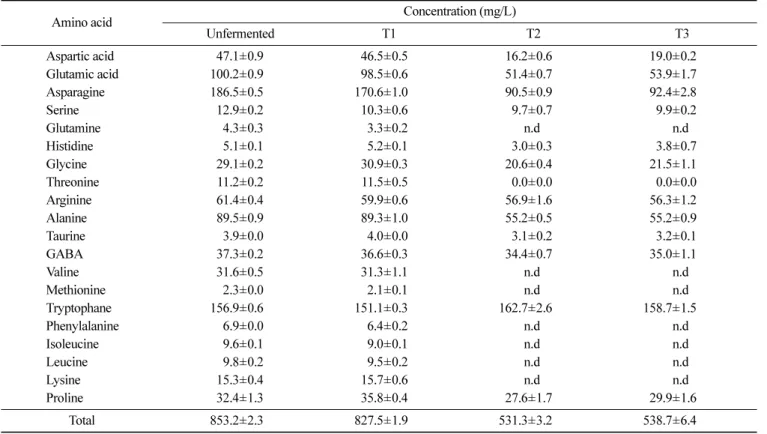
밀기울의 유산균 발효: 향기성분 및 유리아미노산 변화를 통한 제빵 소재로서의 가능성 527 다(Hsieh, 1994). 본 실험에 사용된 동물유래 유산균 중 Bifidobac-terrium은 이취물질인 hexanal을 대사하여 감소시키기 때문에 (Tridjoko 등, 1993) 이 물질이 발효에 의해 감소되고 hexanol이 증가됨을 증명하였다. 따라서, 이취로 인한 밀기울의 식품소재로 써의 한계점을 극복할 수 있는 가능성을 확인하였다. 알데하이드 함량은 발효에 의해 줄어드는 경향을 보였으며 위에서 언급한 바 와 같이 hexanal과 nonanal은 발효에 의해 줄어들었고(Fig 2), 대 사산물인 hexanol과 nonanol이 증가하는 경향을 확인할 수 있었 다(Table 1). 특히 알데하이드류는 alcohol류 보다 odor threshold 가 낮아 이취 감소 효과가 관능적으로도 크게 나타날 것을 기대 할 수 있다(Eriksson 등, 1976). 산류는 hexanoic acid가 검출되었 는데 이것은 유산균의 혐기성 발효에 의한 대사물질(Chammas 등, 2006)로 antimicrobial 물질로도 알려져 있어 발효 중 잡균의 오염 을 방지해 발효물의 저장성을 높일 수 있다(Huang 등, 2011). 케 톤류는 2,3-butanedione이 가장 많이 검출되었는데(Fig. 3), T2와 T3에서 각각 18.44 및 16.95 ng/g 검출 되었고(Table 1), 이 물질 은 diacetyl로 알려진 강한 버터향의 물질이다. 주로 티아민피로 인산을 매개로 하여 피브루산과 아세틸CoA 축합을 통해 생성 된 다(Benito de Cárdenas 등, 1985). 주로 동물유래 유산균에 의해 생성되며 유제품의 중요한 향기성분이기 때문에 대사조작을 통 해 diacetyl을 늘리는 균주를 생산하기도 한다. 2-Heptanone 또한 유제품에서의 중요한 향기성분으로 T2와 T3에서 발효로 인해 각 각 3.34 및 2.84 ng/g이 검출되는 것을 확인하였다(Table 1). 유리아미노산 함량의 변화 발효에 의한 아미노산 변화를 분석하기 위해 HPLC를 이용해 21종의 유리아미노산을 분석한 결과 Table 2와 같이 나타났다. 전 반적으로 발효에 의해 유리아미노산 함량이 줄어드는 경향을 보 였으며 T1, T2, T3에서 각각 2.8, 37.6, 36.7%로 감소한 것으로 확인했다. 이것은 유산균의 대사과정에서 유리아미노산이 소비되 는 것으로 leucine, valine, isoleucine 등 Ehrlich pathway를 통하 여 알코올 또는 알데하이드 성분이 생성된다고 알려져 있다(Yvon 와 Rijnen, 2001; Tavaria 등, 2002). T1의 경우 감소하는 경향을 확인할 수 있었고, T2와 T3의 경우 발효 후에 검출되지 않았다. 향기성분 분석 결과와 비교해 발효 후 증가하는 알코올류 들 중 3-methyl-1-butanol, phenethyl alcohol의 경우 각각 아미노산 leu-cine, phenylalanine에 의해 생성되는 것으로 유추해 볼 수 있다 (Chen, 1978).
요
약
밀기울을 유산균 종류에 따라 각각 발효물을 제조하고 그에 따 른 향기성분을 SPME로 추출하여 GC-MS로 분석하였다. 총 19 종류의 향기성분이 검출되었으며 이 중 알콜류가 차지하는 비중 이 가장 컸으며 그 중에서도 1-hexanol이 21.05-29.06 ng/g으로 가 장 다량으로 검출되었다. 이 중 유산균의 아미노산 대사에 의해 형성되는 알코올류인 3-methyl-1-butanol, phenethyl alcohol은 발효 후 증가하고, 아미노산 leucine, phenylalanine는 감소되는 경향을 확인하였다. 케톤류 또한 발효에 의해 증가되는 경향을 보였는데 주로 유제품 유산균 발효에 의한 것으로 2,3-butanedione를 비롯 한 buttery 풍미를 내는 케톤류들이 검출되었다. 이는 밀기울 유 산균 발효 산물의 풍미를 증대시켜 식품 소재로서의 가치를 상 승시킬 것이라 생각한다. 또한 알데하이드류는 감소하였는데, 알 데하이드류는 주로 밀기울이 가지고 있는 이취 물질들으므로 유 산균 발효를 통해 밀기울 소재의 한계점을 극복하고 품질을 향 상시킬 수 있을 것이라고 생각한다. 본 연구를 통해 사료나 폐기 되는 제분 부산물을 유산균 발효를 통해 고부가가치 식품 소재 로서의 가능성을 확인하였고, 제과 및 제빵에 발효 밀기울을 응 용, 적용함으로써 고 식이섬유 제품 및 풍미가 강화된 제품을 제 조할 수 있을 것이다.Fig. 1. Total flavor components in wheat bran fermented with different sources of LAB (T1), fermented by plant-based LAB (health guard); (T2), fermented by animal-based LAB (ABY-3); (T3), fermented by plant-based, animal-based LAB (health guard, ABY-3)
Fig. 2. Decrease of aldehyde in wheat bran by LAB fermentation (T1), fermented by plant-based LAB (health guard); (T2), fermented by animal-based LAB (ABY-3); (T3), fermented by plant-based, animal-based LAB (health guard, ABY-3)
Fig. 3. Increase of ketones in wheat bran by LAB fermentation (T1), fermented by plant-based LAB (health guard); (T2), fermented by animal-based LAB (ABY-3); (T3), fermented by plant-based, animal-based LAB (health guard, ABY-3)
References
An EM, Lee JK, Choi YS. Physicochemical properties of wheat bran in different areas prepared by a high-pressure homogenizer pro-cess. Korean J. Food Sci. Technol. 46: 404-409 (2014)
Anderson JW. Health implications of wheat fiber. Am. J. Clin. Nutr. USA 41: 1103-1112 (1985)
Bate NJ, Riley JCM, Thompson JE, Rothstein SJ. Quantitative and qualitative differences in C6-volatile production from the lipoxy-genase pathway in an alcohol dehydrolipoxy-genase mutant of Arabidop-sis thaliana. Physiol. Plant 104: 97-104 (1998)
Benito de Cárdenas IL, Ledesma OV, Pesce de Ruiz Holgado AA, Oliver G. Effect of lactate on the growth and production of diacetyl and acetoin by lactobacilli. J. Dairy Sci. 68: 1897-1901 (1985)
Chammas GI, Saliba R, Corrieu G, Béal C. Characterisation of lactic acid bacteria isolated from fermented milk “laban.” Int. J. Food Microbiol. 110: 52-61(2006)
Chirinang P, Intarapichet K-O. Amino acids and antioxidant proper-ties of the oyster mushrooms, Pleurotus ostreatus and Pleurotus sajor-caju. Science Asia 35: 326 (2009)
Eriksson CE, Lundgren B, Vallentin K. Odor detectability of alde-hydes and alcohols originating from lipid oxidation. Chem. Senses 2: 3-15 (1976)
Chen E. C.-H. The Relative contribution of ehrlich and biosynthetic pathways to the formation of fusel alcohols, J. Am. Soc. Brew. Chem. 36: 1, 39-43 (1978)
Galliard T, Gallagher DM. The effects of wheat bran particle size and storage period on bran flavour and baking quality of bran/ flour blends. J. Cereal Sci. 8: 147-154 (1988)
Gilliland SE. Health and nutritional benefits from lactic acid bacteria. FEMS. Microbiol. Rev. 7: 175-188 (1990)
Hsieh RJ. Contribution of lipoxygenase pathway to food flavors. In: Ho C-T, Hartman TG (eds) Lipids in food flavors. ACS., Wash-ington, DC, pp 30-48 (1994)
Huang CB, Alimova Y, Myers TM, Ebersole JL. Short- and medium-chain fatty acids exhibit antimicrobial activity for oral microor-ganisms. Arch. Oral. Biol. 56: 650-654 (2011)
Hwang JK, Kim CT, Cho SJ, Kim CJ. Effects of various thermal treatments on physicochemical properties of wheat bran. Korean J. Food Sci. Technol. 27: 394-403 (1995)
Katina K, Juvonen R, Laitila A. Fermented wheat bran as a func-tional ingredient in baking. Cereal Chem. 89: 126-134 (2012) Kim CT, Hwang JK, Cho SJ. Effect of screw configurations and
pro-cess parameters on characteristics of wheat bran extrudates. Korean J. Food Sci. Technol. 28: 169-178 (1996)
Salmenkallio-Marttila M, Katina K, Autio K. Effects of bran fermen-tation on quality and microstructure of high-fiber wheat bread. Cereal Chem. 78: 429-435 (2001)
Stevenson L, Phillips F, O’sullivan K, Walton J. Wheat bran: its composition and benefits to health, a European perspective. Int. J. Food Sci. Nutr. 63: 1001-1013 (2012)
Tavaria FK, Dahl S, Carballo FJ, Malcata FX. Amino acid catabo-lism and generation of volatiles by lactic acid bacteria. J. Dairy Sci. 85: 2462-2470 (2002)
Tridjoko W. Murti, Christian Bouillanne, Michele Landon, Michel J. De Smazeaud. Bacterial growth and volatile compounds in yoghurt-type products from soymilk containing Bifidobacterium spp. J. Food Sci. 58: 153-157 (1993)
Vetrimani R, Haridas Rao P. Studies on stabilization of wheat bran. J. Food Sci. Technol. 27: 332-335 (1990)
Yvon M, Rijnen L. Cheese flavour formation by amino acid catabo-lism. Int. Dairy J. 11: 185-201 (2001)
Zhang D, Moore WR. Wheat bran particle size effects on bread baking performance and quality. J. Sci. Food Agric. 79: 805-809 (1999) Zubaidah E, Nurcholis M, Wulan SN, Kusuma A. Comparative study
on synbiotic effect of fermented rice bran by probiotic lactic acid bacteria Lactobacillus casei and newly isolated lactobacillus plantarum B2 in wistar rats. APCBEE Procedia. 2: 170-177 (2012)
Table 2. Changes of amino acids in wheat bran fermented with different sources of LAB
Amino acid Concentration (mg/L)
Unfermented T1 T2 T3 Aspartic acid 47.1±0.9 46.5±0.5 16.2±0.6 19.0±0.2 Glutamic acid 100.2±0.9 98.5±0.6 51.4±0.7 53.9±1.7 Asparagine 186.5±0.5 170.6±1.0 90.5±0.9 92.4±2.8 Serine 12.9±0.2 10.3±0.6 9.7±0.7 9.9±0.2 Glutamine 4.3±0.3 3.3±0.2 n.d n.d Histidine 5.1±0.1 5.2±0.1 3.0±0.3 3.8±0.7 Glycine 29.1±0.2 30.9±0.3 20.6±0.4 21.5±1.1 Threonine 11.2±0.2 11.5±0.5 0.0±0.0 0.0±0.0 Arginine 61.4±0.4 59.9±0.6 56.9±1.6 56.3±1.2 Alanine 89.5±0.9 89.3±1.0 55.2±0.5 55.2±0.9 Taurine 3.9±0.0 4.0±0.0 3.1±0.2 3.2±0.1 GABA 37.3±0.2 36.6±0.3 34.4±0.7 35.0±1.1 Valine 31.6±0.5 31.3±1.1 n.d n.d Methionine 2.3±0.0 2.1±0.1 n.d n.d Tryptophane 156.9±0.6 151.1±0.3 162.7±2.6 158.7±1.5 Phenylalanine 6.9±0.0 6.4±0.2 n.d n.d Isoleucine 9.6±0.1 9.0±0.1 n.d n.d Leucine 9.8±0.2 9.5±0.2 n.d n.d Lysine 15.3±0.4 15.7±0.6 n.d n.d Proline 32.4±1.3 35.8±0.4 27.6±1.7 29.9±1.6 Total 853.2±2.3 827.5±1.9 531.3±3.2 538.7±6.4
T1: fermented by plant-based LAB of wheat bran T2: fermented by animal-based LAB of wheat bran