• 검색 결과가 없습니다.

A Successful Bilateral Lung Transplantation in a Patient with High Panel Reactive Antibody and Positive Cross Matching

N/A
N/A
Protected

Academic year: 2021

Share "A Successful Bilateral Lung Transplantation in a Patient with High Panel Reactive Antibody and Positive Cross Matching"

Copied!
3
0
0

로드 중.... (전체 텍스트 보기)

전체 글

(1)

Korean J Thorac Cardiovasc Surg 2014;47:420-422 □ Case Report □ http://dx.doi.org/10.5090/kjtcs.2014.47.4.420 ISSN: 2233-601X (Print) ISSN: 2093-6516 (Online)

− 420 −

1

Department of Thoracic and Cardiovascular Surgery,

2

Transplant Center, Seoul National University Hospital,

3

Transplantation Research Institute, Seoul National University College of Medicine

Received: October 23, 2013, Revised: November 26, 2013, Accepted: November 30, 2013, Published online: August 5, 2014

Corresponding author: Young Tae Kim, Department of Thoracic and Cardiovascular Surgery, Seoul National University Hospital, 101 Daehak-ro, Jongno-gu, Seoul 110-744, Korea

(Tel) 82-2-2072-3161 (Fax) 82-2-764-3664 (E-mail) [email protected]

C

The Korean Society for Thoracic and Cardiovascular Surgery. 2014. All right reserved.

CC
This is an open access article distributed under the terms of the Creative Commons Attribution Non-Commercial License (http://creative- commons.org/licenses/by-nc/3.0) which permits unrestricted non-commercial use, distribution, and reproduction in any medium, provided the original work is properly cited.

A Successful Bilateral Lung Transplantation in a Patient with High Panel Reactive Antibody and Positive Cross Matching

Jin San Bok, M.D.

1

, Jae Hyun Jun, M.D.

1

, Hyun Joo Lee, M.D., Ph.D.

1

, In Kyu Park, M.D., Ph.D.

1

, Chang Hyun Kang, M.D., Ph.D.

1

, Jaeseok Yang, M.D., Ph.D.

2,3

, Young Tae Kim, M.D., Ph.D.

1,3

A 44-year-old pregnant female patient gave stillbirth while being treated for pneumonia. She developed acute respi- ratory failure, which resulted in mechanical ventilator support. Diagnostic lung biopsy revealed a cryptogenic organiz- ing pneumonia. The patient’s condition deteriorated and a venous-venous extracorporeal membrane oxygenation was placed. She was listed for lung transplantation. Because of her worsening condition lung transplantation was per- formed despite positive cross matching result. She was treated with rituximab, intravenous immunoglobulin, and plasmapheresis and recovered without event. There is no sign of rejection at the time of last follow-up.

Key words: 1. Histocompatibility testing 2. Lung transplantation 3. Plasmapheresis

CASE REPORT

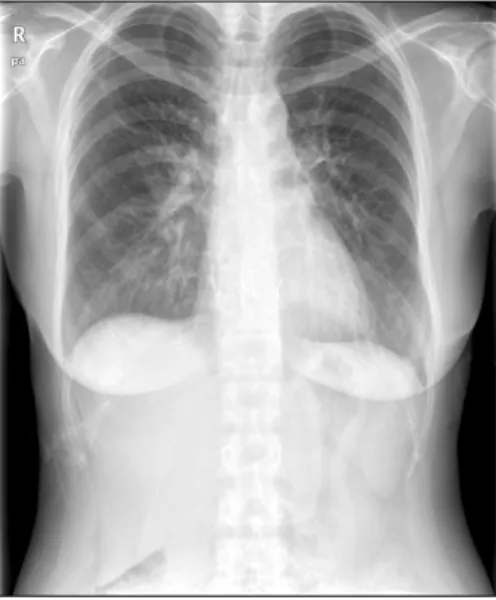
A 44-year-old pregnant female patient at a gestational age of 23 weeks was admitted to the hospital with the symptoms of pneumonia. During the course of the antibiotic treatment, fetal death in utero was detected, and she had a stillbirth. Her pneumonia deteriorated and required mechanical ventilator support. A video-assisted thoracic surgery lung biopsy was performed, and the pathological report revealed a diagnosis of cryptogenic organizing pneumonia. Following a worsening of her respiratory symptoms, a venous-venous extracorporeal membrane oxygenation (ECMO) was inserted, and she was listed for lung transplantation (Fig. 1). The lung trans- plantation work-up revealed a high panel reactive antibody (PRA) score (which was tested by using the luminex techni-

que; class I, 78%; class II, 53%), and a very weak level of donor-specific antibody (DSA) against DR9 was detected (mean fluorescent intensity [MFI]<1,000). Thirteen days lat- er, a matched donor was registered. The donor was a 45-year-old male patient who had died of cerebral infarction.

An arterial blood gas analysis (ABGA) revealed a pO

2

to

FiO

2

ratio of 425, and the chest X-ray was normal. The

T-cell cross-match was negative in both the comple-

ment-dependent cytotoxicity and the flow cytometric

cross-match tests. However, the B-cell flow cytometric

cross-match test was weakly positive (MFI ratio=2.5). Despite

the fact that the cross-matching result was positive, lung

transplantation was proceeded because of the worsening con-

dition of the patient. Bilateral sequential lung transplantation

was performed under cardiopulmonary bypass. To compensate

(2)

Lung TPL with Positive Cross Matching

− 421 − Fig. 1. Preoperative chest X-ray. Note veno-veno extracorporeal membrane oxygenation cannula.

Fig. 2. Chest X-ray at the time of last follow-up.

for the size discrepancy, a right middle lobe wedge resection was performed. The cold ischemic time was 5 hours 29 mi- nutes for the right lung and 7 hours for the left lung. The warm ischemic time of the right and left lung was 1 hour 18 minutes and 28 minutes, respectively.

Because of the positive cross-match, the recipient was treated with rituximab (375 mg/m

2

) before the transplantation and intravenous immunoglobulin (IVIG, 2 g/kg) for 4 days during the perioperative period. Although the level was weak, anti-DR9 DSA persisted on the 4th postoperative day (1,000

<MFI<3,000). Therefore, the recipient was treated with plasmapheresis on the 5th and 7th postoperative days, and the anti-DR9 DSA completely disappeared on the 9th post- operative day. On the 12th postoperative day, bronchoscopy did not reveal any abnormal findings. On the 20th post- operative day, the mechanical ventilator was weaned to BiPAP, which was subsequently weaned on the 28th post- operative day with the ABGA results of pCO

2

42.2 and pO

2

72.7 without a supply of oxygen. On the 43rd postoperative day, the T-cannula was removed, and the patient was dis- charged from the hospital with no specific complications on the 49th postoperative day. During the 3-month follow-up, no graft rejection was observed (Fig. 2).

DISCUSSION

The prevention of graft rejection affects both the short- and long-term survival of the recipient. Therefore, the selection of the most compatible donor is a critical part of a successful transplantation. However, the shortage of donors and the wor- sening condition of recipients often force surgeons to proceed lung transplantations from incompatible donors.

A high PRA score (>50% or >80%) is known to be a poor prognostic marker for transplantation [1]. Lee et al. [2]

reported the graft rejection rate among renal allograft recipients. The graft rejection rate was 8.6% in recipients whose PRA score was zero. However, the graft rejection rate was 20% in recipients whose PRA score was less than 50%, and 25% when the PRA score was more than 50% (p<0.05).

Data from the United Network for Organ Sharing Standard Transplant Analysis and Research files from 1987 to 2005 in- dicate that survival decreased with increasing PRA, and the difference was significant when the PRA score exceeded 25%. A multivariable analysis indicated that PRA was asso- ciated with an increase in the 30-day (hazard risk, 2.6) and the overall mortality (hazard risk, 1.3) [3].

A high PRA score indicates a high probability of the

pre-existing donor-specific antibody. To remove the pre-exist-

ing donor-specific antibody, desensitization protocols were de-

veloped in the late 1990s to deal with the increasing number

(3)

Jin San Bok, et al

− 422 − of sensitized patients. These approaches, which employ com- binations of IVIG, plasma exchange, and rituximab, have gained acceptance [4].

Haririan et al. [5] compared the short-term and long-term results of patients who received kidney transplantations with positive cross-match patients who were treated with plasma- pheresis and IVIG. The 1-year graft survival rate was 89.9%

and the 5-year graft survival rate was 69.4% for the positive cross-match recipients, whereas the 1-year graft survival rate was 97.6% and the 5-year graft survival rate was 80.6% for the control group. A positive cross-match was associated with an increased risk of graft loss (hazard risk, 2.6; p=0.04).

It is known that antibody-mediated rejection (AMR) is re- lated to the pre-existing donor-specific antibody. Earlier stud- ies of renal transplant examined the role of IVIG alone dur- ing the treatment of AMR. Later studies evaluated IVIG plus rituximab or IVIG plus plasmapheresis plus rituximab. More recently, bortezomib, a proteasome inhibitor, and eculizumab, a monoclonal antibody against terminal complement protein C5 that inhibits terminal complement activation, have been investigated [6]. Daoud et al. [6] reported a treatment for AMR. Two AMR patients after lung transplantation received plasmapheresis and IVIG, resulting in clinical improvement and the ultimate elimination of DSA [6].

Lung transplantation involving a positive cross-match result is not yet a common practice. Yu et al. [7] reported a lung transplantation between an O-type blood donor and an A-type blood recipient. The recipient was treated with OKT3 imme- diately and did not show graft rejection during a 4-month fol- low-up.

In our case, the preoperative PRA level was high, and the preoperative cross-matching result was positive. To prevent acute graft rejection, the recipient was treated with rituximab,

IVIG, and plasmapheresis. Although the long-term result re- mains to be determined, graft rejection was not observed 3 months after the transplant.

In conclusion, positive cross-match lung transplantation is a feasible option when combined with plasmapheresis and ap- propriate medication. However, a more delicate protocol for a positive cross-match is required. Moreover, the long-term re- sults of positive cross-match lung transplantation are needed.

CONFLICT OF INTEREST

No potential conflict of interest relevant to this article was reported.

REFERENCES

1. Jang JY, Kim YJ, Kim Y, Park YJ, Han K, Oh EJ.

Application of calculated panel reactive antibody using HLA frequencies in Koreans. Ann Lab Med 2012;32:66-72.

2. Lee KW, Kim SJ, Lee DS, et al. Effect of panel-reactive an- tibody positivity on graft rejection before or after kidney transplantation. Transplant Proc 2004;36:2009-10.

3. Glanville AR. Antibody-mediated rejection in lung trans- plantation: myth or reality? J Heart Lung Transplant 2010;

29:395-400.

4. Vo AA, Petrozzino J, Yeung K, et al. Efficacy, outcomes, and cost-effectiveness of desensitization using IVIG and rituximab. Transplantation 2013;95:852-8.

5. Haririan A, Nogueira J, Kukuruga D, et al. Positive cross- match living donor kidney transplantation: longer-term outcomes. Am J Transplant 2009;9:536-42.

6. Daoud AH, Betensley AD. Diagnosis and treatment of anti- body mediated rejection in lung transplantation: a retro- spective case series. Transpl Immunol 2013;28:1-5.

7. Yu SH, Kim HK, Lee DY, et al. Lung transplantation in

ABO compatible but nonidentical patients. Korean J Thorac

Cardiovasc Surg 2001;34:94-6.

수치

Fig. 2. Chest X-ray at the time of last follow-up.

참조

관련 문서

Single all her life, she poured it out for one great thing: to make Jesus Christ known among the unreached, the poor, and the sick.. Laura was a widow, a medical doctor,

As one of the few Companies that entered India early, I think we have shaped the Indian per- ception on Korean Companies and products to a fair extent .Having made an entry into

–The AABB suggests adhering to a restrictive strategy in hospitalized patients with preexisting cardiovascular disease and considering transfusion for patients with symptoms or

This book contains hundreds of complete, working examples illustrating many common Java programming tasks using the core, enterprise, and foun- dation classes APIs.. Java Examples

Respiratory acidosis and metabolic alkalosis : chronic lung disease and diuretics 5.. Mixed acute and chronic respiratory acidosis : chronic lung disease

a prospective analysis of 50 cases. Preoperative staging of non-small-cell lung cancer with positron-emission tomography. Staging of non- small-cell lung cancer

In addition, Wallace and Froum 20) reported that the bone formation rate was superior in the cases using a barrier membrane in comparison with the

After her husband died for his country, she had a crisis in her writing, but she overcame her anxiety of being alone in a period of turbulence