The Effects of Strengthening Exercise of Hip Abductors on Muscle Strength and Ambulation in Patient with ACL Reconstruction
앞십자인대 재건술 후 엉덩관절 벌림근 강화운동이 근력과 보행에 미치는 영향
Purpose: The purpose of this study was to investigate the effect of strengthening exercises of hip abductors on muscle strength and ambulation for patients with ACL reconstruction.
Methods: The subjects were randomly assigned to the intervention group (general exercise plus strengthening of hip abductors) or the control group (general exercise without the strengthening of hip abductors). Both groups participated in a six-week exercise protocol after the surgery for ACL reconstruction. The knee strength test (quadriceps, hamstring, hip abductor) and gait analysis were performed in pretest and post-test.
Results: Muscle strength was measured using the Biodex system Ⅲ model (Biodex Medical System, Inc, NY, US). The results showed no significant difference in knee strength (quadriceps, hamstring) between the two groups (p>0.05), however, there was a significant difference in hip abductors (p<0.05). The gait analysis was measured with Gaitrite system (CIR System Inc, US).
Results of comparison between groups showed a significant increase in the step length of both groups. (p<0.05), and there was a significant difference in the affected leg of the intervention group(p<0.05).
Conclusion: Exercise of hip abductors for patients with ACL reconstruction provides significant benefits with respect to improvement of muscle strength in hip abductors, increasing the stride. This result indicates that a training program designed for ACL reconstruction patients should include strengthening of the hip abductor. We think that further study is needed to determine the relationship of hip muscles and knee joint for patients with ACL reconstruction.
Key Words:ACL reconstruction, Hip abductors, Biodex system, Gaitrite system Byung-Joon Park1, Joong-Hwi Kim2
1Department of Physical Therapy, Graduate School, Catholic University of Daegu, 2Department of Physical Therapy, College of Medical Science, Catholic University of Daegu
박병준1, 김중휘2
1대구가톨릭대학교 대학원 물리치료학과, 2대구가톨릭대학교 의료과학대학 물리치료학과
The Journal of Korean Society of Physical Therapy Original articles
Ⅰ. 서론
최근 생활수준이 향상되고 여가가 늘어나면서 운동과 건강에
Copylight ⓒ 2014 The Korea Society of Physical Therapy
This is an Open Access article distribute under the terms of the Creative Commons Attribution Non-commercial License (Http:// creativecommons.org/license/by-nc/3.0.) which permits unrestricted non-commercial use, distribution,and reproduction in any medium, provided the original work is properly cited.
Received Sep 11, 2014 Revised Oct 12, 2014 Accepted Oct 15, 2014
Corresponding author Joong-Hwi Kim, [email protected]
대한 관심이 증대됨에 따라 스포츠 활동에 따른 손상도 증 가되고 있다. 이러한 스포츠 손상 중 무릎관절의 앞십자인 대(anterior cruciate ligament, ACL) 손상은 가장 흔한 손상 으로 스포츠 선수뿐만 아니라 일반인들도 자주 손상을 입는 다.1
앞십자인대의 손상은 넙다리뼈에 비하여 정강뼈에 작용하 는 안쪽 돌림력(internal rotation)에 의해 가장 흔하게 발생되 며,2 치료 목표는 무릎관절의 안정성을 확보하고 운동범위 및 근력을 정상수준으로 회복시켜 무릎관절의 기능이 원활히
수행될 수 있도록 하는데 있다.3,4
앞십자인대가 손상된 환자의 경우 엉덩관절 벌림근 근력 저하로 인해 엉덩관절 몸쪽 조절이 감소되고, 이로 인해 무릎의 운동 역학의 저하를 야기한다.5 또한 엉덩관절의 신경근 조절은 무릎에 의해 생산되는 힘에 영향을 줄 수 있으며, 엉덩관절 벌림근의 약화가 발생할수록 무릎 밖굽이 최대관절이동(peak joint displacement, PJD)이 증가한다고 보고하였고,6 Cale5등은 엉덩관절 벌림근의 최대토크(peak torque, PT)가 증가한 환자의 경우 엉덩관절의 몸쪽 조절이 무릎 밖굽이 PJD 감소를 보고하였다. 이는 엉덩관절 벌림근 근력이 무릎에 영향을 미칠 수 있다는 걸 보여주는 것으로 생각되며, 무릎관절 수술 후 엉덩관절 근력을 연구한 결과 수술하지 않은 다리보다 수술한 다리의 엉덩관절 벌림근, 모 음근, 굽힘근, 폄근의 등척성 근력이 12~25%정도 감소를 보고하였다.7 이 결과들은 무릎관절 수술 후 근력 소실이 오 직 무릎관절 굽힘근, 폄근에만 국한되지 않음을 시사하고, 무 릎관절 수술 후 더 큰 근력 소실이 발생할 것을 시사한다.8
최근 앞십자인대 손상의 보행 연구는 활발히 진행되고 있 다.9 앞십자인대 손상 환자 가운데 75%는 보행 형태가 변하 게 되고 넙다리회피보행(quadriceps avoidance gait)을 하게 되며, 입각기 동안 넙다리네갈래근 활동이 감소하기 때문에 무릎관절 활동의 약 140% 감소한다고 보고 하였다. 그리고 앞십자인대 재건술은 보행동안 넙다리네갈래근 약화, 부종, 통증 등으로 인해 보행 형태가 변하게 된다.10 하지 근육들 중 엉덩관절 벌림근은 서있는 자세 혹은 보행에서 걸음을 디딜 때 주로 하지의 안정성을 유지하며 보행의 너비를 조절하는 작용을 한다. 이중 엉덩관절 벌림근은 입각기 중 골반 안정에 중요한 역할을 하며, 이 부위의 약화는 체간 가쪽 굽힘의 한 원인이 된다. 무게 중심이 외측으로 옮길 수 있도록 엉덩관절 벌림근인 중간볼기근 및 작은 볼기근의 활동이 매우 중요하 다.11
중간볼기근의 근력 강화운동은 하지 움직임을 개선하고 손 상을 예방하며 통증을 감소 시킬 수 있으며,12 이로 인해 최 근에는 하지 손상 후 치료와 예방을 위해 엉덩관절 특히 엉 덩관절 벌림근에 대한 연구가 중요시 되고 있다.13
그러나 현재 연구된 선행 연구들에서는 앞십자인대 재건술 환자의 치료를 위한 재활운동이 강조되어 재활 프로그램과 관련한 연구가 많은 추세이나 엉덩관절 벌림근의 약화 수준을 고려하여 구분한 연구가 부족한 현실이며 또한 보행능력과 관련된 국내 연구는 미비한 실정이다.
따라서 본 연구에서는 앞십자인대 재건술을 한 환자를 대
상으로 엉덩관절 벌림근 근력 강화시 일상적인 생활 수준과 보행능력에 큰 영향을 줄 수 있을 것으로 생각되어 보행능력 과 근력에 미치는 영향과 효과를 알아보고자 한다.
II. 연구방법
1. 연구대상
본 연구는 스포츠 손상이나 사고에 의해 앞십자인대 파열로 재건술을 받은 2주 이상인 환자로 울산 G병원 스포츠 재활 센터에서 운동을 하고 수술 후 염증과 부작용이 없는 환자, 하지의 말초신경에 마비가 없는 환자, 보행에 문제가 없는 환자로 총 18명을 6주간 일반운동군(9명)과 일반운동군에 엉덩관절 벌림근 운동을 추가한 군(9명)으로 무작위로 선별하 였다. 본 연구는 대상자의 동의를 얻어 실시하였으며, 연구 대상자의 일반적 특성은 다음과 같다(Table 1).
2. 실험방법 1) 측정도구
⑴ Biodex system
본 연구에서는 근력의 측정을 위해 Biodex system Ⅲ model (Biodex Medical System, Inc.,NY, 미국)을 사용하였다.14 자동 프로그램과 수동 프로그램으로 스피드와 토크를 조절할 수 있는 장비로써 등속성 원리를 컴퓨터와 인체의 7개의 주요 관절(shoulder, elbow, wrist, hip, knee, ankle, back)과 그 주변 근육의 근력, 내구력, 운동량, 부하량 등을 컴퓨터로 정확히 측정하여 진단 및 분석, 치료에 도움을 주는 장비이다.
각 관절의 측정자세는 Biodex메뉴얼에 제시된 방법으로 측정하였다. 엉덩관절의 벌림 측정은 의자를 180° 눕혀 평면 이 되게 하고 역량(dynamometer)를 등지고 옆으로 누워 넙다 리뼈 큰돌기 위쪽(superior to greater trochanter)을 축으로 하고, 다리 오금(popliteal fossa)에 패드를 고정시킨 후 시작 하도록 하여 측정하였다. 한편, 무릎관절 측정은 엉덩관절이 90° 굽힘 되도록 하고, 5개의 고정 벨트를 이용하여 상체와 골반 및 넙다리부와 발목의 안쪽복사 직상방 부위를 각각 고정하며, 또한 하지의 무게가 무릎관절 최대 우력에 영향을 주는 것을 막기 위해 중력 효과 토크(gravity effect torque)를 측정하여 컴퓨터에 입력하였다.
⑵ Gaitrite system
본 연구에서는 연구 대상자들의 보행 요소를 측정하기 위하 여 Gaitrite system (CIR System Inc, 미국)을 사용하여 측정
하였다. 측정에 들어가기 전에 대상자의 하지장 길이를 좌,우 세번씩 측정 후 평균을 내어 컴퓨터 시스템에 입력하였다.
측정은 평소 보행을 유지하게 하기 위해 출발 신호와 함께 보행판 3 m 전 지점에서 도착은 보행판 3 m이상 지점을 지나 서 멈추도록 하고, 검사자를 따라 1회 연습 보행을 실시한 후 3회의 검사를 실시하였다. 보행은 대상자마다 느끼는 안정한 속도로 보행하도록 하였다. 사람이 느끼는 가장 안정한 보행 속도는 사람마다 다르며 기존의 연구에 의해 보행 속도는 안 정성에 영향을 미치지 않는 것이 증명되었다.15
3. 자료분석
자료 분석은 SPSS for windows ver 20.0의 통계 프로그램을 이용하였다. 연구 대상자의 일반적 특성 및 두 집단의 모든 변인은 기술통계로 평균과 표준편차를 산출하였다. 또한 각 집단 내의 운동 전, 후의 무릎관절 근력, 엉덩관절 벌림근 근 력과 보행능력의 차이 검증은 대응표본 t 검정(paired t-test) 으로, 두 그룹간의 무릎관절 근력, 엉덩관절 근력, 보행 능력 의 차이 검증은 독립표본 t 검정(independent t-test)으로 분 석하였다. 통계학적 유의수준은 0.05로 하였다.
NAE(n=9) AE(n=9) t p
Gender Male 9 7
Female 0 2
Age (year) 37.22 ± 11.55 32.44 ± 11.76 0.87 0.40
Height ( ㎝ ) 177.22 ± 3.46 175.00 ± 3.57 1.21 0.24
Weight ( ㎏ ) 71.11 ± 5.60 68.11 ± 10.85 0.74 0.47
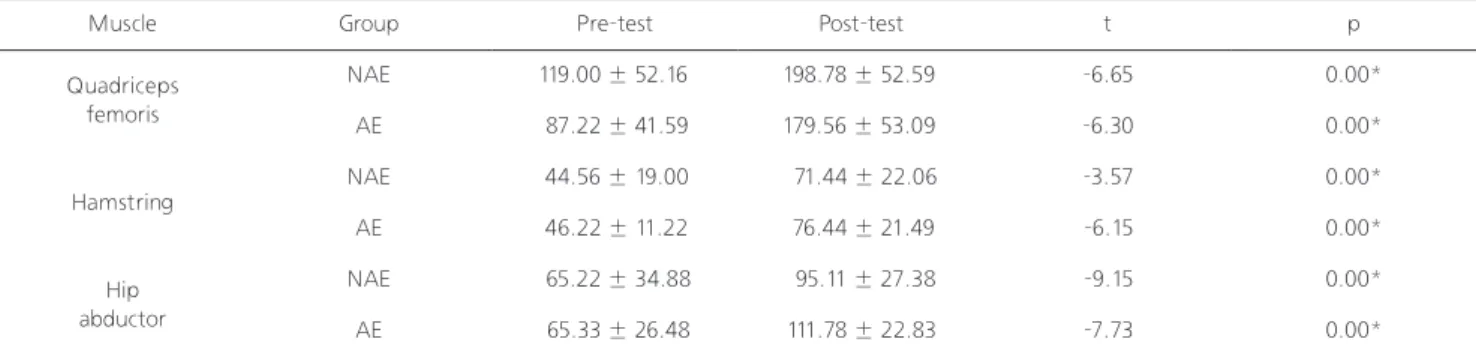
Muscle Group Pre-test Post-test t p
Quadriceps femoris
NAE 119.00 ± 52.16 198.78 ± 52.59 -6.65 0.00*
AE 87.22 ± 41.59 179.56 ± 53.09 -6.30 0.00*
Hamstring NAE 44.56 ± 19.00 71.44 ± 22.06 -3.57 0.00*
AE 46.22 ± 11.22 76.44 ± 21.49 -6.15 0.00*
Hip abductor
NAE 65.22 ± 34.88 95.11 ± 27.38 -9.15 0.00*
AE 65.33 ± 26.48 111.78 ± 22.83 -7.73 0.00*
Muscle NAE AE t p
Quadriceps femoris 79.78 ± 36.01 92.44 ± 44.09 -0.66 0.51
Hamstring 27.00 ± 22.55 30.00 ± 14.71 -0.33 0.74
Hip abductor 30.11 ± 9.67 46.44 ± 17.60 -2.43 0.02*
Table 1. Characteristics of subjects
Table 2. Comparison of muscular strength between the two groups at pre-test and post-test in the involved leg (Unit: PT/BW %)
Table 3. Comparison of mean differences of leg muscular strength between the two groups in the involved leg (Unit: PT/BW %) Values are mean ± standard deviation
NAE: non-abductors exercise AE: abductors exercise
*p<0.01
Values are mean ± standard deviation PT/BW: Peak torque/body weight
NAE: non-abductors exercise, AE: abductors exercise
*p<0.05
Values are mean ± standard deviation
NAE: Non-abductors exercise, AE: Abductors exercise PT/BW: Peak torque/body weight%
III. 결과
1. 근력 변화 분석
본 연구에서 그룹 내 전후 넙다리네갈래근 근력은 대조군은 119.00±52.16%에서 198.78±52.59%로, 실험군은 87.2 2±41.59%에서 179.56±53.09%로 통계학적으로 유의 한 증가를 나타냈으나, 그룹 간의 차이 비교에서는 유의한 차이는 없었다(p>0.05). 그룹 내 뒤넙다리근 근력은 대조군 은 44.56±19.00%에서 71.44±22.26%로, 실험군은 46.2 2±11.22%에서 76.44±21.48%로 유의한 증가를 나타 냈으나, 그룹 간의 차이 비교에서는 유의한 차이는 없었다 (p>0.05).
그룹 내 엉덩관절 벌림근 근력은 대조군은 65.22±34.88
%에서 95.11±27.38%로, 실험군은 65.33±26.48%에서 111.78±22.83%로 유의한 증가를 보였고, 그룹 간의 차이 비 교에서도 유의한 차이를 보였다(p<0.05)(Table 2, 3).
2. 보행 능력 분석
본 연구에서 보행과 관련된 시.공간적 변수를 측정한 결과 그룹 내 전후 한발짝길이(step length)에서 대조군 환측은
59.09±7.10 cm에서 65.25±7.65 cm로, 건측은 55.88
±11.48 cm에서 60.93±18.60 cm로, 실험군 환측은 50.25
±10.61 cm에서 65.90±6.87 cm로 건측은 48.63±14.81 cm에서 67.63±6.81 cm로 유의한 증가를 보였고, 그룹간의 차이 비교에서는 실험군 환측에서는 유의한 차이를 보였다 (p<0.05)(Table 4 ,5).
IV. 고찰
앞십자인대 재건술을 받은 환자들을 위한 치료에 있어서 근 력과 보행을 향상시키는 것은 매우 중요하며, 대부분의 앞 십자인대 재건술 후 초기 불안정한 무릎관절 상태에 따른 일 정기간 동안 보조기의 사용은 근육이 소실되어 근 위축을 초래하게 되는데,16 선행 연구에서는 앞십자인대 재건술 후 12주간 재활운동 적용 후 폄 근력 10.8%, 굽힘 근력 12.2%의 결손율을 보고하였고17, 24주 재활운동 후 남자 축구 선수의 폄 근력 7.9%, 굽힘 근력 3.7%의 결손율, 여자 축구선수의 폄 근력 17.6%, 굽힘 근력 12.5%의 결손율을 보고하였다.18 본 연구에서는 앞십자인대 재건술 후 6주간 운동 후 무릎관절 폄 근력, 굽힘 근력, 엉덩관절 벌림근의 근력을 측정한 결과 넙다
Variable Group Pre-test Post-test t p
Step length (cm)
NAE I 59.09 ± 7.10 65.25 ± 7.65 -2.03 0.07
N 55.88 ± 11.48 60.93 ± 18.60 -0.79 0.44
AE I 50.25 ± 10.61 65.90 ± 6.87 -5.37 0.00*
48.63 ± 14.81 67.63 ± 6.81 -4.75 0.00*
Cadence (steps/min)
NAE 108.88 ± 26.76 131.83 ± 46.71 -1.32 0.22
AE 99.26 ± 20.62 114.70 ± 9.01 -2.12 0.06
Variable Group NAE AE t p
Step length (cm)
I 6.15 ± 9.06 15.64 ± 8.73 -2.26 0.03*
N 5.04 ± 18.94 19.00 ± 11.98 -1.86 0.08
Cadence (steps/min) 22.94 ± 52.02 15.43 ± 21.77 0.40 0.69
Table 4. Comparison of the gait parameters before and after between the two groups at pre-test and post-test
Table 5. Compaison of mean differences of the gait parameters between two groups
*p<0.01
Values are mean ± standard deviation
NAE: non-abductors exercise, AE: abductors exercise, I: involved leg, N: non-involved leg
*p<0.05
Values are mean ± standard deviation
NAE: non-abductors exercise, AE: abductors exercise, I: involved leg, N: non-involved leg
리네갈래근 근력은 대조군 31%, 실험군 40%, 뒤넙다리근 근력은 대조군 46%, 실험군 42%의 결손율을 보였으나, 통계학적으로 유의한 차이는 없었다(p>0.05). 이는 두 그 룹 모두 넙다리네갈래근, 뒤넙다리근 운동 병행으로 인한 것으로 생각되어진다. Jaramillo 등5은 무릎관절 수술 후 엉덩관절 근력을 연구한 결과 수술하지 않은 다리보다 수술 한 다리의 엉덩관절 벌림근, 모음근, 굽힘근, 폄근의 등척 성 근력이 12~25%정도 감소를 보고하였다. 본 연구에서 엉덩관절 벌림근 근력 측정 결과 대조군 16%, 실험군 6%
결손율로 통계학적으로 유의한 차이를 보였다(p<0.05). 이 는 엉덩관절 벌림근 운동 유무의 차이 때문으로 보이며, 선 행연구와 동일하게 무릎관절 근력, 엉덩관절 벌림근 근력 감 소에 관해 유사한 결과를 보인다. 이는 엉덩관절 근육 활동 이 감소할수록 무릎 밖굽이 움직임은 커지고, 또한 부적절한 근육 활동은 밖굽이 부하가 과도하게 증가하게 되어 결국 손상 위험이 커지며,19 그 결과 더 큰 엉덩관절의 모음과 안쪽 돌림을 허락하여 그것으로 인해 정강넙다리 관절의 돌림력을 증가시켜 앞십자인대의 파열을 유발할 수 있다20는 것을 뒷받침해주는 결과라고 생각된다.
앞십자인대 재건술 후 재활을 시작 할 때 우선 순위를 만 들고 제일 하고 싶은 것으로 보행을 선택하는데,21,22 이는 보 행이 일상생활에 끼치는 영향이 높기 때문이다.22,23 보행과 관 련된 지표 중 보행속도는 일상생활능력과 예후기능 파악에 간단하면서 정확한 방법으로 쓰여지고 있으며,24 건강한 정상 인에 비하여 정형외과적, 신경학적 병변을 동반한 환자인 경 우에 정상인의 평균 보행 속도와 비교 시 많은 차이가 있는 것으로 나타났다.25 보행은 신경계와 근골격계의 상호작용에 의해 이루어지는 복잡한 운동으로 하지의 건강상태에 따라 그 패턴이 다양하게 나타난다.26
하지 근육들 중 엉덩관절 벌림근은 서있는 자세 혹은 보행 에서 걸음을 디딜 때 하지의 안정성을 유지하며 보행의 너비 를 조절하는데 주로 작용을 한다.27
선행연구에서 앞십자인대 재건술 후 재활트레이닝 경과에 따른 보행 패턴 분석에서 재활훈련이 길어질수록 한발짝길 이를 자신 있게 하여 한발짝너비가 커지는 것으로 나타났다.28 청장년층과 노년층의 보행을 연구에서 노년층의 보행속도가 젊은층 보다 현저히 떨어졌는데 그 이유가 한발짝률이 아니라 한발짝길이가 짧아졌기 때문이라고 하였다.29 본 연구에서는 엉덩관절 벌림근 운동이 보행능력에 미치는 영향을 측정한 결과 한발짝길이에서 대조군 환측이 10%, 건측이 9% 길 어지고, 실험군 환측이 24%, 건측이 29%가 길어져 통계학적
으로 유의한 차이를 보였으며(p<0.05), 이는 엉덩관절 벌 림근의 근력강화로 하지의 안정성을 가져와 한발짝길이의 증가를 가져온 것으로 생각되어지고, 선행연구와 비슷한 결과 를 보였다.
Kim30은 국내 정상성인은 한발짝률은 114.5±5.4 step/
min, Kwon31은 106±10.1 step/min 보고하였다. 본 연 구에서 한발짝률은 6주 운동 후 대조군은 108.88±26.76 에서 131.83±46.71(17%)로 증가 하였고, 실험군은 99.26
±20.62에서 114.70±9.01(13%)로 증가하였으나, 통계학적 으로 유의한 차이는 없었으며(p>0.05), 이는 보행속도 감 소는 한발짝률의 감소보다 한발짝길이 감소 때문이라는 연 구결과를 뒷받침해주는 결과라고 생각된다.
결론적으로 앞십자인대 재건술 환자에게 엉덩관절 벌림근 운동은 엉덩관절 벌림근 근력의 향상과 함께 한발짝길이 증가에 의미 있는 효과를 제공하는 중재 방법이며, 이는 앞 십자인대 재건술 환자의 재활 훈련 과정에서 엉덩관절 벌 림근 근력 강화가 반드시 포함 되어야 한다는 것을 제시한다.
본 연구는 대상자 수가 적고, 보행 평가에서 대상자의 신체 활동과 환경적 요인을 고려하지 못해 대상자의 일상생활을 통제할 수 없었고 훈련기간이 짧아 결과를 일반화하기에 무리가 있다. 또한 엉덩관절 근력 중 엉덩관절 벌림근만을 평가하여 엉덩관절 전반에 걸친 평가가 부족하였으며, 보행 분석 기기 시·공간적 변수와 보행 특성 평가로 한정되어 있어 서 향후 연구에서는 3차원 동작분석을 이용하여 엉덩관절, 무릎관절, 발목관절의 동적 관절가동범위 측정하여 시·공 간적인 변수와 함께 측정이 필요할 것으로 생각되며, 앞십자 인대 재건술 환자에게 엉덩관절 벌림근과 함께 엉덩관절 신전근의 훈련 효과에 관한 연구도 시행되어야 할 것이다.
본 연구의 결과를 통해 앞십자인대 재건술 환자에게 엉덩 관절 벌림근 운동은 엉덩관절 벌림근 근력의 향상과 함께 걸음길이 증가에 의미 있는 효과를 제공하며, 이는 앞십자 인대 재건술 환자의 재활 훈련 과정에서 무릎관절 주위 근육 강화와 함께 엉덩관절 벌림근 근력 강화가 반드시 포함되어야 한다고 판단된다.
참고문헌
1. Chung JS. The effects of accelerated rehabilitation exercise on knee function, thigh circumference and lysholm score after ACL reconstruction. KEAGW. 2006;20(5):172-86.
2. Lee LH. The effects of muscle strength and muscle power after
rehabilitation exercise program in ACL reconstruction patients.
Yeungnam University. Dissertation of Master’s Degree 2006.
3. Feagin, J.A, Curl WW. Isolated tear of the anterior cruciate ligament: 5-year follow-up study. Am J Sports Med.
1976;4(3):95-100.
4. Kim YJ, Lee YM. The effects of closed kinetic chain exercises on thigh circumference and lysholm scale of the knee joints of patients with ACL reconstruction. J Korean Soc Phys Ther.
2007;19(6):31-6.
5. Jacobs CA, Uhl TL, Mattacola CG et al. Hip Abductor Function and Lower Extremity Landing Kinematics: Sex Differences. J athletic training 2007;42(1);76.
6. Griffin LY, Agel J, Albohm MJ et al. Noncontact anterior cruciate ligament injuries: risk factors and prevention strategies.
J Am Acad Orthop Surg. 2000;8(3):141-150.
7. Jaramillo J, Worrell T, Ingersoll C. Hip isometric strength following knee surgery. J Orthop Sports Phys Ther.
1994;20(3):160-5.
8. Judd DL, Eckhoff DG, Stevens-Lapsley JE. Muscle strength loss in the lower limb after total knee arthroplasty. Am J Phys Med Rehab. 2012;91(3):221.
9. Andriacchi TP. Functional analysis of pre and post-knee surgery: total knee arthroplasty and ACL reconstruction. J Biomech Eng, 1993;115(4B):575-81.
10. Berchuck M, Andriacchi TP, Bach B. R. & Reider B. Gait adaptations by patients who have a deficient anterior cruciate ligament. J Bone Joint Surg Am, 1990;72(6):871-77.
11. Choi WH. Effetcs of eccentric exercise of affected hip abductors on balance in patients with hemiplegia. Yong-In University.
Dissertation of Master’s Degree. 2002.
12. Fredericson M, Cookingham CL, Chaudhari AM et al. Hip abductor weakness in distance runners with iliotibial band syndrome. Clin J Sport Med. 2000;10(3):169-75.
13. Dwyer MK, Boudreau SN, Mattacola CG et al. Comparison of lower extremity kinematics and hip muscle activation during rehabilitation tasks between sexes. J Athl Training.
2010;45(2):181.
14. Yu CS, Chang SK. The isokinetic evaluation of knee extensors and flexors in the normal subjects for those twenties. J Korean Soc Phys Ther. 2013;25(4):167-73.
15. Stergiou N, Moraiti C, Giakas G et al. The effect of the walking speed on the stability of the anterior cruciate ligament deficient knee. Clin Biomech. 2004;19(9):957-63.
16. Richardson RS, Saltin B. Human muscle blood flow and metabolism studied in the isolated quadriceps muscles. Med Sci Sports Exerc. 1998;30(1):28-33.
17. Kim YK. The Effects of a 12-week exercise training program on ligament stability, knee function, and lysholm score after anterior cruciate ligament reconstruction. Seoul National University. Dissertation of Doctorate Degree. 2002.
18. Ahn DY. Effect of Rehabilitative Exercise on Isokinetic Muscle Function and Functional Exercise Performance in Male and Female Soccer Players with ACLR. Seonam University.
Dissertation of Doctorate Degree. 2013.
19. Hollman JH, Ginos BE, Kozuchowski J et al. Relationships between knee valgus, hip-muscle strength, and hip-muscle recruitment during a single-limb step-down. J Sport Rehab 2009;18(1):104.
20. Claiborne TL, Armstrong CW, Gandhi V et al. Relationship between hip and knee strength and knee valgus during a single leg squat. J Appl Biomech. 2006;22(1):41-50.
21. ML Keast ML. Nordic Walking: Introducing a New Low-Impact Exercise System for Cardiac Rehabilitation Patients. Minto Prevention and Rehabilitation Centre, University of Ottawa Heart Institute. 2009;13-4.
22. Kang YH. Effects of Nordic walking on tibialis anterior muscle fatigue. J Korean Soc Phys Ther. 2014;26(2):62-7.
23. Nam SH, Kang KW, Kwon JW et al. The effects of handrails during treadmill gait training in stroke patients. J Korean Soc Phys Ther. 2013;25(1):23-8.
24. Kim MJ, Lee SA, Kim SK, Sung IY. The study for gait speed of stroke patients: comfortable versus maximum safe speed. J of Korean Acad. Of Rehab. Med. 1994;18(4):736-41.
25. Kim JH. Relationship between gait symmetry and functional balance, walking performance in subjects with stroke. J Korean Soc Phys Ther. 2014;26(1):1-8.
26. Kim MK, Kim KH, Son K. Gait analysis of the normal and ACL deficient patients after reconstruction surgery using foot- ground reaction force. KSME.2006;2006(6):247-52.
27. Choi WH, Kim MJ. Effects of Eccentric Exercise of Hip Abductors on Gait Balance. KAOMPT. 2003;9(2):59-67.
28. Jin YW, Song JW, Kang SG et al. Analysis of gait pattern according to passage of rehabilitation training of ACL patients.
JESK. 2010;2010(5);250-3.
29. Winter DA, Patla AE, Frank JS et al. Biomechanical walking pattern changes in the fit and healthy elderly. Phys Ther.
1990;70(6):340-7.
30. Kim HW. A study on kinematic gait analysis of the normal adult. Kyung bok college. 2001;(5):513-20.
31. Kwon DY, Sung IY, You JY et al. 3-Dimensional gait analysis of Korean adults. J. of Korean Acad. of Rehab. Med.
1998;22(5);1107-13.