DAEHAN HWAHAK HWOEJEE
(Journal of the Korean Chemical Society}
Vol. 33, No. 6, 1989
Printed in the Republic of Korea
Mn2+-
치환 제올라이트A
의 수화 및 탈수 구조에 관한 연구 朴鍾烈* •金洋•金恩植•崔相九부산대학교
자연고]-학대학화학과
(1989. 7. 18접수)
A Study on the Hydrated and Dehydrated Mn2+-E xchanged Zeolite A
Jong Yul Park', Yang Kim, Un Sik Kim, and Sang Gu Choi
Department of Chemistry, Pusan National University, Pusan 609-735, Korea
(Received July 18, 1989)요 약. Mi
】
2+-치환
제올라이트 A 는 가열 탈수되어도 그 구조가열적으로
안정하였다. 厂A의 수화상태 및
탈수상태에 있어서의 골조원자,이온 및
물분자들의 위치와 결합에너지를 몇가지 퍼텐셜함
수들을 써서 계산하여 구하였다.
탈수상태의
Mn^Na^A에있어서
골조원자들의 결합에너지는 열적으로안정한 것으로 알려져 있는
탈수상태의
(3注+-치환
제올라이트 A(C&-A)및
Co2+-치환제올라이트
A(CsNa^A)의 그것과
비슷하였다.
M『+-
치환 제올라이트 A 골조 내에는 결합에너지의 결합형식이 서로 다른
세
가지그룹의
물분자들 즉인접
물분자 또는골조 산소원자와수소결합을
하고 있는 물 ; W (I), Na+이온에 배위되면서 인접
물 분자와수소결합을
하는 물 ; W(II)및
MT+에 배위면서수소결
합을 하는 W(III)그룹의
물분자들이
존재하였으며 그들의결합에너지 및 탈수반응의 활성화에너지의 크기
순서는 W(III)
〉
W(II)〉
W(I)이였다.ABSTRACT. The positions and interaction energies of framework atoms and water molecules of
Mn2+- exchanged zeolite A were calculated using some potential energy functions and an optimization program. The sum of interaction energies of framework atoms in dehydrated Mn4 5Na3-A was approximately the same as those of thermally stable Ca2+- or Mg2+-exchanged zeolite A. Since Mn2+ ions can form good coordination bonds with framework oxygens even in dehydrated state, Mn"- exchanged zeolite A is considered to be thermally stable. The optimized positions of framework atoms and ions in this work are agreed well with the crystallographic data1. Three groups of water molecules are found in hydrated Mn2+-exchanged zeolite A; W(I) group of water molecules having only hydrogen bonds, W(II) group coordinated to Na+ ion, and W(III) group coordinated to Mn2+ ion. The average binding energy of each group of water molecules decrease in the order of W(III) > W(II) > W(I). The activation energies in the dehydration reaction of each group of water molecules increased in accordance with their binding energy.
INTRODUCTION
Zeolites are a class of aluminosilicates with relatively rigid anionic frameworks, and crystallographically well-defined channels and cavities. These contain exchangeable cations and
removable guest molecules such as water.
Since zeolites have been widely used as molecular sieves, catalysts, adsorbents, and ion ex
changers, many researches on the physicochemical properties of zeolite have been made.
Zeolite A exchanged with Ca2+, Zn2+; Sr2+ or 623
624
朴鍾烈•金洋•金恩植•崔相九
Co2+ ion are stable on dehydration upon heating or under vacuum, while some divalent cations ex
changed zeolite A with such as Ba2+, Cr흐
+,
Ni2+, Cu2+, Pb2+, or Hg2+ are thermally unstable on dehydration.2-5In recent years, many theoretical studies on the structure and stability of zeolite framework by the calculation of interaction energy have been reported.6-12
In this work, three kinds of Mn2+-exchanged zeolite A having different compositions (Mim
卬弗一
处丄;r=l, 2, and 4.5) were prepared by static ion exchange method.Thermal stability of Mn2+-exchanged zeolite A was investigated by means of powder x-ray dif
fraction, infrared spectroscopy, and thermal anal
ysis (TG, DSC). The interaction energies were calculated using some potential energy functions and an optimization program VA10A.13
An explanation on the thermal stability of Mn
오
+-exchanged zeolite A could be made by the analysis of the theoretical and experimental results.EXPERIMENTAL
Zeolite A was purchased from Toyo Soda Ind.
Co. and ion exchange were carried out with 0.1 M solution of Mn(C104)2 6H2O by static ion exchan
ge method, and three compositions of Mn2+- exchanged zeolite A; MnrNa12 _ 2j.Si12Al12O48 가七0
(①드
1, 2, and 4.5) were obtained.Thermograms of thermogravimetric analysis (TGA) and differential scanning calorimetry (DSC) were recorded on a Rigaku Thermal Analyzer TAS100 system. Diffractograms within 5° < 20
< 40° were obtained by using Rigaku Geigerflec D/Max. IIIA differactometer. Infrared spectra of Mr^Nai?
一
2厂A zeolites were recorded on a Matterson-Polaris TM spectrometer.METHODS OF CALCULATION
(a) Mode] compound; In this study, the geometry of Mn2+-exchanged zeolite A were taken from x-ray crystallographic study.1
(b) Refinement of potential energy function;
The parameters of potential energy functions were refined by constraint method.
The potential parameters were obtained by the minimization of the following function.
JC N 3
£ £ £ d/daiLdV°/d^=fJ=i,2,3 (1)
(=I 1= 1 J= 1where
件/•••이”g;, 彼
…, %''〕 ⑵
V°=V[ai,a2
,-, an,
(3)where a, is ith potential parameters, qj and 务이 represent the 顶th coordinate of the Zth atom and that in an equilibrium structure, respectively.
The stabilization energy (V) of the model is ex
pressed as a sum of several energy terms.
卩
=竭+*이+
1釘+*3 (4) and the net force at the ith coordinate of the nth atom is expressed as,蒐
=-GV/
滿(5)n=l,2,3,-,N
£=1,2,3〔or x,y, z\
and the force constant is expressed as follows;
&/=
〔矿【〃为7如加;,或
“殮扌(6) (1) Electrostatic energy (*)The net charges of the atoms are considered as point charges and electrostatic energy is given as
rnn
(7)n
where and &丸 are the net atomic charges of the mth and nth atoms, respectively, and rmn is
Mn2+-
치 환
제올라이트 A 의수화 및 탈수 구조에 관한 연구
625their interatomic distance. The net atomic charges are calculated using Hueey's electronegativity set14 and Sanderson *s electronegativity equaliza
tion method.15
£
用=一版 (8)녀:
Na务
+
3力=4 + 如%, (9)where i andj represent Tb T2,
。⑴,
O(2), and O(3) O'⑶ and Tj and T2 are Si or Al atom.The calculated net atomic charges are as follows;
臨尸
0.625,公产1.250,(財=—0.4509,<5*<X2)= -0.4548
(
为⑶=一
0.4458,瓦⑶=一
0.4458, ^n=0.5861, 心2=0.5861(2) Polarization energy (V诚
)
For T-0 bonds, the harmonic function is as follows,
农o=l/2EZ 扁
&广
为2 (n)t
j> I
where and ro^ are harmonic potential parameters and % is an interatomic distance.
(4) Dispersion and Repulsion energy (Vd_r) (a) Lennard-Jones (6-12) type potential function was used for describing non-bonding interactions of the O-O, O-Nat and O-Mn atomic pairs in dehydrated Mn2+-exchanged zeolite A.
皿—
5=4号£5〔((山/尸
时)"- WQ〕(12)where 气 and
。切
are L-J parameters and % is an interatomic distance.(b) A modified Kitaigorodskii potential function16:
N
*이=~1/22研
〔
(2言)+ (
1 j* 1
沙Table 1. The refined potential parameters of dehydrat
ed Mn45Na9-A +
(扑)勺
J+ I (10) Parameter Parameter
r°T-o(i) 1.8611 0 4481
where a
t is the atomic p이arizability of the ith
r°T-o(2) 1.6778 0.1980 atom and €ij is the electric field in the x- direc- rT-o(3)2.2122
£o-Mn 0.2182 ti이
i at the ith atomic position created byjth atom.(J 0-0
2.776 ⑴ 0.4464⑶ Harmonic potenntial energy (VT <)
)
(7 0-Na 1.1335 "t-0⑵ 0.5508"Mn 2.b9JU
知
W⑶ 0.1818丁사浪
2. The optimized positions and energies of framework atoms and ions in dehydrated and hydrated Mn4 =Nao-A
(in parenthesis; the energy calculated at crystallographic position1 )atom dehydrated state (energy) hydrated state (energy)
x(A)
yW
") (kcal/mol) x(A) 又A) z(A) (kcal/mol)Ti 1.6071 6.0875 3.8595 -197.95
(1.6071 6.0875 3.8595 -197.75) (1.5826 6.1340 3.8890 -236.40)
o3 2.2086 7.4724 4.6502 1.94
(2.1306 7.4633 4.7117 2.90) (1.9751 7.5203 4.7477 -26.10)
o2 2.5164 6.0273 2.5067 3.68
(2.4837 6.0875 2.4837 3.89) (2.5395 6.1340 2.5395 -55.21) t2 3.8586 6.0891 1.6072 -186.21
(3.8595 6.0875 1.6071 -186.20) (3.8890 6.1340 1.5826 -234.18)
O3 4.7127 4.7127 2.1287 -8.07
(4.7117 4.7117 2.1306 -8.02) (4.7477 4.7477 1.9751 -65.58)
01 3.6721 6.0501 -0.0232 8.57
(3.6769 6.0875 0.0000 8.65) (3.4288 6.1340 0.0000 -102.84)
Etot
-378.04 (-720.31)(-376.73)
Vol. 33, No. 6, 1989
626
朴鍾烈•金洋•金恩植,崔相九
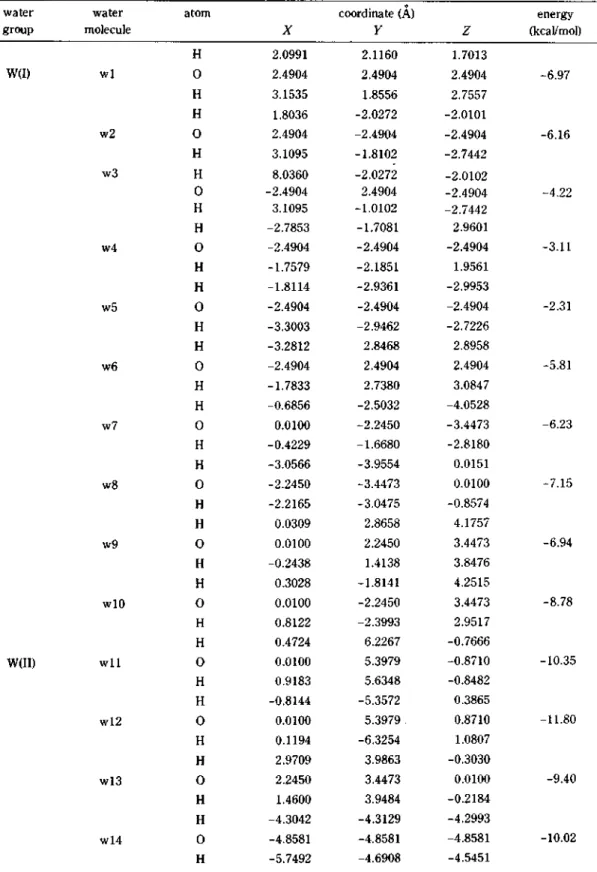
Table 3. The optimized positions and interaction energies of water molecules in hydrated Mn4 5Na3~A
watergroup
water molecule
atom
X
coordinate (A)
Y Z
energy (kcal/mol)
H 2.0991 2.1160 1.7013
W(I) wl 0 2.4904 2.4904 2.4904 -6.97
H 3.1535 1.8556 2.7557
H 1.8036 -2.0272 -2.0101
w2 0 2.4904 -2.4904 -2.4904 -6.16
H 3.1095 -1.8102 -2.7442
w3 H 8.0360 -2.0272 -2.0102
0 -2.4904 2.4904 -2.4904 -4.22
H 3.1095 -1.0102 -2.7442
H -2.7853 -1.7081 2.9601
w4 0 -2.4904 -2.4904 -2.4904 -3.11
H -1.7579 -2.1851 1.9561
H -1.8114 -2.9361 -2.9953
w5 0 -2.4904 -2.4904 -2.4904 -2.31
H -3.3003 -2.9462 -2.7226
H -3.2812 2.8468 2.8958
w6 0 -2.4904 2.4904 2.4904 -5.81
H -1.7833 2.7380 3.0847
H -0.6856 -2.5032 -4.0528
w7 0 0.0100 -2.2450 -3.4473 -6.23
H -0.4229 -1.6680 -2.8180
H -3.0566 -3.9554 0.0151
w8 0 -2.2450 -3.4473 0.0100 - 7.15
H -2.2165 -3.0475 -0.8574
H 0.0309 2.8658 4.1757
w9 0 0.0100 2.2450 3.4473 -6.94
H -0.2438 1.4138 3.8476
H 0.3028 -1.8141 4.2515
wlO 0 0.0100 -2.2450 3.4473 -8.78
H 0.8122 -2.3993 2.9517
H 0.4724 6.2267 -0.7666
W(II) wll 0 0.0100 5.3979 -0.8710 -10.35
H 0.9183 5.6348 -0.8482
H -0.8144 -5.3572 0.3865
w!2 0 0.0100 5.3979 0.8710 -11.80
H 0.1194 -6.3254 1.0807
H 2.9709 3.9863 -0.3030
wl3 0 2.2450 3.4473 0.0100 -9.40
H 1.4600 3.9484 -0.2184
H -4.3042 -4.3129 -4.2993
wl4 0 -4.8581 -4.8581 -4.8581 -10.02
H -5.7492 -4.6908 -4.5451
H -1.5366 4.0898 0.0041
Mn2+・치환 제올라이트 A 의
수화 및 탈수 구조에 관한 연구
627water group
water molecule
atom
X
coordinate (A)
Y Z
energy (kcal/mol)
wl5 O -2.2450 3.4473 0.0100 -10.66
H -3.0039 3.9293 0.3395
H 2.0489 -4.3055 0.3905
wl6 O 2.2450 -3.4473 0.0100 -10.17
H 2.2155 -2.8452 0.7544
H -2.6964 0.3921 1.7903
wl7 O -3.4473 0.0100 2.2450 -11.08
H -3.5909 0.5863 2.9958
H -4.2567 -0.0543 -2.7523
wl8 O -3.4473 0.0100 -2.2450 -9.19
H -2.9592 -0.7826 -2.4740
H 3.8073 -0.2330 3.0990
wl9 O 3.4473 0.0100 2.2450 -9.96
H 4.2048 0.0360 1.6634
H 3.9072 0.3738 -3.0016
20 O 3.4473 0.0100 -2.2450 -11.83
H 4.0258 0.1813 -1.5049
H 0.6254 2.9578 -3.6012
w21 O 0.0100 2.2450 -3.4473 -10.83
H 0.1239 1.6627 -4.2031
H 4.6262 4.3352 5.6256
W(III) w22 O 4.8581 4.8581 4.8581 -20.43
H 5.6382 4.4384 4.0548
H 4.3960 -5.6337 -4.5219
w23 O 4.8581 -4.8581 -4.8581 -20.76
H 4.2759 -4.5135 -5.5329
H -4.5806 4.1901 -5.4948
w24 O -4.8581 4.8581 -4.8581 -16.22
H -5.6481 4.4856 -4.4631
H -4.6240 -4.3323 5.6260
w25 O -4.8581 -4.8581 4.8581 -14.89
H -5.6281 -4.4157 4.4963
H -5.3298 0.3788 0.8282
w26 O -5.3979 0.8710 0.0100 -16.66
H -6.2737 0.6685 -0.3192
(
Vd-r(kit
)) was used for the description of dispersion
and repulsion between water molecules and framework atoms or ions in hydrated structure.= Z
万 ktkj [ — A/(1 — I J> i
(1
一,
/人『여〕Cexp(-aZ)] (13)where Z=R^ and
氏
气=
【(가爲”)(간硏
卩仏whereR
:w and
琳 are the van der Walls radii of atom i and j. The parameter A, C, and a are 0.214 kcal/mol, 47000 kcal/mol( and 12.35, respectively. The multiplication factor kif and
幻
represents the nature of the interacting atom i andVol. 33, No. 6, 1989
628
朴鍾烈•金洋•金恩植•崔相九
J. The values used in
나
lis work are KH= 1.00, Ko= 1.36
】
7, 7^=2.10, *血=2.861匕
此 is the net charge of atom i, and Ni血
is the number of valence electrons of neutral atom i. This modification scheme is also applied to the case of hydrogen bond.
The location of each ion and water m
이
ecule has been optimized by minimizing the interaction en- nergy using the optimization program VA10A developed by Fletcher.13The refined potential parameters of dehydrated Mn4 5Na3-A are listed in Table 1 and
나}
e optimized positions and interaction energies of framework atoms in dehydrated and hydrated Mn4 5 Na3-A are listed in Table 2, The binding energies of water molecules in hydrated Mn45Na3- A at their op
timized positions are shown at Table 3.
RESULTS AND DISCUSSION
Typical results of powder x-ray diffraction and infrared spectroscopy experiments on Mn2+- ex
changed zeolite A are shown in Fig. 1 and 2.
It was reported that when the thermally unstable Ba2+-exchanged zeolite A are heated at 300°C, all x-ray diffraction peaks disappear because of the collapse of zeolite framework.4' 5 Ni2+-exchanged zeolite A in our work were also thermally unstable. When Ni5Na2-A zeolite is heated at 300°C, no x-ray diffraction peaks are observed. But Mn2+-exchanged zeolite A (Mnx NaRhA; 1, 2, and 4.5) heated at 300°C for 5 hours shows almost the same strong peak inten
sities and patterns of x-ray diffraction regardless of the contents of Mn2+ ion (see Fig. 1). This means that the framework of Mn2+-exchanged zeolite A is stable even after heating and dehydration.
In recent years, many systematic investigations on the framework structures of various synthetic zeolites have been carried out by infrared spec
troscopic methods,18-19. The interpretations of these
■人
4
사*버J丿
Jim
丿1 人Journal of the Korean Chemical Society
I I I 1 1 I I I
To
20 30 40Fig. 1. The x-ray diffraction patterns of Mn2+- ex
changed zeolite A heated at 300 °C, ; Mn45Na3 A, b;
Mn2Na8 A, c; MnjNajo A.
spectra are based on assignment of infrared bands to certain structural groups in various zeolite frameworks.
In general, infrared spectra of zeolites consist of strongest asymmetric stre
난
ling vibration of internal tetrahedron (Al, Si)O4 found at 950- 1250 cm-1, next strong T-0 bending mode and symmetric stre
아
ling vibration modes of internal tetrahedron (TO4) at 420-500 cm-1 and 650- 820 cmf respectively, and the vibration mode due to double ring of external linkage in the region of 500-650 cm-1, etc.20The hydrated MojNa^-A and partially dehydrated Mn^Na^^-A (x = l, 2, and 4.5) show
ed strong absorption bands at 675 cm-1 (T-0 ben
ding), 550 cm-1 (vibration of D4R), 675 cm-1
Mn2+- 치 환 제올라이
트
A 의수화 및
탈수구조에
관한연구
629"
OM el '-E 2.LL
으 」
Fig. 2. Infrared spectra of Mn2+-e3t-changed zeolite A,
a,b,c; heated at 300°C, a; Mn4 5Na3 A, b; Mn2Na8 At c;Mn^Naio A, d; MniNaiNam A (unheated).
(symmetric streching of internal tetrahedron, (Al, Si)()4, and 1020 cm-1 (asymmetric streching of in
ternal tetrahedron) in Fig. 2.
In our earlier study5, when Ba^-A is heated above 200°C, the bands found in the above regions
almost disappeared. This might be
이
os이y related to the collapse of zeolite frameworks upon dehydration. The fact that infrared spectra related to the framework of Mn2+-exchanged zeolite A heated at 300°C remains with strong intensities without any great changes discloses that Mn2+-exchanged zeolite A is thermally stable.
Using the refined potential parameters and potential energy functions, the coordinates and bin
ding energies of the framework atoms of dehydrated and hydrated Mn4 5Na3-A were calculated and then compared with crystallographic data. The optimized coordinates are agreed well with the x-ray crystallographic results.1
The sum of the binding energies of framework atoms in
나)
e reduced system21 (AlO2SiO2) of the hydrated Mn4 5Na3-A was -720.31 kcal/mol and that of the dehydrated Mn4 5Na3-A was -378.04 kcal/ngL This indicates that the hydrated structure is more stable by 342.27 kcal/moLThe sum of the binding energies of the framework atoms of dehydrated Mn4 5Na3-A is almost the same as those of dehydrated Ca6-A (-373.02 kcal/mol) and Co4Na4-A (-365.39 kcal/
mol)22 which are known to be stable in their dehydrated state. Therfore, it may be conclud
ed that Mn2+-exchanged zeolite A is thermal
ly more stable than others due to 나
}
e greater binding energy of its framework even in dehydrated state.The sum of binding energies of framework atoms in dehydrated Ni3 Na&-A is -257.17 kcal/
이시
which is smaller than that of Mn2+-exchanged zeolite A. The lower binding energy of Ni2 +-exchanged zeolite A is responsible for the accumulation of proton 욘 produced by hydrolysis of Ni (H2O) n2+. It is proposed that the attack of protons to framework oxygen atoms makes the framework of zeolite unstable.
In general, the cations in the zeolite structures move toward the framework oxygen atoms upon dehydration.4- 5
Vol. 33, No. 6, 1989
630
朴鍾烈•金洋•金恩植•崔相九
Table 4. The number and average binding energies of
three different groups of water molecules in hydrated Mn45Na3-Agroup Tm of DSC Number of water Average binding molecules energy by (°C) by TG by calculation calculation (kcal/mol)
Total binding energy of 26 H2O by -261.193 calculation;
Dehydration energy per unit cell by DSC; 253.76
W(I) 87.0 9.86 10 -5.77
W(II) 147.8 10.94 11 -10.48
W(III) 217.0 5.20 5 -17.79
It is known that when Mn2+-exchanged zeolite A is dehydrated, Mn2 + ions move from the deep position in -cage to near the center of 6-ring plane. The ionic radius of Ba2+ ion is 1.34 A. Since the large Ba2+ ions can not move into the vicinity of the 6-ring plane, Ba2+ ions can not form good coordination bonds with the framework oxygens.
Therefore, the hydrated Ba2+- exchanged zeolite A is unstable upon dehydration. However, the relatively small Mn2+ ions (ionic radius of Mn2+ =0.81 A) can easily approach and make stable bonds with framework oxygens, O(3)'s.
Therefore, the Mn2+-exchanged zeolite A is stable even after heating and dehydration.
The position and binding energy of twenty six water molecules are calculated and are shown in
Table 3. Water molecules can be easily classified
into three major catergories by the type of bonds and binding energies. That is, W(I) group where water molecules are hydrogen bonded with other water molecules or framework oxygens, W (II) group where water molecules are coordinated to Na+ ions and also hydrogen bonded with either adjacent water molecules or framework oxygens, and W(III) group where water molecules are coordinated to Mn2+ ions and hydrogen bonded.
Mn2+ ions in the hydrated Mn4 5Na3-A form a trigonal bipyramidal structure with three framework oxygen, 0(3)'s and two water
Fig. 3. The TG and DSC thermograms of hydrated
Mn2+-exchanged zeolite, A, a; MnjNan) A, b;Mn2Nag A, c; Mn4 5Na3 A, heating rate; 10°C7min.
molecules. Water molecules in the a -cage form a distorted dodecahedron. Table 4
아
lows that there are ten water molecules in W(I) group, eleven water molecules in W(II) group, and five water moleucles in W(III) group. The average binding energies are - 5.77 kcal/mol, -10.48 kcal/mol, and -17.79 kcal/mol for W(I), W(II), and W(III) groups, respectively. As expected, the W(III) group of water molecules has strong bonds, while the W(I) group has weak bonds.The sum of dehydration energies of twenty six water molecules per unit cell is approximately 253.76 kcal. This energy amount is almost the same as the absolute value of the calculated total binding energies of twenty six water molecules (-261.93 kcal).
There appeared three endothermic peaks in the DSC thermograms of Mn2+-exchanged zeolite A.
When heated at the rate of 10°C/min, first en- do peak appeared at approximately 82°C as a shoulder, second endo peak at 147.8°C, and third endo peak at 217°C (see Table 5 and Fig. 3)
Journal of the Korean Chemical Society
Mr『
七
■ 치환제올己卜이트
A의 수화
및탈수 구조에
관한연구
631Table 5. The activation energy in the dehydration reaction of hydrated Mn2+-exchanged zeolite A by Ozawa method
Heating 1st endo peak 2nd endo peak 3rd endo peak
rate Tm Ea Tm Ea Tm Ea
(°C/min) (°C) (kcal/mol) (°C) (kcal/mol) (°C) (kcal/mol)
6 68.0 136.4
MniNanyA 10 79.0 5.17 147.0 8.26
14 87.5 155.1
18 93.0 157.7
6 73.0 140.1 207.0
Mn2Na8-A 10 85.5 5.26 150.1 9.08 216.0 14.30
14 93.5 154.8 220.5
18 98.0 161.2 224.5
6 73.0 134.3 206.0
Mn45Na3-A 10 82.0 7.02 141.9 9.86 210.8 15.72
14 87.0 147.8 217.0
18 92.0 152.7 221.0
As the content of Mn2+ ions per unit cell in
creased, the area of third endo peak at 217°C in
creased while that of second endo peak at 147°C decreased. These phenomena suggest that the first endo peak at 82°C is due to the dehydration of W(I) group, the second endo peak at 147°C due to the dehydration of W(II) group, and the third endo peak at 217°C due to 나le dehydrationn of W(III) group coordinated strongly to Mn2+ ions.
Ozawa23 proposed that the activation energies may be estimated from the shifting of maximum deflection temperature (Tm) of DSC peaks as the heating rate (0) is changed. We can evaluate the activation energy using the following Ozawa's equation.
log ‘ + 0.4567 E„!RTm = constant
Plotting log 0 versus 1/Tm gives a straight line with a slope of 0.4567 EJR, and the activation energy (EJ can be calculated from the slope. The activation energy in the dehydration of hydrated Mn2 + -exchanged zeolite A was obtained by Ozawa's method
Fig. 4 shows good linear relationships for all en
dothermic peaks in the dehydration reaction of Miq A.
Table 5 shows that the activation energies of dehydration is greater at the higher dehydration temperature. This indicates that the greater are the
Fig. 4. Ozawa's plot of log 。 vs. 1/7, for the hydrated
Mn45Na3 A.binding energies, the larger activation energies are required for the dehydration of these water molecules.
To summarize the present works, Mn2+- ex
changed zeolite A is stable even after heating and dehydration. The binding energies for the framework atoms of Mn2+-exchanged zeolite A are almost the same as thermally stable Ca2+- or Co2+-exchanged zeolite A. The thermal stability of Mn2+-exchanged zeolite A may be due to the fact that Mn2+ ion can have good coordination en
vironments with the framework oxygen, 0(3) after dehydration. The authors confirmed that Ni2 +-exchanged zeolite A is thermally very unstable. The instability of Ni2+-exchanged zeolite A may due to the accumulation of H+ ions
Vol. 33, No. 6, 1989
632
朴鍾烈•金洋•金恩植•崔相九
which are produced by the hydrolysis of Ni(H2 O)n2+ ion. The positions and binding energies of twenty six water molecules per unit cell were calculated and determined. These water molecules could be classified into three groups; W(I), W(II), and W(III) by the type of bonding and bond energies. The magnitude of their binding energies and the activation energies of dehydration decrease in the order of W(III) > W(II) > W(I).
ACKNOWLEDGEMENT
This work was supported by the Basic Science Institute Program, Ministry of Education, 1988.
REFERENCES
1- Y. Russel, Yanagida, T. Blake Vance, Jr., and Karl Sefft J. Inorg, Chem., 13, 723 (1974).
2. H. S. Sherry, H. F. Walton, J. Phys. Chem., 71,1457 (1968).
3・ A. Deyer, W. Z Celler, and M. Shute, Molecular
Sieve Zeolites I; Advances in Chemistry Series 101, Am. Chem. Soc., 437 (1971).
4. Y. Kim, V Subramanian, R. L. Firror, and K Seff, ACS Symposium Series No. 135, Adsorption and ion exchange with synthetic zeolites, 137-153 (1980).
5. J. Y. Park, Ph.D. Thesis, Pusan National Univ, (1985).
6 K Ogawa, M. Nitta, and K. Aomura, J. Phy. Chem,, 82, 1655 (1978).
7. K. T. NO, H. Chon, T. Ree, andM. S. 가
}
on, J. Phys.Chem.f 85, 2061 (1981).
8. E. Pwss, G. Linden, and M Peuckert, J. Phys. Chem.,
89, 2955 (1985).
9. S. Beran, and J. Dubsky, Chem. Phys. Lett., 71, 300 (1980).
10. E. C. De Lara, and R. Zahradnik, J. Phys. Chem., 80, 1917 (1976).
11. J. Sauer, P. Hobza, and R. Zahradnik, J. Phys.
Chem., 86, 703 (1984)
12. J. Sauer, P. Hobza, and R. Zahradnik, J. Phys.
Chem., 84, 3318 (1980).
13. R. Fletcher, Fortran Subroutines for minimization by Quasi-Newton Methods AERE Report R 7125 (1974).
14. J. E. Hueey, J. Phys. Chem., 69, 3284 (1965) 15. R. T. Sanderson, "Chemical Periodicity”, Reinhold,
New York, (I960)
16. J. Gaillet, P. Claverie, and B. Pullman, Acta
Crystallogr., B32, 2740 (1976).
17. M. J. Huron, and P. Claverie, J. Phys. Chem., 76, 2123 (1972).
18. W. M. Butler, C. L. Agell, W. Mcallister, and W. M.
Risen, Jr., J. Phys. Chem.f 81, 2061 (1977).
19.
J. W. Ward, J. Phys. Chem., 72, 4211 (1968).20. D. W. Breck, "Zeolite Molecular Sieves”, John Wiley
& Sons, (1974)
21. K. T. NO, and M. S. John, J. Korean, Chem. Soc., 23, 374 (1979).
22. J. Y. Pa아c, Y. Kim, U. S. Kim,
히
id S. G. Choi, J.Korean Chem. Soc., 33, 357 (1989).
23. T. Ozawa, Bull, Chem. Soc. Jpn, 38, 1881 (1965).