ISSN 2288-1069 (Online)
http://dx.doi.org/10.12925/jkocs.2013.30.2.264
Monoamonium Phosphate를 이용한 수분산 폴리우레탄 수지의 합성과 물성에 관한 연구
이주엽 † ․김기준 *
중원대학교 융합과학부 방재안전과학과
(2013년 5월 20일 접수; 2013년 6월 28일 수정; 2013년 6월 28일 채택)
A study on Mechanical properties of Waterborne polyurethane dispersion by Monoammonium phosphate
Joo-Youb Lee
†
․Ki-Jun Kim*
Department of Disaster Mitigation and Safety Science, Jungwon University Chungbuk, Korea
(Received May 20, 2013 ; Revised June 28, 2013 ; Accepted June 28, 2013)
요 약 : 본 연구에서는 monoammonium phosphate가 WPU의 물성에 끼치는 영향을 필름 상태와 피 혁(Full-Grain) 표면에 코팅을 하여 기계적 물성을 분석 하였다.
DSC 결과 monoammonium phosphate가 많이 함유된 WPU-AM3 샘플이 382℃로 높은 물성이 측 정되었으며, 내용제성은 모든 샘플이 우수함을 알 수 있었다. 인장강도의 경우 monoammonium phosphate가 가장 많이 함유된 WPU-AM3(2.130 kg
f
/㎟)가 가장 낮은 물성을 보였으며, 연실율과 내마 모성 역시 monoammonium phosphate가 많이 함유된 WPU-AM3가 615 % 및 52.07 ㎎.loss로 낮은 물성을 나타내었다.Abstract : In this study, we have synthesized waterborne polyurethane dispersion(WPU) and analyzed mechanical properties of WPU film and leather coatings in different content of monoammonium phosphate. According to the measured data by DSC, sample WPU-AM3 which included high content of monoammonium phosphate showed the highest Tm at 382℃. All samples had good solvent resistance. In tensile tests, WPU-AM3(2.130 kg
f
/㎟) had the lowest physical properties. Also abrasion resistance properteis and elongation properties were investigated, WPU-AM3 had lowest physical properties with 52.07 ㎎.loss for abraison and 615 % of elongation.Keywords : polyurethane, waterborne, polyol, leather coatings,
monoammonium phosphate
✝ Corresponding author (E-mail : [email protected])
1. 서 론
최근 산업전반에 걸쳐 유기용제 타입의 폴리우 레탄은 많은 환경적 문제점을 내포하고 있어 친 환경적 또는 인체에 유해한 영향을 줄이기 위해 많은 연구결과가 발표되고 있다. 그의 일환으로 수분산 폴리우레탄은 무독성, 화재안정성 그리고 공기오염이 없는 이유로 점차 커다란 관심을 받 고 있다. 특히 수분산 폴리우레탄은 친환경적인 접착제와 코팅제로써 많은 연구가 이루어지고 있 다[1-9].
수분산 폴리우레탄은 코팅 산업 전반에 널리 활용되고 있는데 특히 뛰어난 내마모도, 내굴곡 성, 내화학적 성질과 물리적 성질이 우수하여 빠 른 속도로 발전되고 있다. 수분산 폴리우레탄은 주로 섬유의 코팅과 목재와 금속표면에 마감 코 팅제로 사용이 되고 있다.
일반적으로 사용되는 수분산 폴리우레탄은 hydroxyl 혹은 amino 기를 갖는 diol 혹은 polyol 과 diisocyanate 혹은 polyisocyanates 의 축합반응에 의하여 생성된다[10-13].
수분산 폴리우레탄에서 polyol 수지의 제조에 서 분자내 poly ethylene oxide기의 도입은 polymer의 수용화를 증진시키고, 전해물질에 대 해서 안정한 상태를 유지시키며, 저온에서도 수분 산체가 겔화되지 않도록 하는 functional group (작용기)으로 작용하였다. polymer내에서 음이온 성 우레탄 기를 형성케하는 dimethylolpropionic acid의 carboxyl기는 아민 중화에 의해 염이 형 성되며, prepolymer 공중합체 말단에 존재하게 되는 –NCO기는 diamine등과 같은 사슬연장제에 의해 분자량의 증가함으로써 강력한 우레탄 결합 을 가진 수지를 합성한다[14-17].
또한 친환경수지의 연구 발전과 더불어 수지의 난연성에 대한 연구 또한 병행하여 꾸준히 이어 져 왔으며, 주로 시공후 방염처리로 수지의 난연 성을 향상 시키는 방법이 활용되고 있다. 본 연구 에서는 시공후 방염처리 방식이 아닌 수분산 폴 리우레탄 수지에 난연제를 적용하여 연구하였다.
일반적으로 난연제는 반응형과 첨가형으로 나 누며, 첨가형은 다시 유기계와 무기계로 나눌 수 있다. 반응형 난연제는 고분자에 화학적으로 결합 되어 내구성이 놓고 난연 효과가 뛰어나지만 중 합하여 사용하기 때문에 고비용과 제조시간이 많 이 걸리는 단점이 있다. 무기계 첨가형 난연제는 가격이 싸고 할로겐화 유기화합물과 상승작용을
일으키며 충진제로 사용가능하고 유기계 첨가형 난연제는 고분자와의 혼합이 쉽다는 장점이 있다.
본 연구에서는 그동안 사용되어오던 할로겐 계 의 난연제 중 브롬계의 난연제가 유해성 문제로 규제를 받고 있는 실정으로 모노인산암모늄 (monoammonium phosphate)을 합성 완성된 수 분산 폴리우레탄에 수용액형태로 적용하여 각종 기계적 화학적 물성 측정을 필름형태 및 피혁 표 면에 코팅 처리하여 각각의 물성 변화를 분석 하 였다.
2. 실 험
2.1. 시약
먼저 WPU 합성시 이용한 시약은 Poly propylene glycol(PPG, 분자량 2000, 한국폴리 올), isoporon diisocyanate(IPDI, Bayer), dimethylolpropionic acid(DMPA, GEO), N-methyl-2-pyrrolidone(NMP, BASF), dibutyltin dilaurate(DBTDL, Aldrich), triethylamine(TEA, Fluka), ethylene diamine(EDA, Fluka), BYK-080(소포제, BYK chemi), monoammonium phosphate(NIST Chemistry).
2.2. 기기
Simultaneous DSC-TGA(SDT Q50, TA Instr., U.S.A), UTM(Universal testing machine, Instron Co., U.S.A.), Scanning electron microscope(SEM, CX-100S, 코셈), Taber abrasion tester(TO 880T, (주)테스트원), Sun lamp(DW-300, 동성과학)
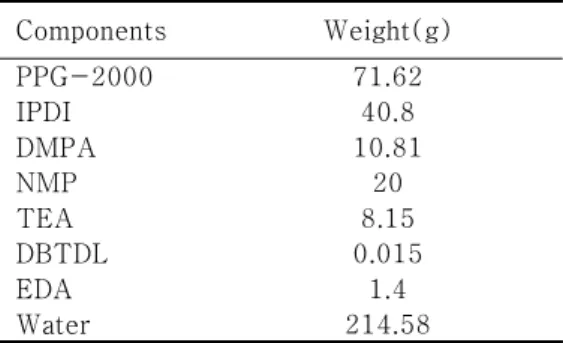
2.3. 수분산 폴리우레탄수지 합성 및 monoammonium phosphate 용액 준비 수분산 폴리우레탄 합성을 위한 프리폴리머를 합성하기 위해서 4구 플라스크를 수분제거를 위 해 40℃에서 질소 치환하면서 1시간동안 가열해 준다. 이후 PPG와 NMP, DMPA를 넣은 다음 질소치환하면서 뒤 60℃에서 2시간 동안 교반시 켰다. 다음단계로 IPDI와 DBTDL을 천천히 플라 스크에 적하한 뒤 85℃에서 6시간 동안 교반시켰 다. 이때 반응물의 NCO함량은 dibuthylamine역 적정법으로 측정하여 잔류 NCO함량이 계산치에 도달했는지 확인하였다. 이후 반응조를 35℃ ∼
Components Weight(g)
PPG-2000 71.62
IPDI 40.8
DMPA 10.81
NMP 20
TEA 8.15
DBTDL 0.015
EDA 1.4
Water 214.58
Components WPU WPU-AM1 WPU-AM2 WPU-AM3
Waterborne polyurethane 100 99 98 97
Monoammonium
phosphate solution 0 1 2 3
Table 3. The compounds used in WPU and WPU-AM 40℃까지 냉각시킨다. 이후 중화제로 TEA를 증
류수와 혼합하여 1차 투입해 준 다음 200 rpm 으로 교반시켜 중화를 완료하였다. 중화 완료 후 증류수를 추가 투입하여 수분산시켜 주었다. 이후 사슬연장을 위해 EDA를 천천히 2시간 동안 적 하시켜 주었다. EDA 투입완료 후 온도를 유지시 켜주면서 3시간동안 교반시킨 뒤 소포제 (BYK-080)을 0.2 % 넣고 1시간 동안 교반 하여 폴리우레탄 수지를 합성 완성한다. 이후 물성 측 정에 필요한 모노인산암모늄 용액은 50℃의 증류 수를 200 ∼ 300 rpm 으로 교반해주면서 monoammonium phosphate을 용해하여 준비해 두었다. 폴리우레탄 화합물의 배합비율은Table 1 과 같고, monoammonium phosphate 용액의 배 합비율은 Table 2와 같다. 이후 물성 측정에 사 용된 시료(Waterborne polyurethane dispersion-monoammonium phosphate, WPU-AM)의 배합 샘플은 Table 3에 나타내었 으며 합성 공정은 Fig. 1에 나타내었다.
Table 1. The compounds used in
monoammonium phosphate solution
Components Weight(g)
Monoammonium phosphate 5
Water 95
Table 2. The compounds used in waterborne polyurethane resin synthesis
3. 결과 및 고찰
3.1. DSC 측정 분석
Monoammonium phosphate를 포함한 WPU의 DSC 측정 결과 Fig 2와 같이 WPU의 Tm이 362℃로 측정됬으며, monoammonium phosphate의 포함량이 증가함에 따라 WPU-AM1이 374℃, WPU-AM2가 379℃, WPU-AM3가 382℃로 Tm 값이 증가함을 알 수 있었다. 이는 WPU에 포함된 인산기가 열 저항성 에 영향을 주었음을 알 수 있다.
3.2. 기계적 물성 측정 분석
Table 4는 준비된 WPU-AM 샘플들의 내용제 성과 내마모도를 측정한 수치이다. 내용제성과 내 마모도 기계적 물성 측정의 시료는 가죽 코팅에 필요한 1차적인 작업이 끝난 상태의 가죽{(Full Grain : 천연소가죽), (주)디아이씨켐}에 각각의 코팅 수지를 0.3 mm 두께로 코팅한 다음 상온에 서 24시간 건조 후 80℃에서 10시간 건조시킨다.
내용제성 측정에는 유기용제인 톨루엔을 가죽 표 면에 2-3방울 적하 한 다음 24시간 후 변색정도 를 Sun lamp로 Glay scale을 확인하였다. 측정된 내용제성은 KS M 6882 에 의거 5등급의 높은 등급을 시료 모두 나타냈으며, 내마모도 측정은 KS K 0815, ASTM 1175 시험방법에 의거하여 시험편의 무게를 측정한 후 내마모도 측정 장비 에 의해서 Wheel number CS-10번으로 1,000 싸이클 회전 후 감소된 무게 측정을 하였다.
Table 5 에서는 인장강도 및 연실율 측정을 위해 필름 시험편을 두께 0.2 ㎜ 너비 30 ㎜ 로 준비 한 다음 인장시험기에 의해서 인장속도 100 ± 20 mm/min으로 인장하였다.
ITEM UNIT
SAMPLES
METHOD
WPU WPU-
AM1
WPU- AM2
WPU- AM3
Solvent resistance Grade 5 5 5 5 KS M 6882
(Toluene test) Abrasion mg.
loss 48.5 51.1 51.9 52.07 ASTM 1175 (H-22, 1,000 cycle) Table 4. Mechanical property test of WPU and WPU-AM in Leather coatings
IPDI + PPG + DMPA
Isocyanate terminated prepolymer
Neutralization(TEA)
Hydrophilic isocyanate terminated prepolymer
1. Emulsion(Water) 2. Crosslinking(EDA)
Waterbonre polyurethane dispersion
Monoammonium phosphate solution
Waterbonre polyurethane dispersion-
monoammonium phosphate resin
Fig. 1. Procedure for synthesise of Waterbonre WPU-AM.
0 100 200 300 400 500
-10 0 10 20 30 40
D S C
Temp
(WPU) (WPU-AM1) (WPU-AM2) (WPU-AM3)
Fig. 2. DSC spectra of samples.
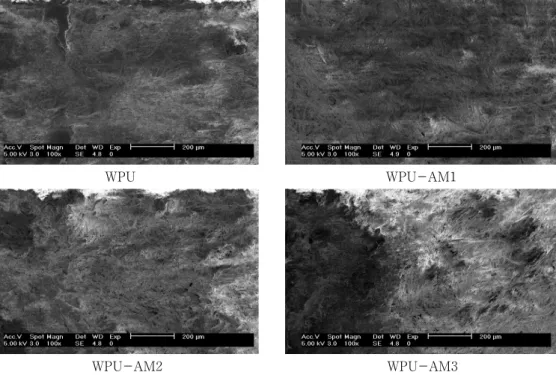
Table 4의 결과에 나타난 내마모도, 인장강도, 연실율의 측정값을 Fig 3, Fig 4, Fig 5 에 그래 프를 통해 나타내었으며, 내용제성과 내마모도 측 정 표면을 SEM을 이용하여 각각 Fig. 6, Fig. 7 에 나타내었으며 내용제성과 마모도 측정에 의한 결과에 따른 표면의 변화를 확인할 수가 있었다.
Fig. 3의 그래프에서 WPU의 내마모성이 가장 높게 나타났으며, 내마모도는 48.5 ㎎.loss 으로 측정되었으며 monoammonium phosphate 용액 이 가장 많이 혼합된 WPU-AM3의 경우 내마모 도가 52.07 ㎎.loss로 monoammonium phosphate의 비율이 높아짐에 따라 코팅된 가죽 표면의 코팅 손실율이 적게나마 많아짐을 알 수 있었다. 인장강도의 경우 Fig. 4 에서와 같이 monoammonium phosphate의 혼합비율이 증가
ITEM UNIT
SAMPLES
METHOD
WPU WPU-AM1 WPU-AM2 WPU-AM3
Tensile strength kg
f
/㎟ 2.423 2.416 2.133 2.130 KS M 6882Elongation % 630 622 620 615 KS M 6882
Table 5. The result of tensile strength and elongation test for films
함에 따라 필름의 인장강도 측정 수치가 작은 차 이로 낮아짐을 알 수 있었으며, WPU의 경우 2.423 kg
f
/㎟ 으로 가장 높은 수치를 나타내었으 며, WPU-AM3의 인장강도 측정 수치는 2.130 kgf
/㎟ 으로 나타났다. 연신율의 경우 Fig. 5 에 서 확인 할 수 있듯이 WPU 시료가 연신율이 가 장 좋은 630 % 이었으며, WPU-AM3의 경우 615 % 임을 알 수 있었다.WPU WPU-AM1 WPU-AM2 WPU-AM3
20 25 30 35 40 45 50 55 60
m g .lo ss
samples
Fig. 3. Abrasion test result of WPU and WPU-AM samples in leather coatings.
WPU WPU-AM1 WPU-AM2 WPU-AM3
0.0 0.5 1.0 1.5 2.0 2.5 3.0 3.5 4.0
T e n si le s tr e n g th (k g f/ m m
2)
samples
Fig. 4. Tensile strength test result of WPU and WPU-AM films.
WPU WPU-AM1 WPU-AM2 WPU-AM3
400 500 600 700
E lo n g a tio n ( % )
samples
Fig. 5. Elongation test result of WPU and WPU-AM films.
Fig 6의 가죽표면 코팅상태를 확인되어진 내용 제성 결과는 샘플들 모두 표면손상이 거의 없음 을 알 수 있었으며, 인장강도 테스트 결과는 Fig 7과 같이 WPU-AM3가 조금더 많이 표면 손상 이 생겼음을 알 수 있다.
4. 결 론
본 연구를 위해 먼저 수분산 폴리우레탄을 합
성하였으며 이후 합성 완성된 수지에
monoammonium phosphate 용액을 혼합하여 아 래와 같은 분석 결과를 얻었다.
DSC 측정 결과 WPU의 경우 Tm이 362℃이 며 monoammonium phosphate 용액의 함유량이 가장 많은 WPU-AM3 경우가 가장 높은 382℃
로 monoammonium phosphate의 함유가 수지의 열적 안정성에 영향을 끼침을 알 수 있었다.
내용제성 실험 결과 WPU 수지에 monoammonium phosphate 용액의 함유량에 따 른 Toluene의 가죽 표면 파괴강도의 변화가 낮음
WPU WPU-AM1
WPU-AM2 WPU-AM3
Fig. 6. Solvent resistance phenomena for WPU and WPU-AM samples on the leather surface observed by SEM.
WPU WPU-AM1
WPU-AM2 WPU-AM3
Fig. 7. Abrasion phenomena for WPU and WPU-AM samples of leather surface by SEM.
을 알 수 있었다.
인장강도 실험 결과 WPU 인장강도가 2.423 kg
f
/㎟ 이며, monoammonium phosphate 용액의 함유가 늘어남에 따라 인장강도가 조금씩 감소해 WPU-AM3의 경우에는 2.130 kgf
/㎟ 으로 인장 강도가 조금 약해짐을 알 수 있었다. 내마모성실험 결과 역시 인장강도와 같이
monoammonium phosphate 용액의 함유량에 따 라 WPU(48.50 ㎎.loss)의 경우가 내마모성의 결 과 수치가 높았으며, WPU-AM3(52.07 ㎎.loss) 의 경우가 내마모성이 낮은 수치를 나타냈음을 알 수 있었다.
연신율의 경우 WPU의 경우가 연신율이 630
%이며 monoammonium phosphate 용액의 함유 가 가장 높은 WPU-AM3의 경우 615 % 임을 알 수 있었다.
위의 결과에 따라 수분산 폴리우레탄 수지에 monoammonium phosphate 용액의 혼합 비율이 높아짐에 따라 피혁 표면 코팅시의 물성 및 필름 의 물성에 점차 변화가 생김을 알 수 있었으며, 이에 따라 많은 양의 monoammonium phosphate 용액이 혼합될시 변화하는 물성을 예 측할 수 있다.
References
1. Y. K. Yang, T. S. Hwang, E. H. Hwang, Preparation of Urethane Nanocomposites with inorganic Nono Fillers and Their Physical Properties. Polymer(Korea). 30, 129 (2006).
2. A. R. Marrion (Ed.), The Chemistry and Physics of Coatings, Royal Society of Chemistry Paperbacks. 1 (1994).
3. J. Y. Lee, and K. J. Kim, Study on Mechanical Properties of Waterborne Polyurethane-Acrylic Hybrid Resin for Leather Coatings, J. Kor. Oil Chemist's Soc., 27, 188 (2010).
4. S. S. Lee, S. H. Lee, D. S. Lee, Preparation and Properties of Waterborne Polyurethane Based on Mixtures of Hybroxy-Terminated Polybutadien and Poly(propylene glycol). Polymer(Korea), 30, 152 (2006).
5. Elisabete Almeida, Dulcínea Santos, and Jorge Uruchurtu, Corrosion performance of waterborne coatings for structural steel, Prog. Org. Coatings, 37, 131 (1999).
6. R. A. Brown, R. G. Coogan, D. G.
Fortier, M. S. Reeve. J. D. Rega, Comparing and contrasting the properties of urethane/acrylic hybrids with those of corresponding blends of urethane dispersions and acrylic emulsion. Prog.
Org. Coatings, 52. 73 (2005).
7. M. Hirose, J. Zhou, K. Nagai, The structure and properties of acrylic-polyurethane hybrid emulsion.
Prog. Org. Coatings, 38, 27 (2000).
8. L. K. Aggarwal, P. C. Thapliyal, S. R.
Karade, Properties of polymer-modified mortars using epoxy and acrylic emulsion, Con. Bul. Materials, 21, 379 (2007).
9. Y. Okamoto, Y. Hasegawa, F. Yoshino, Urethane/acrylic composite polymer emulsions, Prog. Org. Coatings, 29, 175 (1996).
10. V. I. Yeliseyeva, N. G, Zharkova, A. V.
Chubarova, P. I. Zubov, Emulsion polymerization of lower alkyl acrylates, Polym, Sci. U.S.S.R, 7, 171 (1965).
11. S. K. Kim, P. W. Shin, D. C, Lee, Synthesis of Water Soluble Acrylic Modified Epoxyester Resin and Physical Properties of Coatings, J. Kor. Oil Chemist's Soc., 28, 35 (2011).
12. Y. K. Lee, S. Y. Cho, H. S. Park and J.
P. Wu, Preparation and Characterization of Polyurethane Emulsion Modified with Halogen Compond, J. Kor. oil Chemist's Soc., vol 18, 241 (2001).
13. Z. Zhaoying, H. Yuhui, L. Bing and C.
Guangming, Studies on particle size of waterborne emulsions derived from epoxy resin, Eur. Polym. J, vol. 37, 1207 (2001).
14. Alex Wegmann, Chemical resistance of waterborne epoxy/amine coatings, Prog.
Org. Coatings, vol. 32, 231 (1997).
15 K. H. Park, Y. S. Lee, J. Y. Song, S. Lee, S. I. Kim, The Effect of Thermal
Decomposition of Epoxy Resin for a Variation of Hardener, J. Kor. oil Chemist's Soc., vol. 24, 397 (2007).
16. W. B. Im and H. S. Park, Preparation and Physical Properties of Polyurethane Flame Retardant Coatings by Phosphate- Containing Modified Polyester/TDI- Adduct, J. Kor. oil Chemist's Soc., vol.
15, 77 (1998).
17. J. W. Lim, S. M. Yun and N. H. Jeong, Synthesis of Epoxy Functionalized Fluoro-silicone Surfactant, J. Kor. oil Chemist's Soc., vol. 27, 87 (2010).